- Market Value (2025): USD 8.35 Bn
- Estimated Value (2026): USD 9.37 Bn
- Forecast Value (2036): USD 29.8 Bn
- CAGR (2026-2036): 12.3%
What is the Sport Trackers Market forecast to be worth by 2036?
USD 9.37 billion in 2026 and a projected USD 29.8 billion by 2036, at a 12.3% CAGR.
- Fact.MR estimates that the sport trackers market reached USD 8.35 billion in 2025.
- Sales are projected to rise from USD 9.37 billion in 2026 to USD 29.8 billion by 2036 as wearable training tools reach more regular exercisers.
- The market is forecast to register a 12.3% CAGR from 2026 to 2036 as recreational users and endurance athletes select devices suited to their activities.
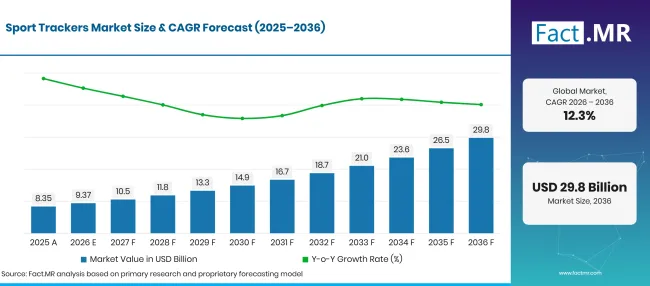
Sport Trackers Market Forecast Global | Source: Fact.MR
| Year | Basis | Market Value (USD billion) |
|---|---|---|
| 2025 | Actual | 8.35 |
| 2026 | Estimate | 9.37 |
| 2036 | Forecast | 29.8 |
| CAGR 2026 to 2036 | Forecast period | 12.3% |
Source: Fact.MR analysis. Updated Oct 30, 2026
What are the defining numbers behind Sport Trackers Market growth?
The market is projected to add USD 20.4 billion between 2026 and 2036.
- Demand Drivers in the Market
- Regular exercisers use pace and activity records to compare their training sessions.
- Heart-rate trends and clear workout summaries help users understand whether their training routine is changing.
- Smartphone pairing lets users review routes and workout history after an exercise session. Shoppers also check whether a tracker works with their existing phone and whether advanced training features require a subscription.
- Battery life and access to replacement straps influence everyday usability. Recreational buyers may prefer one device for exercise and daily wear, while competitive athletes often look for lighter models with controls they can use during training.
- Key Segments Analyzed
- By Product Type: Smartwatches are projected to account for 38.5% share in 2026, as one wrist device can cover training and everyday activities.
- By Application: Running represents 35.2% share in 2026, since pace and distance are easy to track across repeated sessions.
- By Distribution Channel: Online Stores secure 48.7% share in 2026, allowing shoppers to compare battery life and sport modes before purchase.
- By End-User: Recreational Users hold 62.2% share in 2026, reflecting use beyond professional training programs.
- Analyst Opinion at Fact.MR
- Shambhu Nath Jha, Principal Consultant at Fact.MR, states, “Users are more likely to keep wearing trackers when the measurements help them assess their workouts. Runners need dependable pace measurements and workout summaries they can understand without extra effort.”
- Strategic Implications
- Device manufacturers need to explain the accuracy and limits of exercise measurements in everyday language.
- Sports retailers can help shoppers compare wrist fit and controls across running watches and all-purpose smartwatches.
- App developers benefit from keeping workout history easy to follow when customers change phones or replace a tracker.
- Distributors can separate entry-level bands from specialist performance watches so product comparisons remain useful.
Japan is projected to record 15.6% CAGR through 2036, followed by Brazil at 14.0%. Germany is forecast at 12.8%, while the UK stands at 12.3%. The USA is estimated to grow at 8.8%.
How does the Sport Trackers Market break down by segment?
Smartwatches account for 38.5%; running for 35.2%; online stores for 48.7%; recreational users for 62.2%.
Which Product Type dominates?
Smartwatches account for 37.1% of 2026 sales.
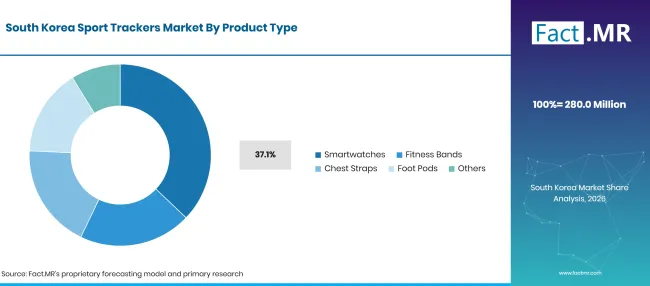
Factmr Sport Trackers Market South Korea By Product Type | Source: Fact.MR
| Product Type | Share (2026) |
|---|---|
| Smartwatches (Leading segment) | 37.1% |
| Other segments combined | 61.5% |
| Total | 100.0% |
Source: Fact.MR analysis. Updated Oct 30, 2026
Smartwatches combine basic workout records with daily notifications. They appeal to users who prefer to carry one wrist device from work to exercise. Fitness bands offer a simpler route for people concerned mainly with steps and routine activity. Chest straps meet a different need when users want a dedicated heart-rate accessory for training.
What leads the Application segment?
Running leads with 35.2% of 2026 sales.
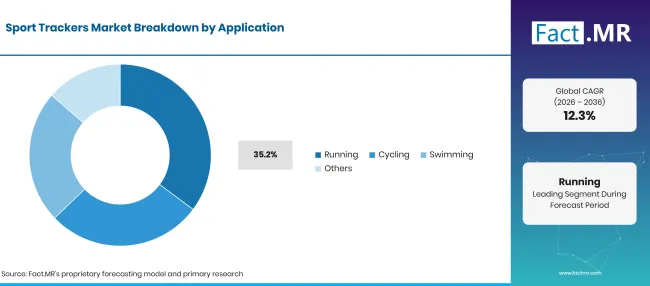
Sport Trackers Market Breakdown Application | Source: Fact.MR
| Application | Share (2026) |
|---|---|
| Running (Leading segment) | 35.2% |
| Other segments combined | 64.8% |
| Total | 100.0% |
Source: Fact.MR analysis. Updated Oct 30, 2026
Running provides a clear reason to keep a training record. Pace, route and distance offer comparisons that are easy to understand between sessions. Cycling users often value route guidance and compatibility with a separate bike computer. Swimming calls for water resistance and lap recording that works while the wrist is moving through water. Other activities include mixed training routines where the device must identify different exercise types.
How does Distribution Channel shape sales?
Online Stores capture 48.7% of 2026 sales.
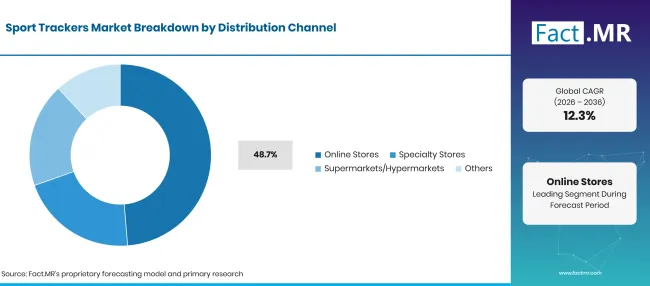
Factmr Sport Trackers Market Breakdown Distribution Channel | Source: Fact.MR
| Distribution Channel | Share (2026) |
|---|---|
| Online Stores (Leading segment) | 48.7% |
| Other segments combined | 51.3% |
| Total | 100.0% |
Source: Fact.MR analysis. Updated Oct 30, 2026
Online stores give consumers space to inspect specifications and compare watch sizes before paying. Product pages can explain GPS features and supported training applications. Specialty stores remain relevant to runners and cyclists who want to check fit or ask about compatibility with other equipment. Supermarkets and hypermarkets give basic fitness bands wider visibility among casual shoppers. Other channels serve local retail needs.
Which End-User group accounts for more demand?
Recreational Users represent 62.2% of 2026 sales.
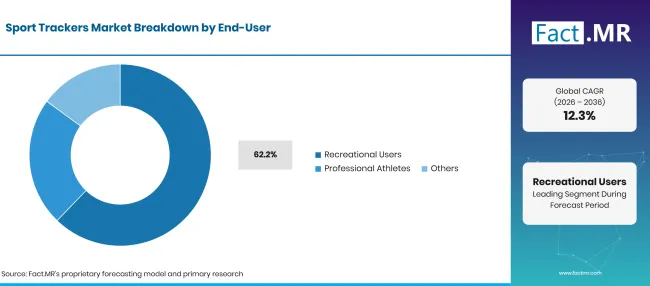
Sport Trackers Market Breakdown End User | Source: Fact.MR
| End-User | Share (2026) |
|---|---|
| Recreational Users (Leading segment) | 62.2% |
| Other segments combined | 37.8% |
| Total | 100.0% |
Source: Fact.MR analysis. Updated Oct 30, 2026
Recreational users often measure progress against their own previous sessions. Their first concern may be whether the watch is comfortable enough to wear daily and simple enough to operate during exercise. Professional athletes usually place greater value on repeatable measurements and training plans that fit a demanding schedule.
What is accelerating Sport Trackers Market adoption, and what is holding it back?
Training feedback, phone compatibility and online product comparisons encourage purchases, while price and battery endurance influence model choice. Recreational users and competitive athletes also place different demands on measurement accuracy.
Drivers Impact Analysis
| DRIVER | (~) % IMPACT ON CAGR | GEOGRAPHIC RELEVANCE | IMPACT TIMELINE |
|---|---|---|---|
| Routine recording of runs and workouts | +1.0% | Global | Short term (<= 2 years) |
| Workout guidance inside smartwatch software | +0.8% | North America, East Asia | Medium term (2–4 years) |
| Access to online model comparisons | +0.7% | Europe, Latin America | Short term (<= 2 years) |
| Links with phone-based training records | +0.5% | Global | Medium term (2–4 years) |
| Sport-specific sensors and controls | +0.4% | Global | Long term (>= 4 years) |
Source: Fact.MR analysis. Updated Oct 30, 2026
Opportunity Impact Analysis
| OPPORTUNITY | (~) % IMPACT ON CAGR | GEOGRAPHIC RELEVANCE | IMPACT TIMELINE |
|---|---|---|---|
| Entry-level exercise tracking for new users | +0.8% | Latin America, Asia | Medium term (2–4 years) |
| More useful recovery summaries | +0.6% | North America, Europe | Medium term (2–4 years) |
| Specialist running and cycling products | +0.5% | Global | Long term (>= 4 years) |
| Online repeat sales and accessories | +0.4% | Global | Short term (<= 2 years) |
Source: Fact.MR analysis. Updated Oct 30, 2026
Restraints Impact Analysis
| RESTRAINT | (~) % IMPACT ON CAGR | GEOGRAPHIC RELEVANCE | IMPACT TIMELINE |
|---|---|---|---|
| Higher price of specialist watches | -0.8% | Global | Short term (<= 2 years) |
| Charging frequency during regular training | -0.6% | Global | Medium term (2–4 years) |
| Unclear differences between health and sport readings | -0.5% | Global | Short term (<= 2 years) |
| Compatibility and replacement costs | -0.4% | Global | Medium term (2–4 years) |
Source: Fact.MR analysis. Updated Oct 30, 2026
Which countries are scaling the Sport Trackers Market through 2036?
| Country | CAGR (2026 to 2036) |
|---|---|
| Japan | 15.6% |
| Brazil | 14.0% |
| Germany | 12.8% |
| UK | 12.3% |
| USA | 8.8% |
Source: Fact.MR analysis. Updated Oct 30, 2026
How is Japan developing sport tracker demand?
15.6% CAGR, reflecting opportunities across routine exercise and dedicated training.
Japanese sport tracker sales are forecast to increase at 15.6% CAGR through 2036. Running watches have a practical role for consumers who want to review split times and routes during a workout. In March 2026, Japan’s Sports Agency reported weekly sports participation of 51.7% among adults aged 20 or older [1].
What supports Brazil’s tracker sales?
14.0% CAGR, tied to mobile-connected exercise habits and online reach.
Brazil is forecast to record a 14.0% CAGR through 2036 as phone-connected trackers appeal to runners and everyday exercisers. The Brazilian Institute of Geography and Statistics reported in July 2026 that 90.5% of people aged 10 or older used the internet in 2025 [5]. Broad internet access provides a practical basis for syncing workout records and comparing models online.
What shapes Germany’s sport tracker outlook?
12.8% CAGR, with careful product comparisons across online and specialist channels.
Germany is forecast to record a 12.8% CAGR from 2026 to 2036, supported by online product comparison and specialist retail advice. Destatis reported in August 2026 that 85% of internet users aged 16 to 74 purchased goods online in 2025 [4]. Sport tracker shoppers can review case sizes and battery specifications online before trying the controls in a shop.
How is the UK tracker market developing?
12.3% CAGR, reflecting established exercise participation and digital buying.
The UK sport trackers market is expected to advance at 12.3% CAGR through 2036. Recreational runners and users of everyday smartwatches have different reasons to replace their devices. Sport England reported that 64.6% of adults in England met weekly physical activity guidelines during November 2024 to November 2025 [2]. Running clubs and specialist shops can help people compare GPS performance and wrist fit.
What is supporting sport tracker demand in the USA?
8.8% CAGR, across daily activity monitoring and performance tracking.
In the USA, sport tracker sales are forecast to expand at 8.8% CAGR from 2026 to 2036. Consumers can select everyday smartwatches or focused running devices according to the workouts they record. The National Center for Health Statistics reported in April 2026 that 47.2% of adults met aerobic activity guidelines in 2024 [3]. This established exercise participation offers regular occasions to use pace and activity records.
Who leads the Sport Trackers Market?
Sport tracker suppliers compete through different product choices. Apple and Samsung sell general-purpose watches with exercise tools beside daily connected functions.
Garmin, Polar, Suunto and COROS place greater emphasis on running or multisport training. WHOOP offers a screen-free wearing approach centered on activity and recovery information. Google’s Fitbit portfolio and Xiaomi reach consumers interested in day-to-day activity monitoring. Huawei also supplies watches with workout functions. Each brand addresses a different mix of fit, software and training needs. Wider connected exercise offerings appear in smart fitness products.
Apple introduced Watch Series 11 In September 2025 [6]. Garmin announced the Forerunner 570 and 970 in May 2025 [7]. Samsung presented Galaxy Watch8 in July 2025 [8]. The launches illustrate different product specifications; they do not establish a ranking by market share.
Which companies are the key providers?
Key companies include Apple Inc.; Garmin Ltd.; Google LLC (Fitbit); Samsung Electronics Co., Ltd.; Xiaomi Corporation; Huawei Technologies Co., Ltd.; Polar Electro Oy; Suunto Oy; WHOOP, Inc.; COROS Wearables, Inc.
- Apple Inc.
- Garmin Ltd.
- Google LLC (Fitbit)
- Samsung Electronics Co., Ltd.
- Xiaomi Corporation
- Huawei Technologies Co., Ltd.
- Polar Electro Oy
- Suunto Oy
- WHOOP, Inc.
- COROS Wearables, Inc.
Bibliography
- [1] Japan Sports Agency. (2026, March 11).[Results of the FY2025 survey on sports participation].
- [2] Sport England. (2026, April 23). England is getting more active but not everyone is benefiting.
- [3] Elgaddal, N., & Kramarow, E. A. (2026, April). Aerobic physical activity among adults age 18 and older: United States, 2024 (NCHS Data Brief No. 555). National Center for Health Statistics.
- [4] Statistisches Bundesamt (Destatis). (2026, August 25). Online-Shopping in Deutschland und der Europäischen Union
- [5] Sousa, M. F., & Brito, R. (2026, July 2). Proporção de usuários da internet no país ultrapassou 90% da população de 10 anos ou mais, em 2025. Instituto Brasileiro de Geografia e Estatística.
- [6] Apple. (2025, September 9). Apple debuts Apple Watch Series 11, featuring groundbreaking health insights.
- [7] Garmin. (2025, May 15). Garmin unveils the Forerunner 570 and Forerunner 970, its newest GPS running and triathlon smartwatches for performance-driven athletes
- [8] Samsung Electronics. (2025, July 9). Samsung Galaxy Watch8 Series: Ultra Comfort, from Sleep to Workout.
This Report Answers
- The analysis explains why general-purpose smartwatches and focused sports watches appeal to different kinds of exercisers.
- Application coverage compares running with cycling and swimming use, including the measurements buyers look for.
- Channel analysis explains how online product comparison differs from advice offered at specialist sports stores.
- Country outlooks consider exercise participation and retail access in Japan, Brazil, Germany, the UK and the USA.
- Supplier coverage compares product marketing without assigning unsupported company market shares.
What does the Sport Trackers Market cover?
The market covers wearable products selected to monitor sport and exercise activity. It includes wrist-worn and simpler fitness bands, as well as chest straps and foot pods used during training. Related categories include wearable computing devices. The adjacent category of smartwatches includes broader everyday connected functions beyond sport-specific measurements.
What is included in the scope?
Sport-focused, fitness bands and dedicated wearable sensors are included when sold for exercise monitoring. Running, cycling and swimming applications fall inside the classification, together with other sport uses. Both recreational users and professional athletes are considered. A related category covers wireless health and fitness devices.
What is excluded from the scope?
Standalone smartphones, gym machines and unrelated medical diagnostic equipment are outside this tracker category. General entertainment accessories are excluded unless they are sold as sport monitoring devices. Subscription services are discussed only where they help explain product choice.
How Was the Analysis Built?
The analysis draws on 120+ sources, 35+ company portfolios, 25+ countries, and more than 20 industry interviews.
- Primary Research: Primary research includes discussions with manufacturers, service providers, technology developers, distributors, end users, and subject-matter experts. These conversations examine purchasing priorities, product adoption, operational challenges, approval requirements, competitive marketing, and the factors that influence wider market acceptance.
- Desk Research: Desk research covers government statistics, regulatory publications, company filings, trade data, technical studies, industry associations, standards, public policy, and other authoritative sources. Every source used in the analysis is documented in the bibliography.
- Market Sizing and Forecasting: Market estimates combine historical performance, demand indicators, pricing and volume trends, segment shares, company participation, country-level growth, adoption patterns, investment activity, and barriers to market expansion.
- Data Validation and Update Cycle: Findings are validated by comparing primary interviews with public data, company activity, regulatory changes, trade patterns, and industry developments. Regular updates review new product launches, capacity changes, partnerships, approvals, and shifts in commercial adoption.
Segmentation
What is the report’s scope and coverage?
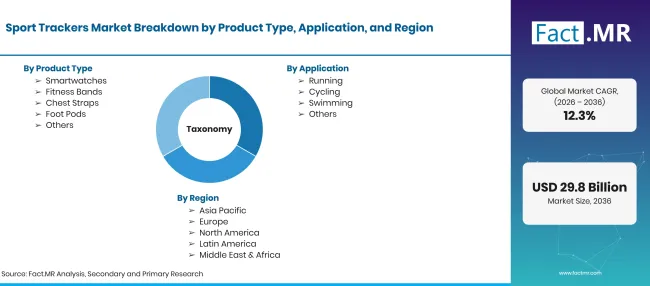
Sport Trackers Market Taxonomy | Source: Fact.MR
| Attribute | Details |
|---|---|
| Quantitative Units | USD billion |
| Market Definition | Wearable devices marketed for sport, exercise and performance tracking. |
| Product Type | Smartwatches; Fitness Bands; Chest Straps; Foot Pods; Others |
| Application | Running; Cycling; Swimming; Others |
| Distribution Channel | Online Stores; Specialty Stores; Supermarkets/Hypermarkets; Others |
| End-User | Recreational Users; Professional Athletes |
| Regions Covered | North America; Latin America; Western Europe; Eastern Europe; East Asia; South Asia & Pacific; Middle East & Africa |
| Countries Covered | Japan; Brazil; Germany; UK; USA |
| Companies Profiled | Apple Inc.; Garmin Ltd.; Google LLC (Fitbit); Samsung Electronics Co., Ltd.; Xiaomi Corporation; Huawei Technologies Co., Ltd.; Polar Electro Oy; Suunto Oy; WHOOP, Inc.; COROS Wearables, Inc. |
| Forecast Period | 2026 to 2036 |
| Approach | Market valuation and segmentation with public sport participation, retail channel and company product evidence. |
Source: Fact.MR analysis. Updated Oct 30, 2026
How is the market segmented?
-
By Product Type
- Smartwatches
- Fitness Bands
- Chest Straps
- Foot Pods
- Others
-
By Application
- Running
- Cycling
- Swimming
- Others
-
By Distribution Channel
- Online Stores
- Specialty Stores
- Supermarkets/Hypermarkets
- Others
-
By End-User
- Recreational Users
- Professional Athletes
-
By Region
- North America
- Latin America
- Western Europe
- Eastern Europe
- East Asia
- South Asia & Pacific
- Middle East & Africa
Frequently Asked Questions
How big is the Sport Trackers Market in 2026?
What is the CAGR of the Sport Trackers Market from 2026 to 2036?
Which product type leads the Sport Trackers Market?
Which application leads the Sport Trackers Market?
Who are the leading companies in the Sport Trackers Market?
Who worked on this report


Preview the report firsthand - request a free sample
Free SampleGet the brochure for pricing and purchase details
Download PDF