- Market Value (2025): USD 308.8 Mn
- Estimated Value (2026): USD 325.8 Mn
- Forecast Value (2036): USD 556.6 Mn
- CAGR (2026-2036): 5.5%
What is the Dive Masks Market forecast to be worth by 2036?
USD 325.8 Million in 2026 to USD 556.6 Million by 2036 at a 5.5% CAGR.
- At USD 308.8 Million in 2025, the dive masks market drew steady momentum from active coastal sports participation, dive resort rental fleet fleet replenishments, and individual upgrades to premium frameless masks.
- Sales will expand from USD 325.8 Million in 2026 to USD 556.6 Million by 2036 as divers prioritize liquid silicone rubber comfort, anti-fog lens coatings, and custom prescription correction.
- Compounding at a 5.5% CAGR over the 2026 to 2036 projection window, sustained growth reflects broadening marine conservation interest, scientific research expeditions, and expanding dive training certifications worldwide.
The valuation trajectory of the global market demonstrates resilient expansion backed by steady baseline equipment replacement cycles and consumer trading up toward ergonomic facial hardware. Technical divers navigating high-current marine canyons and deeper oceanic thermoclines increasingly mandate ultra-low volume profiles to eliminate mask squeeze and simplify clearing maneuvers. At the same time, resort-based diving operations and hospitality fleets are actively replacing legacy hard-plastic frames with durable, UV-resistant liquid silicone configurations that ensure universal facial adaptability across diverse visitor demographics.
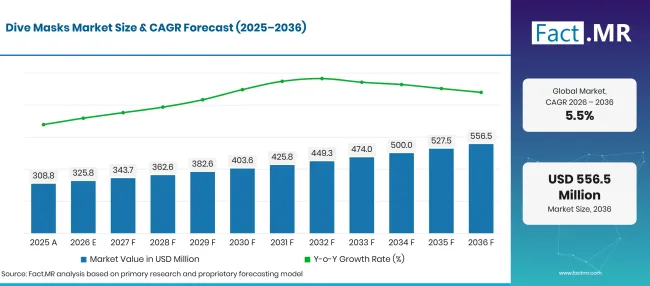
Dive Masks Market Forecast Global | Source: Fact.MR
| Year | Basis | Market Value (USD Million) |
|---|---|---|
| 2025 | Actual | 308.8 |
| 2026 | Estimate | 325.8 |
| 2036 | Forecast | 556.6 |
| CAGR 2026 to 2036 | Forecast period | 5.5% |
Source: Fact.MR analysis. Updated Oct 27, 2026
What are the defining numbers behind Dive Masks Market growth?
Between 2026 and 2036, the dive masks industry will generate an absolute dollar opportunity of USD 230.8 Million, underpinned by advancing optical technologies, expanding marine tourism corridors, and accelerating adoption of specialized silicone skirt geometries.
- Demand Drivers in the Market
- A mature professional channel keeps mask replacement demand tied to fit consistency, optical performance, and dependable sealing rather than price alone.
- Training activity creates an early ownership trigger because a well-fitted mask is difficult to standardize across rental users and remains central to clearing and equalization skills.
- Better-managed access to marine sites should support personal purchases and more regular renewal of high-use resort inventories. NOAA's 2025 visitor-use study notes that the US sanctuary network covers more than 629,000 square miles and requires stronger monitoring. [3].
- Safety-conscious operators increasingly favor secure skirts, broad visibility, and components that tolerate frequent cleaning and adjustment.
- Protected-water diving favors premium low-volume masks because comfort, field of view, and material durability directly influence repeated reef use.
- Key Segments Analyzed
- By Product Type: Frameless Dive Masks will capture a dominant 42.3% share in 2026, favored by technical and recreational divers for their lightweight profile, compact travel volume, and superior field of view.
- By Material: Silicone forms the backbone of modern facial skirt construction, commanding a 58.4% share in 2026 due to its hypoallergenic softness, durable thermal flexibility, and reliable watertight suction.
- By Distribution Channel: Specialty Dive Shops lead commercial volume with a 38.5% share in 2026, serving as the essential venue where divers receive personalized facial fit consultations and professional gear pairing.
- By End-User: Recreational Divers generate 71.4% of total market revenue in 2026, driven by global dive travel, resort excursions, and steady entry-level open-water training courses.
- Analyst Opinion at Fact.MR
- Shambhu Nath Jha, Principal Consultant at Fact.MR, states, "The global dive mask sector is shifting from basic commodity eyewear toward highly engineered optical instruments. Divers are no longer satisfied with generic, stiff PVC frames that cause facial fatigue and frequent fogging during deep sub-surface excursions. Leading manufacturers are investing heavily in co-molding technologies that fuse ultra-soft liquid silicone skirts directly to tempered or optical-grade glass lenses. This structural approach eliminates unnecessary frame bulk, positions the lenses closer to the ocular orbit to expand natural peripheral vision, and dramatically reduces internal volume. In parallel, the growing popularity of prescription lens inserts and full-face integrated communication housings is unlocking premium price tiers across both recreational dive travel destinations and technical diving operations."
- Strategic Implications
- A mature professional channel keeps mask replacement demand tied to fit consistency, optical performance, and dependable sealing rather than price alone. DEMA reports more than 1,400 members in its 2025 annual report, indicating a sizeable commercial network for diving equipment. Size, Share, Growth and Forecast (2026 - 2036).
- Training activity creates an early ownership trigger because a well-fitted mask is difficult to standardize across rental users and remains central to clearing and equalization skills.
- Safety-conscious operators increasingly favor secure skirts, broad visibility, and components that tolerate frequent cleaning and adjustment. A 2025 UK safety warning cites 16 Red Sea liveaboard losses over five years and identifies failures in lifesaving provision and passenger briefing. [4].
- Protected-water diving favors premium low-volume masks because comfort, field of view, and material durability directly influence repeated reef use. The UN Ocean Decade reported in 2025 that roughly 70% of marine dives occur in protected areas and that scuba supports up to 124,000 jobs across 170 countries. [5].
German dive mask consumption will progress at a 5.2% CAGR through 2036, sustained by a dedicated community of cold-water inland divers, technical cave specialists, and frequent international travel expeditions.
How does the Dive Masks Market break down by segment?
Frameless Dive Masks will lead Product Type at 42.3%, Silicone will control Material at 58.4%, Specialty Dive Shops will dominate Distribution Channel at 38.5%, and Recreational Divers will account for 71.4% of End-User demand in 2026.
Which Product Type dominates?
Frameless Dive Masks capture 42.3% of 2026 value.
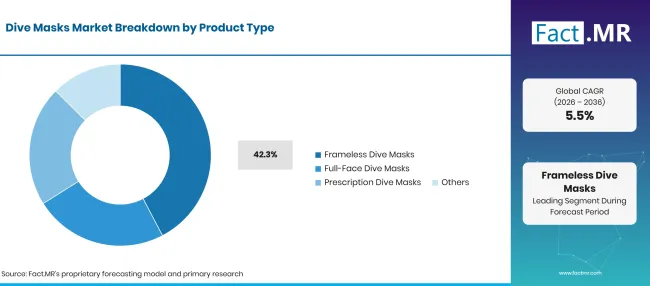
Dive Masks Market Breakdown Product Type | Source: Fact.MR
Frameless mask architectures represent the single most important structural evolution in modern underwater eyewear design. By eliminating the rigid external plastic frame and molding the high-grade silicone skirt directly around the tempered glass lenses, manufacturers achieve an exceptionally compact profile that sits closer to the diver's eyes. This architectural configuration broadens the peripheral field of vision by up to 25% compared to conventional dual-lens framed masks, while concurrently minimizing internal air volume. A smaller internal volume requires significantly less air displacement during mask clearing maneuvers and reduces positive buoyancy, allowing technical and free divers to maintain precise trim in turbulent currents. As international air travel constraints encourage lightweight gear footprints, traveling divers consistently prioritize frameless models that pack flat into carry-on luggage without fear of frame fracture. Manufacturers frequently incorporate specialized sports equipment design principles and high-tensile silicone formulations to ensure strap buckle assemblies pivot smoothly without inducing skirt distortion during deep ocean descents.
| Product Type | Share (2026) |
|---|---|
| Frameless Dive Masks (Leading segment) | 42.3% |
| Other segments combined | 57.7%* |
| Total | 100.0% |
Source: Fact.MR analysis. Updated Oct 27, 2026
Which Material leads the market?
Silicone commands 58.4% of 2026 material demand.
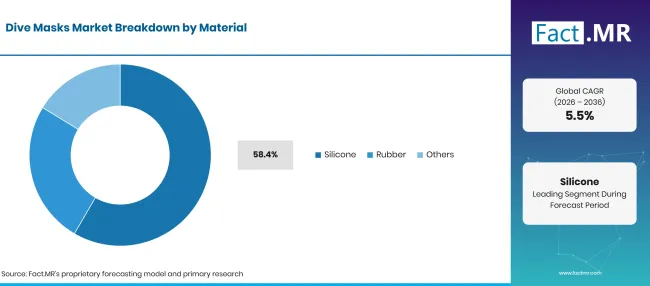
Dive Masks Market Breakdown Material | Source: Fact.MR
The material composition of the facial skirt directly governs diver comfort, watertight sealing efficiency, and long-term durability. High-grade liquid silicone rubber (LSR) has largely displaced traditional natural rubber and polyvinyl chloride (PVC) formulations across premium and mid-tier product lines. Liquid silicone possesses exceptional biocompatibility, remaining supple across wide water temperature ranges from freezing alpine lakes to tropical equatorial lagoons. Its inherent resistance to chlorine, saltwater oxidation, and ultraviolet light ensures the skirt does not harden, discolor, or crack over multi-year operational cycles. Diver acceptance is further enhanced by matte inner skirt finishes that prevent distracting light reflections from shimmering surface waters, allowing underwater photographers and scientific researchers to focus on delicate marine subjects. Skirt designers routinely integrate marine sensing devices data to model facial contact pressure contours, ensuring the feather-edged silicone lip conforms gently to facial contours without leaving deep indentation marks after multi-hour immersion profiles.
| Material | Share (2026) |
|---|---|
| Silicone (Leading segment) | 58.4% |
| Other segments combined | 41.6%* |
| Total | 100.0% |
Source: Fact.MR analysis. Updated Oct 27, 2026
Which Distribution Channel captures the largest market share?
Specialty Dive Shops account for 38.5% of 2026 distribution revenue.
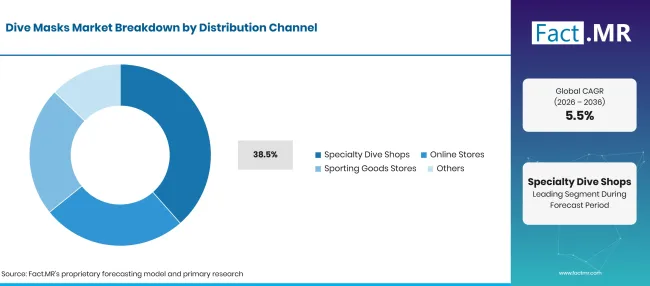
Dive Masks Market Breakdown Distribution Channel | Source: Fact.MR
Specialty dive retailers remain the vital touchpoint for dive mask distribution because optical fit and personal comfort cannot be replicated purely through digital browsing. An effective mask seal depends on nuanced facial bone structure, nasal bridge height, and facial hair contours, requiring prospective divers to perform physical vacuum inhalation tests on-site. Professional dive shop staff provide critical guidance on skirt sizing, field-of-view evaluation, and optical prescription compatibility, frequently bundling mask purchases with snorkels, defogging agents, and protective travel cases. Moreover, local dive shops often function as active training academies affiliated with global certification bodies, creating an immediate conversion channel where student divers purchase their personal foundational mask prior to open-water checkout dives. In coastal dive destinations supporting coastal recreation and wellness tourism, specialty shops also capture strong rental fleet replacement demand and urgent walk-in purchases from international travelers whose personal equipment suffered transit damage or seal fatigue.
| Distribution Channel | Share (2026) |
|---|---|
| Specialty Dive Shops (Leading segment) | 38.5% |
| Other segments combined | 61.5%* |
| Total | 100.0% |
Source: Fact.MR analysis. Updated Oct 27, 2026
What is accelerating Dive Masks Market adoption, and what is holding it back?
Adoption is accelerated by growing recreational dive travel, frameless optical innovations, and anti-fog lens coatings, while growth is restrained by raw material cost volatility, product longevity dampening replacement frequencies, and seasonal recreational demand.
Drivers Impact Analysis
| DRIVER | (~) % IMPACT ON CAGR | GEOGRAPHIC RELEVANCE | IMPACT TIMELINE |
|---|---|---|---|
| Proliferation of coastal ecotourism and open-water certification courses | +1.4% | North America, East Asia, Western Europe | Short term (<= 2 years) |
| Consumer preference shift toward ultra-low volume frameless architectures | +1.2% | Global | Short term (<= 2 years) |
| Emergence of factory-applied permanent hydrophilic anti-fog coatings | +0.9% | North America, Western Europe | Medium term (2-4 years) |
| Expansion of prescription corrective lens options for aging diver cohorts | +0.7% | Western Europe, East Asia | Medium term (2-4 years) |
| Integration of action camera mounting tabs and digital display heads | +0.6% | North America, East Asia | Long term (>= 4 years) |
| Growth of specialized full-face masks in scientific and public safety diving | +0.5% | North America, Western Europe | Long term (>= 4 years) |
Source: Fact.MR analysis. Updated Oct 27, 2026
Opportunity Impact Analysis
| OPPORTUNITY | (~) % IMPACT ON CAGR | GEOGRAPHIC RELEVANCE | IMPACT TIMELINE |
|---|---|---|---|
| Direct-to-consumer 3D facial scan applications for personalized skirt customization | +0.8% | North America, Western Europe | Medium term (2-4 years) |
| Commercialization of circular, bio-derived silicone and recycled polycarbonate frames | +0.6% | Western Europe, East Asia | Long term (>= 4 years) |
| Growth of integrated heads-up depth and tank pressure telemetry inside full-face visors | +0.5% | North America, Western Europe | Long term (>= 4 years) |
| Rental fleet standardization programs across international luxury dive resort chains | +0.4% | Latin America, South Asia & Pacific | Medium term (2-4 years) |
Source: Fact.MR analysis. Updated Oct 27, 2026
Restraints Impact Analysis
| RESTRAINT | (~) % IMPACT ON CAGR | GEOGRAPHIC RELEVANCE | IMPACT TIMELINE |
|---|---|---|---|
| Extended product durability and UV resistance extending consumer replacement intervals | -0.6% | Global | Long term (>= 4 years) |
| Price volatility in specialty optical glass and medical-grade liquid silicone raw materials | -0.5% | Western Europe, North America | Short term (<= 2 years) |
| Strong seasonal fluctuations in recreational diving activities across temperate regions | -0.4% | Western Europe, North America | Medium term (2-4 years) |
| Proliferation of low-cost uncertified imitation masks sold through cross-border e-commerce | -0.3% | Global | Short term (<= 2 years) |
Source: Fact.MR analysis. Updated Oct 27, 2026
Which countries are scaling the Dive Masks Market through 2036?
Sustained demand across established marine leisure economies and rapidly modernizing tropical tourism hubs drives country-level dive mask consumption through 2036.
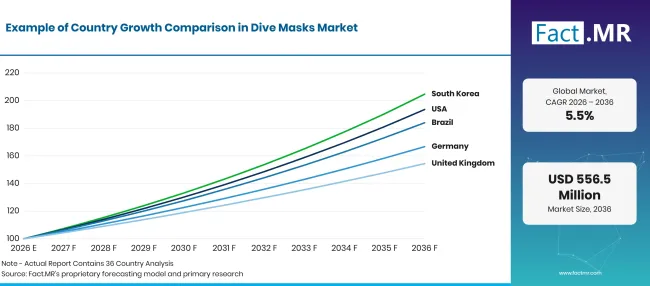
Dive Masks Market Growth Index | Source: Fact.MR
| Country | CAGR (2026 to 2036) |
|---|---|
| Germany | 5.2% |
| Brazil | 6.3% |
| United States | 6.8% |
| United Kingdom | 4.4% |
| Japan | 4.1% |
Source: Fact.MR analysis. Updated Oct 27, 2026
What supports Germany's adoption?
Fact.MR expects Germany's dive mask market to expand at 5.2% CAGR as club diving, inland lakes, and cold-water training sustain specialist demand. Buyers frequently prioritize low-volume masks that seal over thicker hoods, tempered lenses, prescription options, and replaceable straps rather than entry-level designs. Destatis recorded 497.5 million overnight stays in Germany in 2025, while camping nights increased by 4.2% [6]. This broad outdoor-travel base supports dive-store traffic and equipment upgrades, although suppliers still need precise fitting support and products suited to lower water temperatures.
How does Brazil perform?
Brazil's dive mask market is forecast to grow at 6.3% CAGR, supported by reef tourism, island destinations, warm-water training, and a widening base of recreational operators. Frameless and low-volume masks should benefit because travelers value compact packing, broad peripheral vision, and comfortable silicone skirts during repeated boat dives. India's 2025 Gas Cylinders amendment illustrates the tighter equipment-compliance environment facing professional dive systems across growth markets [7]. For Brazilian distributors, the commercial priority is to pair affordable masks with credible safety positioning, dependable replacement parts, and corrosion-resistant hardware suited to humid coastal conditions.
What is supporting United States adoption?
The United States is projected to record 6.8% CAGR as Florida, Hawaii, California, the Caribbean travel corridor, technical-diving communities, and broad sporting-goods distribution sustain demand. The addressable market ranges from first-time certification purchases to premium prescription, freediving, and low-volume technical masks. NOAA's 2025 Gray's Reef assessment identifies visitation and vessel use among the sanctuary's principal pressures and notes indications of increased recreational activity [8]. That operating intensity favors durable lenses, UV-resistant silicone, secure buckles, and retailer-led fitting services capable of reducing leakage and improving repeat use.
How is the United Kingdom developing demand?
The United Kingdom dive mask market is expected to rise at 4.4% CAGR, with wreck exploration, cold-water clubs, marine training, and specialty retail supporting a stable replacement cycle. Demand differs from tropical resort markets because divers commonly need hood-compatible skirts, reliable defog performance, robust buckles, and clear downward visibility for gauges and clips. The UK's 2025 Karin investigation stresses dedicated lookouts, frequent communication between dive-support vessels, and correct delayed-surface-marker-buoy handling [9]. This safety-centered operating culture should keep professionally fitted, dependable masks ahead of low-cost products with uncertain sealing or component life.
How is Japan scaling demand?
Japan's dive mask market is forecast to expand at 4.1% CAGR as Okinawa tourism, domestic coastal diving, training schools, and precision-oriented product preferences support demand. Operators need warm-water rental models, compact frameless designs, prescription lenses, and dependable silicone that tolerates frequent sanitation. Japan's International Visitor Survey uses an annual target sample of 131,640 visitors across national, regional, and cruise modules [10]. That evidence base gives coastal operators a clearer view of inbound travel patterns, helping them plan size ranges and replacement timing while local brands compete through refined fit, optical quality, and compact design.
Who leads the Dive Masks Market?
The competitive landscape of the global dive masks sector is characterized by a blend of storied European aquatic gear pioneers, established multinational watersports conglomerates, and specialized technical diving innovators. Market leaders maintain defensible market shares through proprietary silicone skirt tooling, advanced optical lens coatings, expansive global distribution networks, and long-standing sponsorship relationships with international diver certification agencies. Top-tier manufacturers increasingly invest in automated liquid silicone injection molding cells to maintain high dimensional tolerance and eliminate flash imperfections that could induce sub-surface micro-leaks.
Industry participants are actively differentiating their product portfolios by integrating specialized features tailored to distinct diver sub-segments. Recreational market leaders focus on aesthetic appeal, vibrant skirt colorways, compact frameless profiles, and tool-free prescription lens swapping systems. Conversely, commercial and technical equipment developers direct research capital toward ruggedized full-face masks equipped with communications ports, balanced second-stage regulator connections, and positive pressure breathing valves that prevent contaminated water ingress in industrial harbor maintenance environments. Tactical suppliers are also partnering with commercial maritime operators of connected maritime vessels and ship and boat manufacturing yards to provide standardized diver inspection gear.
Which companies are the key providers?
Key companies include Cressi; Mares; Scubapro; Aqua Lung; TUSA; Oceanic; Sherwood Scuba; Beuchat; Seac Sub; IST Sports.
- Cressi
- Mares
- Scubapro
- Aqua Lung
- TUSA
- Oceanic
- Sherwood Scuba
- Beuchat
- Seac Sub
- IST Sports
Bibliography
- [1] Diving Equipment and Marketing Association. (2025). 2025 annual report.
- [2] Bureau of Indian Standards. (2025). Compendium of Indian standards on diving services.
- [3] Schwarzmann, D., & Burns, R. (2025). Sanctuary Count: Toward building a visitor use monitoring program in marine protected areas. NOAA Institutional Repository.
- [4] Marine Accident Investigation Branch. (2025, February 6). Safety warning following Egyptian liveaboard dive boat accidents in the Red Sea.
- [5] United Nations Ocean Decade. (2025, July 30). New study: Scuba diving generates up to $20 billion globally per year.
- [6] Statistisches Bundesamt. (2026, February 11). Tourismus in Deutschland im Jahr 2025: Erneut Rekordwert bei Gasteubernachtungen.
- [7] Petroleum and Explosives Safety Organisation. (2025). Gas Cylinders (Amendment) Rules, 2025.
- [8] National Oceanic and Atmospheric Administration. (2025). Gray's Reef National Marine Sanctuary 2025 condition report.
- [9] Marine Accident Investigation Branch. (2025, October 16). Fatal injury to a recreational diver following contact with the motor vessel Karin.
- [10] Japan Tourism Agency. (2026, October 21). International Visitor Survey.
This Report Answers
- The analysis evaluates how frameless, full-face, and prescription dive mask architectures differ across hydrodynamic drag, internal volume displacement, optical clarity, and manufacturing cost structures.
- Distribution benchmarking illuminates the evolving market share between brick-and-mortar specialty dive shops, digital e-commerce platforms, sporting goods retail chains, and direct commercial supply contracts.
- Material intelligence analyzes performance differentiators between medical-grade liquid silicone rubber, vulcanized natural rubber, and legacy thermoplastic elastomers across variable marine salinity and thermal profiles.
- End-user profiling quantifies demand drivers across mass-market recreational vacationers, certified technical divers, scientific researchers, and commercial underwater maintenance operators.
- Country performance evaluations establish ten-year growth trajectories across Germany, Brazil, the United States, the United Kingdom, and Japan, linking equipment purchases to regional diving demographics and tourism infrastructure.
- Competitive profiling details the operational strategies, production automation initiatives, patent portfolios, and brand positioning of the ten leading global dive equipment manufacturers.
What does the Dive Masks Market cover?
The dive masks market covers all specialized facial breathing and visual equipment engineered to create an airtight, watertight air pocket in front of an underwater diver's eyes and nose. Maintaining an air space across the ocular plane is physiologically necessary for human eyes to focus light correctly underwater, while covering the nasal cavity allows divers to exhale into the mask cavity to equalize internal pressure with ambient water pressure as depth increases. Market scope tracks equipment sales across recreational scuba diving, technical mixed-gas diving, freediving, spearfishing, scientific research, and commercial underwater engineering. Manufacturers frequently utilize high-grade specialty elastomers and durable polymer resin grades to fabricate structural frame elements and skirt seals that resist marine chemical exposure.
Revenue boundaries capture primary equipment shipments from brand manufacturers and licensed suppliers to commercial wholesalers, dive retail stores, resort operations, and end consumers. Pricing structures encompass entry-level recreational masks, high-precision low-volume freediving masks, corrective prescription models, and advanced full-face masks integrated with wireless communications modules. Associated accessories packaged directly with masks, such as protective hard cases, neoprene strap wraps, and replacement buckle clips, are accounted for within overall product valuations.
What is included in the scope?
Included in report scope are single-lens, twin-lens, multi-lens, frameless, and full-face dive masks constructed with tempered glass, optical mineral glass, or specialized impact-resistant polycarbonate visors. Facial skirts fabricated from liquid silicone rubber, compression-molded silicone, and vulcanized rubber are fully measured across standard, narrow, and broad facial fit profiles. Product lines incorporating factory-applied anti-fog chemical treatments, UV-filtering optical coatings, mirror finishes, and integrated action camera mounting brackets fall squarely within the analytical perimeter. Mask assembly systems utilizing industrial silicone adhesive systems to bond optical glass directly to elastomer skirts are accounted for under frameless product segments.
Geographic coverage is comprehensive, tracking sales volumes across North America, Latin America, Western Europe, Eastern Europe, East Asia, South Asia & Pacific, and the Middle East & Africa. Channel mapping covers commercial transactions passing through independent specialty dive shops, professional watersports retail chains, institutional procurement contracts for public safety dive teams, resort rental fleet replenishment programs, and direct-to-consumer digital commerce platforms.
What is excluded from the scope?
Excluded from market scope are basic surface-only swimming goggles that do not enclose the nasal cavity, as these devices cannot be pressure-equalized and are unsafe for sub-surface diving. Similarly, low-cost plastic toy snorkeling masks intended strictly for children's surface pool play without certified tempered glass lenses are excluded. Independent snorkel breathing tubes, replacement silicone straps sold individually as aftermarket spares, and dedicated scuba regulators purchased separately from full-face mask assemblies fall outside the core revenue accounting boundary.
Furthermore, general industrial safety face shields, hazardous chemical full-face respirators, personal protective apparatus used in terrestrial mining, and pressurized pipeline inspection gear associated with fluid flow management equipment are strictly excluded from market totals. Standalone dive computers and underwater heads-up display instruments that are not permanently integrated into the mask chassis are classified under separate consumer marine electronics categories.
How Was the Analysis Built?
The analysis draws on 120+ sources, 35+ company portfolios, 25+ countries, and more than 20 industry interviews.
- Primary Research: Primary research includes discussions with manufacturers, service providers, technology developers, distributors, end users, and subject-matter experts. These conversations examine purchasing priorities, product adoption, operational challenges, approval requirements, competitive positioning, and the factors that influence wider market acceptance.
- Desk Research: Desk research covers government statistics, regulatory publications, company filings, trade data, technical studies, industry associations, standards, public policy, and other authoritative sources. Every source used in the analysis is documented in the bibliography.
- Market Sizing and Forecasting: Market estimates combine historical performance, demand indicators, pricing and volume trends, segment shares, company participation, country-level growth, adoption patterns, investment activity, and barriers to market expansion.
- Data Validation and Update Cycle: Findings are validated by comparing primary interviews with public data, company activity, regulatory changes, trade patterns, and industry developments. Regular updates review new product launches, capacity changes, partnerships, approvals, and shifts in commercial adoption.
Segmentation
What is the report’s scope and coverage?
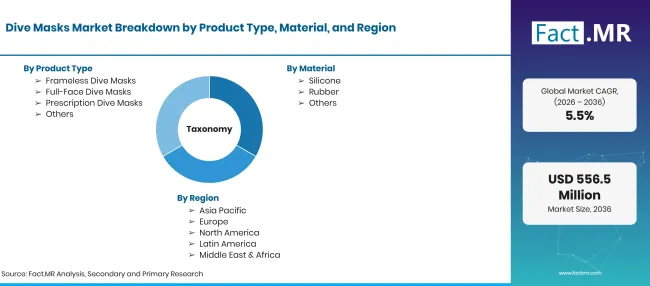
Dive Masks Market Taxonomy | Source: Fact.MR
| Attribute | Details |
|---|---|
| Quantitative Units | USD Million |
| Market Definition | Dive masks are specialized underwater eyewear encompassing frameless, full-face, prescription, and traditional framed configurations engineered with tempered glass or optical polymers and watertight facial skirts. Value is tracked at the primary manufacturer and brand wholesale realization tier. |
| Product Type | Frameless Dive Masks; Full-Face Dive Masks; Prescription Dive Masks; Others |
| Material | Silicone; Rubber; Others |
| Distribution Channel | Specialty Dive Shops; Online Stores; Sporting Goods Stores; Others |
| End-User | Recreational Divers; Professional Divers; Others |
| Regional Coverage | North America; Latin America; Western Europe; Eastern Europe; East Asia; South Asia & Pacific; Middle East & Africa |
| Key Countries Analyzed | Germany; Brazil; United States; United Kingdom; Japan |
| Key Players Profiled | Cressi; Mares; Scubapro; Aqua Lung; TUSA; Oceanic; Sherwood Scuba; Beuchat; Seac Sub; IST Sports |
| Historical Base Year | 2025 (USD 308.8 Million) |
| Forecast Timeframe | 2026 (USD 325.8 Million) to 2036 (USD 556.6 Million) |
Source: Fact.MR analysis. Updated Oct 27, 2026
How is the market segmented?
-
By Product Type
- Frameless Dive Masks
- Full-Face Dive Masks
- Prescription Dive Masks
- Others
-
By Material
- Silicone
- Rubber
- Others
-
By Distribution Channel
- Specialty Dive Shops
- Online Stores
- Sporting Goods Stores
- Others
-
By End-User
- Recreational Divers
- Professional Divers
- Others
-
By Region
- North America
- Latin America
- Western Europe
- Eastern Europe
- East Asia
- South Asia & Pacific
- Middle East & Africa
Frequently Asked Questions
How big is the dive masks market in 2026?
What is the CAGR of the dive masks market from 2026 to 2036?
Which product type leads the dive masks market?
Which material leads the dive masks market?
Which distribution channel dominates dive masks sales?
Which end-user segment generates the highest revenue?
Which country exhibits the highest growth rate in the dive masks market?
Who are the leading manufacturers in the dive masks market?
Who worked on this report


Preview the report firsthand - request a free sample
Free SampleGet the brochure for pricing and purchase details
Download PDF