- Base Value(2025): 610.1 Mn
- Forecast Value (2035): 1431.1 Mn
- CAGR (2035): 9.7%
GPS Trackers Market Outlook 2025 to 2035
The global GPS trackers market is expected to reach USD 1,431.1 million by 2035, up from USD 610.1 million in 2025. During the forecast period 2025 to 2035, the industry is projected to expand at a CAGR of 8.9%.
The GPS trackers market is becoming more critical in improving personal safety and security of assets and operation in industries. The market is growing due to the increased demand for real-time tracking of vehicles and fleets, the increased usage of IoT-based solutions, and the development of satellite and cellular connectivity.
GPS trackers play a significant role in logistics, transportation, and personal safety applications and are utilized to provide the location precisely, enhance productivity, and minimize losses to allow smarter and more efficient operations all over the globe.
Quick Stats for GPS Trackers Market
- Industry Value (2025): USD 610.1 million
- Projected Value (2035): USD 1,431.1 million
- Forecast CAGR (2025 to 2035): 8.9%
- Leading Segment (2025): Fleet Management & Logistics (48.4% Market Share)
- Fastest Growing Country (2025-2035): China (6.2% CAGR)
- Top Key Players: CalAmp, Sierra Wireless, Orbocomm, Queclink, Geotab, Teltonika, TomTom, ATrack Technology Inc., Garmin Ltd., Meitrack Group
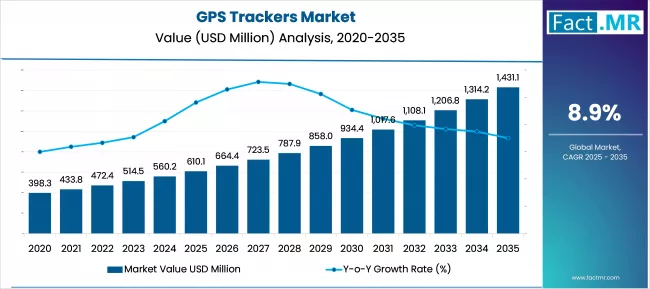
Gps Trackers Market Market Value Analysis | Source: Fact.MR
What are the drivers of the GPS Trackers Market?
GPS Trackers Market is undergoing a rapid growth as a result of the increased demand in real-time location tracking, asset protection, and efficiency in operations in logistics, transport, and personal safety application. With more and more businesses and individuals becoming interdependent on connected devices and IoT-based solutions, the GPS tracker is incorporated into the fleet management systems, as well as the asset tracking and wearable safety devices to optimize performance, minimize losses, and make timely interventions.
Adoption is being driven by regulatory focus on vehicle and cargo tracking as well as by innovation in satellite, cellular and hybrid connectivity. The device manufacturers, service providers, and integrators are entering into strategic alliances that are increasing accessibility to tailor-made tracking solutions worldwide.
What are the regional trends of the GPS Trackers Market?
The GPS Trackers Market regional environment is determined by infrastructural development, regulatory emphasis, and the adoption of technology. North America is the pioneer in fleet telematics and personal safety equipment, which is powered by new advanced IoT networks and high standards of vehicle monitoring.
The growth in Europe is also seen with regulatory requirements on the visibility of logistics and integration of connected mobility solutions, which are seen to be the most innovative in Germany and the United Kingdom.
The Asia-Pacific is witnessing impressive growth, which is being driven by the growing e-commerce, urbanization, and smart city developments in India, China, and Southeast Asia.
The growth of adoption in Latin America, Middle East, and Africa is achieved through the implementation of government-supported transportation monitoring programs and the increase in the demand of asset security solutions.
What are the challenges and restraining factors of the GPS Trackers Market?
Data accuracy and device reliability under various environments and conditions of use is one of the major issues in GPS trackers Market. The unreliable performance of the Google Glass may be caused by signal interference, battery capacity, and hardware life cycle, which restricts its use by the commercial and personal users. The other limitation is the integration with legacy fleet management and IoT systems, particularly among the small and medium businesses.
The high start-up expenses, subscriptions to be connected, and geographical disparity laws regarding tracking and data privacy further hamper the growth of the market. GPS solutions are also challenging to standardize, interoperate, and scale globally because of the presence of many local device vendors in the market, which complicates market fragmentation.
Country-Wise Insights
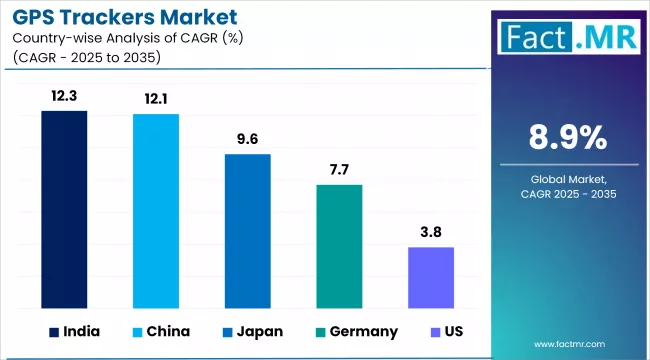
Gps Trackers Market Cagr Analysis By Country | Source: Fact.MR
Fleet Optimization and Safety Regulations Shape United States Market
The U.S. GPS Trackers Market is driven by the increasing demand on fleet management, vehicle telematics and personal safety gadgets. The adoption of IoT-enabled solutions is increasing, which enables real-time tracking, optimal route, and theft prevention of transportation, logistics, and e-commerce industries.
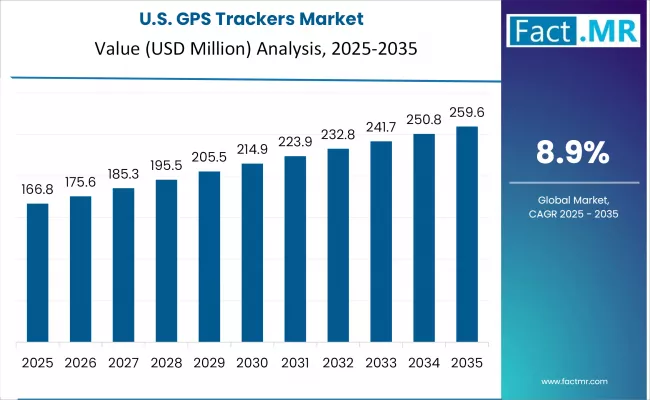
Gps Trackers Market Country Value Analysis | Source: Fact.MR
Fleet trackers are being hastily embraced by regulatory requirements such as Electronic Logging Devices (ELD) compliance. Consumer-oriented GPS trackers of children, elderly, and pets are taking pace in big cities.
The presence of advanced cellular and satellite networks enables stable connectivity, and the integration of solutions between device manufacturers and fleet services is growing. The market awareness in terms of asset security and efficiency of operations remains high, which generates growth.
Smart City Initiatives and Technological Innovation Drive Japan Adoption
The GPS Trackers Market in Japan is influenced by the great focus on technological innovation, high efficiency in logistics, and management of public transportation. There is an increasing trend in the adoption of fleet and vehicle tracking by the delivery, logistics, and automotive industries to achieve on-time operations and optimization of routes.
Smart city initiatives and urbanization are causing the use of personal and wearable GPS tracking in the name of safety and mapping. Manufacturers are oriented towards miniature, high precision equipment as part of an IoT platform. The partnership of technology companies, logistic service providers and local governments helps in big scale tracking programs.
The need to ensure that the monitoring solutions are real-time is further supported by strict safety standards, and the acceptance of a culture of accuracy and effectiveness.
Automotive Standards and Logistics Efficiency Propel Germany GPS Deployment
The GPS Trackers Market in Germany is mainly influenced by the high motor industry, logistics and the strict transport laws in the country. GPS trackers are used as fleet management solutions to the commercial vehicles, cargo monitoring, and optimization of deliveries.
Increasing e-commerce and mobility schemes in the cities is increasing the pressure on asset tracking and intelligent vehicles. The industry trend embraced by manufacturers focuses on high precision, durable and IoT devices that can be used in alignment with the European data privacy rules.
Deploying large scale deployments in GPS solution providers, fleet operators and technology integrators through strategic collaborations. The emerging popularity of related vehicles, intelligent logistics, and digital fleet monitoring serves as an additional confirmation of the role of Germany as one of the most important European markets.
Category-Wise Analysis
Real-time monitoring and optimization drive fleet efficiency growth
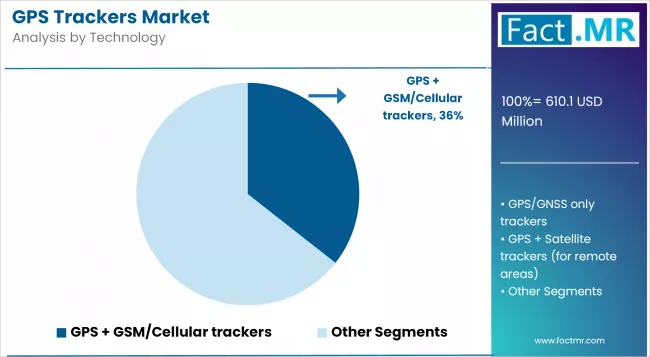
Gps Trackers Market Analysis By Technology | Source: Fact.MR
The Fleet Management and Logistics division is the sector that leads the GPS tracker adoption because of the necessity of real-time vehicle tracking, route optimization, and cargo security. Businesses use GPS positioning tools to maximize their efficiency, minimize cost of fuel, and deliver goods within a better schedule. Through integration with telematics platforms, predictive maintenance, driver behavior analysis and transportation compliance can be performed.
Increasing e-commerce, city delivery requirements, and government requirements surrounding tracking of fleets are hastening the adoption. Service providers also provide the scalable service to fleets of any size, and advanced analytics and IoT integration allow to make logistics management smarter, which makes this segment a valuable driver of market growth in GPS trackers.
Cellular connectivity enables versatile, cost-effective tracking solutions
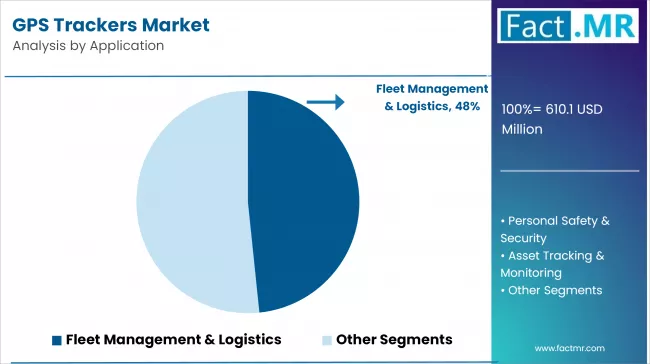
Gps Trackers Market Analysis By Application | Source: Fact.MR
GPS + GSM/ Cellular Trackers segment is increasing very fast because it is very expansive in connectivity and is affordable. These trackers send location information through cellular networks, and it can be used to monitor vehicles, assets, and personal safety devices in real-time. They are extremely popular in fleet management, personal wearable, and tracking assets in urban and semi-urban locations with strong cellular networks.
The addition of such functionalities as geofencing, alerts, and remote diagnostics make operations more efficient. Centralized monitoring can be achieved by integrating with mobile apps and cloud platforms. This segment is a major driver of market growth because of the low expenses involved in installation, compatibility with the existing telecommunication infrastructure, and ease of installation.
Large-scale deployments enhance asset management and operational efficiency
The Commercial/Enterprise market share is also large, with large enterprise customers that execute the roll-out of GPS trackers in corporate vehicles, logistics and industrial asset management. Trackers are applications used in organizations when it comes to real-time monitoring, operational analytics, theft prevention, and regulatory compliance.
The addition of enterprise resource planning (ERP) and IoT solutions allows managing data centrally and optimizing the workflow. Adoption is driven by increasing demand by e-commerce, logistics, construction, and manufacturing industries. Companies are progressively investing on tailored tracking solutions that are specific to asset type, size of fleet, and operational needs with a focus on efficiency, cost saving, and risk reduction. This segment is a premium and fast-developing segment of GPS trackers market.
Competitive Analysis
Key players in the GPS trackers market include CalAmp, Sierra Wireless, Orbocomm, Queclink, Geotab, Teltonika, TomTom, ATrack Technology Inc., Garmin Ltd., Meitrack Group
GPS Trackers Market is growing with increasing demand of real-time location tracking, fleet optimization and individual and asset security solutions. Major stakeholders are investing in IoT-based trackers, hybrid connectivity and integrated telematics platform to improve accuracy, reliability, and scalability. Product differentiation is being done through advanced capabilities like geofencing, predictive analytics, and integration of mobile apps. Competition is increasing through strategic alliances between device makers, software suppliers and fleet managers. Localized services and regional production centres are additional benefits to market penetration. The competitive forces are being influenced by constant innovation, adherence to regulations, and emphasis on economical and user-friendly solutions across the world.
Recent Development
- In May 2025, Spanish tech-company GMV introduced LUPIN, a GPS-like navigation system to the moon that was created as part of the European Space Agency initiative. LUPIN will enhance the lunar surface missions positioning, navigation and timing, aid research in space, lunar mining and possible tourism. This system was put to test in a terrain akin to cosmic, which can be regarded as a major milestone in the technology of extra-terrestrial navigation.
- In July 2025, BSJ IoT wrote that their 4G GPS trackers assisted a mid-sized delivery fleet in cutting their monthly fuel expenses by 25 percent, raising the number of on-time deliveries by 15 percent, and avoiding inappropriate off-road driving. The trackers have driver behavior monitoring and real-time alerts, proving the efficacy of the GPS tracking in improving the efficiency of the fleet and lower the cost of operations.
Fact.MR has provided detailed information about the price points of key manufacturers of GPS Trackers Market positioned across regions, sales growth, production capacity, and speculative technological expansion, in the recently published report.
Methodology and Industry Tracking Approach
The survey of 2025 Global GPS Trackers Market report was carried out on 10,000 participants in 30 different countries, with 300 participants in each market as a minimum. Two-thirds of the respondents were end users/adopters (i.e., fleet operators, logistics companies, commercial enterprises), and one-third of the industry professionals (i.e., device manufacturers, telematics service providers, distributors). The information gathered between September 2024 and August 2025 reflected the market trends and trends in adoption, technological developments, regulatory forces, and investment opportunities. More than 250 secondary sources such as patents, regulatory filings, company reports and academic publications were examined. The creation of advanced statistical procedures, including regression and trend analysis, was utilized to guarantee the correct data-driven insights of the market.
With Fact.MR monitoring consumer behavior, product efficacy, industry trends, and market opportunities since 2018, this report is becoming an authoritative source of information that stakeholders can rely on.
Segmentation
Segmentation of GPS Trackers Market
-
By Type :
- Personal GPS Trackers
- Wearable trackers
- Portable trackers
- Vehicle GPS Trackers
- Car trackers
- Fleet trackers (trucks, logistics vehicles)
- Two-wheeler trackers
- Asset GPS Trackers
- Equipment and machinery tracking
- Cargo/Shipment tracking
- Personal GPS Trackers
-
By Connectivity :
- SIM-based / Cellular trackers
- Wi-Fi enabled trackers
- Satellite connectivity trackers
- Hybrid connectivity trackers
-
By Application :
- Fleet Management & Logistics
- Personal Safety & Security
- Asset Tracking & Monitoring
- Pet Tracking
- Sports & Outdoor Activities
- Emergency Response & Healthcare Monitoring
-
By Technology :
- GPS/GNSS only trackers
- GPS + GSM/Cellular trackers
- GPS + Satellite trackers (for remote areas)
- IoT-enabled GPS trackers
- Bluetooth-enabled GPS trackers (short-range)
-
By End User :
- Individual / Consumer
- Commercial / Enterprise
- Logistics & Transportation
- Construction & Heavy Equipment
- Healthcare & Emergency Services
- Government & Defense
-
By Region :
- North America
- Latin America
- Western Europe
- Eastern Europe
- East Asia
- South Asia & Pacific
- Middle East & Africa
Frequently Asked Questions
What was the Global GPS Trackers Market Size Reported by Fact.MR for 2025?
Who are the Major Players Operating in the GPS Trackers Market?
What is the Estimated Valuation of the GPS Trackers Market in 2035?
What Value CAGR did the GPS Trackers Market Exhibit Over the Last Five Years?
Who worked on this report


Preview the report firsthand - request a free sample
Free SampleGet the brochure for pricing and purchase details
Download PDF