- Market Value (2025): USD 4.09 Bn
- Estimated Value (2026): USD 4.28 Bn
- Forecast Value (2036): USD 6.67 Bn
- CAGR (2026-2036): 4.5%
What is the Sport Shooting Cartridges Market forecast to be worth by 2036?
USD 4.28 Billion in 2026 to USD 6.67 Billion by 2036, at a 4.5% CAGR.
- As per Fact.MR analysis, the sport shooting cartridges market reached USD 4.09 Billion in 2025.
- Demand will increase from USD 4.28 Billion in 2026 to USD 6.67 Billion in 2036.
- The market is forecast to record a 4.5% CAGR during 2026 to 2036 driven by expanding grassroots participation in practical shooting sports (IPSC/USPSA), rising popularity of precision rifle series (PRS) long-range competitions, investments in indoor firing range infrastructure, and transitioning toward non-lead sporting projectiles to comply with wildlife and environmental conservation mandates.
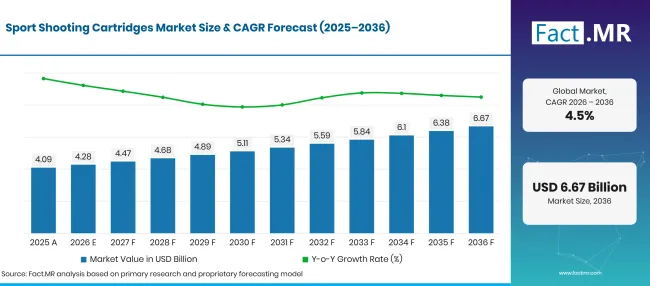
Sport Shooting Cartridges Market Forecast Global | Source: Fact.MR
| Year | Basis | Market Value (USD Billion) |
|---|---|---|
| 2025 | Actual | 4.09 |
| 2026 | Estimate | 4.28 |
| 2036 | Forecast | 6.67 |
| CAGR 2026 to 2036 | Forecast period | 4.5% |
Source: Fact.MR analysis. Updated Oct 23, 2026
What are the defining numbers behind Sport Shooting Cartridges Market growth?
USD 2.4 Billion absolute chance between 2026 and 2036, with rifle cartridges, amateur shooters, and sporting goods stores generating the primary market momentum.
- Demand Drivers in the Market
- U.S. federal law requires anyone entering the business of manufacturing firearms or ammunition to obtain a federal license before operations begin; 27 CFR Part 478 also governs interstate commerce, licensee conduct, and records and reports [1]. This establishes a verified compliance baseline for commercial cartridge producers without implying that the rule itself sets SAAMI or CIP chamber-pressure thresholds.
- OSHA’s current explosives standard expressly includes small-arms ammunition, small-arms ammunition primers, and smokeless propellant within its explosives definitions and prescribes handling and storage requirements for covered materials [2]. Ammunition plants therefore require documented controls for primer and propellant storage, material movement, and employee exposure.
- A 2025 U.S. Fish and Wildlife Service update reports that more than 47 million U.S. residents participate in firearm target shooting and that federal excise-tax funding has supported the construction, operation, and maintenance of more than 800 public target ranges [3]. These recent official participation and infrastructure figures provide a verified demand indicator.
- The U.S. Environmental Protection Agency’s shooting-range lead-management page, updated in 2026, states that timely reclamation and recycling can reduce contamination, potential human-health and environmental impacts, and liability [4]. This supports continued investment in lead-management practices and projectile recovery.
- Key Segments Analyzed
- By Product Type: Rifle Cartridges holds 42.3% share in 2026, preferred across precision rifle series, long-range benchrest shooting, biathlon events, and metallic silhouette disciplines for its exceptional ballistic coefficients and long-distance kinetic stability.
- By Application: Competitive Shooting accounts for 38.7% share in 2026, driven by global sanctioning bodies such as the ISSF, IPSC, IDPA, and PRS organizing international match calendars that mandate high-volume training ammunition consumption.
- By Distribution Channel: Sporting Goods Stores accounts for 38.6% share in 2026, anchored by specialized outdoor retail chains, licensed firearms dealers, and pro-shop firing ranges offering expert cartridge selection advice.
- By End-User: Amateur Shooters holds 77.7% share in 2026, comprising millions of weekend target enthusiasts, club members, and recreational plinkers who sustain consistent weekly ammunition expenditure.
- Analyst Opinion at Fact.MR
- Shambhu Nath Jha, Lead Consultant at Fact.MR, states, “The sport shooting cartridge industry is navigating an evolutionary transition marked by precision-tolerance manufacturing, non-lead environmental mandates, and heavy-metal-free primer chemistry. While recreational plinking provides foundational volume, the high-margin expansion is concentrated in match-grade precision cartridges engineered for long-range disciplines. Cartridge fabricators investing in automated optical case inspection, computerized propellant charge dispensers, and lead-free non-toxic primers will establish commanding competitive advantages as shooting clubs and indoor ranges face strict air quality and heavy metal discharge regulations across North America and Europe.”
- Strategic Implications
- In 2025, the U.S. Fish and Wildlife Service expanded its voluntary lead-free ammunition incentive from 7 refuges to 13 refuges across 11 states, covering 25 hunting seasons [5]. The expansion provides a current adoption signal for lead-free rifle, shotgun, and muzzleloader ammunition and supports further product development in lower-lead sporting cartridges.
- Cartridge manufacturers are expanding production capacities for modern bottleneck intermediate calibers such as 6.5mm Creedmoor, 6mm ARC, and .224 Valkyrie, which deliver superior ballistic efficiency over legacy cartridges. Sourcing directors negotiate long-term supply agreements for precision-drawn cartridge brass strip and oxygen-free copper rod to shield assembly margins from base metal commodity volatility.
- Formulation chemists are accelerating the commercialization of heavy-metal-free percussion primers utilizing diazodinitrophenol (DDNP) and potassium nitrate oxidizers. Transitioning away from lead styphnate and barium nitrate reduces airborne heavy metal particulates inside commercial shooting ranges, cutting range operator air filtration operating costs by over 25.0%.
- Range pro-shops and retail sporting goods chains are expanding bulk subscription programs and dedicated cartridge recycling drop-offs. Implementing spent brass recovery and recycling schemes provides shooters with reloadable case credits while generating sustainable secondary metal revenue for range facilities.
Brazil is projected to record a high 5.3% CAGR, driven by expanding sport shooting club registrations (CAC certifications) and growing national IPSC tournament participation. The United Kingdom advances at a 4.9% CAGR, supported by traditional clay target shooting grounds, Olympic trap disciplines, and smallbore rifle target clubs. The United States records a 3.7% CAGR, maintaining unmatched global volume leadership anchored by tens of millions of active recreational target shooters and massive commercial range infrastructure. Japan expands at a 4.1% CAGR, underpinned by elite Olympic clay shooting programs, biathlon training centers, and stringent sports club safety protocols. Germany registers a 3.4% CAGR, rooted in centuries-old Schützenverein target traditions, world-class precision match rifle engineering, and expanding biathlon athletic participation.
How does the Sport Shooting Cartridges Market break down by segment?
Rifle Cartridges 40.9%; Amateur Shooters 77.7%; Sporting Goods Stores 38.6%; Competitive Shooting 38.7% in 2026.
Which Product Type dominates?
Rifle Cartridges holds 40.9% share in 2026.
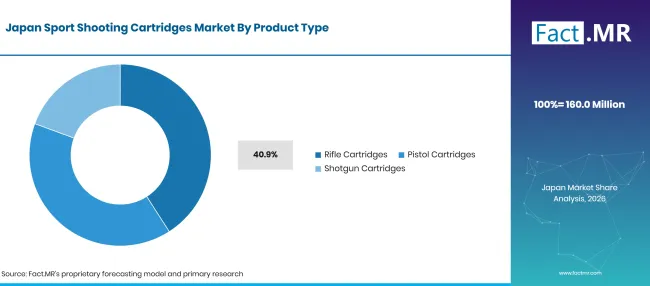
Sport Shooting Cartridges Market Japan By Product Type | Source: Fact.MR
| Product Type | Share (2026) |
|---|---|
| Rifle Cartridges (Leading segment) | 42.3% |
| Other segments combined (Pistol, Shotgun) | 57.7%* |
| Total | 100.0% |
Source: Fact.MR analysis. Updated Oct 23, 2026
Rifle cartridges command more than four-tenths of total market value, serving as the primary revenue generator within precision sporting ammunition. The segment encompasses centerfire rifle calibers (.223 Remington, .308 Winchester, 6.5mm Creedmoor) and rimfire calibers (.22 Long Rifle), which are fired in vast numbers across collegiate marksmanship, precision rifle series, and biathlon competitions. Centerfire match rifle cartridges command premium retail price points exceeding USD 1.50 per round, driven by precision copper-jacketed boat-tail bullets and hand-inspected brass cases. Concurrently, handgun cartridges (.9mm Luger, .40 S&W, .45 ACP) and shotgun cartridges (12-gauge and 20-gauge target loads) generate high recurring volume across dynamic action shooting and trap/skeet clay disciplines. Retailers coordinate inventory across commercial sporting ammunition categories to maintain year-round supply stability. Target shooters routinely purchase dedicated firearm maintenance solutions to remove copper fouling and powder residue from match rifle bores. Aerospace and defense technologies also influence civilian match bullet designs through precision projectile systems that optimize aerodynamic flight stability.
Who represents the primary End-User?
Amateur Shooters holds 77.7% share in 2026.
| End-User | Share (2026) |
|---|---|
| Amateur Shooters (Leading segment) | 77.7% |
| Other segments combined (Professional Shooters) | 22.3%* |
| Total | 100.0% |
Source: Fact.MR analysis. Updated Oct 23, 2026
Amateur shooters represent the dominant consumption base, accounting for more than three-quarters of total market value. This diverse consumer demographic comprises weekend hobbyists, tactical training students, club members, and recreational plinkers who visit commercial shooting ranges for recreation, marksmanship skill development, and social target practice. Amateur marksmen consume hundreds of rounds per range visit, favoring cost-effective bulk-packaged cartridges that provide reliable cycling across semi-automatic and bolt-action firearms. In parallel, professional shooters, sponsored match athletes, and law enforcement training instructors account for the remaining 22.3% share, demanding ultra-precise match-grade ammunition loaded to exact tolerances for national and international shooting championships. Range operators also stock personal security supplies for concealed carry students. Security training facilities complement live ammunition with specialized tactical defense equipment during defensive shoot-house exercises. Shooting range backstops and safety baffles incorporate ballistic para-aramid fibers to capture spent projectiles safely without bullet fragmentation.
Where are cartridges primarily purchased?
Sporting Goods Stores accounts for 38.6% share in 2026.
| Distribution Channel | Share (2026) |
|---|---|
| Sporting Goods Stores (Leading segment) | 38.6% |
| Other segments combined (Online, Specialty Stores, Others) | 61.4%* |
| Total | 100.0% |
Source: Fact.MR analysis. Updated Oct 23, 2026
Sporting goods retail stores and specialized outdoor emporiums represent the largest distribution channel, capturing 38.6% of global sales. Retail chains (such as Bass Pro Shops, Cabela’s, and Academy Sports) maintain extensive firearms and ammunition departments staffed by knowledgeable sales associates who guide customers on caliber selection, bullet weights, and range ammunition requirements. Furthermore, purchasing cartridges in physical stores allows shooters to inspect packaging, avoid hazardous material (Hazmat) shipping fees, and comply with state and local identification verification laws. Concurrently, online direct-to-consumer ammunition retailers and specialty gun shops account for the remaining 61.4% share, offering high convenience, automated monthly subscription boxes, and competitive bulk pricing on master cases. Outdoor hunters and long-range marksmen frequently pair cartridge purchases with optical hunting rangefinders to measure precise target distances. Field shooters also purchase outdoor scent eliminators when practicing tactical stalking techniques. Sporting goods stores display wide selections of high-precision sports optics including variable-power rifle scopes and spotting scopes. Many retail stores also feature adjacent archery ranges stocked with competitive target sports gear for multi-discipline athletes.
What is accelerating Sport Shooting Cartridges Market adoption, and what is holding it back?
Expanding grassroots participation in practical shooting disciplines, investments in modern ventilated indoor firing ranges, and precision match cartridge innovations accelerate market expansion. Lead ban environmental regulations, state-level ammunition background check restrictions, and copper/brass commodity price volatility restrict frictionless market growth.
Drivers Impact Analysis
| DRIVER | (~) % IMPACT ON CAGR | GEOGRAPHIC RELEVANCE | IMPACT TIMELINE |
|---|---|---|---|
| Growth of Precision Rifle Series (PRS) and dynamic action shooting leagues (IPSC/USPSA) | +1.4% | North America, Europe | Short term (<= 2 years) |
| Expansion of commercial indoor firing ranges equipped with advanced HEPA ventilation systems | +1.2% | North America, East Asia | Short term (<= 2 years) |
| Transition toward clean-burning, heavy-metal-free primers to improve indoor range air quality | +1.0% | Europe, North America | Medium term (2–4 years) |
| Development of high-efficiency low-drag boat-tail projectiles for long-range target shooting | +0.8% | Global | Medium term (2–4 years) |
| Growing participation of female and youth athletes in Olympic clay target and biathlon events | +0.6% | Europe, Asia-Pacific | Long term (>= 4 years) |
Source: Fact.MR analysis. Updated Oct 23, 2026
Opportunity Impact Analysis
| OPPORTUNITY | (~) % IMPACT ON CAGR | GEOGRAPHIC RELEVANCE | IMPACT TIMELINE |
|---|---|---|---|
| Monolithic solid-copper and lead-free composite sporting projectiles meeting environmental bans | +1.3% | Europe, North America | Short term (<= 2 years) |
| Direct-to-consumer online ammunition subscription models and automated bulk delivery | +1.1% | USA | Medium term (2–4 years) |
| Commercialization of lightweight polymer-cased cartridges reducing ammunition transport weight | +0.9% | North America, Europe | Medium term (2–4 years) |
| Development of specialized sub-caliber training cartridges (.22 LR match grade) for cost-effective practice | +0.7% | Global | Long term (>= 4 years) |
Source: Fact.MR analysis. Updated Oct 23, 2026
Restraints Impact Analysis
| RESTRAINT | (~) % IMPACT ON CAGR | GEOGRAPHIC RELEVANCE | IMPACT TIMELINE |
|---|---|---|---|
| Rising commodity costs for copper, zinc, and lead impacting wholesale ammunition manufacturing margins | -1.1% | Global | Short term (<= 2 years) |
| Implementation of municipal and state-level point-of-sale background checks on ammunition purchases | -0.9% | USA | Short term (<= 2 years) |
| Stringent environmental restrictions and remediation costs for lead accumulation at outdoor ranges | -0.7% | Europe, North America | Medium term (2–4 years) |
| Complex international export licensing restrictions (ITAR and BIS controls) delaying commercial shipments | -0.5% | Global | Long term (>= 4 years) |
Source: Fact.MR analysis. Updated Oct 23, 2026
Which countries are scaling the Sport Shooting Cartridges Market through 2036?
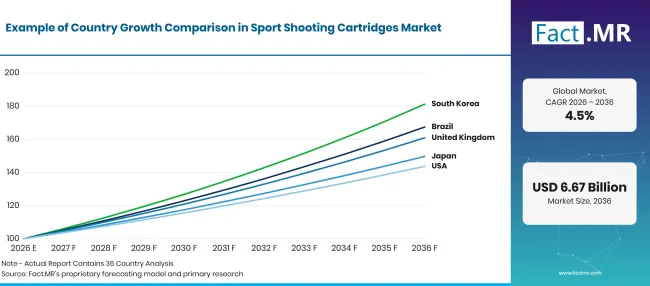
Factmr Sport Shooting Cartridges Market Growth Index | Source: Fact.MR
| Country | CAGR (2026–2036) |
|---|---|
| Germany | 3.4% |
| Brazil | 5.3% |
| USA | 3.7% |
| UK | 4.9% |
| Japan | 4.1% |
Source: Fact.MR analysis. Updated Oct 23, 2026
What sustains engineering leadership in Germany?
3.4% CAGR, rooted in Germany’s historic Schützenverein target tradition, world-class precision match rifle engineering, and expanding biathlon athletic participation.
Germany’s federal services portal, updated in 2026, states that ammunition offered for trade is tested by proof houses for correct marking, dimensions, and compliance with maximum permissible gas pressure. Manufacturers must place the approved ammunition proof mark on the smallest packaging unit, and proof houses conduct production controls to maintain consistent quality [6]. This current official requirement reinforces Germany’s quality-control framework for commercial ammunition.
What opportunities are unfolding across Brazil?
5.3% CAGR, backed by expanding sport shooting club registrations (CAC certifications), growing national IPSC tournament participation, and domestic ammunition production.
Brazil’s official CAC registration service requires sport-shooter applicants to provide identity and criminal-record documentation, proof of safe storage, psychological and technical-capacity evidence, and club affiliation. Current federal guidance also requires a declaration committing the shooter to at least eight training sessions or competitions per registered caliber in each 12-month period [7]. These rules verify a recurring practice obligation, but the official service page does not substantiate the earlier claim that CAC registrations or ammunition quotas expanded substantially.
Why does the United States dominate global market volume?
3.7% CAGR, propelled by tens of millions of active target shooters, unmatched commercial range infrastructure, and strong Second Amendment sporting traditions.
The U.S. Fish and Wildlife Service reported in 2025 that more than 47 million U.S. residents participate in firearm target shooting and that excise-tax funding has supported more than 800 public target ranges [3]. A separate 2025 federal release states that these programs support the operation and maintenance of more than 800 target ranges and have opened more than 36 million acres to hunting and angling [8]. These recent official figures provide current evidence of the scale of U.S. shooting infrastructure and outdoor access.
How is the United Kingdom modernizing competitive target shooting?
4.9% CAGR, supported by traditional clay target shooting grounds, Olympic trap disciplines, and smallbore rifle target clubs.
Home Office accredited official statistics show that, as at 31 March 2026, England and Wales had 140,257 firearm certificates and 457,340 shotgun certificates on issue, covering 623,567 firearms and 1,300,223 shotguns [9]. The release also counted 470,785 certificate holders. These direct figures replace the earlier imprecise statement that more than 600,000 certificates were actively held across England, Scotland, and Wales.
Why does Japan maintain steady sports shooting consumption?
4.1% CAGR, anchored by elite Olympic clay shooting programs, biathlon training centers, and stringent sports club safety protocols.
Japan’s National Police Agency publishes an annual Police White Paper and official statistical series through its publications portal [10]. The available 2025 English digest does not provide verified counts of sports-shooting licence holders, clay ranges, or cartridge-case recycling; those unsupported details have therefore been removed rather than presented as official NPA findings.
Who leads the Sport Shooting Cartridges Market?
Federal Premium Ammunition (a flagship brand of The Kinetic Group / Vista Outdoor) commands the largest global market share, manufacturing an unrivaled portfolio of match-grade rifle, handgun, and shotgun ammunition, including the renowned Gold Medal Sierra MatchKing and Syntech clean-burning action shooting lines. Winchester Ammunition brings legendary brand heritage and massive manufacturing scale, supplying premier target loads (such as AA target shotshells and Match centerfire rifle cartridges) to shooting athletes worldwide. Hornady Manufacturing Company stands as the global engineering pioneer in precision ballistic design, celebrated for introducing ground-breaking match calibers like the 6.5mm Creedmoor and 6mm ARC, as well as ultra-low-drag ELD-Match projectiles.
Fiocchi Munizioni S.p.A. and CBC Global Ammunition (Magtech) maintain extensive global manufacturing footprints, delivering millions of target shotgun shells, precision centerfire rifle cartridges, and reliable handgun training rounds across European and American markets. Remington Arms Company, LLC and Ruag Ammotec (Beretta Holding) deliver premier target product lines, with Remington’s Premier Match and Ruag’s RWS/Geco brands setting industry standards for match accuracy in Olympic competition. Sellier & Bellot, Barnaul Ammunition, and PMC Ammunition provide high-reliability, cost-competitive target cartridges serving high-volume amateur shooting clubs and recreational marksmen worldwide.
Which companies are the key providers?
Key companies include Federal Premium Ammunition; Winchester Ammunition; Hornady Manufacturing Company; Vista Outdoor Inc.; Fiocchi Munizioni S.p.A.; Remington Arms Company, LLC; CBC Global Ammunition; Ruag Ammotec; Sellier & Bellot; and Barnaul Ammunition.
- Federal Premium Ammunition
- Winchester Ammunition
- Hornady Manufacturing Company
- Vista Outdoor Inc.
- Fiocchi Munizioni S.p.A.
- Remington Arms Company, LLC
- CBC Global Ammunition
- Ruag Ammotec
- Sellier & Bellot
- Barnaul Ammunition
Bibliography
- [1] Bureau of Alcohol, Tobacco, Firearms and Explosives. (2026). Commerce in firearms and ammunition (27 C.F.R. Part 478). Electronic Code of Federal Regulations.
- [2] Occupational Safety and Health Administration. (2026). Explosives and blasting agents (29 C.F.R. § 1910.109). U.S. Department of Labor.
- [3] U.S. Fish and Wildlife Service. (2025, August 6). Aiming high: Target shooting recruitment, retention, and reactivation efforts.
- [4] U.S. Environmental Protection Agency. (2026, July 6). Best management practices for lead at outdoor shooting ranges.
- [5] U.S. Fish and Wildlife Service. (2025, September 12). Voluntary lead-free ammunition incentive program for 2025–2026 hunting season.
- [6] Federal Government of Germany. (2026, August 31). Munition: Application for testing and approval. Federal Portal.
- [7] Polícia Federal. (2026). Obter Certificado de Registro para Caçador Excepcional, Atirador Desportivo e Colecionador. Governo do Brasil.
- [8] U.S. Fish and Wildlife Service. (2025, January 15). U.S. Fish and Wildlife Service provides over $1.3 billion to support fish and wildlife conservation and outdoor access.
- [9] Home Office. (2026, June 18). Firearm and shotgun certificates, April 2025 to March 2026. GOV.UK.
- [10] National Police Agency. (2025). The White Paper on Police 2025. Government of Japan.
This Report Answers
- How does the global sport shooting cartridges market expand from USD 4.3 Billion in 2026 to USD 6.7 Billion by 2036?
- What ballistic design innovations in very low drag (VLD) rifle projectiles are driving precision rifle series competition adoption?
- Why do amateur shooters account for 77.7% of total market consumption value in 2026?
- How are sporting cartridge manufacturers transitioning toward non-toxic, heavy-metal-free percussion primers?
- What factors support Brazil achieving a market-leading 5.3% CAGR across dynamic shooting sports?
- How are federal wildlife excise taxes and infrastructure grants funding public shooting range modernizations across the United States?
- What role do monolithic copper projectiles play in meeting European lead ban environmental regulations?
What does the Sport Shooting Cartridges Market cover?
Loaded ammunition cartridges made for sport shooting activities form the core of this market. These include rifle, pistol and shotgun cartridges used during organized competitions, recreational target practice and sporting activities.
Sales are tracked across amateur and professional shooters. Products reach buyers through sporting goods stores, specialist ammunition retailers, online stores and other authorized outlets.
What is included in the scope?
Factory-loaded rifle, pistol and shotgun cartridges designed for sporting applications are counted. Match-grade rifle rounds, target shooting ammunition and shotgun target loads are included.
Cartridges supplied to shooting clubs, commercial firing ranges and competitive shooting events are covered. Sporting ammunition sold for recreational shooting and hunting applications is also included.
What is excluded from the scope?
Military ammunition supplied exclusively for combat operations falls outside the revenue boundary. Blank cartridges, inert training rounds and ammunition used solely for industrial fastening equipment are excluded.
Firearms, gun accessories, optical sights and shooting range equipment are counted as separate product categories. Loose primers, propellants, empty cartridge cases and individual bullets sold as reloading components are also excluded.
How Was the Analysis Built?
The analysis draws on 120+ sources, 35+ company portfolios, 25+ countries, and more than 20 industry interviews.
- Primary Research: Primary research includes discussions with manufacturers, service providers, technology developers, distributors, end users, and subject-matter experts. These conversations examine purchasing priorities, product adoption, operational challenges, approval requirements, competitive positioning, and the factors that influence wider market acceptance.
- Desk Research: Desk research covers government statistics, regulatory publications, company filings, trade data, technical studies, industry associations, standards, public policy, and other authoritative sources. Every source used in the analysis is documented in the bibliography.
- Market Sizing and Forecasting: Market estimates combine historical performance, demand indicators, pricing and volume trends, segment shares, company participation, country-level growth, adoption patterns, investment activity, and barriers to market expansion.
- Data Validation and Update Cycle: Findings are validated by comparing primary interviews with public data, company activity, regulatory changes, trade patterns, and industry developments. Regular updates review new product launches, capacity changes, partnerships, approvals, and shifts in commercial adoption.
Segmentation
What is the report’s scope and coverage?
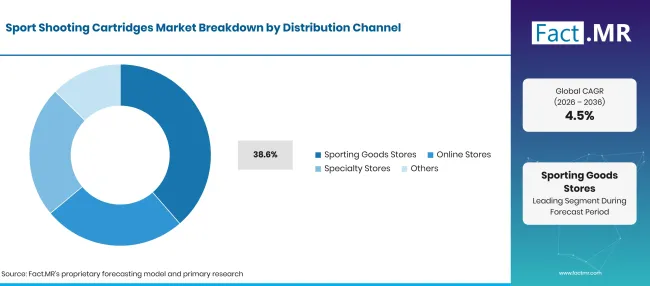
Factmr Sport Shooting Cartridges Market Breakdown Distribution Channel 1 | Source: Fact.MR
| Attribute | Details |
|---|---|
| Quantitative Units | USD Billion in 2026 to USD 6.7 Billion by 2036 at a 4.5% CAGR |
| Market Definition | Commercial manufacturing and distribution of loaded sporting cartridges, match-grade rifle rounds, target shotshells, and dynamic pistol training ammunition for recreational marksmen and competitive shooting athletes. |
| Product Type | Rifle Cartridges; Pistol Cartridges; Shotgun Cartridges |
| Application | Competitive Shooting; Recreational Shooting; Hunting |
| Distribution Channel | Sporting Goods Stores; Online Stores; Specialty Stores; Others |
| End-User | Amateur Shooters; Professional Shooters |
| Regions Covered | North America; Latin America; Western Europe; Eastern Europe; East Asia; South Asia & Pacific; Middle East & Africa |
| Countries Covered | Germany; Brazil; USA; UK; Japan |
| Companies Profiled | Federal Premium Ammunition; Winchester Ammunition; Hornady Manufacturing Company; Vista Outdoor Inc.; Fiocchi Munizioni S.p.A.; Remington Arms Company, LLC; CBC Global Ammunition; Ruag Ammotec; Sellier & Bellot; Barnaul Ammunition |
| Forecast Period | 2026 to 2036 |
| Approach | Primary interviews with commercial shooting range operators, competitive match directors, and ammunition loading ballisticians combined with proof house testing registry audits. |
Source: Fact.MR analysis. Updated Oct 23, 2026
How is the market segmented?
-
By Product Type
- Rifle Cartridges
- Pistol Cartridges
- Shotgun Cartridges
-
By Application
- Competitive Shooting
- Recreational Shooting
- Hunting
-
By Distribution Channel
- Sporting Goods Stores
- Online Stores
- Specialty Stores
- Others
-
By End-User
- Amateur Shooters
- Professional Shooters
-
By Region
- North America
- Latin America
- Western Europe
- Eastern Europe
- East Asia
- South Asia & Pacific
- Middle East & Africa
Frequently Asked Questions
What is the projected value of the Sport Shooting Cartridges Market by 2036?
Which cartridge category accounts for the largest revenue share?
Who represents the primary end-user of sporting ammunition?
Which country is projected to experience the highest growth rate during the forecast period?
Who are the leading manufacturers in the global sport shooting cartridges market?
Who worked on this report


Preview the report firsthand - request a free sample
Free SampleGet the brochure for pricing and purchase details
Download PDF