- Market Value (2025): USD 2.1 Bn
- Estimated Value (2026): USD 2.22 Bn
- Forecast Value (2036): USD 3.78 Bn
- CAGR (2026-2036): 5.5%
What is the Sprycel Market forecast to be worth by 2036?
USD 2.2 billion in 2026 to USD 3.8 billion by 2036, at a 5.5% CAGR.
- As per Fact.MR analysis, the sprycel market reached USD 2.1 billion in 2025.
- Sales are projected to rise from USD 2.22 billion in 2026 to USD 3.78 billion by 2036.
- The outlook indicates a 5.5% CAGR during 2026 to 2036 as hematology care centers manage eligible CML and Ph-positive ALL treatment.
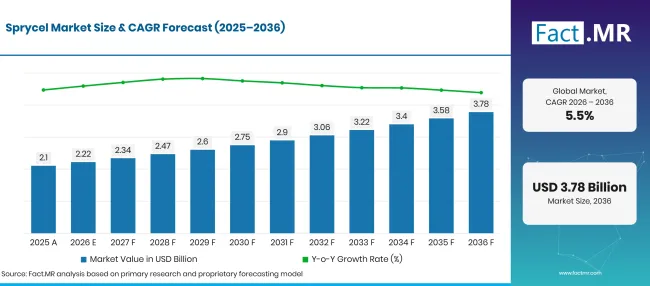
Sprycel Market Forecast Global | Source: Fact.MR
| Year | Basis | Market Value (USD billion) |
|---|---|---|
| 2025 | Actual | 2.1 |
| 2026 | Estimate | 2.22 |
| 2036 | Forecast | 3.78 |
| CAGR 2026 to 2036 | Forecast period | 5.5% |
Source: Fact.MR analysis. Updated Oct 23, 2026
What are the defining numbers behind Sprycel Market growth?
USD 1.6 billion additional market value between 2026 and 2036, with CML and hospital pharmacies accounting for the main segments.
Demand Drivers in the Market
- Hematologists use molecular testing to identify Philadelphia chromosome-positive CML before selecting tyrosine kinase inhibitor treatment. The prescribing pathway gives disease-specific evidence and patient response a direct role in medication selection.
- Pediatric cancer services need carefully defined options for Ph-positive ALL alongside chemotherapy. The U.S. prescribing information covers newly diagnosed pediatric Ph-positive ALL in combination with chemotherapy. [1]
- Hospital pharmacies coordinate specialist prescriptions and review medication safety during long courses of oral therapy. Clear dosing instructions matter because tablet strengths and patient circumstances vary across approved treatment groups.
Key Segments Analyzed
- By Indication: Chronic Myeloid Leukemia is projected to hold 72.3% share in 2026 as approved CML treatment spans several clinical situations.
- By Distribution Channel: Hospital Pharmacies are estimated to represent 54.2% share in 2026 because oncology prescribing commonly begins in specialist care.
- By Dosage Form: Tablets are forecast to hold 84.6% share in 2026 since the branded product is supplied in multiple tablet strengths.
Analyst Opinion at Fact.MR
Shambhu Nath Jha, Principal Consultant at Fact.MR, states, “The Sprycel market depends on the continued clinical place of dasatinib within a changing treatment pathway. Its commercial outlook is shaped by follow-up testing and branded-drug access, while availability of other dasatinib products puts pressure on pricing. Specialist care providers need reliable supply and careful medicine review throughout treatment.”
Strategic Implications
- Branded medicine suppliers should maintain consistent tablet availability across approved strengths so hematology teams can continue prescribed treatment.
- Hospital pharmacy teams benefit from clear handling procedures and accurate medication records for patients moving between inpatient and outpatient care.
- Healthcare systems should evaluate branded and alternative dasatinib products under applicable substitution rules and clinical oversight.
- Oncology clinicians should base treatment choices on disease phase, molecular response, tolerance, and the current prescribing information.
Germany carries a 6.3% CAGR forecast, while Brazil records 5.8% across the 2026 to 2036 period. The United States is projected at 5.2%, followed by the United Kingdom at 4.7% and Japan at 4.1%. Treatment access, local approvals and reimbursement arrangements vary across these healthcare systems.
How does the Sprycel Market break down by segment?
Chronic Myeloid Leukemia 72.3%; Hospital Pharmacies 54.2%; Tablets 84.6% in 2026.
Which Indication holds the main share?
Chronic Myeloid Leukemia accounts for 72.3% share in 2026.
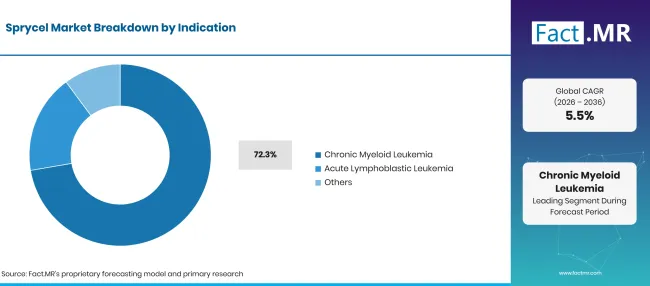
Sprycel Market Breakdown Indication | Source: Fact.MR
| Indication | Share (2026) |
|---|---|
| Chronic Myeloid Leukemia (Leading segment) | 72.3% |
| Other segments combined | 27.7% |
| Total | 100.0% |
Source: Fact.MR analysis. Updated Oct 23, 2026
Chronic myeloid leukemia makes up the main Sprycel treatment segment because dasatinib has approved uses across defined phases of Philadelphia chromosome-positive CML. Molecular response checks guide follow-up decisions after treatment begins. Acute lymphoblastic leukemia is a separate indication involving Philadelphia chromosome-positive disease and carefully defined adult or pediatric prescribing. Other leukemia uses must remain within locally authorized labels.
What leads the Distribution Channel segment?
Hospital Pharmacies lead with 54.2% share in 2026.
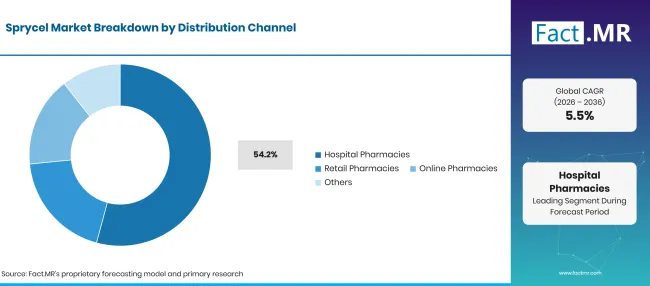
Sprycel Market Breakdown Distribution Channel | Source: Fact.MR
| Segment | Share (2026) |
|---|---|
| Hospital Pharmacies (Leading segment) | 54.2% |
| Other segments combined | 45.8% |
| Total | 100.0% |
Source: Fact.MR analysis. Updated Oct 23, 2026
Hospital pharmacies handle a large share of specialty leukemia treatment supply within oncology services. Many prescriptions begin with hematology assessment and treatment planning, so hospital pharmacy staff frequently coordinate the initial medicine order. Retail pharmacies may supply later refills where local arrangements permit specialist prescribing. Online pharmacy services depend on the same prescription and medicine distribution safeguards. Consistent supply matters during long treatment courses, since changes to the prescribed medicine need clinical review.
Which Dosage Form has the wider role?
Tablets represent 84.6% share in 2026.
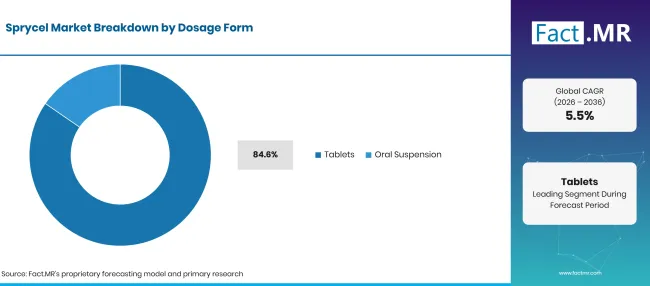
Sprycel Market Breakdown Dosage Form | Source: Fact.MR
| Dosage | Share (2026) |
|---|---|
| Tablets (Leading segment) | 84.6% |
| Other segments combined | 15.4% |
| Total | 100.0% |
Source: Fact.MR analysis. Updated Oct 23, 2026
Tablets remain the standard branded presentation described in U.S. prescribing information for Sprycel. Strength selection follows the labeled disease indication and patient characteristics. Oral suspension is retained as a market taxonomy category, but availability differs by brand and jurisdiction. The European product information describes tablets and an oral suspension, while the U.S. brand label describes film-coated tablets [4]. Buyers therefore need to check the approved presentation in each country.
What is accelerating Sprycel Market adoption, and what is holding it back?
Prescribing follows a confirmed leukemia diagnosis, while local access rules and other dasatinib products influence branded sales.
Drivers Impact Analysis
| DRIVERS | (~) % IMPACT ON CAGR | GEOGRAPHIC RELEVANCE | IMPACT TIMELINE |
|---|---|---|---|
| Ph-positive CML treatment | +1.0% | Global | Medium term |
| Specialist hematology services | +0.8% | North America, Europe | Medium term |
| Response-guided continuation | +0.7% | Global | Long term |
| Eligible pediatric use | +0.5% | Selected markets | Long term |
| Prescribed tablet availability | +0.4% | Global | Short term |
Source: Fact.MR analysis. Updated Oct 23, 2026
Opportunity Impact Analysis
| OPPORTUNITY | (~) % IMPACT ON CAGR | GEOGRAPHIC RELEVANCE | IMPACT TIMELINE |
|---|---|---|---|
| Treatment continuity services | +0.7% | Global | Medium term |
| Pharmacy coordination | +0.6% | North America, Europe | Short term |
| Pediatric specialty care | +0.5% | Selected markets | Long term |
| Locally approved formulations | +0.3% | Europe, Japan | Medium term |
Source: Fact.MR analysis. Updated Oct 23, 2026
Restraints Impact Analysis
| RESTRAINTS | (~) % IMPACT ON CAGR | GEOGRAPHIC RELEVANCE | IMPACT TIMELINE |
|---|---|---|---|
| Generic dasatinib competition | -0.8% | United States, Europe | Short term |
| Safety monitoring burden | -0.6% | Global | Medium term |
| Payer access criteria | -0.5% | Global | Medium term |
| Treatment switching decisions | -0.4% | Global | Long term |
Source: Fact.MR analysis. Updated Oct 23, 2026
Which countries are scaling the Sprycel Market through 2036?
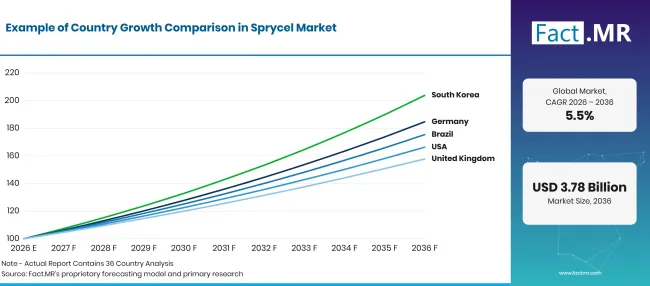
Sprycel Market Growth Index | Source: Fact.MR
| Country | CAGR (2026–2036) |
|---|---|
| Germany | 6.3% |
| Brazil | 5.8% |
| United States | 5.2% |
| United Kingdom | 4.7% |
| Japan | 4.1% |
Source: Fact.MR analysis. Updated Oct 23, 2026
Why is Germany expanding Sprycel treatment access?
6.3% CAGR, shaped by specialist hematology services.
German hematology centers use chromosome testing to identify the form of leukemia before choosing a targeted medicine. The Robert Koch Institute describes leukemia surveillance in its 2025 cancer information, which helps clinics assess the wider care burden [5]. Physicians then review how patients respond to treatment and whether adverse effects affect continuation. Hospital prescribing and insurance coverage shape access to the Sprycel brand within approved uses.
How is Brazil shaping Sprycel use?
5.8% CAGR, linked to oncology treatment access.
Brazilian cancer centers face different medicine access arrangements across public and private care. The National Cancer Institute estimated 12,220 new leukemia cases annually for 2026 to 2028 across all leukemia types [6]. Specialist teams distinguish Philadelphia chromosome-positive disease before considering dasatinib as one of the available treatments. Local approval, clinical follow-up and the ability to continue therapy influence branded prescriptions.
What supports Sprycel treatment in the United States?
5.2% CAGR, linked to defined treatment indications.
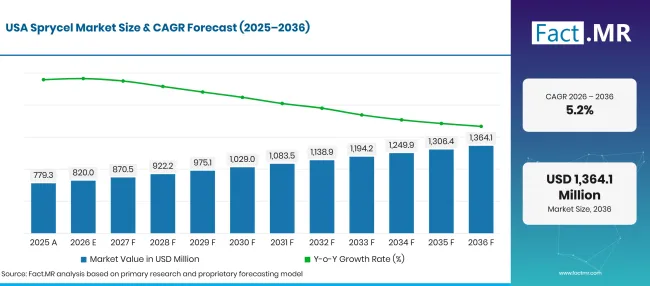
Sprycel Market Forecast Usa | Source: Fact.MR
In the United States, molecular testing identifies patients whose leukemia matches an approved Sprycel indication. The National Cancer Institute estimates 9,650 new chronic myeloid leukemia cases in 2026 [2]. The FDA has also authorized separate generic dasatinib products, giving physicians and health plans additional supply choices [3]. Continued branded sales therefore depend on clinical suitability, coverage decisions and reliable pharmacy access for patients already receiving treatment.
How is the United Kingdom managing Sprycel access?
4.7% CAGR, shaped by specialist prescribing.
United Kingdom hematology services assess molecular results and patient tolerance before continuing long-term CML treatment. In September 2025, the Department of Health and Social Care published an assessment of health trends in England that includes cancer-related care [7]. NHS prescribing processes and specialist follow-up determine how patients receive oral leukemia medicines. Treatment choice remains tied to the approved indication and the patient’s response.
What is influencing Sprycel prescriptions in Japan?
4.1% CAGR, linked to specialist leukemia management.
Japan’s hospital-based oncology services manage leukemia through specialist diagnosis and regular assessment of treatment response. The National Cancer Center Japan projected 15,200 new leukemia cases in 2025 across all leukemia types [8]. Physicians must identify the appropriate disease subtype before prescribing targeted treatment such as dasatinib. Domestic approval conditions and medicine coverage influence dispensing decisions, while follow-up visits support safe treatment continuation.
Who leads the Sprycel Market?
Bristol Myers Squibb holds the central position in the Sprycel market as the company directly associated with the branded dasatinib medicine. Its role is tied to supplying Sprycel for approved leukemia indications and supporting continued access through specialist prescribing and pharmacy channels.
Teva Pharmaceuticals, Dr. Reddy’s Laboratories, Apotex, Zydus Lifesciences, Lupin Pharmaceuticals, Aurobindo Pharma, Alembic Pharmaceuticals, Biocon Pharma, and Nanocopoeia participate through dasatinib or related generic-drug activity. Their presence creates competition around product availability, pricing, pharmacy access, and substitution rules, while Sprycel remains a distinct branded product. Competitive positioning therefore depends on approved product status, reliable supply, and acceptance within specialist hematology treatment pathways rather than on a common branded portfolio.
Which companies are the key providers?
Key companies include Bristol-Myers Squibb Company; Teva Pharmaceuticals, Inc.; Dr. Reddy's Laboratories Ltd.; Apotex Corp.; Zydus Lifesciences Ltd.; Lupin Pharmaceuticals, Inc.; Aurobindo Pharma Limited; Alembic Pharmaceuticals Ltd.; Biocon Pharma Inc.; Nanocopoeia.
- Bristol-Myers Squibb Company
- Teva Pharmaceuticals, Inc.
- Dr. Reddy's Laboratories Ltd.
- Apotex Corp.
- Zydus Lifesciences Ltd.
- Lupin Pharmaceuticals, Inc.
- Aurobindo Pharma Limited
- Alembic Pharmaceuticals Ltd.
- Biocon Pharma Inc.
- Nanocopoeia
Bibliography
- [1] U.S. Food and Drug Administration. (2026, October). SPRYCEL (dasatinib) prescribing information.\
- [2] National Cancer Institute. (n.d.). Cancer stat facts: Leukemia—Chronic myeloid leukemia (CML). Surveillance, Epidemiology, and End Results Program.
- [3] U.S. Food and Drug Administration. (n.d.). Competitive generic therapy approvals.
- [4] European Medicines Agency. (2026, October 2). Sprycel: European public assessment report.
- [5] Robert Koch Institute. (2024, October 14). Leukämien.
- [6] Instituto Nacional de Câncer. (2026). Estimativa 2026: Incidência de câncer no Brasil.
- [7] Department of Health and Social Care. (2025, September 25). Health trends and variation in England, 2025.
- [8] National Cancer Center Japan. (2025, December 24). Projected cancer statistics.
This Report Answers
- The report reviews how CML and Philadelphia chromosome-positive ALL indications shape branded dasatinib use.
- Distribution analysis explains the specialist role of hospital pharmacies during treatment initiation and repeat supply.
- Dosage-form assessment compares tablets with an oral-suspension category under country-specific product approvals.
- Country analysis considers local oncology treatment access across Germany, Brazil, the United States, the United Kingdom and Japan.
- Competitive review distinguishes the Sprycel brand owner from other oncology medicine companies and alternative dasatinib products.
What does the Sprycel Market cover?
The market covers the branded medicine Sprycel within its locally approved use for Philadelphia chromosome-positive leukemia. It examines indication, distribution and dosage-form categories relevant to medicine access and sales. Generic dasatinib products are discussed as competition, not counted as Sprycel brand manufacturing.
What is included in the scope?
The scope includes prescription medicines supplied under the Sprycel brand to eligible patient groups. Hospital and community dispensing channels are assessed where permitted by local rules. Disease phase and treatment history affect clinical eligibility, so the analysis does not treat every leukemia diagnosis as a potential Sprycel prescription. Pharmacy services linked to dispensing are discussed without treating unrelated medical services as drug sales.
What is excluded from the scope?
The scope excludes unrelated oncology drugs and non-dasatinib treatments. Separate dasatinib brands and generic versions are competitive context rather than Sprycel branded sales. General leukemia care, diagnostic services, and drug products outside the relevant marketing authorization are also beyond the branded medicine market boundary.
How Was the Analysis Built?
The analysis draws on 120+ sources, 35+ company portfolios, 25+ countries, and more than 20 industry interviews.
- Primary Research: Primary research includes discussions with manufacturers, service providers, technology developers, distributors, end users, and subject-matter experts. These conversations examine purchasing priorities, product adoption, operational challenges, approval requirements, competitive positioning, and the factors that influence wider market acceptance.
- Desk Research: Desk research covers government statistics, regulatory publications, company filings, trade data, technical studies, industry associations, standards, public policy, and other authoritative sources. Every source used in the analysis is documented in the bibliography.
- Market Sizing and Forecasting: Market estimates combine historical performance, demand indicators, pricing and volume trends, segment shares, company participation, country-level growth, adoption patterns, investment activity, and barriers to market expansion.
- Data Validation and Update Cycle: Findings are validated by comparing primary interviews with public data, company activity, regulatory changes, trade patterns, and industry developments. Regular updates review new product launches, capacity changes, partnerships, approvals, and shifts in commercial adoption.
Segmentation
What is the report’s scope and coverage?
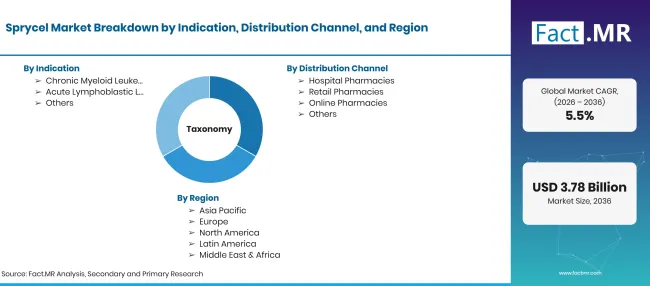
Sprycel Market Taxonomy | Source: Fact.MR
| Attribute | Details |
|---|---|
| Quantitative Units | USD billion in 2026 to USD billion by 2036, at CAGR |
| Market Definition | Sales associated with Sprycel, the branded dasatinib medicine, for locally approved leukemia indications. |
| Indication | Chronic Myeloid Leukemia; Acute Lymphoblastic Leukemia; Others |
| Distribution Channel | Hospital Pharmacies; Retail Pharmacies; Online Pharmacies; Others |
| Dosage Form | Tablets; Oral Suspension |
| Regions Covered | North America; Latin America; Western Europe; Eastern Europe; East Asia; South Asia & Pacific; Middle East & Africa |
| Countries Covered | Germany; Brazil; United States; United Kingdom; Japan |
| Companies Profiled | Bristol-Myers Squibb Company; Teva Pharmaceuticals, Inc.; Dr. Reddy's Laboratories Ltd.; Apotex Corp.; Zydus Lifesciences Ltd.; Lupin Pharmaceuticals, Inc.; Aurobindo Pharma Limited; Alembic Pharmaceuticals Ltd.; Biocon Pharma Inc.; Nanocopoeia |
| Forecast Period | 2026 to 2036 |
| Approach | Disease-specific treatment assessment, medicine labeling, channel analysis and public regulatory review |
Source: Fact.MR analysis. Updated Oct 23, 2026
How is the market segmented?
-
By Indication
- Chronic Myeloid Leukemia
- Acute Lymphoblastic Leukemia
- Others
-
By Distribution Channel
- Hospital Pharmacies
- Retail Pharmacies
- Online Pharmacies
- Others
-
By Dosage Form
- Tablets
- Oral Suspension
-
By Region
- North America
- Latin America
- Western Europe
- Eastern Europe
- East Asia
- South Asia & Pacific
- Middle East & Africa
Frequently Asked Questions
How big is the Sprycel market in 2026?
What is the CAGR from 2026 to 2036?
Which indication leads?
Which distribution channel leads?
Who are the main companies in the sprycel market?
Who worked on this report


Preview the report firsthand - request a free sample
Free SampleGet the brochure for pricing and purchase details
Download PDF