Stabilization and Solidification Additives for Hazardous Waste Market

Stabilization and Solidification Additives for Hazardous Waste Market Size and Share Forecast Outlook 2026 to 2036

Stabilization and solidification additives for hazardous waste market is projected to grow from USD 0.7 billion in 2026 to USD 1.5 billion by 2036, at a CAGR of 8.7%. Cementitious Additives (Cement, Fly Ash, Slag) will dominate with a 36.0% market share, while heavy metal-contaminated waste will lead the waste type segment with a 34.0% share.

Stabilization and Solidification Additives for Hazardous Waste Market Forecast and Outlook 2026 to 2036

The global market for stabilization and solidification additives used in hazardous waste treatment is projected to reach USD 1.54 billion by 2036. The market is valued at USD 0.67 billion in 2026 and is set to rise at an 8.7% CAGR during the assessment period.

Key Takeaways from the Stabilization and Solidification Additives for Hazardous Waste Market

  • Market Value for 2026: USD 0.67 Billion
  • Market Value for 2036: USD 1.54 Billion
  • Forecast CAGR (2026-2036): 8.7%
  • Leading Additive Type Share (2026): Cementitious Additives (Cement, Fly Ash, Slag) (36%)
  • Leading Waste Type Share (2026): Heavy Metal-Contaminated Waste (34%)
  • Leading End-Use Sector Share (2026): Environmental Remediation & Waste Management Firms (32%)
  • Key Players in the Market: Clean Harbors, Veolia Environmental Services, Remondis Group, SUEZ (Veolia), US Ecology (Republic Services Inc.)
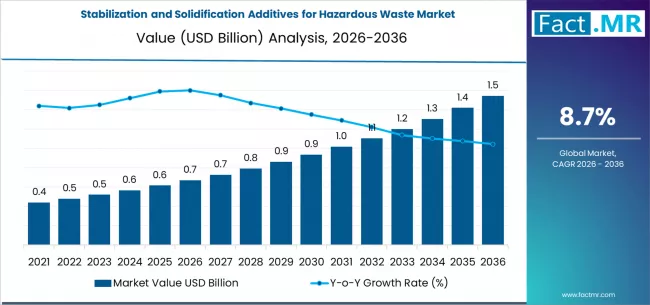
Stabilization And Solidification Additives For Hazardous Waste Market Market Value Analysis

By additive type, cementitious additives hold a leading 36% share. Heavy metal-contaminated waste represents the dominant waste type segment at 34%. Environmental remediation and waste management firms constitute the primary end-use sector, with a 32% share.

This growth is driven by stringent global regulations mandating the safe, long-term immobilization of hazardous constituents before landfill disposal or site closure. Stabilization and solidification (S/S) technology is a cornerstone treatment method, transforming dangerous, leachable waste into a stable, monolithic solid that minimizes environmental risk.

These specialized additives are critical for chemically binding or encapsulating toxic elements within a treated waste matrix. Their application is essential for managing industrial by-products, remediation wastes, and contaminated soils, ensuring regulatory compliance and protecting human health and the environment from contaminant migration.

Stabilization and Solidification Additives for Hazardous Waste Market

Metric Value
Market Value (2026) USD 0.67 Billion
Market Forecast Value (2036) USD 1.54 Billion
Forecast CAGR (2026-2036) 8.7%

Category

Category Segments
Additive Type Cementitious Additives (Cement, Fly Ash, Slag), Pozzolanic & Mineral Additives, Polymer-Based Solidification Agents, Sulfur-Based & Reactive Additives, Other Specialty Stabilizers & Immobilizers
Waste Type Heavy Metal-Contaminated Waste, Industrial Chemical Sludge & Solids, Oil & Petrochemical Waste, Radioactive & Nuclear Waste, Other Hazardous Mixed Waste
End-Use Sector Environmental Remediation & Waste Management Firms, Industrial Manufacturing & Chemical Plants, Oil, Gas & Petrochemical Sites, Government & Municipal Waste Handlers, Mining & Metallurgical Waste Treatment
Region North America, Latin America, Western Europe, Eastern Europe, East Asia, South Asia & Pacific, MEA

Segmental Analysis

By Additive Type, Which Chemistry Forms the Foundation of Most S/S Formulations?
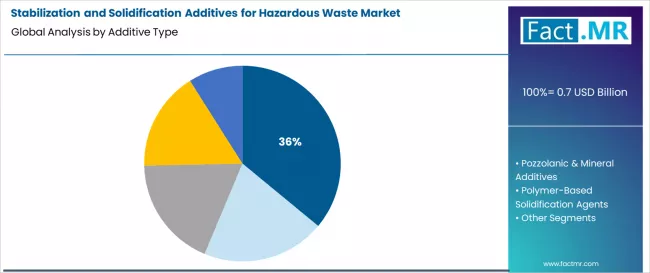
Stabilization And Solidification Additives For Hazardous Waste Market Analysis By Additive Type

Cementitious additives, including Portland cement, fly ash, and blast furnace slag, lead the segment with a 36% share. Their dominance is due to their widespread availability, low cost, and well-understood chemistry that provides both chemical stabilization through precipitation and adsorption and physical solidification through hydration and monolithic block formation.

They are highly effective for a broad range of inorganic wastes, particularly heavy metals, and the resulting treated material often meets regulatory strength and leachability criteria for landfill disposal.

By Waste Type, Which Hazardous Stream is the Most Prevalent Target for Immobilization?
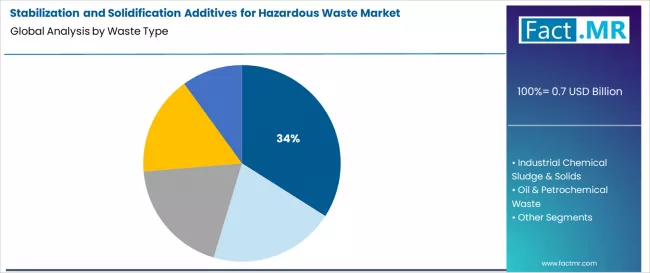
Stabilization And Solidification Additives For Hazardous Waste Market Analysis By Waste Type

Heavy metal-contaminated waste represents the largest waste type segment at 34%. The persistence, toxicity, and mobility of metals like lead, chromium, arsenic, and cadmium make them a primary regulatory concern.

S/S is a proven best demonstrated available technology (BDAT) for many metal-bearing wastes, as it can chemically fix metals into insoluble forms within a solid matrix, preventing leaching into groundwater. The volume of such waste from industrial processes, mining, and remediation activities ensures consistent demand.

By End-Use Sector, Who are the Primary Specifiers and Handlers of S/S Treatments?
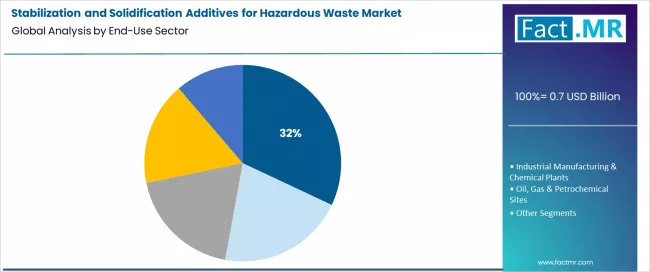
Stabilization And Solidification Additives For Hazardous Waste Market Analysis By End Use Sector

Environmental remediation and waste management firms lead the end-use sector with a 32% share. These specialized companies are engaged at the intersection of regulatory compliance and waste handling.

They apply S/S technology on-site during remediation projects to treat excavated contaminated soil or off-site at treatment, storage, and disposal facilities (TSDFs) to process incoming waste streams. Their role as the technical implementers and guarantors of final waste form quality makes them the central market for additive procurement and formulation expertise.

What are the Drivers, Restraints, and Key Trends of the Stabilization and Solidification Additives for Hazardous Waste Market?

The fundamental market driver is the stringent, globally evolving regulatory landscape governing hazardous waste disposal, particularly landfill acceptance criteria that mandate treatment to reduce toxicity and mobility.

Regulations like the US Resource Conservation and Recovery Act (RCRA) and similar frameworks worldwide enforce treatment standards that S/S is uniquely positioned to meet. The increasing cost of landfill space and liability also makes volume reduction and stabilization economically advantageous.

A primary restraint is the potential for long-term stability issues if the treated waste form is exposed to adverse environmental conditions not anticipated during formulation, such as extreme pH or freeze-thaw cycles, which can cause deterioration and contaminant release.

The treatment process can also significantly increase the volume and weight of the final waste form, impacting transportation and disposal costs. Furthermore, the effectiveness of S/S on certain organic contaminants and mixed wastes can be limited, requiring more complex and expensive additive blends.

Key trends include the development of advanced, tailored additive blends that incorporate specialty adsorbents to handle complex mixed wastes containing organics. There is growing use of alternative, low-carbon cementitious materials like geopolymers to reduce the environmental footprint of the S/S process.

The market is moving toward real-time monitoring and process control during mixing to ensure consistent quality. Research into additives for stabilizing emerging contaminants like PFAS within solid matrices is also a significant focus area.

Analysis of the Stabilization and Solidification Additives for Hazardous Waste Market by Key Countries
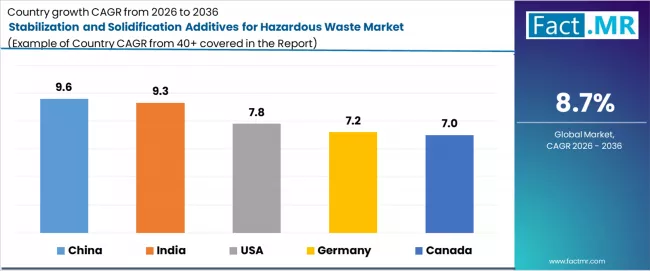
Stabilization And Solidification Additives For Hazardous Waste Market Cagr Analysis By Country

Country CAGR (2026-2036)
China 9.60%
India 9.30%
USA 7.80%
Germany 7.20%
Canada 7.00%

How are China's Industrial Waste Volumes and Environmental Regulations Shaping Demand?

Massive generation of industrial hazardous waste and the government’s rigorous enforcement of new, stricter waste management and soil pollution laws fuel China’s leading CAGR of 9.60%. As the world's largest manufacturing hub, China's need to treat metal-laden sludges and contaminated soils is immense, driving widespread adoption of S/S as a primary treatment technology and creating vast demand for cementitious and other additives.

What is the Impact of India's Growing Industrial Base and Regulatory Enforcement on the Market?

India's 9.30% growth is driven by the expansion of its manufacturing and chemical sectors, coupled with stronger enforcement of hazardous waste rules by the Central Pollution Control Board. The increasing volume of waste requiring treatment and the development of new waste processing infrastructure are creating significant opportunities for S/S technology and its associated additive chemicals.

How does the USA's Mature Regulatory Framework and Remediation Activity Influence the Market?
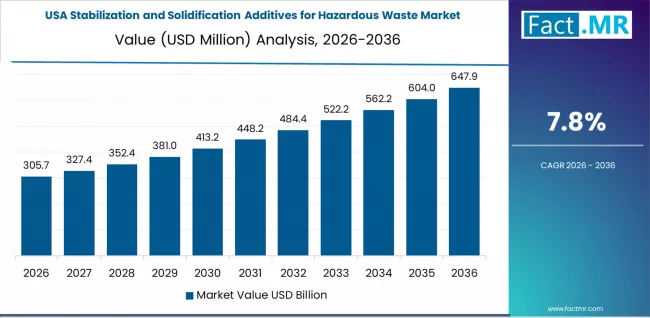
Stabilization And Solidification Additives For Hazardous Waste Market Country Value Analysis

The USA's 7.80% growth is supported by a well-established RCRA regulatory structure and ongoing large-scale environmental remediation projects (e.g., Superfund). The need to treat and dispose of vast quantities of contaminated media and listed hazardous wastes to meet LDR standards sustains a steady, high-volume market for proven S/S additive systems.

Why is Germany a Key Market for High-Performance and Engineered Waste Forms?

Germany's 7.20% CAGR reflects its stringent waste acceptance criteria and engineering-focused approach to waste treatment. German regulations demand high-integrity, predictable waste forms with verified long-term stability. This drives demand for advanced, performance-tested additive blends and precise formulation methodologies, positioning Germany as a market for high-end stabilization solutions.

What Role does Canada's Resource and Industrial Sector Play in Driving Demand?

Canada's 7.00% growth is anchored in the need to manage hazardous waste from its extensive mining, oil & gas, and manufacturing industries. Federal and provincial contaminated sites programs require treatment of excavated materials, and the management of metal-bearing wastes from mining sustains demand for effective stabilization technologies suitable for challenging waste streams and climates.

Competitive Landscape of the Stabilization and Solidification Additives for Hazardous Waste Market
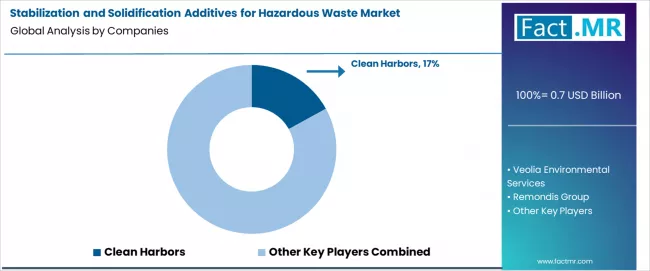
Stabilization And Solidification Additives For Hazardous Waste Market Analysis By Company

Large, integrated environmental service and waste management corporations dominate the competitive landscape. Leaders like Clean Harbors, Veolia, and Remondis compete by offering comprehensive waste treatment services that include on-site S/S operations, additive supply, and final disposal.

Competition centers on providing cost-effective, regulatory-compliant formulations, demonstrating successful treatability studies for difficult wastes, and leveraging extensive logistics networks to manage waste streams from generation to final disposal.

Key Players in the Stabilization and Solidification Additives for Hazardous Waste Market

  • Clean Harbors
  • Veolia Environmental Services
  • Remondis Group
  • SUEZ (Veolia)
  • US Ecology (Republic Services Inc.)

Scope of Report

Items Values
Quantitative Units USD Billion
Additive Type Cementitious, Pozzolanic/Mineral, Polymer-Based, Sulfur-Based, Other
Waste Type Heavy Metal Waste, Chemical Sludge, Petrochemical Waste, Radioactive Waste, Mixed
End-Use Sector Remediation/Waste Firms, Industrial Plants, Oil & Gas Sites, Government, Mining
Key Countries China, India, USA, Germany, Canada
Key Companies Clean Harbors, Veolia, Remondis, SUEZ, US Ecology
Additional Analysis Analysis of binder-to-waste ratios and mix design; leachability testing protocols (TCLP, SPLP); long-term durability testing of treated waste forms; regulatory waste acceptance criteria for landfills; total cost analysis of S/S versus other treatment/disposal options.

Market by Segments

  • Additive Type :

    • Cementitious Additives (Cement, Fly Ash, Slag)
    • Pozzolanic & Mineral Additives
    • Polymer-Based Solidification Agents
    • Sulfur-Based & Reactive Additives
    • Other Specialty Stabilizers & Immobilizers
  • Waste Type :

    • Heavy Metal-Contaminated Waste
    • Industrial Chemical Sludge & Solids
    • Oil & Petrochemical Waste
    • Radioactive & Nuclear Waste
    • Other Hazardous Mixed Waste
  • End-Use Sector :

    • Environmental Remediation & Waste Management Firms
    • Industrial Manufacturing & Chemical Plants
    • Oil, Gas & Petrochemical Sites
    • Government & Municipal Waste Handlers
    • Mining & Metallurgical Waste Treatment
  • Region :

    • North America
      • USA
      • Canada
    • Latin America
      • Brazil
      • Mexico
      • Argentina
      • Rest of Latin America
    • Western Europe
      • Germany
      • UK
      • France
      • Spain
      • Italy
      • BENELUX
      • Rest of Western Europe
    • Eastern Europe
      • Russia
      • Poland
      • Czech Republic
      • Rest of Eastern Europe
    • East Asia
      • China
      • Japan
      • South Korea
      • Rest of East Asia
    • South Asia & Pacific
      • India
      • ASEAN
      • Australia
      • Rest of South Asia & Pacific
    • MEA
      • Saudi Arabia
      • UAE
      • Turkiye
      • Rest of MEA

Table of Content

  1. Executive Summary
    • Global Market Outlook
    • Demand to side Trends
    • Supply to side Trends
    • Technology Roadmap Analysis
    • Analysis and Recommendations
  2. Market Overview
    • Market Coverage / Taxonomy
    • Market Definition / Scope / Limitations
  3. Market Background
    • Market Dynamics
      • Drivers
      • Restraints
      • Opportunity
      • Trends
    • Scenario Forecast
      • Demand in Optimistic Scenario
      • Demand in Likely Scenario
      • Demand in Conservative Scenario
    • Opportunity Map Analysis
    • Product Life Cycle Analysis
    • Supply Chain Analysis
    • Investment Feasibility Matrix
    • Value Chain Analysis
    • PESTLE and Porter’s Analysis
    • Regulatory Landscape
    • Regional Parent Market Outlook
    • Production and Consumption Statistics
    • Import and Export Statistics
  4. Global Market Analysis 2021 to 2025 and Forecast, 2026 to 2036
    • Historical Market Size Value (USD Million) Analysis, 2021 to 2025
    • Current and Future Market Size Value (USD Million) Projections, 2026 to 2036
      • Y to o to Y Growth Trend Analysis
      • Absolute $ Opportunity Analysis
  5. Global Market Pricing Analysis 2021 to 2025 and Forecast 2026 to 2036
  6. Global Market Analysis 2021 to 2025 and Forecast 2026 to 2036, By Additive Type
    • Introduction / Key Findings
    • Historical Market Size Value (USD Million) Analysis By Additive Type, 2021 to 2025
    • Current and Future Market Size Value (USD Million) Analysis and Forecast By Additive Type, 2026 to 2036
      • Cementitious Additives (Cement, Fly Ash, Slag)
      • Pozzolanic & Mineral Additives
      • Polymer-Based Solidification Agents
      • Sulfur-Based & Reactive Additives
      • Other Specialty Stabilizers & Immobilizers
    • Y to o to Y Growth Trend Analysis By Additive Type, 2021 to 2025
    • Absolute $ Opportunity Analysis By Additive Type, 2026 to 2036
  7. Global Market Analysis 2021 to 2025 and Forecast 2026 to 2036, By Waste Type
    • Introduction / Key Findings
    • Historical Market Size Value (USD Million) Analysis By Waste Type, 2021 to 2025
    • Current and Future Market Size Value (USD Million) Analysis and Forecast By Waste Type, 2026 to 2036
      • Heavy Metal-Contaminated Waste
      • Industrial Chemical Sludge & Solids
      • Oil & Petrochemical Waste
      • Radioactive & Nuclear Waste
      • Other Hazardous Mixed Waste
    • Y to o to Y Growth Trend Analysis By Waste Type, 2021 to 2025
    • Absolute $ Opportunity Analysis By Waste Type, 2026 to 2036
  8. Global Market Analysis 2021 to 2025 and Forecast 2026 to 2036, By End-Use Sector
    • Introduction / Key Findings
    • Historical Market Size Value (USD Million) Analysis By End-Use Sector, 2021 to 2025
    • Current and Future Market Size Value (USD Million) Analysis and Forecast By End-Use Sector, 2026 to 2036
      • Environmental Remediation & Waste Management Firms
      • Industrial Manufacturing & Chemical Plants
      • Oil, Gas & Petrochemical Sites
      • Government & Municipal Waste Handlers
      • Mining & Metallurgical Waste Treatment
    • Y to o to Y Growth Trend Analysis By End-Use Sector, 2021 to 2025
    • Absolute $ Opportunity Analysis By End-Use Sector, 2026 to 2036
  9. Global Market Analysis 2021 to 2025 and Forecast 2026 to 2036, By Region
    • Introduction
    • Historical Market Size Value (USD Million) Analysis By Region, 2021 to 2025
    • Current Market Size Value (USD Million) Analysis and Forecast By Region, 2026 to 2036
      • North America
      • Latin America
      • Western Europe
      • Eastern Europe
      • East Asia
      • South Asia and Pacific
      • Middle East & Africa
    • Market Attractiveness Analysis By Region
  10. North America Market Analysis 2021 to 2025 and Forecast 2026 to 2036, By Country
    • Historical Market Size Value (USD Million) Trend Analysis By Market Taxonomy, 2021 to 2025
    • Market Size Value (USD Million) Forecast By Market Taxonomy, 2026 to 2036
      • By Country
        • USA
        • Canada
        • Mexico
      • By Additive Type
      • By Waste Type
      • By End-Use Sector
    • Market Attractiveness Analysis
      • By Country
      • By Additive Type
      • By Waste Type
      • By End-Use Sector
    • Key Takeaways
  11. Latin America Market Analysis 2021 to 2025 and Forecast 2026 to 2036, By Country
    • Historical Market Size Value (USD Million) Trend Analysis By Market Taxonomy, 2021 to 2025
    • Market Size Value (USD Million) Forecast By Market Taxonomy, 2026 to 2036
      • By Country
        • Brazil
        • Chile
        • Rest of Latin America
      • By Additive Type
      • By Waste Type
      • By End-Use Sector
    • Market Attractiveness Analysis
      • By Country
      • By Additive Type
      • By Waste Type
      • By End-Use Sector
    • Key Takeaways
  12. Western Europe Market Analysis 2021 to 2025 and Forecast 2026 to 2036, By Country
    • Historical Market Size Value (USD Million) Trend Analysis By Market Taxonomy, 2021 to 2025
    • Market Size Value (USD Million) Forecast By Market Taxonomy, 2026 to 2036
      • By Country
        • Germany
        • UK
        • Italy
        • Spain
        • France
        • Nordic
        • BENELUX
        • Rest of Western Europe
      • By Additive Type
      • By Waste Type
      • By End-Use Sector
    • Market Attractiveness Analysis
      • By Country
      • By Additive Type
      • By Waste Type
      • By End-Use Sector
    • Key Takeaways
  13. Eastern Europe Market Analysis 2021 to 2025 and Forecast 2026 to 2036, By Country
    • Historical Market Size Value (USD Million) Trend Analysis By Market Taxonomy, 2021 to 2025
    • Market Size Value (USD Million) Forecast By Market Taxonomy, 2026 to 2036
      • By Country
        • Russia
        • Poland
        • Hungary
        • Balkan & Baltic
        • Rest of Eastern Europe
      • By Additive Type
      • By Waste Type
      • By End-Use Sector
    • Market Attractiveness Analysis
      • By Country
      • By Additive Type
      • By Waste Type
      • By End-Use Sector
    • Key Takeaways
  14. East Asia Market Analysis 2021 to 2025 and Forecast 2026 to 2036, By Country
    • Historical Market Size Value (USD Million) Trend Analysis By Market Taxonomy, 2021 to 2025
    • Market Size Value (USD Million) Forecast By Market Taxonomy, 2026 to 2036
      • By Country
        • China
        • Japan
        • South Korea
      • By Additive Type
      • By Waste Type
      • By End-Use Sector
    • Market Attractiveness Analysis
      • By Country
      • By Additive Type
      • By Waste Type
      • By End-Use Sector
    • Key Takeaways
  15. South Asia and Pacific Market Analysis 2021 to 2025 and Forecast 2026 to 2036, By Country
    • Historical Market Size Value (USD Million) Trend Analysis By Market Taxonomy, 2021 to 2025
    • Market Size Value (USD Million) Forecast By Market Taxonomy, 2026 to 2036
      • By Country
        • India
        • ASEAN
        • Australia & New Zealand
        • Rest of South Asia and Pacific
      • By Additive Type
      • By Waste Type
      • By End-Use Sector
    • Market Attractiveness Analysis
      • By Country
      • By Additive Type
      • By Waste Type
      • By End-Use Sector
    • Key Takeaways
  16. Middle East & Africa Market Analysis 2021 to 2025 and Forecast 2026 to 2036, By Country
    • Historical Market Size Value (USD Million) Trend Analysis By Market Taxonomy, 2021 to 2025
    • Market Size Value (USD Million) Forecast By Market Taxonomy, 2026 to 2036
      • By Country
        • Kingdom of Saudi Arabia
        • Other GCC Countries
        • Turkiye
        • South Africa
        • Other African Union
        • Rest of Middle East & Africa
      • By Additive Type
      • By Waste Type
      • By End-Use Sector
    • Market Attractiveness Analysis
      • By Country
      • By Additive Type
      • By Waste Type
      • By End-Use Sector
    • Key Takeaways
  17. Key Countries Market Analysis
    • USA
      • Pricing Analysis
      • Market Share Analysis, 2025
        • By Additive Type
        • By Waste Type
        • By End-Use Sector
    • Canada
      • Pricing Analysis
      • Market Share Analysis, 2025
        • By Additive Type
        • By Waste Type
        • By End-Use Sector
    • Mexico
      • Pricing Analysis
      • Market Share Analysis, 2025
        • By Additive Type
        • By Waste Type
        • By End-Use Sector
    • Brazil
      • Pricing Analysis
      • Market Share Analysis, 2025
        • By Additive Type
        • By Waste Type
        • By End-Use Sector
    • Chile
      • Pricing Analysis
      • Market Share Analysis, 2025
        • By Additive Type
        • By Waste Type
        • By End-Use Sector
    • Germany
      • Pricing Analysis
      • Market Share Analysis, 2025
        • By Additive Type
        • By Waste Type
        • By End-Use Sector
    • UK
      • Pricing Analysis
      • Market Share Analysis, 2025
        • By Additive Type
        • By Waste Type
        • By End-Use Sector
    • Italy
      • Pricing Analysis
      • Market Share Analysis, 2025
        • By Additive Type
        • By Waste Type
        • By End-Use Sector
    • Spain
      • Pricing Analysis
      • Market Share Analysis, 2025
        • By Additive Type
        • By Waste Type
        • By End-Use Sector
    • France
      • Pricing Analysis
      • Market Share Analysis, 2025
        • By Additive Type
        • By Waste Type
        • By End-Use Sector
    • India
      • Pricing Analysis
      • Market Share Analysis, 2025
        • By Additive Type
        • By Waste Type
        • By End-Use Sector
    • ASEAN
      • Pricing Analysis
      • Market Share Analysis, 2025
        • By Additive Type
        • By Waste Type
        • By End-Use Sector
    • Australia & New Zealand
      • Pricing Analysis
      • Market Share Analysis, 2025
        • By Additive Type
        • By Waste Type
        • By End-Use Sector
    • China
      • Pricing Analysis
      • Market Share Analysis, 2025
        • By Additive Type
        • By Waste Type
        • By End-Use Sector
    • Japan
      • Pricing Analysis
      • Market Share Analysis, 2025
        • By Additive Type
        • By Waste Type
        • By End-Use Sector
    • South Korea
      • Pricing Analysis
      • Market Share Analysis, 2025
        • By Additive Type
        • By Waste Type
        • By End-Use Sector
    • Russia
      • Pricing Analysis
      • Market Share Analysis, 2025
        • By Additive Type
        • By Waste Type
        • By End-Use Sector
    • Poland
      • Pricing Analysis
      • Market Share Analysis, 2025
        • By Additive Type
        • By Waste Type
        • By End-Use Sector
    • Hungary
      • Pricing Analysis
      • Market Share Analysis, 2025
        • By Additive Type
        • By Waste Type
        • By End-Use Sector
    • Kingdom of Saudi Arabia
      • Pricing Analysis
      • Market Share Analysis, 2025
        • By Additive Type
        • By Waste Type
        • By End-Use Sector
    • Turkiye
      • Pricing Analysis
      • Market Share Analysis, 2025
        • By Additive Type
        • By Waste Type
        • By End-Use Sector
    • South Africa
      • Pricing Analysis
      • Market Share Analysis, 2025
        • By Additive Type
        • By Waste Type
        • By End-Use Sector
  18. Market Structure Analysis
    • Competition Dashboard
    • Competition Benchmarking
    • Market Share Analysis of Top Players
      • By Regional
      • By Additive Type
      • By Waste Type
      • By End-Use Sector
  19. Competition Analysis
    • Competition Deep Dive
      • Clean Harbors
        • Overview
        • Product Portfolio
        • Profitability by Market Segments (Product/Age /Sales Channel/Region)
        • Sales Footprint
        • Strategy Overview
          • Marketing Strategy
          • Product Strategy
          • Channel Strategy
      • Veolia Environmental Services
      • Remondis Group
      • SUEZ (Veolia)
      • US Ecology (Republic Services Inc.)
  20. Assumptions & Acronyms Used
  21. Research Methodology

List Of Table

  • Table 1: Global Market Value (USD Million) Forecast by Region, 2021 to 2036
  • Table 2: Global Market Value (USD Million) Forecast by Additive Type, 2021 to 2036
  • Table 3: Global Market Value (USD Million) Forecast by Waste Type, 2021 to 2036
  • Table 4: Global Market Value (USD Million) Forecast by End-Use Sector, 2021 to 2036
  • Table 5: North America Market Value (USD Million) Forecast by Country, 2021 to 2036
  • Table 6: North America Market Value (USD Million) Forecast by Additive Type, 2021 to 2036
  • Table 7: North America Market Value (USD Million) Forecast by Waste Type, 2021 to 2036
  • Table 8: North America Market Value (USD Million) Forecast by End-Use Sector, 2021 to 2036
  • Table 9: Latin America Market Value (USD Million) Forecast by Country, 2021 to 2036
  • Table 10: Latin America Market Value (USD Million) Forecast by Additive Type, 2021 to 2036
  • Table 11: Latin America Market Value (USD Million) Forecast by Waste Type, 2021 to 2036
  • Table 12: Latin America Market Value (USD Million) Forecast by End-Use Sector, 2021 to 2036
  • Table 13: Western Europe Market Value (USD Million) Forecast by Country, 2021 to 2036
  • Table 14: Western Europe Market Value (USD Million) Forecast by Additive Type, 2021 to 2036
  • Table 15: Western Europe Market Value (USD Million) Forecast by Waste Type, 2021 to 2036
  • Table 16: Western Europe Market Value (USD Million) Forecast by End-Use Sector, 2021 to 2036
  • Table 17: Eastern Europe Market Value (USD Million) Forecast by Country, 2021 to 2036
  • Table 18: Eastern Europe Market Value (USD Million) Forecast by Additive Type, 2021 to 2036
  • Table 19: Eastern Europe Market Value (USD Million) Forecast by Waste Type, 2021 to 2036
  • Table 20: Eastern Europe Market Value (USD Million) Forecast by End-Use Sector, 2021 to 2036
  • Table 21: East Asia Market Value (USD Million) Forecast by Country, 2021 to 2036
  • Table 22: East Asia Market Value (USD Million) Forecast by Additive Type, 2021 to 2036
  • Table 23: East Asia Market Value (USD Million) Forecast by Waste Type, 2021 to 2036
  • Table 24: East Asia Market Value (USD Million) Forecast by End-Use Sector, 2021 to 2036
  • Table 25: South Asia and Pacific Market Value (USD Million) Forecast by Country, 2021 to 2036
  • Table 26: South Asia and Pacific Market Value (USD Million) Forecast by Additive Type, 2021 to 2036
  • Table 27: South Asia and Pacific Market Value (USD Million) Forecast by Waste Type, 2021 to 2036
  • Table 28: South Asia and Pacific Market Value (USD Million) Forecast by End-Use Sector, 2021 to 2036
  • Table 29: Middle East & Africa Market Value (USD Million) Forecast by Country, 2021 to 2036
  • Table 30: Middle East & Africa Market Value (USD Million) Forecast by Additive Type, 2021 to 2036
  • Table 31: Middle East & Africa Market Value (USD Million) Forecast by Waste Type, 2021 to 2036
  • Table 32: Middle East & Africa Market Value (USD Million) Forecast by End-Use Sector, 2021 to 2036

List Of Figures

  • Figure 1: Global Market Pricing Analysis
  • Figure 2: Global Market Value (USD Million) Forecast 2021 to 2036
  • Figure 3: Global Market Value Share and BPS Analysis by Additive Type, 2026 and 2036
  • Figure 4: Global Market Y to o to Y Growth Comparison by Additive Type, 2026 to 2036
  • Figure 5: Global Market Attractiveness Analysis by Additive Type
  • Figure 6: Global Market Value Share and BPS Analysis by Waste Type, 2026 and 2036
  • Figure 7: Global Market Y to o to Y Growth Comparison by Waste Type, 2026 to 2036
  • Figure 8: Global Market Attractiveness Analysis by Waste Type
  • Figure 9: Global Market Value Share and BPS Analysis by End-Use Sector, 2026 and 2036
  • Figure 10: Global Market Y to o to Y Growth Comparison by End-Use Sector, 2026 to 2036
  • Figure 11: Global Market Attractiveness Analysis by End-Use Sector
  • Figure 12: Global Market Value (USD Million) Share and BPS Analysis by Region, 2026 and 2036
  • Figure 13: Global Market Y to o to Y Growth Comparison by Region, 2026 to 2036
  • Figure 14: Global Market Attractiveness Analysis by Region
  • Figure 15: North America Market Incremental Dollar Opportunity, 2026 to 2036
  • Figure 16: Latin America Market Incremental Dollar Opportunity, 2026 to 2036
  • Figure 17: Western Europe Market Incremental Dollar Opportunity, 2026 to 2036
  • Figure 18: Eastern Europe Market Incremental Dollar Opportunity, 2026 to 2036
  • Figure 19: East Asia Market Incremental Dollar Opportunity, 2026 to 2036
  • Figure 20: South Asia and Pacific Market Incremental Dollar Opportunity, 2026 to 2036
  • Figure 21: Middle East & Africa Market Incremental Dollar Opportunity, 2026 to 2036
  • Figure 22: North America Market Value Share and BPS Analysis by Country, 2026 and 2036
  • Figure 23: North America Market Value Share and BPS Analysis by Additive Type, 2026 and 2036
  • Figure 24: North America Market Y to o to Y Growth Comparison by Additive Type, 2026 to 2036
  • Figure 25: North America Market Attractiveness Analysis by Additive Type
  • Figure 26: North America Market Value Share and BPS Analysis by Waste Type, 2026 and 2036
  • Figure 27: North America Market Y to o to Y Growth Comparison by Waste Type, 2026 to 2036
  • Figure 28: North America Market Attractiveness Analysis by Waste Type
  • Figure 29: North America Market Value Share and BPS Analysis by End-Use Sector, 2026 and 2036
  • Figure 30: North America Market Y to o to Y Growth Comparison by End-Use Sector, 2026 to 2036
  • Figure 31: North America Market Attractiveness Analysis by End-Use Sector
  • Figure 32: Latin America Market Value Share and BPS Analysis by Country, 2026 and 2036
  • Figure 33: Latin America Market Value Share and BPS Analysis by Additive Type, 2026 and 2036
  • Figure 34: Latin America Market Y to o to Y Growth Comparison by Additive Type, 2026 to 2036
  • Figure 35: Latin America Market Attractiveness Analysis by Additive Type
  • Figure 36: Latin America Market Value Share and BPS Analysis by Waste Type, 2026 and 2036
  • Figure 37: Latin America Market Y to o to Y Growth Comparison by Waste Type, 2026 to 2036
  • Figure 38: Latin America Market Attractiveness Analysis by Waste Type
  • Figure 39: Latin America Market Value Share and BPS Analysis by End-Use Sector, 2026 and 2036
  • Figure 40: Latin America Market Y to o to Y Growth Comparison by End-Use Sector, 2026 to 2036
  • Figure 41: Latin America Market Attractiveness Analysis by End-Use Sector
  • Figure 42: Western Europe Market Value Share and BPS Analysis by Country, 2026 and 2036
  • Figure 43: Western Europe Market Value Share and BPS Analysis by Additive Type, 2026 and 2036
  • Figure 44: Western Europe Market Y to o to Y Growth Comparison by Additive Type, 2026 to 2036
  • Figure 45: Western Europe Market Attractiveness Analysis by Additive Type
  • Figure 46: Western Europe Market Value Share and BPS Analysis by Waste Type, 2026 and 2036
  • Figure 47: Western Europe Market Y to o to Y Growth Comparison by Waste Type, 2026 to 2036
  • Figure 48: Western Europe Market Attractiveness Analysis by Waste Type
  • Figure 49: Western Europe Market Value Share and BPS Analysis by End-Use Sector, 2026 and 2036
  • Figure 50: Western Europe Market Y to o to Y Growth Comparison by End-Use Sector, 2026 to 2036
  • Figure 51: Western Europe Market Attractiveness Analysis by End-Use Sector
  • Figure 52: Eastern Europe Market Value Share and BPS Analysis by Country, 2026 and 2036
  • Figure 53: Eastern Europe Market Value Share and BPS Analysis by Additive Type, 2026 and 2036
  • Figure 54: Eastern Europe Market Y to o to Y Growth Comparison by Additive Type, 2026 to 2036
  • Figure 55: Eastern Europe Market Attractiveness Analysis by Additive Type
  • Figure 56: Eastern Europe Market Value Share and BPS Analysis by Waste Type, 2026 and 2036
  • Figure 57: Eastern Europe Market Y to o to Y Growth Comparison by Waste Type, 2026 to 2036
  • Figure 58: Eastern Europe Market Attractiveness Analysis by Waste Type
  • Figure 59: Eastern Europe Market Value Share and BPS Analysis by End-Use Sector, 2026 and 2036
  • Figure 60: Eastern Europe Market Y to o to Y Growth Comparison by End-Use Sector, 2026 to 2036
  • Figure 61: Eastern Europe Market Attractiveness Analysis by End-Use Sector
  • Figure 62: East Asia Market Value Share and BPS Analysis by Country, 2026 and 2036
  • Figure 63: East Asia Market Value Share and BPS Analysis by Additive Type, 2026 and 2036
  • Figure 64: East Asia Market Y to o to Y Growth Comparison by Additive Type, 2026 to 2036
  • Figure 65: East Asia Market Attractiveness Analysis by Additive Type
  • Figure 66: East Asia Market Value Share and BPS Analysis by Waste Type, 2026 and 2036
  • Figure 67: East Asia Market Y to o to Y Growth Comparison by Waste Type, 2026 to 2036
  • Figure 68: East Asia Market Attractiveness Analysis by Waste Type
  • Figure 69: East Asia Market Value Share and BPS Analysis by End-Use Sector, 2026 and 2036
  • Figure 70: East Asia Market Y to o to Y Growth Comparison by End-Use Sector, 2026 to 2036
  • Figure 71: East Asia Market Attractiveness Analysis by End-Use Sector
  • Figure 72: South Asia and Pacific Market Value Share and BPS Analysis by Country, 2026 and 2036
  • Figure 73: South Asia and Pacific Market Value Share and BPS Analysis by Additive Type, 2026 and 2036
  • Figure 74: South Asia and Pacific Market Y to o to Y Growth Comparison by Additive Type, 2026 to 2036
  • Figure 75: South Asia and Pacific Market Attractiveness Analysis by Additive Type
  • Figure 76: South Asia and Pacific Market Value Share and BPS Analysis by Waste Type, 2026 and 2036
  • Figure 77: South Asia and Pacific Market Y to o to Y Growth Comparison by Waste Type, 2026 to 2036
  • Figure 78: South Asia and Pacific Market Attractiveness Analysis by Waste Type
  • Figure 79: South Asia and Pacific Market Value Share and BPS Analysis by End-Use Sector, 2026 and 2036
  • Figure 80: South Asia and Pacific Market Y to o to Y Growth Comparison by End-Use Sector, 2026 to 2036
  • Figure 81: South Asia and Pacific Market Attractiveness Analysis by End-Use Sector
  • Figure 82: Middle East & Africa Market Value Share and BPS Analysis by Country, 2026 and 2036
  • Figure 83: Middle East & Africa Market Value Share and BPS Analysis by Additive Type, 2026 and 2036
  • Figure 84: Middle East & Africa Market Y to o to Y Growth Comparison by Additive Type, 2026 to 2036
  • Figure 85: Middle East & Africa Market Attractiveness Analysis by Additive Type
  • Figure 86: Middle East & Africa Market Value Share and BPS Analysis by Waste Type, 2026 and 2036
  • Figure 87: Middle East & Africa Market Y to o to Y Growth Comparison by Waste Type, 2026 to 2036
  • Figure 88: Middle East & Africa Market Attractiveness Analysis by Waste Type
  • Figure 89: Middle East & Africa Market Value Share and BPS Analysis by End-Use Sector, 2026 and 2036
  • Figure 90: Middle East & Africa Market Y to o to Y Growth Comparison by End-Use Sector, 2026 to 2036
  • Figure 91: Middle East & Africa Market Attractiveness Analysis by End-Use Sector
  • Figure 92: Global Market - Tier Structure Analysis
  • Figure 93: Global Market - Company Share Analysis

- FAQs -

How big is the stabilization and solidification additives for hazardous waste market in 2026?

The global stabilization and solidification additives for hazardous waste market is estimated to be valued at USD 0.7 billion in 2026.

What will be the size of stabilization and solidification additives for hazardous waste market in 2036?

The market size for the stabilization and solidification additives for hazardous waste market is projected to reach USD 1.5 billion by 2036.

How much will be the stabilization and solidification additives for hazardous waste market growth between 2026 and 2036?

The stabilization and solidification additives for hazardous waste market is expected to grow at a 8.7% CAGR between 2026 and 2036.

What are the key product types in the stabilization and solidification additives for hazardous waste market?

The key product types in stabilization and solidification additives for hazardous waste market are cementitious additives (cement, fly ash, slag), pozzolanic & mineral additives, polymer-based solidification agents, sulfur-based & reactive additives and other specialty stabilizers & immobilizers.

Which waste type segment to contribute significant share in the stabilization and solidification additives for hazardous waste market in 2026?

In terms of waste type, heavy metal-contaminated waste segment to command 34.0% share in the stabilization and solidification additives for hazardous waste market in 2026.

Stabilization and Solidification Additives for Hazardous Waste Market