- Market Value (2025): USD 1.4 Bn
- Estimated Value (2026): USD 1.48 Bn
- Forecast Value (2036): USD 2.5 Bn
- CAGR (2026-2036): 5.4%
What is the Static Orthotics Market forecast to be worth by 2036?
USD 1.48 billion in 2026 to USD 2.5 billion by 2036 at a 5.4% CAGR.
- The static orthotics market was valued at USD 1.4 billion in 2025, with spending linked to prescribed braces and immobilizing supports.
- Sales are projected to rise from USD 1.48 billion in 2026 to USD 2.5 billion by 2036 as clinics fit devices for joint protection and rehabilitation.
- The 5.4% CAGR for 2026 to 2036 reflects demand from patients who need controlled positioning after injury or during long-term care.
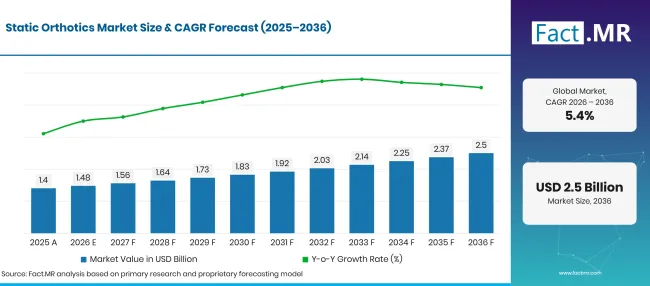
Static Orthotics Market Forecast Global | Source: Fact.MR
| Year | Basis | Market Value (USD billion) |
|---|---|---|
| 2025 | Actual | 1.4 |
| 2026 | Estimate | 1.48 |
| 2036 | Forecast | 2.5 |
| CAGR 2026 to 2036 | Forecast period | 5.4% |
Source: Fact.MR analysis. Updated Nov 3, 2026
What are the defining numbers behind Static Orthotics Market growth?
The forecast represents an additional USD 1.0 billion in annual market value by 2036.
- Demand Drivers in the Market
- Orthotists need devices that restrict selected movements without introducing pressure at the skin.
- Clinicians treating people with persistent mobility limitations need adjustable immobilization and a reliable fit.
- Rehabilitation teams use static braces when a joint needs to remain at a prescribed angle during treatment. They review alignment and skin pressure during fitting because a brace that controls movement still needs to remain comfortable throughout the recommended wear period.
- Families and caregivers need fastening steps that are easy to repeat at home, especially when rigid braces must remain in the intended position. In February 2025, the World Health Organization reported that access to needed assistive products was as low as 3% in some settings [6].
- Clinics need a dependable range of sizes so patients can be fitted without unnecessary delays. Standard models cover many common requirements, while custom fabrication remains important when a patient’s anatomy or clinical needs call for a closer fit.
- Key Segments Analyzed
- By Product Type: Foot Orthotics account for 35.2% of 2026 sales, linked to demand for positioning and foot protection. Related products include lower limb orthotics.
- By Application: Pediatrics represents 40.3% of 2026 sales, reflecting specialist fitting needs in children requiring joint or limb positioning.
- By Material: Plastic holds 42.7% of 2026 sales because molded shells combine rigidity with practical adjustments.
- By Distribution Channel: Clinics capture 32.4% of 2026 sales as assessment and fitting remain central to device choice.
- Analyst Opinion at Fact.MR
- Shambhu Nath Jha, Principal Consultant at Fact.MR, states, “For a static orthosis to work as intended, clinicians must achieve the prescribed position without placing excessive pressure on the patient. Rigid foot and ankle products show why this balance matters: the shell provides stability, but its contact points must suit the skin and any footwear used.”
- Strategic Implications
- Orthotic manufacturers should keep clear product indications and sizing information available so clinicians can distinguish an immobilizing device from a flexible support.
- Clinics should assess pressure areas and teach patients how to apply the prescribed orthosis before discharge, particularly when follow-up access is limited.
- Distributors should keep frequently prescribed sizes available and maintain a route for special orders, because delayed supply can disrupt planned rehabilitation.
- Material suppliers should give fabricators consistent sheet properties and traceable specifications to reduce variation across molded braces.
Germany leads the five-country forecast with a 6.8% CAGR, followed by Japan at 6.4%. The USA is forecast at 5.4%, Brazil at 4.8% and the UK at 4.1%. Differences in clinical fitting access and patient needs help explain the variation in these projections.
How does the Static Orthotics Market break down by segment?
Foot Orthotics account for 35.2% of 2026 value, Pediatrics for 40.3%, Plastic for 42.7% and Clinics for 32.4% within their respective classifications.
Which Product Type dominates?
Foot Orthotics account for 35.2% of 2026 market value.
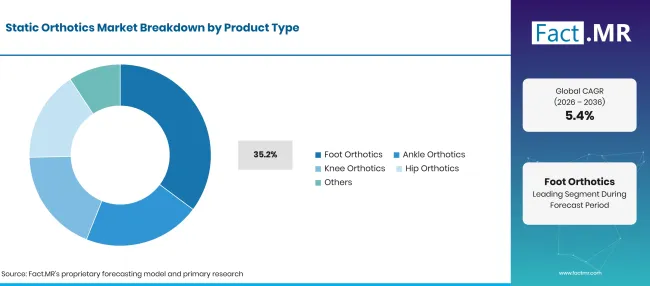
Static Orthotics Market Breakdown Product Type | Source: Fact.MR
| Product Type | Share (2026) |
|---|---|
| Foot Orthotics (Leading segment) | 35.2% |
| Other segments combined | 64.8% |
| Total | 100.0% |
Source: Fact.MR analysis. Updated Nov 3, 2026
Foot orthotics support positioning when clinicians need to restrict selected movement or protect tissue under load. Shape and contact points determine whether a patient can use the device comfortably for the intended period. Ankle orthotics can hold the joint at a prescribed angle during recovery. Knee products are selected for extension control or joint immobilization, while hip devices address more specialized positioning needs.
What leads the Application segment?
Pediatrics represents 40.3% of 2026 market value.
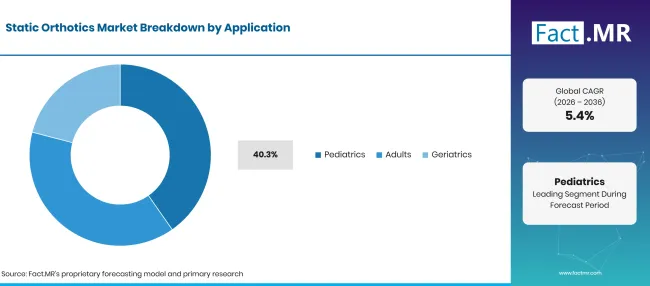
Static Orthotics Market Breakdown Application | Source: Fact.MR
| Application | Share (2026) |
|---|---|
| Pediatrics (Leading segment) | 40.3% |
| Other segments combined | 59.7% |
| Total | 100.0% |
Source: Fact.MR analysis. Updated Nov 3, 2026
Pediatric orthoses call for regular reassessment because growth changes limb dimensions and strap placement. Clinicians consider the need for safe positioning alongside the child’s ability to manage daily activities. Adults may use immobilizing braces after injury or surgery. Geriatric care places greater weight on skin condition and ease of application where dexterity is limited.
How does Material shape product selection?
Plastic captures 42.7% of 2026 market value.
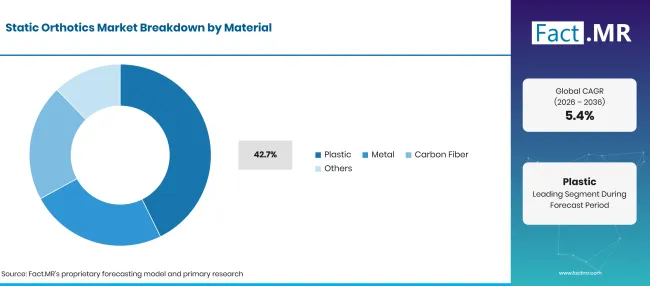
Static Orthotics Market Breakdown Material | Source: Fact.MR
| Material | Share (2026) |
|---|---|
| Plastic (Leading segment) | 42.7% |
| Other segments combined | 57.3% |
| Total | 100.0% |
Source: Fact.MR analysis. Updated Nov 3, 2026
Plastic shells can be molded to a patient’s shape and trimmed to improve contact around the limb. Their rigidity makes them useful in designs intended to limit movement. Metal elements are employed where hinges, uprights or added structural support are needed. Carbon fiber can offer a stiffer construction at lower weight in selected designs, although fabrication and replacement costs differ.
Which Distribution Channel leads?
Clinics lead with 32.4% of 2026 market value.
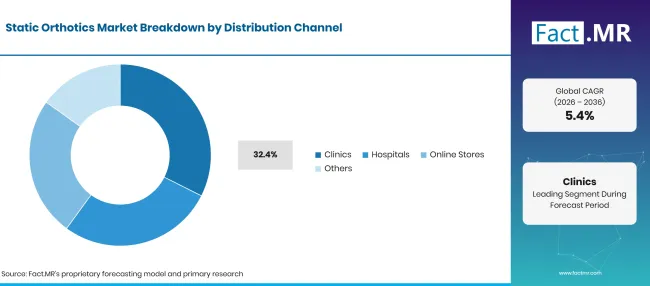
Static Orthotics Market Breakdown Distribution Channel | Source: Fact.MR
| Distribution Channel | Share (2026) |
|---|---|
| Clinics (Leading segment) | 32.4% |
| Other segments combined | 67.6% |
| Total | 100.0% |
Source: Fact.MR analysis. Updated Nov 3, 2026
Clinics handle assessment and repeated fitting, giving them a close connection to custom and specialist static devices. Hospitals often start immobilization during acute treatment and may refer patients for later adjustment. Online stores serve more standardized products, but remote purchase makes sizing and indication checks especially important.
What is accelerating Static Orthotics Market adoption, and what is holding it back?
Prescribed joint stabilization and access to specialist fitting underpin demand. Skin pressure, custom fabrication requirements and patient costs influence how quickly a suitable orthosis can be supplied.
Drivers Impact Analysis
| DRIVERS | (~) % IMPACT ON CAGR | GEOGRAPHIC RELEVANCE | IMPACT TIMELINE |
|---|---|---|---|
| Joint stabilization after injury | +0.9% | North America, Western Europe | Short term |
| Long-term neurological and mobility care | +0.7% | Western Europe, East Asia | Long term |
| Specialist orthotic assessment | +0.6% | North America, Western Europe | Medium term |
| Pediatric positioning requirements | +0.4% | Global | Medium term |
| Availability of standard and custom devices | +0.3% | Global | Medium term |
Source: Fact.MR analysis. Updated Nov 3, 2026
Opportunity Impact Analysis
| OPPORTUNITY | (~) % IMPACT ON CAGR | GEOGRAPHIC RELEVANCE | IMPACT TIMELINE |
|---|---|---|---|
| Better pressure relief and padding | +0.6% | Global | Medium term |
| Custom-molded pediatric shells | +0.4% | Western Europe, East Asia | Medium term |
| Clinic replenishment programs | +0.3% | North America, Europe | Short term |
| Clear fitting and care guidance | +0.2% | Global | Short term |
Source: Fact.MR analysis. Updated Nov 3, 2026
Restraints Impact Analysis
| RESTRAINTS | (~) % IMPACT ON CAGR | GEOGRAPHIC RELEVANCE | IMPACT TIMELINE |
|---|---|---|---|
| Fit and pressure intolerance | -0.7% | Global | Short term |
| Complex custom fabrication | -0.6% | Global | Medium term |
| Price and coverage limits | -0.4% | Latin America, Europe | Medium term |
| Incorrect self-selection | -0.3% | Online channels | Short term |
Source: Fact.MR analysis. Updated Nov 3, 2026
Which countries are scaling the Static Orthotics Market through 2036?
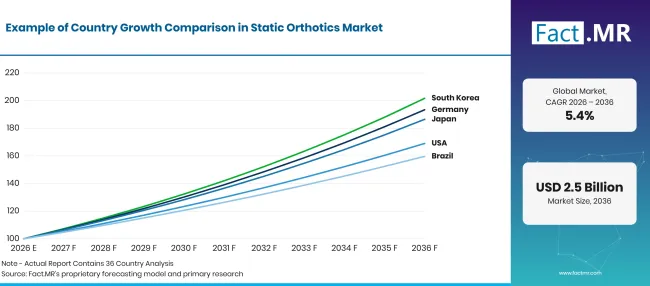
Static Orthotics Market Growth Index | Source: Fact.MR
| Country | CAGR (2026 to 2036) |
|---|---|
| Germany | 6.8% |
| Japan | 6.4% |
| USA | 5.4% |
| Brazil | 4.8% |
| UK | 4.1% |
Source: Fact.MR analysis. Updated Nov 3, 2026
What supports Germany adoption?
6.8% CAGR, reflecting specialist fitting services.
Germany’s static orthotics market reflects demand for prescribed joint positioning and the services needed to fit rigid devices. Destatis reported 7.8 million residents with recognized severe disabilities at the end of 2025 [2], although only some people in this group require orthotic support. Specialist teams assess limb shape and pressure areas before fitting a shell, then review comfort as treatment continues.
What supports Japan adoption?
6.4% CAGR, shaped by ageing and careful device fitting.
In Japan, clinicians consider static braces for patients who need defined ankle or knee positioning during care. In its September 14, 2025 release, Japan’s Statistics Bureau reported that people aged 65 or older accounted for 29.4% of the country’s population [4]. Older patients may need easy-to-manage fastening and support from caregivers when following a wear schedule.
What supports USA adoption?
5.4% CAGR, linked to specialist orthotic care.
In the USA, orthotists and clinics assess whether a patient needs a rigid brace and how it should be fitted. The Bureau of Labor Statistics recorded about 9,500 orthotist and prosthetist jobs in 2025 [1]. Changes in swelling, contact pressure and the patient’s mobility can require further adjustments after delivery.
What supports Brazil adoption?
4.8% CAGR, influenced by local access to fitting.
Brazil’s outlook depends partly on access to clinics that can measure, fit and adjust immobilizing devices. IBGE reported 14.4 million people aged two or older with a disability in the 2022 census [5], although that population includes many people without a need for static orthoses. Rehabilitation services may offer ready-sized braces for common indications and arrange custom shells for more complex needs.
What supports UK adoption?
4.1% CAGR, tied to clinical service capacity.
In the UK, hospitals and community orthotic services assess whether a patient needs fixed joint positioning and then arrange fitting and follow-up. The Department for Work and Pensions estimated that 16.7 million people, equivalent to 25% of the UK population, were disabled in the 2024 to 2025 financial year [3]. This survey-based population estimate covers disabilities broadly rather than the number of patients using static orthoses.
Who leads the Static Orthotics Market?
Suppliers in this market offer rigid supports, clinical braces and more specialized orthotic systems, but their products differ in intended use. Ottobock supplies lower-limb orthoses, while Enovis offers DonJoy and ProCare products.
Breg and DeRoyal serve clinical bracing applications, and Bauerfeind and Thuasne offer supports with different levels of rigidity. Fillauer supplies orthotic and prosthetic components, while AliMed carries clinical support products. Buyers need to check the indication of each product because a company’s broader brace range is not necessarily limited to static orthotics.
Which companies are the key providers?
Key companies include Ottobock SE & Co. KGaA; Enovis Corporation; Breg, Inc.; DeRoyal Industries, Inc.; Bauerfeind AG; Thuasne; Fillauer LLC; AliMed, LLC.
- Ottobock SE & Co. KGaA
- Enovis Corporation
- Breg, Inc.
- DeRoyal Industries, Inc.
- Bauerfeind AG
- Thuasne
- Fillauer LLC
- AliMed, LLC
Bibliography
- [1] U.S. Bureau of Labor Statistics. (2026, August 27). Orthotists and prosthetists. Occupational Outlook Handbook
- [2] Statistisches Bundesamt (Destatis). (2026, July 13). 7,8 Millionen schwerbehinderte Menschen leben in Deutschland
- [3] Department for Work and Pensions. (2026, March 26). Family Resources Survey: Financial year 2024 to 2025
- [4] Statistics Bureau of Japan. (2025, September 14).[Statistical Topics No. 146: Older persons in Japan]
- [5] Instituto Brasileiro de Geografia e Estatística. (2025, June 24). Censo 2022: 7,3% da população com 2 anos ou mais tinha alguma deficiência
- [6] World Health Organization. (2025, February 25). Public notice and comments on the Technical Advisory Group on the use of digital technologies to enhance access to assistive technology
This Report Answers
- The report distinguishes immobilizing foot, ankle, knee and hip products from flexible supports that permit substantial joint movement.
- Material analysis explains why molded plastic shells suit selected clinical indications and when metal or carbon fiber may be used.
- Channel analysis compares fitting through clinics and hospitals with more standardized products sold online.
- Country sections assess differing patient needs and orthotic-service conditions in Germany, Japan, the USA, Brazil and the UK.
- Competitive analysis reviews the stated companies by product relevance and clinical role without attributing unsupported market shares.
What does the Static Orthotics Market cover?
The market covers external orthotic devices designed to stabilize a foot or joint in a prescribed position. Included devices may be prefabricated or custom fitted. Revenue is assigned to the orthotic product rather than the entire rehabilitation service supplied with it.
What is included in the scope?
Rigid foot products and immobilizing ankle, knee and hip orthoses are included where their main purpose is to restrict movement.
Plastic shells with straps and structural components are counted when sold as complete devices. Clinical fitting is an important channel characteristic. Related products include foot and ankle devices.
What is excluded from the scope?
Flexible sleeves and elastic compression products are outside the primary static category when their purpose is movement support rather than immobilization.
Prosthetic limbs, internal orthopedic implants and general footwear are excluded. A brace combining rigid and flexible features is classified by its intended clinical function.
How Was the Analysis Built?
The analysis draws on 120+ sources, 35+ company portfolios, 25+ countries, and more than 20 industry interviews.
- Primary Research: Primary research includes discussions with manufacturers, service providers, technology developers, distributors, end users, and subject-matter experts. These conversations examine purchasing priorities, product adoption, operational challenges, approval requirements, competitive positioning, and the factors that influence wider market acceptance.
- Desk Research: Desk research covers government statistics, regulatory publications, company filings, trade data, technical studies, industry associations, standards, public policy, and other authoritative sources. Every source used in the analysis is documented in the bibliography.
- Market Sizing and Forecasting: Market estimates combine historical performance, demand indicators, pricing and volume trends, segment shares, company participation, country-level growth, adoption patterns, investment activity, and barriers to market expansion.
- Data Validation and Update Cycle: Findings are validated by comparing primary interviews with public data, company activity, regulatory changes, trade patterns, and industry developments. Regular updates review new product launches, capacity changes, partnerships, approvals, and shifts in commercial adoption.
Segmentation
What is the report’s scope and coverage?
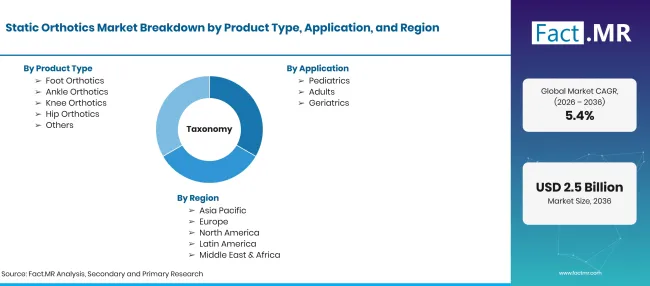
Static Orthotics Market Taxonomy | Source: Fact.MR
| Attribute | Details |
|---|---|
| Quantitative Units | USD billion |
| Market Definition | Rigid or positioning orthotic devices designed to restrict movement or hold a body segment at a prescribed angle. |
| Product Type | Foot Orthotics; Ankle Orthotics; Knee Orthotics; Hip Orthotics; Others |
| Application | Pediatrics; Adults; Geriatrics |
| Material | Plastic; Metal; Carbon Fiber; Others |
| Distribution Channel | Clinics; Hospitals; Online Stores; Others |
| Regions Covered | North America; Latin America; Western Europe; Eastern Europe; East Asia; South Asia & Pacific; Middle East & Africa |
| Countries Covered | Germany; Brazil; USA; UK; Japan |
| Companies Profiled | Ottobock SE & Co. KGaA; Enovis Corporation; Breg, Inc.; DeRoyal Industries, Inc.; Bauerfeind AG; Thuasne; Fillauer LLC; AliMed, LLC. |
| Forecast Period | 2026 to 2036 |
| Approach | Market-value forecast evaluated against device indication, care setting, material choices and country conditions. |
Source: Fact.MR analysis. Updated Nov 3, 2026
How is the market segmented?
-
By Product Type
- Foot Orthotics
- Ankle Orthotics
- Knee Orthotics
- Hip Orthotics
- Others
-
By Application
- Pediatrics
- Adults
- Geriatrics
-
By Material
- Plastic
- Metal
- Carbon Fiber
- Others
-
By Distribution Channel
- Clinics
- Hospitals
- Online Stores
- Others
-
By Region
- North America
- Latin America
- Western Europe
- Eastern Europe
- East Asia
- South Asia & Pacific
- Middle East & Africa
Frequently Asked Questions
How big is the Static Orthotics Market in 2026?
What is the CAGR of the Static Orthotics Market from 2026 to 2036?
Which product type leads the Static Orthotics Market?
Which application leads the Static Orthotics Market?
Who are the leading companies in the Static Orthotics Market?
Who worked on this report


Preview the report firsthand - request a free sample
Free SampleGet the brochure for pricing and purchase details
Download PDF