- Base Value(2026): 158.0 Mn
- Estimated Value(2026): 158.0 Mn
- Forecast Value (2036): 259.8 Mn
- CAGR (2026 - 2036): 5.1%
Static Spray Balls Market Forecast and Outlook 2026 to 2036
The global static spray balls market is expected to grow from USD 158 million in 2026 to around USD 259.8 million by 2036, reflecting a CAGR of 5.1%.
Key Takeaways from Static Spray Balls Market
- Static Spray Balls Market Value 2026: USD 158 million
- Static Spray Balls Market Forecast Value 2036: USD 259.8 million
- Static Spray Balls Market Forecast CAGR: 5.1%
- Leading Coverage Pattern Segment: 360° full coverage 53%
- Key Growth Regions: U.S., Japan, South Korea, Europe, China, Brazil
- Prominent Players: Alfa Laval, GEA, SPX FLOW, Tetra Pak, Lechler, Spraying Systems Co., Anderson-Negele, Dixon Sanitary, Scanjet Systems, Adamant Valves
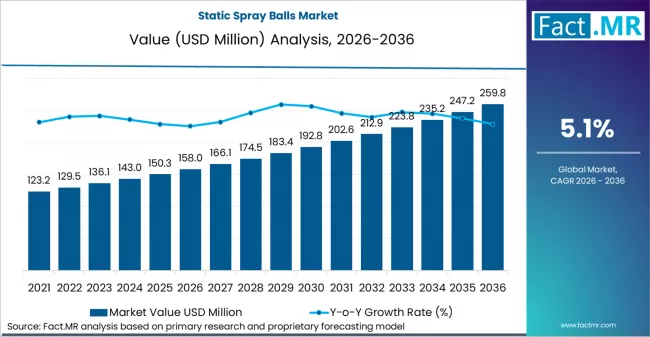
Static Spray Balls Market Market Value Analysis | Source: Fact.MR
360° full coverage spray balls dominate the coverage pattern segment, providing uniform cleaning and efficient sanitation across tanks and vessels. 180° hemispherical, 90° quarter, and directional jet designs are also applied depending on tank geometry and process requirements.
316L stainless steel leads the material segment due to its corrosion resistance, durability, and suitability for hygienic applications, while 304 stainless steel, PTFE, and Hastelloy or alloy options are used for specialized environments. Food and beverage applications account for the largest end-use segment, followed by pharma/biotech, breweries, and dairy industries. North America, particularly the U.S., is a primary growth region, with Japan, South Korea, Europe, China, U.K., and Brazil showing steady adoption. Suppliers focus on material integrity, consistent coverage, and compatibility with various connections to meet stringent hygiene standards.
Static Spray Balls Market
| Metric | Value |
|---|---|
| Estimated Value in (2026E) | USD 158.0 million |
| Forecast Value in (2036F) | USD 259.8 million |
| Forecast CAGR (2026 to 2036) | 5.1% |
Source: Fact.MR analysis. Updated Jan 27, 2026
Category
| Category | Segments |
|---|---|
| Coverage Pattern | 360° Full-Coverage Spray; 180° Hemispherical Coverage; 90° Quarter Coverage; Directional Jet Spray; Other |
| Material | 316L Stainless Steel; 304 Stainless Steel; PTFE; Hastelloy or Alloy Materials; Other |
| Connection | Threaded Connections; Weld-On Fittings; Clamp or Tri-Clamp Interfaces; Other |
| End Use | Food and Beverage Processing; Pharma or Biotech Facilities; Breweries; Dairy Processing; Other |
| Region | North America; Europe; Asia Pacific; Latin America; Middle East & Africa |
Source: Fact.MR analysis. Updated Jan 27, 2026
Segmental Analysis
By Coverage Pattern, Which Segment Holds the Dominant Share in the Static Spray Balls Market?
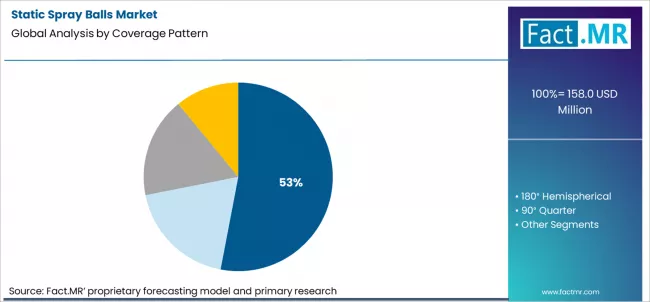
Static Spray Balls Market Analysis By Coverage Pattern | Source: Fact.MR
In terms of coverage pattern, 360° full coverage spray balls account for a 53.0% share, leading adoption within the static spray balls market. Processing facilities select full coverage designs to achieve uniform internal cleaning across tanks and vessels.
- Full coverage spray balls support consistent surface exposure during clean in place cycles.
- Broad spray distribution reduces residue buildup in enclosed processing equipment.
By Material, Which Segment Accounts for the Largest Share in the Static Spray Balls Market?
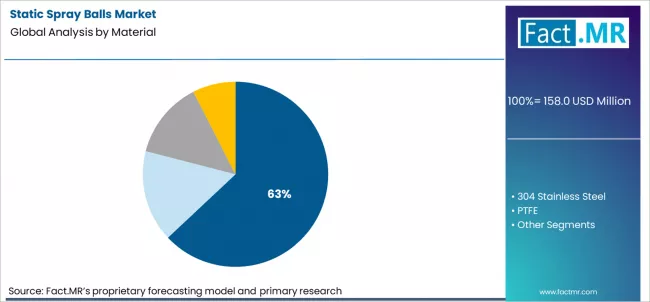
Static Spray Balls Market Analysis By Material | Source: Fact.MR
316L stainless steel represents a 63.0% share, establishing it as the most widely used material in static spray ball manufacturing. Corrosion resistance and hygienic properties drive material preference across sanitary applications.
- 316L stainless steel supports repeated exposure to aggressive cleaning agents.
- Material durability aligns with long service intervals in regulated processing environments.
By Connection, Which Segment Leads Demand in the Static Spray Balls Market?
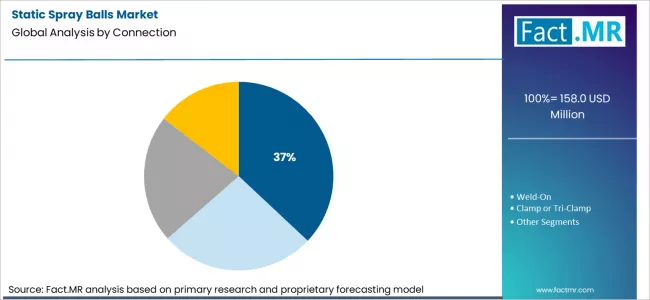
Static Spray Balls Market Analysis By Connection | Source: Fact.MR
Threaded connections hold a 37.0% share, making them the most common connection type. Ease of installation and compatibility with standard fittings support widespread use.
- Threaded spray balls allow straightforward integration into existing piping systems.
- Adoption reflects maintenance simplicity and replacement efficiency.
By End Use, Which Segment Maintains the Highest Share in the Static Spray Balls Market?
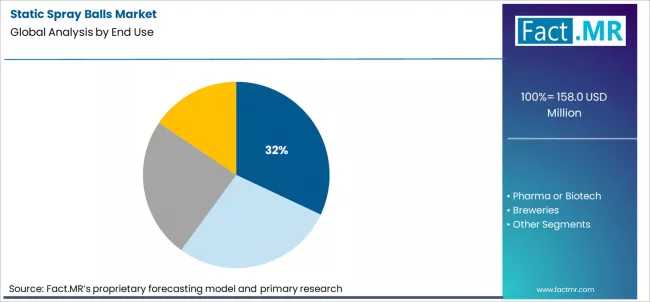
Static Spray Balls Market Analysis By End Use | Source: Fact.MR
Food and beverage applications account for a 32.0% share, positioning this sector as the leading end use segment. High hygiene standards and frequent cleaning cycles drive consistent demand.
- Static spray balls support sanitation requirements across tanks, mixers, and storage vessels.
- Usage concentration reflects strict cleaning protocols within food processing operations.
What are the Drivers, Restraints, and Key Trends of the Static Spray Balls Market?
- Drivers: Food, beverage, dairy, and pharma processors rely on static spray balls to deliver consistent tank cleaning without moving parts, driving demand for solutions that ensure hygiene compliance, repeatable wash coverage, and low maintenance operation in CIP systems.
- Restraint: Cleaning effectiveness depends heavily on correct spray pattern selection, flow rate, and tank geometry, and mismatched designs can lead to shadow areas or higher water and chemical consumption, limiting performance in complex vessels.
- Trend 1: 360° full coverage spray balls made from 316L stainless steel are increasingly specified for sanitary applications as operators prioritize corrosion resistance, cleanability, and compatibility with aggressive cleaning agents.
- Trend 2: Clamp and tri clamp connections are gaining wider adoption, particularly in food and pharma plants, as they simplify installation, inspection, and replacement while supporting faster changeovers and validated cleaning processes.
Analysis of the Static Spray Balls Market by Key Country
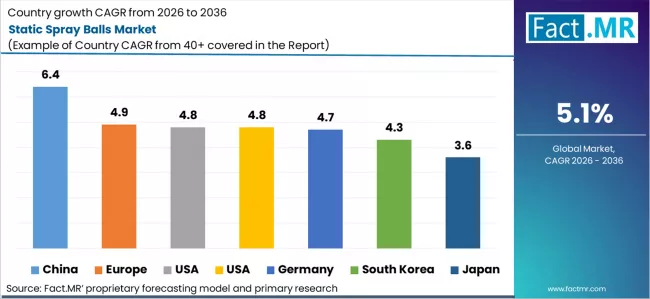
Static Spray Balls Market Cagr Analysis By Country | Source: Fact.MR
| Country | CAGR |
|---|---|
| China | 6.4% |
| Brazil | 6.0% |
| Europe | 4.9% |
| U.S. | 4.8% |
| U.K. | 4.8% |
| Germany | 4.7% |
| South Korea | 4.3% |
| Japan | 3.6% |
Source: Fact.MR analysis. Updated Jan 27, 2026
The report covers an in depth analysis of 8 countries; higher growth markets are highlighted below.
What Is Driving Growth of Static Spray Balls in China?
China records the strongest growth at 6.4%, supported by capacity additions in food processing, pharmaceuticals, and chemical manufacturing. Static spray balls are widely installed in tanks and vessels requiring consistent internal cleaning. Demand is shaped by emphasis on hygienic design, stainless steel construction, and compatibility with automated CIP systems.
- Expansion of hygienic processing facilities supports steady demand.
- CIP system integration drives adoption of full coverage spray designs.
How Is Brazil Emerging as a High-Growth Market for Static Spray Balls?
Brazil is projected to grow at 6.0%, driven by rising investment in food, beverage, and dairy processing plants. Static spray balls are used to ensure reliable cleaning of storage tanks and mixers. Purchasing decisions focus on corrosion resistance, simple installation, and suitability for varied cleaning cycles.
- Growth in food and dairy processing supports equipment uptake.
- Material durability influences product selection.
What Is Supporting Market Expansion Across Europe?
Europe is expected to expand at 4.9%, supported by strict hygiene standards in food, beverage, and brewery operations. Static spray balls with defined coverage patterns are selected to ensure repeatable cleaning performance. Buyers emphasize stainless steel grades, sanitary connections, and compliance with industry norms.
- Regulatory hygiene requirements sustain consistent demand.
- Standardized sanitary designs support broad adoption.
What Defines Market Conditions in the U.S.?
The U.S. market is forecast to grow at 4.8%, shaped by steady use of clean in place systems across food, beverage, and biotech facilities. Static spray balls are favored for their reliability and low maintenance. Replacement demand contributes to ongoing market activity.
- CIP based operations sustain baseline demand.
- Replacement cycles support steady purchasing.
How Is the U.K. Positioned in the Static Spray Balls Market?
The U.K. is projected to grow at 4.8%, driven by brewery modernization and pharmaceutical production. Static spray balls are selected to meet sanitation requirements while maintaining simple system design. Buyers focus on ease of integration with existing vessels and piping layouts.
- Brewery upgrades support cleaning equipment demand.
- Integration flexibility influences buying decisions.
What Role Does Germany Play in Market Development?
Germany is expected to grow at 4.7%, reflecting strong emphasis on process reliability and hygienic engineering. Static spray balls are widely used in dairy and high purity processing. Demand aligns with equipment upgrades and investment in efficient cleaning systems.
- Precision engineering standards support product adoption.
- Equipment modernization sustains market activity.
How Is South Korea Contributing to Market Growth?
South Korea is forecast to grow at 4.3%, driven by pharmaceutical and biotech manufacturing expansion. Static spray balls are used where controlled and repeatable cleaning is required. Buyers prioritize material quality and compatibility with validated cleaning protocols.
- Biotech manufacturing growth supports demand.
- Validation requirements influence equipment choice.
What Factors Shape Market Development in Japan?
Japan is expected to register a CAGR of 3.6%, reflecting mature food and pharmaceutical processing sectors. Static spray balls remain in service over long operating cycles due to durable construction. Demand remains steady as facilities focus on optimization rather than capacity expansion.
- Mature processing infrastructure sustains baseline demand.
- Long service life limits rapid market expansion.
Competitive Landscape of the Static Spray Balls Market
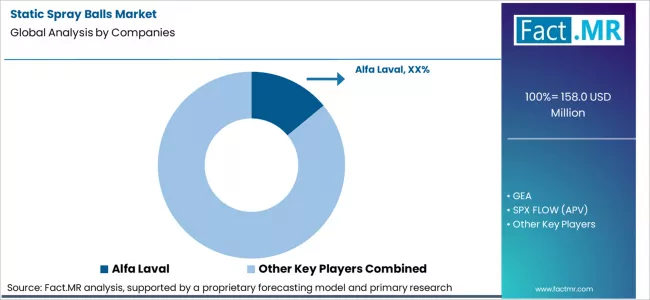
Static Spray Balls Market Analysis By Company | Source: Fact.MR
The static spray balls market supports cleaning-in-place systems where consistent, repeatable internal cleaning is required without moving parts. These devices are widely installed in tanks, vessels, and reactors across food and beverage, dairy, breweries, pharmaceuticals, and biotech processing lines. Buyers focus on reliable coverage, hygienic design, low maintenance, and predictable performance under varying flow and pressure conditions. Competition in this market is shaped by spray coverage efficiency, material compatibility, and compliance with sanitary standards.
Manufacturers differentiate through coverage patterns such as full 360° distribution for complete vessel cleaning, hemispherical and quarter-spray designs for targeted zones, and directional jets for specific residue challenges. Material choice plays a central role, with 316L stainless steel preferred for hygienic and corrosive environments, while PTFE and specialty alloys are used for aggressive media or high-purity processes. Connection options including threaded, weld-on, and clamp fittings allow integration into both new installations and retrofit projects. Suppliers that offer validated spray performance and easy cleanability gain strong preference among regulated industries.
Market players include Alfa Laval, GEA, SPX FLOW, Tetra Pak, Lechler, Spraying Systems Co., Anderson-Negele, Dixon Sanitary, Scanjet Systems, and Adamant Valves, supplying static spray balls tailored for hygienic, industrial, and high-purity cleaning applications.
Key Players in the Static Spray Balls Market
- Alfa Laval
- GEA
- SPX FLOW
- Tetra Pak
- Lechler
- Spraying Systems Co.
- Anderson-Negele
- Dixon Sanitary
- Scanjet Systems
- Adamant Valves
Bibliography
- European Hygienic Engineering and Design Group. (2024). Hygienic design principles for clean in place systems and tank cleaning devices. Frankfurt, Germany.
- International Society for Pharmaceutical Engineering. (2024). Clean in place equipment selection and spray device performance in hygienic manufacturing. Tampa, FL.
- U.S. Food and Drug Administration. (2024). Equipment cleaning and sanitation requirements for food and pharmaceutical processing facilities. Silver Spring, MD.
- National Institute of Standards and Technology. (2025). Corrosion resistance and surface finish behavior of 316L stainless steel in sanitary process environments. Gaithersburg, MD.
- World Health Organization. (2024). Hygiene and sanitation standards for processing equipment used in food and pharmaceutical production. Geneva, Switzerland.
Segmentation
Scope of the Report
| Items | Values |
|---|---|
| Quantitative Units 2026 | USD 158 Million |
| Coverage Pattern | 360° full coverage spray balls, 180° hemispherical coverage, 90° quarter coverage, Directional jet spray balls |
| Material | 316L stainless steel, 304 stainless steel, PTFE, Hastelloy or alloy materials |
| Connection | Threaded connections, Weld-on connections, Clamp or tri-clamp connections |
| End Use | Food and beverage processing, Pharma or biotech manufacturing, Breweries, Dairy processing |
| Regions Covered | North America, Europe, Asia Pacific, Latin America, Middle East & Africa |
| Countries Covered | U.S., Japan, South Korea, Germany, China, U.K., Brazil |
| Key Companies Profiled | Alfa Laval, GEA, SPX FLOW, Tetra Pak, Lechler, Spraying Systems Co., Anderson-Negele, Dixon Sanitary, Scanjet Systems, Adamant Valves |
| Additional Attributes | Dollar revenue by static spray ball coverage pattern, material, connection type, and end use; regional demand trends; hygiene and clean-in-place compliance requirements; adoption in sanitary processing industries; emphasis on corrosion resistance and cleanability; replacement demand driven by plant upgrades and regulatory standards |
Source: Fact.MR analysis. Updated Jan 27, 2026
Static Spray Balls Market Segments
-
Coverage Pattern:
- 360 Degree Full Coverage
- 180 Degree Hemispherical
- 90 Degree Quarter
- Directional Jet
-
Material:
- 316L Stainless Steel
- 304 Stainless Steel
- PTFE
- Hastelloy or Alloy
-
Connection:
- Threaded
- Weld On
- Clamp or Tri Clamp
- Other
-
End Use:
- Food and Beverage
- Pharma or Biotech
- Breweries
- Dairy
-
Region:
- North America
- U.S.
- Canada
- Mexico
- Europe
- Germany
- Italy
- UK
- France
- Spain
- Netherlands
- Switzerland
- Rest of Europe
- Asia Pacific
- Japan
- Australia
- South Korea
- China
- India
- Rest of Asia Pacific
- Latin America
- Brazil
- Argentina
- Rest of Latin America
- Middle East and Africa
- United Arab Emirates
- South Africa
- Rest of Middle East and Africa
- North America
Frequently Asked Questions
How big is the static spray balls market in 2026?
What will be the size of static spray balls market in 2036?
How much will be the static spray balls market growth between 2026 and 2036?
What are the key product types in the static spray balls market?
Which material segment to contribute significant share in the static spray balls market in 2026?
Who worked on this report


Preview the report firsthand - request a free sample
Free SampleGet the brochure for pricing and purchase details
Download PDF