Steroid Measurement Reagents Market
Steroid Measurement Reagents Market Size and Share Forecast Outlook 2026 to 2036
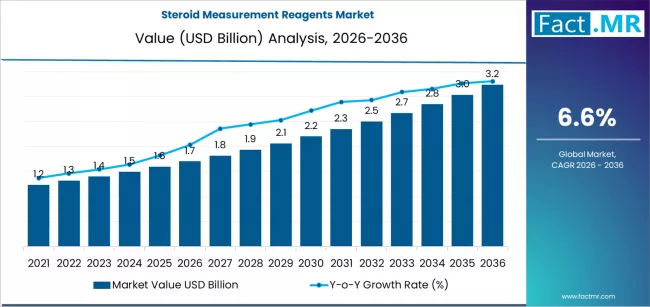
Steroid measurement reagents market is projected to grow from USD 1.7 billion in 2026 to USD 3.2 billion by 2036, at a CAGR of 6.6%. Cortisol assay reagents will dominate with a 17.1% market share, while endocrine disorder diagnosis will lead the application segment with a 26.6% share.
Steroid Measurement Reagents Market Forecast and Outlook 2026 to 2036
The global steroid measurement reagents market is projected to total USD 1.70 billion in 2026, advancing to USD 3.24 billion by 2036, progressing at a 6.6% CAGR. This growth is driven by the essential role of steroid hormone testing in diagnosing and managing a wide spectrum of conditions, from endocrine disorders to fertility issues and hormone-dependent cancers. Cortisol assay reagents lead the product segment, underpinning critical adrenal function assessments.
Key Takeaways from the Steroid Measurement Reagents Market
- Market Value for 2026: USD 1.70 Billion
- Market Value for 2036: USD 3.24 Billion
- Forecast CAGR 2026 to 2036: 6.6%
- Leading Reagents Segment (2026): Cortisol Assay Reagents (17.1%)
- Leading Application Segment (2026): Endocrine Disorder Diagnosis (26.6%)
- Leading End User Segment (2026): Hospital Laboratories (24.7%)
- Key Growth Countries: India (9.4% CAGR), Brazil (8.9% CAGR), China (8.5% CAGR), USA (5.6% CAGR), UK (5.5% CAGR), Germany (5.4% CAGR), France (5.3% CAGR)
- Key Players: F. Hoffmann-La Roche Ltd, Abbott Laboratories, Siemens Healthineers, Beckman Coulter Inc., DiaSorin S.p.A.
Endocrine disorder diagnosis remains the dominant application, reflecting the high prevalence of conditions like Cushing's syndrome and adrenal insufficiency. Hospital laboratories constitute the primary end-user, performing a significant volume of routine diagnostic tests.
Accelerated growth in India, Brazil, and China is linked to improving diagnostic infrastructure and rising awareness of hormonal health. The market is further shaped by the ongoing technological evolution from traditional immunoassays toward more specific liquid chromatography-mass spectrometry panels.
Steroid Measurement Reagents Market
| Metric | Value |
|---|---|
| Market Value (2026) | USD 1.70 Billion |
| Market Forecast Value (2036) | USD 3.24 Billion |
| Forecast CAGR 2026 to 2036 | 6.6% |
Category
| Category | Segments |
|---|---|
| Reagents | Cortisol Assay Reagents, Testosterone Assay Reagents, Estradiol Assay Reagents, Progesterone Assay Reagents, LC-MS/MS Steroid Panels, Calibrators & Sample Prep Reagents |
| Application | Endocrine Disorder Diagnosis, Fertility & IVF Monitoring, Adrenal Disorder Workups, Pediatric Endocrinology, Hormone-Dependent Oncology |
| End User | Hospital Laboratories, Reference Laboratories, Fertility Clinics, Endocrinology Clinics, Academic & Research Labs |
| Region | North America, Latin America, Western Europe, Eastern Europe, East Asia, South Asia & Pacific, Middle East & Africa |
Which Clinical and Technological Trends are Reshaping Hormone Testing?
| Trend | Impact |
|---|---|
| Expansion of LC-MS/MS in Routine Labs | Increases demand for specific reagent kits and calibrators for multi-analyte steroid panels, moving beyond immunoassays for complex cases. |
| Growing Focus on Hormonal Health & Wellness | Drives higher testing volumes for testosterone, cortisol, and estrogen in general practice, beyond traditional disease diagnosis. |
| Personalization of Fertility & Oncology Care | Elevates the need for precise, serial hormone measurements to tailor treatment protocols in IVF and certain cancer therapies. |
| Automation & Throughput Demands | Favors reagent formulations compatible with high-volume, automated clinical chemistry and immunoassay platforms in core hospital labs. |
Segmental Analysis
By Reagents, Which Hormone Test Serves as a Cornerstone of Stress and Adrenal Assessment?
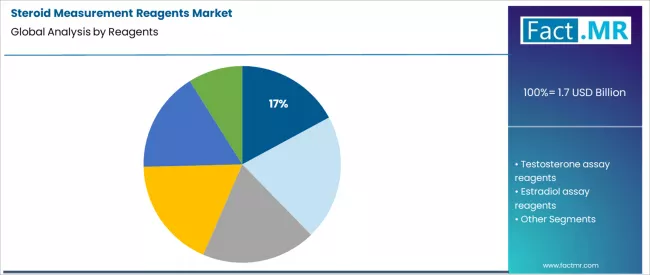
Cortisol assay reagents command a leading 17.1% share. This segment’s significance stems from cortisol’s role as a primary stress hormone and a key diagnostic marker for adrenal disorders like Addison’s disease and Cushing’s syndrome.
Testing is routine in hospital settings for both diagnosis and dynamic function tests. The critical nature of these assessments for patient management ensures consistent, high-volume consumption of reliable cortisol immunoassays and associated calibrators.
By Application, Where is Testing Most Integral to Initial Diagnostic Pathways?
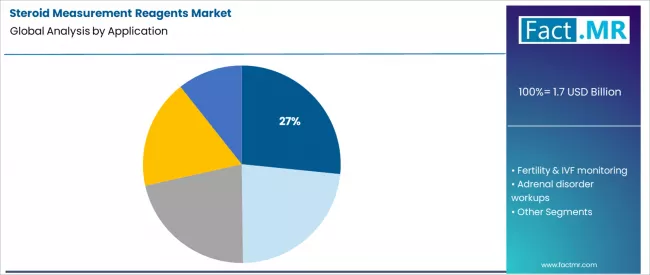
Endocrine disorder diagnosis constitutes the primary application segment at 26.6%. This encompasses a broad range of conditions affecting the adrenal, pituitary, and gonadal axes. Accurate steroid measurement is often the first objective step in evaluating symptoms like fatigue, weight change, or hormonal imbalance. The high prevalence of such disorders and the necessity for biochemical confirmation before imaging secure this application’s dominant position in driving reagent demand.
By End User, Where is the Bulk of Routine Diagnostic Testing Performed?
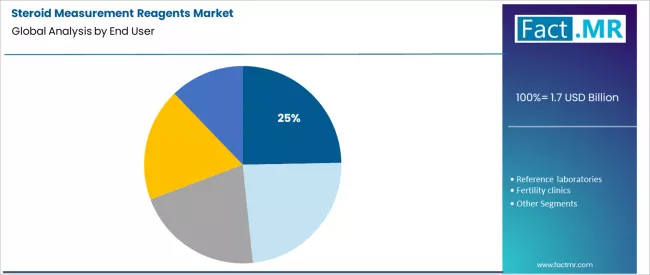
Hospital laboratories hold a leading 24.7% share. These facilities serve as the frontline for diagnostic workups, receiving samples from emergency departments, inpatient wards, and outpatient clinics.
The requirement for rapid, reliable results to guide immediate clinical decisions supports significant consumption of reagents for high-throughput automated platforms. Their central role in the diagnostic workflow makes them the largest volume-based consumers.
Navigating the Competitive Matrix: What Strategies define the Steroid Measurement Reagents Market’s Trajectory?
Expanding clinical understanding of steroid hormones' role in chronic disease, metabolic health, and aging is broadening testing indications beyond classic endocrinology, steadily increasing test volumes. A challenge is the analytical interference and specificity limitations of some immunoassays, particularly for steroids like estradiol and testosterone, which can compromise result accuracy and drive the need for more costly confirmatory methods.
Significant potential lies in developing highly specific, cost-effective mass spectrometry-based reagent kits that can be adopted by mid-tier laboratories, bridging the gap between high-complexity reference labs and routine immunoassay platforms. The market is concurrently witnessing a strategic shift towards offering integrated test menus that combine steroids with other related biomarkers, providing clinicians with more comprehensive diagnostic profiles.
Analysis of the Steroid Measurement Reagents Market by Key Countries
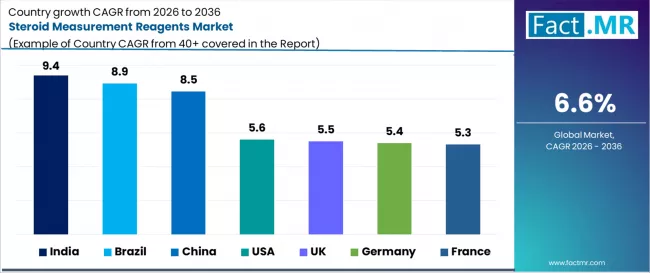
| Country | CAGR 2026 to 2036 |
|---|---|
| USA | 5.6% |
| Germany | 5.4% |
| China | 8.5% |
| India | 9.4% |
| Brazil | 8.9% |
| France | 5.3% |
| UK | 5.5% |
How does the USA's Integrated Healthcare System Influence Testing Volumes?
A 5.6% CAGR reflects a mature market where testing is integrated into standard care pathways for endocrinology, fertility, and oncology. Demand is sustained by high awareness, comprehensive insurance coverage for diagnostic tests, and a significant number of specialized reference laboratories utilizing advanced LC-MS/MS methods alongside routine immunoassays.
What Drives Demand within Germany's Precision-Focused Diagnostic Framework?
Germany's 5.4% CAGR is characterized by a strong emphasis on assay precision and adherence to rigorous quality standards (RiliBÄK). This environment supports the use of well-validated reagent kits from major diagnostics firms. Demand is steady, driven by a structured approach to endocrine diagnosis and a robust network of hospital and independent laboratories.
Which Factors Underpin China's High-Growth Diagnostic Expansion?
China's 8.5% CAGR is fueled by massive healthcare infrastructure development, including the modernization of hospital laboratories. Rising middle-class demand for advanced healthcare services, including fertility treatment and comprehensive health check-ups, is significantly increasing the volume of hormone tests performed, driving reagent consumption.
Why is India's Market Growth Exceptionally Linked to Sectoral Expansion?
India's leading 9.4% CAGR is propelled by the parallel expansion of its private hospital sector and a rapidly growing fertility clinic industry. Increasing diagnosis of lifestyle-related endocrine disorders and greater investment in laboratory automation are creating substantial new demand for standardized, reliable steroid assay reagents.
How is Brazil's Healthcare Modernization Reflected in Market Development?
Brazil's 8.9% CAGR is connected to the ongoing improvement of diagnostic services in both major private hospital networks and public health initiatives. Growing clinical focus on metabolic and endocrine health is increasing test utilization. Market growth is concentrated in urban centers where laboratory capabilities are advancing most rapidly.
What Characterizes France's Hospital-Centric Diagnostic Model?
France's 5.3% CAGR benefits from a hospital-led healthcare system where most complex testing is centralized. This promotes standardized procurement and use of reagent kits across regional hospital networks. Stable demand is driven by established clinical protocols for endocrinology and gynecology within the national health insurance framework.
How does the UK's Commissioned Pathology Services Shape the Market?
The UK’s 5.5% CAGR operates within an NHS system where pathology services are increasingly consolidated into hub laboratories. This drives volume-based, competitive tendering for reagent supplies. Adoption is influenced by cost-effectiveness and the ability to meet service-level agreements for test turnaround times and quality.
Competitive Landscape of the Steroid Measurement Reagents Market
The competitive landscape is consolidated among major global in-vitro diagnostics corporations that supply reagents for high-throughput automated immunoassay platforms. These players compete on menu breadth, assay performance, and seamless integration with their installed instrument bases.
Competition also extends to the high-complexity testing segment, where specialty companies and broader analytical instrument vendors provide solutions for mass spectrometry-based steroid profiling.
What Key Strategies Can Secure a Competitive Edge in this Market?
| Strategic Imperative | Impact |
|---|---|
| Technological Differentiation | Investing in novel antibody development for immunoassays to reduce cross-reactivity and improve accuracy, or creating simplified, robust LC-MS/MS reagent kits for broader lab adoption. |
| Menu Expansion & Bundling | Developing and marketing comprehensive steroid profiles or bundling steroid tests with related biomarkers (e.g., Vitamin D, SHBG) to provide more valuable clinical insights. |
| Targeted End-User Engagement | Creating specialized reagent portfolios and support programs for high-growth segments like fertility clinics and endocrinology centers, which have distinct testing needs. |
| Strategic Partnerships & Acquisitions | Forming alliances with academic centers to validate new biomarkers or acquiring niche players with proprietary mass spectrometry methods to quickly access advanced market segments. |
Key Players in the Steroid Measurement Reagents Market
- F. Hoffmann-La Roche Ltd
- Abbott Laboratories
- Siemens Healthineers
- Beckman Coulter Inc.
- DiaSorin S.p.A.
- Others
Scope of Report
| Items | Metrics |
|---|---|
| Quantitative Units | USD Billion |
| Reagents | Cortisol, Testosterone, Estradiol, Progesterone Assay Reagents, LC-MS/MS Panels, Calibrators |
| Application | Endocrine Disorder Diagnosis, Fertility & IVF, Adrenal Workups, Pediatric Endocrinology, Oncology |
| End User | Hospital Labs, Reference Labs, Fertility Clinics, Endocrinology Clinics, Academic & Research Labs |
| Key Countries | India, Brazil, China, USA, UK, Germany, France |
| Key Companies | F. Hoffmann-La Roche Ltd, Abbott Laboratories, Siemens Healthineers, Beckman Coulter Inc., DiaSorin S.p.A. |
| Additional Analysis | Comparative analytical performance of immunoassays vs. LC-MS/MS for specific steroids; impact of direct-to-consumer hormone testing on clinical lab volumes; review of standardization initiatives for steroid assays; analysis of reagent stability and shelf-life demands in varying laboratory environments. |
Market by Segments
-
Reagents :
- Cortisol Assay Reagents
- Testosterone Assay Reagents
- Estradiol Assay Reagents
- Progesterone Assay Reagents
- LC-MS/MS Steroid Panels
- Calibrators & Sample Prep Reagents
-
Application :
- Endocrine Disorder Diagnosis
- Fertility & IVF Monitoring
- Adrenal Disorder Workups
- Pediatric Endocrinology
- Hormone-Dependent Oncology
-
End User :
- Hospital Laboratories
- Reference Laboratories
- Fertility Clinics
- Endocrinology Clinics
- Academic & Research Labs
-
Region :
- North America
- USA
- Canada
- Latin America
- Brazil
- Mexico
- Argentina
- Rest of Latin America
- Western Europe
- Germany
- France
- UK
- Italy
- Spain
- BENELUX
- Rest of Western Europe
- Eastern Europe
- Poland
- Russia
- Czech Republic
- Rest of Eastern Europe
- East Asia
- China
- Japan
- South Korea
- Rest of East Asia
- South Asia & Pacific
- India
- ASEAN
- Australia & New Zealand
- Rest of South Asia & Pacific
- Middle East & Africa
- GCC Countries
- South Africa
- Turkiye
- Rest of MEA
- North America
References
- Endocrine Society. (2025). Clinical Practice Guidelines for the Diagnosis and Treatment of Adrenal Incidentaloma.
- Handelsman, D. J., & Wartofsky, L. (2023). Requirement for mass spectrometry sex steroid assays in the Journal of Clinical Endocrinology and Metabolism. The Journal of Clinical Endocrinology & Metabolism.
- Rosner, W., & Auchus, R. J. (2024). Challenges to the measurement of estradiol: an endocrine society position statement. Journal of Clinical Endocrinology & Metabolism.
- U.S. Food and Drug Administration. (2024). Class II Special Controls Guidance Document: Steroid Hormone Testing Systems.
- Wheeler, M. J., & Fiers, T. (2025). The Role of Liquid Chromatography-Tandem Mass Spectrometry in the Clinical Endocrinology Laboratory. Clinical Chemistry.
- World Health Organization. (2024). Laboratory Manual for the Examination and Processing of Human Semen.
Table of Content
- Executive Summary
- Global Market Outlook
- Demand to side Trends
- Supply to side Trends
- Technology Roadmap Analysis
- Analysis and Recommendations
- Market Overview
- Market Coverage / Taxonomy
- Market Definition / Scope / Limitations
- Market Background
- Market Dynamics
- Drivers
- Restraints
- Opportunity
- Trends
- Scenario Forecast
- Demand in Optimistic Scenario
- Demand in Likely Scenario
- Demand in Conservative Scenario
- Opportunity Map Analysis
- Product Life Cycle Analysis
- Supply Chain Analysis
- Investment Feasibility Matrix
- Value Chain Analysis
- PESTLE and Porter’s Analysis
- Regulatory Landscape
- Regional Parent Market Outlook
- Production and Consumption Statistics
- Import and Export Statistics
- Market Dynamics
- Global Market Analysis 2021 to 2025 and Forecast, 2026 to 2036
- Historical Market Size Value (USD Million) Analysis, 2021 to 2025
- Current and Future Market Size Value (USD Million) Projections, 2026 to 2036
- Y to o to Y Growth Trend Analysis
- Absolute $ Opportunity Analysis
- Global Market Pricing Analysis 2021 to 2025 and Forecast 2026 to 2036
- Global Market Analysis 2021 to 2025 and Forecast 2026 to 2036, By Reagents
- Introduction / Key Findings
- Historical Market Size Value (USD Million) Analysis By Reagents, 2021 to 2025
- Current and Future Market Size Value (USD Million) Analysis and Forecast By Reagents, 2026 to 2036
- Cortisol assay reagents
- Testosterone assay reagents
- Estradiol assay reagents
- Progesterone assay reagents
- LC-MS/MS steroid panels
- Calibrators & sample prep reagents
- Cortisol assay reagents
- Y to o to Y Growth Trend Analysis By Reagents, 2021 to 2025
- Absolute $ Opportunity Analysis By Reagents, 2026 to 2036
- Global Market Analysis 2021 to 2025 and Forecast 2026 to 2036, By Application
- Introduction / Key Findings
- Historical Market Size Value (USD Million) Analysis By Application, 2021 to 2025
- Current and Future Market Size Value (USD Million) Analysis and Forecast By Application, 2026 to 2036
- Endocrine disorder diagnosis
- Fertility & IVF monitoring
- Adrenal disorder workups
- Pediatric endocrinology
- Hormone-dependent oncology
- Endocrine disorder diagnosis
- Y to o to Y Growth Trend Analysis By Application, 2021 to 2025
- Absolute $ Opportunity Analysis By Application, 2026 to 2036
- Global Market Analysis 2021 to 2025 and Forecast 2026 to 2036, By End User
- Introduction / Key Findings
- Historical Market Size Value (USD Million) Analysis By End User, 2021 to 2025
- Current and Future Market Size Value (USD Million) Analysis and Forecast By End User, 2026 to 2036
- Hospital laboratories
- Reference laboratories
- Fertility clinics
- Endocrinology clinics
- Academic & research labs
- Hospital laboratories
- Y to o to Y Growth Trend Analysis By End User, 2021 to 2025
- Absolute $ Opportunity Analysis By End User, 2026 to 2036
- Global Market Analysis 2021 to 2025 and Forecast 2026 to 2036, By Region
- Introduction
- Historical Market Size Value (USD Million) Analysis By Region, 2021 to 2025
- Current Market Size Value (USD Million) Analysis and Forecast By Region, 2026 to 2036
- North America
- Latin America
- Western Europe
- Eastern Europe
- East Asia
- South Asia and Pacific
- Middle East & Africa
- Market Attractiveness Analysis By Region
- North America Market Analysis 2021 to 2025 and Forecast 2026 to 2036, By Country
- Historical Market Size Value (USD Million) Trend Analysis By Market Taxonomy, 2021 to 2025
- Market Size Value (USD Million) Forecast By Market Taxonomy, 2026 to 2036
- By Country
- USA
- Canada
- Mexico
- By Reagents
- By Application
- By End User
- By Country
- Market Attractiveness Analysis
- By Country
- By Reagents
- By Application
- By End User
- Key Takeaways
- Latin America Market Analysis 2021 to 2025 and Forecast 2026 to 2036, By Country
- Historical Market Size Value (USD Million) Trend Analysis By Market Taxonomy, 2021 to 2025
- Market Size Value (USD Million) Forecast By Market Taxonomy, 2026 to 2036
- By Country
- Brazil
- Chile
- Rest of Latin America
- By Reagents
- By Application
- By End User
- By Country
- Market Attractiveness Analysis
- By Country
- By Reagents
- By Application
- By End User
- Key Takeaways
- Western Europe Market Analysis 2021 to 2025 and Forecast 2026 to 2036, By Country
- Historical Market Size Value (USD Million) Trend Analysis By Market Taxonomy, 2021 to 2025
- Market Size Value (USD Million) Forecast By Market Taxonomy, 2026 to 2036
- By Country
- Germany
- UK
- Italy
- Spain
- France
- Nordic
- BENELUX
- Rest of Western Europe
- By Reagents
- By Application
- By End User
- By Country
- Market Attractiveness Analysis
- By Country
- By Reagents
- By Application
- By End User
- Key Takeaways
- Eastern Europe Market Analysis 2021 to 2025 and Forecast 2026 to 2036, By Country
- Historical Market Size Value (USD Million) Trend Analysis By Market Taxonomy, 2021 to 2025
- Market Size Value (USD Million) Forecast By Market Taxonomy, 2026 to 2036
- By Country
- Russia
- Poland
- Hungary
- Balkan & Baltic
- Rest of Eastern Europe
- By Reagents
- By Application
- By End User
- By Country
- Market Attractiveness Analysis
- By Country
- By Reagents
- By Application
- By End User
- Key Takeaways
- East Asia Market Analysis 2021 to 2025 and Forecast 2026 to 2036, By Country
- Historical Market Size Value (USD Million) Trend Analysis By Market Taxonomy, 2021 to 2025
- Market Size Value (USD Million) Forecast By Market Taxonomy, 2026 to 2036
- By Country
- China
- Japan
- South Korea
- By Reagents
- By Application
- By End User
- By Country
- Market Attractiveness Analysis
- By Country
- By Reagents
- By Application
- By End User
- Key Takeaways
- South Asia and Pacific Market Analysis 2021 to 2025 and Forecast 2026 to 2036, By Country
- Historical Market Size Value (USD Million) Trend Analysis By Market Taxonomy, 2021 to 2025
- Market Size Value (USD Million) Forecast By Market Taxonomy, 2026 to 2036
- By Country
- India
- ASEAN
- Australia & New Zealand
- Rest of South Asia and Pacific
- By Reagents
- By Application
- By End User
- By Country
- Market Attractiveness Analysis
- By Country
- By Reagents
- By Application
- By End User
- Key Takeaways
- Middle East & Africa Market Analysis 2021 to 2025 and Forecast 2026 to 2036, By Country
- Historical Market Size Value (USD Million) Trend Analysis By Market Taxonomy, 2021 to 2025
- Market Size Value (USD Million) Forecast By Market Taxonomy, 2026 to 2036
- By Country
- Kingdom of Saudi Arabia
- Other GCC Countries
- Turkiye
- South Africa
- Other African Union
- Rest of Middle East & Africa
- By Reagents
- By Application
- By End User
- By Country
- Market Attractiveness Analysis
- By Country
- By Reagents
- By Application
- By End User
- Key Takeaways
- Key Countries Market Analysis
- USA
- Pricing Analysis
- Market Share Analysis, 2025
- By Reagents
- By Application
- By End User
- Canada
- Pricing Analysis
- Market Share Analysis, 2025
- By Reagents
- By Application
- By End User
- Mexico
- Pricing Analysis
- Market Share Analysis, 2025
- By Reagents
- By Application
- By End User
- Brazil
- Pricing Analysis
- Market Share Analysis, 2025
- By Reagents
- By Application
- By End User
- Chile
- Pricing Analysis
- Market Share Analysis, 2025
- By Reagents
- By Application
- By End User
- Germany
- Pricing Analysis
- Market Share Analysis, 2025
- By Reagents
- By Application
- By End User
- UK
- Pricing Analysis
- Market Share Analysis, 2025
- By Reagents
- By Application
- By End User
- Italy
- Pricing Analysis
- Market Share Analysis, 2025
- By Reagents
- By Application
- By End User
- Spain
- Pricing Analysis
- Market Share Analysis, 2025
- By Reagents
- By Application
- By End User
- France
- Pricing Analysis
- Market Share Analysis, 2025
- By Reagents
- By Application
- By End User
- India
- Pricing Analysis
- Market Share Analysis, 2025
- By Reagents
- By Application
- By End User
- ASEAN
- Pricing Analysis
- Market Share Analysis, 2025
- By Reagents
- By Application
- By End User
- Australia & New Zealand
- Pricing Analysis
- Market Share Analysis, 2025
- By Reagents
- By Application
- By End User
- China
- Pricing Analysis
- Market Share Analysis, 2025
- By Reagents
- By Application
- By End User
- Japan
- Pricing Analysis
- Market Share Analysis, 2025
- By Reagents
- By Application
- By End User
- South Korea
- Pricing Analysis
- Market Share Analysis, 2025
- By Reagents
- By Application
- By End User
- Russia
- Pricing Analysis
- Market Share Analysis, 2025
- By Reagents
- By Application
- By End User
- Poland
- Pricing Analysis
- Market Share Analysis, 2025
- By Reagents
- By Application
- By End User
- Hungary
- Pricing Analysis
- Market Share Analysis, 2025
- By Reagents
- By Application
- By End User
- Kingdom of Saudi Arabia
- Pricing Analysis
- Market Share Analysis, 2025
- By Reagents
- By Application
- By End User
- Turkiye
- Pricing Analysis
- Market Share Analysis, 2025
- By Reagents
- By Application
- By End User
- South Africa
- Pricing Analysis
- Market Share Analysis, 2025
- By Reagents
- By Application
- By End User
- USA
- Market Structure Analysis
- Competition Dashboard
- Competition Benchmarking
- Market Share Analysis of Top Players
- By Regional
- By Reagents
- By Application
- By End User
- Competition Analysis
- Competition Deep Dive
- F. Hoffmann-La Roche Ltd
- Overview
- Product Portfolio
- Profitability by Market Segments (Product/Age /Sales Channel/Region)
- Sales Footprint
- Strategy Overview
- Marketing Strategy
- Product Strategy
- Channel Strategy
- Abbott Laboratories
- Siemens Healthineers
- Beckman Coulter Inc.
- DiaSorin S.p.A.
- Others
- F. Hoffmann-La Roche Ltd
- Competition Deep Dive
- Assumptions & Acronyms Used
- Research Methodology
List Of Table
- Table 1: Global Market Value (USD Million) Forecast by Region, 2021 to 2036
- Table 2: Global Market Value (USD Million) Forecast by Reagents, 2021 to 2036
- Table 3: Global Market Value (USD Million) Forecast by Application, 2021 to 2036
- Table 4: Global Market Value (USD Million) Forecast by End User, 2021 to 2036
- Table 5: North America Market Value (USD Million) Forecast by Country, 2021 to 2036
- Table 6: North America Market Value (USD Million) Forecast by Reagents, 2021 to 2036
- Table 7: North America Market Value (USD Million) Forecast by Application, 2021 to 2036
- Table 8: North America Market Value (USD Million) Forecast by End User, 2021 to 2036
- Table 9: Latin America Market Value (USD Million) Forecast by Country, 2021 to 2036
- Table 10: Latin America Market Value (USD Million) Forecast by Reagents, 2021 to 2036
- Table 11: Latin America Market Value (USD Million) Forecast by Application, 2021 to 2036
- Table 12: Latin America Market Value (USD Million) Forecast by End User, 2021 to 2036
- Table 13: Western Europe Market Value (USD Million) Forecast by Country, 2021 to 2036
- Table 14: Western Europe Market Value (USD Million) Forecast by Reagents, 2021 to 2036
- Table 15: Western Europe Market Value (USD Million) Forecast by Application, 2021 to 2036
- Table 16: Western Europe Market Value (USD Million) Forecast by End User, 2021 to 2036
- Table 17: Eastern Europe Market Value (USD Million) Forecast by Country, 2021 to 2036
- Table 18: Eastern Europe Market Value (USD Million) Forecast by Reagents, 2021 to 2036
- Table 19: Eastern Europe Market Value (USD Million) Forecast by Application, 2021 to 2036
- Table 20: Eastern Europe Market Value (USD Million) Forecast by End User, 2021 to 2036
- Table 21: East Asia Market Value (USD Million) Forecast by Country, 2021 to 2036
- Table 22: East Asia Market Value (USD Million) Forecast by Reagents, 2021 to 2036
- Table 23: East Asia Market Value (USD Million) Forecast by Application, 2021 to 2036
- Table 24: East Asia Market Value (USD Million) Forecast by End User, 2021 to 2036
- Table 25: South Asia and Pacific Market Value (USD Million) Forecast by Country, 2021 to 2036
- Table 26: South Asia and Pacific Market Value (USD Million) Forecast by Reagents, 2021 to 2036
- Table 27: South Asia and Pacific Market Value (USD Million) Forecast by Application, 2021 to 2036
- Table 28: South Asia and Pacific Market Value (USD Million) Forecast by End User, 2021 to 2036
- Table 29: Middle East & Africa Market Value (USD Million) Forecast by Country, 2021 to 2036
- Table 30: Middle East & Africa Market Value (USD Million) Forecast by Reagents, 2021 to 2036
- Table 31: Middle East & Africa Market Value (USD Million) Forecast by Application, 2021 to 2036
- Table 32: Middle East & Africa Market Value (USD Million) Forecast by End User, 2021 to 2036
List Of Figures
- Figure 1: Global Market Pricing Analysis
- Figure 2: Global Market Value (USD Million) Forecast 2021 to 2036
- Figure 3: Global Market Value Share and BPS Analysis by Reagents, 2026 and 2036
- Figure 4: Global Market Y to o to Y Growth Comparison by Reagents, 2026 to 2036
- Figure 5: Global Market Attractiveness Analysis by Reagents
- Figure 6: Global Market Value Share and BPS Analysis by Application, 2026 and 2036
- Figure 7: Global Market Y to o to Y Growth Comparison by Application, 2026 to 2036
- Figure 8: Global Market Attractiveness Analysis by Application
- Figure 9: Global Market Value Share and BPS Analysis by End User, 2026 and 2036
- Figure 10: Global Market Y to o to Y Growth Comparison by End User, 2026 to 2036
- Figure 11: Global Market Attractiveness Analysis by End User
- Figure 12: Global Market Value (USD Million) Share and BPS Analysis by Region, 2026 and 2036
- Figure 13: Global Market Y to o to Y Growth Comparison by Region, 2026 to 2036
- Figure 14: Global Market Attractiveness Analysis by Region
- Figure 15: North America Market Incremental Dollar Opportunity, 2026 to 2036
- Figure 16: Latin America Market Incremental Dollar Opportunity, 2026 to 2036
- Figure 17: Western Europe Market Incremental Dollar Opportunity, 2026 to 2036
- Figure 18: Eastern Europe Market Incremental Dollar Opportunity, 2026 to 2036
- Figure 19: East Asia Market Incremental Dollar Opportunity, 2026 to 2036
- Figure 20: South Asia and Pacific Market Incremental Dollar Opportunity, 2026 to 2036
- Figure 21: Middle East & Africa Market Incremental Dollar Opportunity, 2026 to 2036
- Figure 22: North America Market Value Share and BPS Analysis by Country, 2026 and 2036
- Figure 23: North America Market Value Share and BPS Analysis by Reagents, 2026 and 2036
- Figure 24: North America Market Y to o to Y Growth Comparison by Reagents, 2026 to 2036
- Figure 25: North America Market Attractiveness Analysis by Reagents
- Figure 26: North America Market Value Share and BPS Analysis by Application, 2026 and 2036
- Figure 27: North America Market Y to o to Y Growth Comparison by Application, 2026 to 2036
- Figure 28: North America Market Attractiveness Analysis by Application
- Figure 29: North America Market Value Share and BPS Analysis by End User, 2026 and 2036
- Figure 30: North America Market Y to o to Y Growth Comparison by End User, 2026 to 2036
- Figure 31: North America Market Attractiveness Analysis by End User
- Figure 32: Latin America Market Value Share and BPS Analysis by Country, 2026 and 2036
- Figure 33: Latin America Market Value Share and BPS Analysis by Reagents, 2026 and 2036
- Figure 34: Latin America Market Y to o to Y Growth Comparison by Reagents, 2026 to 2036
- Figure 35: Latin America Market Attractiveness Analysis by Reagents
- Figure 36: Latin America Market Value Share and BPS Analysis by Application, 2026 and 2036
- Figure 37: Latin America Market Y to o to Y Growth Comparison by Application, 2026 to 2036
- Figure 38: Latin America Market Attractiveness Analysis by Application
- Figure 39: Latin America Market Value Share and BPS Analysis by End User, 2026 and 2036
- Figure 40: Latin America Market Y to o to Y Growth Comparison by End User, 2026 to 2036
- Figure 41: Latin America Market Attractiveness Analysis by End User
- Figure 42: Western Europe Market Value Share and BPS Analysis by Country, 2026 and 2036
- Figure 43: Western Europe Market Value Share and BPS Analysis by Reagents, 2026 and 2036
- Figure 44: Western Europe Market Y to o to Y Growth Comparison by Reagents, 2026 to 2036
- Figure 45: Western Europe Market Attractiveness Analysis by Reagents
- Figure 46: Western Europe Market Value Share and BPS Analysis by Application, 2026 and 2036
- Figure 47: Western Europe Market Y to o to Y Growth Comparison by Application, 2026 to 2036
- Figure 48: Western Europe Market Attractiveness Analysis by Application
- Figure 49: Western Europe Market Value Share and BPS Analysis by End User, 2026 and 2036
- Figure 50: Western Europe Market Y to o to Y Growth Comparison by End User, 2026 to 2036
- Figure 51: Western Europe Market Attractiveness Analysis by End User
- Figure 52: Eastern Europe Market Value Share and BPS Analysis by Country, 2026 and 2036
- Figure 53: Eastern Europe Market Value Share and BPS Analysis by Reagents, 2026 and 2036
- Figure 54: Eastern Europe Market Y to o to Y Growth Comparison by Reagents, 2026 to 2036
- Figure 55: Eastern Europe Market Attractiveness Analysis by Reagents
- Figure 56: Eastern Europe Market Value Share and BPS Analysis by Application, 2026 and 2036
- Figure 57: Eastern Europe Market Y to o to Y Growth Comparison by Application, 2026 to 2036
- Figure 58: Eastern Europe Market Attractiveness Analysis by Application
- Figure 59: Eastern Europe Market Value Share and BPS Analysis by End User, 2026 and 2036
- Figure 60: Eastern Europe Market Y to o to Y Growth Comparison by End User, 2026 to 2036
- Figure 61: Eastern Europe Market Attractiveness Analysis by End User
- Figure 62: East Asia Market Value Share and BPS Analysis by Country, 2026 and 2036
- Figure 63: East Asia Market Value Share and BPS Analysis by Reagents, 2026 and 2036
- Figure 64: East Asia Market Y to o to Y Growth Comparison by Reagents, 2026 to 2036
- Figure 65: East Asia Market Attractiveness Analysis by Reagents
- Figure 66: East Asia Market Value Share and BPS Analysis by Application, 2026 and 2036
- Figure 67: East Asia Market Y to o to Y Growth Comparison by Application, 2026 to 2036
- Figure 68: East Asia Market Attractiveness Analysis by Application
- Figure 69: East Asia Market Value Share and BPS Analysis by End User, 2026 and 2036
- Figure 70: East Asia Market Y to o to Y Growth Comparison by End User, 2026 to 2036
- Figure 71: East Asia Market Attractiveness Analysis by End User
- Figure 72: South Asia and Pacific Market Value Share and BPS Analysis by Country, 2026 and 2036
- Figure 73: South Asia and Pacific Market Value Share and BPS Analysis by Reagents, 2026 and 2036
- Figure 74: South Asia and Pacific Market Y to o to Y Growth Comparison by Reagents, 2026 to 2036
- Figure 75: South Asia and Pacific Market Attractiveness Analysis by Reagents
- Figure 76: South Asia and Pacific Market Value Share and BPS Analysis by Application, 2026 and 2036
- Figure 77: South Asia and Pacific Market Y to o to Y Growth Comparison by Application, 2026 to 2036
- Figure 78: South Asia and Pacific Market Attractiveness Analysis by Application
- Figure 79: South Asia and Pacific Market Value Share and BPS Analysis by End User, 2026 and 2036
- Figure 80: South Asia and Pacific Market Y to o to Y Growth Comparison by End User, 2026 to 2036
- Figure 81: South Asia and Pacific Market Attractiveness Analysis by End User
- Figure 82: Middle East & Africa Market Value Share and BPS Analysis by Country, 2026 and 2036
- Figure 83: Middle East & Africa Market Value Share and BPS Analysis by Reagents, 2026 and 2036
- Figure 84: Middle East & Africa Market Y to o to Y Growth Comparison by Reagents, 2026 to 2036
- Figure 85: Middle East & Africa Market Attractiveness Analysis by Reagents
- Figure 86: Middle East & Africa Market Value Share and BPS Analysis by Application, 2026 and 2036
- Figure 87: Middle East & Africa Market Y to o to Y Growth Comparison by Application, 2026 to 2036
- Figure 88: Middle East & Africa Market Attractiveness Analysis by Application
- Figure 89: Middle East & Africa Market Value Share and BPS Analysis by End User, 2026 and 2036
- Figure 90: Middle East & Africa Market Y to o to Y Growth Comparison by End User, 2026 to 2036
- Figure 91: Middle East & Africa Market Attractiveness Analysis by End User
- Figure 92: Global Market - Tier Structure Analysis
- Figure 93: Global Market - Company Share Analysis
- FAQs -
How big is the steroid measurement reagents market in 2026?
The global steroid measurement reagents market is estimated to be valued at USD 1.7 billion in 2026.
What will be the size of steroid measurement reagents market in 2036?
The market size for the steroid measurement reagents market is projected to reach USD 3.2 billion by 2036.
How much will be the steroid measurement reagents market growth between 2026 and 2036?
The steroid measurement reagents market is expected to grow at a 6.6% CAGR between 2026 and 2036.
What are the key product types in the steroid measurement reagents market?
The key product types in steroid measurement reagents market are cortisol assay reagents, testosterone assay reagents, estradiol assay reagents, progesterone assay reagents, lc-ms/ms steroid panels and calibrators & sample prep reagents.
Which application segment to contribute significant share in the steroid measurement reagents market in 2026?
In terms of application, endocrine disorder diagnosis segment to command 26.6% share in the steroid measurement reagents market in 2026.