Remote Ventilator Monitoring Market
Remote Ventilator Monitoring Market Size and Share Forecast Outlook 2026 to 2036
Remote ventilator monitoring market is projected to grow from USD 1.0 billion in 2026 to USD 2.9 billion by 2036, at a CAGR of 10.9%. Cloud-based monitoring software will dominate with a 28.5% market share, while icu ventilation management will lead the clinical use cases segment with a 34.2% share.
Remote Ventilator Monitoring Market Forecast and Outlook 2026 to 2036
The global remote ventilator monitoring market is projected to total USD 1.04 billion in 2026, advancing to USD 2.94 billion by 2036, progressing at a 10.9% CAGR. This accelerated growth signifies a fundamental transformation in critical care delivery, moving from reactive, bedside management to proactive, data-driven oversight. The paradigm shift is fueled by the convergence of persistent clinical staffing shortages, the imperative to standardize care across expanding tele-ICU networks, and lessons from pandemic-era surges that highlighted the vulnerability of traditional monitoring models.
Key Takeaways from the Remote Ventilator Monitoring Market
- Market Value for 2026: USD 1.04 Billion
- Market Value for 2036: USD 2.94 Billion
- Forecast CAGR 2026 to 2036: 10.9%
- Leading Platform Segment (2026): Cloud-Based Monitoring Software (28.5%)
- Leading Clinical Use Case Segment (2026): ICU Ventilation Management (34.2%)
- Leading End User Segment (2026): Hospitals & ICUs (38.0%)
- Key Growth Countries: India (14.0% CAGR), Brazil (13.5% CAGR), China (13.1% CAGR), USA (10.1% CAGR), Germany (10.2% CAGR), UK (10.0% CAGR), France (9.8% CAGR)
- Key Players: Koninklijke Philips N.V., GE Healthcare Technologies, Inc., Drägerwerk AG & Co. KGaA, ResMed Inc., Medtronic plc
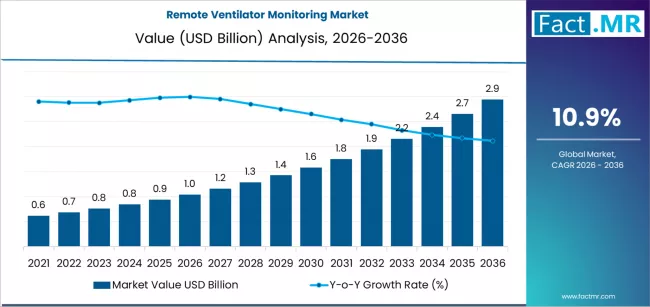
Cloud-based monitoring software emerges as the enabling platform, allowing for the centralized surveillance of ventilator parameters across disparate locations. The management of ICU ventilated patients represents the most acute clinical use case, where early intervention on worsening trends can significantly impact outcomes. This technology is redefining the boundaries of the intensive care unit, extending specialist expertise to step-down units, wards, and increasingly, into the patient's home.
Remote Ventilator Monitoring Market
| Metric | Value |
|---|---|
| Market Value (2026) | USD 1.04 Billion |
| Market Forecast Value (2036) | USD 2.94 Billion |
| Forecast CAGR 2026 to 2036 | 10.9% |
Category
| Category | Segments |
|---|---|
| Remote Monitoring Platform | Cloud-Based Monitoring Software, Integrated Ventilator Analytics, AI-Driven Alert Systems, Data Integration Middleware, Service & Support Contracts |
| Clinical Use Cases | ICU Ventilation Management, Step-Down & Ward Monitoring, Home Mechanical Ventilation, Tele-ICU Programs, Pandemic Surge Monitoring |
| End User | Hospitals & ICUs, Telehealth Providers, Home Care Providers, Integrated Delivery Networks, Government Health Systems |
| Region | North America, Latin America, Western Europe, Eastern Europe, East Asia, South Asia & Pacific, Middle East & Africa |
How are Healthcare Digitization and Workforce Challenges Reshaping Ventilator Management?
The strategic digitization of hospital systems creates the necessary infrastructure for integrating ventilator data into centralized command centers and electronic health records. This integration is no longer a technical novelty but a operational requirement to manage patient loads across geographically dispersed facilities within a single health network.
The global shortfall of trained respiratory therapists and intensivist physicians makes remote expertise sharing and protocol enforcement essential for maintaining quality standards. These platforms allow specialized teams to extend their reach, supporting general ward staff in managing ventilated patients and enabling the safe, monitored transition of chronic respiratory failure patients into home care settings, thereby freeing acute care resources.
Segmental Analysis
By Platform, Which Technology Enables Scalable, Centralized Surveillance?
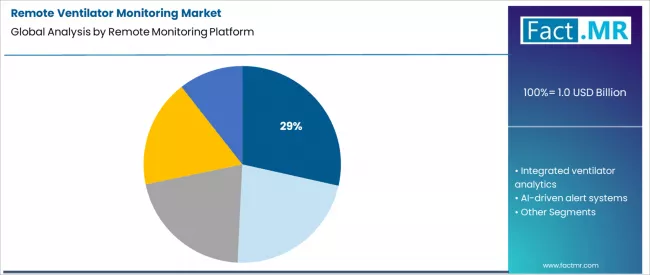
Cloud-based monitoring software commands a leading 28.5% share. This segment’s dominance is rooted in its ability to aggregate real-time data from multiple ventilator brands and models across an entire health system into a single, accessible dashboard.
It eliminates the limitations of proprietary, device-specific networks, offering scalability, remote accessibility for specialists, and a foundation for advanced analytics. The cloud model reduces local IT burden and facilitates software updates and feature expansion, making it the architectural choice for building enterprise-wide remote monitoring capabilities.
By Clinical Use Case, Where is the Concentration of High-Acuity, High-Cost Care?
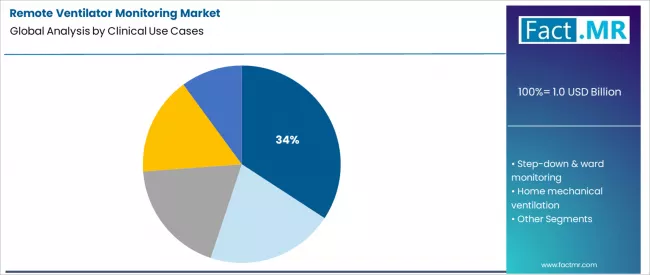
ICU ventilation management constitutes the primary use case segment at 34.2%. The intensive care unit represents the highest concentration of critically ill, mechanically ventilated patients where minute-to-minute management directly influences mortality and morbidity.
Remote monitoring here allows for continuous oversight by intensivists beyond rounds, early detection of asynchrony or deteriorating parameters, and support for less experienced frontline staff, directly addressing core challenges of ICU safety and capacity management.
By End User, Which Setting is the Primary Investor in Critical Care Infrastructure?
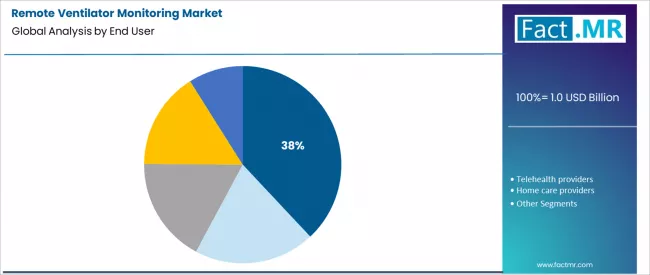
Hospitals and ICUs hold a leading 38.0% share. These institutions bear the direct clinical and financial responsibility for managing ventilated patients. Their investment in remote monitoring platforms is driven by goals to reduce ICU length of stay, prevent costly complications like ventilator-associated pneumonia, and optimize the utilization of high-cost ventilator assets and specialist personnel across their facility, making them the foundational market for this technology.
Which Dynamics Influence the Growth of the Remote Ventilator Monitoring Market?
| Attribute | Impact |
|---|---|
| Driver | The permanent integration of telehealth and remote patient monitoring into standard care models, accelerated by the demonstration of its necessity during global health crises. |
| Restraint | Data security and patient privacy concerns associated with transmitting sensitive, real-time physiological data across cloud networks and between healthcare entities. |
| Opportunity | Development of advanced middleware and interoperability standards that seamlessly integrate ventilator data into diverse EHR systems and telehealth platforms without custom engineering. |
| Trend | Proliferation of artificial intelligence and machine learning algorithms for predictive analytics, moving from simple alarm generation to forecasting patient readiness for weaning or risk of deterioration. |
Analysis of the Remote Ventilator Monitoring Market by Key Countries
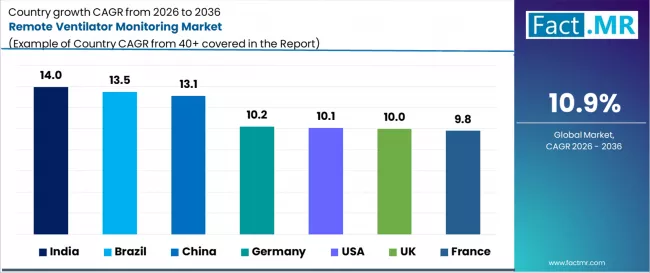
| Country | CAGR 2026 to 2036 |
|---|---|
| USA | 10.1% |
| Germany | 10.2% |
| China | 13.1% |
| India | 14.0% |
| Brazil | 13.5% |
| France | 9.8% |
| UK | 10.0% |
What Distinguishes the USA Market's Advanced Telehealth Infrastructure?
A 10.1% CAGR is supported by a mature telehealth regulatory and reimbursement landscape, a high density of academic medical centers operating tele-ICU command centers, and strong integration between medical device companies and health IT vendors. Adoption focuses on enterprise-grade platforms that serve integrated delivery networks, combining data from multiple facilities to create system-wide clinical and operational visibility.
How does Germany's Precision Engineering Influence Platform Specifications?
Germany's 10.2% CAGR reflects a demand for highly reliable, secure, and precise data integration that aligns with the country's stringent medical device and data protection regulations. German hospital associations often seek solutions that provide deep, analytics-ready data feeds for clinical research and quality benchmarking, beyond basic remote viewing capabilities.
Which Strategic Investments Underpin China's Rapid Digital Health Scale-Up?
China's 13.1% CAGR is propelled by national Internet & Healthcare policies and massive investments in smart hospital infrastructure. Provincial and municipal health commissions are driving the adoption of centralized monitoring platforms for ICU management, particularly in tier-3 hospitals, to improve quality metrics and enable specialist support for underserved regions.
Why does India's Growth Potential Center on Affordable Innovation?
India's leading 14.0% CAGR is driven by the need to bridge acute specialist shortages across its vast geography. The market favors cost-optimized, mobile-first software platforms that can operate effectively with intermittent connectivity, enabling urban tertiary care centers to remotely support district hospital ICUs and manage home ventilation for a growing chronic respiratory disease population.
How are Brazil's Public Health Initiatives Shaping Technology Adoption?
Brazil's 13.5% CAGR is linked to government-led programs to expand critical care access and telemedicine in the public SUS system. Initiatives to create regional tele-ICU hubs are generating demand for robust, Portuguese-language monitoring platforms that can standardize care protocols across diverse hospital capabilities, from major cities to remote areas.
What Characterizes France's Centralized Approach to Healthcare Technology?
France's 9.8% CAGR operates within a system where regional hospital groups (GHT) are standardizing clinical tools. Procurement for remote monitoring platforms is often conducted at this group level, favoring solutions that can be deployed uniformly across multiple member hospitals to create coordinated regional critical care networks and facilitate patient transfer decisions.
How does the UK's NHS Digital Transformation Strategy Guide Implementation?
The UK’s 10.0% CAGR is influenced by NHS Long Term Plan mandates to increase digital maturity and virtual ward capacity. Adoption is channeled through national digital frameworks, prioritizing platforms that demonstrate interoperability with NHS systems like the National Record and support the strategic shift of respiratory care from hospital to home settings.
Competitive Landscape of the Remote Ventilator Monitoring Market
The competitive landscape features traditional ventilator manufacturers expanding into digital services and health IT giants offering broader clinical surveillance platforms. Ventilator OEMs like Philips, Dräger, and Medtronic compete by offering native, deeply integrated remote monitoring for their own device fleets, leveraging proprietary data streams.
Healthcare IT firms like GE Healthcare compete through agnostic platforms that aggregate data across multiple OEMs, appealing to health systems with mixed ventilator inventories. Success increasingly depends on demonstrating clinical outcome improvements, providing robust implementation and change management services, and ensuring seamless, bi-directional data flow with the EHR to avoid clinician alert fatigue and workflow disruption.
Key Players in the Remote Ventilator Monitoring Market
- Koninklijke Philips N.V.
- GE Healthcare Technologies, Inc.
- Drägerwerk AG & Co. KGaA
- ResMed Inc.
- Medtronic plc
- Others
Scope of Report
| Items | Metrics |
|---|---|
| Quantitative Units | USD Billion |
| Platform | Cloud Software, Integrated Analytics, AI Alert Systems, Data Middleware, Service Contracts |
| Clinical Use Cases | ICU Management, Step-Down/Ward, Home Ventilation, Tele-ICU, Pandemic Monitoring |
| End User | Hospitals & ICUs, Telehealth Providers, Home Care, IDNs, Government Systems |
| Key Countries | India, Brazil, China, USA, Germany, UK, France |
| Key Companies | Koninklijke Philips N.V., GE Healthcare Technologies, Inc., Drägerwerk AG & Co. KGaA, ResMed Inc., Medtronic plc |
| Additional Analysis | Clinical outcome studies on remote monitoring impact on ventilator days and complication rates; total cost of care models for health systems; analysis of data interoperability standards (e.g., FHIR) in ventilator data integration; review of alert algorithm validation and customization for reducing false alarms. |
Market by Segments
-
Remote Monitoring Platform :
- Cloud-Based Monitoring Software
- Integrated Ventilator Analytics
- AI-Driven Alert Systems
- Data Integration Middleware
- Service & Support Contracts
-
Clinical Use Cases :
- ICU Ventilation Management
- Step-Down & Ward Monitoring
- Home Mechanical Ventilation
- Tele-ICU Programs
- Pandemic Surge Monitoring
-
End User :
- Hospitals & ICUs
- Telehealth Providers
- Home Care Providers
- Integrated Delivery Networks
- Government Health Systems
-
Region :
- North America
- USA
- Canada
- Latin America
- Brazil
- Mexico
- Argentina
- Rest of Latin America
- Western Europe
- Germany
- France
- UK
- Italy
- Spain
- BENELUX
- Rest of Western Europe
- Eastern Europe
- Poland
- Russia
- Czech Republic
- Rest of Eastern Europe
- East Asia
- China
- Japan
- South Korea
- Rest of East Asia
- South Asia & Pacific
- India
- ASEAN
- Australia & New Zealand
- Rest of South Asia & Pacific
- Middle East & Africa
- GCC Countries
- South Africa
- Turkiye
- Rest of MEA
- North America
References
- American Association for Respiratory Care (AARC). (2025). Clinical Practice Guideline: Remote Monitoring of the Mechanically Ventilated Patient.
- European Society of Intensive Care Medicine (ESICM). (2024). Recommendations for the Structure and Organization of Intensive Care Units: The Role of Telemedicine.
- Hess, D. R., & Kacmarek, R. M. (2023). Essentials of Mechanical Ventilation. McGraw Hill.
- Society of Critical Care Medicine. (2025). Guidelines for the Use of Tele-ICU in Critical Care.
- U.S. Food and Drug Administration. (2024). Digital Health Policy Navigator: Software for Remote Monitoring of Medical Devices.
- World Health Organization. (2024). *Technical specifications for ventilator integrated remote monitoring systems for COVID-19 and beyond*.
Table of Content
- Executive Summary
- Global Market Outlook
- Demand to side Trends
- Supply to side Trends
- Technology Roadmap Analysis
- Analysis and Recommendations
- Market Overview
- Market Coverage / Taxonomy
- Market Definition / Scope / Limitations
- Market Background
- Market Dynamics
- Drivers
- Restraints
- Opportunity
- Trends
- Scenario Forecast
- Demand in Optimistic Scenario
- Demand in Likely Scenario
- Demand in Conservative Scenario
- Opportunity Map Analysis
- Product Life Cycle Analysis
- Supply Chain Analysis
- Investment Feasibility Matrix
- Value Chain Analysis
- PESTLE and Porter’s Analysis
- Regulatory Landscape
- Regional Parent Market Outlook
- Production and Consumption Statistics
- Import and Export Statistics
- Market Dynamics
- Global Market Analysis 2021 to 2025 and Forecast, 2026 to 2036
- Historical Market Size Value (USD Million) Analysis, 2021 to 2025
- Current and Future Market Size Value (USD Million) Projections, 2026 to 2036
- Y to o to Y Growth Trend Analysis
- Absolute $ Opportunity Analysis
- Global Market Pricing Analysis 2021 to 2025 and Forecast 2026 to 2036
- Global Market Analysis 2021 to 2025 and Forecast 2026 to 2036, By Remote Monitoring Platform
- Introduction / Key Findings
- Historical Market Size Value (USD Million) Analysis By Remote Monitoring Platform, 2021 to 2025
- Current and Future Market Size Value (USD Million) Analysis and Forecast By Remote Monitoring Platform, 2026 to 2036
- Cloud-based monitoring software
- Integrated ventilator analytics
- AI-driven alert systems
- Data integration middleware
- Service & support contracts
- Cloud-based monitoring software
- Y to o to Y Growth Trend Analysis By Remote Monitoring Platform, 2021 to 2025
- Absolute $ Opportunity Analysis By Remote Monitoring Platform, 2026 to 2036
- Global Market Analysis 2021 to 2025 and Forecast 2026 to 2036, By Clinical Use Cases
- Introduction / Key Findings
- Historical Market Size Value (USD Million) Analysis By Clinical Use Cases, 2021 to 2025
- Current and Future Market Size Value (USD Million) Analysis and Forecast By Clinical Use Cases, 2026 to 2036
- ICU ventilation management
- Step-down & ward monitoring
- Home mechanical ventilation
- Tele-ICU programs
- Pandemic surge monitoring
- ICU ventilation management
- Y to o to Y Growth Trend Analysis By Clinical Use Cases, 2021 to 2025
- Absolute $ Opportunity Analysis By Clinical Use Cases, 2026 to 2036
- Global Market Analysis 2021 to 2025 and Forecast 2026 to 2036, By End User
- Introduction / Key Findings
- Historical Market Size Value (USD Million) Analysis By End User, 2021 to 2025
- Current and Future Market Size Value (USD Million) Analysis and Forecast By End User, 2026 to 2036
- Hospitals & ICUs
- Telehealth providers
- Home care providers
- Integrated delivery networks
- Government health systems
- Hospitals & ICUs
- Y to o to Y Growth Trend Analysis By End User, 2021 to 2025
- Absolute $ Opportunity Analysis By End User, 2026 to 2036
- Global Market Analysis 2021 to 2025 and Forecast 2026 to 2036, By Region
- Introduction
- Historical Market Size Value (USD Million) Analysis By Region, 2021 to 2025
- Current Market Size Value (USD Million) Analysis and Forecast By Region, 2026 to 2036
- North America
- Latin America
- Western Europe
- Eastern Europe
- East Asia
- South Asia and Pacific
- Middle East & Africa
- Market Attractiveness Analysis By Region
- North America Market Analysis 2021 to 2025 and Forecast 2026 to 2036, By Country
- Historical Market Size Value (USD Million) Trend Analysis By Market Taxonomy, 2021 to 2025
- Market Size Value (USD Million) Forecast By Market Taxonomy, 2026 to 2036
- By Country
- USA
- Canada
- Mexico
- By Remote Monitoring Platform
- By Clinical Use Cases
- By End User
- By Country
- Market Attractiveness Analysis
- By Country
- By Remote Monitoring Platform
- By Clinical Use Cases
- By End User
- Key Takeaways
- Latin America Market Analysis 2021 to 2025 and Forecast 2026 to 2036, By Country
- Historical Market Size Value (USD Million) Trend Analysis By Market Taxonomy, 2021 to 2025
- Market Size Value (USD Million) Forecast By Market Taxonomy, 2026 to 2036
- By Country
- Brazil
- Chile
- Rest of Latin America
- By Remote Monitoring Platform
- By Clinical Use Cases
- By End User
- By Country
- Market Attractiveness Analysis
- By Country
- By Remote Monitoring Platform
- By Clinical Use Cases
- By End User
- Key Takeaways
- Western Europe Market Analysis 2021 to 2025 and Forecast 2026 to 2036, By Country
- Historical Market Size Value (USD Million) Trend Analysis By Market Taxonomy, 2021 to 2025
- Market Size Value (USD Million) Forecast By Market Taxonomy, 2026 to 2036
- By Country
- Germany
- UK
- Italy
- Spain
- France
- Nordic
- BENELUX
- Rest of Western Europe
- By Remote Monitoring Platform
- By Clinical Use Cases
- By End User
- By Country
- Market Attractiveness Analysis
- By Country
- By Remote Monitoring Platform
- By Clinical Use Cases
- By End User
- Key Takeaways
- Eastern Europe Market Analysis 2021 to 2025 and Forecast 2026 to 2036, By Country
- Historical Market Size Value (USD Million) Trend Analysis By Market Taxonomy, 2021 to 2025
- Market Size Value (USD Million) Forecast By Market Taxonomy, 2026 to 2036
- By Country
- Russia
- Poland
- Hungary
- Balkan & Baltic
- Rest of Eastern Europe
- By Remote Monitoring Platform
- By Clinical Use Cases
- By End User
- By Country
- Market Attractiveness Analysis
- By Country
- By Remote Monitoring Platform
- By Clinical Use Cases
- By End User
- Key Takeaways
- East Asia Market Analysis 2021 to 2025 and Forecast 2026 to 2036, By Country
- Historical Market Size Value (USD Million) Trend Analysis By Market Taxonomy, 2021 to 2025
- Market Size Value (USD Million) Forecast By Market Taxonomy, 2026 to 2036
- By Country
- China
- Japan
- South Korea
- By Remote Monitoring Platform
- By Clinical Use Cases
- By End User
- By Country
- Market Attractiveness Analysis
- By Country
- By Remote Monitoring Platform
- By Clinical Use Cases
- By End User
- Key Takeaways
- South Asia and Pacific Market Analysis 2021 to 2025 and Forecast 2026 to 2036, By Country
- Historical Market Size Value (USD Million) Trend Analysis By Market Taxonomy, 2021 to 2025
- Market Size Value (USD Million) Forecast By Market Taxonomy, 2026 to 2036
- By Country
- India
- ASEAN
- Australia & New Zealand
- Rest of South Asia and Pacific
- By Remote Monitoring Platform
- By Clinical Use Cases
- By End User
- By Country
- Market Attractiveness Analysis
- By Country
- By Remote Monitoring Platform
- By Clinical Use Cases
- By End User
- Key Takeaways
- Middle East & Africa Market Analysis 2021 to 2025 and Forecast 2026 to 2036, By Country
- Historical Market Size Value (USD Million) Trend Analysis By Market Taxonomy, 2021 to 2025
- Market Size Value (USD Million) Forecast By Market Taxonomy, 2026 to 2036
- By Country
- Kingdom of Saudi Arabia
- Other GCC Countries
- Turkiye
- South Africa
- Other African Union
- Rest of Middle East & Africa
- By Remote Monitoring Platform
- By Clinical Use Cases
- By End User
- By Country
- Market Attractiveness Analysis
- By Country
- By Remote Monitoring Platform
- By Clinical Use Cases
- By End User
- Key Takeaways
- Key Countries Market Analysis
- USA
- Pricing Analysis
- Market Share Analysis, 2025
- By Remote Monitoring Platform
- By Clinical Use Cases
- By End User
- Canada
- Pricing Analysis
- Market Share Analysis, 2025
- By Remote Monitoring Platform
- By Clinical Use Cases
- By End User
- Mexico
- Pricing Analysis
- Market Share Analysis, 2025
- By Remote Monitoring Platform
- By Clinical Use Cases
- By End User
- Brazil
- Pricing Analysis
- Market Share Analysis, 2025
- By Remote Monitoring Platform
- By Clinical Use Cases
- By End User
- Chile
- Pricing Analysis
- Market Share Analysis, 2025
- By Remote Monitoring Platform
- By Clinical Use Cases
- By End User
- Germany
- Pricing Analysis
- Market Share Analysis, 2025
- By Remote Monitoring Platform
- By Clinical Use Cases
- By End User
- UK
- Pricing Analysis
- Market Share Analysis, 2025
- By Remote Monitoring Platform
- By Clinical Use Cases
- By End User
- Italy
- Pricing Analysis
- Market Share Analysis, 2025
- By Remote Monitoring Platform
- By Clinical Use Cases
- By End User
- Spain
- Pricing Analysis
- Market Share Analysis, 2025
- By Remote Monitoring Platform
- By Clinical Use Cases
- By End User
- France
- Pricing Analysis
- Market Share Analysis, 2025
- By Remote Monitoring Platform
- By Clinical Use Cases
- By End User
- India
- Pricing Analysis
- Market Share Analysis, 2025
- By Remote Monitoring Platform
- By Clinical Use Cases
- By End User
- ASEAN
- Pricing Analysis
- Market Share Analysis, 2025
- By Remote Monitoring Platform
- By Clinical Use Cases
- By End User
- Australia & New Zealand
- Pricing Analysis
- Market Share Analysis, 2025
- By Remote Monitoring Platform
- By Clinical Use Cases
- By End User
- China
- Pricing Analysis
- Market Share Analysis, 2025
- By Remote Monitoring Platform
- By Clinical Use Cases
- By End User
- Japan
- Pricing Analysis
- Market Share Analysis, 2025
- By Remote Monitoring Platform
- By Clinical Use Cases
- By End User
- South Korea
- Pricing Analysis
- Market Share Analysis, 2025
- By Remote Monitoring Platform
- By Clinical Use Cases
- By End User
- Russia
- Pricing Analysis
- Market Share Analysis, 2025
- By Remote Monitoring Platform
- By Clinical Use Cases
- By End User
- Poland
- Pricing Analysis
- Market Share Analysis, 2025
- By Remote Monitoring Platform
- By Clinical Use Cases
- By End User
- Hungary
- Pricing Analysis
- Market Share Analysis, 2025
- By Remote Monitoring Platform
- By Clinical Use Cases
- By End User
- Kingdom of Saudi Arabia
- Pricing Analysis
- Market Share Analysis, 2025
- By Remote Monitoring Platform
- By Clinical Use Cases
- By End User
- Turkiye
- Pricing Analysis
- Market Share Analysis, 2025
- By Remote Monitoring Platform
- By Clinical Use Cases
- By End User
- South Africa
- Pricing Analysis
- Market Share Analysis, 2025
- By Remote Monitoring Platform
- By Clinical Use Cases
- By End User
- USA
- Market Structure Analysis
- Competition Dashboard
- Competition Benchmarking
- Market Share Analysis of Top Players
- By Regional
- By Remote Monitoring Platform
- By Clinical Use Cases
- By End User
- Competition Analysis
- Competition Deep Dive
- Koninklijke Philips N.V.
- Overview
- Product Portfolio
- Profitability by Market Segments (Product/Age /Sales Channel/Region)
- Sales Footprint
- Strategy Overview
- Marketing Strategy
- Product Strategy
- Channel Strategy
- GE Healthcare Technologies, Inc.
- Drägerwerk AG & Co. KGaA
- ResMed Inc.
- Medtronic plc
- Others
- Koninklijke Philips N.V.
- Competition Deep Dive
- Assumptions & Acronyms Used
- Research Methodology
List Of Table
- Table 1: Global Market Value (USD Million) Forecast by Region, 2021 to 2036
- Table 2: Global Market Value (USD Million) Forecast by Remote Monitoring Platform, 2021 to 2036
- Table 3: Global Market Value (USD Million) Forecast by Clinical Use Cases, 2021 to 2036
- Table 4: Global Market Value (USD Million) Forecast by End User, 2021 to 2036
- Table 5: North America Market Value (USD Million) Forecast by Country, 2021 to 2036
- Table 6: North America Market Value (USD Million) Forecast by Remote Monitoring Platform, 2021 to 2036
- Table 7: North America Market Value (USD Million) Forecast by Clinical Use Cases, 2021 to 2036
- Table 8: North America Market Value (USD Million) Forecast by End User, 2021 to 2036
- Table 9: Latin America Market Value (USD Million) Forecast by Country, 2021 to 2036
- Table 10: Latin America Market Value (USD Million) Forecast by Remote Monitoring Platform, 2021 to 2036
- Table 11: Latin America Market Value (USD Million) Forecast by Clinical Use Cases, 2021 to 2036
- Table 12: Latin America Market Value (USD Million) Forecast by End User, 2021 to 2036
- Table 13: Western Europe Market Value (USD Million) Forecast by Country, 2021 to 2036
- Table 14: Western Europe Market Value (USD Million) Forecast by Remote Monitoring Platform, 2021 to 2036
- Table 15: Western Europe Market Value (USD Million) Forecast by Clinical Use Cases, 2021 to 2036
- Table 16: Western Europe Market Value (USD Million) Forecast by End User, 2021 to 2036
- Table 17: Eastern Europe Market Value (USD Million) Forecast by Country, 2021 to 2036
- Table 18: Eastern Europe Market Value (USD Million) Forecast by Remote Monitoring Platform, 2021 to 2036
- Table 19: Eastern Europe Market Value (USD Million) Forecast by Clinical Use Cases, 2021 to 2036
- Table 20: Eastern Europe Market Value (USD Million) Forecast by End User, 2021 to 2036
- Table 21: East Asia Market Value (USD Million) Forecast by Country, 2021 to 2036
- Table 22: East Asia Market Value (USD Million) Forecast by Remote Monitoring Platform, 2021 to 2036
- Table 23: East Asia Market Value (USD Million) Forecast by Clinical Use Cases, 2021 to 2036
- Table 24: East Asia Market Value (USD Million) Forecast by End User, 2021 to 2036
- Table 25: South Asia and Pacific Market Value (USD Million) Forecast by Country, 2021 to 2036
- Table 26: South Asia and Pacific Market Value (USD Million) Forecast by Remote Monitoring Platform, 2021 to 2036
- Table 27: South Asia and Pacific Market Value (USD Million) Forecast by Clinical Use Cases, 2021 to 2036
- Table 28: South Asia and Pacific Market Value (USD Million) Forecast by End User, 2021 to 2036
- Table 29: Middle East & Africa Market Value (USD Million) Forecast by Country, 2021 to 2036
- Table 30: Middle East & Africa Market Value (USD Million) Forecast by Remote Monitoring Platform, 2021 to 2036
- Table 31: Middle East & Africa Market Value (USD Million) Forecast by Clinical Use Cases, 2021 to 2036
- Table 32: Middle East & Africa Market Value (USD Million) Forecast by End User, 2021 to 2036
List Of Figures
- Figure 1: Global Market Pricing Analysis
- Figure 2: Global Market Value (USD Million) Forecast 2021 to 2036
- Figure 3: Global Market Value Share and BPS Analysis by Remote Monitoring Platform, 2026 and 2036
- Figure 4: Global Market Y to o to Y Growth Comparison by Remote Monitoring Platform, 2026 to 2036
- Figure 5: Global Market Attractiveness Analysis by Remote Monitoring Platform
- Figure 6: Global Market Value Share and BPS Analysis by Clinical Use Cases, 2026 and 2036
- Figure 7: Global Market Y to o to Y Growth Comparison by Clinical Use Cases, 2026 to 2036
- Figure 8: Global Market Attractiveness Analysis by Clinical Use Cases
- Figure 9: Global Market Value Share and BPS Analysis by End User, 2026 and 2036
- Figure 10: Global Market Y to o to Y Growth Comparison by End User, 2026 to 2036
- Figure 11: Global Market Attractiveness Analysis by End User
- Figure 12: Global Market Value (USD Million) Share and BPS Analysis by Region, 2026 and 2036
- Figure 13: Global Market Y to o to Y Growth Comparison by Region, 2026 to 2036
- Figure 14: Global Market Attractiveness Analysis by Region
- Figure 15: North America Market Incremental Dollar Opportunity, 2026 to 2036
- Figure 16: Latin America Market Incremental Dollar Opportunity, 2026 to 2036
- Figure 17: Western Europe Market Incremental Dollar Opportunity, 2026 to 2036
- Figure 18: Eastern Europe Market Incremental Dollar Opportunity, 2026 to 2036
- Figure 19: East Asia Market Incremental Dollar Opportunity, 2026 to 2036
- Figure 20: South Asia and Pacific Market Incremental Dollar Opportunity, 2026 to 2036
- Figure 21: Middle East & Africa Market Incremental Dollar Opportunity, 2026 to 2036
- Figure 22: North America Market Value Share and BPS Analysis by Country, 2026 and 2036
- Figure 23: North America Market Value Share and BPS Analysis by Remote Monitoring Platform, 2026 and 2036
- Figure 24: North America Market Y to o to Y Growth Comparison by Remote Monitoring Platform, 2026 to 2036
- Figure 25: North America Market Attractiveness Analysis by Remote Monitoring Platform
- Figure 26: North America Market Value Share and BPS Analysis by Clinical Use Cases, 2026 and 2036
- Figure 27: North America Market Y to o to Y Growth Comparison by Clinical Use Cases, 2026 to 2036
- Figure 28: North America Market Attractiveness Analysis by Clinical Use Cases
- Figure 29: North America Market Value Share and BPS Analysis by End User, 2026 and 2036
- Figure 30: North America Market Y to o to Y Growth Comparison by End User, 2026 to 2036
- Figure 31: North America Market Attractiveness Analysis by End User
- Figure 32: Latin America Market Value Share and BPS Analysis by Country, 2026 and 2036
- Figure 33: Latin America Market Value Share and BPS Analysis by Remote Monitoring Platform, 2026 and 2036
- Figure 34: Latin America Market Y to o to Y Growth Comparison by Remote Monitoring Platform, 2026 to 2036
- Figure 35: Latin America Market Attractiveness Analysis by Remote Monitoring Platform
- Figure 36: Latin America Market Value Share and BPS Analysis by Clinical Use Cases, 2026 and 2036
- Figure 37: Latin America Market Y to o to Y Growth Comparison by Clinical Use Cases, 2026 to 2036
- Figure 38: Latin America Market Attractiveness Analysis by Clinical Use Cases
- Figure 39: Latin America Market Value Share and BPS Analysis by End User, 2026 and 2036
- Figure 40: Latin America Market Y to o to Y Growth Comparison by End User, 2026 to 2036
- Figure 41: Latin America Market Attractiveness Analysis by End User
- Figure 42: Western Europe Market Value Share and BPS Analysis by Country, 2026 and 2036
- Figure 43: Western Europe Market Value Share and BPS Analysis by Remote Monitoring Platform, 2026 and 2036
- Figure 44: Western Europe Market Y to o to Y Growth Comparison by Remote Monitoring Platform, 2026 to 2036
- Figure 45: Western Europe Market Attractiveness Analysis by Remote Monitoring Platform
- Figure 46: Western Europe Market Value Share and BPS Analysis by Clinical Use Cases, 2026 and 2036
- Figure 47: Western Europe Market Y to o to Y Growth Comparison by Clinical Use Cases, 2026 to 2036
- Figure 48: Western Europe Market Attractiveness Analysis by Clinical Use Cases
- Figure 49: Western Europe Market Value Share and BPS Analysis by End User, 2026 and 2036
- Figure 50: Western Europe Market Y to o to Y Growth Comparison by End User, 2026 to 2036
- Figure 51: Western Europe Market Attractiveness Analysis by End User
- Figure 52: Eastern Europe Market Value Share and BPS Analysis by Country, 2026 and 2036
- Figure 53: Eastern Europe Market Value Share and BPS Analysis by Remote Monitoring Platform, 2026 and 2036
- Figure 54: Eastern Europe Market Y to o to Y Growth Comparison by Remote Monitoring Platform, 2026 to 2036
- Figure 55: Eastern Europe Market Attractiveness Analysis by Remote Monitoring Platform
- Figure 56: Eastern Europe Market Value Share and BPS Analysis by Clinical Use Cases, 2026 and 2036
- Figure 57: Eastern Europe Market Y to o to Y Growth Comparison by Clinical Use Cases, 2026 to 2036
- Figure 58: Eastern Europe Market Attractiveness Analysis by Clinical Use Cases
- Figure 59: Eastern Europe Market Value Share and BPS Analysis by End User, 2026 and 2036
- Figure 60: Eastern Europe Market Y to o to Y Growth Comparison by End User, 2026 to 2036
- Figure 61: Eastern Europe Market Attractiveness Analysis by End User
- Figure 62: East Asia Market Value Share and BPS Analysis by Country, 2026 and 2036
- Figure 63: East Asia Market Value Share and BPS Analysis by Remote Monitoring Platform, 2026 and 2036
- Figure 64: East Asia Market Y to o to Y Growth Comparison by Remote Monitoring Platform, 2026 to 2036
- Figure 65: East Asia Market Attractiveness Analysis by Remote Monitoring Platform
- Figure 66: East Asia Market Value Share and BPS Analysis by Clinical Use Cases, 2026 and 2036
- Figure 67: East Asia Market Y to o to Y Growth Comparison by Clinical Use Cases, 2026 to 2036
- Figure 68: East Asia Market Attractiveness Analysis by Clinical Use Cases
- Figure 69: East Asia Market Value Share and BPS Analysis by End User, 2026 and 2036
- Figure 70: East Asia Market Y to o to Y Growth Comparison by End User, 2026 to 2036
- Figure 71: East Asia Market Attractiveness Analysis by End User
- Figure 72: South Asia and Pacific Market Value Share and BPS Analysis by Country, 2026 and 2036
- Figure 73: South Asia and Pacific Market Value Share and BPS Analysis by Remote Monitoring Platform, 2026 and 2036
- Figure 74: South Asia and Pacific Market Y to o to Y Growth Comparison by Remote Monitoring Platform, 2026 to 2036
- Figure 75: South Asia and Pacific Market Attractiveness Analysis by Remote Monitoring Platform
- Figure 76: South Asia and Pacific Market Value Share and BPS Analysis by Clinical Use Cases, 2026 and 2036
- Figure 77: South Asia and Pacific Market Y to o to Y Growth Comparison by Clinical Use Cases, 2026 to 2036
- Figure 78: South Asia and Pacific Market Attractiveness Analysis by Clinical Use Cases
- Figure 79: South Asia and Pacific Market Value Share and BPS Analysis by End User, 2026 and 2036
- Figure 80: South Asia and Pacific Market Y to o to Y Growth Comparison by End User, 2026 to 2036
- Figure 81: South Asia and Pacific Market Attractiveness Analysis by End User
- Figure 82: Middle East & Africa Market Value Share and BPS Analysis by Country, 2026 and 2036
- Figure 83: Middle East & Africa Market Value Share and BPS Analysis by Remote Monitoring Platform, 2026 and 2036
- Figure 84: Middle East & Africa Market Y to o to Y Growth Comparison by Remote Monitoring Platform, 2026 to 2036
- Figure 85: Middle East & Africa Market Attractiveness Analysis by Remote Monitoring Platform
- Figure 86: Middle East & Africa Market Value Share and BPS Analysis by Clinical Use Cases, 2026 and 2036
- Figure 87: Middle East & Africa Market Y to o to Y Growth Comparison by Clinical Use Cases, 2026 to 2036
- Figure 88: Middle East & Africa Market Attractiveness Analysis by Clinical Use Cases
- Figure 89: Middle East & Africa Market Value Share and BPS Analysis by End User, 2026 and 2036
- Figure 90: Middle East & Africa Market Y to o to Y Growth Comparison by End User, 2026 to 2036
- Figure 91: Middle East & Africa Market Attractiveness Analysis by End User
- Figure 92: Global Market - Tier Structure Analysis
- Figure 93: Global Market - Company Share Analysis
- FAQs -
How big is the remote ventilator monitoring market in 2026?
The global remote ventilator monitoring market is estimated to be valued at USD 1.0 billion in 2026.
What will be the size of remote ventilator monitoring market in 2036?
The market size for the remote ventilator monitoring market is projected to reach USD 2.9 billion by 2036.
How much will be the remote ventilator monitoring market growth between 2026 and 2036?
The remote ventilator monitoring market is expected to grow at a 10.9% CAGR between 2026 and 2036.
What are the key product types in the remote ventilator monitoring market?
The key product types in remote ventilator monitoring market are cloud-based monitoring software, integrated ventilator analytics, ai-driven alert systems, data integration middleware and service & support contracts.
Which clinical use cases segment to contribute significant share in the remote ventilator monitoring market in 2026?
In terms of clinical use cases, icu ventilation management segment to command 34.2% share in the remote ventilator monitoring market in 2026.