- Base Value(2025): 15.9 Bn
- Estimated Value(2025): 15.9 Bn
- Forecast Value (2035): 41.9 Bn
- CAGR (2025 - 2035): 10.2%
Molecular Biology Enzymes, Reagents & Kits Market Forecast and Outlook 2025 to 2035
The global molecular biology enzymes, reagents & kits market is projected to reach USD 41.9 billion by 2035, recording an absolute increase of USD 26.0 billion over the forecast period. The market is valued at USD 15.9 billion in 2025 and is set to rise at a CAGR of 10.2% during the assessment period.
The market is expected to grow by 2.6 times during the same period, supported by increasing demand from genomics research operations and expanding applications in molecular diagnostics development across both developed and emerging biotechnology markets. Additionally, growing application diversity in next-generation sequencing platforms, gene editing technologies, and precision medicine initiatives creates expanding opportunities for enzyme innovation and specialized reagent development.
Quick Stats for Molecular Biology Enzymes, Reagents & Kits Market
- Molecular Biology Enzymes, Reagents & Kits Market Value (2025): USD 15.9 billion
- Molecular Biology Enzymes, Reagents & Kits Market Forecast Value (2035): USD 41.9 billion
- Molecular Biology Enzymes, Reagents & Kits Market Forecast CAGR: 10.2%
- Leading Product in Molecular Biology Enzymes, Reagents & Kits Market: Kits & Reagents (60.2%)
- Key Growth Regions in Molecular Biology Enzymes, Reagents & Kits Market: North America, Europe, and Asia Pacific
- Top Players in Molecular Biology Enzymes, Reagents & Kits Market: Thermo Fisher Scientific, Illumina Inc., Agilent Technologies, QIAGEN, Promega Corporation, New England Biolabs, Merck KGaA, F. Hoffmann-La Roche Ltd., Bio-Rad Laboratories, Takara Bio Inc.
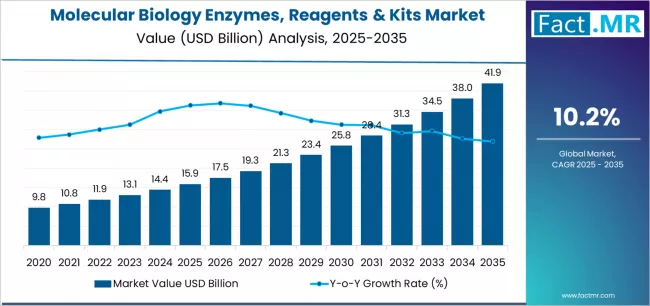
Molecular Biology Enzymes, Reagents & Kits Market Market Value Analysis | Source: Fact.MR
Rising research investment in life sciences institutions, coupled with expanding biotechnology processing capacity through advanced laboratory facilities and modern genomics infrastructure, further accelerate market penetration across diverse research segments. The growing global demand for molecular diagnostic solutions, particularly in infectious disease detection and oncology applications, generates sustained requirements for high-quality PCR reagents and sequencing preparation materials.
Technical advancements in CRISPR-based technologies demonstrating measurable improvements in gene editing efficiency, reduced workflow complexity, and assay performance optimization reinforce researcher confidence in molecular biology product economics, while personalized medicine sector trends toward targeted therapeutics expand addressable market opportunities beyond traditional research applications into clinical diagnostic supply chains.
Pharmaceutical companies and diagnostic laboratories increasingly incorporate advanced molecular tools into drug development programs, clinical testing workflows, and biomarker discovery platforms, creating mainstream consumption channels that extend beyond specialty research applications into conventional healthcare environments. However, stringent regulatory requirements for diagnostic applications and complex quality control standards for molecular reagents may pose challenges to market expansion.
Technical expertise requirements for advanced molecular techniques in certain regions and supply chain constraints for specialized enzyme production also influence product accessibility, requiring manufacturers to develop comprehensive training programs and reliable distribution networks catering to specific operational requirements across different geographical markets.
Product development complexity during enzyme optimization and the technical requirements for cold-chain logistics, stability validation, and batch consistency operations may limit accessibility among smaller laboratories in developing regions with limited infrastructure for advanced molecular biology research and specialized reagent storage systems.
Molecular Biology Enzymes, Reagents & Kits Market Year-over-Year Forecast 2025 to 2035
Between 2025 and 2030, the molecular biology enzymes, reagents & kits market is projected to expand from USD 15.9 billion to USD 26.0 billion, resulting in a value increase of USD 10.1 billion, which represents 38.8% of the total forecast growth for the decade. This phase of development will be shaped by rising demand for next-generation sequencing reagents and PCR-based diagnostic solutions, product innovation in CRISPR enzyme formulations and advanced polymerase technologies, as well as expanding integration with precision medicine initiatives and genomic research platforms. Companies are establishing competitive positions through investment in enzyme engineering technology development, high-purity reagent manufacturing capabilities, and strategic market expansion across pharmaceutical research facilities, clinical diagnostic segments, and academic research applications.
From 2030 to 2035, the market is forecast to grow from USD 26.0 billion to USD 41.9 billion, adding another USD 15.9 billion, which constitutes 61.2% of the overall ten-year expansion. This period is expected to be characterized by the expansion of specialized molecular biology products, including targeted enzyme formulations and customized kit configurations tailored for specific research applications, strategic collaborations between reagent manufacturers and diagnostic platform developers, and an enhanced focus on automation-compatible reagent systems and workflow optimization solutions. The growing emphasis on liquid biopsy technologies and RNA therapeutics development will drive demand for high-performance molecular biology solutions across diverse research and clinical applications.
Molecular Biology Enzymes, Reagents & Kits Market Key Takeaways
| Metric | Value |
|---|---|
| Market Value (2025) | USD 15.9 billion |
| Market Forecast Value (2035) | USD 41.9 billion |
| Forecast CAGR (2025-2035) | 10.2% |
Source: Fact.MR analysis. Updated Dec 1, 2025
Why is the Molecular Biology Enzymes, Reagents & Kits Market Experiencing Strong Growth?
The molecular biology enzymes, reagents & kits market grows by enabling pharmaceutical companies, research institutions, and diagnostic laboratories to access high-quality molecular tools that support scientific discovery while meeting research demand for consistent performance specifications and reproducible results.
Biotechnology researchers and clinical laboratory professionals face mounting pressure to develop robust assays with proven sensitivity and specificity characteristics, with molecular biology reagents typically providing validated performance and stringent quality control essential for genomics research, diagnostic development, and therapeutic production, making these products essential for competitive positioning in pharmaceutical research, clinical diagnostics, and academic investigation categories.
The life sciences industry's need for reliable reagent supply and consistent product quality creates demand for diverse enzyme formulations that can provide superior catalytic efficiency, maintain predictable performance across different experimental conditions, and ensure result reproducibility without compromising research economics or experimental validity.
Government initiatives promoting genomics research and precision medicine programs drive adoption in pharmaceutical development facilities, academic research laboratories, and clinical diagnostic operations, where molecular biology product quality has a direct impact on experimental outcomes and diagnostic accuracy.
The healthcare industry's growing focus on personalized medicine and targeted therapeutics further expands market opportunities, with clinical research demonstrating measurable advantages from advanced molecular techniques, including enhanced disease detection capabilities and improved treatment selection guidance.
However, supply chain complexity during specialized enzyme procurement and the technical requirements for proper reagent storage, handling protocols, and quality validation processes may limit accessibility among smaller laboratories and developing regions with limited infrastructure for advanced molecular biology research and cold-chain logistics systems.
Segmental Analysis
The market is segmented by product, application, end-use, and region. By product, the market is divided into kits & reagents and enzymes. By application, the market includes sequencing, PCR, epigenetics, genotyping, RCA/MDA, RNA therapeutics, transcriptomics, proteomics, liquid biopsy, and other applications.
By end-use, the market covers pharma & biotech, academic & research, hospital & diagnostics, and others. Regionally, the market is divided into North America, Europe, Asia Pacific, Latin America, and Middle East & Africa.
What Makes Kits & Reagents the Dominant Product Segment in the Molecular Biology Market?
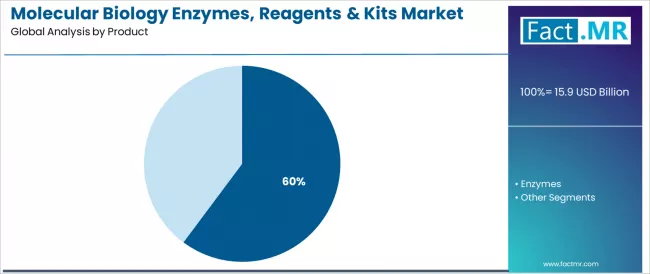
Molecular Biology Enzymes, Reagents & Kits Market Analysis By Product | Source: Fact.MR
The kits & reagents segment represents the dominant force in the molecular biology enzymes, reagents & kits market, capturing approximately 60.2% of total market share in 2025. This established product category encompasses solutions featuring complete workflow systems for molecular applications, including PCR kits, qPCR kits, RT-PCR kits, library preparation kits, cloning kits, purification kits, gene editing kits, and other specialized reagent formulations that enable streamlined experimental protocols and standardized research workflows across all molecular biology applications.
The kits & reagents segment's market leadership stems from its essential role in workflow simplification, with complete kit solutions capable of meeting diverse research requirements while maintaining cost-effective implementation and operational reliability across all laboratory environments. Within the kits & reagents segment, PCR kits account for the largest consumption share at 18.0%, driven by widespread diagnostic testing applications and fundamental research requirements across global laboratory operations.
The enzymes segment maintains a substantial 39.8% market share, serving researchers who require individual enzyme components for custom assay development, specialized applications, and high-volume production workflows. These products offer flexibility for protocol optimization, cost advantages for large-scale operations, and specialized functionality for advanced research applications while providing sufficient versatility to meet diverse experimental demands and technical requirements. Within the enzymes segment, polymerases represent the dominant subsegment at 17.2%, serving PCR, sequencing, and amplification applications requiring high-fidelity DNA synthesis across molecular biology workflows.
Key advantages driving the kits & reagents segment include:
- Established workflow standardization with integrated reagent systems that reduce experimental complexity and ensure consistent protocol execution
- Complete solution convenience allowing simplified procurement across different molecular applications without significant optimization requirements
- Proven performance validation, delivering reliable results while maintaining competitiveness against custom reagent formulations
- Broad laboratory acceptance enabling straightforward product specification and quality standards across multiple research institutions
Which Application Category Leads in the Molecular Biology Market?

Molecular Biology Enzymes, Reagents & Kits Market Analysis By Application | Source: Fact.MR
The sequencing segment captures 34.6% of the market share, driven by explosive growth in next-generation sequencing adoption and expanding genomics research initiatives across pharmaceutical development and clinical applications. These applications encompass library preparation reagents, sequencing polymerases, and specialized enzymes essential for DNA and RNA sequencing workflows across diverse platforms.
Within the sequencing segment, pharma & biotech applications account for 10.4% of total market share, reflecting significant investment in drug discovery programs and biomarker identification research.
The PCR segment maintains a significant 27.2% market share, serving fundamental molecular biology applications including gene expression analysis, genotyping, pathogen detection, and diagnostic testing across research and clinical laboratories. These applications demonstrate established market presence with proven workflow reliability and broad platform compatibility.
Within PCR applications, pharma & biotech operations capture 9.5% of total market share, driven by extensive utilization in pharmaceutical research, quality control testing, and production monitoring workflows. Additional application segments including epigenetics, genotyping, RCA/MDA, RNA therapeutics, transcriptomics, proteomics, liquid biopsy, and other specialized applications account for the remaining market share, serving emerging research areas and specialized molecular biology techniques.
How Do End-Use Categories Shape Market Demand?

Molecular Biology Enzymes, Reagents & Kits Market Analysis By End Use | Source: Fact.MR
The pharma & biotech segment dominates with a 41.3% market share, reflecting substantial investment in drug discovery research, therapeutic development programs, and biomanufacturing operations requiring comprehensive molecular biology tools. This segment encompasses research applications (14.8% of total market), therapeutics/production operations (12.6%), academic collaborations (8.3%), and diagnostic development activities (3.1%), demonstrating the pharmaceutical industry's extensive utilization of molecular biology technologies across diverse operational functions. The segment benefits from significant R&D budgets, advanced technical capabilities, and persistent demand for innovative molecular tools supporting next-generation therapeutic development.
The academic & research segment captures approximately 32.2% market share, driven by fundamental scientific investigation, genomics research programs, and disease mechanism studies across universities and research institutions. Within this segment, genetics & disease research accounts for 13.8% of total market share, oncology studies represent 8.9%, and molecular diagnostics research captures 6.1%, reflecting diverse research priorities across academic laboratories. The hospital & diagnostics and others segments account for the remaining market share, serving clinical testing laboratories and specialized application areas requiring molecular diagnostic tools and research reagents.
What are the Drivers, Restraints, and Key Trends of the Molecular Biology Enzymes, Reagents & Kits Market?
The market is driven by three concrete demand factors tied to scientific advancement and healthcare transformation. First, increasing genomics research investment and precision medicine initiatives create growing demand for sequencing reagents and gene analysis tools, with global genomics research funding expanding by 8-10% annually in major research markets worldwide, requiring comprehensive molecular biology product infrastructure. Second, expanding molecular diagnostics adoption for infectious disease detection, cancer screening, and genetic testing drives increased utilization of PCR reagents and diagnostic kits, with many healthcare systems implementing comprehensive molecular testing programs by 2030. Third, technological advancements in CRISPR gene editing, single-cell analysis, and liquid biopsy technologies enable more effective and efficient molecular research that reduces sample requirements while improving detection sensitivity and experimental throughput capabilities.
Market restraints include stringent regulatory requirements for diagnostic applications that can deter smaller companies from developing clinical-grade molecular products, particularly in regions where regulatory approval processes face complexity constraints or extensive validation requirements. High product development costs and technical complexity pose another significant challenge, as enzyme optimization, quality control validation, and manufacturing scale-up require substantial investment and specialized expertise, potentially causing increased market entry barriers and limited competition. Cold-chain logistics requirements and product stability constraints create additional market challenges for global distribution, demanding ongoing investment in specialized shipping infrastructure and temperature-controlled storage capabilities.
Key trends indicate accelerated adoption in Asia Pacific markets, particularly China and India, where expanding biotechnology sectors and government research funding drive comprehensive molecular biology product consumption. Technology integration trends toward automation-compatible reagent formats with liquid handling compatibility, digital workflow integration, and quality tracking systems enable optimized laboratory approaches that reduce manual handling requirements and minimize experimental variability. However, the market thesis could face disruption if significant advances in alternative molecular technologies or major shifts in research methodologies reduce reliance on traditional enzyme-based amplification and sequencing approaches.
Analysis of the Molecular Biology Enzymes, Reagents & Kits Market by Key Countries
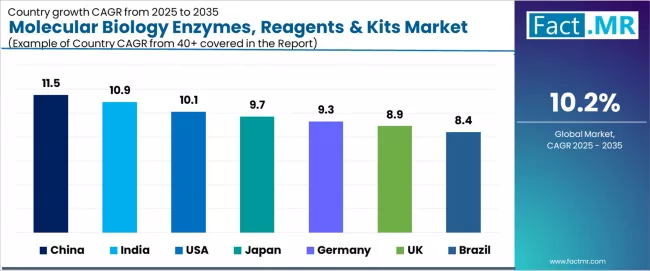
Molecular Biology Enzymes, Reagents & Kits Market Cagr Analysis By Country | Source: Fact.MR
| Country | CAGR (2025 to 2035) |
|---|---|
| China | 11.5% |
| India | 10.9% |
| USA | 10.1% |
| Japan | 9.7% |
| Germany | 9.3% |
| UK | 8.9% |
| Brazil | 8.4% |
Source: Fact.MR analysis. Updated Dec 1, 2025
The molecular biology enzymes, reagents & kits market is expanding robustly, with China leading at an 11.5% CAGR through 2035, driven by national genome projects and expanding sequencing infrastructure supporting comprehensive research programs. India follows at 10.9%, supported by rapid uptake of PCR & NGS technologies and growing biotech funding initiatives. USA records 10.1%, reflecting high adoption of molecular diagnostics across clinical and research applications.
Japan posts 9.7%, anchored by aging population demographics driving precision diagnostics growth and advanced research capabilities. Germany grows at 9.3%, with strong R&D infrastructure and cancer genomics programs supporting molecular research. UK advances at 8.9%, emphasizing government genomics initiatives and healthcare system integration programs, while Brazil grows steadily at 8.4%, focusing on rising molecular testing expansion in public sector healthcare and research institutions.
China Leads Global Market Expansion
China demonstrates the strongest growth potential in the molecular biology enzymes, reagents & kits market with a CAGR of 11.5% through 2035. The country's leadership position stems from ambitious national genome projects, rapidly expanding sequencing infrastructure, and substantial government investment in biotechnology research enabling mainstream molecular biology adoption.
Growth is concentrated in major research hubs, including Beijing, Shanghai, Guangzhou, and Shenzhen, where biotechnology clusters and expanding pharmaceutical infrastructure are implementing advanced molecular biology workflows for genomics research and diagnostic development applications.
Distribution channels through specialized life science distributors, direct manufacturer relationships, and e-commerce platforms expand deployment across research institutes and pharmaceutical companies. The country's growing biotechnology sector provides policy support for innovation development, including funding programs for genomics research facilities.
Key market factors:
- Research demand concentrated in genomics centers and pharmaceutical development facilities with comprehensive sequencing capabilities
- Infrastructure development through national genome initiatives and biotechnology park establishment
- Comprehensive research ecosystem, including established academic institutions with proven molecular biology expertise
- Technology integration featuring advanced sequencing platforms, CRISPR research programs, and liquid biopsy development initiatives
India Emerges as Biotechnology Growth Market
In major biotechnology hubs including Bangalore, Hyderabad, Pune, and Mumbai, the adoption of molecular biology products is accelerating across research laboratories and diagnostic facilities, driven by expanding PCR testing infrastructure and next-generation sequencing implementation.
The market demonstrates strong growth momentum with a CAGR of 10.9% through 2035, linked to government biotechnology funding initiatives, expanding pharmaceutical research operations, and sustained demand for molecular diagnostic capabilities. Indian researchers are implementing advanced molecular biology techniques and genomics platforms to enhance research output while meeting growing healthcare diagnostic requirements.
The country's expanding biotech sector creates persistent demand for molecular reagents, while increasing emphasis on indigenous research capabilities drives adoption of comprehensive molecular biology product portfolios.
Key development areas:
- Academic research institutions and pharmaceutical companies leading molecular biology consumption with expanding research programs
- Integrated supply networks providing efficient product distribution with growing logistics infrastructure
- Technology partnerships between Indian research organizations and international reagent manufacturers are expanding market reach
- Integration of molecular diagnostics into public healthcare programs and comprehensive disease surveillance initiatives
USA Shows Established Market Leadership
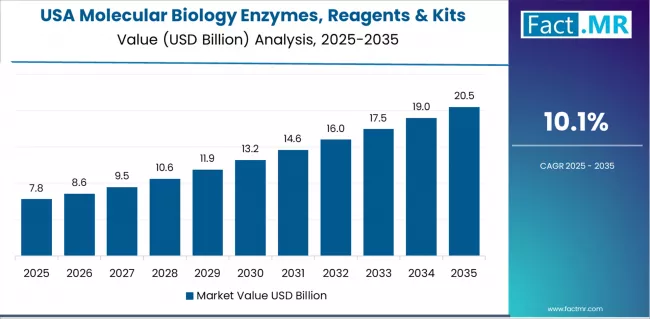
Molecular Biology Enzymes, Reagents & Kits Market Country Value Analysis | Source: Fact.MR
USA's market expansion is driven by high molecular diagnostics adoption, including comprehensive testing programs across clinical laboratories in major metropolitan regions, and expanding precision medicine initiatives across multiple healthcare systems. The country demonstrates solid growth potential with a CAGR of 10.1% through 2035, supported by advanced healthcare infrastructure, leading pharmaceutical research operations, and strong integration with clinical genomics programs.
American researchers face evolving challenges related to reimbursement policies and regulatory requirements, requiring ongoing collaboration with healthcare payers and regulatory agencies. However, substantial research funding and established biotechnology ecosystem create compelling business cases for molecular biology product utilization, particularly in regions where pharmaceutical development and clinical diagnostics have a direct impact on healthcare innovation.
Key market characteristics:
- Pharmaceutical research and clinical diagnostics segments showing robust growth with substantial molecular biology requirements
- Regional concentration focused on biotechnology clusters in Boston, San Francisco, San Diego, and Research Triangle
- Future projections indicate continued leadership in gene therapy development and liquid biopsy commercialization programs
- Growing emphasis on companion diagnostics and pharmacogenomics applications in precision medicine workflows
Japan Demonstrates Precision Medicine Focus
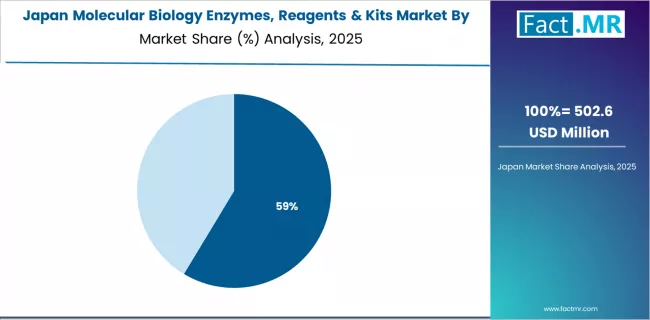
Molecular Biology Enzymes, Reagents & Kits Market Japan Market Share Analysis By Product | Source: Fact.MR
The market in Japan leads in high-quality molecular diagnostics based on integration with aging population healthcare needs and premium clinical testing infrastructure for enhanced disease management. The country shows steady potential with a CAGR of 9.7% through 2035, driven by demographic pressures toward precision diagnostics, strong pharmaceutical industry presence, and the expansion of genomic medicine programs in major medical centers, including Tokyo, Osaka, Kyoto, and Yokohama.
Japanese researchers are adopting advanced molecular biology platforms for cancer genomics and personalized treatment applications, particularly in regions with sophisticated healthcare systems and specialized medical institutions demanding comprehensive molecular testing capabilities. Technology deployment channels through established clinical laboratories and research hospitals expand coverage across cancer centers and specialty diagnostic providers.
Leading market segments:
- Clinical diagnostics and pharmaceutical research operations implementing comprehensive molecular testing programs
- Strategic partnerships with international reagent suppliers, achieving stringent quality specifications and performance standards
- Collaborative research between medical institutions and biotechnology companies are expanding innovation capabilities
- Focus on cancer genomics and rare disease diagnosis through advanced molecular techniques
Germany Emphasizes Research Excellence
In major research centers including Munich, Heidelberg, Berlin, and Hamburg, pharmaceutical companies and academic institutions are implementing comprehensive molecular biology strategies to optimize research programs and improve drug development outcomes, with documented case studies showing significant productivity improvements through advanced genomics platforms and high-throughput screening technologies.
The market shows steady growth potential with a CAGR of 9.3% through 2035, linked to established research infrastructure, diversified pharmaceutical industry base, and ongoing cancer genomics initiatives in major research regions.
German researchers are adopting consistent molecular biology workflows and quality assurance protocols to enhance research efficiency while maintaining performance standards demanded by regulatory requirements and scientific publication criteria. The country's mature research infrastructure creates persistent demand for reliable reagent supply and quality consistency solutions that integrate with existing laboratory systems.
Market development factors:
- Pharmaceutical companies and academic research centers leading molecular biology consumption across Germany
- Research funding policies and innovation support programs providing comprehensive infrastructure development
- Strategic relationships between German research institutions and international reagent manufacturers are expanding supply security
- Emphasis on reproducibility standards and technical excellence across molecular biology applications
UK Shows Genomics Initiative Leadership
UK's molecular biology market demonstrates strategic positioning focused on government genomics programs and healthcare system integration, with documented adoption of comprehensive sequencing initiatives achieving population-scale genomic analysis through Genomics England and NHS genomic medicine programs in major medical centers across England, Scotland, Wales, and Northern Ireland.
The country maintains steady growth momentum with a CAGR of 8.9% through 2035, driven by national genomics strategy implementation, established pharmaceutical research presence, and strategic investment in precision medicine infrastructure. Major research institutions, including operations in Cambridge, London, Oxford, and Manchester, showcase advanced deployment of molecular biology technologies where genomics integration supports clinical decision-making and comprehensive disease research programs.
Key market characteristics:
- Healthcare system genomics programs and pharmaceutical research driving molecular biology adoption with emphasis on clinical translation
- Public-private partnerships enabling genomic medicine integration with comprehensive healthcare delivery programs
- Technology collaboration between UK researchers and international diagnostic companies is expanding market capabilities
- Emphasis on health equity and accessible genomic testing methodologies
Brazil Shows Public Health Integration
Brazil's molecular biology market demonstrates expanding landscape focused on molecular testing expansion in public healthcare sector, with documented adoption of PCR diagnostics achieving improved disease surveillance and infectious disease management across major public health laboratories in São Paulo, Rio de Janeiro, Brasília, and Belo Horizonte.
The country shows promising growth momentum with a CAGR of 8.4% through 2035, driven by expanding molecular diagnostics infrastructure, growing pharmaceutical research operations, and strategic investments in public health laboratory capacity. Brazil's emphasis on infectious disease management and tropical medicine research creates requirements for accessible molecular testing solutions that support comprehensive public health initiatives and clinical diagnostic programs. The market benefits from strong partnerships between public health agencies and reagent suppliers, creating comprehensive supply ecosystems that prioritize product accessibility and technical support.
Key market characteristics:
- Public health laboratories and research institutions driving molecular biology requirements with emphasis on diagnostic accessibility
- Disease surveillance programs enabling comprehensive testing infrastructure with expanding laboratory networks
- Technology collaboration between Brazilian health authorities and international manufacturers is expanding supply capabilities
- Emphasis on infectious disease diagnostics and endemic disease research methodologies
Europe Market Split by Country
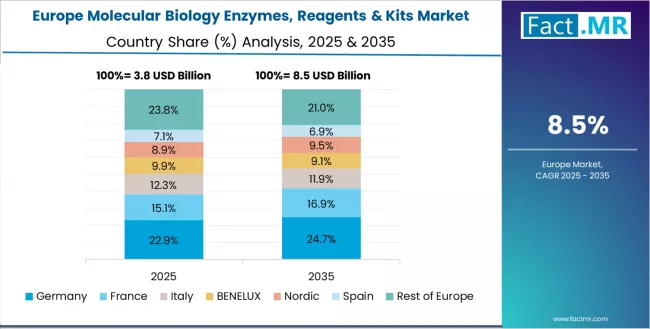
Molecular Biology Enzymes, Reagents & Kits Market Europe Country Market Share Analysis, 2025 & 2035 | Source: Fact.MR
The molecular biology enzymes, reagents & kits market in Europe is projected to grow from USD 4.2 billion in 2025 to USD 10.8 billion by 2035, registering a CAGR of 9.9% over the forecast period. Germany is expected to maintain its leadership position with a 28.7% market share in 2025, supported by its advanced pharmaceutical research infrastructure, comprehensive genomics programs, and strong academic research presence across major scientific centers.
The UK follows with a 22.4% share in 2025, driven by government genomics initiatives and integrated healthcare system programs. France holds a 19.8% share in 2025 through its established pharmaceutical industry and comprehensive research infrastructure. Switzerland commands a 15.3% share, while Rest of Europe accounts for 13.8% in 2025.
By 2035, Germany is projected to hold 28.2% share, UK 22.8%, France 20.1%, Switzerland 15.5%, and Rest of Europe 13.4%, reflecting sustained growth momentum across all major European markets and increasing molecular biology adoption in diversified research operations implementing advanced genomics and diagnostic development programs.
Competitive Landscape of the Molecular Biology Enzymes, Reagents & Kits Market
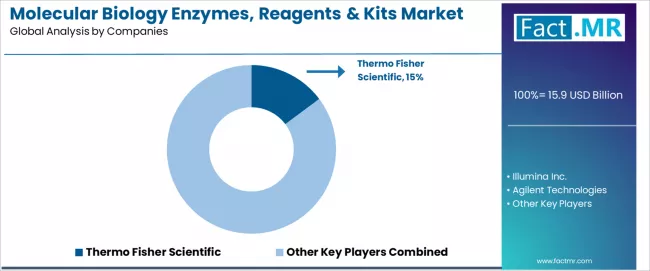
Molecular Biology Enzymes, Reagents & Kits Market Analysis By Company | Source: Fact.MR
The molecular biology enzymes, reagents & kits market features approximately 30-40 meaningful players with moderate to high concentration, where the top three companies control roughly 35-45% of global market share through established product portfolios and extensive distribution networks across life sciences sectors.
Market leaders include Thermo Fisher Scientific, Illumina Inc., and Agilent Technologies, which maintain competitive advantages through comprehensive molecular biology product portfolios, global distribution networks, and deep expertise in the life sciences research and diagnostics sectors, creating strong customer relationships among pharmaceutical companies and research institutions.
These companies leverage established brand recognition and ongoing product innovation initiatives to defend market positions while expanding into adjacent genomics applications and diagnostic platform markets. Thermo Fisher Scientific commands approximately 14.8% market share through integrated life sciences solutions and strategic positioning in research and clinical markets.
Challengers encompass QIAGEN, Promega Corporation, and New England Biolabs, which compete through specialized product offerings and strong technical reputation in molecular biology research communities. Specialty producers, including Merck KGaA, F. Hoffmann-La Roche Ltd., and Bio-Rad Laboratories, focus on specific application segments or technology platforms, offering differentiated capabilities in assay development, quality systems, and technical support services.
Regional players and emerging manufacturers create competitive pressure through innovative enzyme technologies and specialized reagent formulations, particularly in high-growth markets including China and India, where local presence provides advantages in market responsiveness and customer engagement.
Market dynamics favor companies that combine proven product quality with comprehensive technical support infrastructure that addresses the complete value chain from product development through manufacturing, distribution, and customer application support. Strategic investments in automation compatibility and digital integration capabilities enable enhanced workflow efficiency and data management functionality across molecular biology operations.
Global Molecular Biology Enzymes, Reagents & Kits Market - Stakeholder Contribution Framework
Molecular biology enzymes, reagents & kits represent critical research tools that enable pharmaceutical companies, academic institutions, and diagnostic laboratories to advance scientific discovery and clinical applications without substantial methodology modifications, typically providing essential amplification, sequencing, and analysis capabilities while supporting diverse research and diagnostic workflows.
With the market projected to grow from USD 15.9 billion in 2025 to USD 41.9 billion by 2035 at a 10.2% CAGR, these products offer compelling advantages - validated performance, consistent quality, and comprehensive technical support - making them essential for sequencing applications (largest application segment), PCR-based research (established adoption), and diverse molecular investigations seeking proven research tools. Scaling innovation and market development requires coordinated action across research policy, industry standards, reagent manufacturers, technology providers, and scientific institutions.
How Governments Could Spur Research Infrastructure and Adoption?
- Research Funding Programs: Include molecular biology infrastructure in national science strategies, providing targeted grants for genomics facilities in priority research regions and supporting academic laboratories through equipment funding and reagent procurement programs.
- Healthcare Integration Initiatives: Implement comprehensive molecular diagnostics integration into public healthcare systems, provide reimbursement frameworks for genetic testing services, and establish quality standards that support molecular testing adoption across clinical laboratories.
- Regulatory Harmonization & Standards: Create balanced regulatory frameworks across research and diagnostic applications, establish international quality standards for molecular reagents, and develop approval pathways that facilitate innovation while ensuring product quality and safety.
- Skills Development & Training: Fund technical education programs for molecular biologists, laboratory technicians, and clinical specialists. Invest in knowledge transfer initiatives that bridge academic research with clinical application and diagnostic implementation.
How Industry Bodies Could Support Market Development?
- Quality Standards & Certification: Define standardized performance specifications for molecular biology products across research and diagnostic applications, establish universal validation protocols and quality metrics, and create certification programs for reagent quality that researchers can trust.
- Market Education & Best Practices: Lead communication initiatives that demonstrate molecular biology applications, emphasizing proven research advantages, experimental reproducibility, and quality consistency compared to alternative methodologies and custom reagent formulations.
- Sustainability Standards: Develop environmental performance benchmarks for reagent manufacturing operations, comprehensive waste management methodologies, and responsible sourcing practices, ensuring sustainable production across different manufacturing environments and operational scales.
How Manufacturers and Technology Players Could Strengthen the Ecosystem?
- Product Innovation & Development: Develop next-generation enzyme formulations with enhanced performance characteristics, improved stability profiles, and application-specific features that enhance research productivity while improving experimental economics and result quality.
- Technical Support Platforms: Provide comprehensive application support that integrates protocol optimization, troubleshooting assistance, quality validation, and performance documentation, enabling researchers to maximize product utility and experimental success.
- Supply Chain Reliability: Offer consistent product availability for pharmaceutical researchers and diagnostic laboratories, including inventory management services, expedited delivery options, and supply security programs that keep reagent supply aligned with research timelines and production requirements.
Key Players in the Molecular Biology Enzymes, Reagents & Kits Market
- Thermo Fisher Scientific
- Illumina Inc.
- Agilent Technologies
- QIAGEN
- Promega Corporation
- New England Biolabs
- Merck KGaA
- F. Hoffmann-La Roche Ltd.
- Bio-Rad Laboratories
- Takara Bio Inc.
Segmentation
Scope of the Report
| Items | Values |
|---|---|
| Quantitative Units | USD 15.9 Billion |
| Product | Kits & Reagents, Enzymes |
| Application | Sequencing, PCR, Epigenetics, Genotyping, RCA/MDA, RNA Therapeutics, Transcriptomics, Proteomics, Liquid Biopsy, Other Applications |
| End-Use | Pharma & Biotech, Academic & Research, Hospital & Diagnostics, Others |
| Regions Covered | North America, Europe, Asia Pacific, Latin America, Middle East & Africa |
| Country Covered | China, India, USA, Japan, Germany, UK, Brazil, and 40+ countries |
| Key Companies Profiled | Thermo Fisher Scientific, Illumina Inc., Agilent Technologies, QIAGEN, Promega Corporation, New England Biolabs, Merck KGaA, F. Hoffmann-La Roche Ltd., Bio-Rad Laboratories, Takara Bio Inc. |
| Additional Attributes | Dollar sales by product categories, application segments, and end-use sectors, regional adoption trends across North America, Europe, and Asia Pacific, competitive landscape with reagent manufacturers and biotechnology companies, product specifications and quality requirements, integration with sequencing platforms and diagnostic testing systems. |
Source: Fact.MR analysis. Updated Dec 1, 2025
Molecular Biology Enzymes, Reagents & Kits Market by Segments
-
Product :
- Kits & Reagents
- PCR Kits
- qPCR Kits
- RT-PCR Kits
- Library Preparation Kits
- Cloning Kits
- Purification Kits
- Gene Editing Kits
- Other Kits
- Enzymes
- Polymerases
- RNA Polymerases
- Reverse Transcriptases
- Ligases
- Nucleases
- CRISPR-associated Enzymes
- Specialty Enzymes
- TdTs
- Kinases
- Phosphatases
- Others
- Kits & Reagents
-
Application :
- Sequencing
- PCR
- Epigenetics
- Genotyping
- RCA/MDA
- RNA Therapeutics
- Transcriptomics
- Proteomics
- Liquid Biopsy
- Other Applications
-
End-Use :
- Pharma & Biotech
- Academic & Research
- Hospital & Diagnostics
- Others
-
Region :
- North America
- USA
- Canada
- Mexico
- Europe
- Germany
- UK
- France
- Switzerland
- Rest of Europe
- Asia Pacific
- China
- India
- Japan
- South Korea
- Australia & New Zealand
- Rest of Asia Pacific
- Latin America
- Brazil
- Rest of Latin America
- Middle East & Africa
- Kingdom of Saudi Arabia
- Other GCC Countries
- Turkey
- South Africa
- Rest of Middle East & Africa
- North America
Frequently Asked Questions
How big is the molecular biology enzymes, reagents & kits market in 2025?
What will be the size of molecular biology enzymes, reagents & kits market in 2035?
How much will be the molecular biology enzymes, reagents & kits market growth between 2025 and 2035?
What are the key product types in the molecular biology enzymes, reagents & kits market?
Which application segment to contribute significant share in the molecular biology enzymes, reagents & kits market in 2025?
Who worked on this report


Preview the report firsthand - request a free sample
Free SampleGet the brochure for pricing and purchase details
Download PDF