Stick-Based Body Lotions Market (2026 - 2036)

Stick-Based Body Lotions Market Size and Share Forecast Outlook 2026 to 2036

Core Findings

    Stick-Based Body Lotions Market Forecast and Outlook 2026 to 2036

    The stick-based body lotions market is projected to reach a value of USD 17.0 billion in 2026 and is expected to expand steadily to USD 24.9 billion by 2036, registering a compound annual growth rate of 3.9% over the forecast period. While headline growth remains measured compared with faster-moving skincare sub-segments, stick formats are gaining strategic importance as body care portfolios evolve toward higher efficacy and sustainability-driven designs.

    Key Takeaways from the Stick-Based Body Lotions Market

    • Stick-Based Body Lotions Market Value (2026): USD 17.0 billion
    • Stick-Based Body Lotions Market Forecast Value (2036): USD 24.9 billion
    • Stick-Based Body Lotions Market Forecast CAGR (2026-2036): 3.9%
    • Leading Skin Concern: Dry and Ultra Hydration (34.70%)
    • Key Growth Regions: Asia Pacific, North America, Middle East & Europe
    • Leading Market Participants: Unilever, L’Oréal Group, Procter & Gamble, Johnson & Johnson, Beiersdorf AG, Shiseido Co., Estée Lauder Companies, Avon, Coty / Calvin Klein Group, and Amway.
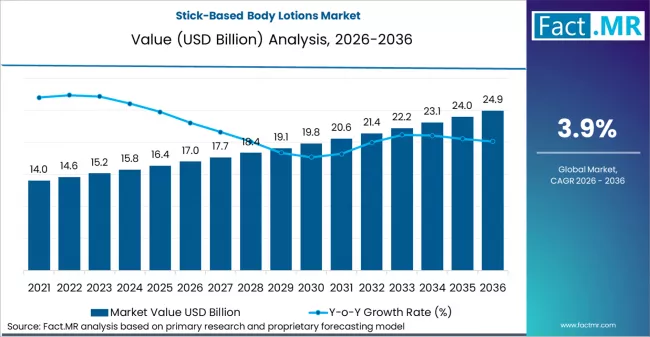
    Stick Based Body Lotions Market Market Value Analysis

    Stick-based lotions increasingly operate at the intersection of premiumization, regulatory compliance, and formulation efficiency. Waterless delivery systems, concentrated actives, and friction-resistant application formats align closely with urban lifestyles shaped by climate stress and extended daily wear. As body care adopts facial skincare logic, stick formats are moving beyond convenience into high-margin platforms capable of supporting advanced actives, targeted claims, and refillable architectures.

    Senior leadership across global beauty companies now view stick-based lotions as operational enablers rather than liquid extensions. Reflecting this shift, Esi Eggleston Bracey, Chief Growth and Marketing Officer at Unilever, noted in a 2025 address: “We are entering an era of ‘Desire at Scale,’ where high-performance formulas and sensorial appeal converge. Whole-body stick innovations respond directly to consumer demand for precision, efficacy, and ease of use.”

    Stick-Based Body Lotions Market

    Metric Value
    Estimated Value in (2026E) USD 17.0 billion
    Forecast Value in (2036F) USD 24.9 billion
    Forecast CAGR (2026 to 2036) 3.9 %

    Category 

    Category Segments
    Skin Concern Dry / Ultra-Hydrating, Sensitive / Soothing, Anti-aging / RejuvenatingDaily Moisturizing
    Distribution Channel Online retail, Supermarkets & Hypermarkets, Beauty & Specialty StoresPharmacy
    Region North America; Europe; Asia Pacific; Latin America; Middle East & Africa

    Segmental Analysis

    By Skin Concern, Which Segment Accounts for the Largest Share in the Stick-Based Body Lotions Market?
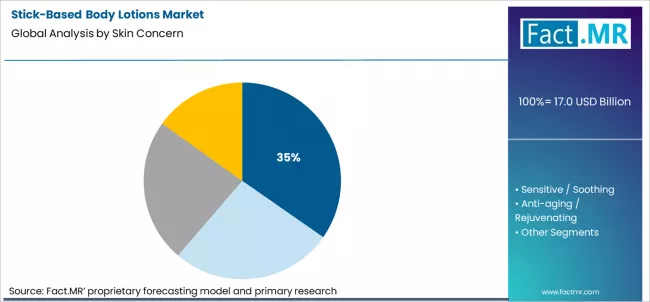
    Stick Based Body Lotions Market Analysis By Skin Concern

    The stick-based body lotions market is decisively shifting from broad, general-purpose moisturization toward targeted, therapeutic skin solutions. This transition is enabled by the solid-stick format, which supports higher concentrations of functional actives without the dilution inherent to water-based lotions, allowing brands to address specific skin conditions with greater precision and efficacy.

    Dry and ultra-hydrating applications dominate the market, accounting for 34.7% share in 2026. Stick formats create a stronger occlusive barrier on the skin surface, significantly reducing transepidermal water loss and delivering prolonged hydration. This makes them particularly effective for extremely dry areas such as elbows, heels, and knees, driving consistent repeat usage.

    By Distribution Channel, Which Channel Leads Sales of Stick-Based Body Lotions?
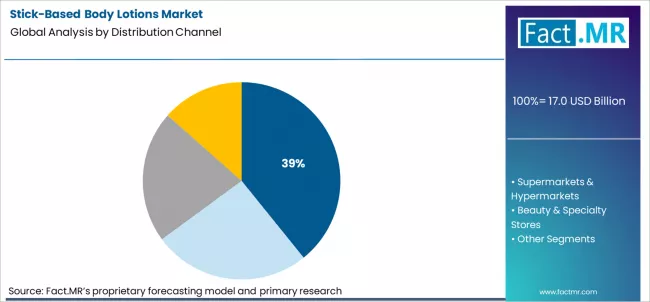
    Stick Based Body Lotions Market Analysis By Distribution Channel

    Distribution dynamics for stick-based body lotions increasingly favor channels that support education, discovery, and format differentiation. Online retail leads with a 39.2% share in 2026, benefiting from the leak-proof nature of sticks, lower shipping costs, and reduced return rates compared to liquid lotions. Digital platforms also allow brands to communicate product benefits and usage more effectively through content and reviews.

    Supermarkets and hypermarkets remain important volume channels but are gradually losing share as consumers migrate toward more specialized environments for non-traditional formats. Beauty and specialty stores play a critical role in premiumization, offering in-store testing that helps overcome skepticism around texture and finish.

    Drivers, Restraints, and Key Trends in the Stick-Based Body Lotions Market

    • Drivers: The stick-based body lotions market is gaining momentum as urban lifestyles increasingly favor compact, spill-proof, and travel-friendly personal care formats. Rapid urbanization and the rise of on-the-go grooming have heightened demand for products that deliver effective hydration without mess or leakage. The expanding waterless beauty movement has further strengthened adoption, positioning stick-based lotions as sustainable and high-potency alternatives to conventional liquid formulations. At the same time, the growing “facification” of body care, where advanced skincare actives traditionally used in facial products are incorporated into body applications. has elevated sticks from convenience items to performance-driven solutions. Strong growth of online retail and social-media-led product education continues to support wider consumer acceptance and repeat usage.
    • Restraints: Despite increasing adoption, certain challenges persist. Some consumers perceive solid lotions as heavier or slower to absorb than water-based emulsions, which may limit usage among oily skin types. In emerging markets, the higher cost of anhydrous formulations can restrict penetration among price-sensitive consumers. Additionally, evolving regulatory requirements around ingredient safety and allergen disclosure increase reformulation costs and can delay product launches, particularly for smaller brands.
    • Trend 1: Shift Toward Clinical-Grade Solid Formulations Brands are increasingly developing concentrated, water-free formulations that emphasize clinical efficacy and ingredient transparency. The stick format enables delivery of high-performance actives while reducing water usage, aligning with consumer expectations for both results and sustainability.
    • Trend 2: Growth of Multifunctional and Targeted Solutions Innovation is accelerating in problem-specific stick formats addressing friction zones, barrier repair, and specialized skin needs. These multifunctional products offer precise application and improved performance, reinforcing the role of stick-based lotions as strategic, high-value components of modern body care portfolios.

    Analysis of the Stick-Based Body Lotions Market by Key Country
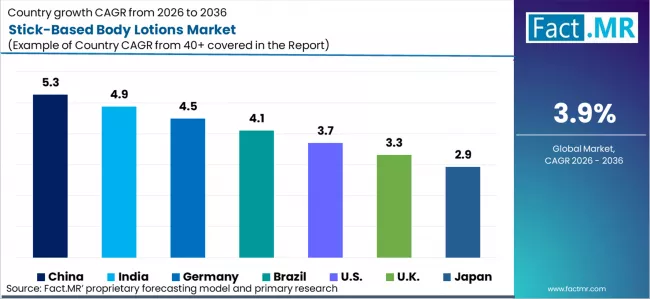
    Stick Based Body Lotions Market Cagr Analysis By Country

    Country CAGR 2026 to 2036
    China 5.3%
    India 4.9%
    Germany 4.5%
    Brazil 4.1 %
    USA 3.7%
    UK 3.3%
    Japan 2.9%

    How is the rise of skin-tellectual body care routines driving functional stick adoption in China?

    China represents the fastest-growing market, expanding at a CAGR of 5.3%, supported by increasing consumer demand for high-potency, localized body treatments inspired by facial skincare science. Functional sticks containing retinol and niacinamide are gaining traction as consumers seek targeted brightening and repair benefits. OEM and ODM manufacturers have rapidly scaled high-precision stick production to meet premium demand. Growth is moderated by value-driven premiumisation, as consumers increasingly assess price-to-performance ratios, limiting ultra-luxury adoption beyond Tier-1 cities.

    How are climate stress and urban youth preferences accelerating the shift toward stick-based body lotions in India?

    India’s market is growing at a CAGR of 4.9%, driven by urban heat stress, high humidity, and rising demand for non-sticky, fast-absorbing skincare formats. Serum-burst stick formulations address these conditions effectively, supporting adoption among younger urban consumers. Localized launches such as Vaseline’s Gluta-Hya stick formats reinforce demand. However, strong price sensitivity and uneven distribution beyond major cities continue to restrain deeper market penetration.

    How are EU chemical bans and clean formulation mandates influencing stick-based body lotion strategies in Germany?

    Germany is expanding at a CAGR of 4.5%, largely due to compliance with EU Omnibus Acts VII and VIII restricting CMR substances. These regulations have accelerated the shift toward clean, mono-material stick formats that simplify compliance ahead of 2026 deadlines. Brands such as Beiersdorf have responded with natural-origin solid products. Growth is tempered by strict regulatory approval processes that increase formulation timelines and development costs.

    Brazil’s market is growing at a CAGR of 4.1%, supported by high-frequency body care rituals and strong cultural emphasis on fragrance and hydration layering. Stick-based lotions that function as fragrance extenders resonate strongly, driving premium adoption. Brands leveraging scent-led positioning have seen outsized growth. Economic volatility and inflationary pressure, however, periodically constrain discretionary spending on premium body care formats.

    How is the shift toward whole-body care and dermatologist-backed actives reshaping stick-based body lotion adoption in the U.S.?

    The U.S. market is growing at a CAGR of 3.7%, driven by consumer expectations for multifunctional body care combining hydration, friction control, and skin repair. Whole-body stick innovations with clinically backed actives have achieved mass-market acceptance. However, category maturity and shelf saturation from legacy liquid lotions limit volume growth, making replacement demand and innovation the primary growth levers.

    How is packaging EPR reform accelerating the transition to mono-material stick formats in the UK?

    The UK market is expanding at a CAGR of 3.3%, shaped by Packaging Extended Producer Responsibility reforms that penalize complex liquid packaging. Stick formats offer a lower-tax alternative, supporting gradual adoption. Pharmacy-led distribution strengthens demand for sensitive-skin sticks, while administrative complexity during regulatory transition continues to challenge smaller brands.

    How are sustainability-led wellness initiatives shaping stick-based body lotion innovation in Japan?

    Japan records the slowest growth at a CAGR of 2.9%, reflecting a mature and highly selective consumer base. Innovation is driven by sustainability-focused wellness strategies, including algae-derived and water-efficient stick prototypes. Adoption remains measured due to conservative purchasing behavior and stringent performance expectations, resulting in steady but restrained market expansion.

    Competitive Landscape Evolution of the Stick-Based Body Lotions Market

    The competitive structure of the stick-based body lotions market has undergone a clear strategic reorientation over the past two years. Before 2024, most established brands positioned stick formats as convenience-led extensions to liquid portfolios. These products were designed for travel or gym use, relied heavily on wax-based occlusive, and received limited research investment. Sticks functioned as secondary SKUs, supporting niche use cases such as anti-chafe protection rather than long-term skin health.

    From 2025 onward, leading players have shifted decisively. Evidence from global beauty groups shows that stick formats are now treated as primary innovation platforms rather than accessories. Premiumisation has become central, with brands embedding facial-grade actives into solid formats to deliver higher efficacy through concentrated, water-free systems. This transition supports superior ingredient stability, precision application, and stronger consumer retention. At the same time, supply-chain strategy has evolved. Localized manufacturing hubs, particularly in the Middle East, reduce exposure to global volatility while supporting regional demand and export scalability.

    Regulatory pressure has further reinforced this shift. Waterless formulations address sustainability mandates while improving gross margins through lower transport weight and packaging intensity. Looking ahead, competitive advantage will rest on solid-state formulation science, refillable architectures, and data-driven personalization. By 2028, stick-based body lotions are expected to emerge as one of the most profitable and strategically resilient delivery systems in the global body care market.

    Key Players in Stick-Based Body Lotions Market

    • Unilever
    • L’Oréal Group
    • Procter & Gamble
    • Johnson & Johnson
    • Beiersdorf AG
    • Shiseido Co.
    • Estée Lauder Companies
    • Avon
    • Coty / Calvin Klein Group
    • Amway

    Scope of Report

    Items Values
    Quantitative Units (2026) USD 17.0 Billion
    Skin Concern Dry / Ultra-Hydrating, Sensitive / Soothing, Anti-aging / RejuvenatingDaily Moisturizing
    Distribution Channel Online retail, Supermarkets & Hypermarkets, Beauty & Specialty StoresPharmacy
    Regions Covered North America, Europe, Asia Pacific, Latin America, Middle East & Africa
    Countries Covered U.S., Canada, Germany, Italy, UK, France, Japan, Australia, and other countries
    Key Companies Profiled Unilever, L’Oréal Group, Procter & Gamble, Johnson & Johnson, Beiersdorf AG, Shiseido Co., Estée Lauder Companies, Avon, Coty / Calvin Klein Group, and Amway.
    Additional Attributes Dollar revenue is segmented by product format, skin concern, ingredient type, distribution channel, end user, and region. Regional demand trends are shaped by fast-paced urban lifestyles, growing preference for waterless and convenient body care formats, rising premiumization of daily skincare routines, and rapid expansion of online, social commerce, and influencer-led beauty channels.

    Stick-Based Body Lotions Market by Segments 

    • Skin Concerns :

      • Dry / Ultra-Hydrating
      • Sensitive / Soothing
      • Anti-aging / Rejuvenating
      • Daily Moisturizing
    • Distribution Channel :

      • Online retail
      • Supermarkets & Hypermarkets
      • Beauty & Specialty Stores
      • Pharmacy
    • Region :

      • Asia Pacific
        • Japan
        • South Korea
        • China
        • Australia
        • New Zealand
        • Rest of Asia Pacific
      • North America
        • United States
        • Canada
        • Mexico
      • Europe
        • France
        • Italy
        • Spain
        • Norway
        • UK
        • Rest of Europe
      • Latin America
        • Chile
        • Peru
        • Argentina
        • Rest of Latin America

    Bibliography

    • International Organization for Standardization. 2023. Cosmetics and personal care products: Safety assessment, formulation standards, and quality management of solid, waterless, and anhydrous body care products. ISO Technical Report. International Organization for Standardization, Geneva.
    • European Committee for Standardization. 2022. Cosmetic product performance and safety evaluation: Ingredient transparency, dermatological testing, and consumer compliance in body care and moisturizing formulations. EN Technical Report. CEN, Brussels.
    • International Federation of Societies of Cosmetic Chemists. 2024. Advances in solid-format body care technologies, anhydrous delivery systems, and high-concentration active formulation science. IFSCC Publications.
    • Journal of Cosmetic Science Editorial Board. 2024. Solid and waterless body care innovations: Occlusive performance, skin barrier compatibility, and consumer usage evaluation. Journal of Cosmetic Science 75(4): 245-262.
    • Personal Care Products Council. 2023. Trends in waterless beauty, solid-format personal care products, and sustainable body care development. PCPC, Washington, DC.

    Table of Content

    1. Executive Summary
      • Supply to side Trends
      • Technology Roadmap Analysis
      • Analysis and Recommendations
    2. Market Overview
      • Market Coverage / Taxonomy
      • Market Definition / Scope / Limitations
    3. Research Methodology
      • Desk Research Programme (Secondary Evidence)
        • Company Annual and Sustainability Reports
        • Peer-reviewed Journals and Academic Literature
        • Corporate Websites, Product Literature, and Technical Notes
        • Earnings Decks and Investor Briefings
        • Statutory Filings and Regulatory Disclosures
        • Technical White Papers and Standards Notes
        • Trade Journals, Industry Magazines, and Analyst Briefs
        • Conference Proceedings, Webinars, and Seminar Materials
        • Government Statistics Portals and Public Data Releases
        • Press Releases and Reputable Media Coverage
        • Specialist Newsletters and Curated Briefings
        • Sector Databases and Reference Repositories
        • FMR Internal Proprietary Databases and Historical Market Datasets
        • Subscription Datasets and Paid Sources
        • Social Channels, Communities, and Digital Listening Inputs
        • Additional Desk Sources
      • Scientists
      • Physicians and Other Healthcare Professionals
    4. Governance, Ethics, and Data Stewardship
      • Research Ethics
      • Data Integrity and Handling
    5. Tooling, Models, and Reference Databases
    6. Data Engineering and Model Build
      • Data Acquisition and Ingestion
      • Cleaning, Normalisation, and Verification
      • Synthesis, Triangulation, and Analysis
    7. Quality Assurance and Audit Trail
    8. Market Background
      • Market Dynamics
        • Drivers
        • Restraints
        • Opportunity
        • Trends
      • Scenario Forecast
        • Demand in Optimistic Scenario
        • Demand in Likely Scenario
        • Demand in Conservative Scenario
      • Opportunity Map Analysis
      • Product Life Cycle Analysis
      • Supply Chain Analysis
      • Investment Feasibility Matrix
      • Value Chain Analysis
      • PESTLE and Porter’s Analysis
      • Regulatory Landscape
      • Regional Parent Market Outlook
      • Production and Consumption Statistics
      • Import and Export Statistics
    9. Global Market Analysis 2021 to 2025 and Forecast, 2026 to 2036
      • Historical Market Size Value (USD Million) Analysis, 2021 to 2025
      • Current and Future Market Size Value (USD Million) Projections, 2026 to 2036
        • Y to o to Y Growth Trend Analysis
        • Absolute $ Opportunity Analysis
    10. Global Market Pricing Analysis 2021 to 2025 and Forecast 2026 to 2036
    11. Global Market Analysis 2021 to 2025 and Forecast 2026 to 2036, By Skin Concern
      • Introduction / Key Findings
      • Historical Market Size Value (USD Million) Analysis By Skin Concern, 2021 to 2025
      • Current and Future Market Size Value (USD Million) Analysis and Forecast By Skin Concern, 2026 to 2036
        • Dry / Ultra-Hydrating
        • Sensitive / Soothing
        • Anti-aging / Rejuvenating
        • Daily Moisturizing
      • Y to o to Y Growth Trend Analysis By Skin Concern, 2021 to 2025
      • Absolute $ Opportunity Analysis By Skin Concern, 2026 to 2036
    12. Global Market Analysis 2021 to 2025 and Forecast 2026 to 2036, By Distribution Channel
      • Introduction / Key Findings
      • Historical Market Size Value (USD Million) Analysis By Distribution Channel, 2021 to 2025
      • Current and Future Market Size Value (USD Million) Analysis and Forecast By Distribution Channel, 2026 to 2036
        • Online retail
        • Supermarkets & Hypermarkets
        • Beauty & Specialty Stores
        • Pharmacy
      • Y to o to Y Growth Trend Analysis By Distribution Channel, 2021 to 2025
      • Absolute $ Opportunity Analysis By Distribution Channel, 2026 to 2036
    13. Global Market Analysis 2021 to 2025 and Forecast 2026 to 2036, By Region
      • Introduction
      • Historical Market Size Value (USD Million) Analysis By Region, 2021 to 2025
      • Current Market Size Value (USD Million) Analysis and Forecast By Region, 2026 to 2036
        • North America
        • Latin America
        • Western Europe
        • Eastern Europe
        • East Asia
        • South Asia and Pacific
        • Middle East & Africa
      • Market Attractiveness Analysis By Region
    14. North America Market Analysis 2021 to 2025 and Forecast 2026 to 2036, By Country
      • Historical Market Size Value (USD Million) Trend Analysis By Market Taxonomy, 2021 to 2025
      • Market Size Value (USD Million) Forecast By Market Taxonomy, 2026 to 2036
        • By Country
          • USA
          • Canada
          • Mexico
        • By Skin Concern
        • By Distribution Channel
      • Market Attractiveness Analysis
        • By Country
        • By Skin Concern
        • By Distribution Channel
      • Key Takeaways
    15. Latin America Market Analysis 2021 to 2025 and Forecast 2026 to 2036, By Country
      • Historical Market Size Value (USD Million) Trend Analysis By Market Taxonomy, 2021 to 2025
      • Market Size Value (USD Million) Forecast By Market Taxonomy, 2026 to 2036
        • By Country
          • Brazil
          • Chile
          • Rest of Latin America
        • By Skin Concern
        • By Distribution Channel
      • Market Attractiveness Analysis
        • By Country
        • By Skin Concern
        • By Distribution Channel
      • Key Takeaways
    16. Western Europe Market Analysis 2021 to 2025 and Forecast 2026 to 2036, By Country
      • Historical Market Size Value (USD Million) Trend Analysis By Market Taxonomy, 2021 to 2025
      • Market Size Value (USD Million) Forecast By Market Taxonomy, 2026 to 2036
        • By Country
          • Germany
          • UK
          • Italy
          • Spain
          • France
          • Nordic
          • BENELUX
          • Rest of Western Europe
        • By Skin Concern
        • By Distribution Channel
      • Market Attractiveness Analysis
        • By Country
        • By Skin Concern
        • By Distribution Channel
      • Key Takeaways
    17. Eastern Europe Market Analysis 2021 to 2025 and Forecast 2026 to 2036, By Country
      • Historical Market Size Value (USD Million) Trend Analysis By Market Taxonomy, 2021 to 2025
      • Market Size Value (USD Million) Forecast By Market Taxonomy, 2026 to 2036
        • By Country
          • Russia
          • Poland
          • Hungary
          • Balkan & Baltic
          • Rest of Eastern Europe
        • By Skin Concern
        • By Distribution Channel
      • Market Attractiveness Analysis
        • By Country
        • By Skin Concern
        • By Distribution Channel
      • Key Takeaways
    18. East Asia Market Analysis 2021 to 2025 and Forecast 2026 to 2036, By Country
      • Historical Market Size Value (USD Million) Trend Analysis By Market Taxonomy, 2021 to 2025
      • Market Size Value (USD Million) Forecast By Market Taxonomy, 2026 to 2036
        • By Country
          • China
          • Japan
          • South Korea
        • By Skin Concern
        • By Distribution Channel
      • Market Attractiveness Analysis
        • By Country
        • By Skin Concern
        • By Distribution Channel
      • Key Takeaways
    19. South Asia and Pacific Market Analysis 2021 to 2025 and Forecast 2026 to 2036, By Country
      • Historical Market Size Value (USD Million) Trend Analysis By Market Taxonomy, 2021 to 2025
      • Market Size Value (USD Million) Forecast By Market Taxonomy, 2026 to 2036
        • By Country
          • India
          • ASEAN
          • Australia & New Zealand
          • Rest of South Asia and Pacific
        • By Skin Concern
        • By Distribution Channel
      • Market Attractiveness Analysis
        • By Country
        • By Skin Concern
        • By Distribution Channel
      • Key Takeaways
    20. Middle East & Africa Market Analysis 2021 to 2025 and Forecast 2026 to 2036, By Country
      • Historical Market Size Value (USD Million) Trend Analysis By Market Taxonomy, 2021 to 2025
      • Market Size Value (USD Million) Forecast By Market Taxonomy, 2026 to 2036
        • By Country
          • Kingdom of Saudi Arabia
          • Other GCC Countries
          • Turkiye
          • South Africa
          • Other African Union
          • Rest of Middle East & Africa
        • By Skin Concern
        • By Distribution Channel
      • Market Attractiveness Analysis
        • By Country
        • By Skin Concern
        • By Distribution Channel
      • Key Takeaways
    21. Key Countries Market Analysis
      • USA
        • Pricing Analysis
        • Market Share Analysis, 2025
          • By Skin Concern
          • By Distribution Channel
      • Canada
        • Pricing Analysis
        • Market Share Analysis, 2025
          • By Skin Concern
          • By Distribution Channel
      • Mexico
        • Pricing Analysis
        • Market Share Analysis, 2025
          • By Skin Concern
          • By Distribution Channel
      • Brazil
        • Pricing Analysis
        • Market Share Analysis, 2025
          • By Skin Concern
          • By Distribution Channel
      • Chile
        • Pricing Analysis
        • Market Share Analysis, 2025
          • By Skin Concern
          • By Distribution Channel
      • Germany
        • Pricing Analysis
        • Market Share Analysis, 2025
          • By Skin Concern
          • By Distribution Channel
      • UK
        • Pricing Analysis
        • Market Share Analysis, 2025
          • By Skin Concern
          • By Distribution Channel
      • Italy
        • Pricing Analysis
        • Market Share Analysis, 2025
          • By Skin Concern
          • By Distribution Channel
      • Spain
        • Pricing Analysis
        • Market Share Analysis, 2025
          • By Skin Concern
          • By Distribution Channel
      • France
        • Pricing Analysis
        • Market Share Analysis, 2025
          • By Skin Concern
          • By Distribution Channel
      • India
        • Pricing Analysis
        • Market Share Analysis, 2025
          • By Skin Concern
          • By Distribution Channel
      • ASEAN
        • Pricing Analysis
        • Market Share Analysis, 2025
          • By Skin Concern
          • By Distribution Channel
      • Australia & New Zealand
        • Pricing Analysis
        • Market Share Analysis, 2025
          • By Skin Concern
          • By Distribution Channel
      • China
        • Pricing Analysis
        • Market Share Analysis, 2025
          • By Skin Concern
          • By Distribution Channel
      • Japan
        • Pricing Analysis
        • Market Share Analysis, 2025
          • By Skin Concern
          • By Distribution Channel
      • South Korea
        • Pricing Analysis
        • Market Share Analysis, 2025
          • By Skin Concern
          • By Distribution Channel
      • Russia
        • Pricing Analysis
        • Market Share Analysis, 2025
          • By Skin Concern
          • By Distribution Channel
      • Poland
        • Pricing Analysis
        • Market Share Analysis, 2025
          • By Skin Concern
          • By Distribution Channel
      • Hungary
        • Pricing Analysis
        • Market Share Analysis, 2025
          • By Skin Concern
          • By Distribution Channel
      • Kingdom of Saudi Arabia
        • Pricing Analysis
        • Market Share Analysis, 2025
          • By Skin Concern
          • By Distribution Channel
      • Turkiye
        • Pricing Analysis
        • Market Share Analysis, 2025
          • By Skin Concern
          • By Distribution Channel
      • South Africa
        • Pricing Analysis
        • Market Share Analysis, 2025
          • By Skin Concern
          • By Distribution Channel
    22. Market Structure Analysis
      • Competition Dashboard
      • Competition Benchmarking
      • Market Share Analysis of Top Players
        • By Regional
        • By Skin Concern
        • By Distribution Channel
    23. Competition Analysis
      • Competition Deep Dive
        • Supergoop!
          • Overview
          • Product Portfolio
          • Profitability by Market Segments (Product/Age /Sales Channel/Region)
          • Sales Footprint
          • Strategy Overview
            • Marketing Strategy
            • Product Strategy
            • Channel Strategy
        • EltaMD
        • Beauty of Joseon
        • Isntree
        • Thank You Farmer
        • Minimalist
        • Dot & Key
        • The Derma Co
        • Aqualogica
    24. Assumptions & Acronyms Used

    List Of Table

    • Table 1: Global Market Value (USD Million) Forecast by Region, 2021 to 2036
    • Table 2: Global Market Value (USD Million) Forecast by Skin Concern, 2021 to 2036
    • Table 3: Global Market Value (USD Million) Forecast by Distribution Channel, 2021 to 2036
    • Table 4: North America Market Value (USD Million) Forecast by Country, 2021 to 2036
    • Table 5: North America Market Value (USD Million) Forecast by Skin Concern, 2021 to 2036
    • Table 6: North America Market Value (USD Million) Forecast by Distribution Channel, 2021 to 2036
    • Table 7: Latin America Market Value (USD Million) Forecast by Country, 2021 to 2036
    • Table 8: Latin America Market Value (USD Million) Forecast by Skin Concern, 2021 to 2036
    • Table 9: Latin America Market Value (USD Million) Forecast by Distribution Channel, 2021 to 2036
    • Table 10: Western Europe Market Value (USD Million) Forecast by Country, 2021 to 2036
    • Table 11: Western Europe Market Value (USD Million) Forecast by Skin Concern, 2021 to 2036
    • Table 12: Western Europe Market Value (USD Million) Forecast by Distribution Channel, 2021 to 2036
    • Table 13: Eastern Europe Market Value (USD Million) Forecast by Country, 2021 to 2036
    • Table 14: Eastern Europe Market Value (USD Million) Forecast by Skin Concern, 2021 to 2036
    • Table 15: Eastern Europe Market Value (USD Million) Forecast by Distribution Channel, 2021 to 2036
    • Table 16: East Asia Market Value (USD Million) Forecast by Country, 2021 to 2036
    • Table 17: East Asia Market Value (USD Million) Forecast by Skin Concern, 2021 to 2036
    • Table 18: East Asia Market Value (USD Million) Forecast by Distribution Channel, 2021 to 2036
    • Table 19: South Asia and Pacific Market Value (USD Million) Forecast by Country, 2021 to 2036
    • Table 20: South Asia and Pacific Market Value (USD Million) Forecast by Skin Concern, 2021 to 2036
    • Table 21: South Asia and Pacific Market Value (USD Million) Forecast by Distribution Channel, 2021 to 2036
    • Table 22: Middle East & Africa Market Value (USD Million) Forecast by Country, 2021 to 2036
    • Table 23: Middle East & Africa Market Value (USD Million) Forecast by Skin Concern, 2021 to 2036
    • Table 24: Middle East & Africa Market Value (USD Million) Forecast by Distribution Channel, 2021 to 2036

    List Of Figures

    • Figure 1: Global Market Pricing Analysis
    • Figure 2: Global Market Value (USD Million) Forecast 2021 to 2036
    • Figure 3: Global Market Value Share and BPS Analysis by Skin Concern, 2026 and 2036
    • Figure 4: Global Market Y to o to Y Growth Comparison by Skin Concern, 2026 to 2036
    • Figure 5: Global Market Attractiveness Analysis by Skin Concern
    • Figure 6: Global Market Value Share and BPS Analysis by Distribution Channel, 2026 and 2036
    • Figure 7: Global Market Y to o to Y Growth Comparison by Distribution Channel, 2026 to 2036
    • Figure 8: Global Market Attractiveness Analysis by Distribution Channel
    • Figure 9: Global Market Value (USD Million) Share and BPS Analysis by Region, 2026 and 2036
    • Figure 10: Global Market Y to o to Y Growth Comparison by Region, 2026 to 2036
    • Figure 11: Global Market Attractiveness Analysis by Region
    • Figure 12: North America Market Incremental Dollar Opportunity, 2026 to 2036
    • Figure 13: Latin America Market Incremental Dollar Opportunity, 2026 to 2036
    • Figure 14: Western Europe Market Incremental Dollar Opportunity, 2026 to 2036
    • Figure 15: Eastern Europe Market Incremental Dollar Opportunity, 2026 to 2036
    • Figure 16: East Asia Market Incremental Dollar Opportunity, 2026 to 2036
    • Figure 17: South Asia and Pacific Market Incremental Dollar Opportunity, 2026 to 2036
    • Figure 18: Middle East & Africa Market Incremental Dollar Opportunity, 2026 to 2036
    • Figure 19: North America Market Value Share and BPS Analysis by Country, 2026 and 2036
    • Figure 20: North America Market Value Share and BPS Analysis by Skin Concern, 2026 and 2036
    • Figure 21: North America Market Y to o to Y Growth Comparison by Skin Concern, 2026 to 2036
    • Figure 22: North America Market Attractiveness Analysis by Skin Concern
    • Figure 23: North America Market Value Share and BPS Analysis by Distribution Channel, 2026 and 2036
    • Figure 24: North America Market Y to o to Y Growth Comparison by Distribution Channel, 2026 to 2036
    • Figure 25: North America Market Attractiveness Analysis by Distribution Channel
    • Figure 26: Latin America Market Value Share and BPS Analysis by Country, 2026 and 2036
    • Figure 27: Latin America Market Value Share and BPS Analysis by Skin Concern, 2026 and 2036
    • Figure 28: Latin America Market Y to o to Y Growth Comparison by Skin Concern, 2026 to 2036
    • Figure 29: Latin America Market Attractiveness Analysis by Skin Concern
    • Figure 30: Latin America Market Value Share and BPS Analysis by Distribution Channel, 2026 and 2036
    • Figure 31: Latin America Market Y to o to Y Growth Comparison by Distribution Channel, 2026 to 2036
    • Figure 32: Latin America Market Attractiveness Analysis by Distribution Channel
    • Figure 33: Western Europe Market Value Share and BPS Analysis by Country, 2026 and 2036
    • Figure 34: Western Europe Market Value Share and BPS Analysis by Skin Concern, 2026 and 2036
    • Figure 35: Western Europe Market Y to o to Y Growth Comparison by Skin Concern, 2026 to 2036
    • Figure 36: Western Europe Market Attractiveness Analysis by Skin Concern
    • Figure 37: Western Europe Market Value Share and BPS Analysis by Distribution Channel, 2026 and 2036
    • Figure 38: Western Europe Market Y to o to Y Growth Comparison by Distribution Channel, 2026 to 2036
    • Figure 39: Western Europe Market Attractiveness Analysis by Distribution Channel
    • Figure 40: Eastern Europe Market Value Share and BPS Analysis by Country, 2026 and 2036
    • Figure 41: Eastern Europe Market Value Share and BPS Analysis by Skin Concern, 2026 and 2036
    • Figure 42: Eastern Europe Market Y to o to Y Growth Comparison by Skin Concern, 2026 to 2036
    • Figure 43: Eastern Europe Market Attractiveness Analysis by Skin Concern
    • Figure 44: Eastern Europe Market Value Share and BPS Analysis by Distribution Channel, 2026 and 2036
    • Figure 45: Eastern Europe Market Y to o to Y Growth Comparison by Distribution Channel, 2026 to 2036
    • Figure 46: Eastern Europe Market Attractiveness Analysis by Distribution Channel
    • Figure 47: East Asia Market Value Share and BPS Analysis by Country, 2026 and 2036
    • Figure 48: East Asia Market Value Share and BPS Analysis by Skin Concern, 2026 and 2036
    • Figure 49: East Asia Market Y to o to Y Growth Comparison by Skin Concern, 2026 to 2036
    • Figure 50: East Asia Market Attractiveness Analysis by Skin Concern
    • Figure 51: East Asia Market Value Share and BPS Analysis by Distribution Channel, 2026 and 2036
    • Figure 52: East Asia Market Y to o to Y Growth Comparison by Distribution Channel, 2026 to 2036
    • Figure 53: East Asia Market Attractiveness Analysis by Distribution Channel
    • Figure 54: South Asia and Pacific Market Value Share and BPS Analysis by Country, 2026 and 2036
    • Figure 55: South Asia and Pacific Market Value Share and BPS Analysis by Skin Concern, 2026 and 2036
    • Figure 56: South Asia and Pacific Market Y to o to Y Growth Comparison by Skin Concern, 2026 to 2036
    • Figure 57: South Asia and Pacific Market Attractiveness Analysis by Skin Concern
    • Figure 58: South Asia and Pacific Market Value Share and BPS Analysis by Distribution Channel, 2026 and 2036
    • Figure 59: South Asia and Pacific Market Y to o to Y Growth Comparison by Distribution Channel, 2026 to 2036
    • Figure 60: South Asia and Pacific Market Attractiveness Analysis by Distribution Channel
    • Figure 61: Middle East & Africa Market Value Share and BPS Analysis by Country, 2026 and 2036
    • Figure 62: Middle East & Africa Market Value Share and BPS Analysis by Skin Concern, 2026 and 2036
    • Figure 63: Middle East & Africa Market Y to o to Y Growth Comparison by Skin Concern, 2026 to 2036
    • Figure 64: Middle East & Africa Market Attractiveness Analysis by Skin Concern
    • Figure 65: Middle East & Africa Market Value Share and BPS Analysis by Distribution Channel, 2026 and 2036
    • Figure 66: Middle East & Africa Market Y to o to Y Growth Comparison by Distribution Channel, 2026 to 2036
    • Figure 67: Middle East & Africa Market Attractiveness Analysis by Distribution Channel
    • Figure 68: Global Market - Tier Structure Analysis
    • Figure 69: Global Market - Company Share Analysis

    - FAQs -

    How big is the stick-based body lotions market in 2026?

    The global stick-based body lotions market is estimated to be valued at USD 17.0 billion in 2026.

    What will be the size of stick-based body lotions market in 2036?

    The market size for the stick-based body lotions market is projected to reach USD 24.9 billion by 2036.

    How much will be the stick-based body lotions market growth between 2026 and 2036?

    The stick-based body lotions market is expected to grow at a 3.9?GR between 2026 and 2036.

    What are the key product types in the stick-based body lotions market?

    The key product types in stick-based body lotions market are dry / ultra-hydrating, sensitive / soothing, anti-aging / rejuvenating and daily moisturizing.

    Which distribution channel segment to contribute significant share in the stick-based body lotions market in 2026?

    In terms of distribution channel, online retail segment to command 39.2% share in the stick-based body lotions market in 2026.

    Stick-Based Body Lotions Market