Subscription Meal Kits Market (2026 - 2036)

Subscription Meal Kits market is segmented by Meal Type (Ready-to-Cook Kits, Fresh Pre-Prepped Meals, Fully Prepared Meals, Snacks & Niche Diets), Model (Monthly, Weekly, Flexible, One-time Boxes, Customizable Plans), Pricing (Economy/Budget, Mid-tier, Premium), Distribution Channel (Direct-to-Consumer (D2C), Retail Partnerships, Third-party Platforms, Corporate / Institutional), and Region, with forecasts covering the period from 2026 to 2036.

Core Findings

    Subscription Meal Kits Market Forecast 2026 to 2036

    In 2025, the global subscription meal kits market was valued at USD 7,310 million. Based on Fact.MR's analysis, demand for subscription meal kitss is projected to reach USD 7,843 million in 2026 and USD 15,719 million by 2036. Fact.MR projects a CAGR of 7.2% during the forecast period.

    The absolute dollar growth from 2026 to 2036 is projected at USD 7,876.2 million. This expansion is primarily driven by increasing consumer preference for convenient, time-saving meal solutions, rising dual-income households, and growing demand for personalized nutrition. Urbanization, digital adoption, and improved last-mile delivery infrastructure are further strengthening market penetration. The shift toward health-conscious eating, calorie-controlled plans, plant-based options, and specialty diets is accelerating subscription adoption across major economies. However, the market faces challenges including high customer acquisition costs, subscription fatigue, supply chain volatility in fresh ingredients, and margin pressure due to logistics and packaging expenses.

    India leads with a CAGR of 7.9%, supported by rapid urbanization, expanding middle-class consumption, and increasing adoption of app-based food services. China follows at 8.0%, driven by strong e-commerce penetration and demand for premium, health-focused meal solutions. Saudi Arabia records a CAGR of 7.8%, fueled by rising demand for convenient food formats and growth in online grocery ecosystems. In developed markets, Germany grows at 7.2%, supported by demand for sustainable, organic, and plant-based meal kits. Japan registers 7.5% CAGR, reflecting aging demographics seeking portion-controlled and nutritionally balanced meals. The USA grows at 6.6%, indicating a more mature but stable subscription base, with growth largely driven by customization, premiumization, and corporate meal partnerships.
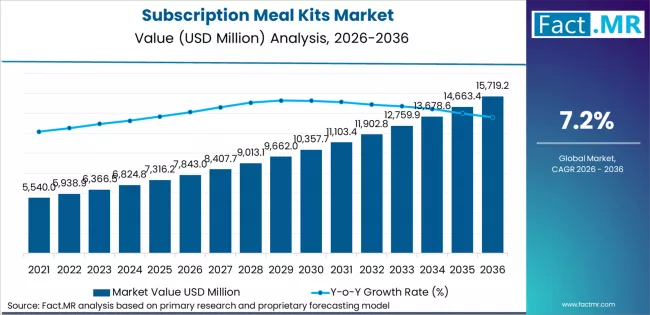
    Subscription Meal Kits Market Market Value Analysis

    Subscription meal kits Market Definition

    The subscription meal kits market consists of organized food delivery services that provide pre-portioned ingredients or fully prepared meals to consumers on a recurring subscription basis. These services are designed to offer convenience, portion control, and menu variety, helping households reduce meal planning time while maintaining dietary preferences and nutritional balance.

    The market includes multiple meal formats such as ready-to-cook kits with measured ingredients, fresh pre-prepped meals requiring minimal preparation, fully prepared heat-and-eat meals, and specialized snack or niche diet boxes tailored to specific dietary needs. Subscription models typically range from weekly and monthly plans to flexible and customizable options.

    Market Inclusions

    The report provides a comprehensive analysis of the global and regional subscription meal kits market, covering the forecast period from 2026 to 2036. It delivers segment-wise insights based on meal type (ready-to-cook kits, fresh pre-prepped meals, fully prepared meals, and snacks & niche diets), subscription model (monthly, weekly, flexible, one-time boxes, and customizable plans), pricing tier (economy/budget, mid-tier, and premium), and distribution channel (direct-to-consumer (D2C), retail partnerships, third-party platforms, and corporate/institutional). The study further evaluates consumer purchasing behavior, pricing strategies, supply chain and last-mile delivery dynamics, competitive landscape, and expansion strategies across key regional markets.

    Market Exclusions

    The scope excludes standalone grocery delivery services, restaurant food delivery platforms, and on-demand meal ordering apps that do not operate under a recurring subscription-based meal kit model. It does not cover conventional packaged ready meals sold through supermarkets without a subscription component.

    Research Methodology

    • Primary Research: In-depth interviews were conducted with subscription meal kit service providers, supply chain partners, packaging vendors, logistics companies, and digital platform operators across key regions. Discussions also included marketing heads, operations managers, procurement teams, and industry experts to validate demand trends, pricing strategies, customer retention patterns, and subscription model performance.
    • Desk Research: The study leveraged company annual reports, investor presentations, regulatory filings, industry publications, consumer surveys, and e-commerce performance data. Publicly available statistics on online food delivery, urban consumption trends, digital payment adoption, and retail food spending were also analyzed to understand market dynamics.
    • Market‑Sizing and Forecasting: A hybrid approach combining bottom-up revenue analysis of leading subscription meal kit providers with top-down benchmarking of online food service and packaged food industries was employed.

    Data Validation and Update Cycle

    Findings were cross-verified through triangulation of primary interviews, secondary research sources, consumer behavior datasets, and internal analytical models to ensure accuracy and consistency.

    Subscription Meal Kits Market Summary

    Market Definition

    The subscription meal kits market comprises organized, recurring food service platforms that deliver pre-portioned ingredients or fully prepared meals directly to consumers, enabling convenient meal planning, preparation, and consumption while supporting dietary preferences, portion control, and lifestyle-driven nutrition needs.

    Demand Drivers

    • Rising Demand for Convenience and Time-Saving Solutions: Increasing urbanization, dual-income households, and busy lifestyles are driving consumers toward subscription meal kits that simplify meal planning and reduce cooking time without compromising on freshness or nutritional value.
    • Growth in Health-Conscious and Personalized Nutrition Trends: Expanding awareness of balanced diets, calorie control, plant-based eating, and specialized dietary preferences (keto, vegan, gluten-free) is encouraging adoption of customizable meal kit subscriptions tailored to individual health goals.
    • Digital Adoption and E-commerce Expansion: Rising smartphone penetration, digital payment adoption, and comfort with app-based ordering are accelerating direct-to-consumer subscription models, enabling seamless ordering, flexible plans, and recurring revenue streams for providers.

    Key Segments

    • By Meal Type: Ready-to-cook kits lead the market, accounting for the largest share due to their balance between convenience and consumer engagement in home cooking. These kits appeal strongly to households seeking portion-controlled, fresh ingredients with minimal preparation time.
    • By Distribution Channel: Direct-to-Consumer (D2C) dominates the market, as most subscription meal kit providers operate through proprietary digital platforms, enabling better customer data control, recurring billing models, and higher margin retention.
    • By Geography: North America is the leading region, supported by high consumer awareness, strong penetration of subscription-based services, advanced last-mile delivery infrastructure, and early adoption of personalized nutrition and convenience-driven food solutions.

    Regional Outlook

    • India: Expected to grow at a CAGR of 7.9, driven by rapid urbanization, rising middle-class disposable income, and increasing adoption of app-based food services.
    • China: Projected to register a CAGR of 8.0, fueled by strong e-commerce penetration, widespread use of super-app ecosystems, and growing consumer preference for premium and customized meal plans.
    • USA: Anticipated to grow at a CAGR of 6.6, reflecting a relatively mature but stable market. Growth is primarily driven by menu innovation, personalization, corporate meal partnerships, and expansion into specialty diet segments such as plant-based, keto, and calorie-controlled plans.

    Analyst Opinion

    The subscription meal kits market is on a sustained growth trajectory, driven by evolving consumer lifestyles, rising demand for convenient meal planning solutions, and increasing preference for personalized nutrition. Growth is particularly strong in urban and digitally connected economies, where time-constrained consumers seek structured, flexible meal solutions that balance health, variety, and affordability.

    Strategic Insights

    • Energy Efficiency Standards: As competition intensifies, subscription meal kit providers are increasingly leveraging data analytics, AI-driven menu recommendations, and flexible plan customization to improve subscriber retention and lifetime value.
    • Regional Dynamics: North America remains the most mature and innovation-driven market, characterized by strong D2C penetration and premium meal offerings. Asia-Pacific markets such as India and China are witnessing rapid adoption driven by digital commerce expansion and urban lifestyle shifts.

    Methodology

    North America remains the most mature and innovation-driven market in the subscription meal kits industry, characterized by strong direct-to-consumer penetration, high customer awareness of subscription models, and widespread availability of premium, health-focused, and customizable meal plans.

    Segmental Analysis

    Subscription Meal Kits Market Analysis by Meal Type
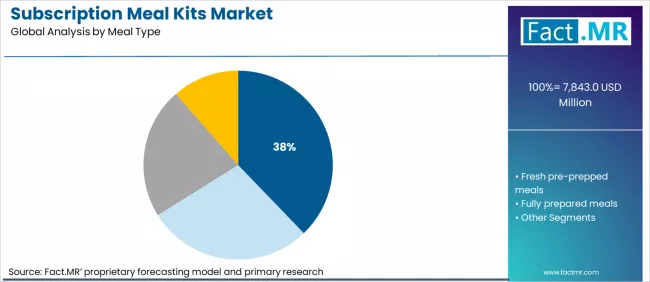
    Subscription Meal Kits Market Analysis By Meal Type

    • Market Overview: Ready-to-cook kits are projected to account for approximately 48% of the market share by 2026, making them the leading meal type segment. These kits offer pre-portioned ingredients with step-by-step recipes, striking a balance between convenience and the experience of home cooking. They appeal strongly to urban households seeking fresh meals without the hassle of grocery shopping or complex meal planning.
    • Demand Drivers:
      • Convenience with Cooking Experience: Ready-to-cook kits allow consumers to enjoy the experience of preparing meals while significantly reducing preparation time and ingredient sourcing efforts.
      • Portion Control & Reduced Food Waste: Pre-measured ingredients help minimize food wastage and support calorie control, making them attractive to health-conscious consumers.
      • Variety & Menu Rotation: Frequent menu updates and diverse cuisine offerings enhance customer engagement and improve subscription retention rates, particularly among younger demographics seeking culinary exploration.

    Subscription Meal Kits Market Analysis by Model Type
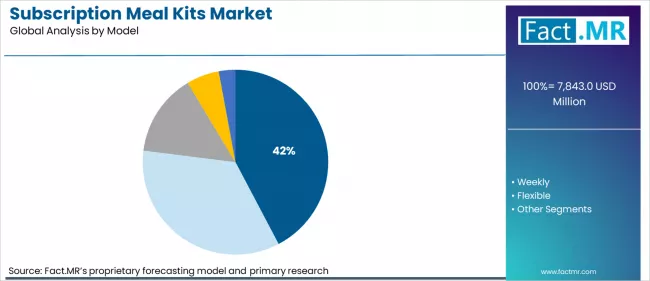
    Subscription Meal Kits Market Analysis By Model

    • Market Overview: The Monthly subscription model is expected to capture approximately 42% of the market share by 2026, making it the leading model type in the subscription meal kits market. Monthly plans offer structured recurring deliveries, predictable billing cycles, and better value propositions for consumers committed to routine meal planning. This model provides revenue visibility and improved demand forecasting for companies, enabling efficient procurement, inventory planning, and logistics optimization.
    • Demand Drivers:
      • Revenue Stability & Predictability: Monthly plans provide consistent recurring revenue streams for providers while offering consumers bundled pricing advantages compared to short-term plans.
      • Customer Retention & Loyalty Programs: Longer subscription commitments allow companies to implement loyalty incentives, personalized menu curation, and bundled discounts that improve retention rates.
      • Operational Efficiency: Monthly forecasting improves procurement planning, reduces ingredient wastage, and enhances supply chain coordination, supporting margin optimization in a cost-sensitive market.

    Subscription Meal Kits Market Drivers, Restraints, and Opportunities

    FMR analysts observe that the subscription meal kits market represents a structurally evolving segment within the broader online food retail and direct-to-consumer ecosystem, closely tied to digital commerce penetration, urban lifestyle shifts, and changing dietary preferences. Historically, traditional grocery shopping and restaurant delivery dominated meal consumption patterns; however, the shift toward structured, recurring meal planning solutions has accelerated adoption of subscription-based kits that combine convenience, portion control, and personalization.

    The 2026 valuation reflects steady investment in digital platforms, cold-chain logistics, menu innovation, and customer acquisition strategies by leading providers. While ready-to-cook kits account for the majority of subscriber volume, fully prepared and specialized diet-focused plans are gaining share. Premium and customized offerings command higher average order values, supporting revenue expansion even as competitive pricing pressures persist. The market maintains momentum because convenience, health consciousness, and predictable meal planning remain critical to modern consumers.

    • Retention & Personalization Imperative: Rising customer acquisition costs are pushing providers to invest in AI-driven personalization, dynamic menu rotation, and loyalty programs to improve subscriber retention and lifetime value.
    • Operational & Logistics Optimization: Efficient last-mile delivery, temperature-controlled packaging, and demand forecasting are becoming central to profitability, particularly as companies scale across metropolitan regions.
    • Digital & Urban Expansion in Emerging Markets: Rapid urbanization and increasing smartphone penetration in markets such as India and China are stimulating new subscriber growth, while North America and Europe focus more on premiumization, sustainability, and model diversification.

    Regional Analysis

    The market analysis covers key global regions, including South Asia and Pacific, Middle East & Africa, North America, Latin America, Western Europe, and Eastern Europe. It is segmented geographically, with specific market dynamics for each region. The full report provides a detailed market attractiveness analysis.
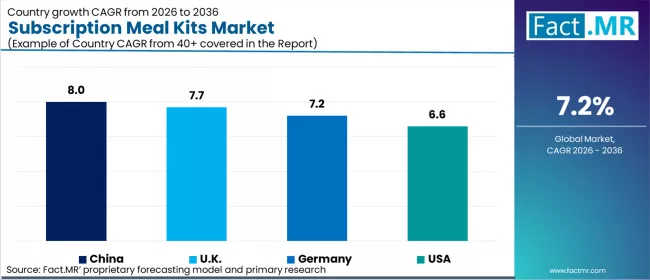
    Subscription Meal Kits Market Cagr Analysis By Country

    Country CAGR (%)
    India 7.9%
    U.K. 7.7%
    USA 6.6%
    Japan 7.5%
    UAE 7.3%
    China 8.0%
    Germany 7.2%
    Japan 7.5%

    Source: Fact MR (FMR) analysis, based on proprietary forecasting model and primary research.

    South Asia and Pacific:

    South Asia and Pacific is emerging as a high-growth region for the subscription meal kits market, supported by rapid urbanization, expanding middle-class populations, and strong growth in digital commerce ecosystems across countries such as India, China, and Japan.

    • India: Demand for subscription meal kits in India is projected to rise at a CAGR of 7.9% through 2036. Growth is driven by expanding urban working populations, increased reliance on app-based food services, and rising health awareness among millennials.
    • Vietnam: Demand for subscription meal kits is projected to rise at a CAGR of 7.6% through 2036. Strong e-commerce penetration, super-app integration, and demand for premium, health-oriented meal options are supporting steady subscriber growth, particularly in tier-1 and tier-2 cities.
    • Indonesia: Demand for subscription meal kits in Indonesia is projected to rise at a CAGR of 7.4% through 2036. Growth is supported by rapid urbanization in cities such as Jakarta and Surabaya, increasing adoption of digital payment platforms, and rising demand for convenient yet affordable meal solutions among young professionals.

    Middle East & Africa:

    The Middle East & Africa represents an emerging growth region for the subscription meal kits market, driven by rising digital commerce adoption, growing expatriate populations, increasing disposable incomes, and a strong preference for convenience-oriented food solutions across Gulf economies. Expanding last-mile delivery networks and increasing consumer comfort with subscription-based digital services are supporting market entry and expansion.

    • Saudi Arabia: Demand for subscription meal kits in Saudi Arabia is projected to rise at a CAGR of 7.8% through 2036. Growth is supported by a young, tech-savvy population, increasing female workforce participation, and rising health consciousness. The expansion of online grocery platforms and digital payment adoption further strengthens recurring subscription models.
    • UAE: Demand for subscription meal kits in the UAE is projected to rise at a CAGR of 7.3% through 2036. Market expansion is driven by high expatriate density, premium meal preferences, strong D2C delivery infrastructure, and growing demand for specialized diet plans such as keto, vegan, and fitness-focused meal programs.

    North America:

    North America represents a mature yet innovation-driven market for subscription meal kits, characterized by high penetration of direct-to-consumer models, advanced last-mile delivery infrastructure, and strong consumer awareness of subscription-based food services. The region demonstrates steady demand supported by digital adoption, premium meal preferences, and continuous menu innovation.

    • USA: Demand for subscription meal kits in the U.S. is projected to rise at a CAGR of 6.6% through 2036. Growth is primarily driven by product diversification, expansion into specialty diet segments, and improvements in personalization algorithms rather than rapid new market penetration.

    Latin America:

    Latin America represents a developing growth market for the subscription meal kits industry, supported by expanding urban populations, rising digital commerce adoption, and increasing demand for convenient, home-delivered food solutions.

    • Brazil: Demand for subscription meal kits in Brazil is projected to rise at a CAGR of 7.6% through 2036. Growth is driven by increasing smartphone penetration, expansion of digital payment platforms, and rising preference for structured meal planning among urban working professionals.

    Western Europe:

    Western Europe represents a mature, sustainability-focused market for subscription meal kits, supported by strong consumer awareness of healthy eating, preference for organic and responsibly sourced ingredients, and well-established e-commerce infrastructure.

    • Germany: Demand for subscription meal kits in Germany is projected to rise at a CAGR of 7.2% through 2036. Growth is driven by increasing demand for plant-based and organic meal options, rising adoption of customizable subscription plans, and strong emphasis on sustainable sourcing and recyclable packaging.

    Fact.MR’s analysis of the subscription meal kits market across South Asia & Pacific, Middle East & Africa, North America, Latin America, and Western Europe includes country-level assessments covering India, China, Japan, Saudi Arabia, the UAE, Brazil, the U.S., and Germany. The report provides detailed insights into digital commerce penetration, consumer subscription behavior, pricing strategies, competitive intensity, and logistics infrastructure developments that are shaping subscriber acquisition, retention trends, and long-term market growth across these countries.

    How Are Key Players Competing in the Subscription Meal Kits Market?

    The subscription meal kits market is being shaped by industry leaders such as HelloFresh, Blue Apron Holdings, and Home Chef, who focus on expanding direct-to-consumer delivery networks, enhancing menu variety, and leveraging data-driven personalization to improve subscriber retention. These companies emphasize supply chain optimization, flexible subscription models, and broad meal customization options to address diverse dietary preferences across mature markets. Players such as Sun Basket specialize in premium, health-focused, and organic meal offerings, targeting consumers seeking specialized diet plans including keto, paleo, and plant-based options. EveryPlate positions itself in the value-driven segment, catering to price-sensitive households with simplified menus and cost-efficient sourcing strategies.

    Recent Industry Developments

    • Business Model Shift - Blue Apron Flexible Ordering Launched - 2025: Blue Apron revised its subscription structure in 2025 to allow customers to order meal kits on a flexible basis (including à-la-carte and autoship options) rather than fixed weekly plans, aiming to better meet current consumer preferences.
    • Industry Visibility - Forbes Meal Kit Features - 2026: Lifestyle and mainstream media outlets such as Forbes featured subscription meal kit services in 2026 as a key convenient dining option, noting trends around dietary customization and sustainability in packaging.

    Key Players of the Subscription Meal Kits Market

    • Hello Fresh
    • Blue Apron Holdings
    • Home Chef
    • Sun Basket
    • Every Plate
    • Green Chef
    • Marley Spoon
    • Freshlings
    • Purple Carrot
    • Gousto

    Report Scope

    Metric Value
    Quantitative Units USD 7,843 million (2026) to USD 15,719 million (2036), at a CAGR of 7.2%
    Market Definition The Subscription Meal Kits Market includes organized, recurring food delivery services that provide pre-portioned ingredients or fully prepared meals directly to consumers through subscription-based models. These services are designed to simplify meal planning, and support dietary preferences while ensuring freshness, portion control, and reliable last-mile delivery.
    By Meal Type Ready-to-cook kits, Fresh pre-prepped meals, Fully prepared meals, Snacks & niche diets
    By Model Monthly, Weekly, Flexible, One-time Boxes, Customizable Plans
    By Pricing Economy/Budget, Mid-tier, Premium
    By Distribution Channel Direct-to-Consumer (D2C), Retail Partnerships, Third-party platforms, Corporate / Institutional
    Regions Covered North America, Latin America, Europe, East Asia, South Asia, Oceania, Middle East and Africa
    Countries Covered United States, Canada, Mexico, Brazil, Argentina, Germany, France, United Kingdom, Italy, Spain, China, India, Japan, South Korea, Indonesia, Australia, and 40+ countries
    Key Companies Profiled Hello Fresh, Blue Apron Holdings, Home Chef, Sun Basket, Every Plate,Green Chef, Marley Spoon, Freshlings, Purple Carrot, and others
    Forecast Period 2026 to 2036
    Approach Hybrid top-down and bottom-up market modeling validated through primary interviews with subscription meal kit providers, logistics partners, and industry experts, supported by e-commerce sales benchmarking, company financial disclosures, and consumer behavior data analysis.

    Subscription Meal Kits Market Key Segments

    • By Meal Type :

      • Ready-to-cook kits
      • Fresh pre-prepped meals
      • Fully prepared meals
      • Snacks & niche diets
    • By Model :

      • Monthly
      • Weekly
      • Flexible
      • One-time Boxes
      • Customizable Plans
    • By Pricing :

      • Economy/Budget
      • Mid-tier
      • Premium
    • By Distribution Channel :

      • Direct-to-Consumer (D2C)
      • Retail Partnerships
      • Third-party platforms
      • Corporate / Institutional
    • Region :

      • North America
        • USA
        • Canada
        • Mexico
      • Europe
        • Germany
        • UK
        • France
        • Italy
        • Spain
        • Nordic Countries
        • BENELUX
        • Rest of Europe
      • Asia Pacific
        • China
        • Japan
        • South Korea
        • India
        • Australia
        • Rest of Asia Pacific
      • Latin America
        • Brazil
        • Argentina
        • Rest of Latin America
      • Middle East and Africa
        • Kingdom of Saudi Arabia
        • United Arab Emirates
        • South Africa
        • Rest of Middle East and Africa
      • Other Regions
        • Oceania
        • Central Asia
        • Other Markets

    Bibliographies

    • Business Model Update - Blue Apron Relaunch: ABC News. (2025). Blue Apron relaunches with new menus and flexible ordering options. ABC News - Good Morning America Food Section. ABC News. [1]
    • Industry Feature - Subscription Meal Kits Market Trend: Forbes. (2026). Best meal kit delivery services and subscription trends. Forbes Personal Shopper Section. [2]

    Table of Content

    1. Executive Summary
      • Global Market Outlook
      • Demand-side Trends
      • Supply-side Trends
      • Technology Roadmap Analysis
      • Analysis and Recommendations
    2. Market Overview
      • Market Coverage / Taxonomy
      • Market Definition / Scope / Limitations
    3. Market Background
      • Market Dynamics
        • Drivers
        • Restraints
        • Opportunity
        • Trends
      • Scenario Forecast
        • Demand in Optimistic Scenario
        • Demand in Likely Scenario
        • Demand in Conservative Scenario
      • Opportunity Map Analysis
      • Product Life Cycle Analysis
      • Supply Chain Analysis
      • Investment Feasibility Matrix
      • Value Chain Analysis
      • PESTLE and Porter’s Analysis
      • Regulatory Landscape
      • Regional Parent Market Outlook
      • Production and Consumption Statistics
      • Import and Export Statistics
    4. Global Market Analysis 2021-2025 and Forecast, 2026-2036
      • Historical Market Size Value (USD Mn) & Volume (No. of Kits) Analysis, 2021-2025
      • Current and Future Market Size Value (USD Mn) & Volume (No. of Kits) Projections, 2026-2036
        • Y-o-Y Growth Trend Analysis
        • Absolute $ Opportunity Analysis
    5. Global Market Pricing Analysis 2021-2025 and Forecast 2026-2036
    6. Global Market Analysis 2021-2025 and Forecast 2026-2036, By Meal Type
      • Introduction / Key Findings
      • Historical Market Size Value (USD Mn) & Volume (No. of Kits) Analysis By Meal Type, 2021-2025
      • Current and Future Market Size Value (USD Mn) & Volume (No. of Kits) Analysis and Forecast By Meal Type, 2026-2036
        • Ready-to-cook kits
        • Fresh pre-prepped meals
        • Fully prepared meals
        • Snacks & niche diets
      • Y-o-Y Growth Trend Analysis By Meal Type, 2021-2025
      • Absolute $ Opportunity Analysis By Meal Type, 2026-2036
    7. Global Market Analysis 2021-2025 and Forecast 2026-2036, By Model
      • Introduction / Key Findings
      • Historical Market Size Value (USD Mn) & Volume (No. of Kits) Analysis By Model, 2021-2025
      • Current and Future Market Size Value (USD Mn) & Volume (No. of Kits) Analysis and Forecast By Model, 2026-2036
        • Monthly
        • Weekly
        • Flexible
        • One-time Boxes
        • Customizable Plans
      • Y-o-Y Growth Trend Analysis By Model, 2021-2025
      • Absolute $ Opportunity Analysis By Model, 2026-2036
    8. Global Market Analysis 2021-2025 and Forecast 2026-2036, By Pricing
      • Introduction / Key Findings
      • Historical Market Size Value (USD Mn) & Volume (No. of Kits) Analysis By Pricing, 2021-2025
      • Current and Future Market Size Value (USD Mn) & Volume (No. of Kits) Analysis and Forecast By Pricing, 2026-2036
        • Economy/Budget
        • Mid-tier
        • Premium
      • Y-o-Y Growth Trend Analysis By Pricing, 2021-2025
      • Absolute $ Opportunity Analysis By Pricing, 2026-2036
    9. Global Market Analysis 2021-2025 and Forecast 2026-2036, By Distribution Channel
      • Introduction / Key Findings
      • Historical Market Size Value (USD Mn) & Volume (No. of Kits) Analysis By Distribution Channel, 2021-2025
      • Current and Future Market Size Value (USD Mn) & Volume (No. of Kits) Analysis and Forecast By Distribution Channel, 2026-2036
        • Direct-to-Consumer (D2C)
        • Retail Partnerships
        • Third-party platforms
        • Corporate / Institutional
      • Y-o-Y Growth Trend Analysis By Distribution Channel, 2021-2025
      • Absolute $ Opportunity Analysis By Distribution Channel, 2026-2036
    10. Global Market Analysis 2021-2025 and Forecast 2026-2036, By Region
      • Introduction
      • Historical Market Size Value (USD Mn) & Volume (No. of Kits) Analysis By Region, 2021-2025
      • Current Market Size Value (USD Mn) & Volume (No. of Kits) Analysis and Forecast By Region, 2026-2036
        • North America
        • Latin America
        • Western Europe
        • Eastern Europe
        • East Asia
        • South Asia and Pacific
        • Middle East & Africa
      • Market Attractiveness Analysis By Region
    11. North America Market Analysis 2021-2025 and Forecast 2026-2036, By Country
      • Historical Market Size Value (USD Mn) & Volume (No. of Kits) Trend Analysis By Market Taxonomy, 2021-2025
      • Market Size Value (USD Mn) & Volume (No. of Kits) Forecast By Market Taxonomy, 2026-2036
        • By Country
          • U.S.
          • Canada
          • Mexico
        • By Meal Type
        • By Model
        • By Pricing
        • By Distribution Channel
      • Market Attractiveness Analysis
        • By Country
        • By Meal Type
        • By Model
        • By Pricing
        • By Distribution Channel
      • Key Takeaways
    12. Latin America Market Analysis 2021-2025 and Forecast 2026-2036, By Country
      • Historical Market Size Value (USD Mn) & Volume (No. of Kits) Trend Analysis By Market Taxonomy, 2021-2025
      • Market Size Value (USD Mn) & Volume (No. of Kits) Forecast By Market Taxonomy, 2026-2036
        • By Country
          • Brazil
          • Chile
          • Rest of Latin America
        • By Meal Type
        • By Model
        • By Pricing
        • By Distribution Channel
      • Market Attractiveness Analysis
        • By Country
        • By Meal Type
        • By Model
        • By Pricing
        • By Distribution Channel
      • Key Takeaways
    13. Western Europe Market Analysis 2021-2025 and Forecast 2026-2036, By Country
      • Historical Market Size Value (USD Mn) & Volume (No. of Kits) Trend Analysis By Market Taxonomy, 2021-2025
      • Market Size Value (USD Mn) & Volume (No. of Kits) Forecast By Market Taxonomy, 2026-2036
        • By Country
          • Germany
          • U.K.
          • Italy
          • Spain
          • France
          • Nordic
          • BENELUX
          • Rest of Western Europe
        • By Meal Type
        • By Model
        • By Pricing
        • By Distribution Channel
      • Market Attractiveness Analysis
        • By Country
        • By Meal Type
        • By Model
        • By Pricing
        • By Distribution Channel
      • Key Takeaways
    14. Eastern Europe Market Analysis 2021-2025 and Forecast 2026-2036, By Country
      • Historical Market Size Value (USD Mn) & Volume (No. of Kits) Trend Analysis By Market Taxonomy, 2021-2025
      • Market Size Value (USD Mn) & Volume (No. of Kits) Forecast By Market Taxonomy, 2026-2036
        • By Country
          • Russia
          • Poland
          • Hungary
          • Balkan & Baltic
          • Rest of Eastern Europe
        • By Meal Type
        • By Model
        • By Pricing
        • By Distribution Channel
      • Market Attractiveness Analysis
        • By Country
        • By Meal Type
        • By Model
        • By Pricing
        • By Distribution Channel
      • Key Takeaways
    15. East Asia Market Analysis 2021-2025 and Forecast 2026-2036, By Country
      • Historical Market Size Value (USD Mn) & Volume (No. of Kits) Trend Analysis By Market Taxonomy, 2021-2025
      • Market Size Value (USD Mn) & Volume (No. of Kits) Forecast By Market Taxonomy, 2026-2036
        • By Country
          • China
          • Japan
          • South Korea
        • By Meal Type
        • By Model
        • By Pricing
        • By Distribution Channel
      • Market Attractiveness Analysis
        • By Country
        • By Meal Type
        • By Model
        • By Pricing
        • By Distribution Channel
      • Key Takeaways
    16. South Asia and Pacific Market Analysis 2021-2025 and Forecast 2026-2036, By Country
      • Historical Market Size Value (USD Mn) & Volume (No. of Kits) Trend Analysis By Market Taxonomy, 2021-2025
      • Market Size Value (USD Mn) & Volume (No. of Kits) Forecast By Market Taxonomy, 2026-2036
        • By Country
          • India
          • ASEAN
          • Australia & New Zealand
          • Rest of South Asia and Pacific
        • By Meal Type
        • By Model
        • By Pricing
        • By Distribution Channel
      • Market Attractiveness Analysis
        • By Country
        • By Meal Type
        • By Model
        • By Pricing
        • By Distribution Channel
      • Key Takeaways
    17. Middle East & Africa Market Analysis 2021-2025 and Forecast 2026-2036, By Country
      • Historical Market Size Value (USD Mn) & Volume (No. of Kits) Trend Analysis By Market Taxonomy, 2021-2025
      • Market Size Value (USD Mn) & Volume (No. of Kits) Forecast By Market Taxonomy, 2026-2036
        • By Country
          • Kingdom of Saudi Arabia
          • Other GCC Countries
          • Turkiye
          • South Africa
          • Other African Union
          • Rest of Middle East & Africa
        • By Meal Type
        • By Model
        • By Pricing
        • By Distribution Channel
      • Market Attractiveness Analysis
        • By Country
        • By Meal Type
        • By Model
        • By Pricing
        • By Distribution Channel
      • Key Takeaways
    18. Key Countries Market Analysis
      • U.S.
        • Pricing Analysis
        • Market Share Analysis, 2024
          • By Meal Type
          • By Model
          • By Pricing
          • By Distribution Channel
      • Canada
        • Pricing Analysis
        • Market Share Analysis, 2024
          • By Meal Type
          • By Model
          • By Pricing
          • By Distribution Channel
      • Mexico
        • Pricing Analysis
        • Market Share Analysis, 2024
          • By Meal Type
          • By Model
          • By Pricing
          • By Distribution Channel
      • Brazil
        • Pricing Analysis
        • Market Share Analysis, 2024
          • By Meal Type
          • By Model
          • By Pricing
          • By Distribution Channel
      • Chile
        • Pricing Analysis
        • Market Share Analysis, 2024
          • By Meal Type
          • By Model
          • By Pricing
          • By Distribution Channel
      • Germany
        • Pricing Analysis
        • Market Share Analysis, 2024
          • By Meal Type
          • By Model
          • By Pricing
          • By Distribution Channel
      • U.K.
        • Pricing Analysis
        • Market Share Analysis, 2024
          • By Meal Type
          • By Model
          • By Pricing
          • By Distribution Channel
      • Italy
        • Pricing Analysis
        • Market Share Analysis, 2024
          • By Meal Type
          • By Model
          • By Pricing
          • By Distribution Channel
      • Spain
        • Pricing Analysis
        • Market Share Analysis, 2024
          • By Meal Type
          • By Model
          • By Pricing
          • By Distribution Channel
      • France
        • Pricing Analysis
        • Market Share Analysis, 2024
          • By Meal Type
          • By Model
          • By Pricing
          • By Distribution Channel
      • India
        • Pricing Analysis
        • Market Share Analysis, 2024
          • By Meal Type
          • By Model
          • By Pricing
          • By Distribution Channel
      • ASEAN
        • Pricing Analysis
        • Market Share Analysis, 2024
          • By Meal Type
          • By Model
          • By Pricing
          • By Distribution Channel
      • Australia & New Zealand
        • Pricing Analysis
        • Market Share Analysis, 2024
          • By Meal Type
          • By Model
          • By Pricing
          • By Distribution Channel
      • China
        • Pricing Analysis
        • Market Share Analysis, 2024
          • By Meal Type
          • By Model
          • By Pricing
          • By Distribution Channel
      • Japan
        • Pricing Analysis
        • Market Share Analysis, 2024
          • By Meal Type
          • By Model
          • By Pricing
          • By Distribution Channel
      • South Korea
        • Pricing Analysis
        • Market Share Analysis, 2024
          • By Meal Type
          • By Model
          • By Pricing
          • By Distribution Channel
      • Russia
        • Pricing Analysis
        • Market Share Analysis, 2024
          • By Meal Type
          • By Model
          • By Pricing
          • By Distribution Channel
      • Poland
        • Pricing Analysis
        • Market Share Analysis, 2024
          • By Meal Type
          • By Model
          • By Pricing
          • By Distribution Channel
      • Hungary
        • Pricing Analysis
        • Market Share Analysis, 2024
          • By Meal Type
          • By Model
          • By Pricing
          • By Distribution Channel
      • Kingdom of Saudi Arabia
        • Pricing Analysis
        • Market Share Analysis, 2024
          • By Meal Type
          • By Model
          • By Pricing
          • By Distribution Channel
      • Turkiye
        • Pricing Analysis
        • Market Share Analysis, 2024
          • By Meal Type
          • By Model
          • By Pricing
          • By Distribution Channel
      • South Africa
        • Pricing Analysis
        • Market Share Analysis, 2024
          • By Meal Type
          • By Model
          • By Pricing
          • By Distribution Channel
    19. Market Structure Analysis
      • Competition Dashboard
      • Competition Benchmarking
      • Market Share Analysis of Top Players
        • By Regional
        • By Meal Type
        • By Model
        • By Pricing
        • By Distribution Channel
    20. Competition Analysis
      • Competition Deep Dive
        • Hello Fresh
          • Overview
          • Product Portfolio
          • Profitability by Market Segments (Product/Age /Sales Channel/Region)
          • Sales Footprint
          • Strategy Overview
          • Blue Apron Holdings
          • Home Chef
          • Sun Basket
          • Every Plate
          • Green Chef
          • Marley Spoon
          • Freshlings
          • Purple Carrot
          • Gousto
          • Abel and Cole
          • Quitoque
          • Fresh Fitness Food
    21. Assumptions & Acronyms Used
    22. Research Methodology

    List Of Table

    • Table 1: Global Market Value (USD Mn) Forecast by Region, 2021 to 2036
    • Table 2: Global Market Volume (No. of Kits) Forecast by Region, 2021 to 2036
    • Table 3: Global Market Value (USD Mn) Forecast by Meal Type, 2021 to 2036
    • Table 4: Global Market Volume (No. of Kits) Forecast by Meal Type, 2021 to 2036
    • Table 5: Global Market Value (USD Mn) Forecast by Model, 2021 to 2036
    • Table 6: Global Market Volume (No. of Kits) Forecast by Model, 2021 to 2036
    • Table 7: Global Market Value (USD Mn) Forecast by Pricing, 2021 to 2036
    • Table 8: Global Market Volume (No. of Kits) Forecast by Pricing, 2021 to 2036
    • Table 9: Global Market Value (USD Mn) Forecast by Distribution Channel, 2021 to 2036
    • Table 10: Global Market Volume (No. of Kits) Forecast by Distribution Channel, 2021 to 2036
    • Table 11: North America Market Value (USD Mn) Forecast by Country, 2021 to 2036
    • Table 12: North America Market Volume (No. of Kits) Forecast by Country, 2021 to 2036
    • Table 13: North America Market Value (USD Mn) Forecast by Meal Type, 2021 to 2036
    • Table 14: North America Market Volume (No. of Kits) Forecast by Meal Type, 2021 to 2036
    • Table 15: North America Market Value (USD Mn) Forecast by Model, 2021 to 2036
    • Table 16: North America Market Volume (No. of Kits) Forecast by Model, 2021 to 2036
    • Table 17: North America Market Value (USD Mn) Forecast by Pricing, 2021 to 2036
    • Table 18: North America Market Volume (No. of Kits) Forecast by Pricing, 2021 to 2036
    • Table 19: North America Market Value (USD Mn) Forecast by Distribution Channel, 2021 to 2036
    • Table 20: North America Market Volume (No. of Kits) Forecast by Distribution Channel, 2021 to 2036
    • Table 21: Latin America Market Value (USD Mn) Forecast by Country, 2021 to 2036
    • Table 22: Latin America Market Volume (No. of Kits) Forecast by Country, 2021 to 2036
    • Table 23: Latin America Market Value (USD Mn) Forecast by Meal Type, 2021 to 2036
    • Table 24: Latin America Market Volume (No. of Kits) Forecast by Meal Type, 2021 to 2036
    • Table 25: Latin America Market Value (USD Mn) Forecast by Model, 2021 to 2036
    • Table 26: Latin America Market Volume (No. of Kits) Forecast by Model, 2021 to 2036
    • Table 27: Latin America Market Value (USD Mn) Forecast by Pricing, 2021 to 2036
    • Table 28: Latin America Market Volume (No. of Kits) Forecast by Pricing, 2021 to 2036
    • Table 29: Latin America Market Value (USD Mn) Forecast by Distribution Channel, 2021 to 2036
    • Table 30: Latin America Market Volume (No. of Kits) Forecast by Distribution Channel, 2021 to 2036
    • Table 31: Western Europe Market Value (USD Mn) Forecast by Country, 2021 to 2036
    • Table 32: Western Europe Market Volume (No. of Kits) Forecast by Country, 2021 to 2036
    • Table 33: Western Europe Market Value (USD Mn) Forecast by Meal Type, 2021 to 2036
    • Table 34: Western Europe Market Volume (No. of Kits) Forecast by Meal Type, 2021 to 2036
    • Table 35: Western Europe Market Value (USD Mn) Forecast by Model, 2021 to 2036
    • Table 36: Western Europe Market Volume (No. of Kits) Forecast by Model, 2021 to 2036
    • Table 37: Western Europe Market Value (USD Mn) Forecast by Pricing, 2021 to 2036
    • Table 38: Western Europe Market Volume (No. of Kits) Forecast by Pricing, 2021 to 2036
    • Table 39: Western Europe Market Value (USD Mn) Forecast by Distribution Channel, 2021 to 2036
    • Table 40: Western Europe Market Volume (No. of Kits) Forecast by Distribution Channel, 2021 to 2036
    • Table 41: Eastern Europe Market Value (USD Mn) Forecast by Country, 2021 to 2036
    • Table 42: Eastern Europe Market Volume (No. of Kits) Forecast by Country, 2021 to 2036
    • Table 43: Eastern Europe Market Value (USD Mn) Forecast by Meal Type, 2021 to 2036
    • Table 44: Eastern Europe Market Volume (No. of Kits) Forecast by Meal Type, 2021 to 2036
    • Table 45: Eastern Europe Market Value (USD Mn) Forecast by Model, 2021 to 2036
    • Table 46: Eastern Europe Market Volume (No. of Kits) Forecast by Model, 2021 to 2036
    • Table 47: Eastern Europe Market Value (USD Mn) Forecast by Pricing, 2021 to 2036
    • Table 48: Eastern Europe Market Volume (No. of Kits) Forecast by Pricing, 2021 to 2036
    • Table 49: Eastern Europe Market Value (USD Mn) Forecast by Distribution Channel, 2021 to 2036
    • Table 50: Eastern Europe Market Volume (No. of Kits) Forecast by Distribution Channel, 2021 to 2036
    • Table 51: East Asia Market Value (USD Mn) Forecast by Country, 2021 to 2036
    • Table 52: East Asia Market Volume (No. of Kits) Forecast by Country, 2021 to 2036
    • Table 53: East Asia Market Value (USD Mn) Forecast by Meal Type, 2021 to 2036
    • Table 54: East Asia Market Volume (No. of Kits) Forecast by Meal Type, 2021 to 2036
    • Table 55: East Asia Market Value (USD Mn) Forecast by Model, 2021 to 2036
    • Table 56: East Asia Market Volume (No. of Kits) Forecast by Model, 2021 to 2036
    • Table 57: East Asia Market Value (USD Mn) Forecast by Pricing, 2021 to 2036
    • Table 58: East Asia Market Volume (No. of Kits) Forecast by Pricing, 2021 to 2036
    • Table 59: East Asia Market Value (USD Mn) Forecast by Distribution Channel, 2021 to 2036
    • Table 60: East Asia Market Volume (No. of Kits) Forecast by Distribution Channel, 2021 to 2036
    • Table 61: South Asia and Pacific Market Value (USD Mn) Forecast by Country, 2021 to 2036
    • Table 62: South Asia and Pacific Market Volume (No. of Kits) Forecast by Country, 2021 to 2036
    • Table 63: South Asia and Pacific Market Value (USD Mn) Forecast by Meal Type, 2021 to 2036
    • Table 64: South Asia and Pacific Market Volume (No. of Kits) Forecast by Meal Type, 2021 to 2036
    • Table 65: South Asia and Pacific Market Value (USD Mn) Forecast by Model, 2021 to 2036
    • Table 66: South Asia and Pacific Market Volume (No. of Kits) Forecast by Model, 2021 to 2036
    • Table 67: South Asia and Pacific Market Value (USD Mn) Forecast by Pricing, 2021 to 2036
    • Table 68: South Asia and Pacific Market Volume (No. of Kits) Forecast by Pricing, 2021 to 2036
    • Table 69: South Asia and Pacific Market Value (USD Mn) Forecast by Distribution Channel, 2021 to 2036
    • Table 70: South Asia and Pacific Market Volume (No. of Kits) Forecast by Distribution Channel, 2021 to 2036
    • Table 71: Middle East & Africa Market Value (USD Mn) Forecast by Country, 2021 to 2036
    • Table 72: Middle East & Africa Market Volume (No. of Kits) Forecast by Country, 2021 to 2036
    • Table 73: Middle East & Africa Market Value (USD Mn) Forecast by Meal Type, 2021 to 2036
    • Table 74: Middle East & Africa Market Volume (No. of Kits) Forecast by Meal Type, 2021 to 2036
    • Table 75: Middle East & Africa Market Value (USD Mn) Forecast by Model, 2021 to 2036
    • Table 76: Middle East & Africa Market Volume (No. of Kits) Forecast by Model, 2021 to 2036
    • Table 77: Middle East & Africa Market Value (USD Mn) Forecast by Pricing, 2021 to 2036
    • Table 78: Middle East & Africa Market Volume (No. of Kits) Forecast by Pricing, 2021 to 2036
    • Table 79: Middle East & Africa Market Value (USD Mn) Forecast by Distribution Channel, 2021 to 2036
    • Table 80: Middle East & Africa Market Volume (No. of Kits) Forecast by Distribution Channel, 2021 to 2036

    List Of Figures

    • Figure 1: Global Market Volume (No. of Kits) Forecast 2021 to 2036
    • Figure 2: Global Market Pricing Analysis
    • Figure 3: Global Market Value (USD Mn) Forecast 2021 to 2036
    • Figure 4: Global Market Value Share and BPS Analysis by Meal Type, 2026 and 2036
    • Figure 5: Global Market Y-o-Y Growth Comparison by Meal Type, 2026 to 2036
    • Figure 6: Global Market Attractiveness Analysis by Meal Type
    • Figure 7: Global Market Value Share and BPS Analysis by Model, 2026 and 2036
    • Figure 8: Global Market Y-o-Y Growth Comparison by Model, 2026 to 2036
    • Figure 9: Global Market Attractiveness Analysis by Model
    • Figure 10: Global Market Value Share and BPS Analysis by Pricing, 2026 and 2036
    • Figure 11: Global Market Y-o-Y Growth Comparison by Pricing, 2026 to 2036
    • Figure 12: Global Market Attractiveness Analysis by Pricing
    • Figure 13: Global Market Value Share and BPS Analysis by Distribution Channel, 2026 and 2036
    • Figure 14: Global Market Y-o-Y Growth Comparison by Distribution Channel, 2026 to 2036
    • Figure 15: Global Market Attractiveness Analysis by Distribution Channel
    • Figure 16: Global Market Value (USD Mn) Share and BPS Analysis by Region, 2026 and 2036
    • Figure 17: Global Market Y-o-Y Growth Comparison by Region, 2026 to 2036
    • Figure 18: Global Market Attractiveness Analysis by Region
    • Figure 19: North America Market Incremental $ Opportunity, 2026 to 2036
    • Figure 20: Latin America Market Incremental $ Opportunity, 2026 to 2036
    • Figure 21: Western Europe Market Incremental $ Opportunity, 2026 to 2036
    • Figure 22: Eastern Europe Market Incremental $ Opportunity, 2026 to 2036
    • Figure 23: East Asia Market Incremental $ Opportunity, 2026 to 2036
    • Figure 24: South Asia and Pacific Market Incremental $ Opportunity, 2026 to 2036
    • Figure 25: Middle East & Africa Market Incremental $ Opportunity, 2026 to 2036
    • Figure 26: North America Market Value Share and BPS Analysis by Country, 2026 and 2036
    • Figure 27: North America Market Value Share and BPS Analysis by Meal Type, 2026 and 2036
    • Figure 28: North America Market Y-o-Y Growth Comparison by Meal Type, 2026 to 2036
    • Figure 29: North America Market Attractiveness Analysis by Meal Type
    • Figure 30: North America Market Value Share and BPS Analysis by Model, 2026 and 2036
    • Figure 31: North America Market Y-o-Y Growth Comparison by Model, 2026 to 2036
    • Figure 32: North America Market Attractiveness Analysis by Model
    • Figure 33: North America Market Value Share and BPS Analysis by Pricing, 2026 and 2036
    • Figure 34: North America Market Y-o-Y Growth Comparison by Pricing, 2026 to 2036
    • Figure 35: North America Market Attractiveness Analysis by Pricing
    • Figure 36: North America Market Value Share and BPS Analysis by Distribution Channel, 2026 and 2036
    • Figure 37: North America Market Y-o-Y Growth Comparison by Distribution Channel, 2026 to 2036
    • Figure 38: North America Market Attractiveness Analysis by Distribution Channel
    • Figure 39: Latin America Market Value Share and BPS Analysis by Country, 2026 and 2036
    • Figure 40: Latin America Market Value Share and BPS Analysis by Meal Type, 2026 and 2036
    • Figure 41: Latin America Market Y-o-Y Growth Comparison by Meal Type, 2026 to 2036
    • Figure 42: Latin America Market Attractiveness Analysis by Meal Type
    • Figure 43: Latin America Market Value Share and BPS Analysis by Model, 2026 and 2036
    • Figure 44: Latin America Market Y-o-Y Growth Comparison by Model, 2026 to 2036
    • Figure 45: Latin America Market Attractiveness Analysis by Model
    • Figure 46: Latin America Market Value Share and BPS Analysis by Pricing, 2026 and 2036
    • Figure 47: Latin America Market Y-o-Y Growth Comparison by Pricing, 2026 to 2036
    • Figure 48: Latin America Market Attractiveness Analysis by Pricing
    • Figure 49: Latin America Market Value Share and BPS Analysis by Distribution Channel, 2026 and 2036
    • Figure 50: Latin America Market Y-o-Y Growth Comparison by Distribution Channel, 2026 to 2036
    • Figure 51: Latin America Market Attractiveness Analysis by Distribution Channel
    • Figure 52: Western Europe Market Value Share and BPS Analysis by Country, 2026 and 2036
    • Figure 53: Western Europe Market Value Share and BPS Analysis by Meal Type, 2026 and 2036
    • Figure 54: Western Europe Market Y-o-Y Growth Comparison by Meal Type, 2026 to 2036
    • Figure 55: Western Europe Market Attractiveness Analysis by Meal Type
    • Figure 56: Western Europe Market Value Share and BPS Analysis by Model, 2026 and 2036
    • Figure 57: Western Europe Market Y-o-Y Growth Comparison by Model, 2026 to 2036
    • Figure 58: Western Europe Market Attractiveness Analysis by Model
    • Figure 59: Western Europe Market Value Share and BPS Analysis by Pricing, 2026 and 2036
    • Figure 60: Western Europe Market Y-o-Y Growth Comparison by Pricing, 2026 to 2036
    • Figure 61: Western Europe Market Attractiveness Analysis by Pricing
    • Figure 62: Western Europe Market Value Share and BPS Analysis by Distribution Channel, 2026 and 2036
    • Figure 63: Western Europe Market Y-o-Y Growth Comparison by Distribution Channel, 2026 to 2036
    • Figure 64: Western Europe Market Attractiveness Analysis by Distribution Channel
    • Figure 65: Eastern Europe Market Value Share and BPS Analysis by Country, 2026 and 2036
    • Figure 66: Eastern Europe Market Value Share and BPS Analysis by Meal Type, 2026 and 2036
    • Figure 67: Eastern Europe Market Y-o-Y Growth Comparison by Meal Type, 2026 to 2036
    • Figure 68: Eastern Europe Market Attractiveness Analysis by Meal Type
    • Figure 69: Eastern Europe Market Value Share and BPS Analysis by Model, 2026 and 2036
    • Figure 70: Eastern Europe Market Y-o-Y Growth Comparison by Model, 2026 to 2036
    • Figure 71: Eastern Europe Market Attractiveness Analysis by Model
    • Figure 72: Eastern Europe Market Value Share and BPS Analysis by Pricing, 2026 and 2036
    • Figure 73: Eastern Europe Market Y-o-Y Growth Comparison by Pricing, 2026 to 2036
    • Figure 74: Eastern Europe Market Attractiveness Analysis by Pricing
    • Figure 75: Eastern Europe Market Value Share and BPS Analysis by Distribution Channel, 2026 and 2036
    • Figure 76: Eastern Europe Market Y-o-Y Growth Comparison by Distribution Channel, 2026 to 2036
    • Figure 77: Eastern Europe Market Attractiveness Analysis by Distribution Channel
    • Figure 78: East Asia Market Value Share and BPS Analysis by Country, 2026 and 2036
    • Figure 79: East Asia Market Value Share and BPS Analysis by Meal Type, 2026 and 2036
    • Figure 80: East Asia Market Y-o-Y Growth Comparison by Meal Type, 2026 to 2036
    • Figure 81: East Asia Market Attractiveness Analysis by Meal Type
    • Figure 82: East Asia Market Value Share and BPS Analysis by Model, 2026 and 2036
    • Figure 83: East Asia Market Y-o-Y Growth Comparison by Model, 2026 to 2036
    • Figure 84: East Asia Market Attractiveness Analysis by Model
    • Figure 85: East Asia Market Value Share and BPS Analysis by Pricing, 2026 and 2036
    • Figure 86: East Asia Market Y-o-Y Growth Comparison by Pricing, 2026 to 2036
    • Figure 87: East Asia Market Attractiveness Analysis by Pricing
    • Figure 88: East Asia Market Value Share and BPS Analysis by Distribution Channel, 2026 and 2036
    • Figure 89: East Asia Market Y-o-Y Growth Comparison by Distribution Channel, 2026 to 2036
    • Figure 90: East Asia Market Attractiveness Analysis by Distribution Channel
    • Figure 91: South Asia and Pacific Market Value Share and BPS Analysis by Country, 2026 and 2036
    • Figure 92: South Asia and Pacific Market Value Share and BPS Analysis by Meal Type, 2026 and 2036
    • Figure 93: South Asia and Pacific Market Y-o-Y Growth Comparison by Meal Type, 2026 to 2036
    • Figure 94: South Asia and Pacific Market Attractiveness Analysis by Meal Type
    • Figure 95: South Asia and Pacific Market Value Share and BPS Analysis by Model, 2026 and 2036
    • Figure 96: South Asia and Pacific Market Y-o-Y Growth Comparison by Model, 2026 to 2036
    • Figure 97: South Asia and Pacific Market Attractiveness Analysis by Model
    • Figure 98: South Asia and Pacific Market Value Share and BPS Analysis by Pricing, 2026 and 2036
    • Figure 99: South Asia and Pacific Market Y-o-Y Growth Comparison by Pricing, 2026 to 2036
    • Figure 100: South Asia and Pacific Market Attractiveness Analysis by Pricing
    • Figure 101: South Asia and Pacific Market Value Share and BPS Analysis by Distribution Channel, 2026 and 2036
    • Figure 102: South Asia and Pacific Market Y-o-Y Growth Comparison by Distribution Channel, 2026 to 2036
    • Figure 103: South Asia and Pacific Market Attractiveness Analysis by Distribution Channel
    • Figure 104: Middle East & Africa Market Value Share and BPS Analysis by Country, 2026 and 2036
    • Figure 105: Middle East & Africa Market Value Share and BPS Analysis by Meal Type, 2026 and 2036
    • Figure 106: Middle East & Africa Market Y-o-Y Growth Comparison by Meal Type, 2026 to 2036
    • Figure 107: Middle East & Africa Market Attractiveness Analysis by Meal Type
    • Figure 108: Middle East & Africa Market Value Share and BPS Analysis by Model, 2026 and 2036
    • Figure 109: Middle East & Africa Market Y-o-Y Growth Comparison by Model, 2026 to 2036
    • Figure 110: Middle East & Africa Market Attractiveness Analysis by Model
    • Figure 111: Middle East & Africa Market Value Share and BPS Analysis by Pricing, 2026 and 2036
    • Figure 112: Middle East & Africa Market Y-o-Y Growth Comparison by Pricing, 2026 to 2036
    • Figure 113: Middle East & Africa Market Attractiveness Analysis by Pricing
    • Figure 114: Middle East & Africa Market Value Share and BPS Analysis by Distribution Channel, 2026 and 2036
    • Figure 115: Middle East & Africa Market Y-o-Y Growth Comparison by Distribution Channel, 2026 to 2036
    • Figure 116: Middle East & Africa Market Attractiveness Analysis by Distribution Channel
    • Figure 117: Global Market - Tier Structure Analysis
    • Figure 118: Global Market - Company Share Analysis

    - FAQs -

    How large is the subscription meal kits market currently?

    The subscription meal kits market was valued at USD 7,843 million in 2026.

    What will be the market size of Subscription Meal Kits globally by 2036?

    The market size for subscription meal kits is projected to reach USD 15,719 million by 2036.

    What is the expected demand growth between 2026 and 2036?

    Demand for subscription meal kits is expected to grow at a CAGR of 7.2% - between 2026 and 2036.

    Which meal type is expected to dominate the market?

    Ready-to-cook kits are expected to dominate the market, accounting for around 48% of the market share in 2026, due to their balance of convenience, freshness, and consumer engagement in home cooking.

    Which subscription model leads the market?

    Monthly subscription plans are expected to lead the market, capturing approximately 42% share in 2026, driven by revenue predictability and customer loyalty benefits.

    Which region is expected to show the highest growth rate?

    China is projected to show the highest regional CAGR at 8.0% during the forecast period, supported by rapid urbanization and digital adoption.

    How significant is the growth outlook for India?

    India is expected to grow at a CAGR of 7.9%, reflecting strong e-commerce penetration and rising demand for health-focused meal subscriptions.

    What is the growth outlook for the U.S.?

    The U.S. is anticipated to grow at a CAGR of 6.6% from 2026 to 2036, supported by personalization strategies, specialty diet expansion, and corporate partnerships in a mature market.

    Subscription Meal Kits Market