- Market Value (2025): USD 1.7 Bn
- Estimated Value (2026): USD 1.8 Bn
- Forecast Value (2036): USD 3.0 Bn
- CAGR (2026-2036): 5.3%
What is the Sunless Tanners Market forecast to be worth by 2036?
USD 3.0 billion by 2036 at a 5.3% CAGR.
- The Sunless Tanners Market reached approximately USD 1.7 billion in 2025.
- Demand is projected to increase from USD 1.8 billion in 2026 to USD 3.0 billion by 2036.
- The market is forecast to expand at a 5.3% CAGR from 2026 to 2036.
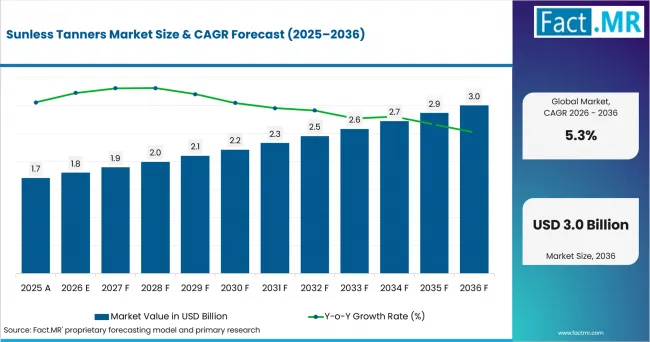
Sunless Tanners Market Value Analysis | Source: Fact.MR
What are the defining numbers behind Sunless Tanners Market growth?
An absolute opportunity of USD 1.2 billion is expected between 2026 and 2036.
- Demand Drivers in the Market
- Consumers seeking a tanned appearance without intentional UV exposure support demand for topical self-tanning products. The U.S. FDA describes sunless tanners as products that create a tanned appearance without sun or other ultraviolet sources, with dihydroxyacetone (DHA) commonly used to darken the skin surface.
- DHA has an established regulatory pathway in major cosmetics markets. In the USA, FDA permits DHA as a color additive for externally applied tanning preparations. The European Commission's Scientific Committee on Consumer Safety considers DHA safe in self-tanning lotion and face cream at concentrations up to 10% under the assessed conditions.
- Home-use formats reduce the need for salon appointments and allow consumers to control application frequency. Lotions, mousses, sprays and drops can be incorporated into routine body-care or facial-care use, supporting repeat purchases where users maintain color over several days.
- Formulation development is shifting purchase criteria beyond tanning intensity. Buyers increasingly compare drying time, streak control, odor, moisturization and compatibility with facial skincare, which creates room for natural-ingredient and hydrating formulations within established self-tanning formats.
- Digital beauty content supports product discovery because application technique materially affects the result. Tutorials, shade guidance and before-and-after content can reduce uncertainty for first-time users, while retail stores remain important for product comparison and immediate purchase.
- Key Segments Analyzed
- Self-Tanning Lotions account for 37.4% of Product in 2026, supported by familiar application, broad body coverage and easy integration with moisturizing routines.
- Personal Home Tanning holds 68.7% of Application in 2026 because consumers can apply and maintain color without salon scheduling.
- Individual Consumers account for 74.1% of End Use in 2026 as most sunless tanning products are purchased for personal cosmetic use.
- DHA-Based Tanning Technology holds 53.8% of Technology in 2026 because DHA is an established self-tanning active with defined regulatory use in major markets.
- Natural Ingredient Formulations account for 42.6% of Formulation in 2026 as buyers increasingly evaluate botanical extracts, moisturizers and ingredient positioning alongside tanning performance.
- Retail Stores hold 61.3% of Distribution Channel in 2026 because consumers can compare shades, formats and price points before purchase.
- Analyst Opinion at Fact.MR
- Shambhu Nath Jha, Sr. Consultant at Fact.MR, states, "Sunless tanning demand is becoming more closely linked with everyday skincare expectations. Consumers still want visible color, but they also evaluate ease of application, drying time and skin feel. Suppliers that combine predictable tanning performance with clear usage instructions and skincare-compatible formulations can improve repeat purchase across home-use channels."
- Strategic Implications
- Brands should explain application time, expected color development and reapplication frequency clearly because product technique influences consumer satisfaction.
- Lotions can be positioned around controlled coverage and moisturization, while mousses, sprays and drops should emphasize the specific workflow they simplify.
- Formulators should treat tanning performance and skincare feel as linked purchase criteria, especially for facial products and repeat users.
- Retail packaging should distinguish shade depth, development speed and application method without implying sun protection where none is provided.
How does the Sunless Tanners Market break down by segment?
The market is segmented by Product, Application, End Use, Technology, Formulation and Distribution Channel.
Why do Self-Tanning Lotions lead Product?
Self-Tanning Lotions are projected to account for a 37.4% share in 2026.
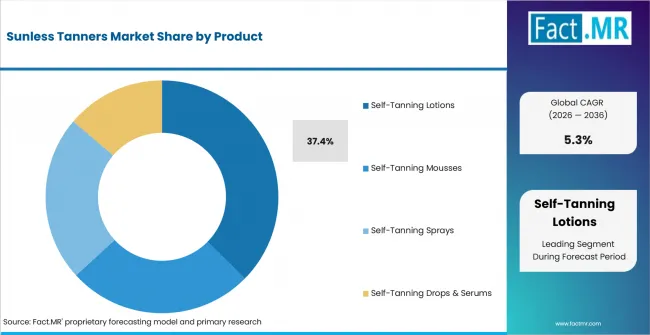
Sunless Tanners Market Analysis By Product | Source: Fact.MR
Lotions lead because they provide controlled application over larger areas of the body and fit familiar moisturizing routines. The format gives users time to spread product before color develops, reducing the learning barrier for home application.
Lotions also provide a practical base for humectants, emollients and botanical ingredients. This allows brands to combine tanning with hydration and skin-feel claims without requiring a separate application step.
The FDA identifies DHA as a commonly used ingredient in sunless tanning products, supporting the established role of lotion-based DHA systems in the category.
Why does Personal Home Tanning lead Application?
Personal Home Tanning is projected to account for a 68.7% share in 2026.
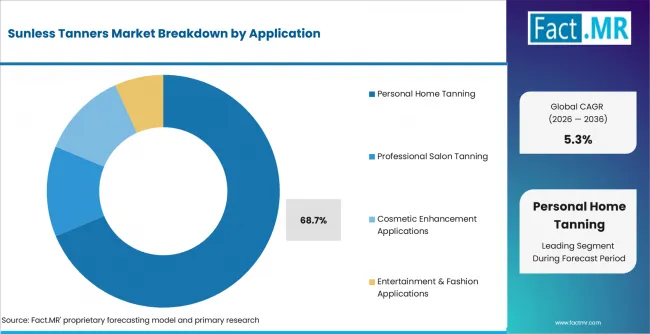
Sunless Tanners Market Analysis By Application | Source: Fact.MR
Home tanning leads because users can apply the product on their own schedule and repeat treatment as color fades. This avoids the travel and appointment requirements associated with professional spray or salon services.
The category also benefits from format choice. Lotions, mousses, sprays and drops allow consumers to choose different application speeds and coverage methods while staying within a home routine.
Clear instructions matter because uneven application can affect the visible result. Brands that reduce technique uncertainty through guides and controlled-dispensing formats can improve repeat use.
Why do Individual Consumers lead End Use?
Individual Consumers are projected to account for a 74.1% share in 2026.
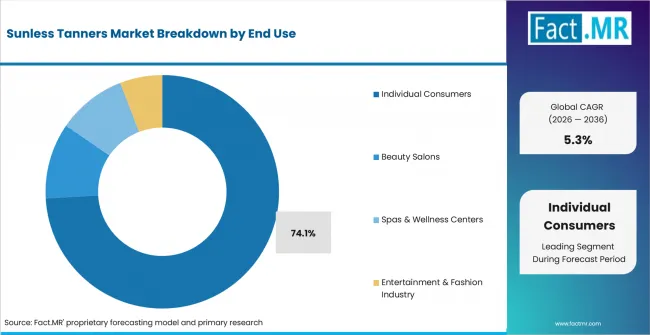
Sunless Tanners Market Analysis By End Use | Source: Fact.MR
Individual consumers lead because sunless tanning is primarily a personal cosmetic purchase. Most products are packaged in retail sizes and designed for repeated self-application rather than institutional use.
Demand is supported by the ability to obtain cosmetic color without deliberately exposing the skin to UV radiation. FDA consumer guidance distinguishes sunless tanning products from tanning beds and lamps, reinforcing the use case for consumers seeking a cosmetic alternative.
Professional salons and entertainment users remain relevant, but their purchases are narrower and tied to service volume or specific appearance requirements.
Why does DHA-Based Tanning Technology lead Technology?
DHA-Based Tanning Technology is projected to account for a 53.8% share in 2026.
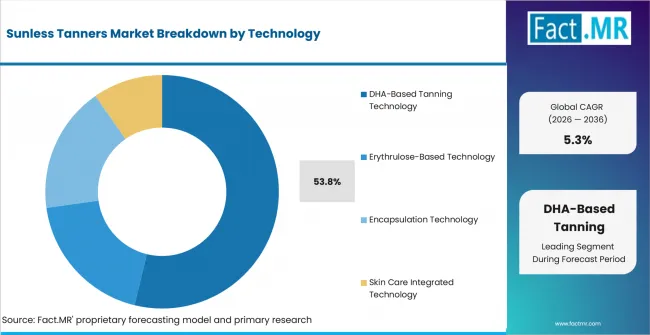
Sunless Tanners Market Analysis By Technology | Source: Fact.MR
DHA-based technology leads because the ingredient darkens the skin surface through a reaction with amino acids in the outer skin layer. It has a long history of use in sunless tanning products and a defined regulatory status in the USA and Europe.
The U.S. FDA permits DHA for externally applied tanning preparations. The European Commission's SCCS has assessed DHA in self-tanning lotion and face cream and found use up to 10% safe under the stated conditions.
Alternative actives such as erythrulose can support slower or combined color development, but DHA remains the reference active for many commercial formulations.
Why do Natural Ingredient Formulations lead Formulation?
Natural Ingredient Formulations are projected to account for a 42.6% share in 2026.
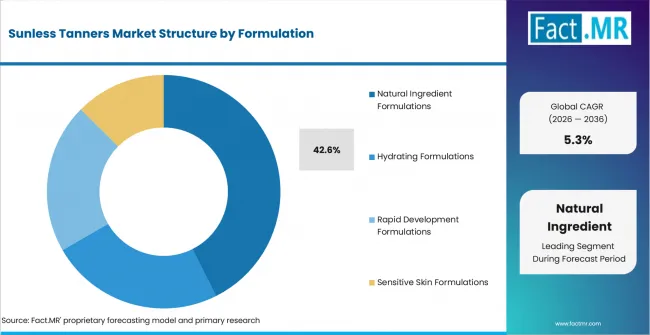
Sunless Tanners Market Analysis By Formulation | Source: Fact.MR
Natural ingredient formulations lead because consumers increasingly compare the tanning active with the wider skincare base. Botanical extracts, moisturizers and plant-derived positioning can influence choice when products are used repeatedly over large skin areas.
The commercial mechanism is differentiation rather than replacement of the tanning active. A formulation can still rely on DHA while using naturally positioned supporting ingredients to improve skin feel and brand appeal.
Hydrating, rapid-development and sensitive-skin systems serve narrower needs, while natural positioning can be applied across several product forms and shade ranges.
Why do Retail Stores lead Distribution Channel?
Retail Stores are projected to account for a 61.3% share in 2026.
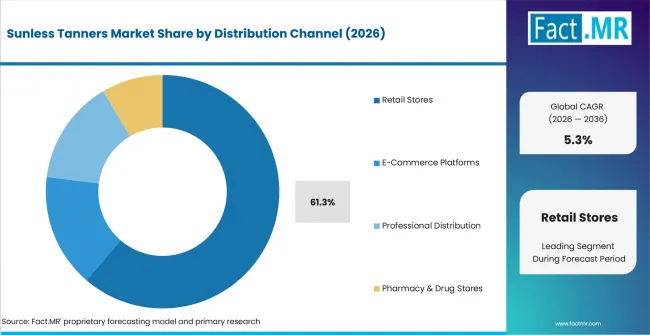
Sunless Tanners Market Analysis By Distribution Channel | Source: Fact.MR
Retail stores lead because consumers often compare multiple formats, shade depths and price points before buying. Physical display allows immediate comparison of lotions, mousses, sprays and facial drops.
Mass retailers and specialty beauty stores also support trial through broad brand assortments. This is useful in a category where consumers may change format after experiencing streaking, drying time or shade mismatch.
E-commerce is expanding product discovery, but retail stores remain important for immediate purchase and for shoppers who want to examine packaging claims before use.
What is accelerating Sunless Tanners Market adoption, and what is holding it back?
Adoption is supported by demand for a cosmetic tan without deliberate UV exposure and by home-use product innovation, while application inconsistency, ingredient sensitivity and regulatory labeling requirements can limit repeat purchase.
Drivers Impact Analysis
| Factor | (~) % Impact on CAGR | Geographic Relevance | Impact Timeline |
|---|---|---|---|
| Preference for tanning without deliberate UV exposure | +1.3% | Global | Short term (≤ 2 years) |
| Home-use beauty routines | +1.0% | Germany; USA; UK; Japan | Short term (≤ 2 years) |
| Skincare-integrated formulations | +0.8% | Global | Medium term (2-4 years) |
| Digital application education | +0.6% | USA; UK; Germany | Medium term (2-4 years) |
| Wider male and facial-use adoption | +0.4% | Global | Long term (≥ 4 years) |
Opportunity Impact Analysis
| Factor | (~) % Impact on CAGR | Geographic Relevance | Impact Timeline |
|---|---|---|---|
| Natural and botanical formulations | +0.9% | Germany; UK; USA | Medium term (2-4 years) |
| Express and gradual tanning systems | +0.7% | Global | Medium term (2-4 years) |
| Facial drops and skincare hybrids | +0.6% | USA; UK; Japan | Medium term (2-4 years) |
| Professional-to-home product conversion | +0.4% | Global | Long term (≥ 4 years) |
Restraints Impact Analysis
| Factor | (~) % Impact on CAGR | Geographic Relevance | Impact Timeline |
|---|---|---|---|
| Uneven application and color mismatch | -0.9% | Global | Short term (≤ 2 years) |
| Ingredient sensitivity and user concerns | -0.7% | USA; Germany; UK | Short term (≤ 2 years) |
| Labeling and formulation compliance | -0.5% | USA; Germany; UK; Japan | Medium term (2-4 years) |
| Competition from bronzers and temporary cosmetics | -0.4% | Global | Long term (≥ 4 years) |
Which countries are scaling the Sunless Tanners Market through 2036?
- Germany: Growth is supported by established cosmetics retail and EU safety rules that provide a defined framework for DHA-containing self-tanning formulations. Buyers can access mass-market and specialty products across lotions, mousses and facial formats.
- Brazil: Beauty and personal-care consumption supports demand for tanning products suited to warm-weather and appearance-focused routines. Product opportunity is tied to formulations that balance visible color with lightweight skin feel.
- USA: FDA regulation permits DHA for externally applied tanning preparations and requires clear labeling for tanning products that do not provide sunscreen protection. The defined regulatory framework supports a broad home-use product market.
- UK: The Scientific Advisory Group on Chemical Safety concluded in 2024 that DHA is acceptable for adult use at stated concentrations in several self-tan formats, providing current safety guidance for product formulation and market supply.
- Japan: Growth is supported by beauty retail and skincare-oriented product development, with demand likely to favor controlled facial and body formulations that fit multi-step personal-care routines.
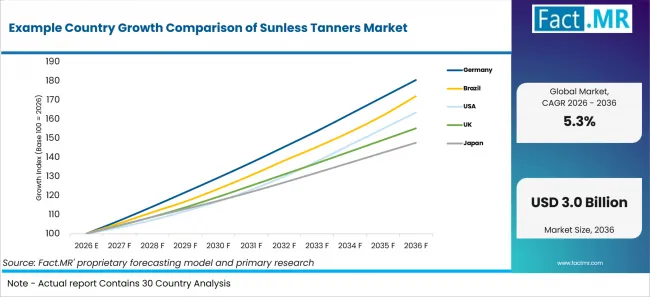
Example Country Growth Comparison Of Sunless Tanners Market | Source: Fact.MR
Country CAGR (2026-2036)
| Country | CAGR 2026-2036 |
|---|---|
| Germany | 6.1% |
| Brazil | 5.6% |
| USA | 5.0% |
| UK | 4.5% |
| Japan | 4.0% |
What is driving Germany's growth through 2036?
Germany is forecast to expand at a 6.1% CAGR from 2026 to 2036.
Germany operates within the EU cosmetics framework, where DHA has been reviewed by the Scientific Committee on Consumer Safety. The committee considers DHA safe in self-tanning lotion and face cream up to 10% under the assessed conditions.
This regulatory clarity supports product development across familiar home-use formats. Retailers can differentiate products through texture, development speed and supporting skincare ingredients while operating within established ingredient requirements.
What is driving Brazil's growth through 2036?
Brazil is forecast to expand at a 5.6% CAGR from 2026 to 2036.
Brazil's opportunity is linked to a large beauty-consumption culture and climatic conditions that sustain year-round interest in body appearance products.
Products that provide visible color while using lightweight, moisturizing bases can fit local skincare routines. Pharmacy, beauty retail and online channels widen access beyond professional tanning services.
What is driving the USA's growth through 2036?
The USA is forecast to expand at a 5.0% CAGR from 2026 to 2036.
The USA has a defined regulatory pathway for DHA. FDA lists DHA as a color additive permitted for externally applied tanning preparations and explains that the ingredient reacts with proteins in the skin surface to impart color.
FDA also requires tanning products without sunscreen to state that they do not protect against sunburn. This makes clear product communication important and encourages brands to separate cosmetic tanning claims from sun-protection claims.
What is driving the UK's growth through 2036?
The UK is forecast to expand at a 4.5% CAGR from 2026 to 2036.
UK growth is supported by continued product development within a defined cosmetic safety framework. In 2024, the Scientific Advisory Group on Chemical Safety concluded that DHA is acceptable for adults at stated concentrations in leave-on, rinse-off and spray-booth self-tan applications.
The market therefore has room for both home and professional formats, although labeling and safe-use instructions remain central to product acceptance.
What is driving Japan's growth through 2036?
Japan is forecast to expand at a 4.0% CAGR from 2026 to 2036.
Japan's growth is expected to come from skincare-led product positioning rather than traditional sunbathing culture alone. Facial drops, gradual lotions and moisturizing systems fit consumers who prefer controlled color within established beauty routines.
Retail and e-commerce access also enables international and domestic brands to test narrower shade, texture and application propositions without relying on salon distribution.
Who Leads the Sunless Tanners Market?
Johnson & Johnson Services, Inc., Clinique Laboratories, LLC, Crown Laboratories, Inc., Bayer Consumer Health, Bali Body Pty Ltd., Groupe Clarins, Dr. Dennis Gross Skincare LLC, Edgewell Personal Care Company, Decleor, Givaudan SA, Christian Dior SA, Clarins Group, and Beiersdorf AG.
Competition depends on product efficacy, application experience and brand trust. Companies compete through lotion, mousse, spray and serum formats while refining shade development, drying time and skincare benefits.
Clinique Laboratories, Crown Laboratories, Bali Body, Clarins-linked entities, Dr. Dennis Gross Skincare, Edgewell Personal Care, Givaudan and Christian Dior appear in the supplied company set. The competitive field also includes brand owners and ingredient or formulation specialists with different roles across finished products and tanning technology.
Supplier advantage is strengthened when product instructions reduce streaking and when formulations maintain a predictable color profile across repeated use. Distribution breadth also matters because retail remains the leading supplied channel.
Which companies are the key providers?
Key companies profiled include Johnson & Johnson Services, Inc.; Clinique Laboratories, LLC; Crown Laboratories, Inc.; Bayer Consumer Health; Bali Body Pty Ltd.; Groupe Clarins; Dr. Dennis Gross Skincare LLC; Edgewell Personal Care Company; Decleor; Givaudan SA; Christian Dior SA; Clarins Group; and Beiersdorf AG.
- Johnson & Johnson Services, Inc.
- Clinique Laboratories, LLC
- Crown Laboratories, Inc.
- Bayer Consumer Health
- Bali Body Pty Ltd.
- Groupe Clarins
- Dr. Dennis Gross Skincare LLC
- Edgewell Personal Care Company
- Decleor
- Givaudan SA
- Christian Dior SA
- Clarins Group
- Beiersdorf AG
Bibliography
- European Commission, Scientific Committee on Consumer Safety. (2020). Opinion on Dihydroxyacetone (DHA), SCCS/1612/19. European Commission.
- Scientific Advisory Group on Chemical Safety. (2024). Final Opinion on Dihydroxyacetone in Cosmetic Products. UK Government.
- U.S. Food and Drug Administration. (2025). Color Additives - Information for Consumers. U.S. Department of Health and Human Services.
- U.S. Food and Drug Administration. (2026). Sunless Tanners & Bronzers. U.S. Department of Health and Human Services.
- U.S. Food and Drug Administration. (2026). Color Additives Permitted for Use in Cosmetics. U.S. Department of Health and Human Services.
- U.S. Food and Drug Administration. (2026). Required Warning Statement for Tanning Products Without Sunscreen. U.S. Department of Health and Human Services.
- U.S. Food and Drug Administration. (2024). Tanning Products. U.S. Department of Health and Human Services.
This Report Answers
- Which sunless tanning formats lead consumer demand?
- How do home-use and professional applications differ?
- Which tanning technologies and formulations shape product selection?
- How do retail and online channels influence product discovery?
- Which country-specific regulatory and consumer factors affect demand?
What does the Sunless Tanners Market cover?
The market covers cosmetic products that create or support a tanned appearance without deliberate exposure to sunlight or artificial ultraviolet radiation. Revenue includes finished self-tanning lotions, mousses, sprays, drops and serums sold within the supplied applications and channels.
What is included in the scope?
The scope includes gradual and instant self-tanning lotions, lightweight and professional mousses, aerosol and pump sprays, facial drops and body serums. It includes home tanning, salon tanning, cosmetic enhancement and entertainment or fashion applications.
Buyer coverage includes individual consumers, beauty salons, spas and wellness centers and entertainment or fashion users. Technology coverage includes DHA, erythrulose, encapsulation and skincare-integrated tanning systems. Distribution follows the supplied retail, e-commerce, professional and pharmacy channels.
What is excluded from the scope?
The scope excludes tanning beds, sunlamps and other ultraviolet-emitting tanning equipment. Sunscreen products are excluded unless they are sold primarily as a covered self-tanning product.
Temporary bronzing makeup that washes off without a self-tanning reaction is outside the core market unless positioned and sold within the supplied sunless tanning taxonomy. Professional salon equipment is excluded from product revenue.
How Was the Analysis Built?
The analysis draws on more than 120 sources, over 35 company portfolios and more than 20 industry interviews across at least 25 countries.
- Primary Research: Interviews with self-tanning brands, cosmetic formulators, beauty retailers, salon operators and consumers examine application preferences, repeat purchase and channel behavior.
- Desk Research: Research covers cosmetic regulations, ingredient safety opinions, product labeling requirements, company portfolios and public consumer-safety guidance.
- Market Sizing and Forecasting: Estimates combine product-format demand, retail pricing, application frequency, consumer penetration, channel mix and country-level category growth.
- Data Validation and Update Cycle: Findings are checked against company activity, regulatory updates and retail product development. Updates reflect formulation changes, channel shifts and consumer adoption.
What is the report's scope and coverage?
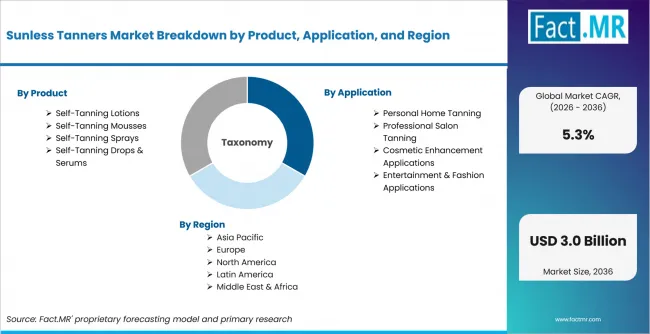
Sunless Tanners Market Breakdown By Product, Application, And Region | Source: Fact.MR
| Attribute | Details |
|---|---|
| Quantitative Units | USD billion |
| Market Definition | Sunless tanning products sold across the supplied product, application, end-use, technology, formulation and distribution categories |
| Segments Covered | Product; Application; End Use; Technology; Formulation; Distribution Channel |
| Regions Covered | North America; Latin America; Europe; East Asia; South Asia and Pacific; Middle East and Africa |
| Countries Covered | Germany; Brazil; USA; UK; Japan |
| Key Companies Profiled | Johnson & Johnson Services, Inc.; Clinique Laboratories, LLC; Crown Laboratories, Inc.; Bayer Consumer Health; Bali Body Pty Ltd.; and others |
| Forecast Period | 2026 to 2036 |
| Base Year | 2025 |
| Market Value, 2026 | USD 1.8 billion |
| Market Value, 2036 | USD 3.0 billion |
| CAGR, 2026-2036 | 5.3% |
| Absolute Opportunity | USD 1.2 billion |
| Approach | Hybrid top-down and bottom-up assessment using product demand, segment shares, application patterns, channel mix, country growth and company activity |
How is the market segmented?
-
By Product:
- Self-Tanning Lotions
- Gradual Tanning Lotions
- Instant Tanning Lotions
- Self-Tanning Mousses
- Lightweight Tanning Mousses
- Professional Tanning Mousses
- Self-Tanning Sprays
- Aerosol Tanning Sprays
- Pump Tanning Sprays
- Self-Tanning Drops & Serums
- Facial Tanning Drops
- Body Tanning Serums
- Self-Tanning Lotions
-
By Application:
- Personal Home Tanning
- Daily Beauty Applications
- Special Occasion Applications
- Professional Salon Tanning
- Beauty Salon Services
- Spa Tanning Services
- Cosmetic Enhancement Applications
- Facial Beauty Applications
- Body Aesthetic Applications
- Entertainment & Fashion Applications
- Photography Applications
- Fashion Applications
- Personal Home Tanning
-
By End Use:
- Individual Consumers
- Female Consumers
- Male Consumers
- Beauty Salons
- Independent Beauty Salons
- Salon Chains
- Spas & Wellness Centers
- Day Spas
- Resort Spas
- Entertainment & Fashion Industry
- Fashion Agencies
- Media & Entertainment Firms
- Individual Consumers
-
By Technology:
- DHA-Based Tanning Technology
- Natural DHA Systems
- Synthetic DHA Systems
- Erythrulose-Based Technology
- Single Active Systems
- Combination Active Systems
- Encapsulation Technology
- Microencapsulation Systems
- Nanoencapsulation Systems
- Skin Care Integrated Technology
- Hydration Enhancement Systems
- Anti Aging Integration Systems
- DHA-Based Tanning Technology
-
By Formulation:
- Natural Ingredient Formulations
- Botanical Based Systems
- Organic Ingredient Systems
- Hydrating Formulations
- Moisturizing Systems
- Nourishing Systems
- Rapid Development Formulations
- Express Tanning Systems
- Ultra Fast Systems
- Sensitive Skin Formulations
- Hypoallergenic Systems
- Barrier Support Systems
- Natural Ingredient Formulations
-
By Distribution Channel:
- Retail Stores
- Mass Retail Stores
- Specialty Beauty Stores
- E-Commerce Platforms
- Third Party Online Platforms
- Brand Owned Platforms
- Professional Distribution
- Salon Distributors
- Spa Distributors
- Pharmacy & Drug Stores
- Chain Pharmacies
- Independent Pharmacies
- Retail Stores
-
By Region:
- North America
- Latin America
- Western Europe
- Eastern Europe
- East Asia
- South Asia and Pacific
- Middle East & Africa