- Base Value(2025): 2251.2 Bn
- Estimated Value(2026): 2395.3 Bn
- Forecast Value (2036): 4454.3 Bn
- CAGR (2026 - 2036): 6.4%
Telecommunications Services Market Forecast and Outlook By Fact.MR
In 2025, the telecommunications services market was valued at USD 2,251.2 billion. Based on Fact.MR analysis, demand for telecommunications services is estimated to grow to USD 2,395.3 billion in 2026 and USD 4,454.3 billion by 2036. FMI projects a CAGR of 6.4% during the forecast period.
The global telecommunications services market is expected to generate an absolute dollar opportunity of around USD 2,059.0 billion during the 2026 to 2036 period. Growth is supported by 5G network densification investment, enterprise digital transformation driving managed connectivity demand, and mobile broadband subscriber expansion across India, Southeast Asia, and Africa. Growth is moderated by spectrum licensing cost pressure, infrastructure-sharing regulatory obligations that compress operator margins in mature markets, and cloud provider competition in unified communications and enterprise connectivity segments.
Country growth reflects 5G rollout, enterprise connectivity demand, and rising mobile subscribers. India leads with 8.5% CAGR, driven by nationwide 5G expansion by Jio and Airtel. China follows at 7.1% with strong 5G Advanced deployment and broadband investment. The United States grows at 6.4% through enterprise private networks and spectrum deployment. South Korea records 5.8% as operators expand 5G-Advanced services for industry. Germany grows at 5.0%, supported by enterprise networks, though infrastructure costs and regulated wholesale access limit faster expansion.
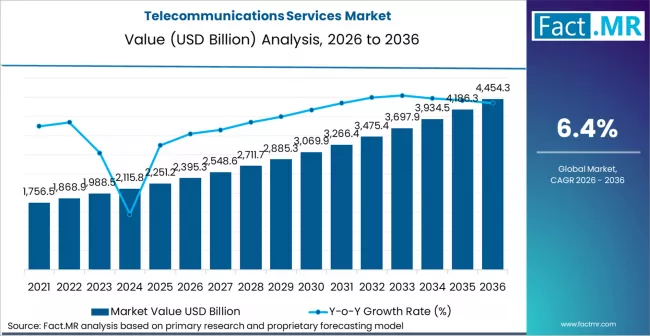
Telecommunications Services Market Market Value Analysis | Source: Fact.MR
| Metric | Value |
|---|---|
| Estimated Value in 2026 | USD 2,395.3 billion |
| Forecast Value in 2036 | USD 4,454.3 billion |
| Forecast CAGR (2026 to 2036) | 6.4% |
Source: Fact.MR analysis. Updated Mar 12, 2026
Market Definition
Telecommunications services include fixed-network and mobile connectivity provided by licensed operators to consumers, enterprises, and governments. Services cover mobile broadband, fixed-line telephony, internet, managed enterprise networks, IoT connectivity, and private 5G solutions. The market includes operator service revenue and excludes telecom equipment sales.
Market Inclusions
Includes global and regional revenue forecasts from 2026 to 2036 across fixed and mobile telecom services. Covers consumer and enterprise connectivity across sectors such as BFSI, healthcare, retail, IT, and e-commerce.
Market Exclusions
Excludes telecom equipment manufacturing, satellite-only communication services, OTT messaging and content platforms, and IT outsourcing contracts where connectivity is not the primary service.
Research Methodology
- Primary Research: Interviews with telecom operator executives, enterprise procurement heads, regulators, and telecom analysts across Asia Pacific, Europe, and North America.
- Desk Research: Sources include operator annual reports, ITU broadband statistics, telecom regulator data, and 5G investment announcements.
- Market Sizing and Forecasting: Hybrid model using subscriber counts, ARPU by service type, enterprise contract benchmarks, and 5G rollout timelines.
- Data Validation and Update Cycle: Data validated using operator revenue disclosures, regulator subscriber statistics, and spectrum auction records.
Summary
- Market Definition
- Telecommunications services include mobile and fixed connectivity delivered to consumers and enterprises, including broadband, managed networks, IoT, and private 5G services.
- Demand Drivers
- India’s nationwide 5G rollout is increasing mobile broadband ARPU and enterprise connectivity demand beyond major cities.
- Enterprise digital transformation is driving demand for SD-WAN, private 5G, and managed network services in BFSI and healthcare sectors.
- China’s 14th Five-Year Plan broadband investment is accelerating 5G network deployment and expanding mobile service demand.
- Key Segments Analyzed
- • By Type: Mobile telecom services hold about 64% share in 2026 due to higher subscriber volumes and 5G plan adoption.
- • By End User: BFSI leads with about 24% share in 2026 due to high demand for secure connectivity and real-time data networks.
- • By Geography: India shows the fastest growth at 8.5% CAGR through 2036, while Asia Pacific leads total revenue.
- Analyst Opinion at FACT.MR
- Shambhu Nath Jha, Principal Consultant at Fact.MR, opines that CXOs will find this report helpful for understanding how 5G network expansion, enterprise private network deployment, and rising demand for managed connectivity services from BFSI, IT, and e-commerce sectors.
- Strategic Implications
- Operators should expand enterprise 5G private network and managed connectivity services targeting BFSI and IT clients.
- Telecom companies should strengthen 5G infrastructure partnerships in fast-growing Asian markets.
- Operators should develop network-as-a-service and cloud connectivity solutions to compete with hyperscale providers.
- Methodology
- Market sizing used subscriber counts and ARPU data validated with operator revenue reports and regulator statistics.
- 5G rollout investment plans and spectrum auction records supported demand forecasts.
- Forecasts included enterprise contract benchmarks, network deployment timelines, and industry expert interviews.
Segmental Analysis
Telecommunications Services Market Analysis by Type
Telecommunications Services Market Analysis By Type | Source: Fact.MR
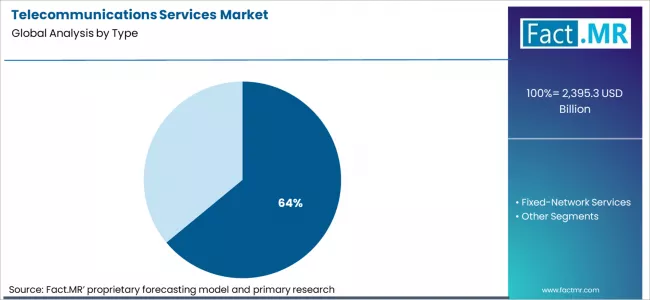
According to FACT.MR, mobile telecom services will hold about 64% share in 2026. Rising mobile subscribers, 5G plan upgrades, and growing enterprise mobile connectivity drive segment dominance.
- Bharti Airtel 5G Enterprise Investment: Bharti Airtel completed nationwide 5G coverage in 2025 and launched Airtel Business private 5G networks for enterprises. The company reported more than 2,000 enterprise deployments by the end of 2024. [5]
- T-Mobile Mid-Band 5G Technology Development: T-Mobile expanded its 2.5 GHz mid-band 5G network to cover 99% of its population base. Standalone 5G architecture now supports network slicing for enterprise and IoT applications. [6]
- Fixed-Network Fibre Broadband Trend: ITU data shows global fixed broadband subscriptions reached 1.55 billion in 2024. Fibre connections represent about 52% of total fixed lines as operator’s upgrade copper networks. [7]
Telecommunications Services Market Analysis by End User
Telecommunications Services Market Analysis By End Use | Source: Fact.MR
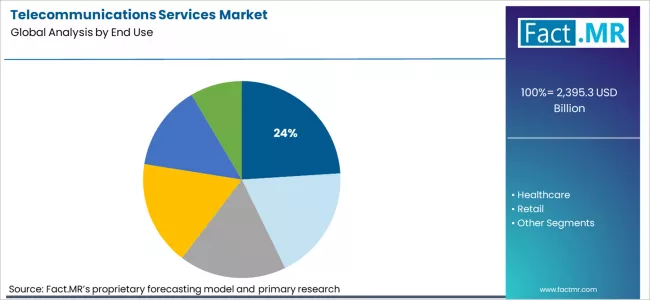
FACT.MR estimates the BFSI sector will hold about 24% share in 2026. Financial institutions demand secure, low-latency, and highly reliable telecom infrastructure for real-time transaction systems.
- Verizon BFSI Enterprise Investment: Verizon expanded private 5G and SD-WAN solutions for financial institutions in 2025, supporting trading floor connectivity with ultra-low latency service agreements. [8]
- Deutsche Telekom Healthcare Connectivity: Deutsche Telekom expanded managed connectivity for hospital systems under Germany’s Hospital Future Act, upgrading more than 1,200 healthcare network connections. [9]
- IT and E-commerce Sector Trend: India’s IAMAI Digital Economy Report shows IT and e-commerce firms as the fastest-growing enterprise telecom clients, with managed connectivity demand rising strongly in expanding Tier 2 and Tier 3 technology hubs. [10]
Drivers, Restraints, and Opportunities
FACT.MR analysts note that the telecommunications services market grows alongside digitalisation, 5G rollout, and enterprise connectivity demand. Valued at USD 2,251.2 billion in 2025, telecom networks remain the core infrastructure for digital commerce, financial services, healthcare, and government services.
The market shows a shift from declining legacy voice and fixed-line services toward 5G mobile broadband, enterprise networks, and IoT connectivity. Operators in mature markets face ARPU pressure in consumer broadband, while enterprise connectivity services generate significantly higher revenue.
- India 5G Spectrum Rollout Policy: India completed nationwide 5G spectrum rollout under the 2022 auction framework. Reliance Jio and Bharti Airtel achieved nationwide 5G coverage by early 2025, expanding premium data plan adoption. Updated telecom law also accelerated tower and fibre deployment. [2]
- EU 5G Cybersecurity Regulation: The EU continued implementing the 5G Cybersecurity Toolbox through 2024-2025. Germany, France, and the Netherlands introduced vendor risk restrictions affecting network procurement by major operators such as Deutsche Telekom and Orange. [3]
- BFSI Enterprise 5G Private Networks: South Korea expanded its 5G+ Industry Convergence Programme supporting enterprise private networks. SK Telecom and KT secured private 5G contracts in banking and insurance sectors, highlighting BFSI as a key telecom enterprise segment. [4]
Regional Analysis
The F is analysed across Asia Pacific, Europe, North America, Latin America, and Middle East and Africa, spanning 40+ countries with distinct demand profiles shaped by 5G spectrum deployment maturity, enterprise connectivity investment, government broadband mandates, and subscriber ARPU development. The full report offers market attractiveness analysis based on 5G rollout timelines and enterprise managed service adoption rates.
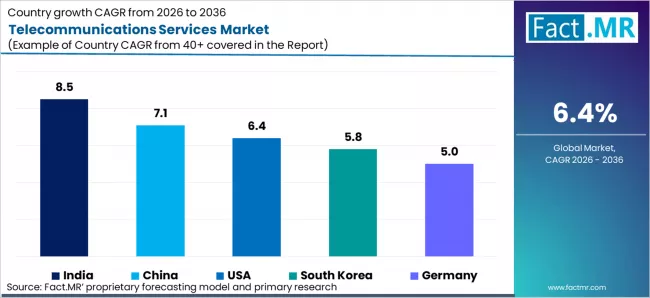
Telecommunications Services Market Cagr Analysis By Country | Source: Fact.MR
| Country | CAGR (2026-2036) |
|---|---|
| India | 8.5% |
| China | 7.1% |
| United States | 6.4% |
| South Korea | 5.8% |
| Germany | 5.0% |
Source: Fact.MR analysis. Updated Mar 12, 2026
Source: Fact.MR (FACT.MR) analysis, based on proprietary forecasting model and primary research
Asia Pacific Telecommunications Services Market Analysis
Asia Pacific represents the largest telecommunications services market globally, driven by large subscriber bases and aggressive 5G investment in China, India, and South Korea.
- India: With an expected CAGR of 8.5% through 2036, India remains the fastest-growing telecom services market. Reliance Jio completed nationwide standalone 5G rollout across all 22 telecom circles in 2024 and reported over 130 million active 5G users. The 2024 Telecommunications Act also introduced virtual network operator provisions enabling enterprise private 5G deployments. Bharti Airtel’s Airtel Business unit reported enterprise 5G revenue growth above 35% year-on-year in Q3 2024.
- China: China is forecast to expand at a 7.1% CAGR through 2036 as the government accelerates 5G-Advanced deployment. The Ministry of Industry and Information Technology mandated wider 5G coverage under the 14th Five-Year Plan. China Mobile announced CNY 180 billion in network capex for 2025, with 60% allocated to 5G. The operator reported 620 million 5G subscribers by the end of 2024.
- South Korea: South Korea’s telecom market is projected to grow at a 5.8% CAGR through 2036. The government expanded its 5G+ Industry Convergence Programme in 2024 with KRW 300 billion in funding for enterprise private networks. SK Telecom reported 40% year-on-year growth in enterprise 5G private network revenue in Q3 2024, while KT identified enterprise 5G contracts as a key ARPU growth driver.
FACT.MR’s Asia Pacific analysis of the telecommunications services market covers China, Japan, South Korea, India, Australia and New Zealand, ASEAN, and Rest of Asia Pacific. Readers can find country CAGR forecasts, 5G rollout timelines, enterprise private network adoption data, and operator competitive positioning by service type.
Europe Telecommunications Services Market Analysis
Europe’s telecommunications market is shaped by strong regulation, cybersecurity requirements, and infrastructure sharing frameworks across EU member states.
- Germany: Germany is expected to record a 5.0% CAGR through 2036. Deutsche Telekom reported 8% growth in enterprise service revenue in 2024 driven by private 5G networks at industrial clients including BMW and Bosch. The German Federal Network Agency issued more than 650 campus 5G licences by December 2024. Vodafone Germany also reported 350 private 5G deployments across industrial facilities during 2024.
FACT.MR’s European analysis of the telecommunications services market covers Germany, France, the United Kingdom, Italy, Spain, the Netherlands, the Nordics, and Rest of Europe. Readers can find EU 5G cybersecurity toolbox compliance impact, enterprise private network adoption trends, wholesale access regulation effects on operator margins, and country-level forecasts by service type and end user.
North America Telecommunications Services Market Analysis
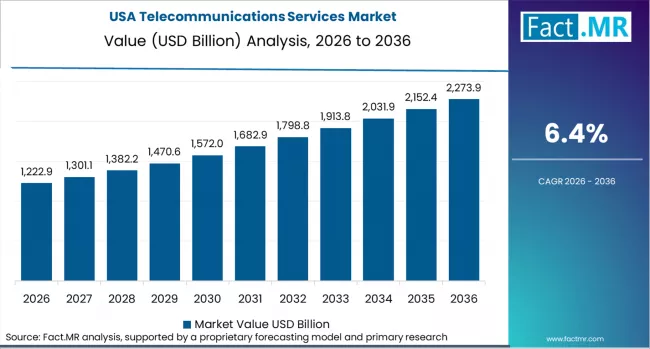
Telecommunications Services Market Country Value Analysis | Source: Fact.MR
North America generates the highest telecom ARPU globally due to strong enterprise connectivity demand and premium 5G pricing.
- United States: The United States telecom services market is projected to grow at a 6.4% CAGR through 2036. The FCC’s 2024 mid-band spectrum auction allocated 100 MHz of 3.45 GHz spectrum to major operators. AT&T reported 12% year-on-year growth in enterprise managed connectivity revenue in Q4 2024. Verizon disclosed more than 600 enterprises private 5G deployments across U.S. business sites by the end of 2024.
FACT.MR’s North American analysis of the telecommunications services market covers the United States, Canada, and Mexico. Readers can find FCC spectrum policy impact, enterprise 5G private network deployment benchmarks, BFSI connectivity spending data, and country-level revenue forecasts by service type and end user.
Latin America Telecommunications Services Market Analysis
Latin America’s telecom sector is expanding as mobile broadband adoption increases and enterprises invest in next-generation connectivity.
- Brazil: Brazil’s telecommunications services market continues expanding with national 5G rollout. Anatel introduced updated coverage obligations in 2024 requiring operators to expand 5G services to cities with populations above 30,000 by 2025. Telefonica’s Vivo reported 5G availability in 250 municipalities by September 2024 and launched enterprise private network pilots with Embraer and Petrobras.
FACT.MR’s Latin American analysis covers Brazil, Mexico, Colombia, and Rest of Latin America. Readers can find regional regulator 5G policy timelines, enterprise connectivity adoption trends, mobile broadband subscriber growth data, and country-level forecasts by service type.
Competitive Aligners for Market Players
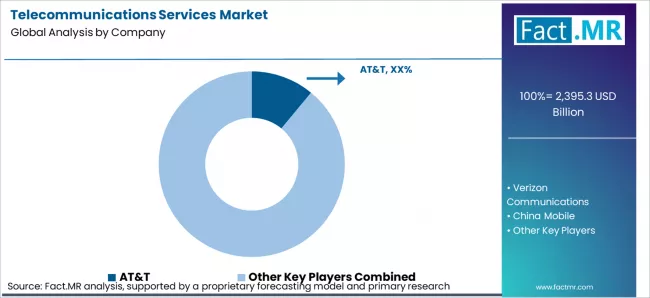
Telecommunications Services Market Analysis By Company | Source: Fact.MR
The global telecommunications services market is competitive, but leadership is usually concentrated within individual countries. In most national markets, one or two major operators control around 25 to 45% of service revenue. Large companies such as China Mobile, AT&T, Verizon, Deutsche Telekom, and Bharti Airtel dominate through strong network coverage, reliable service quality, and extensive enterprise connectivity offerings. In recent years, competition has shifted beyond basic coverage toward advanced services such as enterprise managed networks, private 5G deployments, and cloud connectivity platforms.
Operators with strong infrastructure assets and enterprise relationships have clear advantages. Companies that control spectrum resources and fibre backhaul networks can deliver faster and more reliable services. Deutsche Telekom benefits from its enterprise IT subsidiary T-Systems and its stake in T-Mobile US, which allows it to combine telecom connectivity with IT services. China Mobile’s close alignment with national 5G programmes and its relationships with state-owned enterprises provide stable demand. In India, Bharti Airtel has strengthened its enterprise business by offering integrated connectivity and cloud services through Airtel Business.
Large enterprise customers often avoid relying on a single telecom provider. Many sign multi-operator contracts across regions to maintain competition and control costs, while still working closely with trusted providers for complex private network deployments.
Key Players
- AT&T
- Verizon Communications
- China Mobile
- Bharti Airtel
- Vodafone Group
- Telecom Egypt
- T-Mobile
- Orange S.A.
- Telefonica
- Deutsche Telekom
Bibliography
- [1] AT&T Inc. and Verizon Communications Inc. (2025). Q4 2024 Earnings Commentary: 5G Network Capital Investment Priorities, Enterprise Private Network Revenue Growth, and 5G Business Services Performance. February 2025. att.com and verizon.com
- [2] Department of Telecommunications, Government of India. (2024). Telecommunications Act 2024: Spectrum Sharing Framework, Virtual Network Operator Licensing Provisions, and Right-of-Way Rules for 5G Infrastructure. December 2024. dot.gov.in
- [3] Deutsche Telekom AG. (2025). Annual Report 2024: German Enterprise Services Division 5G Private Network Deployment Count, BMW Group and Bosch Programme Disclosure, and EU 5G Cybersecurity Compliance Investment. February 2025. telekom.com
- [4] SK Telecom Co., Ltd. (2024). Q3 2024 Earnings Disclosure: Enterprise 5G Private Network Service Revenue Growth, BFSI and Manufacturing Sector Contract Wins, and 5G+ Industry Convergence Programme Co-investment Update. November 2024. sktelekom.com
- [5] Bharti Airtel Limited. (2025). Press Release: Nationwide 5G Rollout Completion Across 22 Telecom Circles and Airtel Business 5G Private Network Services Launch at 2,000 Enterprise Sites. January 2025. airtel.in
- [6] T-Mobile US Inc. (2024). Network Update: 2.5 GHz Mid-Band 5G Standalone Architecture Deployment Completion and Network Slicing Enterprise Availability Launch for Q4 2024. December 2024. t-mobile.com
- [7] International Telecommunication Union. (2024). Measuring Digital Development: Facts and Figures 2024 Global Fixed Broadband Subscription Count and Fibre-to-the-Home Share Statistics. November 2024. itu.int
- [8] Verizon Communications Inc. (2025). Verizon Business Enterprise Strategy Update: Private 5G Network Deployment Count, Financial Services Compliance Feature Launch, and SEC Rule 17a-4 SLA Guarantee Programme. January 2025. verizon.com
- [9] Deutsche Telekom AG. (2024). Product Announcement: Telekom Healthcare Network Expansion Private 5G and Managed Broadband Connectivity for German Hospital Systems Under Hospital Future Act Programme. November 2024. telekom.com
- [10] Internet and Mobile Association of India. (2024). IAMAI Digital Economy Report 2024: Enterprise Telecom Spending by Sector IT Services and E-commerce Segment Growth Data and Managed 5G Connectivity Investment Analysis. December 2024. iamai.in
This Report Addresses
- Strategic insights on India’s Telecommunications Act enabling 5G private networks, China’s 5G Advanced mandate, EU cybersecurity rules, South Korea’s 5G+ programme, and FCC mid-band spectrum expansion.
- Market forecast from USD 2,395.3 billion in 2026 to USD 4,454.3 billion by 2036 at a 6.4% CAGR, segmented by service type, end user, and region.
- Growth opportunities across India’s 5G rollout, China Mobile’s 5G Advanced expansion, South Korea’s BFSI private networks, U.S. enterprise 5G deployments, and Germany’s industrial campus networks.
- Country growth outlook: India 8.5%, China 7.1%, United States 6.4%, South Korea 5.8%, Germany 5.0%.
- Competitive analysis of AT&T, Verizon, China Mobile, Bharti Airtel, Deutsche Telekom, and T-Mobile.
- Technology trends including 5G Advanced, standalone 5G network slicing, private campus networks, SD-WAN integration, and IoT connectivity platforms.
- Regulatory coverage including India Telecom Act 2024, China MIIT 5G mandates, EU NIS2 security rules, South Korea 5G+ programme, and FCC spectrum auctions.
- Report delivered in PDF, Excel, PowerPoint, and dashboard formats using operator reports, ITU data, regulator records, and primary interviews.
Segmentation
Scope of Report
| Quantitative Units | USD 2,395.3 billion (2026) to USD 4,454.3 billion (2036), at a CAGR of 6.4% |
|---|---|
| Market Definition | Fixed-network and mobile telecommunications services enabling voice, data, broadband, and enterprise connectivity for consumer, business, and government end users globally. |
| Type Segmentation | Mobile Telecom Services (64%), Fixed-Network Services |
| End User Segmentation | BFSI (24%), Healthcare, Retail, IT, E-commerce, Others |
| Application Coverage | Mobile broadband, enterprise managed connectivity, 5G private networks, IoT connectivity, fixed-line voice, IPTV, and cloud-based unified communications. |
| Regions Covered | Asia Pacific, Europe, North America, Latin America, Middle East and Africa |
| Countries Covered | China, Japan, South Korea, India, Australia and New Zealand, ASEAN, Rest of Asia Pacific, Germany, UK, France, Italy, Spain, Netherlands, Nordics, Rest of Europe, United States, Canada, Mexico, Brazil, Colombia, Rest of Latin America, Saudi Arabia, UAE, South Africa, Turkey, Rest of MEA |
| Key Companies Profiled | AT&T, Verizon Communications, China Mobile, Bharti Airtel, Vodafone Group, Telecom Egypt, T-Mobile, Orange S.A., Telefonica, Deutsche Telekom |
| Forecast Period | 2026 to 2036 |
| Approach | Hybrid top-down and bottom-up model using national subscriber data, ARPU by service type, enterprise contract values, and 5G rollout investment timelines from primary interviews and operator disclosures. |
Source: Fact.MR analysis. Updated Mar 12, 2026
Telecommunications Services Market by Segment
-
By Type
- Fixed-Network Services
- Mobile Telecom Services
-
By End User
- Banking, Financial Services, and Insurance (BFSI)
- Healthcare
- Retail
- IT
- E-commerce
- Others
-
By Region
- North America
- United States
- Canada
- Mexico
- Europe
- Germany
- United Kingdom
- France
- Italy
- Spain
- Netherlands
- Nordics
- Rest of Europe
- Asia Pacific
- China
- Japan
- South Korea
- India
- Australia and New Zealand
- ASEAN
- Rest of Asia Pacific
- Latin America
- Brazil
- Mexico
- Colombia
- Rest of Latin America
- Middle East and Africa
- Kingdom of Saudi Arabia
- United Arab Emirates
- South Africa
- Turkey
- Rest of Middle East and Africa
- North America
Frequently Asked Questions
How large is the telecommunications services market in 2025?
What will the market size be in 2026?
What is the projected market size by 2036?
What is the expected CAGR for the forecast period 2026 to 2036?
Which type segment holds the leading share?
Which end user segment commands the largest share?
Which country is projected to grow the fastest?
What is the expected growth rate for China?
What is the forecast CAGR for South Korea?
How is the telecommunications services market in Germany expected to grow?
Who worked on this report


Preview the report firsthand - request a free sample
Free SampleGet the brochure for pricing and purchase details
Download PDF