- Base Value(2025): 26.3 Bn
- Forecast Value (2035): 87.7 Bn
- CAGR (2035): 13.5%
Voice Commerce Services Market Outlook 2025 to 2035
Global voice commerce services market is expected to reach USD 87.7 billion by 2035, up from USD 26.3 billion in 2025. During the forecast period 2025 to 2035, the industry is projected to expand at a CAGR of 12.8%.
The market of voice commerce services is growing because the use of smart speakers is increasing, more people prefer the convenience of hands-free technology, and AI and natural language processing are evolving. Connected devices are making homes shopping malls, and frictionless voice shopping creates loyalty.
Quick Stats for Voice Commerce Services Market
- Industry Value (2025): USD 26.3 Billion
- Projected Value (2035): USD 87.7 Billion
- Forecast CAGR (2025 to 2035): 12.8%
- Leading Segment (2025): Smartphones (47% Market Share)
- Fastest Growing Country (2025-2035): India (13.6% CAGR)
- Top Key Players: Amazon, Apple, Google, Samsung, and Sony
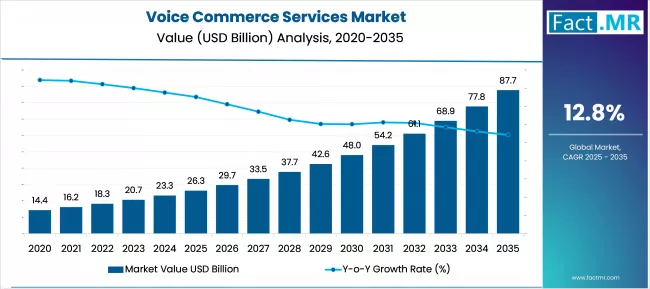
Voice Commerce Services Market Market Value Analysis | Source: Fact.MR
What are the drivers of the voice commerce service market?
The rising popularity of smart speakers and voice-enabled devices is one of the factors which are influencing the development of voice commerce services. Connected devices are becoming popular as shopping devices and the purchases are becoming smooth. Such type of device integration has turned the homes into business centers, where voice shopping is often advertised.
The other is the convenience that voice-based shopping promises because it goes hand in hand with the new trend of speed and hands-free consumer behavior. Customers do not have to touch screens to arrange groceries, follow orders or even compare prices on items. This convenient shopping experience helps eliminate the burden of the purchasing experience and increase customer loyalty.
Artificial intelligence and natural language processing only complement voice commerce. Greater precision in speech recognition and situational processing results in more relevant recommendations and risk-free transactions. These innovations have enhanced trust, usability and voice commerce is a typical digital retailer channel.
What are the regional trends of the voice commerce service market?
Voice commerce is dominated by North America, with the United States being in command as they adopted smart speakers first, and their e-commerce infrastructure is well developed. The tech giants contribute to the growth in the region.
Asia Pacific is the most rapidly expanding area as a result of a high population of smartphone users and the swift uptake of online payments in nations, including China and India. Growing eCommerce ecosystems and increasing consumption awareness of voice assistants are increasingly adopted.
Europe demonstrates stable growth as consumers in the UK, Germany, and France grow more and more accustomed to using voice assistants as part of shopping activities. Highly developed digital infrastructure and increased investment in voice enabled solutions by retailers are driving growth.
Other growing markets that are not fast adopters include Latin America and Middle East and Africa which are gradually improving. The growing use of smartphone devices, alongside a growing level of e-commerce activity, will open voice commerce services to long-term growth opportunities.
What are the challenges and restraining factors of the voice commerce service market?
Voice commerce market has a problem with the speech recognition accuracy, since the differences in accents, dialects, and languages usually lead to inconsistencies. Such mistakes will result in wrong answers or unwanted buying, which will anger the user and lower confidence in the technology. Most consumers would be reluctant to make voice their channel of choice when it comes to shopping without being reassured that it is a reliable platform. This is reducing the rate of adoption even in high device penetrated markets.
The question of privacy and security also complicates the development of voice commerce because consumers are still doubtful about associating sensitive payment data with voice-anywhere systems. The risk of unauthorized access, information misuse, or unwanted purchases is a problem that makes it hard to trust. Despite the investments that are being made by the companies in encryption and authentication technology, doubts remain among the people. This reluctance is still holding back the size of voice-based transactions.
One market limitation is that small and mid-sized retailers have been slower to adopt voice commerce systems; they do not always have the resources to do so. As large actors take the lead on a global scale, small businesses struggle to afford and to have technical capacity. This poses a disadvantageous playing field and limits the presence of voice-enabled shopping options in different retail segments. Consequently, this leads to slow mass adoption, particularly in the developing markets.
Country-Wise Insights
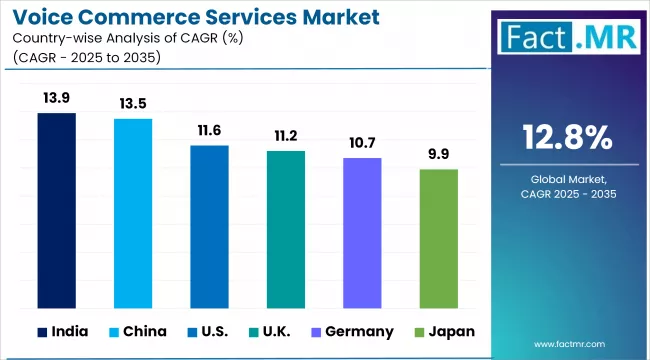
Voice Commerce Services Market Cagr Analysis By Country | Source: Fact.MR
U.S. voice commerce services market driven by smart assistant adoption, retail innovation, and AI-enabled payment integration
Voice commerce services are gaining traction not only due to the increasing numbers of individuals using smart assistants like Alexa, Google Assistant or Siri, but also because retailers have invested a lot to integrate voice-based shopping services. Consumers are engaging with voice-enabled devices more frequently to search and use, order and pay, and businesses are considering them as a way of improving customer experiences, streamlining the checkout process, and as an addition to an omnichannel commerce program.
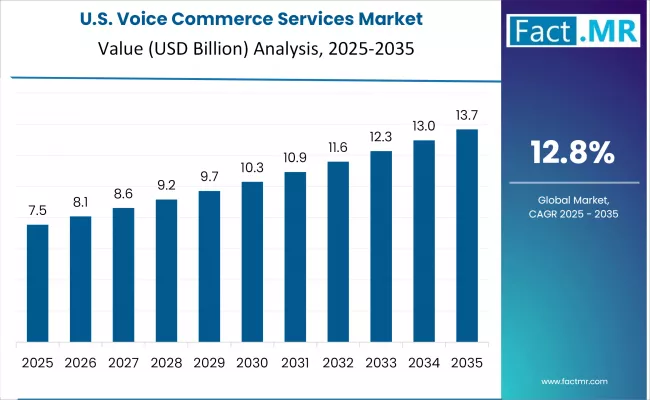
Voice Commerce Services Market Country Value Analysis | Source: Fact.MR
Big box retailers and online sellers are building voice-based platforms that eliminate the friction of online transactions and amplify personalization using AI-based recommendation engines. Secure digital payment regulatory rules and emerging data privacy concerns are also informing the design and implementation of voice commerce platforms by companies.
China voice commerce services market driven by super-app ecosystems, mobile-first adoption, and AI-powered payment innovation
The voice commerce service sector is growing in scale due to the integration of voice-based shopping features in the widely used super-apps and mobile commerce apps. Consumers are shifting past product search and ordering to voice interfaces in paying the bill, at the time of food delivery, or when making their travel arrangements, further suggesting the existence of mobile-first shopping behavior. Companies are investing heavily in personalization with the help of AI and voice-enabled mini-programs to directly reach users on online platforms.
Large technology conglomerates are integrating e-commerce, payments, and lifestyle applications with voice assistants, which only increases the reliance of consumers on frictionless and instant transactions. Cybersecurity, online payment, and privacy of consumer information laws are influencing how platforms are formed and constructed around voice-based commerce.
India market driven by smartphone penetration, vernacular adoption, and fintech integration
The voice commerce service market is growing at a pace because of rapidly penetrating smart phones, cheap access to internet networks and higher utilization of vernacular voice assistants. Consumers are increasingly adopting voice interfaces to recharge, pay utility bills, shop groceries, and make regular retail purchases and companies are realizing the power of voice enabled solutions to contact a larger number of consumers in both urban and rural markets.
Voice interfaces are being incorporated into applications and wallets on e-commerce platforms and e-payment service providers, allowing new internet users and those unable to speak English to make purchases as well. The voice-enabled commerce ecosystems are increasingly gaining trust due to regulatory activity in the field of safe digital operations and standardized payment networks.
Category-Wise Analysis
Smartphones emerge as the leading interface for voice commerce adoption
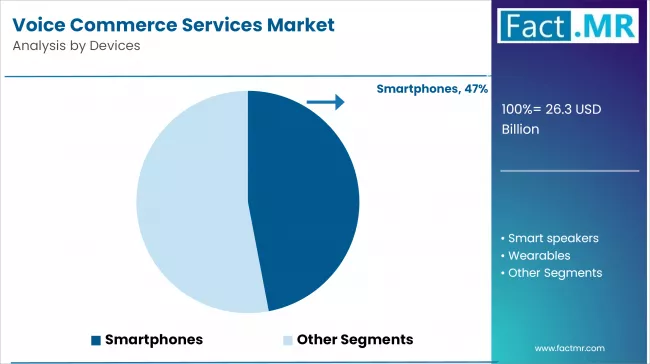
Voice Commerce Services Market Analysis By Devices | Source: Fact.MR
Smartphones are becoming the primary category of devices that make voice commerce possible, and the assistants that are built-in to them are becoming a part of the digital purchasing patterns. Consumers use smartphones not just to make voice-based searches and product recommendations but also to make secure payments and use conversational AI to manage loyalty programs. Smartphones are the most convenient and extensively used voice commerce medium because of their portability, 24/7 connectivity and integration with e-wallets.
The segment is backed by the fast development of natural language processing (NLP), secure biometric authentication, and voice assistance integration into mobile applications. Businesses are making huge investments in mobile-first voice interface optimization to support a wide range of consumer preferences, especially in retail, financial services, and food delivery industries.
Consumer goods and retail sector drives mainstream adoption of voice commerce
Consumer goods and retail sector is proving to be the most high-profile user of voice commerce solutions, and they are using voice commerce solutions to develop frictionless, personalized and efficient shopping experiences. Retailers are integrating voice-based assistants into mobile applications and smart products to allow product discovery, price comparison and immediate ordering, especially in fast-moving consumer goods (FMCG) and grocery sectors. Simple commands to make repeat orders, monitor deliveries, and receive custom promotions are changing the customer loyalty strategies.
This market is being propelled through the convergence of conversational AI with omnichannel retail platforms, in which voice interfaces complement online, in-store, and app-based shopping. Major consumer brands and online shopping platforms are using recommendation engines that run on AI, voice-activated offers, and interactivity in product information to increase interactions.
Voice-enabled ordering reshapes customer engagement with convenience-driven commerce
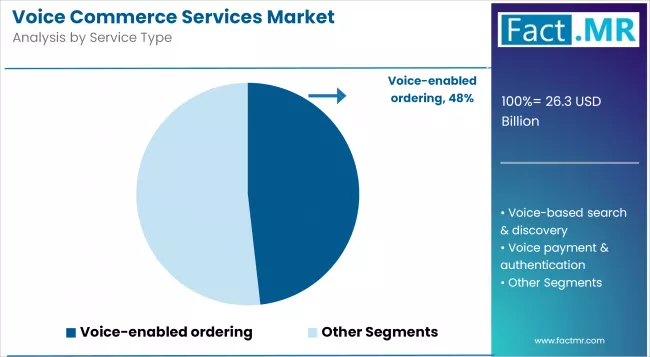
Voice Commerce Services Market Analysis By Service Type | Source: Fact.MR
Voice-enabled ordering is emerging as one of the most disruptive types of services within the voice commerce ecosystem, where consumers can make and finalize transactions by speaking in response to a simple voice prompt. This functionality is picking up in food delivery and grocery shopping and in quick-service retailing areas, where speed and convenience are king.
Customers are starting to rely on smart speakers, smartphones, and in-car assistants to recalculate regularly purchased products, monitor the status of orders and receive individual offers without navigation on the conventional interface.
Businesses consider voice-enabled ordering as a competitive edge and have introduced it into their mobile applications, electronic wallets, and online shopping services to reduce the buying process. The use of natural language processing (NLP), artificial intelligence-based personalization, and voice authentication with security is reinforcing confidence in this service model.
Competitive Analysis
The voice commerce services market is characterized by a very fast rate of innovation of AI, online natural language processing, and payment systems. Players in the market are investing in the incorporation of voice into the existing retail, financial and lifestyle ecosystems as a way to reinforce consumer adoption. Accuracy in speech recognition, multilingual and the ability to smoothly integrate voice interaction with app- and web-based commerce are driving differentiation.
The market is also becoming increasingly competitive on the ecosystem integration front, and collaboration with retailers, fintechs, and smart device makers are essential to broaden its scope. The providers are also investing in personalization features and fraud detection mechanisms along with loyalty program tie-ins to boost user trust and user engagement. It is likely that this will lead to the consolidation of the market as stronger ecosystems are able to outcompete the smaller entrants to niche verticals or regional markets.
Key players in the voice commerce service market are Amazon, Apple, Google, Samsung, Sony, and others.
Recent Developments
- In August 2025, Amazon introduced Alexa+, the artificial intelligence (AI)-powered version of its voice assistant, marking a significant upgrade in its capabilities. The new voice assistant, boasts advanced contextual understanding, improved smart home control, and a highly personalised experience tailored to individual users' behaviour.
- In February2025, SoundHound AI Inc, a global leader in voice artificial intelligence, unveiled the first ever in-vehicle voice commerce platform with a demo at CES 2025. The platform, which allows drivers and passengers to order takeout for pick-up directly from the car’s infotainment system.
Fact.MR has provided detailed information about the price points of key manufacturers of Voice Commerce Services Market positioned across regions, sales growth, production capacity, and speculative technological expansion, in the recently published report.
Methodology and Industry Tracking Approach
The Global Voice Commerce Services Report 2025 was created as a result of interviews with over 11,000 experts working in fields like conversational AI, natural language processing, voice-enabled payments, retail and e-commerce innovation, fintech integration, fraud detection, smart device ecosystem development, and regulatory compliance regarding digital transactions. The respondents were senior AI and speech technology developers, retail and consumer goods leaders, fintech and banking digital strategy managers, healthcare IT heads, enterprise architects, government digital commerce advisors, and startups that were developing voice-based customer engagement.
In October 2024 and August 2025, the research was carried out with the help of a set of structured questionnaires based on the horizontal research design. The accuracy, scalability, and efficiency of voice commerce solutions, implementation of AI-powered personalization, biometric voice authentication, and mobile-first commerce models were assessed by the methodology.
With Fact.MR monitoring consumer behavior, product efficacy, industry trends, and market opportunities since 2018, this report is becoming an authoritative source of information that stakeholders can rely on.
Segmentation
Segmentation of Voice Commerce Services Market
-
By Devices Type :
- Smartphones
- Smart speakers
- Wearables
- In-car systems
-
By Industry :
- Consumer Goods & Retail
- Healthcare
- Automotive
- BFSI
- Media & Entertainment
- Hospitality & Travel
-
By Service Type :
- Voice-enabled ordering
- Voice-based search & discovery
- Voice payment & authentication
-
By Region :
- North America
- Latin America
- Western Europe
- Eastern Europe
- East Asia
- South Asia & Pacific
- Middle East & Africa
Frequently Asked Questions
What was the voice commerce service market size reported by Fact.MR for 2025?
Who are the major players operating in the voice commerce service market?
What is the estimated valuation of the voice commerce service market in 2035?
What value CAGR did the voice commerce service market exhibit over the last five years?
Who worked on this report


Preview the report firsthand - request a free sample
Free SampleGet the brochure for pricing and purchase details
Download PDF