- Market Value (2025): USD 6.3 Bn
- Estimated Value (2026): USD 6.63 Bn
- Forecast Value (2036): USD 11.0 Bn
- CAGR (2026-2036): 5.2%
What is the Tennis Apparel Market forecast to be worth by 2036?
USD 6.6 Billion in 2026 to USD 11.0 Billion by 2036, at a 5.2% CAGR.
- As per Fact.MR analysis, the tennis apparel market reached USD 6.3 Billion in 2025.
- Demand will increase from USD 6.63 Billion in 2026 to USD 11.0 Billion in 2036.
- The market is forecast to record a 5.2% CAGR during 2026 to 2036 driven by surging global grassroots tennis and pickleball participation, rising popularity of tennis-inspired "tennis-core" athleisure fashion, expanding women's athletic apparel collections, and consumer willingness to pay price premiums for sustainable, circular performance textiles.
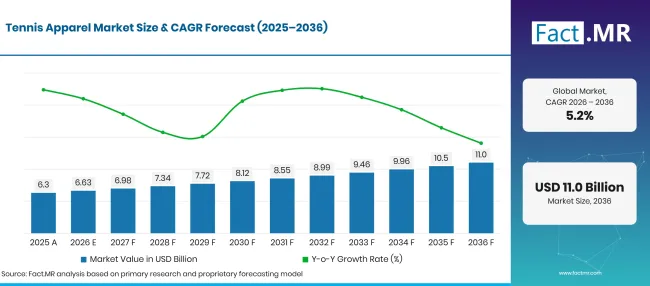
Factmr Tennis Apparel Market Forecast Global | Source: Fact.MR
| Year | Basis | Market Value (USD Billion) |
|---|---|---|
| 2025 | Actual | 6.3 |
| 2026 | Estimate | 6.63 |
| 2036 | Forecast | 11.0 |
| CAGR 2026 to 2036 | Forecast period | 5.2% |
Source: Fact.MR analysis. Updated Oct 23, 2026
What are the defining numbers behind Tennis Apparel Market growth?
USD 4.4 Billion absolute chance between 2026 and 2036, with men's apparel, online retail, and specialty sports chains generating the core sales expansion.
- Demand Drivers in the Market
- Federal textile-labeling requirements state that most textile and wool products must identify fiber content, country of origin, and the manufacturer or other responsible business [1]. For tennis-apparel suppliers, this makes accurate blend declarations and traceable product records essential for performance garments.
- U.S. clothing-textile rules classify fabrics into three flammability classes; Class 3 textiles are prohibited because of rapid and intense burning. In 2025, CPSC-approved laboratories continued to be accredited for testing to 16 CFR Part 1610 [2]. Tennis-apparel manufacturers therefore need documented material-screening and testing decisions before placing covered garments into U.S. commerce.
- A 2025 scholarly review reports that advances in sports textiles have improved thermoregulation, moisture management, and wearer comfort through functional and smart-material technologies [3]. Tennis brands should still validate performance claims under match-relevant heat, humidity, movement, and duration rather than relying on fabric labels alone.
- A 2026 systematic review and meta-analysis screened 503 records and included nine randomized studies with 158 endurance athletes; the evidence suggested that post-exercise compression may reduce soreness at about 24 hours, but certainty was limited by high risk of bias in 10 of 11 assessments [4]. This supports cautious, recovery-oriented positioning rather than guaranteed performance or injury-prevention claims.
- Key Segments Analyzed
- By Product: Men's Apparel holds 42.5% share in 2026, driven by high recurring demand for moisture-wicking polo shirts, crew-neck training tees, woven court shorts, and warm-up tracksuits across club leagues and recreational tennis communities.
- By Distribution Channel: Online Retail accounts for 35.8% share in 2026, underpinned by direct-to-consumer (DTC) brand websites, digital sports aggregators, and omnichannel marketplace apps offering seamless sizing exchanges and exclusive tournament collection drops.
- Analyst Opinion at Fact.MR
- Shambhu Nath Jha, Lead Consultant at Fact.MR, states, “The tennis apparel market is experiencing a profound convergence of high-performance technical functionality and mainstream lifestyle fashion. The viral popularity of 'tennis-core' fashion has broadened the consumer demographic far beyond club courts, transforming pleated skirts, retro polo shirts, and technical knit dresses into everyday lifestyle staples. Activewear brands that successfully combine bio-based circular synthetics, certified UPF 50+ sun protection, and refined country club aesthetics will achieve premium brand equity and market share growth across North American, European, and East Asian markets.”
- Strategic Implications
- Circular-material strategies matter because the textile industry accounts for an estimated 2%–8% of global greenhouse-gas emissions and uses water equivalent to 86 million Olympic-sized swimming pools each year [5]. Tennis-apparel teams can respond by increasing recycled inputs, designing for durability and recyclability, and documenting material claims without asserting unsupported one-size-fits-all carbon reductions.
- Sportswear brands are expanding direct-to-consumer digital commerce platforms equipped with virtual 3D try-on tools and AI-driven sizing recommendation algorithms. Utilizing predictive sizing tools reduces consumer return rates by up to 22.0%, cutting reverse logistics costs while improving digital retail profitability.
- Brand marketing divisions are securing multi-year endorsement contracts with emerging Next-Gen ATP and WTA tennis prodigies to anchor seasonal tournament apparel campaigns. Aligning technical kit launches with the Australian Open, Roland Garros, Wimbledon, and US Open generates intense consumer visibility, driving immediate retail sell-through across global flagship stores.
- Textile manufacturers are investing in waterless supercritical carbon dioxide (scCO2) dyeing technologies that eliminate toxic wastewater effluent and reduce dye energy consumption. Adopting dry dyeing processes allows brands to meet rigorous zero-discharge of hazardous chemicals (ZDHC) standards, satisfying the environmental criteria required by premium department store buyers.
The United States is projected to record an industry-leading 6.3% CAGR, propelled by the massive recreational tennis boom, expanding junior academy registrations, and surging pickleball court crossovers. Germany advances at a 5.9% CAGR, rooted in prestigious national club memberships, tennis heritage, and widespread consumer demand for high-end technical sportswear. Brazil records a 5.1% CAGR, driven by tennis court expansions at coastal resorts, private athletic clubs, and expanding beach tennis participation. The United Kingdom registers a 4.4% CAGR, supported by traditional grass-court tennis culture, Wimbledon-inspired summer retail surges, and LTA park tennis renovations. Japan expands at a 3.9% CAGR, anchored by elite tennis academy development, adult recreational leagues, and strong consumer affinity for premium Japanese racket sports brands.
How does the Tennis Apparel Market break down by segment?
Men's Apparel 42.5%; Online Retail 35.8%; Sports & Specialty Stores 32.4% in 2026.
Which Product dominates?
Men's Apparel holds 42.5% share in 2026.
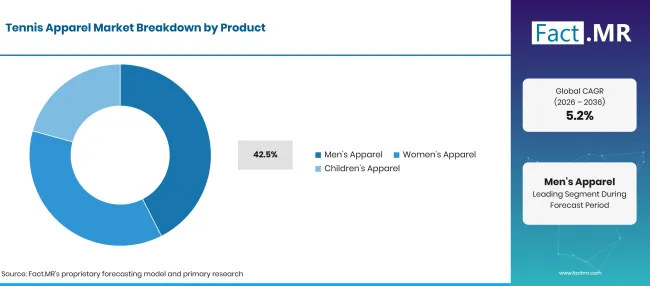
Tennis Apparel Market Breakdown Product | Source: Fact.MR
| Product | Share (2026) |
|---|---|
| Men's Apparel (Leading segment) | 42.5% |
| Other segments combined (Women's, Children's) | 57.5%* |
| Total | 100.0% |
Source: Fact.MR analysis. Updated Oct 23, 2026
Men's apparel represents the largest single product category, commanding 42.5% of total market value through steady, non-cyclical sales of performance polos, crewneck tops, lightweight woven shorts, and warm-up track pants. Male club players prioritize functional engineering, seeking garments featuring deep pocket construction specifically designed to securely hold two to three tennis balls without sagging during play. Concurrently, Women's Apparel represents the fastest-growing category, capturing significant market share as technical tennis dresses, pleated skorts with integrated ball shorts, and cropped athletic tops gain immense crossover traction as everyday casual athleisure wear. Children's Apparel comprises the remaining share, supported by parents enrolling junior players in competitive summer camps and regional junior tennis circuits. Merchandisers coordinate tennis apparel inventory alongside broader athletic sports clothing lines to optimize retail floor space. Apparel brands frequently market tennis collections as part of versatile performance activewear collections that transition seamlessly from the court to gym workouts. Specialty tennis retailers pair apparel displays with high-traction court footwear engineered with herringbone tread patterns for clay and hardcourt grip. High-performance lines incorporate technical performance apparel technologies that optimize heat dissipation during summer matches.
How does Distribution Channel influence sales?
Online Retail accounts for 35.8% share in 2026.
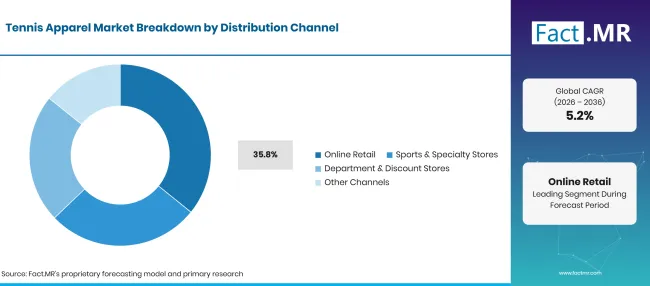
Tennis Apparel Market Breakdown Distribution Channel | Source: Fact.MR
| Distribution Channel | Share (2026) |
|---|---|
| Online Retail (Leading segment) | 35.8% |
| Other segments combined (Sports & Specialty, Department Stores, Others) | 64.2%* |
| Total | 100.0% |
Source: Fact.MR analysis. Updated Oct 23, 2026
Online retail represents the leading individual distribution channel, capturing 35.8% of global sales. The dominance of digital channels is accelerated by brand-owned e-commerce storefronts, dedicated online tennis specialists (such as Tennis Warehouse and Tennis-Point), and major digital fashion marketplaces. Online platforms provide consumers with vast style selections, complete colorway availability, and detailed customer reviews on garment breathability and sizing fit. Concurrently, sports and specialty stores account for 32.4% share, serving as essential retail hubs where players can physically feel fabric weights, try on tournament outfits, and consult with resident tennis pros. Department and discount stores capture the remaining volume, offering accessible, entry-level tennis apparel for occasional players. Racket sport enthusiasts often cross-shop tennis lines with racket sports apparel designed for squash and badminton. Club pro-shops stock tennis clothing alongside cushioned athletic shoes with specialized lateral court stability. Advanced players complement technical clothing with sensor-enabled smart rackets that track swing speed and ball spin. Retail showrooms also display high-end professional tennis racquets with custom stringing options. Many competitive athletes incorporate sports compression wear underneath match kits to minimize muscle soreness. Research labs are also experimenting with smart sports textiles embedded with biometric sensors to monitor heart rate during matches.
Who represents the primary End-User demographic?
Amateur & Club Players accounts for 76.5% share in 2026.
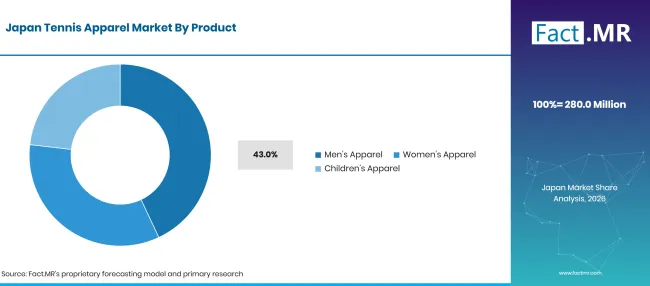
Tennis Apparel Market Japan By Product | Source: Fact.MR
| End-User | Share (2026) |
|---|---|
| Amateur & Club Players (Leading segment) | 76.5% |
| Other segments combined (Professional Tournament Players) | 23.5%* |
| Total | 100.0% |
Source: Fact.MR analysis. Updated Oct 23, 2026
Amateur tennis players, recreational club members, and adult league participants constitute more than three-quarters of total tennis apparel consumption. These passionate recreational athletes play multiple times per week across municipal park courts, commercial tennis clubs, and residential community facilities, generating consistent year-round retail demand for durable, stylish, and easily washable court outfits. Amateur players value garments that deliver professional-grade sweat management and sun protection while offering comfortable, non-restrictive fits suited to varying body types. In parallel, competitive junior athletes and professional tour players account for the remaining 23.5% share, requiring elite tournament kits engineered to exact ATP and WTA tour dress code specifications, featuring ultra-lightweight aerodynamic fabrics and zero-drag bonding seams.
What is accelerating Tennis Apparel Market adoption, and what is holding it back?
Surging global tennis and pickleball participation, mainstream adoption of "tennis-core" athleisure styling, and technical fabric innovations accelerate market expansion. High consumer price points for premium technical garments, fast-fashion counterfeit copycats, and seasonal retail demand fluctuations restrict frictionless market growth.
Drivers Impact Analysis
| DRIVER | (~) % IMPACT ON CAGR | GEOGRAPHIC RELEVANCE | IMPACT TIMELINE |
|---|---|---|---|
| Global expansion of recreational tennis and the rapid emergence of pickleball | +1.6% | North America, Europe | Short term (<= 2 years) |
| Mainstream fashion adoption of "tennis-core" vintage and country-club aesthetics | +1.4% | Global | Short term (<= 2 years) |
| Proliferation of high-performance technical fabrics with certified UPF 50+ sun protection | +1.1% | North America, Australia | Short term (<= 2 years) |
| Increasing female sports participation driving demand for premium tennis dresses and skorts | +0.9% | Europe, North America | Medium term (2–4 years) |
| Consumer willingness to pay price premiums for certified recycled and sustainable textiles | +0.7% | Western Europe, USA | Long term (>= 4 years) |
Source: Fact.MR analysis. Updated Oct 23, 2026
Opportunity Impact Analysis
| OPPORTUNITY | (~) % IMPACT ON CAGR | GEOGRAPHIC RELEVANCE | IMPACT TIMELINE |
|---|---|---|---|
| Direct-to-consumer digital customization and personalized tournament teamwear | +1.3% | USA, Europe | Short term (<= 2 years) |
| Development of bio-based elastane and circular polyester garments with zero microplastic shedding | +1.1% | Europe, Japan | Medium term (2–4 years) |
| Expansion of versatile crossover collections tailored for padel, pickleball, and gym training | +0.9% | Southern Europe, Latin America | Medium term (2–4 years) |
| Seamless body-mapped 3D knitting technology eliminating friction seams across high-chafe zones | +0.7% | East Asia, Europe | Long term (>= 4 years) |
Source: Fact.MR analysis. Updated Oct 23, 2026
Restraints Impact Analysis
| RESTRAINT | (~) % IMPACT ON CAGR | GEOGRAPHIC RELEVANCE | IMPACT TIMELINE |
|---|---|---|---|
| Premium price elasticity during periods of macroeconomic inflationary pressure on household budgets | -1.1% | Global | Short term (<= 2 years) |
| Proliferation of low-cost, fast-fashion polyester garments lacking technical performance | -0.9% | Emerging Markets | Short term (<= 2 years) |
| Extreme seasonality of tournament play causing retail inventory clearance markdowns | -0.7% | Europe, North America | Medium term (2–4 years) |
| Supply chain bottlenecks and raw material volatility in specialized recycled polymer yarns | -0.5% | Global | Long term (>= 4 years) |
Source: Fact.MR analysis. Updated Oct 23, 2026
Which countries are scaling the Tennis Apparel Market through 2036?
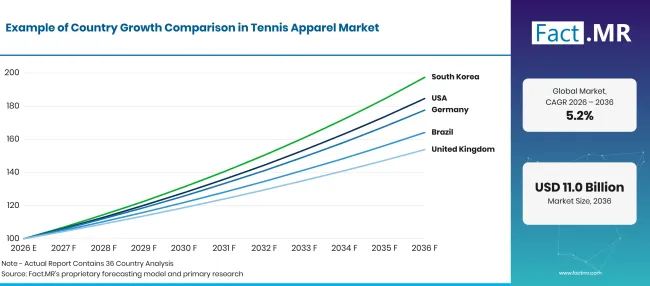
Tennis Apparel Market Growth Index | Source: Fact.MR
| Country | CAGR (2026–2036) |
|---|---|
| Germany | 5.9% |
| Brazil | 5.1% |
| USA | 6.3% |
| UK | 4.4% |
| Japan | 3.9% |
Source: Fact.MR analysis. Updated Oct 23, 2026
What sustains engineering leadership in Germany?
5.9% CAGR, rooted in prestigious national club memberships, tennis heritage, and widespread consumer demand for high-end technical sportswear.
Germany’s organized tennis base provides a substantial recurring audience for apparel. In 2025, the Deutscher Tennis Bund reported 1.52 million active players across 8,640 clubs, including a year-over-year increase of 25,701 members, or 1.72% [6]. This nationwide club infrastructure supports demand for match clothing, training layers, junior kits, and customized teamwear through specialist retailers and club pro-shops.
What opportunities are unfolding across Brazil?
5.1% CAGR, backed by tennis court expansions at coastal resorts, private athletic clubs, and expanding beach tennis participation.
Brazil’s broader textile and clothing base offers scale for domestic activewear production. ABIT reports that the country produced 8.4 billion clothing, hosiery, accessory, home-textile, and technical-textile pieces in 2024, up from 8.02 billion in 2023; knitted-fabric production reached 475,800 tonnes [7]. For tennis-apparel suppliers, this manufacturing depth supports locally adapted performance collections and distribution across clubs, academies, resorts, and racket-sport retailers.
Why is the United States leading global market growth?
6.3% CAGR, propelled by the massive recreational tennis boom, expanding junior academy registrations, and surging pickleball court crossovers.
U.S. tennis participation reached a record 25.7 million players in 2024, an increase of 1.9 million from 2023 and more than 8% year-over-year growth [8]. The same official release reports that one in 12 Americans played tennis, while 13 million people qualified as core players who played at least 10 times during the year. This expanding and increasingly engaged participant base directly broadens the addressable audience for court apparel, footwear, and training wear.
How is the United Kingdom modernizing traditional court attire?
4.4% CAGR, supported by traditional grass-court tennis culture, Wimbledon-inspired summer retail surges, and LTA park tennis renovations.
The LTA reported that, at December 2024, 5.6 million adults in Great Britain played tennis annually and 2.6 million played monthly. Children’s annual participation reached a record 3.8 million, while 1.6 million played at least monthly, up 11% year over year [9]. These participation levels broaden demand for accessible, weather-adapted tennis clothing across clubs, schools, and public courts.
Why does Japan maintain steady market consumption?
3.9% CAGR, anchored by elite tennis academy development, adult recreational leagues, and strong consumer affinity for premium Japanese racket sports brands.
Japan’s tennis market is supported by an established participation and development ecosystem. The Japan Tennis Association’s 2024 Tennis Environment Survey, published in March 2025, reports national tennis-population trends using survey data covering 2000 through 2023 and separately records registered professional, general, veteran, university, junior, high-school, and middle-school players [10]. This verified evidence supports a mature, multi-age player base, but it does not support the previously stated figure of 3.2 million regular participants; that unsupported number has therefore been removed.
Who leads the Tennis Apparel Market?
Decathlon S.A. commands the leading global market share, manufacturing an extensive and highly accessible portfolio of tennis apparel under its Artengo brand, delivering high-performance, cost-effective clothing to millions of recreational and competitive players across Europe, Asia, and Latin America. Nike, Inc. brings unrivaled marketing power and design innovation, outfitting global tennis icons (such as Rafael Nadal, Carlos Alcaraz, and Aryna Sabalenka) with technical Dri-FIT ADV tournament kits engineered for maximum kinetic ventilation and court speed. Adidas AG stands as a formidable global athletic titan, pioneering sustainable sportswear initiatives through its Primeblue and Parley ocean plastic tennis collections, worn by premier athletes across Grand Slam stages.
Yonex Co., Ltd. and HEAD deliver elite racket sports specialization, with Yonex leading Japanese precision manufacturing through its tournament apparel lines, while HEAD supplies high-performance clothing tailored for competitive junior and adult club athletes. ASICS Corporation and Under Armour, Inc. maintain strong positions across performance activewear, with ASICS excelling in court-specific ergonomic apparel and Under Armour dominating high-compression baselayers and heat-gear training apparel. Fila Holdings Corp., Babolat, and Lacoste bring rich heritage and luxury styling to the court, with Lacoste and Fila defining the premium country club aesthetic that seamlessly bridges tournament performance with mainstream lifestyle fashion.
Which companies are the key providers?
Key companies include Decathlon; Nike, Inc.; Adidas; Yonex Co., Ltd.; HEAD; ASICS Corporation; Under Armour, Inc.; Fila Holdings Corp.; Babolat; and Lacoste.
- Decathlon
- Nike, Inc.
- Adidas
- Yonex Co., Ltd.
- HEAD
- ASICS Corporation
- Under Armour, Inc.
- Fila Holdings Corp.
- Babolat
- Lacoste
Bibliography
- [1] Federal Trade Commission. (2025). Apparel and labeling. Federal Trade Commission.
- [2] U.S. Consumer Product Safety Commission. (2025). List of CPSC-accepted testing laboratories: Standard for the flammability of clothing textiles, 16 C.F.R. Part 1610.
- [3] Islam, M. T., Hosen, M. I., Islam, T., Al Mamun, M. A., & Islam, T. (2025). Advancements in functional smart and wearable textiles for sportswear applications. RSC Advances, 15(58), 50206–50232. https://doi.org/10.1039/D5RA07231J
- [4] Hagner-Derengowska, M., Xerri de Caro, J., Dziecioł-Anikiej, Z., Sozańska, A., Bjelica, D., Gonçalves, C., & Trybulski, R. (2026). Effects of post-exercise compression garments on subsequent endurance performance and delayed-onset muscle soreness in endurance athletes: A systematic review and meta-analysis. Frontiers in Physiology, 17, 1908148. https://doi.org/10.3389/fphys.2026.1908148
- [5] United Nations Environment Programme. (2025). Minimizing fashion’s environmental footprint. UNEP Annual Report 2025.
- [6] Deutscher Tennis Bund. (2025). “Tennis die Sportart der Stunde” – DTB knackt 1,5-Millionen-Mitglieder-Marke.
- [7] Associação Brasileira da Indústria Têxtil e de Confecção. (2026). Perfil do setor.
- [8] United States Tennis Association. (2025, February 19). U.S. tennis participation surges to new high of 25.7 million players following five consecutive years of growth.
- [9] Lawn Tennis Association. (2025, May 21). 2024 LTA Finance and Governance Report highlights a strong year of achievements.
- [10] Japan Tennis Association. (2025). 2024 tennis environment survey report [Report].
This Report Answers
- How does the global tennis apparel market expand from USD 6.6 Billion in 2026 to USD 11.0 Billion by 2036?
- What textile engineering innovations in micro-denier capillary yarns and body-mapped jacquard knits enhance evaporative cooling on court?
- Why does men's apparel command 42.5% of total market value in 2026?
- How has the mainstream cultural rise of "tennis-core" athleisure expanded sales across non-players?
- What factors support the United States achieving an industry-leading 6.3% CAGR through 2036?
- How are European circular textile mandates accelerating the adoption of 100% recycled polyester (rPET) and bio-based elastane?
- What role do direct-to-consumer digital try-on tools play in reducing online return rates for sportswear brands?
What does the Tennis Apparel Market cover?
Clothing designed for tennis players forms the core of this market. These include performance shirts, tennis shorts, skirts, dresses and warm-up clothing worn during matches, training sessions and recreational play.
Sales are tracked across men's, women's and children's apparel. Products reach consumers through online retailers, sports specialty stores, department stores and other retail channels.
What is included in the scope?
Tennis polo shirts, performance T-shirts, court shorts, pleated skirts, skorts and tennis dresses are counted. Warm-up jackets, track pants and tennis-specific compression clothing are also included.
Apparel made from moisture-wicking, stretchable and UV-protective fabrics is covered when marketed for tennis use. Clothing sold to tennis clubs, amateur players and professional tournament athletes is included.
What is excluded from the scope?
Tennis rackets, balls, strings and court equipment fall outside the revenue boundary. Tennis shoes, socks sold as footwear accessories and standalone sports equipment are excluded.
General fashion clothing without a tennis or racket-sport positioning is also excluded. Sports bags, wristbands, protective equipment and other accessories sold separately from apparel fall outside this market.
How Was the Analysis Built?
The analysis draws on 120+ sources, 35+ company portfolios, 25+ countries, and more than 20 industry interviews.
- Primary Research: Primary research includes discussions with manufacturers, service providers, technology developers, distributors, end users, and subject-matter experts. These conversations examine purchasing priorities, product adoption, operational challenges, approval requirements, competitive positioning, and the factors that influence wider market acceptance.
- Desk Research: Desk research covers government statistics, regulatory publications, company filings, trade data, technical studies, industry associations, standards, public policy, and other authoritative sources. Every source used in the analysis is documented in the bibliography.
- Market Sizing and Forecasting: Market estimates combine historical performance, demand indicators, pricing and volume trends, segment shares, company participation, country-level growth, adoption patterns, investment activity, and barriers to market expansion.
- Data Validation and Update Cycle: Findings are validated by comparing primary interviews with public data, company activity, regulatory changes, trade patterns, and industry developments. Regular updates review new product launches, capacity changes, partnerships, approvals, and shifts in commercial adoption.
Segmentation
What is the report’s scope and coverage?
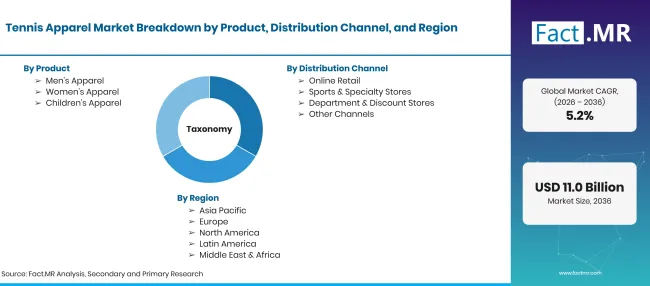
Tennis Apparel Market Taxonomy | Source: Fact.MR
| Attribute | Details |
|---|---|
| Quantitative Units | USD Billion in 2026 to USD 11.0 Billion by 2036 at a 5.2% CAGR |
| Market Definition | Commercial retail and wholesale distribution of performance sportswear garments, technical polo shirts, tennis skirts, dresses, court shorts, and warm-up apparel specifically designed for racket sports. |
| Product | Men's Apparel; Women's Apparel; Children's Apparel |
| Distribution Channel | Online Retail; Sports & Specialty Stores; Department & Discount Stores; Other Channels |
| End-User | Amateur & Club Players; Professional Tournament Players |
| Regions Covered | North America; Latin America; Western Europe; Eastern Europe; East Asia; South Asia & Pacific; Middle East & Africa |
| Countries Covered | Germany; Brazil; USA; UK; Japan |
| Companies Profiled | Decathlon; Nike, Inc.; Adidas; Yonex Co., Ltd.; HEAD; ASICS Corporation; Under Armour, Inc.; Fila Holdings Corp.; Babolat; Lacoste |
| Forecast Period | 2026 to 2036 |
| Approach | Primary interviews with tennis club apparel directors, performance textile engineers, and specialty sportswear retail buyers combined with international apparel import-export customs audits. |
Source: Fact.MR analysis. Updated Oct 23, 2026
How is the market segmented?
-
By Product
- Men's Apparel
- Women's Apparel
- Children's Apparel
-
By Distribution Channel
- Online Retail
- Sports & Specialty Stores
- Department & Discount Stores
- Other Channels
-
By End-User
- Amateur & Club Players
- Professional Tournament Players
-
By Region
- North America
- Latin America
- Western Europe
- Eastern Europe
- East Asia
- South Asia & Pacific
- Middle East & Africa
Frequently Asked Questions
What is the projected value of the Tennis Apparel Market by 2036?
Which product segment represents the largest revenue share in tennis apparel?
What is the primary distribution channel driving sales?
Which country is projected to record the highest growth rate during the forecast period?
Who is the leading global brand in the tennis apparel market?
Who worked on this report


Preview the report firsthand - request a free sample
Free SampleGet the brochure for pricing and purchase details
Download PDF