- Base Value(2025): 11.80 Bn
- Estimated Value(2026): 12.15 Bn
- Forecast Value (2036): 16.33 Bn
- CAGR (2026 - 2036): 3.0%
Thermic Fluids Market Size, Market Forecast and Outlook By Fact.MR
The Thermic Fluids market was valued at USD 11.80 billion in 2025, projected to reach USD 12.15 billion in 2026, and is forecast to expand to USD 16.33 billion by 2036 at a 3.0% CAGR. Sustained capacity additions in oil refining, petrochemical processing, and concentrated solar power installations continue to widen the installed base of indirect heating circuits that rely on thermic fluids. What were once optional thermal management upgrades have now become mandatory operational specifications for process safety compliance, compelling plant managers to budget for fluid replacement cycles alongside new capital expenditure approvals.
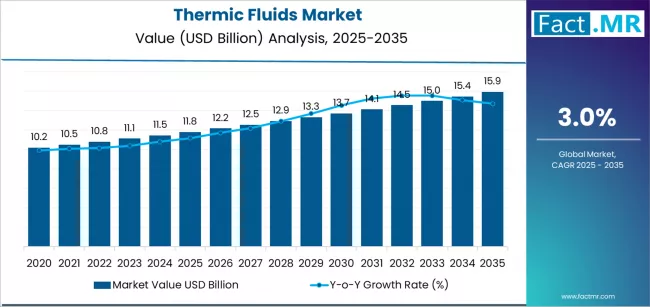
Thermic Fluids Market Market Value Analysis | Source: Fact.MR
Summary of Thermic Fluids Market
- Market Overview
- The Thermic Fluids market is valued at USD 11.80 billion in 2025 and is projected to reach USD 16.33 billion by 2036.
- The industry is expected to grow at a 3.0% CAGR from 2026 to 2036, creating an incremental opportunity of USD 4.18 billion.
- The market is a mature, volume-driven industrial consumable category where fluid replacement cycles, process safety mandates, and refinery capacity additions define demand trajectories.
- Demand and Growth Drivers
- Demand is expanding as oil refining and petrochemical processing facilities commission new indirect heating circuits that require certified thermic fluid fills.
- Concentrated solar power installations and food processing sterilization lines are broadening the application base beyond traditional chemical manufacturing.
- Tightening environmental regulations on spent fluid disposal are accelerating conversion from mineral oils to longer-life synthetic and silicone-based alternatives.
- Among key countries, India leads at 3.7% CAGR, followed by China at 3.6%, the USA at 3.2%, the UK at 3.1%, Canada at 3.0%, Mexico at 2.9%, and Germany at 2.8%.
- Product and Segment View
- Thermic fluids are heat-transfer liquids engineered to operate within closed-loop indirect heating or cooling circuits across a defined temperature range without phase change under normal operating pressure.
- Aromatic fluids lead by Product with 36.4% share in 2026, owing to their superior thermal stability at temperatures above 300 degrees Celsius in petrochemical service.
- Oil & Gas commands by Application with 35.6% share in 2026, driven by refinery heater circuits and offshore platform thermal management requirements.
- Scope includes aromatic, silicone-based, mineral oil, and glycol-based thermic fluids used in indirect heat transfer; excludes direct-fired heating media, steam systems, and refrigerants.
- Geography and Competitive Outlook
- India and China are the fastest-growing markets due to refinery expansion and solar thermal capacity additions, while North America and Europe represent mature replacement-demand bases.
- Competition is shaped by feedstock integration, technical service networks, and long-term supply contracts with process plant operators.
- Key companies include Eastman Chemical Company, ExxonMobil, Huntsman Corporation, Parathem Corporation, Royal Dutch Shell, Clariant AG, British Petroleum Plc, HPCL, and Thermic Fluids Pvt. Ltd.
- Analyst Opinion at Fact.MR
- Shambhu Nath Jha , Principal Consultant for Chemicals, opines: 'In my analysis, I have observed that the real margin differentiator in the thermic fluids space is no longer bulk pricing but fluid longevity and disposal cost avoidance. Plant operators running high-temperature aromatic circuits are moving away from short-cycle mineral oil fills toward extended-drain synthetic formulations that reduce both unplanned shutdowns and hazardous waste volumes. Suppliers that fail to offer integrated fluid management services, including condition monitoring and spent-fluid take-back, will lose specification authority at the procurement stage. Refinery engineering teams now treat heat-transfer fluid selection as a lifecycle cost exercise, not a spot purchase.'
- Strategic Implications / Executive Takeaways
- Fluid suppliers must develop condition-monitoring service packages that extend drain intervals and reduce unplanned thermal circuit shutdowns for refinery and petrochemical clients.
- Plant engineering directors should mandate lifecycle cost evaluations rather than unit-price comparisons when specifying thermic fluids for new indirect heating installations.
- Procurement teams must secure long-term supply agreements with integrated take-back provisions for spent fluid to comply with tightening hazardous waste discharge regulations.
Thermic Fluids Market Key Takeaways
| Metric | Details |
|---|---|
| Industry Size (2026) | USD 12.15 billion |
| Industry Value (2036) | USD 16.33 billion |
| CAGR (2026 to 2036) | 3.0% |
Source: Fact.MR analysis. Updated Apr 6, 2026
Source: Fact.MR, 2026
The absolute dollar opportunity between 2026 and 2036 amounts to approximately USD 4.18 billion. Growth at 3.0% CAGR is incremental rather than disruptive, reflecting a mature commodity where volumes track industrial output expansion more closely than technology shifts. Feedstock price fluctuations in base oil markets, tightening environmental discharge norms for spent fluids, and the gradual displacement of mineral formulations by synthetic alternatives in high-temperature zones shape the revenue trajectory across the decade.
India sets the pace with a 3.7% CAGR, fueled by refinery modernization and solar thermal commitments under the National Solar Mission. China follows at 3.6%, supported by petrochemical complex expansions across Zhejiang and Shandong provinces. United States operations advance at 3.2%, anchored by Gulf Coast downstream processing upgrades. United Kingdom networks maintain a 3.1% trajectory tied to food processing automation investments. Canada tracks at 3.0%, while Mexico registers 2.9% as nearshoring activity drives new manufacturing heat-transfer requirements. Germany records a 2.8% pace, constrained by energy transition policies that redirect some thermal process loads toward electrification alternatives.
Why is the Thermic Fluids Market Experiencing Steady Growth?
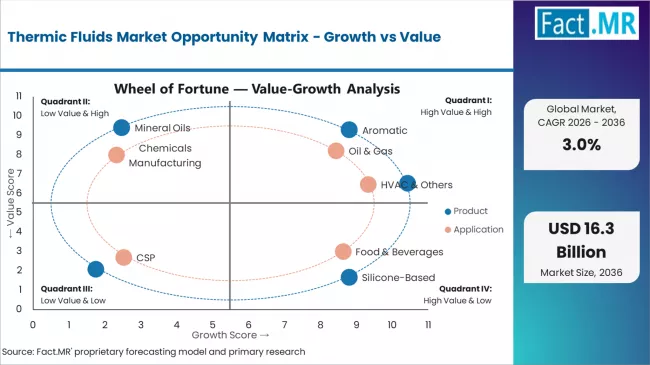
Thermic Fluids Market Opportunity Matrix Growth Vs Value | Source: Fact.MR
The thermic fluids market grows by enabling industrial operators, process manufacturers, and energy facilities to access efficient heat transfer media that support process optimization while meeting operational requirements for temperature control and system reliability.
Industrial companies face mounting pressure to improve energy efficiency and reduce operational costs with proven thermal management capabilities, with high-performance thermic fluid systems typically providing 300-400°C operating temperature ranges comparable to steam systems, making these fluids essential for competitive positioning in process-intensive industries.
The heat transfer industry's need for versatile thermal media and operational safety creates demand for diverse thermic fluid types that can provide superior heat transfer coefficients, maintain consistent performance across different operating conditions, and ensure system longevity without compromising process efficiency or equipment protection standards.
Government initiatives promoting industrial energy efficiency and renewable energy development drive adoption in chemical processing applications, concentrated solar power installations, and manufacturing facility partnerships, where thermic fluid performance has a direct impact on energy consumption and operational costs.
The industrial sector's growing focus on process safety and environmental compliance further expands market opportunities, with engineering research demonstrating measurable improvements in heat transfer efficiency, reduced maintenance requirements, and lower carbon footprint through optimized thermal fluid systems.
However, supply chain complexity during specialized chemical sourcing and the technical requirements for proper fluid monitoring and system maintenance may limit accessibility among smaller industrial facilities and developing regions with limited infrastructure for thermal engineering expertise and fluid testing laboratories.
Segmental Analysis
The market is segmented by product, application, and region. By product, the market is divided into mineral oils, silicone-based, aromatic, glycol-based, and others. Based on application, the market is categorized into oil & gas, food & beverages, chemicals manufacturing, CSP (solar power), and HVAC & others. Regionally, the market is divided into Europe, North America, Asia Pacific, Latin America, and Middle East & Africa.
What makes Aromatic the Dominant Product Segment in the Thermic Fluids Market?
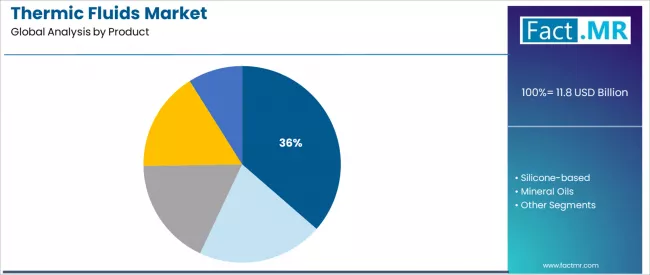
Thermic Fluids Market Analysis By Product | Source: Fact.MR
The aromatic segment represents the dominant force in the thermic fluids market, capturing approximately 36.4% of total market share in 2025. This established product category encompasses solutions featuring superior thermal stability and high-temperature performance capabilities from synthetic aromatic hydrocarbon formulations, enabling efficient heat transfer and consistent operational reliability across all industrial process heating applications.
The aromatic segment's market leadership stems from its superior performance characteristics, with products capable of meeting demanding temperature requirements while maintaining excellent heat transfer properties and operational safety across all process environments. The aromatic segment demonstrates steady growth trajectory with projected market value expanding from USD 4.3 billion in 2025 to USD 5.9 billion by 2035, representing a CAGR of 3.5%, driven by widespread adoption in chemical processing and high-temperature industrial applications.
The mineral oils segment maintains substantial market presence valued at USD 3.2 billion in 2025, projected to reach USD 4.3 billion by 2035 at a CAGR of 3.3%, serving applications requiring cost-effective heat transfer solutions with moderate temperature capabilities. These fluids offer reliable performance for standard industrial heating while providing sufficient thermal stability to meet conventional process requirements.
The silicone-based segment accounts for USD 2.1 billion in 2025, expanding to USD 2.8 billion by 2035 at a CAGR of 3.1%, serving specialized high-temperature and extreme environment applications. Glycol-based fluids represent USD 1.8 billion in 2025, growing to USD 2.7 billion by 2035 at a CAGR of 4.1% through food processing and pharmaceutical applications. Others including bio-based and specialty synthetic fluids capture USD 0.4 billion in 2025, reaching USD 0.5 billion by 2035 at a CAGR of 2.4%.
Key advantages driving the aromatic segment include:
- Advanced thermal stability characteristics with proven high-temperature performance that reduces degradation risks and extends fluid service life
- High heat transfer efficiency capabilities allowing optimal energy utilization across different industrial heating systems without significant thermal losses
- Proven chemical compatibility, delivering reliable operation while maintaining system integrity against process fluid interactions
- Broad industry acceptance enabling straightforward specification and established operational protocols across multiple industrial sectors
How Does the Oil & Gas Application Lead Market Share?
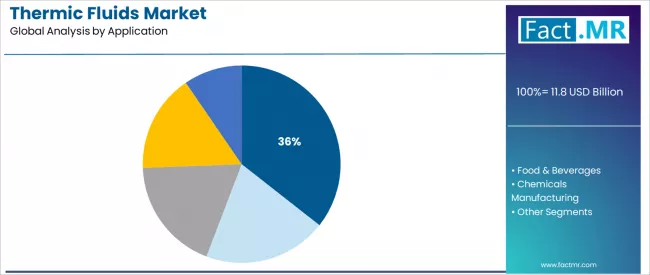
Thermic Fluids Market Analysis By Application | Source: Fact.MR
Oil & gas dominates the application segment with approximately 35.6% market share in 2025, reflecting the critical role of thermic fluids in supporting global petroleum processing and refining operations worldwide. The oil & gas segment's market leadership is reinforced by extensive heat transfer requirements across refining processes, petrochemical production, and pipeline heating applications, with widespread adoption in crude oil processing, distillation units, and downstream manufacturing facilities across developed and emerging markets. The oil & gas segment is valued at USD 4.2 billion in 2025, projected to reach USD 5.6 billion by 2035 at a CAGR of 3.1%.
Chemicals manufacturing represents a significant application category valued at USD 2.5 billion in 2025, growing to USD 3.4 billion by 2035 at a CAGR of 3.5%, driven by reactor heating and process temperature control requirements. HVAC & others account for USD 2.4 billion in 2025, reaching USD 2.9 billion by 2035 at a CAGR of 2.0%, serving building climate control and industrial comfort applications. CSP (solar power) captures USD 1.6 billion in 2025, expanding to USD 2.4 billion by 2035 at a CAGR of 4.3% through concentrated solar thermal energy storage systems. Food & beverages represents USD 1.1 billion in 2025, growing to USD 1.5 billion by 2035 at a CAGR of 3.3%, serving food processing and cooking applications.
Key market dynamics supporting application growth include:
- Oil & gas expansion driven by refining capacity additions and petrochemical facility development requiring reliable heat transfer systems
- Chemicals manufacturing modernization trends require precise temperature control and efficient thermal management
- CSP technology advancement enabling renewable energy storage and thermal power generation applications
- Growing emphasis on application diversity driving demand for comprehensive, industry-specific thermic fluid solutions
What are the Drivers, Restraints, and Key Trends of the Thermic Fluids Market?
The market is driven by three concrete demand factors tied to industrial growth and energy efficiency priorities. First, increasing global industrialization creates growing demand for process heating solutions, with worldwide chemical production and manufacturing output expanding by 3-5% annually in major industrial economies, requiring comprehensive heat transfer infrastructure. Second, renewable energy sector growth, particularly concentrated solar power development, drives increased adoption of thermal energy storage systems utilizing thermic fluids, with CSP capacity additions accelerating in regions with high solar irradiation by 2030. Third, technological advancements in synthetic fluid chemistry and thermal stability enhancement enable more efficient and longer-lasting heat transfer media that improve system performance while reducing maintenance frequency and operational costs.
Market restraints include volatile crude oil prices affecting thermic fluid raw material costs, particularly for petroleum-derived formulations where feedstock price fluctuations impact product pricing. Environmental concerns and disposal regulations pose another significant challenge, as used thermic fluids require proper handling and disposal procedures, potentially causing increased operational costs and regulatory compliance burdens. System contamination risks and thermal degradation management across different operating conditions create additional market challenges for fluid longevity, demanding ongoing investment in fluid monitoring programs and preventive maintenance protocols.
Key trends indicate accelerated adoption in Asia Pacific markets, particularly China and India, where expanding manufacturing capacity and industrial infrastructure development drive comprehensive thermic fluid utilization. Technology integration trends toward bio-based formulations with specific sustainability characteristics, synthetic high-performance blends, and smart monitoring systems enable proactive fluid management approaches that optimize performance and minimize degradation risks. However, the market thesis could face disruption if significant advances in alternative heat transfer technologies such as molten salt systems or direct electric heating reduce reliance on traditional liquid thermic fluid applications.
Analysis of the Thermic Fluids Market by Key Countries
.webp "Top Country Growth Comparison Thermic Fluids Market Cagr (2026 2036)")
Top Country Growth Comparison Thermic Fluids Market Cagr (2026 2036) | Source: Fact.MR
| Country | CAGR (2026 to 2036) |
|---|---|
| India | 3.7% |
| China | 3.6% |
| USA | 3.2% |
| UK | 3.1% |
| Canada | 3.0% |
| Mexico | 2.9% |
| Germany | 2.8% |
Source: Fact.MR analysis. Updated Apr 6, 2026
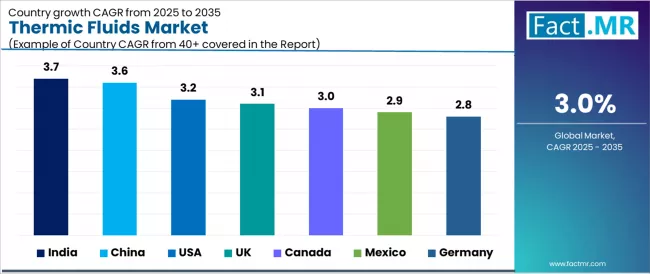
Thermic Fluids Market Cagr Analysis By Country | Source: Fact.MR
The thermic fluids market is expanding steadily, with India leading at a 3.7% CAGR through 2036, driven by expansion of manufacturing sector, renewable energy project development, and growing chemical processing industries. China follows at 3.6%, supported by rapid industrialization, urbanization driving energy demand, and substantial investments in concentrated solar power projects. USA posts 3.2%, anchored by strong industrial base, established oil & gas sector operations, and chemical manufacturing facilities requiring efficient heat transfer systems.
The UK advances at 3.1%, representing growth in CSP applications and food processing sector adoption of advanced thermal management solutions. Canada grows at 3.0%, with expansion in renewable energy applications and industrial process heating requirements. Mexico records 2.9%, reflecting expanding chemical industry and manufacturing sector development, while Germany grows at 2.8%, focusing on regulatory push for sustainable fluids and industrial energy efficiency programs.
What is the Outlook for the Thermic Fluids Market in India?
India demonstrates the strongest growth potential in the thermic fluids market with a CAGR of 3.7% through 2036. The country's leadership position stems from expansion of manufacturing sector, renewable energy project development, and growing chemical processing industries enabling mainstream thermic fluid adoption.
Growth is concentrated in major industrial regions, including Gujarat, Maharashtra, Tamil Nadu, and Rajasthan, where chemical manufacturing facilities, textile processing plants, and solar thermal installations are implementing advanced heat transfer systems.
Distribution channels through industrial chemical suppliers, equipment manufacturers, and specialized thermal engineering companies expand deployment across process industries and renewable energy projects. The country's growing industrial sector provides policy support for energy efficiency initiatives, including Make in India manufacturing programs and renewable energy development targets.
Key market factors:
- Demand concentrated in chemical processing and renewable energy sectors with comprehensive thermal management requirements
- Industrial growth through manufacturing expansion, solar power development, and process industry modernization
- Comprehensive industrial ecosystem including expanding thermal engineering expertise and fluid testing capabilities
- Technology integration featuring advanced heat transfer system design, monitoring equipment, and maintenance protocols
Why is China Emerging as a High Growth Market for Thermic Fluids?
In major industrial regions including Jiangsu, Zhejiang, Shandong, and Guangdong provinces, the adoption of thermic fluid systems is accelerating across chemical manufacturing, textile processing, and concentrated solar power segments, driven by industrial modernization and renewable energy policies. The market demonstrates strong growth momentum with a CAGR of 3.6% through 2036, linked to rapid industrialization, urbanization driving energy demand, and substantial CSP investments.
Chinese industrial operators are implementing advanced thermic fluid systems and thermal management technologies to enhance energy efficiency while meeting growing process heating requirements in expanding manufacturing sectors and renewable energy installations. The country's industrial development strategies create persistent demand for heat transfer fluids, while increasing emphasis on environmental sustainability drives adoption of efficient thermal systems and cleaner fluid technologies.
Key development areas:
- Chemical manufacturing and renewable energy sectors leading thermic fluid adoption with comprehensive system integration
- Domestic production providing cost-competitive fluids with 75% local manufacturing capabilities
- Technology partnerships between international fluid suppliers and Chinese industrial companies are expanding market reach
- Integration of advanced monitoring systems and comprehensive thermal efficiency optimization programs
How will the Market in USA Expand?
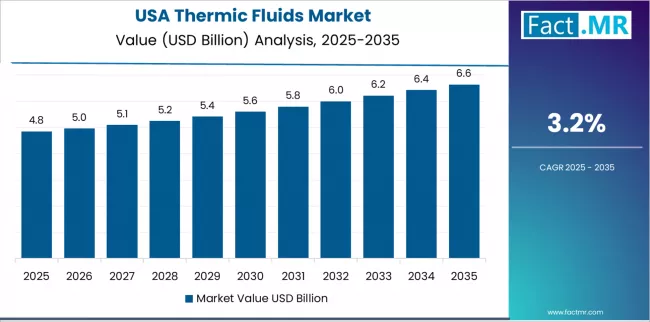
Thermic Fluids Market Country Value Analysis | Source: Fact.MR
In major industrial regions including Gulf Coast chemical corridor, Midwest manufacturing belt, and Southwest oil & gas regions, industrial operators are implementing comprehensive thermic fluid systems to optimize process heating and enhance energy efficiency, with documented installations showing improved thermal performance through advanced fluid management. The market shows steady growth potential with a CAGR of 3.2% through 2036, linked to strong industrial base, established oil & gas sector operations, and extensive chemical manufacturing requiring reliable heat transfer systems.
American industrial operators benefit from mature thermic fluid technologies and comprehensive technical support services to ensure system optimization while meeting environmental regulations demanded by EPA standards and industry safety protocols. The country's established industrial market creates persistent demand for product reliability and technical innovation solutions that integrate with existing thermal management infrastructure and process control systems.
Market development factors:
- Chemical processing and petroleum refining facilities leading thermic fluid utilization across USA
- Safety standards including OSHA requirements providing framework for proper fluid handling and system operation
- Strategic partnerships between fluid manufacturers and industrial end-users are expanding application optimization
- Emphasis on energy efficiency programs and preventive maintenance protocols ensuring system longevity
What is the Forecast for the Thermic Fluids Market in the UK?
The UK's thermic fluids market demonstrates focused application development in concentrated solar power and food processing sectors, with documented adoption of advanced thermal management systems achieving improved energy efficiency in industrial operations.
The country maintains stable growth momentum with a CAGR of 3.1% through 2036, driven by growth in CSP applications and food processing sector adoption of advanced thermal management solutions.
Major industrial regions showcase thermic fluid system deployment where renewable energy integration combines with food manufacturing requirements for precise temperature control and efficient heat transfer.
Key market characteristics:
- Renewable energy and food processing sectors driving thermic fluid demand with emphasis on sustainability
- Industry standards providing comprehensive guidelines for fluid selection and system design requirements
- Technology collaboration between UK industrial operators and international fluid suppliers is expanding capabilities
- Emphasis on environmental compliance and sustainable thermal management practices
How will the Energy Sector Stimulate Thermic Fluids Demand in Canada?
Canada's thermic fluids market demonstrates steady industrial application focus driven by oil sands processing operations and renewable energy development, with established thermal management systems supporting energy extraction and processing facilities.
The country shows stable growth momentum with a CAGR of 3.0% through 2036, representing expansion in renewable energy applications and industrial process heating requirements.
Major industrial regions showcase thermic fluid implementations where conventional energy sector operations integrate with emerging renewable energy thermal storage applications.
Key market characteristics:
- Energy sector and manufacturing facilities driving thermic fluid requirements with emphasis on operational reliability
- Technical standards enabling comprehensive system design and fluid performance verification
- Technology collaboration between Canadian industrial operators and fluid suppliers is maintaining market position
- Emphasis on cold climate performance and system winterization requirements
How will the Market Expand in Germany?
The German market leads in sustainable thermic fluid applications based on integration with environmental regulations and industrial energy efficiency programs for enhanced thermal management. The country shows steady potential with a CAGR of 2.8% through 2036, driven by regulatory push for sustainable fluids and industrial energy efficiency initiatives.
German industrial companies are adopting environmentally responsible thermic fluid formulations and optimized thermal systems for process heating, particularly in chemical manufacturing facilities and food processing operations demanding comprehensive sustainability standards. Technology deployment channels through established fluid suppliers and thermal engineering firms expand coverage across manufacturing plants and process industries.
Leading market segments:
- Chemical and pharmaceutical manufacturers implementing sustainable thermic fluid systems with rigorous environmental compliance
- Energy efficiency programs achieving comprehensive thermal optimization through systematic fluid management
- Strategic collaborations between fluid manufacturers and industrial associations are expanding best practice adoption
- Focus on bio-based fluid development and circular economy initiatives
How will the Manufacturing Sector Enhance Thermic Fluids Demand in Mexico?
Mexico's market expansion is driven by chemical industry development and manufacturing sector growth, particularly in automotive components, plastics processing, and chemical production requiring efficient heat transfer systems. The country demonstrates promising growth potential with a CAGR of 2.9% through 2036, supported by expanding chemical industry and manufacturing sector development.
Mexican industrial operators face challenges related to technical expertise availability and system maintenance capabilities, requiring partnership development with international fluid suppliers and engineering service providers.
However, growing foreign investment in manufacturing and expanding industrial infrastructure create compelling business cases for thermic fluid adoption, particularly in northern industrial regions where automotive and chemical manufacturing concentrations demand reliable thermal management.
Market characteristics:
- Chemical and automotive manufacturing sectors showing steady growth with increasing process heating requirements
- Regional concentration in northern states with major industrial parks and manufacturing facilities
- Future projections indicate need for enhanced technical support infrastructure and operator training programs
- Growing emphasis on safety compliance and operational efficiency standards
Europe Market Split by Country
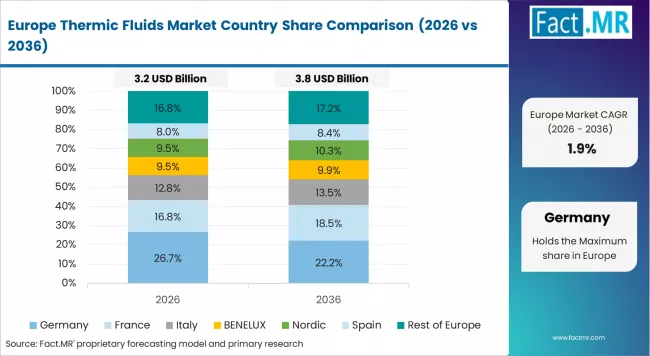
Thermic Fluids Market Europe Country Market Share Analysis, 2026 & 2036 | Source: Fact.MR
The thermic fluids market in Europe is projected to grow from USD 2.1 billion in 2026 to USD 2.8 billion by 2036, registering a CAGR of 2.8% over the forecast period. Germany is expected to maintain its leadership position with a 32.4% market share in 2026, maintaining approximately 32.2% by 2036, supported by its advanced chemical manufacturing infrastructure, comprehensive industrial base, and strong environmental regulations driving sustainable fluid adoption across major production regions.
France follows with a 24.6% share in 2026, projected to reach 24.8% by 2036, driven by chemical processing facilities and food manufacturing applications. UK holds a 19.7% share in 2026, expected to reach 20.1% by 2036 through renewable energy development and food processing sector growth.
Italy commands a 12.8% share, while Spain accounts for 7.2% in 2026. The rest of Europe region is anticipated to maintain steady position, with collective share moving from 3.3% to 3.4% by 2036, attributed to increasing thermic fluid adoption in Nordic industrial facilities and emerging Eastern European manufacturing operations implementing modern thermal management programs.
Competitive Landscape of the Thermic Fluids Market
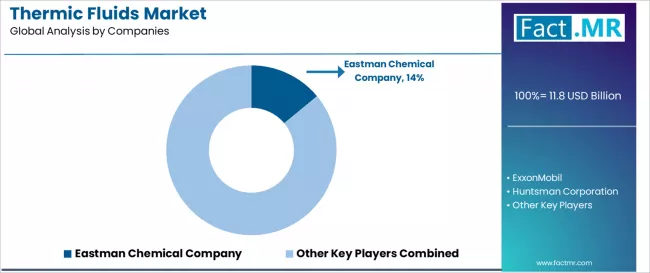
Thermic Fluids Market Analysis By Company | Source: Fact.MR
The thermic fluids market features approximately 10-15 meaningful players with moderate concentration, where the top three companies control roughly 36-37% of global market share through established product portfolios and extensive technical support networks serving industrial customers. Competition centers on thermal performance, technical expertise, and comprehensive service support rather than price competition alone.
Market leaders include Eastman Chemical Company, ExxonMobil, and Huntsman Corporation, which maintain competitive advantages through comprehensive thermic fluid product portfolios, global manufacturing and distribution capabilities, and deep expertise in the heat transfer fluids, synthetic chemicals, and specialty oils sectors, creating high customer loyalty among industrial operators.
These companies leverage established performance track records and ongoing technical innovation to defend market positions while expanding into renewable energy applications and sustainable fluid formulations. Eastman Chemical Company commands approximately 14.0% market share through synthetic aromatic fluid excellence and comprehensive thermal management solutions.
Challengers encompass Parathem Corporation and Royal Dutch Shell, which compete through specialized product offerings and strong positions in industrial heat transfer and petroleum-based fluid markets. Industry specialists, including Clariant AG, British Petroleum Plc, and HPCL, focus on specific regional markets or application segments, offering differentiated capabilities in specialty formulations, regional distribution excellence, and integrated petroleum products.
Regional players and emerging fluid manufacturers create competitive pressure through localized production and competitive pricing strategies, particularly in high-growth markets including India and China, where manufacturing proximity provides advantages in logistics costs and technical service responsiveness.
Market dynamics favor companies that combine proven fluid formulations with comprehensive technical support programs that address the complete thermal management journey from system design through fluid monitoring and maintenance optimization. Strategic collaborations between fluid manufacturers and equipment suppliers accelerate technology integration, while distributor partnership programs enable market penetration and technical training initiatives.
Global Thermic Fluids Market - Stakeholder Contribution Framework
Thermic fluid products represent a critical thermal management technology that enables industrial operators, process manufacturers, and renewable energy facilities to deliver efficient heat transfer without steam generation complexity, typically providing 300-400°C operating temperature ranges comparable to steam systems while eliminating boiler requirements and pressure vessel regulations.
With the market projected to grow from USD 11.8 billion in 2025 to USD 15.9 billion by 2035 at a 3.0% CAGR, these fluids offer compelling advantages - operational efficiency, system simplicity, and temperature control precision - making them essential for oil & gas processing (leading segment), chemical manufacturing (growing adoption), and diverse industrial applications seeking reliable thermal management solutions. Scaling market penetration and system reliability requires coordinated action across industrial policy, technical standards, fluid manufacturers, equipment providers, and thermal engineering services.
How Governments Could Spur Industrial Efficiency and Market Development?
- Energy Efficiency Programs: Include thermic fluid system optimization in national industrial energy efficiency initiatives, providing incentives for high-efficiency heat transfer equipment adoption and supporting industrial operators through technical assistance programs and energy audit subsidies.
- Environmental Regulation & Technology Support: Implement balanced regulations encouraging environmentally responsible fluid formulations, provide transition support for sustainable technology adoption, and establish research funding for bio-based and recyclable thermic fluid innovations that meet both environmental and performance requirements.
- Technical Standards Development: Create harmonized fluid specifications across industrial applications, establish qualification requirements for system designers and operators, and develop testing protocols that facilitate performance verification while supporting international trade in thermic fluid products and services.
- Training & Certification Programs: Fund vocational programs for thermal system operators, maintenance technicians, and thermal engineers. Invest in training infrastructure that enables proper system design, fluid management, and safety protocol implementation supporting consistent operational performance.
How Industry Associations Could Support Market Development?
- Performance Standards & Specifications: Define standardized fluid specifications for different temperature ranges and application sectors, establish universal testing protocols for thermal stability and heat transfer performance, and create certification programs that enable informed fluid selection decisions.
- Technical Education & Best Practices: Lead comprehensive training programs demonstrating proper system design, fluid handling procedures, and maintenance protocols, emphasizing proven thermal efficiency and lifecycle cost benefits compared to alternative heat transfer methods.
- Sustainability Guidelines: Develop consensus standards for fluid lifecycle management, disposal procedures, and environmental impact assessment, ensuring industry advancement toward reduced environmental footprint while maintaining operational effectiveness.
How Manufacturers and Service Providers Could Strengthen the Ecosystem?
- Advanced Product Development: Develop next-generation fluid formulations with enhanced thermal stability, improved environmental profiles, and specialized performance characteristics that address specific operating conditions while expanding temperature capabilities and extending fluid service life.
- Technical Support Programs: Provide comprehensive system design assistance that integrates fluid selection guidance, heat transfer calculations, equipment recommendations, and operational training, enabling industrial operators to maximize system efficiency and minimize operational issues through proper implementation.
- Fluid Management Services: Offer condition monitoring programs including periodic fluid testing, performance analysis, and maintenance recommendations, helping industrial facilities optimize fluid replacement timing and prevent system degradation through proactive management strategies.
Key Players in the Thermic Fluids Market
- Eastman Chemical Company
- ExxonMobil
- Huntsman Corporation
- Parathem Corporation
- Royal Dutch Shell
- Clariant AG
- British Petroleum Plc
- HPCL
- Thermic Fluids Pvt. Ltd.
Bibliography
- International Energy Agency. (2025). World Energy Outlook 2025: Refinery capacity and downstream investment projections. IEA.
- Ministry of New and Renewable Energy, Government of India. (2025). National Solar Mission Phase III: Concentrated solar power deployment targets. MNRE.
- European Chemicals Agency. (2024). REACH Regulation Annex XVII: Restrictions on hazardous heat-transfer fluid formulations. ECHA.
- U.S. Energy Information Administration. (2025). Annual Energy Outlook 2025: Petroleum refining capacity additions. EIA.
- Organisation for Economic Co-operation and Development. (2024). Environmental Performance Reviews: Industrial chemical discharge standards. OECD.
This bibliography is provided for reader reference. The full Fact.MR report contains the complete reference list with primary research documentation.
This Report Addresses
- Market sizing and quantitative forecast metrics detailing the precise industrial fluid expenditure dedicated to thermic fluid procurement across major refining and chemical processing sectors through 2036.
- Segmentation analysis mapping the adoption velocity of aromatic, silicone-based, mineral oil, and glycol-based formulations and evaluating the technical performance thresholds driving product transitions.
- Regional deployment intelligence comparing aggressive refinery capacity expansion strategies in South Asia against mature replacement-cycle dynamics in European and North American process plants.
- Regulatory compliance assessment analyzing how tightening spent-fluid discharge norms and occupational exposure limits force procurement shifts toward longer-life synthetic formulations.
- Competitive posture evaluation tracking the mandatory shift toward integrated fluid management services and the resulting commoditization of standalone fluid supply contracts.
- Capital project strategic guidance defining the exact fluid specification and lifecycle cost parameters required to support next-generation indirect heating circuit installations.
- Supply chain vulnerability analysis identifying specific feedstock price transmission mechanisms that affect thermic fluid procurement budgets during crude oil volatility cycles.
- Custom data delivery formats encompassing interactive dashboards, raw Excel datasets, and comprehensive PDF narrative reports.
Thermic Fluids Market Definition
Thermic fluids are specially formulated heat-transfer liquids designed to carry thermal energy within closed-loop piping circuits in industrial process plants. These fluids operate across a wide temperature band, typically from minus 80 degrees Celsius to above 400 degrees Celsius, without undergoing phase change under normal system pressure. End users procure thermic fluids to maintain precise temperature control in oil refining heaters, chemical reactors, food sterilization systems, concentrated solar power collectors, and HVAC chillers. The market covers the manufacture, blending, distribution, and lifecycle management of these fluids across all major industrial geographies.
Thermic Fluids Market Inclusions
Market scope includes aromatic heat-transfer oils, silicone-based thermal fluids, mineral oil formulations, glycol-based antifreeze heat-transfer media, and bio-based thermic fluid blends. Fluid condition monitoring services, spent-fluid reclamation programmes, and closed-loop fluid management contracts tied directly to fluid procurement are incorporated. Regional and country-level market sizing covers the forecast period from 2026 to 2036 with segmentation by product type and application.
Thermic Fluids Market Exclusions
Standard boiler feed water, direct-fired heating media, and steam generation systems are excluded from the analytical scope. Refrigerants, cryogenic coolants, and transformer dielectric oils fall outside defined boundaries. Physical heat-exchange hardware such as shell-and-tube units, plate exchangers, and piping systems is explicitly omitted from the valuation.
Thermic Fluids Market Research Methodology
- Primary Research: Analysts engaged with refinery process engineers, petrochemical plant thermal system managers, and concentrated solar power procurement leads to map the decision triggers governing fluid specification and replacement cycles.
- Desk Research: Data collection phases aggregated crude oil refining capacity expansion schedules, national solar mission deployment targets, and food safety authority sterilization temperature mandates.
- Market-Sizing and Forecasting: Baseline values derive from a bottom-up aggregation of industrial fluid consumption volumes per installed thermal circuit, applying region-specific capacity utilization rates to project adoption velocity.
- Data Validation and Update Cycle: Projections are rigorously tested against publicly reported capital expenditure guidance from leading oil and gas majors and chemical conglomerates.
Segmentation
Scope of the Report
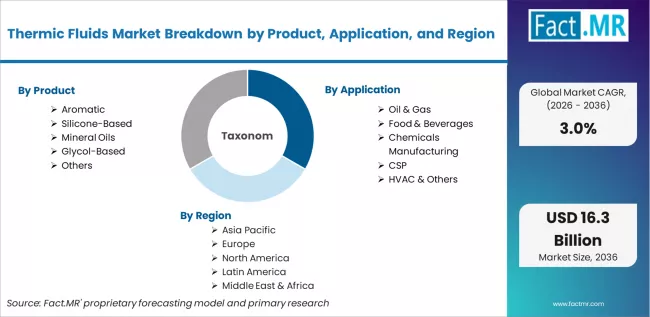
Thermic Fluids Market Breakdown By Product, Application, And Region | Source: Fact.MR
| Metric | Value |
|---|---|
| Quantitative Units | USD 12.15 billion to USD 16.33 billion, at a CAGR of 3.0% |
| Market Definition | Thermic Fluids encompass heat-transfer liquids engineered to carry thermal energy within closed-loop indirect heating or cooling circuits across industrial process plants without phase change under normal operating pressure. |
| Product Segmentation | Aromatic, Silicone-Based, Mineral Oils, Glycol-Based, Others |
| Application Segmentation | Oil & Gas, Food & Beverages, Chemicals Manufacturing, CSP, HVAC & Others |
| Regions Covered | North America, Latin America, Europe, East Asia, South Asia, Middle East & Africa |
| Countries Covered | India, China, USA, UK, Canada, Mexico, Germany, and 30 plus countries |
| Key Companies Profiled | Eastman Chemical Company, ExxonMobil, Huntsman Corporation, Parathem Corporation, Royal Dutch Shell, Clariant AG, British Petroleum Plc, HPCL, Thermic Fluids Pvt. Ltd. |
| Forecast Period | 2026 to 2036 |
| Approach | Forecasting models apply a bottom-up methodology starting with global installed thermal circuit metrics and projecting conversion rates to synthetic and high-performance fluid grades. |
Source: Fact.MR analysis. Updated Apr 6, 2026
Thermic Fluids Market by Segments
-
Product :
- Mineral Oils
- Silicone-based
- Aromatic
- Glycol-based
- Others
-
Application :
- Oil & Gas
- Food & Beverages
- Chemicals Manufacturing
- CSP (Solar Power)
- HVAC & Others
-
Region :
- Europe
- Germany
- UK
- France
- Italy
- Spain
- Nordic
- Rest of Europe
- North America
- USA
- Canada
- Mexico
- Asia Pacific
- China
- Japan
- South Korea
- India
- Australia & New Zealand
- ASEAN
- Rest of Asia Pacific
- Latin America
- Brazil
- Chile
- Rest of Latin America
- Middle East & Africa
- Kingdom of Saudi Arabia
- Other GCC Countries
- Turkiye
- South Africa
- Rest of Middle East & Africa
- Europe
Frequently Asked Questions
How large is the demand for Thermic Fluids in the global market in 2026?
What will be the market size of Thermic Fluids in the global market by 2036?
What is the expected demand growth for Thermic Fluids in the global market between 2026 and 2036?
Which Product type is poised to lead global sales by 2026?
How significant is the role of Oil & Gas in driving Thermic Fluids adoption in 2026?
What is the India growth outlook in this report?
What is China's growth outlook in this report?
What is Thermic Fluids and what is it mainly used for?
Who worked on this report


Preview the report firsthand - request a free sample
Free SampleGet the brochure for pricing and purchase details
Download PDF