- Base Value(2026): 187.8 Mn
- Estimated Value(2026): 187.8 Mn
- Forecast Value (2036): 469.7 Mn
- CAGR (2026 - 2036): 9.6%
On-Farm Compost Activator Nutrient Starter Market Forecast and Outlook 2026 to 2036
The global on-farm compost activator nutrient starter market is projected to grow from USD 187.82 million in 2026 to USD 469.73 million by 2036, advancing at a CAGR of 9.6%. This growth signifies the strategic integration of circular nutrient management into mainstream crop production.
Key Takeaways from the On-Farm Compost Activator Nutrient Starter Market
- Market Value for 2026: USD 187.82 Million
- Market Value for 2036: USD 469.73 Million
- Forecast CAGR (2026-2036): 9.6%
- Leading Equipment Share (2026): High-Speed Planter (46%)
- Leading Formulation Share (2026): High-Ortho Liquid (45%)
- Leading Sales Channel Share (2026): Ag-Retailers (63%)
- Key Players in the Market: BASF SE, UPL, Nutrien, ICL Group, Novonesis, Lallemand Plant Care
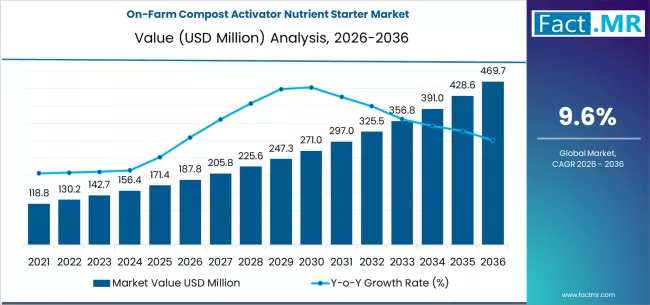
On Farm Compost Activator Nutrient Starter Market Market Value Analysis | Source: Fact.MR
These specialized products are designed to accelerate the decomposition of on-farm organic residues into stable, nutrient-rich compost while simultaneously providing a boost of readily available plant nutrition to jumpstart the composting process and the subsequent crop cycle.
High-speed planting equipment is the dominant application method, accounting for a 46% share, as it enables the efficient incorporation of both finished compost and starter additives during field operations.
High-orthophosphate liquid formulations lead the product segment with a 45% share, prized for their rapid availability to both the microbial community in the compost pile and the emerging crop. Ag-Retailers are the central sales channel, commanding a 63% share, due to their critical role in providing the technical guidance necessary for successful compost recipe formulation, pile management, and integration with precision equipment.
The dual economic drivers of reducing synthetic fertilizer dependency and managing on-farm organic waste fuel market expansion. These activator starters address the primary barriers to on-farm composting: slow decomposition times and inconsistent nutrient quality.
By introducing concentrated nutrients and often microbial inoculants, they transform composting from a passive, long-term activity into an active, managed component of the fertility program. This technology enables farmers to close the nutrient loop on their operations more efficiently, building soil organic matter while creating a reliable, home-grown fertilizer source.
Metric
| Metric | Value |
|---|---|
| Market Value (2026) | USD 187.82 Million |
| Market Forecast Value (2036) | USD 469.73 Million |
| Forecast CAGR (2026-2036) | 9.6% |
Source: Fact.MR analysis. Updated Dec 31, 2025
Category
| Category | Segments |
|---|---|
| Equipment | High-Speed Planter, Standard Drill, Strip-Till Rig, Drone |
| Formulation | High-Ortho Liquid, Polyphosphate, Micro-Granule, Chelated Mix |
| Sales Channel | Ag-Retailers, Direct-to-Farmer, Online Marketplaces, Cooperatives |
| Region | North America, Latin America, Western Europe, Eastern Europe, East Asia, South Asia & Pacific, MEA |
Source: Fact.MR analysis. Updated Dec 31, 2025
Segmental Analysis
By Equipment, Which System Facilitates Integrated Application?
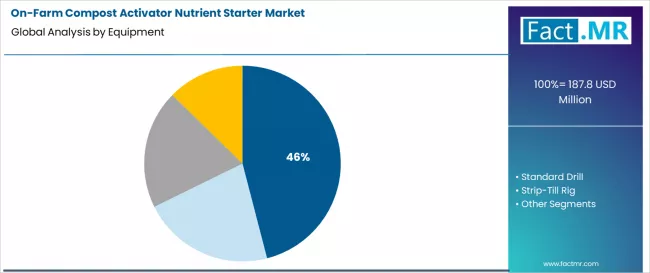
On Farm Compost Activator Nutrient Starter Market Analysis By Equipment | Source: Fact.MR
High-speed planters lead with a 46% share. This dominance reflects a practice where finished, activator-enhanced compost is applied in-furrow or in a band simultaneously with seeding. The planter’s dry fertilizer or liquid systems meter and place the compost blend with precision, ensuring direct seed-zone contact. This merges the long-term soil-building benefits of compost with the operational efficiency of modern planting, making compost use scalable for large-acreage farms that produce their own organic amendments.
By Formulation, What Kicks Off Both Microbial and Plant Growth?
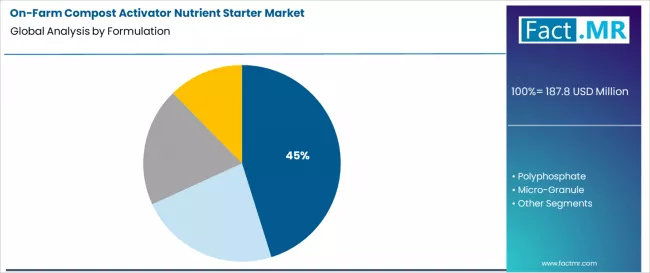
On Farm Compost Activator Nutrient Starter Market Analysis By Formulation | Source: Fact.MR
High-orthophosphate liquid formulations are foremost, holding a 45% share. Phosphorus is a critical catalyst for microbial proliferation in the compost pile. A readily available orthophosphate source injected at pile construction rapidly fuels the microbes responsible for breaking down carbon, speeding up the thermophilic phase. When applied with compost at planting, this same available phosphorus immediately supports seedling root development, providing a dual-stage benefit.
By Sales Channel, Who Provides the Recipe for Success?

On Farm Compost Activator Nutrient Starter Market Analysis By Sales Channel | Source: Fact.MR
Ag-retailers are the pivotal channel, controlling 63% of the market. Effective on-farm composting is a technical process involving carbon-to-nitrogen ratios, moisture management, and aeration.
Retail agronomists provide essential service by testing raw organic materials, prescribing the correct type and rate of activator starter to optimize decomposition, and advising on pile management and compost maturity testing. This hands-on guidance is indispensable for farmer confidence and program success.
What are the Drivers, Restraints, and Key Trends of the Market?
The primary driver is the rising cost and volatility of manufactured fertilizers, which incentivizes investment in on-farm nutrient cycling. Simultaneously, increasing regulatory and societal pressure to manage agricultural waste, such as manure, responsibly pushes farmers toward valorization through composting. The growing understanding of soil health and the irreplaceable value of stable organic matter for water retention and nutrient holding further elevates compost from a waste product to a strategic input.
A key restraint is the significant labor, time, and management attention required for consistent composting, which competes with other farm priorities. The physical space needed for proper pile construction and turning can be a limitation. Without proper management, compost quality can be variable, affecting its agronomic value and farmer trust. The initial investment in spreading or incorporation equipment, if not already owned, can also be a barrier to entry for some operations.
Significant trends include the development of customized starter formulations tailored to specific feedstock types, such as high-carbon straw or high-nitrogen poultry litter. There is a strong move toward integrated biological-chemical starters that combine nutrients with specialized thermophilic bacteria and fungi to ensure rapid, pathogen-suppressing decomposition. The market is also seeing the rise of compact, in-vessel composting systems for smaller farms, which are often sold with proprietary starter product subscriptions.
Analysis of the On-Farm Compost Activator Nutrient Starter Market by Key Countries
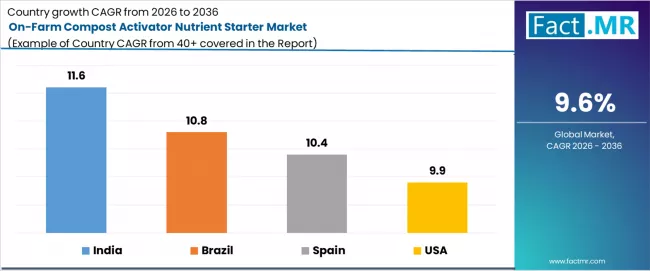
On Farm Compost Activator Nutrient Starter Market Cagr Analysis By Country | Source: Fact.MR
| Country | CAGR (2026-2036) |
|---|---|
| India | 11.6% |
| Brazil | 10.8% |
| Spain | 10.4% |
| USA | 9.9% |
Source: Fact.MR analysis. Updated Dec 31, 2025
How do India's Smallholder Systems and Policy Promote Circular Nutrient Management?
India's leading CAGR of 11.6% is driven by government initiatives like the Promotion of Agricultural Mechanization for In-Situ Management of Crop Residue scheme, which aims to curb stubble burning.
Activator starters are promoted to help farmers rapidly compost rice straw and wheat stubble into a valuable input. The affordability and scalability of these products make them suitable for adoption across small and medium-sized diversified farms seeking to improve soil fertility with on-farm resources.
What Factors Underpin Adoption in Brazil's Large-Scale Livestock and Crop Integration?
Brazil's 10.8% growth is anchored in its massive integrated crop-livestock systems. The need to manage vast quantities of feedlot and poultry manure efficiently, while recovering nutrients for subsequent soybean or corn crops, creates a perfect use case.
Activator starters are used to accelerate the composting of these manures, reducing odor, stabilizing nutrients, and producing a uniform product that can be applied at scale with precision equipment across extensive fields.
Why is Spain a European Leader in High-Value Horticultural Composting?
Spain's 10.4% CAGR reflects its extensive horticulture and vineyard sectors, where soil organic matter is crucial for quality and drought resilience. Spanish growers have a tradition of using compost.
The adoption of advanced starter products allows for faster production of consistent, high-quality compost from grape marc, olive pomace, and crop trimmings, enabling these high-value operations to efficiently recycle waste into a premium soil amendment.
How is USA’s Market Segmenting Between Dairy, Row-Crop, and Organic Sectors?
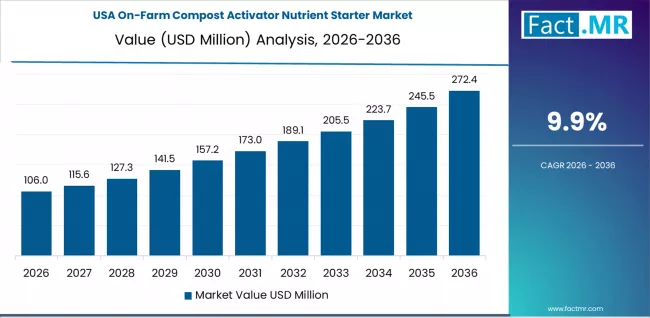
On Farm Compost Activator Nutrient Starter Market Country Value Analysis | Source: Fact.MR
The USA's 9.9% growth is segmented. In dairy-intensive regions, starters help manage nutrient loads from manure to comply with environmental regulations. In the Corn Belt, they are used to compost cover crop biomass ahead of planting.
The robust organic farming sector represents a core market, relying heavily on compost and seeking starters that are compliant with organic certification standards, driving demand for specific biological and mineral-based products.
Competitive Landscape of the On-Farm Compost Activator Nutrient Starter Market

On Farm Compost Activator Nutrient Starter Market Analysis By Company | Source: Fact.MR
The competitive landscape blends traditional agricultural input companies with specialized biological firms. Competition is multifaceted: chemical companies compete on the efficiency and cost of nutrient delivery formulas, while biological firms compete on the efficacy of proprietary microbial consortia.
Success depends on providing robust, field-validated protocols for different composting scenarios, offering flexible product forms (bulk liquid, easy-handling granules), and establishing credibility through partnerships with universities and extension services to demonstrate compost quality and crop yield outcomes.
Key Players in the On-Farm Compost Activator Nutrient Starter Market
- BASF SE
- UPL
- Nutrien
- ICL Group
- Novonesis
- Lallemand Plant Care
Segmentation
Scope of Report
| Items | Values |
|---|---|
| Quantitative Units | USD Million |
| Equipment | High-Speed Planter, Standard Drill, Strip-Till Rig, Drone |
| Formulation | High-Ortho Liquid, Polyphosphate, Micro-Granule, Chelated Mix |
| Sales Channel | Ag-Retailers, Direct-to-Farmer, Online Marketplaces, Cooperatives |
| Key Countries | India, Brazil, USA, Spain |
| Key Companies | BASF SE, UPL, Nutrien, ICL Group, Novonesis, Lallemand Plant Care |
| Additional Analysis | Chemistry and biology of the composting process; optimal C:N ratios and activator timing; analysis of finished compost quality and nutrient availability; economic comparison of on-farm compost production vs. purchased fertilizer; compatibility of compost starters with various spreading and incorporation equipment. |
Source: Fact.MR analysis. Updated Dec 31, 2025
Market by Segments
-
Equipment :
- High-Speed Planter
- Standard Drill
- Strip-Till Rig
- Drone
-
Formulation :
- High-Ortho Liquid
- Polyphosphate
- Micro-Granule
- Chelated Mix
-
Sales Channel :
- Ag-Retailers
- Direct-to-Farmer
- Online Marketplaces
- Cooperatives
-
Region :
- North America
- USA
- Canada
- Latin America
- Brazil
- Mexico
- Argentina
- Rest of Latin America
- Western Europe
- Spain
- Germany
- UK
- France
- Italy
- BENELUX
- Rest of Western Europe
- Eastern Europe
- Russia
- Poland
- Czech Republic
- Rest of Eastern Europe
- East Asia
- China
- Japan
- South Korea
- Rest of East Asia
- South Asia & Pacific
- India
- ASEAN
- Australia
- Rest of South Asia & Pacific
- MEA
- Saudi Arabia
- UAE
- Turkiye
- Rest of MEA
- North America
Frequently Asked Questions
How big is the on-farm compost activator nutrient starter market in 2026?
What will be the size of on-farm compost activator nutrient starter market in 2036?
How much will be the on-farm compost activator nutrient starter market growth between 2026 and 2036?
What are the key product types in the on-farm compost activator nutrient starter market?
Which formulation segment to contribute significant share in the on-farm compost activator nutrient starter market in 2026?
Who worked on this report


Preview the report firsthand - request a free sample
Free SampleGet the brochure for pricing and purchase details
Download PDF