The Nutrient-Use-Efficiency Optimized NPK Solution Market is segmented by Product Type, Application, Crop Type, End Use, and Region. Forecast for 2026 to 2036.
By Fact.MR Chemical & Materials DeskLead analyst:
S.N. JhaPublished :
Updated :
16 min read
Fact-checked under the Fact.MR editorial process
Nutrient-Use-Efficiency Optimized NPK Solution Market Forecast and Outlook By Fact.MR
In 2025, the nutrient-use-efficiency optimized NPK solution market was valued at USD 4.9 billion.
Based on Fact.MR estimates, demand for nutrient-use-efficiency optimized NPK solutions is estimated to grow to USD 5.2 billion in 2026 and USD 9.8 billion by 2036.
Fact.MR projects a CAGR of 6.5% during the forecast period.
Nutrient Use Efficiency Optimized Npk Solution Market Market Value Analysis | Source: Fact.MR
Summary of Nutrient-Use-Efficiency Optimized NPK Solution Market
Market Definition
The market includes liquid and water-soluble NPK solution programs designed to improve nutrient efficiency through precise delivery, irrigation compatibility, and crop-stage aligned feeding.
Demand Drivers
Fertigation systems are increasing the relevance of soluble NPK products because nutrients can be distributed through irrigation with better timing and more even placement.
Greenhouse and protected cultivation systems are supporting demand for fully soluble nutrition programs that fit controlled feeding environments.
Precision fertilization is increasing interest in balanced formulations that allow growers to match nutrient ratios more closely with crop stage and production targets.
Key Segments Analyzed
By Product Type: Standard water-soluble NPK solutions are estimated to lead with approximately 36% share in 2026, supported by broad applicability across field fertigation and greenhouse nutrition programs.
By Application: Fertigation is expected to hold approximately 41% share in 2026, driven by irrigation-linked nutrient delivery and higher nutrient-use efficiency.
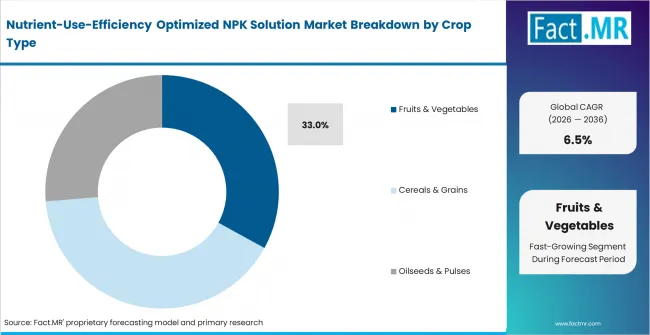
By Crop Type: Fruits & vegetables are projected to account for approximately 33% share in 2026, supported by high-value cropping and stronger demand for controlled nutrient delivery.
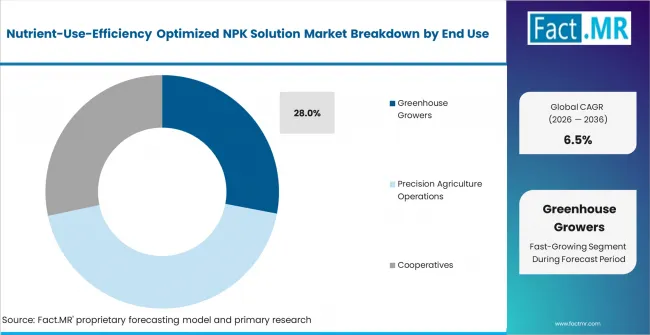
By End Use: Greenhouse growers are expected to contribute approximately 28% share in 2026, backed by intensive crop management and precise feeding requirements.
By Geography: India leads growth at 8.4% CAGR through 2036, supported by expanding fertigation relevance in horticulture and protected cultivation.
Analyst Opinion at Fact.MR
Shambhu Nath Jha, Senior Analyst at Fact.MR, opines, “CXOs should read this market as a precision feeding category rather than a premium fertilizer niche. Growers are adopting optimized NPK solutions to connect nutrient balance with dilution control, timing, and crop-stage application.”
Strategic Implications
Invest in crop-stage and crop-specific NPK solution portfolios for fertigation-led production systems.
Build technical sales capability around dilution guidance, water compatibility, and irrigation-linked nutrient planning.
Position micronutrient-enriched blends in greenhouse, horticulture, and protected-cultivation systems where crop response and quality carry stronger commercial weight.
Methodology
Market sizing uses crop-system suitability, fertigation relevance, greenhouse intensity, and water-soluble fertilizer fit across major agricultural regions.
Analysis includes fertigation references from fertilizer associations and technical positioning from solution-fertilizer suppliers.
Forecasts account for irrigation expansion, crop-value intensity, and adoption of solution-based nutrient programs in open-field and controlled environments.
The market is projected to generate USD 4.6 billion in absolute opportunity between 2026 and 2036. Growth is being supported by the spread of fertigation, the wider use of water-soluble fertilizers in professional horticulture, and rising interest in crop-stage nutrition. Solution-based NPK products are better aligned with irrigation-linked feeding systems, and that makes them more commercially relevant in greenhouse crops, orchards, vegetables, and other intensive farming systems.
The market is also benefiting from a broader agronomic push toward nutrient-use efficiency. Fertigation literature from industry and fertilizer bodies consistently links irrigation-based nutrient delivery with more even distribution, better nutrient availability, and stronger control over timing. This improves the commercial case for optimized NPK solutions, especially where growers want more value from each fertilizer pass and where water management is becoming more important to farm economics.
India is projected to lead with a CAGR of 8.4% through 2036, driven by the wider relevance of fertigation in horticulture and protected cultivation. Brazil follows at 7.6%, supported by irrigated fruit and specialty crop systems. Spain is expected to grow at 7.1%, underpinned by intensive horticulture and greenhouse-linked nutrition programs. The United States is projected at 6.8%, driven by precision agriculture and specialty crop nutrition. Canada grows at 6.2%, supported by greenhouse and irrigated crop systems. Mexico records 5.9%, backed by export-oriented horticulture and irrigation-fed production. This divergence reflects differences in irrigation penetration, crop mix, greenhouse intensity, and grower readiness to adopt solution-led feeding programs.
Segmental Analysis
Nutrient-Use-Efficiency Optimized NPK Solution Market Analysis by Product Type
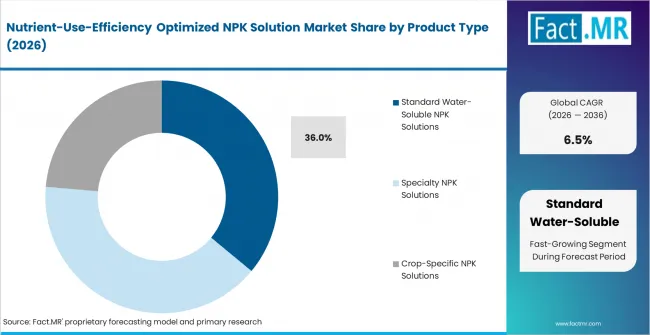
Nutrient Use Efficiency Optimized Npk Solution Market Analysis By Product Type | Source: Fact.MR
Standard water-soluble NPK solutions are estimated to hold 36% share in 2026. They lead because they fit the widest range of fertigation and soluble-feeding programs across field crops, vegetables, orchards, and greenhouse systems. Suppliers position these products around full solubility, nutrient balance, and compatibility with irrigation-based nutrition, which makes them the default commercial format before growers move into more specialized or crop-stage blends. Specialty NPK solutions continue to expand where higher-value crops need tighter nutrient adjustment, while micronutrient-enriched products are gaining traction in technically managed systems. Product leadership in this market depends less on novelty and more on whether the formulation dissolves cleanly, runs reliably through irrigation systems, and fits professional crop-feeding routines.
ICL Nova NPK: ICL positions Nova NPK as a complete range of water-soluble NPK fertilizers designed for use in fertigation systems in open-field and controlled-environment cropping systems.
Yara Crop-Stage Logic: YaraTera includes growth-stage based water-soluble NPK ranges for open-field and greenhouse use, reinforcing the importance of crop-stage feeding.
Micronutrient Integration: Micronutrient-enriched soluble products are becoming more relevant where growers need complete nutrition in one dissolved feeding program.
Nutrient-Use-Efficiency Optimized NPK Solution Market Analysis by Application
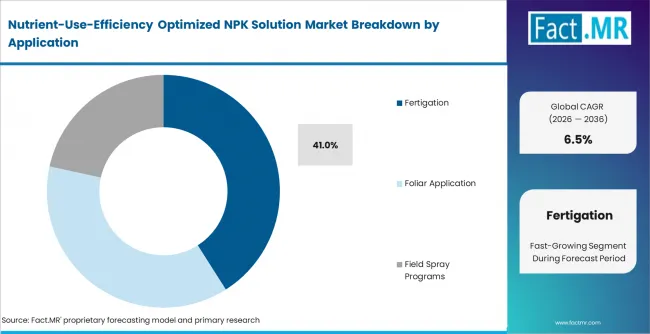
Nutrient Use Efficiency Optimized Npk Solution Market Analysis By Application | Source: Fact.MR
Fertigation is expected to hold approximately 41% share in 2026. This segment leads because it combines irrigation and fertilizer delivery into one system, improves nutrient placement, and supports more even distribution of dissolved nutrients through the root zone. Fertigation is also commercially attractive because it allows growers to adjust nutrient supply more closely to crop stage, soil status, and water availability. Foliar programs remain important in supplemental nutrition and rapid correction, while hydroponic delivery is structurally important in controlled-environment production even though it covers a narrower acreage base. Field spray programs also hold value in certain professional systems, though their role is usually secondary to irrigation-linked feeding. Demand in this segment is strongest where irrigation infrastructure is already established and where growers can capture value from more precise nutrient control.
IFA Fertigation Efficiency: The International Fertilizer Association notes that fertigation can produce up to 90% nutrient-use efficiency and high water-use efficiency in suitable systems.
Even Distribution Advantage: Supplier materials consistently state that fertigation distributes fertilizers evenly in irrigation water and improves nutrient availability.
Controlled Feeding: Application leadership favors systems where nutrient timing and concentration can be adjusted without major workflow disruption.
Nutrient-Use-Efficiency Optimized NPK Solution Market Analysis by Crop Type
Nutrient Use Efficiency Optimized Npk Solution Market Analysis By Crop Type | Source: Fact.MR
Fruits & vegetables are projected to account for approximately 33% share in 2026. They lead because these crops are more sensitive to nutrient balance, quality variation, and crop-stage feeding than broad commodity systems. Growers in these segments are more likely to adopt water-soluble NPK solutions because fertilizer delivery directly affects fruit setting, quality development, size uniformity, and marketable yield. Greenhouse vegetables, berries, orchard crops, and protected horticulture support especially strong demand for optimized NPK programs. Cereals and grains create additional opportunity where irrigation-based agriculture is stronger, though solution programs in these crops still face competition from conventional fertilizer formats. Crop leadership in this market is shaped by the value of precision rather than acreage alone.
Horticulture Fit: ICL states that its water-soluble fertilizers are premium solutions for fruit trees, vegetables, and other cash crops.
Greenhouse Relevance: Controlled-environment cropping strengthens the need for fully soluble and crop-stage aligned nutrition.
Intensive Crop Logic: High-value crops support stronger adoption because nutrient imbalance carries more visible commercial consequences.
Nutrient-Use-Efficiency Optimized NPK Solution Market Analysis by End Use
Nutrient Use Efficiency Optimized Npk Solution Market Analysis By End Use | Source: Fact.MR
Greenhouse growers are expected to contribute approximately 28% share in 2026. This segment leads because greenhouse operations depend on precise feeding routines, tighter climate control, and more disciplined irrigation management than most open-field systems. These growers are more likely to value solubility, dilution accuracy, and compatibility with fertigation and hydroponic delivery systems. Precision agriculture operations and large farms also create strong demand where irrigation-linked feeding is established and where nutrient efficiency is tied to measurable operating performance. Cooperatives and agri-service providers remain important because they help translate product availability into workable nutrient programs for growers who need support on formulation selection and crop-stage use.
Controlled-System Demand: Greenhouse and protected-cultivation operators need solution-grade fertilizers that run reliably through feeding systems.
Technical Support Requirement: Adoption rises where growers receive guidance on mixing, dilution, and growth-stage nutrient planning.
Service-Led Expansion: Distributors and agronomy channels matter because the market depends on more than product sales alone.
Drivers, Restraints, and Opportunities
Nutrient Use Efficiency Optimized Npk Solution Market Opportunity Matrix Growth Vs Value | Source: Fact.MR
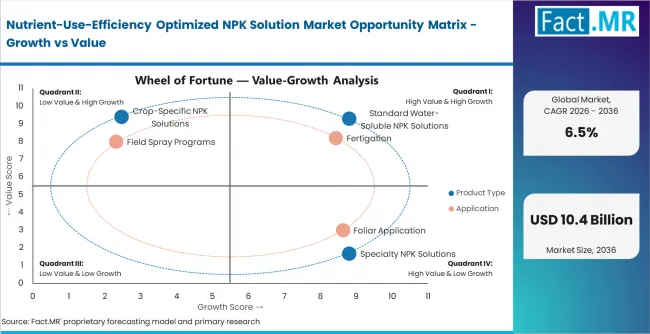
Fact.MR analysts observe that the nutrient-use-efficiency optimized NPK solution market is being shaped by irrigation-linked precision feeding, stronger nutrient accountability, and the spread of professional crop-management systems. Structural demand is anchored in the need to deliver nutrients more evenly, improve plant availability, and match fertilizer use more closely with crop requirement. Fertigation and soluble-feeding references consistently reinforce this logic, which strengthens the case for solution-grade NPK programs across greenhouse, horticulture, and irrigated field crops.
Infrastructure remains the main restraint. Solution-based nutrition depends on irrigation systems, water quality management, mixing discipline, and grower confidence in crop-stage feeding programs. Not every farming system can support those requirements. In broader field agriculture, conventional granular fertilizers still retain cost and logistics advantages. This keeps the market growing steadily rather than shifting abruptly. Product complexity also slows adoption in some regions because buyers need clarity on compatibility, concentration, and use timing before they replace familiar fertilizer formats.
Fertigation Expansion: Wider use of fertigation remains the clearest commercial opportunity because it links irrigation and nutrient delivery in one precision system.
Greenhouse Intensity: Greenhouse and controlled-environment agriculture create strong demand where crop performance depends on controlled feeding.
Specialty Blends: Micronutrient-enriched and crop-specific soluble NPK blends create higher-value opportunity where growers need more tailored nutrition and higher crop consistency.
Regional Analysis
The nutrient-use-efficiency optimized NPK solution market is assessed across North America, Europe, Asia Pacific, Latin America, and Middle East and Africa, covering 40+ countries with demand profiles shaped by irrigation infrastructure, greenhouse intensity, protected cultivation, fertigation use, and solution-fertilizer awareness. The full report provides market attractiveness analysis by region and country.
Top Country Growth Comparison Nutrient Use Efficiency Optimized Npk Solution Market Cagr (2026 2036) | Source: Fact.MR
Country
CAGR (2026 to 2036)
India
8.4%
Brazil
7.6%
Spain
7.1%
United States
6.8%
Canada
6.2%
Mexico
5.9%
Source: Fact.MR analysis. Updated Jun 15, 2026
Source: Fact.MR analysis, based on proprietary forecasting model and primary research
Nutrient Use Efficiency Optimized Npk Solution Market Cagr Analysis By Country | Source: Fact.MR
North America Nutrient-Use-Efficiency Optimized NPK Solution Market Analysis
Nutrient Use Efficiency Optimized Npk Solution Market Country Value Analysis | Source: Fact.MR
North America remains an important commercial region because it combines specialty crop systems, greenhouse operations, and growing interest in precision agriculture. Demand is strongest where irrigation-supported production and professional nutrient management already exist. Solution-based NPK programs have clearer commercial traction in greenhouse vegetables, berries, orchard crops, and other intensive systems than in lower-management field crops. Growth in this region depends less on broad fertilizer substitution and more on the spread of technically managed feeding systems.
United States: Precision agriculture adoption and professional horticulture support U.S. demand. The market in the United States is projected to expand at a CAGR of 6.8% through 2036, supported by specialty crop nutrition and irrigation-linked feeding systems.
Canada: Greenhouse vegetables, ornamental production, and controlled irrigation systems support Canadian adoption. Nutrient-use-efficiency optimized NPK solution demand in Canada is expected to grow at 6.2% CAGR through 2036.
Mexico: Export horticulture and irrigated vegetable production create a practical fit for solution-grade nutrition. Sales of nutrient-use-efficiency optimized NPK solutions in Mexico are likely to rise at 5.9% CAGR during the forecast period.
Fact.MR’s analysis of North America covers the United States, Canada, and Mexico. Includes greenhouse growth, horticulture demand, and fertigation-linked nutrient delivery patterns.
Europe Nutrient-Use-Efficiency Optimized NPK Solution Market Analysis
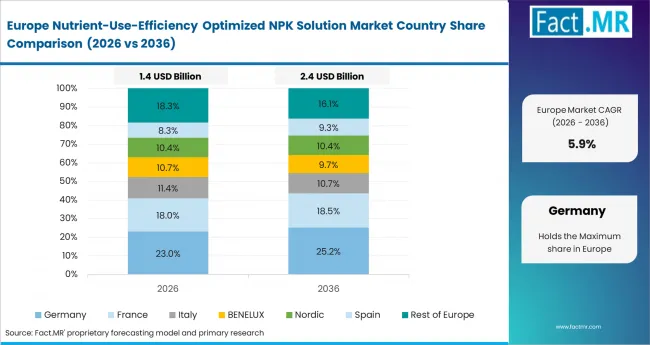
Nutrient Use Efficiency Optimized Npk Solution Market Europe Country Market Share Analysis, 2026 & 2036 | Source: Fact.MR
Europe remains a nutrient-efficiency and horticulture-led region for this market. Several countries have stronger greenhouse infrastructure, higher-value crop systems, and better technical support for precision feeding. This supports the commercial relevance of fully soluble NPK programs, especially in greenhouse crops, orchards, and intensive open-field horticulture. Europe also benefits from stronger grower familiarity with crop-stage feeding and irrigation-led nutrient management.
Spain: Intensive horticulture and fertigation-led crop management support stronger adoption in Spain. Demand for nutrient-use-efficiency optimized NPK solutions in Spain is estimated to expand at a CAGR of 7.1% through 2036.
Fact.MR’s analysis covers Spain, the Netherlands, Germany, France, Italy, and Rest of Europe. Includes greenhouse nutrition, open-field horticulture, and water-soluble fertilizer demand conditions.
Asia Pacific and Latin America Nutrient-Use-Efficiency Optimized NPK Solution Market Analysis
Asia Pacific and Latin America offer the strongest long-term expansion potential because horticulture intensity, irrigation-linked agriculture, and commercial interest in nutrient efficiency are rising across multiple crop systems. Demand in these regions is likely to strengthen where growers move from generic bulk nutrition toward more managed feeding programs. Adoption depends heavily on channel education, irrigation access, and the ability of suppliers to translate product chemistry into practical crop programs.
India: Growing relevance of fertigation in horticulture and protected cultivation supports Indian demand. The market in India is projected to grow at 8.4% CAGR through 2036.
Brazil: Irrigated fruit systems, cash crops, and professional horticulture support Brazilian expansion. Nutrient-use-efficiency optimized NPK solution demand in Brazil is expected to rise at 7.6% CAGR through 2036.
Fact.MR’s analysis covers India, China, Japan, ASEAN, Australia, Brazil, Argentina, and Rest of Latin America. Includes irrigation-linked fertilizer demand, protected cultivation, and solution-nutrition suitability across major agricultural systems.
Competitive Aligners for Market Players
Nutrient Use Efficiency Optimized Npk Solution Market Analysis By Company | Source: Fact.MR
The nutrient-use-efficiency optimized NPK solution market is moderately concentrated at the formulation and brand level, while distribution and technical support remain more fragmented. Major crop nutrition companies benefit from recognized soluble-fertilizer portfolios, irrigation-compatible products, and agronomy support. Their competitive strength is reinforced when they combine product quality with clear guidance on dilution, crop-stage use, and water compatibility.
Competitive advantage is defined by formulation quality, solubility, irrigation-system compatibility, and the ability to turn technical feeding programs into workable crop routines. Companies with broad soluble portfolios and strong agronomic support are better positioned than firms competing only on nutrient content. Buyers in this market usually choose on reliability, feeding flexibility, and technical confidence rather than on basic NPK supply alone.
Buyer dynamics vary by crop type and production intensity. Greenhouse and professional horticulture buyers are less willing to compromise on product consistency because small nutrition errors can affect yield quality and crop uniformity. Broader agricultural buyers remain more price-sensitive, though they are more likely to shift when fertigation and precision agriculture move from optional to operationally necessary. Competitive intensity is therefore rising fastest in technically managed crop systems.
Key Players
Yara International ASA
ICL Group Ltd.
Haifa Group
SQM S.A.
Coromandel International Ltd.
The Mosaic Company
UPL Ltd.
Bibliography
ICL Group. (n.d.). Fertigation water soluble fertilizers.
ICL Growing Solutions. (n.d.). Nova NPK®: Fully soluble NPK fertilizers with trace elements.
Yara India. (2026). YaraTera: Soluble fertilisers for fertigation.
Chakrabarti, B., Bhatia, A., Sharma, S., Tomer, R., Sharma, A., Paul, A., Kumar, V., & Sutton, M. A. (2024, December 20). Nitrification and urease inhibitors reduce gaseous N losses and improve nitrogen use efficiency in wheat exposed to elevated CO₂ and temperature. Frontiers in Sustainable Food Systems, 8, Article 1460994.
This Report Addresses
Strategic intelligence on optimized NPK solution demand across fertigation, foliar nutrition, hydroponic delivery, and precision crop-feeding systems.
Growth opportunity mapping across standard soluble NPK, specialty blends, crop-stage formulations, and micronutrient-enriched solutions.
Segment analysis by product type, application, crop type, and end use.
Regional outlook covering North America, Europe, Asia Pacific, Latin America, and Middle East and Africa.
Competitive analysis of Yara International, ICL Group, Haifa Group, Nutrien, EuroChem, and other participants.
Report delivered in PDF, Excel datasets, and presentation formats. Supported by primary interviews, fertigation references, and supplier technical documentation.
The market covers liquid and fully water-soluble NPK fertilizer solutions designed to improve nutrient-use efficiency through precise delivery, controlled dilution, and crop-stage feeding. It includes complete NPK formulations used through fertigation, foliar feeding, hydroponic systems, and other professional nutrient-delivery programs where irrigation compatibility and balanced plant nutrition are commercially important [1][4]. b
Covers global and regional forecasts from 2026 to 2036. Includes standard water-soluble NPK blends, specialty and crop-specific formulations, micronutrient-enriched NPK solutions, and solution programs used in open-field fertigation, controlled-environment agriculture, and hydroponic crop systems. Covers nutrient-delivery models where growers use dissolved NPK nutrition to improve placement accuracy and nutrient availability [1][3].
Excludes conventional granular NPK fertilizers not positioned as solution-based nutrition systems. Omits coated granules, bulk compound fertilizers, and commodity straight fertilizers sold without a soluble-feeding program. Excludes irrigation hardware unless it is bundled directly into a nutrient-solution program, and excludes general crop advisory services that are not tied to actual NPK solution deployment.
Nutrient-Use-Efficiency Optimized NPK Solution Market Research Methodology
Primary Research
Interviews with greenhouse growers, fertigation specialists, nutrient program distributors, hydroponic operators, cooperative agronomy teams, and large-farm crop nutrition managers across key agricultural regions.
Desk Research
Uses technical materials from ICL, Yara, and other solution-fertilizer suppliers, along with fertilizer-body references on fertigation efficiency and nutrient-delivery practices [1][2][4].
Market-Sizing and Forecasting
Hybrid model using water-soluble fertilizer relevance, fertigation penetration, greenhouse and horticulture intensity, crop-specific nutrition demand, and adoption potential across solution-based feeding systems.
Data Validation and Update Cycle
Validated using supplier technical positioning, fertigation practice references, and recurring checks on irrigation-linked nutrition use cases across field, orchard, vegetable, and greenhouse systems [1][2].
Market Breakdown
Segmentation
Scope of Report
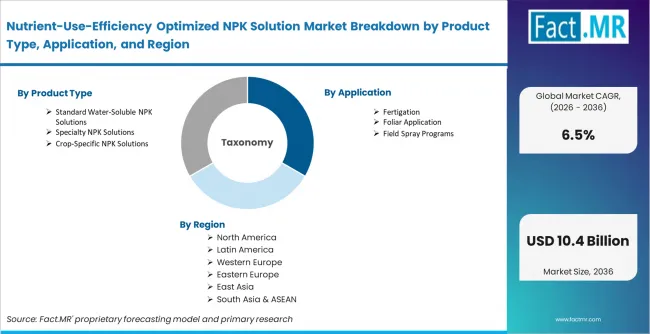
Nutrient Use Efficiency Optimized Npk Solution Market Breakdown By Product Type, Application, And Region | Source: Fact.MR
Attribute
Details
Quantitative Units
USD billion (2026) to USD billion (2036), at a CAGR
Market Definition
Liquid and water-soluble NPK fertilizer solutions designed to improve nutrient-use efficiency through precise delivery, irrigation compatibility, crop-stage feeding, and controlled nutrient placement across professional crop production systems.
North America, Europe, Asia Pacific, Latin America, Middle East and Africa
Countries Covered
United States, Canada, Mexico, Spain, Netherlands, Germany, France, India, China, Australia, Brazil, Argentina, and 40+ countries
Key Companies Profiled
Yara International ASA, ICL Group Ltd., Haifa Group, SQM S.A., Coromandel International Ltd., The Mosaic Company, UPL Ltd.
Forecast Period
2026 to 2036
Approach
Hybrid top-down and bottom-up model using crop-system suitability, fertigation relevance, greenhouse intensity, irrigation-linked fertilizer demand, and primary interviews with growers, distributors, and agronomy teams.
Source: Fact.MR analysis. Updated Jun 15, 2026
Nutrient-Use-Efficiency Optimized NPK Solution Market by Segments
By Product Type:
Standard Water-Soluble NPK Solutions
Specialty NPK Solutions
Crop-Specific NPK Solutions
Micronutrient-Enriched NPK Solutions
Others
By Application:
Fertigation
Foliar Application
Hydroponic Nutrient Delivery
Field Spray Programs
Others
By Crop Type:
Fruits & Vegetables
Cereals & Grains
Oilseeds & Pulses
Plantation Crops
Turf & Ornamentals
Others
By End Use:
Large Farms
Greenhouse Growers
Precision Agriculture Operations
Cooperatives
Agri-Service Providers
Others
By Region:
North America
United States
Canada
Latin America
Brazil
Mexico
Argentina
Rest of Latin America
Western Europe
Spain
Netherlands
Germany
France
Italy
Rest of Western Europe
Eastern Europe
Poland
Hungary
Rest of Eastern Europe
East Asia
China
Japan
South Korea
South Asia and Pacific
India
ASEAN
Australia and New Zealand
Rest of South Asia and Pacific
Middle East and Africa
South Africa
Other GCC Countries
Turkey
Rest of Middle East and Africa
Questions Answered
Frequently Asked Questions
What is the expected CAGR from 2026 to 2036?
Fact.MR projects a CAGR of 6.5% for the global nutrient-use-efficiency optimized NPK solution market during the 2026 to 2036 forecast period.
Which product type is poised to lead the market?
Standard water-soluble NPK solutions lead with approximately 36% share in 2026, driven by wide use across fertigation and greenhouse nutrition systems.
Which application segment holds the largest share?
Fertigation leads with approximately 41% share in 2026, supported by irrigation-linked nutrient delivery and higher nutrient-use efficiency [2].
Which crop segment is expected to remain strongest?
Fruits & vegetables are projected to account for approximately 33% share in 2026, supported by higher-value cropping and tighter nutrient control.
Which end-use segment is likely to remain commercially important?
Greenhouse growers are expected to contribute approximately 28% share in 2026 because controlled environments depend on precise feeding routines.
Which country shows the fastest growth?
India leads at 8.4% CAGR through 2036, driven by expanding fertigation relevance in horticulture and protected cultivation.
What is driving demand for optimized NPK solutions?
Demand is being driven by the rise of fertigation, stronger crop-stage nutrition practices, and the need to improve nutrient-use efficiency through more precise delivery [1][2][4].
What is the key challenge in this market?
The main challenge is that solution-based nutrition depends on irrigation systems, water-quality management, and technical confidence in feeding programs.
What makes this market different from conventional NPK fertilizer demand?
This market is shaped by delivery precision, solubility, and crop-stage control rather than by bulk fertilizer volume alone.

.webp "Top Country Growth Comparison Nutrient Use Efficiency Optimized Npk Solution Market Cagr (2026 2036)")