- Base Value(2024): 384 Mn
- Forecast Value (2035): 1014 Mn
- CAGR (2035): 9.9%
Truffles Market Outlook (2025 to 2035)
The global truffles market is expected to reach USD 1,014 million by 2035, up from USD 384 million in 2024. During the forecast period (2025 to 2035), the industry is projected to grow at a CAGR of 9.2%, driven by emerging gourmet food consumption, expanding cultivation in non-native regions, and a growing preference for clean-label, organic ingredients.
Premiumization trends in fine dining, combined with broader retail availability, have driven global demand. Innovations in truffle-infused products, including sauces, oils, and snacks, have enhanced consumer accessibility and diversified application channels.
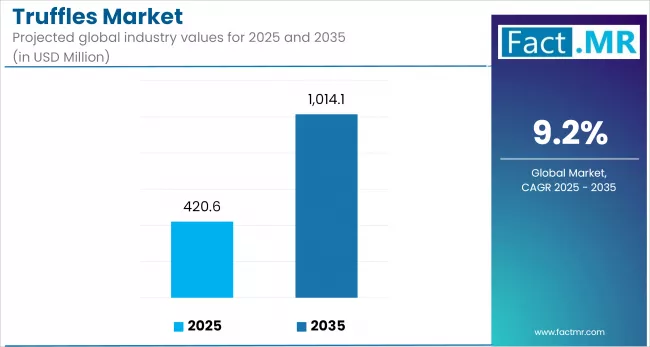
Truffles Market Projected Global Industry Value For 2025 To 2035 | Source: Fact.MR
What has driven the rising demand for truffles in gourmet and premium food applications globally?
The surge in consumer demand for gourmet and luxury food experiences has significantly contributed to the growth of the truffle market. The demand has risen through the efforts of chefs and high-end restaurants that continue to incorporate truffles in their dishes, leading to a surge in popularity not only in urban areas but also in premium restaurants. Besides their culinary and palatability qualities, truffles have been identified as having nutritional and antioxidant benefits, a characteristic appreciated by health-conscious customers.
Innovations in truffle production, including the development of truffle farms, have addressed supply chain challenges and supported market expansion. The increased presence of gourmet retail, as well as the export of food media and tourism, has also contributed to the growing interest in truffle-based products among a broader population.
What are the key market trends currently shaping the growth of the global truffles market?
Use of truffled products has been integrated into the mainstream, with the products in demand in restaurants influencing trends in packaged foods, sauces, snacks, and oils. There is an upsurge in consumer demand for natural and traditionally hand-made food products in the market, and truffles qualify under this category since they are natural or hand-picked.
The cosmetic and nutraceutical sectors have incorporated the use of truffle extracts in skincare products to leverage their antioxidant and anti-aging properties. There is an increased production of cultivated truffles, especially in areas not traditionally located in European truffle zones, thereby broadening the supply base. As consumers have increasingly sought more premium and experience-driven food, a greater focus has been placed on truffles in seasonal and high-end food offerings.
Why has limited truffle cultivation scalability restrained consistent supply growth in the global truffles market?
The growing popularity of truffles has revealed several limitations within the market landscape. It is not highly scalable because of its high production and harvesting costs, which are labor-intensive. Truffle cultivation is constrained by specific weather conditions and the extended maturation period of the fruit, therefore limiting farming success.
The natural truffle habitat has also been affected by climate change, especially in traditional European regions. Inconsistencies in supply have impacted pricing stability, thereby rendering truffles accessible to broader consumer segments.
The market has also encountered challenges related to authenticity, as imitation products and artificial flavors have fostered negative perceptions and undermined consumer confidence. These factors have hindered the market’s ability to achieve broader mainstream integration despite strong demand.
Which regions have driven the most significant growth in the global truffles market recently?
The market of truffles in North America has been growing steadily, supported by the increased popularity of gourmet food and culinary experiences. To reduce reliance on imports, the region has developed domestic truffle cultivation, particularly in Oregon and California. Awareness and long-term demand have also been backed by consumer interactions, through culinary tourism and festivals.
In recent years, the truffle market in East Asia has expanded rapidly, driven by increasing disposable incomes and a growing demand for luxury culinary experiences. China and Japan have shown strong demand for the product, whereas Australia, which has developed the production of black truffles, has contributed to the regional supply. Adoption has been reinforced by the market awareness and the product’s premium positioning.
Western Europe has remained the dominant player in the global truffles market, with France, Italy, and Spain leading both production and consumption. The long-term culinary traditions and favorable climatic conditions of the area have been advantageous to the region. However, the inconsistency of climate has triggered enhancements in climate-proofing by investing in truffle production and ensuring that agricultural activities remain sustainable.
Country-wise Outlook
Health-Conscious Consumers and Functional Ingredients Have Boosted the U.S. Truffles Market
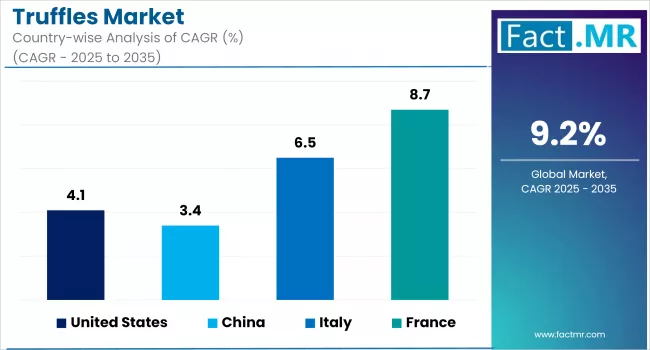
Truffles Market Country Wise Analysis Of CAGR 2025 To 2035 | Source: Fact.MR
The truffle market in the United States has shown a consistent upward trend, largely driven by shifting consumer preferences toward nutrient-enriched pastry products. The fascination with wellness and clean-label ingredients has prompted bakers to invest in natural preservatives, such as truffles. This aligns with a broader shift in eating habits, as individuals become more health-conscious, transparent, and purpose-driven.
Truffle breads, whether artisan or organic, have gained popularity, with American shoppers proving an appreciation for both quality and preservative-free options. Truffles have increasingly been used in frozen dough products, a format favored by convenience-focused retail outlets. These products have benefited from extended shelf life without compromising the flavor or texture, reinforcing their role as a functional ingredient in modern baking.
Clean-Label Compliance and Dairy Innovation Have Propelled China's Truffles Market
The truffles market in China has also experienced significant development due to the enhanced focus on clean-label product integrity and food quality. The demand of consumers has shifted toward organic and additive-free foods, leading producers to adopt natural food preservatives, such as truffles. These ingredients have been crucial in maintaining the quality of the products, as noted in the emerging Chinese regulatory regime.
Truffles have successfully entered the dairy and bakery sectors, where they are used to prevent spoilage while preserving taste and consistency. This is supported by the fact that truffles have become a viable solution as natural preservatives that do not violate environmentally friendly production methods, and the growing awareness of health among consumers, as clean-label regulations have become a widespread practice across China's manufacturing regions.
Heritage Cuisine and Gourmet Consumption Have Spurred France's Truffles Market
Truffles have maintained a stable market in France, with the domestic sector playing an important role in supporting growth, often driven by periods of high demand. This has encouraged producers to adopt new farming practices with the objective of increasing crop yields and reducing growing periods. Truffles have been a key element of French gourmet cuisine, particularly during festive periods when demand peaks.
French consumers and chefs alike have continued to take pride in locally sourced truffles, valuing their role in preserving culinary heritage. Although imported truffles have created competition, the local market has also gained an advantage by focusing on products made in France, which have always been popular at both local and international levels. This luxurious positioning has enabled truffles to remain a favorite in high-end restaurants, stores, and foreign markets.
Category-Wise Market Outlook
Black Truffles Gain Momentum Amid Gourmet Affinity and Culinary Prestige
Black truffles represent a rapidly growing product segment within the truffle market due to their rising demand and widespread culinary appeal. Their strong smell and flavor profile have elevated them to the level of gourmet chefs and food connoisseurs worldwide. They are increasingly used in fine cuisine and the formulation of high-quality products, such as truffle oils, sauces, and infusions. This is primarily driven by their ability to add a luxurious appeal to dishes, a hallmark of status in cooking.
The demand has been high, especially in Europe and North America, where the culture of home cooking is evolving toward the use of exotic and premium ingredients. Both chefs and customers also relate black truffles with culinary status, and this prompts their cultivation.
Fresh Truffles Surge Forward as Chefs Prioritize Authenticity and Aroma
The rise of experiential dining and the growing demand for ingredient authenticity have driven fresh truffles into a phase of rapid, accelerated growth. The fresh forms have been preferred by the chefs in up-scale and specialty restaurants due to their distinctive aroma, texture, and potency.
Encouraged by media and cooking shows, consumers are becoming more sophisticated and seek fresh truffles for home cooking as part of a gourmet experience. The enhanced availability of the cold chain in logistics has enabled the wider distribution of fresh truffles without compromising quality, particularly in regions known for their culinary standards, such as Western Europe and Japan.
Organic Truffles See Rapid Uptake Amid Sustainability and Ethical Foraging Trends
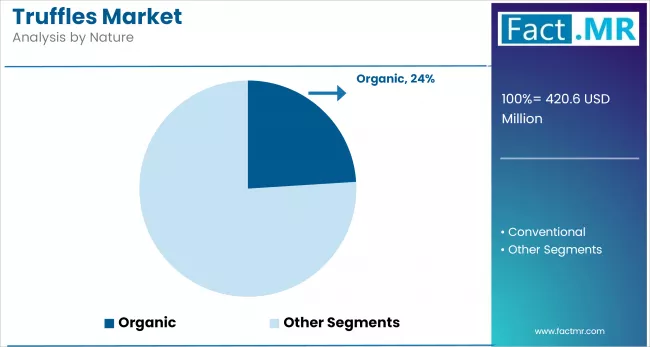
Truffles Market Analysis By Nature | Source: Fact.MR
The popularity of organic truffles is growing as buyers seek transparency about product origin and, most importantly, prefer purchasing organic items. Truffle producers are focusing on organic certified harvesting practices, avoiding chemicals and preserving natural forest habitats. This aligns with the clean-label movement and the expanding market of consumers who value sustainable and ethically sourced gourmet products.
They are popular in a range of contexts beyond health issues, such as the story behind their production, often linked to biodiverse forests and traditional foraging procedures. Germany, France and some areas in Scandinavia have shown notable progress in this segment, supported by their strict ecological preferences in food consumption.
Competitive Analysis
Competitive Outlook: Truffles Market
The development of the truffle trade on the global scene has intensified competition worldwide as the gourmet food culture continues to influence consumer preferences in the market. Industry leaders such as the Sabatino Tartufi, Urbani Truffles and TruffleHunter Ltd. have established their dominance by offering high-end product lines and high distribution status in global market.
These organizations have been innovative, environmentally conscious, and have introduced truffles to new consumer segments. Meanwhile, The Truffle & Wine Co. and PLANTIN Truffles have managed to provide a focus on quality and traceability, and these companies can be viewed as the reliable suppliers of black and white truffles.
Other influential operators, such as Monini, Savitar Tartufi, Gazzarrini Tartufi, Alba Royal Truffles, and Trufas Alonso, have focused on niche products, local branding, and artisanal production. Monini, a company specializing in gourmet oils, has incorporated truffle-based products into its range to position itself as a high-end brand.
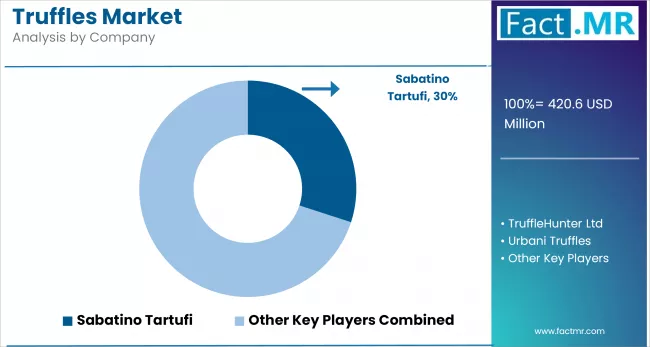
Truffles Market Analysis By Company | Source: Fact.MR
Companies such as Savitar Tartufi or Trufas Alonso have maintained their positions by utilizing techniques based on heritage and exclusive relationships with chefs and premium restaurants. This combination of competing and developing participants has created a competitive environment characterized by dynamic and healthy competition in the global truffle market.
Key players of the truffles industry are Sabatino Tartufi, TruffleHunter Ltd, Urbani Truffles, The Truffle & Wine Co., PLANTIN Truffles, Monini, Savitar Tartufi, Gazzarrini Tartufi, Alba Royal Truffles, Trufas Alonso.
Recent Development:
- In December 2024, Lindt introduced Lindor Non-Dairy OatMilk Truffles, catering to the growing demand for plant-based indulgent treats. These truffles offer a smooth-melting center made with oat milk chocolate, expanding Lindt's offerings to include vegan-friendly options.
- In September 2024, Be Truffle launched a disruptive range of affordable truffle products, including sauces and condiments, to make truffle flavors accessible to a broader audience. The brand's innovative approach combines quality truffle ingredients with everyday products, aiming to demystify truffle consumption.
Fact.MR has provided detailed information about the price points of key manufacturers in the Truffles Market positioned across regions, sales growth, production capacity, and speculative technological expansion, in the recently published report.
Methodology and Industry Tracking Approach
The 2025 global truffles market report by Fact.MR establishes a new gold standard in strategic market intelligence, offering a precision-calibrated, data-rich examination of truffles’ growing impact across global foodservice, gourmet retail, and sustainable flavor innovation ecosystems. Drawing insights from over 7,500 stakeholders across 35 countries, each contributing 300+ qualified responses, the report delivers unparalleled analytical depth, global coverage, and sectoral relevance.
The respondent framework has been meticulously architected to ensure a holistic 360° industry view. Two-thirds of participants consist of end users and senior decision-makers, including executive chefs, procurement directors, category heads, and sustainability officers from premium foodservice, hospitality, and specialty retail organizations. The remaining one-third comprises domain specialists, including truffle cultivators, mycologists, food scientists, cold-chain experts, and trade consultants, who are involved in organic cultivation, artisanal preservation, and cross-border gourmet logistics.
Spanning a comprehensive research cycle from July 2024 to June 2025, the study captures transformational shifts in the truffles market ranging from cultivation technology (e.g., climate-adaptive inoculation, soil microbiome enhancement), post-harvest optimization (cold-chain automation, anti-oxidative packaging), and product innovation (truffle oils, infused cheeses, functional snacks) to evolving regulatory frameworks surrounding geographical indications (GIs), export quality grading, and organic certification protocols. Advanced stratified sampling ensures insight weighting by geography, stakeholder tier, and distribution format.
Backed by over 250 rigorously validated sources, including customs data, regulatory dossiers, cultivation patents, research journals, and proprietary channel audits, the report employs cutting-edge analytical tools such as segmentation mapping, price trend analysis, and predictive modeling to generate high-confidence strategic foresight.
Continuously monitored since 2018, the 2025 edition is a must-have resource for truffle growers, CPG innovation leaders, premium food brands, sustainability-led procurement teams, and global investors seeking early-mover advantage in the rapidly expanding truffles economy.
Segmentation
Segmentation of Truffles Market Research
-
By Type :
- Black Truffles
- White Truffles
- Summer Truffles
- Burgundy Truffles
- Others (e.g., Garlic, Chinese)
-
By Form :
- Fresh
- Frozen
- Dried
- Canned
- Powdered
-
By Nature :
- Organic
- Conventional
-
By Application :
- Culinary Garnishing
- Gourmet Sauces & Infusions
- Truffle Oils and Butters
- Flavored Snacks and Savory Products
- Nutraceutical/Functional Ingredient Use
-
By End Use :
- Food & Beverage Industry
- Foodservice (Hotels, Restaurants, Caterers)
- Retail/Household
- Cosmetics & Personal Care (for truffle extracts)
- Nutraceuticals & Supplements
-
By Sales Channel :
- B2B (Direct Sales)
- B2C (Supermarkets/Hypermarkets)
- Specialty Stores
- Online Retail
- Others (e.g., Gourmet Boutiques)
-
By Region :
- North America
- Latin America
- Western Europe
- Eastern Europe
- East Asia
- South Asia & Pacific
- Middle East & Africa
Frequently Asked Questions
What was the Global Truffles Market Size Reported by Fact.MR for 2024?
Who are the Major Players Operating in the Truffles Market?
What is the Estimated Valuation of the Truffles Market in 2035?
What Value CAGR did the Truffles Market Exhibit Over the Last Five Years?
Who worked on this report


Preview the report firsthand - request a free sample
Free SampleGet the brochure for pricing and purchase details
Download PDF