- Forecast Value (2036): 2.28 Bn
- CAGR (2036): 5.4%
Turboexpander Market Forecast and Outlook 2026 to 2036
In 2025, the turboexpander market was valued at approximately USD 1.28 billion. Based on Fact.MR analysis, demand for turboexpanders is estimated to reach around USD 1.35 billion in 2026 and approximately USD 2.28 billion by 2036. Fact.MR projects a CAGR of 5.4% during the forecast period. Market growth reflects sustained investments in gas processing, air separation units, and cryogenic infrastructure where energy recovery and process efficiency remain critical design parameters.
The market adds close to USD 1.0 billion in incremental value over the forecast window, reflecting steady compounding supported by large scale industrial projects rather than high shipment volatility. Early period growth is driven by new natural gas processing plants and LNG related infrastructure in Asia. Mid period performance aligns with capacity expansions in industrial gas and hydrogen production, where turboexpanders are integral to cold energy recovery. In later years, value growth is shaped by replacement demand and efficiency upgrades in mature facilities, supporting stable order intake without sharp cyclic swings.
India leads growth at 6.7% CAGR, supported by expanding gas processing and industrial gas capacity. South Korea follows at 6.4% driven by cryogenic and hydrogen related investments. The United Kingdom records 6.1% as gas infrastructure modernization progresses, while China reaches 6.0% aligned with large scale air separation and chemical projects. The United States grows at 5.6% supported by gas processing upgrades, while Germany at 4.8% and Japan at 4.2% remain replacement led, reflecting stable installed bases and long equipment operating lifecycles.
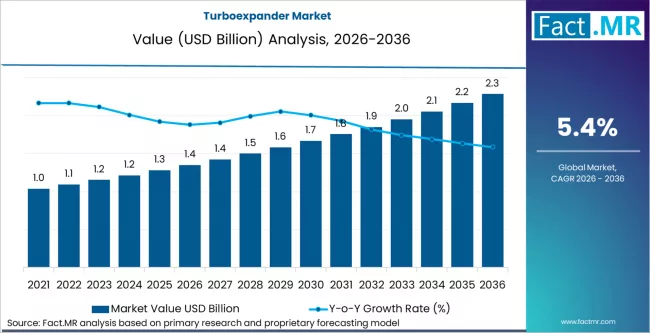
Turboexpander Market Market Value Analysis | Source: Fact.MR
Turboexpander Market Definition
The turboexpander market covers rotating equipment used to recover energy from high pressure gas streams by expanding the gas and converting pressure energy into mechanical power. Turboexpanders are installed in natural gas processing, air separation, petrochemical production, and liquefied gas facilities to reduce gas temperature while generating usable energy. The recovered energy is often used to drive compressors or generators within the same process. Equipment design, efficiency, and industrial application align with process energy management guidance issued by the US Department of Energy and natural gas processing frameworks referenced by the US Energy Information Administration. [1]
Turboexpander Market Inclusions
The report covers global and regional market size estimates in volume and value terms with a forecast period from 2026 to 2036. Segmentation includes turboexpander type by power range, application across natural gas processing, air separation units, and petrochemical plants, and end use covering oil and gas, industrial gases, and chemical manufacturing. The scope also includes regional demand patterns, pricing benchmarks, and international trade flows for turbomachinery equipment.
Turboexpander Market Exclusions
The scope excludes gas turbines, pressure letdown valves without energy recovery capability, and steam turbines operating on different thermodynamic principles. Cryogenic compressors, heat exchangers, and generators sold as standalone equipment are not included. Power generation systems sold as complete packages are excluded. Laboratory scale expanders, prototype machinery, aftermarket maintenance services, and plant level engineering services are also outside the scope.
Turboexpander Market Research Methodology
- Primary Research: Primary research involved interviews with turboexpander manufacturers, gas processing plant operators, engineering procurement contractors, and process engineers.
- Desk Research: Desk research used industrial energy efficiency documentation from the US Department of Energy and gas processing data published by the US Energy Information Administration, along with industrial production statistics and company annual reports filed with securities regulators.
- Market Sizing and Forecasting: Market sizing applied a hybrid top down and bottom up model using natural gas processing capacity, air separation unit installations, and turbomachinery deployment rates by industry.
- Data Validation and Update Cycle: Outputs were cross checked against plant capacity disclosures, trade statistics, energy infrastructure data, and public capital expenditure records, with updates applied when verified public sources issue revisions.
Summary of turboexpander market
-
Market definition
- The turboexpander market covers rotating equipment used in gas processing, air separation, and cryogenic facilities to expand high-pressure gas streams, reduce temperature, and recover mechanical energy for compressors or generators within industrial process systems.
-
Demand drivers
- Expansion of natural gas processing, LNG infrastructure, and industrial gas plants increases installation of turboexpanders where pressure letdown and refrigeration are integral to plant design.
- Energy recovery economics drive adoption in air separation and cryogenic hydrogen systems, supported by industrial energy efficiency guidance from. [2]
- Long operating lifecycles and specification-led project execution sustain demand through replacement and efficiency upgrade cycles rather than short-term upstream investment swings.
-
Key segments analyzed
- Product type: Axial flow turboexpanders lead with about 50% share due to suitability for high-flow, continuous-duty gas processing and cryogenic applications.
- Loading device: Compressor-loaded turboexpanders account for roughly 53% share, reflecting direct use of recovered energy within integrated process loops.
- Geography: India, South Korea, China, and the United Kingdom show higher growth tied to gas processing, air separation, and hydrogen-related investments, while the United States, Germany, and Japan remain replacement-led.
-
Analyst opinion at Fact.MR
- Shambhu Nath Jha, Principal Consultant at Fact.MR, opines, ‘CXOs will find this report useful for understanding how gas processing efficiency targets, energy recovery integration, and long project execution cycles are shaping sustained demand for turboexpanders across industrial gas and cryogenic applications.’
-
Strategic Implications / Executive Takeaways
- Align product development with axial flow and compressor-loaded configurations specified in large-scale gas and cryogenic projects.
- Emphasize efficiency validation and reliability data to support EPC-led procurement and long qualification timelines.
- Target replacement and upgrade opportunities in mature facilities operating under gas processing frameworks referenced by. [3]
-
Methodology
- Market sizing based on gas processing capacity, air separation unit installations, and turboexpander deployment rates.
- Validation through plant capacity disclosures, trade statistics, and public energy infrastructure data.
- Forecasts derived from reproducible top-down and bottom-up models grounded in verified industrial benchmarks.
Segmental Analysis
Turboexpander Market Analysis by Product Type
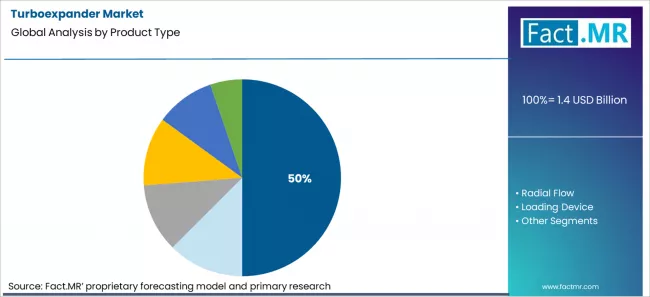
Turboexpander Market Analysis By Product Type | Source: Fact.MR
Based on Fact.MR analysis, consumption of axial flow turboexpanders is estimated to hold 50% share of the global turboexpander market. Fact.MR analysts note that axial flow designs lead due to their suitability for high flow rate gas processing applications where continuous operation and energy recovery are required. As per Fact.MR, this product type addresses operator requirements for stable performance in cryogenic air separation, LNG processing, and large-scale natural gas handling facilities, where pressure reduction and refrigeration generation are integral to process efficiency and operational reliability across industrial installations worldwide.
- Energy processing context: Government energy agencies document the use of turboexpanders in cryogenic gas separation and natural gas processing systems.
- Flow suitability: Axial flow designs handle large volumetric gas throughput with consistent expansion efficiency.
- Industrial deployment: These units are commonly installed in continuous-duty gas processing plants.
Turboexpander Market Analysis by Loading Device
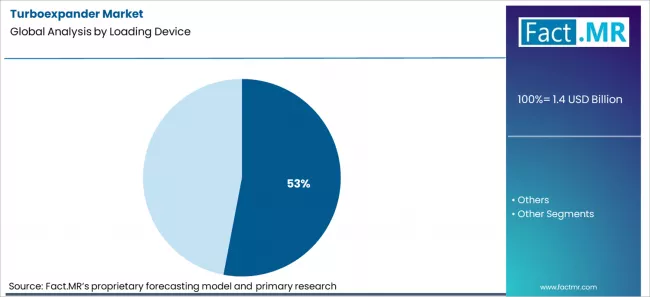
Turboexpander Market Analysis By Loading Device | Source: Fact.MR
Based on Fact.MR analysis, consumption of compressor-loaded turboexpanders is estimated to hold 53% share of the global market. Fact.MR opines that this loading configuration leads because recovered expansion energy is directly used to drive compressors within the same process loop. As per Fact.MR, compressor-loaded systems address plant requirements for energy efficiency improvement, reduced external power demand, and integrated process control in natural gas, petrochemical, and air separation facilities operating under steady-state conditions worldwide.
- Energy efficiency linkage: Industrial energy efficiency programs recognize mechanical energy recovery systems as contributors to reduced power consumption. [5]
- Process integration: Compressor-loaded designs eliminate the need for separate power recovery equipment.
- Operational stability: Direct mechanical coupling supports consistent load control during pressure fluctuations.
Turboexpander Market Drivers, Restraints, And Opportunities
Fact.MR analysis indicates that the turboexpander market exists as a specialised mechanical equipment segment used in energy, petrochemical, and industrial gas processing applications where expansion of high-pressure gas streams is required for power recovery, refrigeration, or gas separation. As per Fact.MR assessment, turboexpanders are integral to processes such as natural gas liquids (NGL) recovery, helium extraction, and ethylene refrigeration, and their performance, safety, and integration requirements are influenced by industry codes and standards such as API Standard 617 (Axial and Centrifugal Compressors and Expander-Compressors), which provides design, fabrication, and testing provisions relevant to turboexpander machinery in industrial environments Fact.MR analysts observe that the current market size is tied to upstream hydrocarbon processing activities, petrochemical capacity expansions, and industrial gas production volumes that specify high-efficiency energy recovery equipment.
Fact.MR is of the opinion that current market dynamics reflect a transition toward higher-efficiency, materials-advanced turboexpanders capable of withstanding corrosive gases, cryogenic temperatures, and varied duty cycles. Based on Fact.MR assessment, conventional expendable technologies and basic centrifugal expanders remain in use in legacy facilities due to historical specifications, but growth is occurring in segments where operators require turboexpanders with advanced metallurgy, tighter tolerances, and integrated control systems that improve energy recovery and operational uptime. These advanced turboexpander systems typically carry higher per-unit pricing because of material and control complexity, meaning realised market value can increase even where shipment volumes grow at a measured pace. Fact.MR analysis suggests this mix of technology transition and premium unit placement shapes near-term market progression.
- Industry design and testing standards: Fact.MR analysts note that reference to standards such as API Standard 617 influences design, fabrication, and testing criteria for turboexpander machinery used in gas processing, petrochemical, and industrial environments.
- Shift toward high-efficiency systems: Based on Fact.MR assessment, demand is rising for turboexpanders with advanced materials and integrated controls that improve energy recovery and operational reliability compared with basic expander technologies.
- Asia Pacific energy infrastructure growth: Fact.MR opines that expanding petrochemical capacity and natural gas processing facilities in China, India, and Southeast Asia support regional turboexpander uptake as part of energy optimisation and industrial gas production systems.
Regional Analysis
Based on regional assessment, the turboexpander sector is analyzed across North America, Europe, East Asia, South Asia, and other major industrial regions, spanning more than 40 countries. Regional performance varies according to investments in gas processing, LNG infrastructure expansion, and demand for energy recovery solutions across petrochemical and industrial gas applications. The analysis also presents a comparative market attractiveness evaluation grounded in region-specific demand trends.
Turboexpander Market CAGR Analysis by Country (2026-2036)
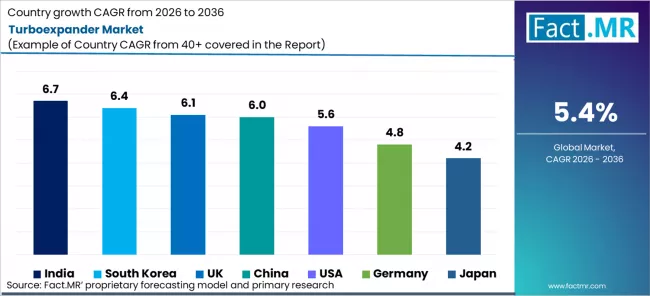
Turboexpander Market Cagr Analysis By Country | Source: Fact.MR
| Country | CAGR |
|---|---|
| India | 6.7% |
| South Korea | 6.4% |
| United Kingdom | 6.1% |
| China | 6.0% |
| United States | 5.6% |
| Germany | 4.8% |
| Japan | 4.2% |
Source: Fact.MR analysis. Updated Feb 23, 2026
Source: Fact.MR analysis, based on proprietary forecasting models and primary research.
Asia Pacific Turboexpander Market Analysis
Asia Pacific operates as a capacity expansion and process efficiency driven turboexpander region supported by rapid growth in natural gas processing petrochemicals and industrial gases. Demand is shaped by investment in LNG terminals air separation units and refinery modernization projects. Adoption is governed by engineering standards project specifications and energy efficiency requirements. Regional activity reflects greenfield plant construction brownfield upgrades and integration of cryogenic recovery systems across large scale industrial clusters supported by public and private capital expenditure programs.
- India: Demand for turboexpanders in India is projected to rise at 6.7% CAGR through 2036. Usage is linked to expansion of natural gas processing facilities refinery upgrades and air separation unit installations, as per Fact.MR.
- China: Demand for turboexpanders in China is projected to rise at 6.0% CAGR through 2036. Adoption is supported by large scale LNG infrastructure development and petrochemical capacity additions, according to Fact.MR.
- South Korea: Demand for turboexpanders in South Korea is projected to rise at 6.4% CAGR through 2036. Usage reflects investments in industrial gas production and petrochemical process optimization, as per Fact.MR.
Fact.MR’s analysis of the Turboexpander Market in Asia Pacific consists of country-wise assessment that includes India, China, and South Korea. Readers can find project investments process industry expansion and equipment demand references.
Europe Turboexpander Market Analysis
Europe functions as a regulation aligned and efficiency focused turboexpander market shaped by energy transition objectives industrial optimization and process reliability requirements. Demand is driven by upgrades in gas processing hydrogen production and industrial gas facilities. Adoption follows strict engineering codes safety regulations and project approval frameworks. Market activity is concentrated in refinery modernization cryogenic recovery systems and efficiency improvement projects supported by capital expenditure in mature industrial infrastructure across Western and Northern European economies regionwide.
- Germany: Demand for turboexpanders in Germany is projected to rise at 4.8% CAGR through 2036. Adoption is driven by refinery modernization and industrial gas facility upgrades aligned with process efficiency requirements, according to Fact.MR.
- United Kingdom: Demand for turboexpanders in the United Kingdom is projected to rise at 6.1% CAGR through 2036. Usage reflects investments in gas processing infrastructure and industrial energy optimization projects, as per Fact.MR.
Fact.MR’s analysis of the Turboexpander Market in Europe consists of country-wise assessment that includes Germany and the United Kingdom. Readers can find regulatory alignment project activity and industrial upgrade references.
North America Turboexpander Market Analysis
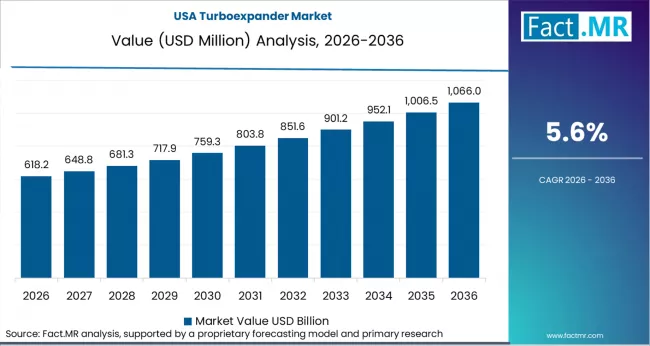
Turboexpander Market Country Value Analysis | Source: Fact.MR
North America operates as a project driven turboexpander market supported by strong natural gas production LNG export capacity and industrial gas demand. Usage is governed by engineering specifications safety standards and project economics. Adoption is concentrated in gas processing plants NGL recovery units and air separation facilities. Market activity reflects continued shale gas development LNG terminal investments and replacement demand within mature processing infrastructure supported by private sector capital spending across energy and industrial segments.
- United States: Demand for turboexpanders in the United States is projected to rise at 5.6% CAGR through 2036. Adoption is supported by LNG export facility expansion and upgrades in gas processing and NGL recovery plants, as per Fact.MR.
Fact.MR’s analysis of the Turboexpander Market in North America consists of country-wise assessment that includes the United States. Readers can find LNG investment trends gas processing activity and equipment demand insights.
Japan Turboexpander Market Analysis
Japan functions as a mature and technology driven turboexpander market with demand linked to industrial gas production LNG import terminals and refinery process optimization. Adoption is governed by strict engineering standards safety requirements and reliability considerations. Market activity is focused on equipment replacement efficiency upgrades and integration within existing cryogenic systems. Growth reflects steady capital expenditure in energy infrastructure industrial gases and chemical processing facilities rather than large scale capacity expansion projects nationwide.
- Japan: Demand for turboexpanders in Japan is projected to rise at 4.2% CAGR through 2036. Usage reflects replacement demand and efficiency upgrades across LNG terminals and industrial gas facilities, according to Fact.MR.
Fact.MR’s analysis of the Turboexpander Market in Japan consists of country-wise assessment that includes Japan. Readers can find infrastructure investment patterns equipment replacement trends and process optimization references.
Competitive Landscape of Turboexpander Market
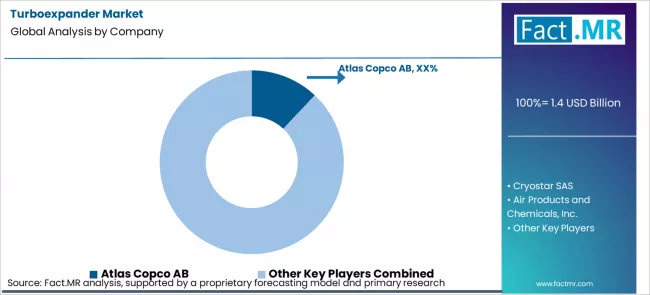
Turboexpander Market Analysis By Company | Source: Fact.MR
As per Fact.MR analysis, the 2026 turboexpander market is defined by validated thermodynamic performance, operational reliability, and multi-region compliance, which determine competitive advantage. Atlas Copco AB and Cryostar SAS lead with high-efficiency turboexpanders that maintain stable output under varying process conditions, which strengthens adoption in natural gas processing and petrochemical applications. Air Products and Chemicals, Inc. and Baker Hughes emphasize validated energy efficiency and material durability, which reduces operational risk and maintenance costs. GE Vernova Inc. and Siemens Energy AG provide modular, performance-verified designs, which improve integration with existing plant systems and accelerate project commissioning. Elliott Group (Ebara Corporation) and Chart Industries focus on high-precision rotor and bearing assemblies with documented reliability, which enhances long-term uptime and reduces failure rates. Nikkiso Co., Ltd. and R&D Dynamics offer specialized cryogenic turboexpanders with validated thermal performance, which supports niche industrial and LNG applications. Across the market, validated performance, engineering precision, and supply chain reliability form enduring competitive moats, reducing reliance on pricing or isolated product claims.
Recent Industry Developments
- Baker Hughes: Utility-Scale Zero-Emissions Launch: In October 2024, Baker Hughes finalized a $90 million equipment agreement with Net Power Inc. to supply specialized turboexpanders for the world’s first utility-scale, near-zero emissions power plant (Project Permian). As of early 2026, equipment validation test campaigns are ongoing to de-risk this technology, which uses a proprietary cycle to transform natural gas into clean power without traditional exhaust. [6]
- Atlas Copco: Hydrogen Liquefaction Expansion: Atlas Copco Gas and Process has become a primary equipment partner for the green hydrogen economy. Following a strategic collaboration with Plug Power, Atlas Copco is delivering advanced nitrogen and hydrogen turboexpanders for 15-ton-per-day liquefaction plants in Texas. By 2026, these units are critical to lowering the cost of hydrogen liquefaction and achieving net-zero goals. [7]
Key Players in Turboexpander Market
- Atlas Copco AB
- Cryostar SAS
- Air Products and Chemicals, Inc.
- Baker Hughes Company
- GE Vernova Inc.
- Siemens Energy AG
- Elliott Group (Ebara Corporation)
- Chart Industries, Inc.
- Nikkiso Co., Ltd.
- R&D Dynamics Corporation
Bibliography
- [1] U.S. Department of Energy. (2024). Advanced manufacturing office: Industrial energy efficiency and energy recovery technologies. Office of Energy Efficiency and Renewable Energy, U.S. Department of Energy; U.S. Energy Information Administration. (2024). Natural gas processing and infrastructure data. U.S. Department of Energy.
- [2] U.S. Department of Energy. (2024). Energy efficiency and energy recovery in industrial process systems. Office of Energy Efficiency and Renewable Energy, U.S. Department of Energy.
- [3] U.S. Energy Information Administration. (2024). Natural gas infrastructure, processing capacity, and energy markets. U.S. Department of Energy.
- [4] U.S. Department of Energy. (2024). Oil and gas research and development: Cryogenic processing and energy recovery. Office of Fossil Energy and Carbon Management, U.S. Department of Energy.
- [5] U.S. Department of Energy. (2024). Energy efficiency in the industrial sector. Office of Energy Efficiency and Renewable Energy, U.S. Department of Energy.
- [6] Baker Hughes Company. (2024). Annual report 2024: Energy transition technologies and turboexpander deployments. Baker Hughes Investor Relations and Corporate Reporting.
- [7] Atlas Copco AB. (2025). Hydrogen and cryogenic process equipment for liquefaction and energy recovery. Atlas Copco Gas and Process - Corporate Publications.
Segmentation
Scope of the Report
| Metric | Value |
|---|---|
| Quantitative Units | USD 1.35 billion (2026) to USD 2.28 billion (2036), at a CAGR of 5.4% |
| Market Definition | The turboexpander market covers rotating machinery used to recover energy from high-pressure gas streams by expanding the gas and converting pressure energy into mechanical power. Turboexpanders are applied in natural gas processing, air separation, petrochemical, and liquefied gas facilities to drive compressors or generators and improve energy efficiency. Equipment design and operation align with US Department of Energy and US Energy Information Administration guidance. |
| Product Type Segmentation | Axial Flow, Radial Flow, Other |
| Loading Device Segmentation | Compressor-loaded, Generator-loaded, Hydraulic/Oil-brake |
| Application Segmentation | Oil & Gas Processing, Air Separation, Cryogenic Applications, Others |
| Power Capacity Segmentation | Less than 1 MW, 1-4 MW, 5-9 MW, 10-19 MW, 20-24 MW, 25 MW or greater |
| Regions Covered | Asia Pacific, Europe, North America, Latin America, Middle East & Africa |
| Countries Covered | India, China, Japan, South Korea, Indonesia, Australia & New Zealand, ASEAN, Rest of Asia Pacific, Germany, Italy, France, United Kingdom, Spain, Benelux, Nordics, Central & Eastern Europe, Rest of Europe, United States, Canada, Mexico, Brazil, Argentina, Chile, Rest of Latin America, Kingdom of Saudi Arabia, United Arab Emirates, South Africa, Turkey, Rest of Middle East & Africa |
| Key Companies Profiled | Atlas Copco AB, Cryostar SAS, Air Products and Chemicals, Inc., Baker Hughes Company, GE Vernova Inc., Siemens Energy AG, Elliott Group (Ebara Corporation), Chart Industries, Inc., Nikkiso Co., Ltd., R&D Dynamics Corporation |
| Forecast Period | 2026 to 2036 |
| Approach | Hybrid top-down and bottom-up modeling validated through primary interviews with turboexpander manufacturers, gas processing plant operators, engineering procurement contractors, and process engineers. Market sizing supported by natural gas processing capacity, air separation unit installations, power range deployment, and alignment with API Standard 617 and US DOE energy efficiency guidance. |
Source: Fact.MR analysis. Updated Feb 23, 2026
Turboexpander Market Analysis by Segments
-
Product Type :
- Axial Flow
- Radial Flow
- Loading Device
- Compressor-loaded Turboexpanders
- Generator-loaded
- Hydraulic/Oil-brake
-
Application :
- Oil & Gas Processing
- Air Separation
- Cryogenic Applications
- Others
-
Power Capacity :
- Less than 1 MW
- 1-4 MW
- 5-9 MW
- 10-19 MW
- 20-24 MW
- 25 MW or greater
-
Region :
- Asia Pacific
- India
- China
- Japan
- South Korea
- Indonesia
- Australia & New Zealand
- ASEAN
- Rest of Asia Pacific
- Europe
- Germany
- Italy
- France
- United Kingdom
- Spain
- Benelux
- Nordics
- Central & Eastern Europe
- Rest of Europe
- North America
- United States
- Canada
- Mexico
- Latin America
- Brazil
- Argentina
- Chile
- Rest of Latin America
- Middle East & Africa
- Kingdom of Saudi Arabia
- United Arab Emirates
- South Africa
- Turkey
- Rest of Middle East & Africa
- Asia Pacific
Frequently Asked Questions
How large is the turboexpander market in 2026?
What will the turboexpander market size be by 2036?
What is the expected CAGR for the turboexpander market during 2026–2036?
What was the market value of turboexpanders in 2025?
How much absolute value is the market expected to add over the forecast window?
Which product type leads the turboexpander market by share?
Why do axial flow turboexpanders dominate demand?
Which loading device configuration is most widely used?
What drives preference for compressor-loaded turboexpanders?
Which application segment is a major contributor to market growth?
Which country is expected to see the fastest growth in the turboexpander market?
How strong is growth expected to be in South Korea?
What is the growth outlook for the United Kingdom?
How does China compare in terms of growth rate?
What is the expected growth rate for the United States market?
Why is growth more moderate in Germany?
How does Japan’s turboexpander market perform over the forecast period?
What supports early-period market growth in the forecast timeline?
What factors influence mid-period market performance?
What shapes turboexpander demand in the later years of the forecast?
Who worked on this report


Preview the report firsthand - request a free sample
Free SampleGet the brochure for pricing and purchase details
Download PDF