- Estimated Value(2026): 540 Mn
- Forecast Value (2036): 1004 Mn
- CAGR (2026 - 2036): 6.4%
Under-soil Heating System Market Forecast Outlook 2026 to 2036
The under-soil heating system market is anticipated to reach USD 540 million in 2026 and grow to USD 1,004 million by 2036, with a CAGR of 6.4%.
Key Takeaways from Under-soil Heating System Market
- Under-soil Heating System Market Value (2026): USD 540 million
- Under-soil Heating System Market Forecast Value (2036): USD 1,004 million
- Under-soil Heating System Market Forecast CAGR (2026-2036): 6.4%
- Leading Segment in Under-soil Heating System Market: Hydronic (Hot Water) (53%)
- Key Growth Region in Under-soil Heating System Market: Asia Pacific
- Key Players in Under-soil Heating System Market: REHAU AG & Co. KG, Uponor Corporation (part of Georg Fischer Group), Danfoss A/S, nVent Electric plc, Ebeco AB, Warmup plc, DEVI (a Danfoss brand), Polypipe Building Services Ltd., Roth Werke GmbH & Co. KG
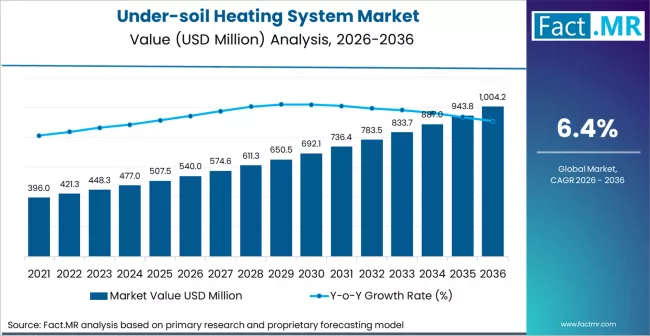
Under Soil heating System Market Market Value Analysis | Source: Fact.MR
Dominant players in this market defend their pricing power by leveraging economies of scale, strong brand recognition, and advanced technology offerings. Established companies maintain entry barriers through intellectual property, long-term contracts, and high capital investment in R&D and manufacturing capabilities. These factors create significant barriers for new entrants attempting to compete on equal footing. Despite this, the market remains fragmented due to a diverse customer base with varying needs, and regional preferences for installation and maintenance services. While consolidation may occur through strategic acquisitions or partnerships, fragmentation is likely to persist, especially as smaller players cater to niche demands and offer cost-effective solutions. As the market matures, the balance between dominance and fragmentation will shape overall competition.
Under-soil Heating System Market
| Metric | Value |
|---|---|
| Estimated Value in (2026E) | USD 540 million |
| Forecast Value in (2036F) | USD 1,004 million |
| Forecast CAGR (2026 to 2036) | 6.4% |
Source: Fact.MR analysis. Updated Feb 11, 2026
Category
| Category | Sub-Segment |
|---|---|
| By Heat Source | Hydronic (Hot Water); Electric Heating Cables; Hybrid Systems; Other |
| By Application | Football Stadiums; Training Facilities; Golf Greens; Other Turf |
| By Control & Monitoring | Basic Thermostat Control; PLC/SCADA Control; Smart Remote Monitoring; Other |
| By Sales Channel | Specialist Sports Turf Contractors; Direct OEM Sales; EPC/MEP Contractors; Other |
| Region | North America; Europe; Asia Pacific; Latin America; Middle East & Africa |
Source: Fact.MR analysis. Updated Feb 11, 2026
Segmental Analysis
How is Hydronic (Hot Water) Technology Shaping the Under‑Soil Heating System Market?
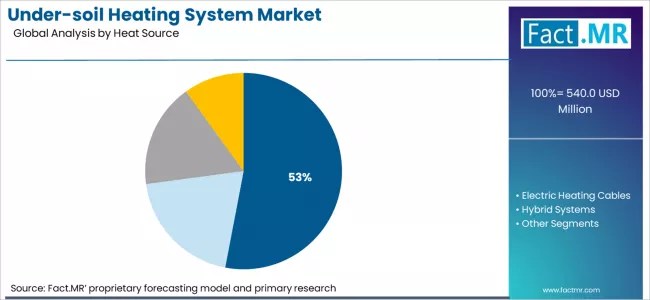
Under Soil heating System Market Analysis By Heat Source | Source: Fact.MR
Hydronic (Hot Water) systems are the leading heat source in the under‑soil heating system market, capturing 53% of the share in 2026. This technology circulates heated fluid through pipe networks installed beneath the turf, providing uniform heat distribution that prevents ground freezing and supports turf health. Hydronic systems are especially effective for large installations where consistent soil temperature is critical, such as sports fields exposed to cold weather conditions. These systems also offer reliable performance with lower operational costs compared with alternatives, making them a preferred solution for permanent turf heating applications.
Why Do Football Stadiums Dominate Applications in the Under‑Soil Heating System Market?
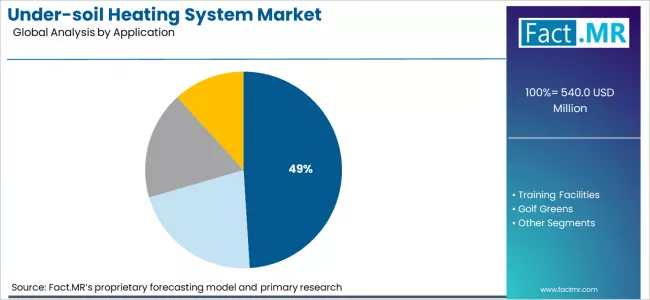
Under Soil heating System Market Analysis By Application | Source: Fact.MR
Football Stadiums represent the largest application segment with 49% of the market share in 2026. Professional football venues rely on under‑soil heating to maintain playable pitches throughout winter months and to avoid match postponements due to frozen ground. These systems are installed beneath natural or hybrid turf to prevent ice accumulation, protect the grass root zone, and ensure surface consistency under extreme weather. The widespread requirement for year‑round field usability in professional leagues drives continued investment in under‑soil heating technologies tailored to football stadium specifications.
What are the Drivers, Restraints, and Key Trends in the Under Soil Heating System Market?
Demand for under‑soil heating systems is shaped by requirements to maintain optimal ground temperatures and prevent frost or ice formation in sports fields, turf arenas, airport runways, and landscape applications. Facility and grounds managers specify systems that deliver consistent, energy‑controlled heat distribution to support surface playability, safety, and landscaping performance in cold climates. Procurement teams prioritize solutions that integrate with automated controls, deliver uniform thermal output, and optimize energy use to align with operational budgets and sustainability targets. Higher installation and energy costs constrain adoption in facilities with limited capital or utility budgets, and variability in soil types, climate conditions, and field usage patterns affects system design and capacity planning. Key trends include development of smart control platforms that adjust heat output based on real‑time weather data and soil moisture feedback, and expansion of modular, scalable heating components that simplify installation, maintenance, and phased upgrades across varied field footprints.
Analysis of the Under-Soil Heating System Market by Key Country
| Country | CAGR (2026-2036) |
|---|---|
| UK | 4.9% |
| Germany | 4.6% |
| Netherlands | 4.4% |
| India | 6.0% |
| Saudi Arabia | 5.6% |
| UAE | 5.3% |
Source: Fact.MR analysis. Updated Feb 11, 2026
The report covers an in-depth analysis of 40+ countries; top-performing countries are highlighted below.
What is Driving the Growth of the Under-Soil Heating System Market in the UK?
The UK’s Under-Soil Heating System market is projected to grow at a steady 4.9%, supported by the increasing demand for energy-efficient heating solutions in residential and commercial buildings. With a strong focus on sustainability and energy conservation, the UK is adopting under-soil heating systems as a means to enhance indoor comfort while reducing energy consumption. Additionally, the growing interest in eco-friendly building technologies and renovations in older buildings is fueling the adoption of under-soil heating systems, particularly in the residential sector.
How is the Under-Soil Heating System Market Expanding in Germany?
The Under-Soil Heating System market in Germany shows a steady 4.6% CAGR, driven by the country’s commitment to energy efficiency and sustainability in building technologies. Germany’s rigorous energy performance standards and the growing preference for environmentally friendly solutions in both residential and commercial sectors are increasing the adoption of under-soil heating systems. These systems provide efficient heating solutions, particularly in colder regions, while helping to reduce energy consumption and carbon footprints. The market is further supported by government incentives aimed at promoting energy-efficient building practices.
What Factors Are Fueling the Under-Soil Heating System Market in the Netherlands?
The Netherlands’ Under-Soil Heating System market is projected to grow at 4.4%, driven by the country's strong focus on sustainability and green building technologies. As part of its energy transition goals, the Netherlands is increasingly adopting under-soil heating systems in residential, commercial, and industrial applications to optimize energy efficiency. With a growing interest in reducing reliance on conventional heating systems and lowering carbon emissions, these energy-efficient heating solutions are gaining popularity in the Dutch market. Furthermore, the government’s policies supporting energy-efficient buildings contribute to the market's growth.
How Is the Under-Soil Heating System Market Growing in India?
India’s Under-Soil Heating System market is growing at 6.0%, fueled by the increasing demand for efficient heating solutions in both residential and commercial sectors. While India has a generally warm climate, cold regions and a rising interest in luxury and energy-efficient home features are driving the demand for under-soil heating systems. As the real estate market grows and consumers increasingly prioritize comfort and energy savings, India is seeing a rise in the installation of these systems. Additionally, the growing adoption of eco-friendly technologies and the government’s initiatives to promote energy-efficient solutions are accelerating market growth.
What Is Contributing to the Growth of the Under-Soil Heating System Market in Saudi Arabia?
Saudi Arabia’s Under-Soil Heating System market is expanding at 5.6%, driven by the country’s ongoing infrastructure development and increasing focus on energy-efficient solutions. As Saudi Arabia moves forward with large-scale real estate and commercial developments, the demand for advanced heating technologies, including under-soil heating systems, is growing. While the climate is generally hot, the adoption of these systems is increasing in luxury buildings and high-end residential projects. The government’s commitment to sustainability and energy conservation in construction further supports the rise of under-soil heating systems in the country.
How Is the Under-Soil Heating System Market Evolving in the UAE?
The UAE’s Under-Soil Heating System market is growing at 5.3%, driven by the country’s growing focus on luxury and high-efficiency buildings. As the UAE continues to develop its real estate sector, there is a rising demand for innovative heating systems that offer both comfort and energy savings. Under-soil heating is increasingly being adopted in both residential and commercial sectors to provide efficient heating while minimizing energy consumption. Additionally, the government’s sustainability goals and emphasis on green building practices contribute to the growing popularity of under-soil heating systems in the UAE.
How Are Key Players Competing in the Under-Soil Heating System Market?
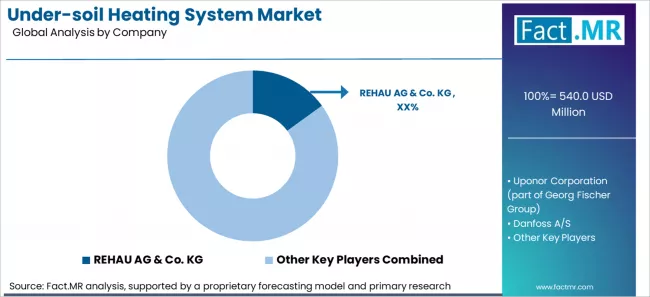
Under Soil heating System Market Analysis By Company | Source: Fact.MR
The under-soil heating system market is highly competitive with key players such as REHAU AG & Co. KG, which provides advanced heating solutions that prioritize energy efficiency and ease of installation. Uponor Corporation, part of Georg Fischer Group, offers innovative underfloor heating systems, specializing in smart, sustainable solutions that provide consistent warmth. Danfoss A/S, with its DEVI brand, leads with high-quality floor heating systems designed for reliable performance and cost-effectiveness. nVent Electric plc provides advanced electric underfloor heating systems, focusing on innovative design and quick installation. Ebeco AB emphasizes energy-efficient solutions in their under-soil heating products, helping to reduce operating costs. Warmup plc offers smart underfloor heating systems, integrating IoT technology for remote control and enhanced comfort. Polypipe Building Services Ltd. focuses on flexible, eco-friendly heating solutions for diverse applications. Roth Werke GmbH & Co. KG is known for its robust and durable underfloor heating systems that ensure efficient heat distribution.
Recent Industry Developments
- Patent (May 23, 2023): Under-soil heating system with integrated moisture and temperature sensors for dynamic heat regulation beneath turf and landscaped surfaces.
https://patents.google.com/patent/US20230158792A1/en - Patent (Nov 12, 2024): Modular under-soil heating cable assembly designed for faster installation and uniform thermal distribution across ground surfaces.
https://patents.google.com/patent/EP4498751A1/en - Product Update (2025): Warmup® enhanced its under-soil heating systems with smart controller integration, weather-based modulation, and remote diagnostics.
https://www.warmup.com/floor-heating/products/under-soil-cable-heating
Key Players of the Under-soil Heating System Market
- REHAU AG & Co. KG
- Uponor Corporation (part of Georg Fischer Group)
- Danfoss A/S
- nVent Electric plc
- Ebeco AB
- Warmup plc
- DEVI (a Danfoss brand)
- Polypipe Building Services Ltd.
- Roth Werke GmbH & Co. KG
Bibliographies
- International Organization for Standardization (ISO). (2023). ISO 11855-1: Building environment design - Embedded radiant heating and cooling systems - Part 1: Definitions, symbols, and comfort criteria. ISO.
- European Committee for Standardization (CEN). (2023). EN 1264-1: Water based surface embedded heating and cooling systems - Definitions and symbols. CEN.
- ASHRAE (American Society of Heating, Refrigerating and Air-Conditioning Engineers). (2023). ASHRAE Handbook-HVAC Applications: Radiant heating and ground heating systems. ASHRAE.
- Chartered Institution of Building Services Engineers (CIBSE). (2023). CIBSE Guide B: Heating, ventilating, air conditioning and refrigeration - Radiant and embedded heating systems. CIBSE.
- Sports Turf Research Institute (STRI). (2023). Managing frost, soil temperature, and rootzone performance in natural sports turf. STRI Research Bulletin.
Segmentation
Scope of the Report
| Items | Values |
|---|---|
| Quantitative Units (2026) | USD 540 Million |
| By Heat Source | Hydronic (Hot Water), Electric Heating Cables, Hybrid Systems, Other |
| By Application | Football Stadiums, Training Facilities, Golf Greens, Other Turf |
| By Control & Monitoring | Basic Thermostat Control, PLC/SCADA Control, Smart Remote Monitoring, Other |
| By Sales Channel | Specialist Sports Turf Contractors, Direct OEM Sales, EPC/MEP Contractors, Other |
| Regions Covered | North America, Europe, Asia Pacific, Latin America, Middle East & Africa |
| Countries Covered | United States, Canada, Mexico, Germany, United Kingdom, France, Japan, South Korea, China, India, Brazil, and other countries |
| Key Companies Profiled | REHAU AG & Co. KG, Uponor Corporation (part of Georg Fischer Group), Danfoss A/S, nVent Electric plc, Ebeco AB, Warmup plc, DEVI (a Danfoss brand), Polypipe Building Services Ltd., Roth Werke GmbH & Co. KG |
| Additional Attributes | Dollar revenue by heat source, application, control & monitoring, sales channel, and region; regional demand trends, competitive landscape, technological advancements in under-soil heating systems, operational performance optimization initiatives, and product development strategies |
Source: Fact.MR analysis. Updated Feb 11, 2026
Under-soil Heating System Market Key Segments
-
By Heat Source
- Hydronic (Hot Water)
- Electric Heating Cables
- Hybrid Systems
- Other
-
By Application
- Football Stadiums
- Training Facilities
- Golf Greens
- Other Turf
-
By Control & Monitoring
- Basic Thermostat Control
- PLC/SCADA Control
- Smart Remote Monitoring
- Other
-
By Sales Channel
- Specialist Sports Turf Contractors
- Direct OEM Sales
- EPC/MEP Contractors
- Other
-
Region
- North America
- USA
- Canada
- Mexico
- Europe
- Germany
- UK
- France
- Italy
- Spain
- Nordic Countries
- BENELUX
- Rest of Europe
- Asia Pacific
- China
- Japan
- South Korea
- India
- Australia
- Rest of Asia Pacific
- Latin America
- Brazil
- Argentina
- Rest of Latin America
- Middle East and Africa
- Kingdom of Saudi Arabia
- United Arab Emirates
- South Africa
- Rest of Middle East and Africa
- Other Regions
- Oceania
- Central Asia
- Other Markets
- North America
Frequently Asked Questions
What is the projected market size for under-soil heating systems in 2026?
What value is expected for under-soil heating systems in 2036?
At what rate will the under-soil heating system market progress from 2026 to 2036?
Which heat source dominates demand and what share does it hold?
Which region is expected to experience the fastest growth and what rate is it projected at?
Who are the major players in the under-soil heating system market?
Who worked on this report


Preview the report firsthand - request a free sample
Free SampleGet the brochure for pricing and purchase details
Download PDF