- Base Value(2026): 1.9 Bn
- Estimated Value(2026): 1.9 Bn
- Forecast Value (2036): 3.1 Bn
- CAGR (2026 - 2036): 5.0%
Demand for Automotive Composites in UK 2026 to 2036
Demand for automotive composites in the UK is expected to rise from USD 1.89 billion in 2026 to USD 3.08 billion in 2036, supported by a forecast CAGR of 5.0%. Lightweight engineering practices continue to gain momentum across multiple vehicle programs, and established manufacturers are broadening their use of advanced composite structures.
Key Takeaways for UK Automotive Composites Industry
- UK Automotive Composites Sales Value (2026): USD 1.89 billion
- UK Automotive Composites Forecast Value (2036): USD 3.08 billion
- UK Automotive Composites Forecast CAGR: 5.0%
- Leading Product Type in UK Automotive Composites Industry: Carbon Fiber (42.3%)
- Key Growth Regions in UK Automotive Composites Industry: England, Scotland, Wales, and Northern Ireland
- Regional Leadership: England holds the leading position in demand
- Key Players in UK Automotive Composites Industry: Toray Industries, Inc., SGL Carbon SE, Hexcel Corporation, Mitsubishi Chemical Group Corporation, Gurit Holding AG, Teijin Limited, Owens Corning, Solvay S.A., 3M Company, BASF SE
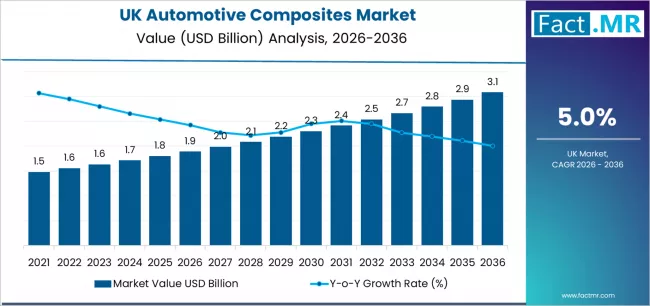
Uk Automotive Composites Market Market Value Analysis | Source: Fact.MR
England’s production hubs show the strongest uptake as modernization programs deepen and electrified vehicle architectures mature. Facilities are expanding investments in automated composite manufacturing systems, with increased emphasis on out-of-autoclave processing and inline inspection capabilities.
UK research priorities increasingly focus on carbon fiber reinforcement systems, since high-strength composite structures support energy-efficient mobility and enhance durability expectations for new vehicle lines. Manufacturers are refining resin chemistries and optimizing fiber placement techniques to achieve tighter tolerance windows.
Hybrid composite assemblies are also advancing, as suppliers work toward a balanced combination of cost efficiency, resilience, and manufacturability. These developments are shaping new production strategies across both high-volume and specialist automotive segments.
From 2030 to 2036, demand grows from USD 2.33 billion to USD 3.08 billion, adding USD 0.75 billion to overall composite consumption. Specialized formulations enter mainstream production, and automation within molding environments becomes more consistent. England and Scotland show rising activity in composite solutions designed for EV structures, battery enclosures, crash-management modules, and aerodynamic components.
Engineering teams across the country are prioritizing higher stiffness-to-weight ratios, stronger thermal tolerance, and more reliable long-term performance, which encourages broader investment in certification-ready composite processes and production capabilities.
UK Automotive Composites Industry
| Metric | Value |
|---|---|
| UK Automotive Composites Sales Value (2026) | USD 1.89 billion |
| UK Automotive Composites Forecast Value (2036) | USD 3.08 billion |
| UK Automotive Composites Forecast CAGR (2026-2036) | 5.0% |
Source: Fact.MR analysis. Updated Dec 16, 2025
Category
| Category | Segment |
|---|---|
| Material | Carbon Fiber, Glass Fiber, Hybrid, Others |
| Component | Body Panels, Chassis, Interior, Others |
| Region | England, Scotland, Wales, Northern Ireland |
Source: Fact.MR analysis. Updated Dec 16, 2025
Segmental Analysis
By Material, Which Segment Holds the Largest Share?
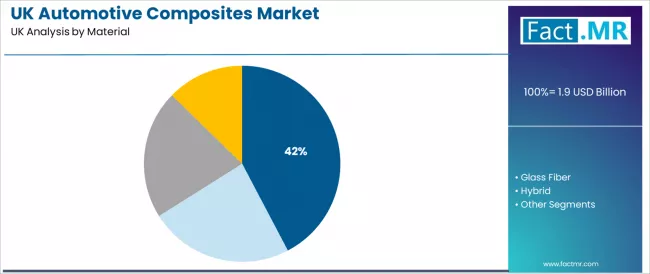
Uk Automotive Composites Market Analysis By Material | Source: Fact.MR
Carbon fiber is projected to account for 42.3% of automotive composites demand in 2026, making it the dominant material type. Manufacturers continue to adopt carbon fiber for its lightweight characteristics, high tensile strength, and established compatibility with existing automotive production lines. These attributes allow manufacturers to enhance vehicle performance and efficiency without undertaking extensive process modifications. The segment’s strong position is further supported by the UK’s mature manufacturing base, where ongoing model upgrades and performance optimization programs encourage wider carbon fiber integration across multiple vehicle platforms.
- Compatibility with current production workflows supports broad utilization across automotive facilities.
- Proven structural performance and supplier reliability reinforce large-scale adoption and long-term material planning.
By Component, Which Segment Registers the Highest Share?
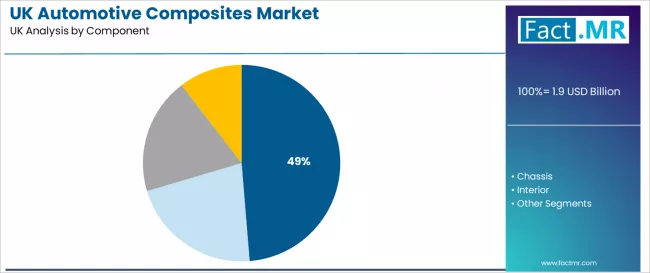
Uk Automotive Composites Market Analysis By Component | Source: Fact.MR
Body panels are expected to represent 48.7% of automotive composites demand in 2026, underscoring their role as the leading component category. Automakers rely on composite body panels to achieve meaningful weight reduction, support fuel-efficiency targets, and maintain structural integrity in high-volume vehicle programs. The segment benefits from consistent demand across major OEMs, specialty vehicle producers, and UK-based assembly operations, where composites enable improved manufacturing efficiency and support evolving design and performance requirements.
- Production needs across manufacturers and assembly lines sustain steady demand for composite-based body panels.
- Composite integration improves manufacturing efficiency, supports regulatory compliance, and helps achieve weight-reduction objectives across diverse vehicle platforms.
What are the Drivers, Restraints, and Key Trends in the UK Automotive Composites Industry?
The UK automotive composites landscape is shaped by rising performance expectations, growing lightweighting priorities, and steady technical adoption across regional manufacturing hubs. England continues to anchor most development activity, supported by evolving national guidelines that encourage higher material efficiency and stronger validation standards.
Suppliers operate in a competitive space defined by alternative material options, cost-sensitive procurement, and ongoing regulatory pressure. These factors influence how quickly composites gain acceptance across vehicle programs and determine the level of technical investment required for long-term adoption.
Growth opportunities come from expanding performance standards, coordinated manufacturing initiatives, and wider integration of weight-optimized composite systems. Companies are building stronger quality management capabilities and advanced validation networks that streamline production, improve reliability, and support more complex applications across multiple vehicle segments.
Emerging composite concepts, collaborative R&D models, and next-generation manufacturing technologies are strengthening supplier positioning, enabling deeper system-level optimization, and improving the economics of composite deployment across the UK’s diverse automotive manufacturing regions.
Analysis of UK Automotive Composites Industry by Key Countries
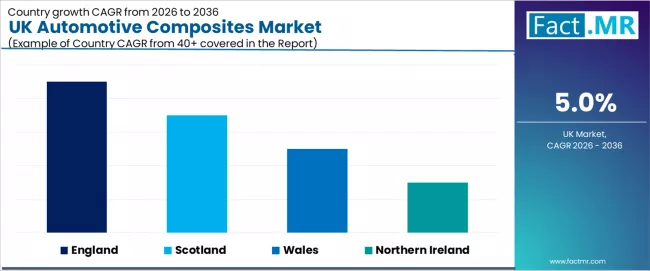
Uk Automotive Composites Market Cagr Analysis By Country | Source: Fact.MR
| Region | CAGR (2026-2036) |
|---|---|
| England | 4.9% |
| Scotland | 4.7% |
| Wales | 4.5% |
| Northern Ireland | 4.3% |
Source: Fact.MR analysis. Updated Dec 16, 2025
What keeps England at the Centre of UK Automotive Composites Demand?
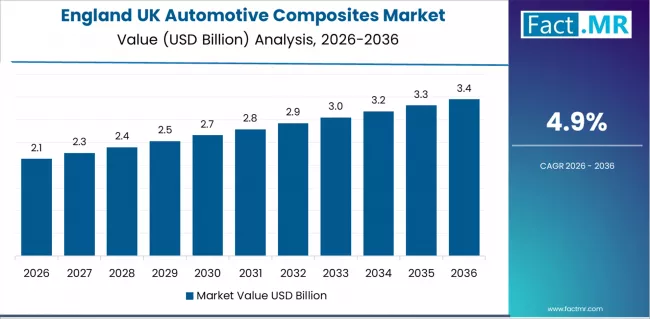
Uk Automotive Composites Market Country Value Analysis | Source: Fact.MR
England continues to lead national composite adoption, expanding at a projected 4.9% CAGR through 2036 as OEM networks, mature testing assets, and strong innovation ecosystems drive sustained material upgrades. Manufacturers are scaling composite programmes to meet lightweighting and performance goals, supported by rapid validation cycles and well-developed engineering infrastructure.
Key Takeaways
- Performance-first OEM specifications strengthen demand for advanced composite systems.
- Established funding and facility depth accelerate deployment of next-generation materials.
Why is Scotland Gathering Momentum?
Scotland is emerging as a high-momentum region, expanding at a projected 4.7% CAGR to 2036 due to concentrated automotive activity around Edinburgh and Glasgow and the region’s strong engineering workforce. Production lines are increasingly integrating composites to achieve component-level gains, enabling suppliers to tailor systems for local manufacturing economics.
Prominent Trends
- Clustered capabilities support quicker transitions from pilots to scaled adoption.
- Growing performance expectations create openings for specialised composite vendors.
What Explains Wales’ Steady, Practical Expansion?
Wales continues to advance at a 4.5% CAGR through 2036, driven by facility modernisation and the need for lighter, more durable components that improve operational efficiency. Composite uptake here is shaped by practical return-on-performance considerations, with manufacturers prioritising materials that strengthen process reliability and product competitiveness.
Key Aspects
- Modernisation efforts favour composite solutions with measurable operational value.
- Investments emphasise integration readiness and consistent production performance.
Which Factors drive Composite Interest in Northern Ireland?
Northern Ireland shows consistent progress, expanding at a projected 4.3% CAGR to 2036 as manufacturers upgrade facilities, diversify production, and invest in lightweighting pathways that improve part durability and engineering differentiation. Collaborative development efforts across facilities are helping accelerate composite adoption.
Prevailing Trends
- Expanding operations create natural entry points for performance-oriented composite systems.
- Regional cooperation enhances testing access and supports broader deployment across sites.
Competitive Landscape of UK Automotive Composites Industry
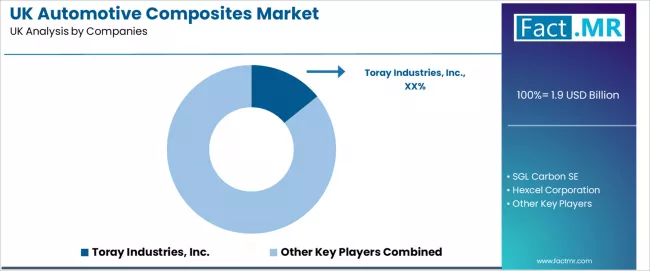
Uk Automotive Composites Market Analysis By Company | Source: Fact.MR
Specialized manufacturers, performance-component developers, and integrated solution providers that anchor the country’s vehicle innovation ecosystem shape competition in the UK automotive composites industry. Major automotive corporations reinforce this environment through deep research capabilities, advanced testing infrastructure, and application-specific engineering support. The broader push toward lightweighting and performance reliability continues to draw sustained investment into new materials, improved process control, and validation frameworks.
Leading composite suppliers such as Toray Industries, SGL Carbon SE, Hexcel Corporation, and Mitsubishi Chemical Group have strengthened their UK positions through technical breadth and multi-disciplinary engineering capabilities. Their offerings span design support, precision production, performance optimization, and application integration for passenger, commercial, and specialized vehicle programs. Each company drives competitiveness by pairing materials expertise with supply chain reliability, enabling smoother adoption across OEMs and tier suppliers.
Industry influence now extends beyond manufacturing. Engineering firms, research institutions, technology partners, and automotive operators are shaping the pace of composite deployment through collaborative R&D, pilot programs, and digital manufacturing initiatives. Workforce development, standardized specifications, and stronger domestic production networks remain central to meeting emerging performance and sustainability expectations.
Investors and financial enablers play an increasingly strategic role by backing facility expansion, composite innovation, and breakthrough production technologies. Their involvement supports modernization of supply capacity, accelerates commercialization cycles, and encourages consolidation among niche producers aiming for scale. The resulting ecosystem positions the UK for steady advancement in composite adoption across next-generation automotive platforms.
Key Players in UK Automotive Composites Industry
- Toray Industries, Inc.
- SGL Carbon SE
- Hexcel Corporation
- Mitsubishi Chemical Group Corporation
- Gurit Holding AG
- Teijin Limited
- Owens Corning
- Solvay S.A.
- 3M Company
- BASF SE
Segmentation
Scope of the Report
| Item | Value |
|---|---|
| Quantitative Units | USD 3.08 billion |
| Material | Carbon Fiber, Glass Fiber, Hybrid, Others |
| Component | Body Panels, Chassis, Interior, Others |
| Regions Covered | England, Scotland, Wales, Northern Ireland |
| Key Companies | Toray Industries, Inc., SGL Carbon SE, Hexcel Corporation, Mitsubishi Chemical Group Corporation, Gurit Holding AG, Teijin Limited, Owens Corning, Solvay S.A., 3M Company, BASF SE, Regional automotive composite specialists |
| Additional Attributes | Sales by material and component segment; regional demand trends across England, Scotland, Wales, and Northern Ireland; competitive landscape with established automotive composite suppliers and specialized manufacturing developers; quality preferences for carbon fiber versus glass fiber technologies; integration with manufacturing programs and advanced automotive policies, particularly advanced in the England region |
Source: Fact.MR analysis. Updated Dec 16, 2025
UK Automotive Composites Industry by Segments
-
Material :
- Carbon Fiber
- Glass Fiber
- Hybrid
- Others
-
Component :
- Body Panels
- Chassis
- Interior
- Others
-
Country :
- England
- Scotland
- Wales
- Northern Ireland
Frequently Asked Questions
How big is the demand for automotive composites in UK in 2026?
What will be the size of automotive composites in UK in 2036?
How much will be the demand for automotive composites in UK growth between 2026 and 2036?
What are the key product types in the automotive composites in UK?
Which component segment is expected to contribute significant share in the automotive composites in UK in 2026?
Who worked on this report


Preview the report firsthand - request a free sample
Free SampleGet the brochure for pricing and purchase details
Download PDF