- Base Value(2025): 2.0 Bn
- Estimated Value(2025): 2.0 Bn
- Forecast Value (2035): 2.7 Bn
- CAGR (2025 - 2035): 3.4%
Conveyor System Industry Analysis Forecast and Outlook 2025 to 2035
The demand for conveyor systems in the United Kingdom is projected to grow from USD 1.95 billion in 2025 to approximately USD 2.72 billion by 2035, the market will rise at a CAGR of 3.4% with recording an absolute increase of USD 0.77 billion over the forecast period. The belt conveyors segment is projected to account for 42.0% of UK conveyor system demand in 2025.
Belt conveyor applications are fundamental to the UK industry for several overlapping reasons, including their superior material handling characteristics, operational effectiveness, and proven capability in delivering reliable throughput performance while maintaining safety standards and system differentiation. The e-commerce & parcel end-use segment is expected to represent 37.0% of UK conveyor system demand in 2025. E-commerce operators and logistics suppliers are fundamental to the conveyor system industry because they provide the advanced automation requirements, comprehensive commercialization opportunities, and standardized performance characteristics required for operational success and supply chain innovation integration.
Quick Stats for United Kingdom Conveyor System Industry
- UK Conveyor System Sales Value (2025): USD 1.95 billion
- UK Conveyor System Forecast Value (2035): USD 2.72 billion
- UK Conveyor System Forecast CAGR: 3.4%
- Leading System Type in UK Conveyor System Industry: Belt Conveyors (42.0%)
- Leading End-Use in UK Conveyor System Industry: E-commerce & Parcel (37.0%)
- Key Growth Regions in UK Conveyor System Industry: England, Scotland, Wales, and Northern Ireland
- Regional Leadership: England holds the leading position in demand
- Key Players in UK Conveyor System Industry: Daifuku, Dematic, SSI Schäfer, Vanderlande, Interroll, Honeywell Intelligrated
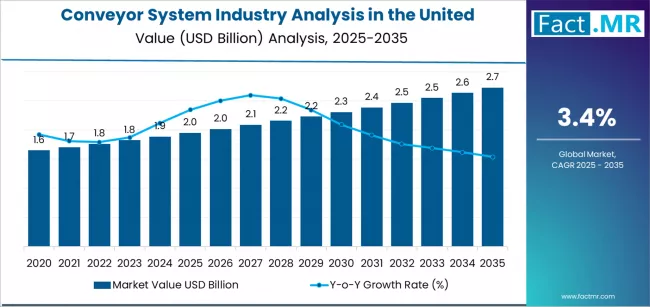
Conveyor System Industry Analysis In The United Kingdom Market Value Analysis | Source: Fact.MR
Between 2025 and 2030, demand for conveyor systems in the United Kingdom is projected to expand from USD 1.95 billion to USD 2.30 billion, resulting in a value increase of USD 0.35 billion, which represents 45.5% of the total forecast growth for the decade. This phase of growth will be shaped by rising e-commerce expansion, increasing warehouse automation investment, and growing demand for advanced material handling solutions across UK logistics sectors, particularly in regions where advanced distribution innovation and efficiency-conscious logistics companies are accelerating conveyor system adoption. Increasing integration of IoT technologies in warehouse operations and growing adoption of digital twin technologies continue to drive demand. Logistics companies and system integrators are expanding their installation capabilities to address the growing complexity of modern supply chain requirements and operational standards, with UK operations leading investments in automation technology and performance optimization systems.
From 2030 to 2035, demand is forecast to grow from USD 2.30 billion to USD 2.72 billion, adding another USD 0.42 billion, which constitutes 54.5% of the overall ten-year expansion. This period is expected to be characterized by expansion of automation scaling and technology optimization initiatives, development of new application categories beyond traditional warehouse operations, and implementation of comprehensive digitalization programs across different logistics and manufacturing sectors. The growing adoption of smart warehouse technologies and enhanced efficiency requirements, particularly in premium logistics and advanced manufacturing applications, will drive demand for more sophisticated system varieties and validated automation solutions.
Between 2020 and 2025, conveyor system demand in the United Kingdom experienced steady expansion, driven by increasing e-commerce growth and growing recognition of conveyor systems as essential capability for enhancing supply chain performance and providing comprehensive logistics solutions across diverse distribution applications. The sector developed as logistics operators and manufacturing companies, especially in major distribution centers, recognized the need for proven material handling systems and effective automation solutions to achieve commercial objectives while meeting industry expectations and operational requirements. Conveyor system suppliers and technology providers began emphasizing system optimization and performance validation to maintain competitive advantages and commercial viability.
UK Conveyor System Industry Key Takeaways
| Metric | Value |
|---|---|
| UK Conveyor System Sales Value (2025) | USD 1.95 billion |
| UK Conveyor System Forecast Value (2035) | USD 2.72 billion |
| UK Conveyor System Forecast CAGR (2025-2035) | 3.4% |
Source: Fact.MR analysis. Updated Nov 19, 2025
Why is the Conveyor System Industry Growing?
Demand expansion is being supported by the accelerating emphasis on supply chain optimization and logistics automation transformation nationwide, with the United Kingdom maintaining its position as an advanced distribution and manufacturing region, and the corresponding need for efficient material handling solutions for warehouse automation, distribution operations, and efficiency-focused logistics approaches. Modern logistics operators rely on conveyor system technologies to ensure operational reliability, throughput satisfaction, and optimal pathway achievement toward enhanced supply chain efficiency.
Distribution centers and manufacturing facilities are increasingly investing in conveyor system integration and automated handling solutions to enhance operational profiles, access supply chain optimization trends, and demonstrate logistics leadership in competitive industrial environments.
Operational standards and workplace safety compliance requirements are establishing standardized automation pathways that require premium system enhancement technologies and performance assurance, with UK operations often pioneering large-scale implementation of advanced conveyor system technologies.
Segment Analysis
The industry is segmented by system type, end-use, and region. By system type, the industry is divided into belt conveyors, roller conveyors, and overhead/others categories. In terms of end-use, the industry is segmented into e-commerce & parcel, food & beverage, and mining/others. Regionally, the industry is divided into England, Scotland, Wales, and Northern Ireland, with England representing a key growth and innovation hub for advanced logistics technologies.
By System Type, Belt Conveyors Segment Accounts for 42.0% Share
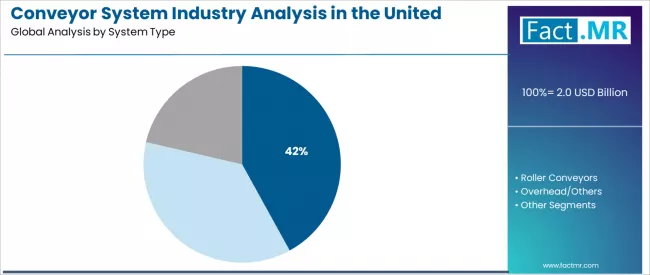
Conveyor System Industry Analysis In The United Kingdom Analysis By System Type | Source: Fact.MR
The belt conveyors segment is projected to account for 42.0% of UK conveyor system demand in 2025, making it the leading system type category across the sector. This dominance reflects the logistics requirements and performance needs of material handling where operational reliability is optimized through superior belt characteristics and reliable engineering architecture.
In the United Kingdom, where substantial logistics infrastructure requires system integration without complete facility redesign, belt conveyor platforms provide practical pathways for operational enhancement while maintaining safety compatibility and handling efficiency. Continuous innovations are improving material consistency, durability characteristics, and logistics integration parameters, enabling operators to achieve throughput standards while maximizing operational performance.
The segment's strong position is reinforced by the extensive existing distribution infrastructure requiring effective handling solutions and growing availability of belt conveyor suppliers with proven commercial experience.
- Facility compatibility and existing operations integrationmake belt conveyor platforms the preferred technology for enhancing distribution, manufacturing, and parcel handling operations.
- Operator demand for reliable performance benefitsand system sourcing track records are enhancing logistics confidence and product viability across large-scale adoption initiatives.
By End-Use, E-commerce & Parcel Segment Accounts for 37.0% Share
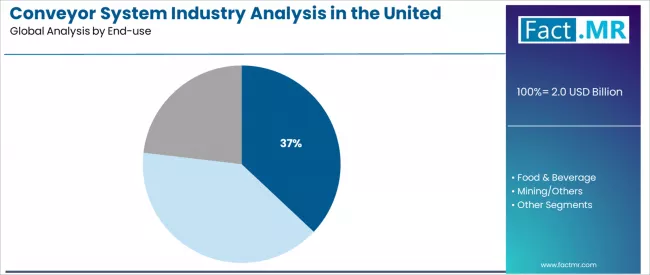
Conveyor System Industry Analysis In The United Kingdom Analysis By End Use | Source: Fact.MR
The e-commerce & parcel segment is expected to represent 37.0% of UK conveyor system demand in 2025, highlighting the critical importance of this category for providing the optimal balance of automation capability, cost-effectiveness, and operational flexibility. Logistics and distribution companies generate consistent demand for this established application category that is technically and economically favorable for a wide range of fulfillment and distribution applications.
The segment benefits from operational characteristics that often provide superior logistics outcomes compared to alternative handling methods, enhancing throughput efficiency and commercial appeal. This application range also accesses enhanced operational versatility through its compatibility with diverse facility layouts that improves handling consistency and commercial viability.
In the United Kingdom, where e-commerce logistics represents a substantial portion of the modern distribution economy, operational excellence requires standardized automation integration across diverse fulfillment operations. In England and major distribution hubs, where e-commerce operations concentrations are significant, conveyor system demand is elevated by emphasis on maintaining operational standardization while achieving efficiency targets.
- Optimal throughput-to-cost ratio and favorable operational economicsmake this the leading end-use segment for conveyor system technologies.
- Automation preferences and versatile handling requirementsdrive consistent demand across fulfillment centers, distribution hubs, and parcel sorting facilities.
United Kingdom Conveyor System Industry Analysis
UK conveyor system demand is advancing steadily due to increasing logistics efficiency requirements and growing recognition of automation necessity for supply chain development, with the England region serving as a key driver of innovation and operational development. The sector faces challenges including competition from alternative material handling methods, need for specialized integration infrastructure development, and ongoing concerns regarding system cost considerations and workplace safety compliance.
National logistics standards and regional-level distribution initiatives, particularly automation development programs in England and major logistics corridors, continue to influence conveyor system selection and adoption timelines.
Growth in Logistics Requirements and Efficiency Standards
The enhancement of logistics regulations, gaining particular significance through operational efficiency guidelines and sustainable distribution campaigns, is enabling conveyor system suppliers to achieve differentiation without prohibitive development costs, providing predictable demand patterns through automation requirements and operator preferences. Enhanced logistics standards offering substantial opportunities for advanced conveyor systems and validated applications provide foundational dynamics while allowing suppliers to secure distribution agreements and manufacturing partnerships.
These trends are particularly valuable for first-mover suppliers and standardized system development that require substantial performance investments without immediate cost advantages.
Deployment of Advanced Automation Technologies and Efficient Supply Chain Systems
Modern conveyor system suppliers and premium distribution facilities are establishing advanced integration networks and centralized automation platforms that improve operational efficiency through system optimization and economies of scale. Integration of automated monitoring systems, high-precision control technology, and coordinated maintenance management enables more efficient conveyor system operation across multiple facility locations.
Advanced automation concepts also support next-generation logistics applications including specialized system integration, distribution cluster optimization, and regional conveyor system service networks that optimize system-level economics while enabling comprehensive performance monitoring across operational regions, with UK developments increasingly adopting collaborative implementation models to reduce individual operator costs and accelerate deployment.
Region
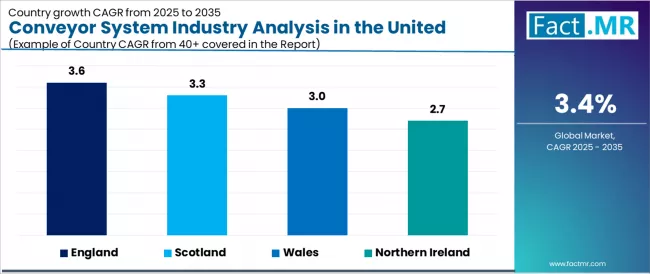
Conveyor System Industry Analysis In The United Kingdom Cagr Analysis By Country | Source: Fact.MR
| Region | CAGR (2025-2035) |
|---|---|
| England | 3.60% |
| Scotland | 3.30% |
| Wales | 3.00% |
| Northern Ireland | 2.70% |
Source: Fact.MR analysis. Updated Nov 19, 2025
The UK conveyor system demand is witnessing steady growth, supported by rising logistics automation requirements, expanding e-commerce initiatives, and the deployment of advanced material handling technologies across regions. England leads the nation with a3.6% CAGR, reflecting progressive logistics trends, substantial distribution innovation, and early adoption of advanced automation systems.
Scotland follows with a3.3% CAGR, driven by extensive distribution infrastructure, favorable logistics demographics, and concentration of specialized operations that enhance system development. Wales grows at3.0%, as logistics modernization and automation opportunities increasingly drive conveyor system deployment. Northern Ireland demonstrates growth at2.7%, supported by expanding distribution facilities and regional logistics initiatives.
England Leads National Growth with Innovation and Logistics Applications
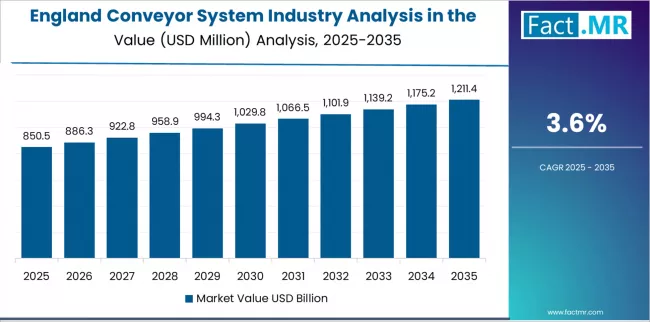
Conveyor System Industry Analysis In The United Kingdom Country Value Analysis | Source: Fact.MR
Demand for conveyor systems in England is projected to exhibit steady growth with a CAGR of3.6%through 2035, driven by progressive distribution preferences, substantial logistics development creating automation opportunities, and concentration of advanced supply chain advancement across London, Birmingham, and Manchester metropolitan areas.
As the dominant region with extensive logistics infrastructure and innovation-focused distribution policies, England's emphasis on comprehensive supply chain excellence and efficiency leadership is creating significant demand for advanced conveyor systems with proven performance and reliable operational potential. Major logistics operators and conveyor system suppliers are establishing comprehensive innovation development programs to support technology advancement and logistics deployment across diverse applications.
- Logistics development trends and efficiency performance preferencesare requiring comprehensive throughput management strategies and automation solutions, driving demand for conveyor systems with demonstrated handling capabilities and permanent performance assurance throughout diverse distribution operations.
- Innovation ecosystem strength and logistics capital availabilityare supporting deployment of next-generation automation technologies and novel application pathways that enhance operational viability, reduce handling risks, and create new market opportunities across e-commerce and manufacturing applications, positioning England as a national industry leadership region.
Scotland Demonstrates Strong Potential with Distribution Infrastructure
Demand for conveyor systems in Scotland is expanding at a CAGR of3.3%, supported by extensive distribution facilities including premium logistics operations, specialty handling, and parcel processing generating concentrated demand favorable for conveyor systems. The region's logistics characteristics, featuring substantial distribution infrastructure and operational requirements ideal for automation integration, provide operational advantages.
Logistics expertise concentrated in Glasgow, Edinburgh, and regional distribution corridors facilitates system development and operations management. Conveyor system suppliers and logistics operators are implementing comprehensive performance strategies to serve expanding efficiency-focused requirements throughout Scotland.
- Distribution concentration and favorable operational economicsare creating opportunities for specialized conveyor system suppliers that can integrate advanced automation systems with existing logistics operations.
- Operational performance positioning and automation awarenessare building regional competitive advantages in logistics applications, enabling comprehensive performance development and distribution cluster enhancement that meets throughput targets while accessing premium logistics opportunities.
Wales Maintains Steady Growth with Logistics Expansion
Demand for conveyor systems in Wales is growing at a CAGR of3.0%, driven by substantial distribution facilities from parcel operations, manufacturing handling venues, and regional logistics consumption requiring advanced automation pathways.
The region's logistics base, supporting critical distribution operations, is increasingly adopting advanced automation technologies to maintain competitiveness while meeting efficiency expectations. Logistics operators and conveyor system suppliers are investing in performance integration systems and regional service infrastructure to address growing operations management requirements.
- Logistics modernization imperatives and operational competitiveness concernsare facilitating adoption of conveyor system technologies that enable continued operations while achieving efficiency enhancement across parcel, manufacturing, and retail distribution operations.
- Logistics performance opportunities including regional automation development and system utilizationfor enhanced distribution operations are creating unique regional advantages and diversified application types throughout Welsh logistics operations.
Northern Ireland Shows Progressive Adoption with Logistics Modernization
Demand for conveyor systems in Northern Ireland is advancing at a CAGR of2.7%, supported by expanding distribution facilities, regional automation development including logistics consumption and operational applications, and growing emphasis on performance solutions across the region.
Logistics modernization and facility expansion are driving consideration of conveyor systems as operational enhancement pathways. Distribution operators and conveyor system suppliers are developing regional capabilities to support emerging performance deployment requirements.
- Logistics expansion and operational diversificationare creating economic drivers for performance technologies and conveyor system deployment across distribution and facility operations seeking competitive differentiation pathways.
- Regional logistics cooperation and coordinated automation developmentare establishing consistent performance environments and shared operational infrastructure that support multi-regional performance projects throughout Northern Ireland distribution operations.
Competitive Landscape of the Conveyor System Industry
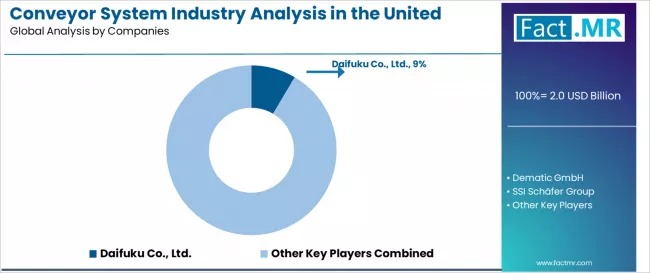
Conveyor System Industry Analysis In The United Kingdom Analysis By Company | Source: Fact.MR
UK conveyor system demand is defined by competition among specialized material handling manufacturers, logistics automation innovation companies, and integrated solution providers, with major industrial corporations maintaining significant influence through engineering resources and system development capabilities. Companies are investing in conveyor system advancement, installation infrastructure optimization, supply chain structures, and comprehensive technical services to deliver effective, reliable, and high-performance logistics solutions across UK distribution and manufacturing applications.
Strategic partnerships, logistics infrastructure development, and first-mover application execution are central to strengthening competitive positioning and presence across system innovation, logistics positioning, and automation integration applications.
Daifuku, internationally recognized logistics automation leader, leads with8.5% share, offering comprehensive conveyor system solutions including product development, standardization, and technical services with focus on distribution applications, system reliability, and performance optimization across UK operations.Dematic, operating with extensive European presence, provides integrated logistics solutions leveraging advanced automation expertise, system development, and operations management capabilities.
SSI Schäferdelivers full-service conveyor system implementation including sourcing development, performance optimization, and logistics integration serving UK and international distribution projects.Vanderlandeemphasizes comprehensive logistics solutions with integrated processing capabilities, specialty systems, and application features leveraging advanced distribution sector expertise.Interrolloffers conveyor system application development and logistics operations for e-commerce and manufacturing applications across UK operations.
UK Conveyor System Industry Analysis - Stakeholder Contribution Framework
The UK conveyor system industry is evolving as a cornerstone of industrial automation, supporting manufacturing efficiency, logistics modernization, and supply chain resilience. With the market projected to exceed significant value driven by e-commerce growth, Industry 4.0 adoption, and demand for energy-efficient operations, growth is fueled by automation mandates, labor optimization, integration of IoT sensors, and smart conveyor solutions for next-generation material handling applications.
The sector's value creation depends on collaborative engagement among government institutions, industry bodies, manufacturers, technology providers, and investors to strengthen domestic manufacturing capacity, secure skilled workforce pipelines, and accelerate innovation across applications from warehouse automation to advanced production lines.
How Governments Could Accelerate Development and Market Competitiveness?
- Automation Adoption Grants: Provide funding and subsidies for SMEs investing in conveyor automation technologies to enhance productivity, reduce operational costs, and improve international competitiveness.
- Industrial Digitalization Tax Incentives: Offer tax credits for companies implementing IoT-enabled, energy-efficient, and data-driven conveyor systems that support the UK's net-zero and digital transformation goals.
- Supply Chain Resilience Programs: Support initiatives for securing the supply of critical components like motors, controllers, and sensors to mitigate import dependence and geopolitical disruptions.
- Standardization and Safety Regulations: Introduce and update UKCA-marked standards for interoperability, cybersecurity in connected systems, and workplace safety for human-robot collaboration environments.
- Skills and Training Initiatives: Fund vocational training and apprenticeship programs focused on mechatronics, robotics, and system integration to build a future-ready workforce for the automation sector.
How Industry Bodies and Associations Could Strengthen Sector Coordination?
- Unified Technical Standards: Develop and promote industry-wide standards for system interoperability, data communication protocols (e.g., OPC UA), and performance metrics to ensure reliability and integration ease.
- Workforce Development and Certification: Create certified training pathways for conveyor system designers, integration specialists, and maintenance engineers to address the skills gap.
- Collaborative Innovation Hubs: Establish forums and consortia that bring together manufacturers, software developers, and end-users to drive innovation in modular design and AI-driven logistics.
- Best Practice Knowledge Repositories: Build centralized databases for case studies, performance benchmarks, and cost-of-ownership data to guide end-user investment decisions.
- Market Outreach and Awareness: Promote the benefits of modern conveyor systems through industry white papers, trade shows, and demonstrations highlighting ROI in efficiency and sustainability.
How Technology and Component Suppliers Could Capture Value and Drive Innovation?
- Advanced Sensor and Control Development: Invest in robust IoT sensors, vision systems, and AI-powered control software that enable predictive maintenance, real-time tracking, and route optimization.
- Modular and Scalable System Design: Develop plug-and-play conveyor modules and flexible platforms that allow for easy reconfiguration and scaling to meet changing operational demands.
- Supply Chain Modernization: Implement digital twins and agile manufacturing processes to ensure timely delivery of custom components and reduce lead times for system integrators.
- Partnership with Research Institutions: Collaborate with universities on advanced materials for belts and components, as well as energy-recovery systems to enhance sustainability.
- Lifecycle and Service Optimization: Introduce remote diagnostics and augmented reality (AR) support tools to minimize downtime and extend the operational lifecycle of installed systems.
How Conveyor Manufacturers and Integrators Could Optimize Production and Expand Demand?
- Smart, Connected System Deployment: Integrate AI-driven analytics, digital twin technology, and cloud monitoring platforms to provide clients with operational insights and maximize system uptime.
- Focus on Niche and Premium Applications: Develop specialized solutions for high-growth sectors like parcel logistics, pharmaceutical handling, and food & beverage, emphasizing hygiene, speed, and sortation accuracy.
- Collaborative Ecosystem Development: Form strategic partnerships with robotics companies, WMS providers, and logistics firms to offer fully integrated, turnkey automation solutions.
- Agile Project Execution Models: Utilize modular designs and phased implementation strategies to reduce installation time, minimize client disruption, and de-risk project scaling.
- Total Cost of Ownership Optimization: Invest in energy-efficient motors, durable materials, and design-for-maintenance principles to lower the long-term operational costs for end-users.
How End-User Industries (Logistics, Manufacturing, Retail) Could Lead Integration and ROI?
- Warehouse and Distribution Center Modernization: Deploy automated sortation systems, autonomous mobile robot (AMR) interfaces, and high-speed conveyor networks to dramatically increase throughput and order accuracy.
- Production Line Enhancement: Integrate custom conveyor solutions in assembly, packaging, and kitting processes to create seamless, just-in-time manufacturing flows.
- Data-Driven Operations Management: Utilize the data generated by smart conveyors for inventory management, bottleneck analysis, and dynamic routing to support continuous improvement.
- Staff Training and Upskilling: Create internal training programs to upskill employees to operate, monitor, and perform basic troubleshooting on advanced conveyor systems.
- Sustainable Operations Initiatives: Optimize conveyor systems with energy-saving modes, regenerative drives, and efficient layout planning to reduce power consumption and environmental impact.
How Investors and Financial Enablers Could Unlock Growth and Technology Scalability?
- Venture Capital for Automation Startups: Support early-stage companies developing innovative conveyor software, robotics integration platforms, and niche material handling solutions.
- Infrastructure and Technology Financing: Provide capital for large-scale warehouse automation projects, retrofitting existing facilities, and upgrading to Industry 4.0-ready conveyor systems.
- Public-Private Investment Platforms: Co-finance testbeds and innovation centers for developing and demonstrating next-generation conveyor technologies in real-world settings.
- Strategic Consolidation Funding: Back mergers and acquisitions that unite specialist conveyor manufacturers with robotics or software firms to create comprehensive automation providers.
- Performance-Linked Financing Models: Offer financing solutions where repayment terms are linked to achieved performance metrics like productivity gains, energy savings, or labor cost reduction.
Key Players in UK Conveyor System Industry Analysis
- Dematic GmbH
- SSI Schäfer Group
- Vanderlande Industries B.V.
- Interroll Holding AG
- Honeywell Intelligrated Inc.
- BEUMER Group GmbH & Co. KG
- TGW Logistics Group GmbH
- Fives Intralogistics S.A.S.
- Bastian Solutions, LLC
- Daifuku Co., Ltd.
Segmentation
Scope of the Report
| Item | Value |
|---|---|
| Quantitative Units | USD 2.72 billion |
| System Type | Belt Conveyors, Roller Conveyors, Overhead/Others |
| End-Use | E-commerce & Parcel, Food & Beverage, Mining/Others |
| Regions Covered | England, Scotland, Wales, Northern Ireland |
| Key Companies | Daifuku Co., Ltd., Dematic GmbH, SSI Schäfer Group, Vanderlande Industries B.V., Interroll Holding AG, Honeywell Intelligrated Inc. |
| Additional Attributes | Sales by system type and end-use categories; regional demand trends across England, Scotland, Wales, and Northern Ireland; competitive landscape with established material handling manufacturers and specialized logistics automation innovators; industry preferences for versatile belt conveyor systems versus modular roller conveyor configurations; integration with e-commerce expansion programs and supply chain optimization policies, particularly advanced in the England region |
Source: Fact.MR analysis. Updated Nov 19, 2025
Conveyor System Industry by Segments
System Type:
- Belt Conveyors
- Roller Conveyors
- Overhead/Others
End-Use:
- E-commerce & Parcel
- Food & Beverage
- Mining/Others
Region:
- England
- Scotland
- Wales
- Northern Ireland
Frequently Asked Questions
How big is the conveyor system industry analysis in the United Kingdom in 2025?
What will be the size of conveyor system industry analysis in the United Kingdom in 2035?
How much will be the conveyor system industry analysis in the United Kingdom growth between 2025 and 2035?
What are the key product types in the conveyor system industry analysis in the United Kingdom?
Which end-use segment to contribute significant share in the conveyor system industry analysis in the United Kingdom in 2025?
Who worked on this report


Preview the report firsthand - request a free sample
Free SampleGet the brochure for pricing and purchase details
Download PDF