- Market Value (2025): USD 5.1 Bn
- Estimated Value (2026): USD 5.7 Bn
- Forecast Value (2036): USD 5.7 Bn
- CAGR (2026-2036): 10.7%
What is the Healthcare Enterprise Content Management ECM Market forecast to be worth by 2036?
USD 5.7 billion in 2026 to USD 15.8 billion by 2036 at 10.7% CAGR.
- The Healthcare Enterprise Content Management ECM market reached USD 5.1 billion in 2025.
- Demand is projected to increase from USD 5.7 billion in 2026 to USD 15.8 billion by 2036.
- The market is forecast to record 10.7% CAGR from 2026 to 2036 as providers organize high-volume healthcare documents under tighter privacy and audit needs.
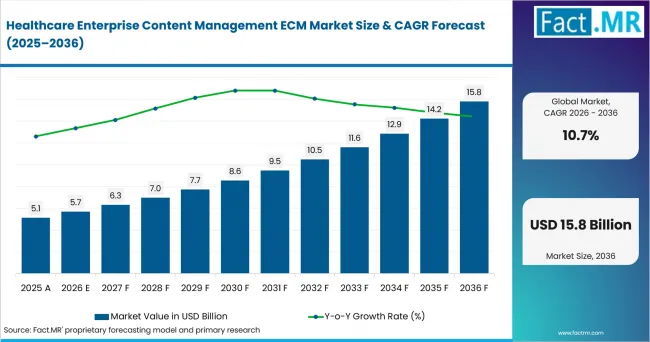
Healthcare Enterprise Content Management Ecm Market Value Analysis | Source: Fact.MR
What are the defining numbers behind Healthcare Enterprise Content Management ECM Market growth?
USD 10.1 billion absolute opportunity by 2036.
- Demand Drivers in the Market
- Healthcare providers need controlled document access because clinical forms and payer records often move across several care and administrative teams.
- Hospitals are expected to prioritize searchable repositories as electronic health records and scanned content continue to work together in daily care operations. The Office of the National Coordinator for Health Information Technology reported in June 2026 that certified EHR adoption among USA non-federal acute care hospitals reached 99% in 2024, adding more digital records for ECM tools to organize.
- Cloud deployment is anticipated to help multi-site provider groups share content without building more local storage at every care location.
- Artificial intelligence-enabled document processing is expected to reduce manual routing when claims files and clinical forms arrive in inconsistent formats.
- Key Segments Analyzed
- By Solution Suite: Document Management is expected to hold 45.0% share in 2026 because providers need one controlled place for clinical and administrative files.
- By Application: Clinical Document Management is projected to account for 43.0% share in 2026 as care teams need reliable access to current patient information.
- By End User: Hospitals are anticipated to capture 41.0% share in 2026 since they handle admissions; billing; consent; and discharge files.
- By Deployment Model: Cloud-based Deployment is estimated to represent 57.0% share in 2026 because provider networks need content access across distributed sites.
- By Core Technology: Artificial Intelligence-enabled Document Processing is forecast to hold 42.0% share in 2026 as automated classification improves file routing and retrieval.
- Analyst Opinion at Fact.MR
- Shambhu Nath Jha, Principal Consultant at Fact.MR, states, “Healthcare ECM demand is moving toward governed content access and not just basic file storage. Providers need systems that make patient documents easier to find and safer to share. Vendors that combine capture with workflow controls and AI-assisted indexing are expected to see stronger buyer attention.”
- Strategic Implications
- Vendors should make clinical document access simple for hospital staff before adding advanced automation features.
- Provider networks should evaluate content governance early so privacy controls are built into workflows from the start.
- Hospitals can reduce manual handling by connecting document capture with downstream review and approval steps.
- Suppliers should show how cloud deployment protects access control across multi-site healthcare systems.
- Implementation partners should prepare migration plans that keep older records usable during phased platform rollouts.
The USA leads at 11.6% CAGR through healthcare IT spending and strict records governance. Germany follows at 11.2% as hospital digitization supports content control. The UK reaches 10.8% through health system modernization. Canada records 10.4% through public healthcare procurement. Australia posts 10.0%; Japan reaches 9.6%; Singapore closes the range at 9.2%.
How does the Healthcare Enterprise Content Management ECM Market break down by segment?
Document Management is expected to lead Solution Suite at 45.0% share in 2026. Clinical Document Management is projected to lead Application at 43.0% share in 2026.
Which Solution Suite dominates?
Document Management is projected to account for 45.0% share in 2026.
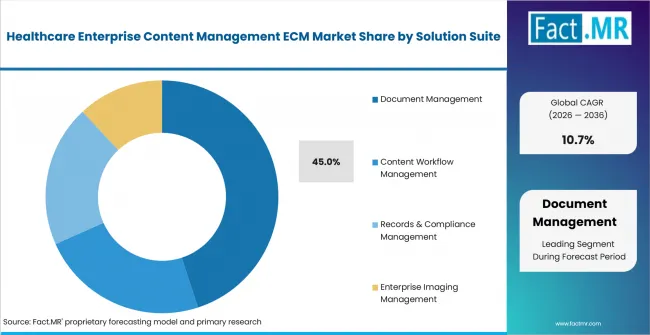
Healthcare Enterprise Content Management Ecm Market Analysis By Solution Suite | Source: Fact.MR
This segment leads because providers need one place for forms and billing files. Content must remain searchable after capture. Buyers are expected to value platforms that support document imaging without adding extra systems. NHS England Digital said in April 2026 that the National Document Repository is being rolled out nationally and lets practices access, view, upload, download, restore versions, and restrict staff access to patient Lloyd George records.
What leads the Application segment?
Clinical Document Management is expected to hold 43.0% share in 2026.
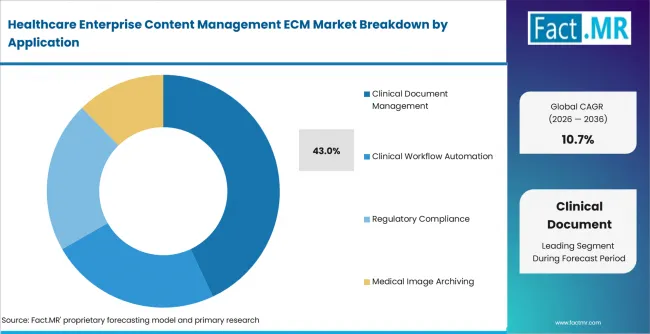
Healthcare Enterprise Content Management Ecm Market Analysis By Application | Source: Fact.MR
Care teams depend on current documents during intake and discharge. The application reduces manual handoffs when files need review. It also prevents confusion when older versions remain in storage. NHS England Digital reported that 93.0% of providers used Electronic Patient Records during April 2025 to June 2025, while 90.0% had a central data repository.
How does the End User segment shape demand?
Hospitals are anticipated to represent 41.0% share in 2026.
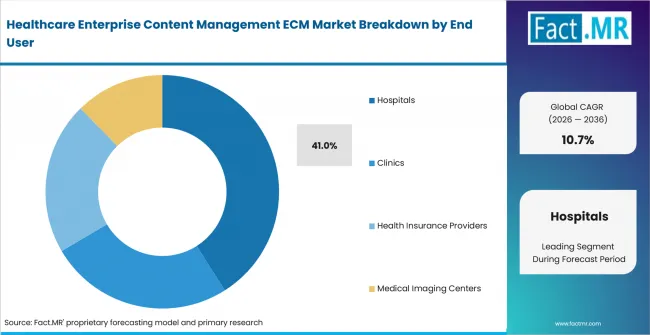
Healthcare Enterprise Content Management Ecm Market Analysis By End User | Source: Fact.MR
Hospitals handle the widest document mix in the market. Patient forms and billing records need consistent filing rules. This makes ECM useful for healthcare business intelligence across departments.
What supports Cloud-based Deployment?
Cloud-based Deployment is estimated to hold 57.0% share in 2026.
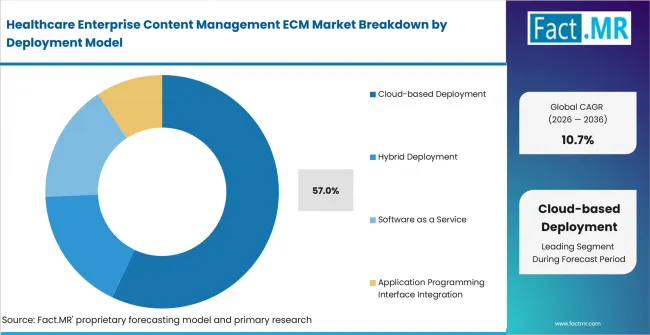
Healthcare Enterprise Content Management Ecm Market Analysis By Deployment Model | Source: Fact.MR
Provider networks need content access across hospitals and clinics. Cloud deployment can reduce local infrastructure pressure. Buyers still ask for clear privacy controls before hosted rollouts. The Australian Digital Health Agency reported that pathology and diagnostic imaging report uploads to My Health Record rose 105.0% to more than 5.0 million weekly uploads as of 7 June 2026, with consumer views rising to more than 3.0 million weekly views.
Why does Artificial Intelligence-enabled Document Processing lead Core Technology?
Artificial Intelligence-enabled Document Processing is forecast to account for 42.0% share in 2026.
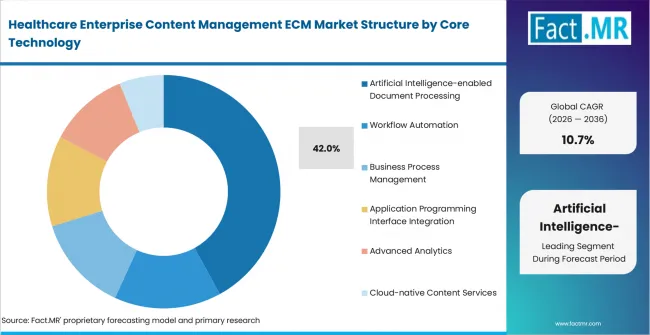
Healthcare Enterprise Content Management Ecm Market Analysis By Core Technology | Source: Fact.MR
Automated classification helps staff route files with fewer manual steps. Better metadata improves knowledge management and search for care coordination. Similar traceability needs appear in enterprise laboratory informatics.
What is accelerating Healthcare Enterprise Content Management ECM Market adoption, and what is holding it back?
Demand is expected to rise through document volume and records governance. Growth may be limited by migration cost and older hospital systems.
Drivers Impact Analysis
| DRIVER | IMPACT ON CAGR | GEOGRAPHIC RELEVANCE | IMPACT TIMELINE |
|---|---|---|---|
| Clinical document volume | High | North America and Europe | Short term (<= 2 years) |
| Records governance and audit needs | Medium-High | Regulated healthcare systems | Short term (<= 2 years) |
| Cloud access across provider networks | High | Global | Medium term (2-4 years) |
| AI-assisted document routing | Medium | North America, Europe, and Asia Pacific | Medium term (2-4 years) |
| Workflow connection with EHR systems | Medium | Hospitals and care networks | Long term (>= 4 years) |
Source: Fact.MR analysis. Updated Aug 10, 2026
- Clinical document volume: Hospitals are expected to need ECM platforms when scanned forms and electronic files increase across admission and discharge workflows.
- Records governance and audit needs: Compliance teams place value on controlled repositories because file history must remain visible during privacy reviews.
- Cloud access across provider networks: Multi-site care systems are anticipated to favor hosted content services when staff need secure access across locations.
Opportunity Impact Analysis
| OPPORTUNITY | IMPACT ON CAGR | GEOGRAPHIC RELEVANCE | IMPACT TIMELINE |
|---|---|---|---|
| AI document classification | Medium-High | USA, Germany, UK | Medium term (2-4 years) |
| Cloud workflow expansion | Medium | Canada, Australia, Singapore | Medium term (2-4 years) |
| Interoperability support | Medium | North America and Europe | Long term (>= 4 years) |
| Mobile content review | Low-Medium | Distributed care networks | Long term (>= 4 years) |
Source: Fact.MR analysis. Updated Aug 10, 2026
- AI document classification: Vendors can create value when indexing reduces manual review without weakening approval control.
- Cloud workflow expansion: Hosted platforms are expected to create opportunity where provider networks need one content layer across several facilities.
- Interoperability support: ECM systems can gain relevance when they connect care documents with accountable care and referral workflows.
Restraints Impact Analysis
| RESTRAINT | IMPACT ON CAGR | GEOGRAPHIC RELEVANCE | IMPACT TIMELINE |
|---|---|---|---|
| Legacy system integration | Medium | Hospitals with older IT estates | Short term (<= 2 years) |
| Migration cost and staff training | Medium | Developing and mid-sized markets | Medium term (2-4 years) |
| Privacy and access-control risk | Medium | Global | Medium term (2-4 years) |
| Vendor lock-in concerns | Low-Medium | Large provider groups | Long term (>= 4 years) |
Source: Fact.MR analysis. Updated Aug 10, 2026
- Legacy system integration: Hospitals may delay projects when older repositories must remain active during migration.
- Migration cost and staff training: New ECM systems require careful change management because staff need simple routes for capture and retrieval.
- Privacy and access-control risk: Buyers are expected to slow purchases when vendors cannot explain role-based access in clear operational terms.
Which countries are scaling Healthcare Enterprise Content Management ECM Market fastest?
- The country comparison spans 2.4 percentage points and forms a steady growth range across the forecast period.
- The USA remains 0.4 percentage point above Germany through healthcare IT spending and strict records governance.
- Germany remains 0.4 percentage point above the UK as hospital digitization supports enterprise content control.
- The UK remains 0.4 percentage point above Canada through national health system modernization and clinical documentation coordination.
- Canada remains 0.4 percentage point above Australia as public healthcare procurement supports structured content platforms.
- Australia remains 0.4 percentage point above Japan through digital health programs and provider-network modernization.
- Japan remains 0.4 percentage point above Singapore through aging-care documentation needs and healthcare technology adoption.
Comparable CAGRs can create different entry conditions because procurement rules differ across markets. Full report coverage includes North America; Europe; Asia Pacific; Latin America; Middle East and Africa.
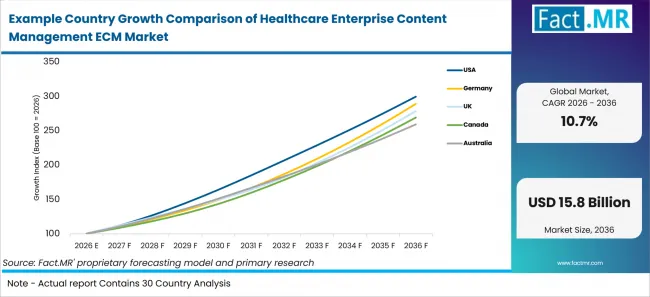
Example Country Growth Comparison Of Healthcare Enterprise Content Management Ecm Market | Source: Fact.MR
| Country | CAGR (2026-2036) |
|---|---|
| USA | 11.6% |
| Germany | 11.2% |
| UK | 10.8% |
| Canada | 10.4% |
| Australia | 10.0% |
| Japan | 9.6% |
| Singapore | 9.2% |
Source: Fact.MR analysis. Updated Aug 10, 2026
What supports USA adoption?
11.6% CAGR, supported by healthcare IT spending and an advanced regulatory framework.
Large USA hospital networks evaluate ECM tools through retrieval speed and audit control. Clinical forms and payer files must move across departments without losing history. Vendors are expected to compete on security settings and EHR integration.
How is Germany scaling demand?
11.2% CAGR, led by its structured healthcare system and medical technology base.
German providers place high value on orderly clinical records. Hospital digitization is expected to raise demand for searchable repositories. Adoption may move carefully when older systems require staged migration. Germany’s Federal Ministry of Health said the 2025 ePA rollout covers around 73.0 million people with statutory health insurance, creating a wider base of digital patient files.
What is driving the UK’s growth from 2026 to 2036?
10.8% CAGR, driven by the national health system and clinical research infrastructure.
UK care networks need document workflows across hospitals and community settings. Clinical teams benefit when referral papers are easy to find. Procurement is expected to favor platforms that fit existing care pathways.
How is Canada developing demand?
10.4% CAGR, backed by universal healthcare and pharmaceutical innovation.
Canada’s demand reflects public healthcare delivery across provincial systems. Providers are expected to seek tools that protect privacy and reduce paper handling. Project timing may depend on procurement cycles.
How does Australia perform?
10.0% CAGR, supported by an advanced healthcare system and clinical research activity.
Australian care networks need secure content access across hospitals and distributed teams. ECM platforms are expected to reduce repeated manual searches. Cloud deployment may appeal where local infrastructure budgets are tight.
What supports Japan’s growth?
9.6% CAGR, led by aging population needs and healthcare technology adoption.
Japan’s market is influenced by documentation needs across hospitals and long-term care. Buyers are expected to favor reliable systems for patient records and referrals. Platform changes may remain gradual.
How is Singapore building market demand?
9.2% CAGR, driven by its role as a regional healthcare hub.
Singapore’s healthcare market needs secure workflows across hospitals and specialist providers. ECM systems are expected to support patient files and administrative records. Buyers are likely to value fast implementation and compliance clarity. Singapore’s Ministry of Health said in February 2025 that HealthHub’s annual operating cost is about SGD 18.0 million and later said the national HealthHub and three cluster apps are planned to be consolidated into one app by 2027.
Who leads the Healthcare Enterprise Content Management ECM Market?
OpenText Corporation and Hyland Software, Inc. show direct relevance through enterprise content and OnBase workflows. Oracle Corporation; Microsoft Corporation; and IBM Corporation add healthcare cloud and automation capabilities. Laserfiche; Box, Inc.; and FUJIFILM Business Innovation Corporation broaden the provider field.
Competition is expected to center on secure repositories and workflow automation. OpenText supports enterprise content management at scale. Oracle Health adds data exchange tools. Microsoft and IBM bring cloud and AI resources. M-Files improves Microsoft 365 document management. Laserfiche adds AI agents. Box and FUJIFILM Business Innovation support content capture. OpenText launched Cloud Editions 25.3 in July 2025 with Core Content updates including zero-downtime patching, advanced workflow automation, a modernized user interface, and intelligent capture tools.
Which companies are the key providers?
Key companies include OpenText Corporation; Hyland Software, Inc.; Oracle Corporation; Microsoft Corporation; IBM Corporation; Laserfiche; Box, Inc.; and FUJIFILM Business Innovation Corporation.
- OpenText Corporation
- Hyland Software, Inc.
- Oracle Corporation
- Microsoft Corporation
- IBM Corporation
- Laserfiche
- Box, Inc.
- FUJIFILM Business Innovation Corporation
Bibliography
- Centers for Medicare & Medicaid Services. (2026, June 24). NHE fact sheet.
- Hyland Software, Inc. (2025, December 4). Release overview.
- Oracle Corporation. (2025, October 9). Health systems simplify secure data exchange with Oracle Health.
- IBM. (2025, December). What’s new in 25.0.1. IBM documentation explicitly identifies 25.0.1 as having general availability in December 2025.
- Laserfiche. (2026, April 28). Laserfiche introduces AI agents: The future of intelligent content management.
- IBM Corporation. (2025, April 29). Box and IBM partner to bring new enterprise-level AI models to support content generation and productivity.
- FUJIFILM Business Innovation Corporation. (2025, September 22). FUJIFILM Business Innovation launches Generative AI-powered “FUJIFILM IWpro Intelligent Data Capture Option” to digitize non-standard business forms.
- NHS England Digital. (2026, March 27). Digital Maturity Assessment report 2024 and 2025 results.
- Australian Digital Health Agency. (2026, July 8). Australians already seeing the benefits of sharing health information by default.
- Ministry of Health. (2025, February 18). Annual cost to maintain various healthcare apps.
This Report Answers
- The report provides strategic intelligence on Healthcare Enterprise Content Management ECM across Solution Suite and Application choices.
- Segment analysis covers Document Management and Clinical Document Management as the share leaders within the 2026 market.
- Country outlook evaluates the USA and Germany alongside the UK and Canada. Australia; Japan; and Singapore complete the comparison.
- Competitive analysis profiles OpenText and Hyland alongside Oracle; Microsoft; and IBM. M-Files; Laserfiche; Box; and FUJIFILM Business Innovation complete the provider set.
- Technology assessment covers AI-enabled document processing and Optical Character Recognition. Workflow Automation and Content Analytics complete the technology view.
What does the Healthcare Enterprise Content Management ECM Market cover?
Healthcare ECM systems manage clinical and administrative documents where access control and retrieval quality affect provider work.
The Healthcare Enterprise Content Management ECM Market covers platforms used by hospitals; clinics; diagnostic centers; payers; and long-term care providers. Coverage extends to document and records management. Workflow management and capture are included where healthcare documents need life-cycle control.
What is included in the scope?
Healthcare ECM systems are used across hospitals and clinics. Diagnostic centers and payers are also included.
The scope includes Solution Suite and Application alongside End User; Deployment Model; and Core Technology. Coverage spans clinical document management and revenue cycle documentation. It includes cloud-based; on-premise; and hybrid deployment. AI-enabled document processing and OCR are included.
What is excluded from the scope?
General business content platforms remain outside the scope when they are not configured for healthcare documentation or provider workflows.
The scope excludes generic storage tools without healthcare document control. It excludes standalone collaboration apps without records governance. General imaging hardware is excluded unless demand depends on healthcare document capture.
How Was the Analysis Built?
The analysis draws on 120+ sources, 35+ company portfolios, 25+ countries, and more than 20 interviews.
- Primary Research: Interviews with manufacturers, retailers, salon operators, and experts examine purchase priorities, adoption, approval requirements, and competitive positioning.
- Desk Research: Desk research covers government statistics, regulatory publications, company filings, trade data, technical studies, industry associations, standards, and public policy.
- Market Sizing and Forecasting: Estimates combine historical performance, demand indicators, pricing, segment shares, company participation, country growth, adoption patterns, and barriers to expansion.
- Data Validation and Update Cycle: Findings are validated against public data, company activity, regulatory changes, product launches, recalls, and adoption shifts.
Segmentation
What is the report’s scope and coverage?
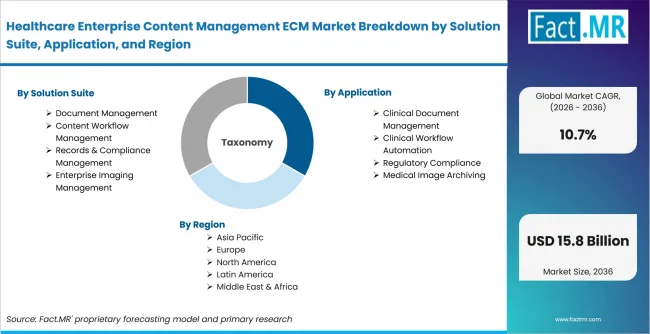
Healthcare Enterprise Content Management Ecm Market Breakdown By Solution Suite, Application, And Region | Source: Fact.MR
| Attribute | Details |
|---|---|
| Quantitative Units | USD billion |
| Market Definition | Healthcare ECM systems used to capture, secure, retrieve, and govern clinical or administrative documents |
| Solution Suite | Document Management; Records Management; Workflow Management; Case Management; Capture and Imaging |
| Application | Clinical Document Management; Revenue Cycle Documentation; Patient Records Management; Compliance and Audit Management |
| End User | Hospitals; Clinics; Diagnostic Centers; Payers; Long-term Care Providers |
| Deployment Model | Cloud-based Deployment; On-premise Deployment; Hybrid Deployment |
| Core Technology | Artificial Intelligence-enabled Document Processing; Optical Character Recognition; Workflow Automation; Content Analytics; Secure Access Control |
| Regions Covered | North America; Europe; Asia Pacific; Latin America; Middle East and Africa |
| Countries Covered | USA; Germany; UK; Canada; Australia; Japan; Singapore |
| Key Companies Profiled | OpenText Corporation; Hyland Software, Inc.; Oracle Corporation; Microsoft Corporation; IBM Corporation; Laserfiche; Box, Inc.; FUJIFILM Business Innovation Corporation |
| Forecast Period | 2026 to 2036 |
| Approach | Hybrid approach using healthcare IT spending; document workflows; cloud needs; AI document processing; country growth; and company portfolio review |
Source: Fact.MR analysis. Updated Aug 10, 2026
How is the market segmented?
-
By Solution Suite
- Document Management
- Enterprise Document Repository
- Medical Record Archiving
- Content Workflow Management
- Business Process Automation
- Content Collaboration
- Records & Compliance Management
- Records Retention Management
- Legal Hold Management
- Enterprise Imaging Management
- Vendor Neutral Archive
- Clinical Image Repository
- Document Management
-
By Application
- Clinical Document Management
- Electronic Health Record Documentation
- Patient Record Management
- Clinical Workflow Automation
- Referral & Care Coordination
- Claims & Billing Documentation
- Regulatory Compliance
- HIPAA Compliance
- Medical Audit Preparation
- Medical Image Archiving
- Diagnostic Image Management
- Multi-specialty Imaging
- Clinical Document Management
-
By End User
- Hospitals
- Integrated Health Systems
- Academic Medical Centers
- Clinics
- Diagnostic Centers
- Ambulatory Surgical Centers
- Health Insurance Providers
- Public Healthcare Organizations
- Regulatory Authorities
- Medical Imaging Centers
- Radiology Departments
- Pathology Laboratories
- Hospitals
-
By Deployment Model
- Cloud-based Deployment
- Public Cloud
- Private Cloud
- Hybrid Deployment
- On-premises Deployment
- Edge-enabled Infrastructure
- Software as a Service
- Managed Services
- Multi-tenant Platform
- Application Programming Interface Integration
- Low-code Integration
- Enterprise System Integration
- Cloud-based Deployment
-
By Core Technology
- Artificial Intelligence-enabled Document Processing
- Natural Language Processing
- Intelligent Document Recognition
- Workflow Automation
- Business Process Management
- Application Programming Interface Integration
- Advanced Analytics
- Digital Audit Trails
- Information Governance Analytics
- Cloud-native Content Services
- Vendor-neutral Image Management
- Artificial Intelligence-assisted Image Classification
- Artificial Intelligence-enabled Document Processing
-
By Region
- North America
- Latin America
- Europe
- East Asia
- South Asia and Oceania
- Middle East and Africa
Frequently Asked Questions
How big is the healthcare enterprise content management ECM market in 2026?
What is the CAGR of the healthcare enterprise content management ECM market from 2026 to 2036?
The healthcare enterprise content management ECM market is projected to grow at a CAGR of 10.7% between 2026 and 2036, supported by rising clinical document volumes, stronger records governance and wider cloud-based content access.
Which application leads the healthcare enterprise content management ECM market?
Clinical Document Management accounts for 43.0% of the healthcare enterprise content management ECM market by application in 2026, reflecting the need for reliable access to current patient documents across intake, care and discharge workflows.
Who worked on this report


Preview the report firsthand - request a free sample
Free SampleGet the brochure for pricing and purchase details
Download PDF