V2X Bidirectional EV Charger Market (2026 - 2036)

The Global V2X Bidirectional EV Charger Market is segmented by Charger Type (AC Charger, DC Charger), Power Output (Up to 10 kW, 10–20 kW, 20–50 kW, Above 50 kW), Application (Vehicle-to-Grid (V2G), Vehicle-to-Home (V2H), Vehicle-to-Building (V2B), Vehicle-to-Vehicle (V2V), Vehicle-to-Everything (V2X – Integrated)), End User (Residential, Commercial, Utilities, Fleet Operators), and Region, with forecasts covering the period from 2026 to 2036.

Core Findings

    V2X Bidirectional EV Charger Market Forecast 2026 to 2036

    In 2025, the global V2X bidirectional EV charger market was valued at USD 884 million. Based on Fact.MR's analysis, demand for V2X bidirectional EV chargers is projected to reach USD 1,03250 million in 2026 and USD 4,103 million by 2036. Fact.MR projects a CAGR of 14.8% during the forecast period.

    The absolute dollar growth from 2026 to 2036 is projected at USD 3,071 million. This expansion is primarily driven by accelerating EV penetration, rising grid modernization investments, and increasing deployment of bidirectional charging to support renewable energy integration and distributed energy resource (DER) management. Growing demand for vehicle-to-grid (V2G) services, residential energy backup (V2H), and fleet-based energy optimization is strengthening global adoption. Utility-driven pilot programs, dynamic tariff structures, and advancements in smart energy management platforms are improving commercial viability. However, high upfront infrastructure costs, limited vehicle compatibility, regulatory fragmentation, and grid interconnection complexities remain key constraints.
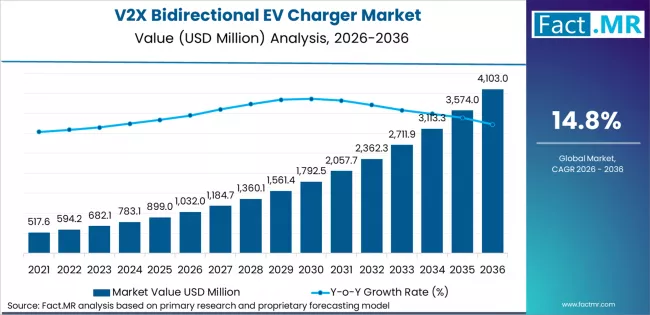
    V2x Bidirectional Ev Charger Market Market Value Analysis

    Among leading countries, the U.S. grows at a CAGR of 15.6%, supported by federal incentives, fleet electrification, and large-scale V2G pilots. China records 15.2%, driven by rapid EV adoption and strong state-backed grid integration programs. The U.K. expands at 15.4%, reflecting advanced smart grid infrastructure and residential V2H adoption. Germany posts 15.0%, supported by renewable energy balancing needs and regulatory support for bidirectional charging. Japan grows at 14.8%, backed by disaster-resilient energy systems and vehicle-to-home deployment. India leads alongside the U.S. at 14.5%, fueled by expanding EV infrastructure, smart city initiatives, and utility modernization efforts.

    V2X Bidirectional EV Charger Market Definition

    The V2X bidirectional EV charger market comprises technologies, hardware systems, software platforms, and related services that enable two-way power flow between electric vehicles (EVs) and external energy systems. Unlike conventional unidirectional chargers, bidirectional chargers allow electricity to flow from the grid to the vehicle and back from the vehicle battery to homes, buildings, or the grid, supporting distributed energy management and grid stabilization.

    This market includes AC and DC bidirectional charging equipment, integrated power electronics, energy management systems (EMS), communication controllers, and interoperability software that enable Vehicle-to-Grid (V2G), Vehicle-to-Home (V2H), Vehicle-to-Building (V2B), Vehicle-to-Vehicle (V2V), and integrated Vehicle-to-Everything (V2X) applications. Supporting components include inverters, converters, control units, smart metering interfaces, and cloud-based monitoring platforms.

    V2X Bidirectional EV Charger Market Inclusions

    The market comprises AC and DC bidirectional charging systems, integrated power electronics (inverters, converters, controllers), smart meters, and communication modules that enable two-way power flow between EVs and energy systems.

    V2X Bidirectional EV Charger Market Exclusions

    The scope excludes conventional unidirectional EV chargers that do not support two-way power flow, as well as public charging infrastructure limited solely to grid-to-vehicle energy transfer.

    V2X Bidirectional EV Charger Research Methodology

    • Primary Research
      • In-depth interviews were conducted with bidirectional EV charger manufacturers, power electronics suppliers, energy management software providers, automotive OEMs, utility companies, and charging infrastructure integrators across key regions. Discussions also included fleet operators, residential energy solution providers, regulatory authorities, and grid operators to validate adoption trends, pricing structures, interoperability standards, policy incentives, vehicle compatibility developments, and application-specific demand across V2G, V2H, V2B, and fleet-based energy optimization use cases.
    • Desk Research
      • The study leveraged company annual reports, investor presentations, regulatory publications, EV infrastructure reports, and energy transition policy documents to assess technological advancements and competitive positioning within the bidirectional charging ecosystem. Publicly available data on EV adoption rates, smart grid initiatives, renewable energy integration targets, vehicle compatibility developments, utility pilot programs, and government incentive schemes were also analyzed to evaluate overall market dynamics, deployment trends, and long-term growth outlook for V2X applications.
    • Market‑Sizing and Forecasting
      • A hybrid approach combining bottom-up revenue analysis of leading bidirectional EV charger manufacturers and energy management solution providers with top-down benchmarking of the broader EV charging infrastructure and smart grid industries was employed.
    • Data Validation and Update Cycle
      • Findings were cross-verified through triangulation of primary interviews, industry reports, regulatory frameworks, EV infrastructure databases, and utility deployment data to ensure accuracy and consistency.

    V2X Bidirectional EV Charger Market Summary

    • Market Definition
      • The V2X Bidirectional EV Charger market comprises technologies, hardware systems, software platforms, and services that enable two-way power flow between electric vehicles and external energy systems. It includes AC and DC bidirectional chargers, integrated power electronics, communication controllers, and energy management software that facilitate Vehicle-to-Grid (V2G), Vehicle-to-Home (V2H), Vehicle-to-Building (V2B), Vehicle-to-Vehicle (V2V), and integrated V2X applications across residential, commercial, fleet, and utility environments.
    • Demand Drivers
      • Accelerating EV Adoption and Grid Modernization Initiatives: Rapid growth in electric vehicle penetration, combined with investments in smart grid infrastructure and distributed energy resource (DER) integration, is driving demand for bidirectional charging systems that support grid balancing, peak shaving, and energy resilience.
      • Rising Need for Renewable Energy Integration and Energy Resilience: Increasing deployment of solar and wind power is creating demand for flexible storage solutions, with V2G and V2H technologies enabling EV batteries to function as distributed storage assets for backup power and demand response programs.
      • Advancements in Power Electronics and Energy Management Software: Improvements in high-efficiency inverters, battery management integration, OCPP-based communication standards, and AI-driven load optimization platforms are enhancing interoperability, cost efficiency, and scalability, supporting broader adoption across utilities, commercial fleets, and residential users.
    • Key Segments
      • By Charger Type: DC Chargers lead the market, accounting for approximately 55–60% of total revenue share. Their dominance is driven by higher power output capability, suitability for commercial and fleet-based V2G applications, faster energy discharge rates, and stronger alignment with grid-scale and utility-driven deployments compared to AC systems.
      • By Power Output: The 20–50 kW segment dominates, holding around 30–35% share, supported by its optimal balance between residential-commercial scalability and grid interaction capability.
      • By Geography: Asia Pacific is the leading region, supported by rapid EV adoption in China and Japan, strong government-backed smart grid initiatives, large-scale renewable energy integration programs, and expanding public and private investments in bidirectional charging infrastructure.
    • Regional Outlook
      • China: Expected to grow at a CAGR of 15.2%, driven by rapid EV adoption, strong state-backed investments in smart grid infrastructure, and large-scale deployment of renewable energy projects requiring grid balancing solutions.
      • USA: Anticipated to grow at a CAGR of 14.5%, supported by federal and state-level incentives for EV infrastructure, expanding fleet electrification, and increasing participation of utilities in V2G and demand response programs.
      • Japan: Projected to expand at a CAGR of 14.8%, reflecting steady deployment of vehicle-to-home (V2H) systems and disaster-resilient energy solutions.
    • Analyst Opinion
      • The V2X Bidirectional EV Charger market is on a strong growth trajectory, driven by accelerating EV adoption, increasing renewable energy integration, and growing emphasis on grid resilience and distributed energy management. Demand is particularly robust in technologically advanced and policy-driven economies, where utilities and governments are prioritizing smart grid modernization, vehicle-to-grid (V2G) deployment, and decentralized storage solutions to support energy transition goals.
    • Strategic Insights
      • Technology Advancement and Cost Optimization: As competition intensifies, bidirectional EV charger manufacturers are increasingly investing in high-efficiency power electronics, advanced inverter architectures, and AI-enabled energy management platforms to enhance conversion efficiency, improve interoperability with multiple EV models, and reduce total system costs.
      • Regional Dynamics: Asia-Pacific remains the most dynamic and volume-driven market, supported by rapid EV penetration, strong government-backed smart grid programs, expanding renewable energy capacity, and large-scale infrastructure investments in countries such as China and Japan.

    Segmental Analysis

    V2X Bidirectional EV Charger Market Analysis by Charger Type
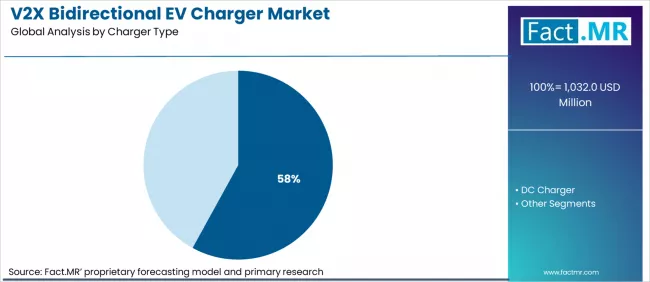
    V2x Bidirectional Ev Charger Market Analysis By Charger Type

    • Market Overview: DC Chargers are projected to account for approximately 55–60% of the market share by 2026, making them the leading charger type segment. These systems are designed to support higher power transfer rates, faster energy discharge, and efficient grid interaction, making them particularly suitable for commercial, fleet, and utility-scale V2G deployments compared to AC bidirectional chargers, which are more common in residential settings.
    • Demand Drivers:
      • Growth in Fleet and Commercial Electrification: Increasing electrification of public transport, logistics fleets, and commercial vehicles is driving demand for high-power DC bidirectional chargers capable of handling large energy volumes and participating in demand response programs.
      • Grid Stabilization and Renewable Integration Needs: Utilities are adopting DC-based V2G infrastructure to manage peak loads, frequency regulation, and renewable energy intermittency, strengthening demand for higher-capacity systems.
      • Advancements in Power Electronics and Efficiency: Improvements in inverter technology, battery management integration, and grid compliance standards are enhancing the performance, reliability, and interoperability of DC bidirectional charging solutions, accelerating adoption across developed markets.

    V2X Bidirectional EV Charger Market Analysis by Power Output
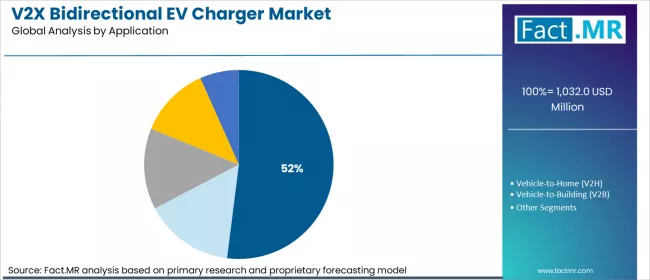
    V2x Bidirectional Ev Charger Market Analysis By Application

    • Market Overview: DC Chargers are expected to capture approximately 55–60% of the market share by 2026, making them the leading charger type segment in the V2X bidirectional EV charger market. DC systems enable direct current flow between the vehicle battery and the grid, allowing faster energy transfer, higher discharge capacity, and improved efficiency for commercial, fleet, and utility-scale V2G deployments.
    • Demand Drivers:
      • High Power Delivery & Grid Participation Capability: DC chargers support higher kW ratings and rapid energy export, making them ideal for frequency regulation, peak shaving, and demand response programs.
      • Commercial and Fleet Electrification Growth: Expansion of electric bus fleets, logistics vehicles, and commercial EV hubs is accelerating demand for DC bidirectional chargers capable of handling larger battery capacities.
      • Improved Conversion Efficiency & Interoperability: Advancements in inverter architecture, battery management system (BMS) integration, and compliance with evolving grid standards are enhancing system efficiency and compatibility, supporting broader adoption across developed and emerging markets.

    Key Dynamics

    V2X Bidirectional EV Charger Market Drivers, Restraints, and Opportunities

    FMR analysts observe that the V2X Bidirectional EV Charger market represents a strategically expanding segment within the broader EV charging and smart grid ecosystem, closely linked to advancements in power electronics, renewable energy integration, and grid digitalization initiatives. Historically, EV charging infrastructure was designed for unidirectional energy flow, however, the shift toward bidirectional architectures enabling Vehicle-to-Grid (V2G), Vehicle-to-Home (V2H), and Vehicle-to-Building (V2B) applications is accelerating adoption across utilities, commercial fleets, and residential users seeking energy resilience and distributed storage capabilities.

    The 2026 valuation reflects sustained investment in high-efficiency DC charging platforms, intelligent energy management systems, and AI-enabled load optimization tools by leading infrastructure providers and utilities.

    • Interoperability & Grid Standardization Imperative: Growing emphasis on harmonized charging standards, OCPP-enabled communication protocols, and vehicle-grid interoperability frameworks is driving collaboration among OEMs, utilities, regulators, and charging solution providers to ensure seamless integration and grid compliance.
    • Cost Optimization & Scalable Infrastructure Deployment: Advances in inverter efficiency, modular charger design, and battery management integration are reducing system costs and improving return on investment, enabling wider adoption across commercial, fleet, and residential markets.
    • Energy Transition & Policy-Driven Expansion in Emerging Economies: Rapid EV adoption and renewable energy expansion in markets such as China and India are accelerating bidirectional charger deployment, while North America and Europe focus on grid resilience, demand response participation, and regulatory frameworks supporting distributed energy resource integration.

    Regional Analysis

    The market analysis covers key global regions, including South Asia and Pacific, Middle East & Africa, North America, Latin America, Western Europe, and Eastern Europe. It is segmented geographically, with specific market dynamics for each region. The full report provides a detailed market attractiveness analysis.
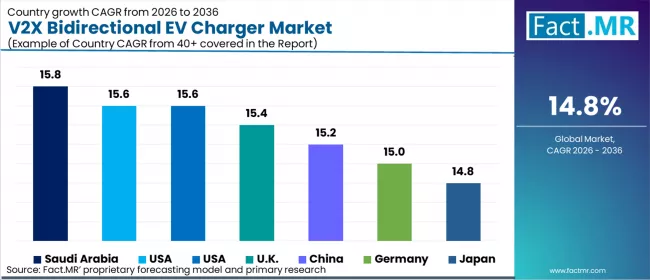
    V2x Bidirectional Ev Charger Market Cagr Analysis By Country

    Country CAGR (%)
    India 15.6%
    U.K. 15.4%
    USA 14.5%
    Japan 14.8%
    KSA 15.8%
    China 15.2%
    Germany 15.0%
    France 15.6%

    Source: Fact.MR (FMR) analysis, based on proprietary forecasting model and primary research.

    South Asia and Pacific:

    South Asia and Pacific is emerging as a high-growth region for the V2X Bidirectional EV Charger market, supported by rapid EV adoption, expanding renewable energy capacity, and strong government investment in smart grid modernization programs across China, India, and Japan.

    • India: Demand for V2X bidirectional EV chargers in India is projected to rise at a CAGR of 15.6% through 2036. Growth is driven by accelerating EV penetration, smart city initiatives, expanding rooftop solar adoption, and increasing focus on grid stability and distributed energy storage solutions.
    • China: Demand for V2X bidirectional EV chargers in China is projected to rise at a CAGR of 15.2% through 2036. Strong state-backed EV infrastructure programs, rapid renewable energy integration, and large-scale V2G pilot deployments are supporting sustained market expansion.
    • Japan: Demand for V2X bidirectional EV chargers in Japan is projected to rise at a CAGR of 14.8% through 2036. Growth is supported by established vehicle-to-home (V2H) adoption, disaster-resilient energy planning, advanced battery technologies, and increasing collaboration between automotive OEMs and utilities to expand grid-interactive charging networks.

    Middle East & Africa:

    The Middle East & Africa represents an emerging growth region for the V2X Bidirectional EV Charger market, driven by increasing investments in renewable energy projects, smart city developments, and gradual expansion of EV infrastructure across Gulf and select African economies.

    • Saudi Arabia Demand for V2X bidirectional EV chargers in Saudi Arabia is projected to rise at a CAGR of 15.8% through 2036. Growth is supported by Vision 2030 sustainability objectives, large-scale renewable energy projects, smart grid modernization programs, and expanding investments in electric mobility infrastructure and commercial fleet electrification.
    • UAE: Demand for V2X bidirectional EV chargers in the UAE is projected to grow steadily through 2036, driven by strong clean energy targets, rapid EV adoption initiatives, smart city programs, and increasing focus on vehicle-to-grid (V2G) participation to enhance grid stability and distributed energy integration.

    North America:
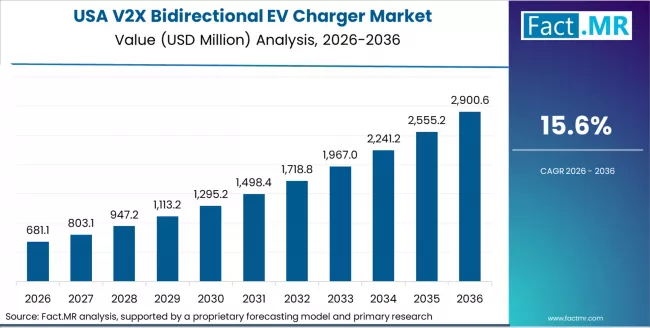
    V2x Bidirectional Ev Charger Market Country Value Analysis

    North America represents a mature yet innovation-driven market for the V2X Bidirectional EV Charger industry, characterized by advanced EV infrastructure, strong policy support for grid modernization, and early adoption of vehicle-to-grid (V2G) technologies.

    • USA: Demand for V2X bidirectional EV chargers in the U.S. is projected to rise at a CAGR of 14.5% through 2036. Growth is primarily driven by federal and state-level EV infrastructure incentives, expanding fleet electrification, rising participation in grid services markets, and sustained investment in smart energy management platforms and AI-enabled load optimization systems rather than purely new infrastructure rollout.

    Latin America:

    Latin America represents a developing growth market for the V2X Bidirectional EV Charger industry, supported by expanding EV adoption, increasing renewable energy integration, and gradual modernization of grid infrastructure across key economies in the region. Governments are focusing on decarbonization targets, urban air quality improvement, and distributed energy resource development, creating emerging opportunities for bidirectional charging deployment in residential and commercial applications.

    • Brazil: Demand for V2X bidirectional EV chargers in Brazil is projected to rise at a CAGR of 15.3% through 2036. Growth is driven by expanding electric mobility initiatives, rising investments in solar and wind energy projects, increasing interest in vehicle-to-grid (V2G) programs for peak load management, and growing collaboration between utilities and infrastructure providers to enhance grid flexibility and energy resilience.

    Western Europe:

    Western Europe represents a technologically advanced and regulation-driven market for the V2X Bidirectional EV Charger industry, supported by aggressive decarbonization targets, high EV penetration rates, and strong policy backing for smart grid integration.

    • Germany: Demand for V2X bidirectional EV chargers in Germany is projected to rise at a CAGR of 15.0% through 2036. Growth is supported by strong renewable energy integration requirements, regulatory backing for grid-interactive charging, expanding commercial fleet electrification, and increasing deployment of smart energy management systems across residential and industrial sectors.

    Fact.MR’s analysis of the V2X Bidirectional EV Charger market across South Asia & Pacific, Middle East & Africa, North America, Latin America, and Western Europe includes country-level assessments covering India, China, Japan, Saudi Arabia, the UAE, Brazil, the U.S., Germany, and the U.K. The report provides detailed insights into EV infrastructure expansion, smart grid modernization initiatives, renewable energy integration policies, vehicle-to-grid (V2G) deployment trends, regulatory frameworks, technology adoption patterns, and competitive dynamics that are shaping charger installation decisions, utility participation models, and long-term market growth across these countries.

    Competitive Landscape

    How Are Key Players Competing in the V2X Bidirectional EV Charger Market?

    The V2X Bidirectional EV Charger market is being shaped by industry participants such as VVDN Technologies, Fermata Energy, Wallbox Chargers, and Bable Smart Cities, who focus on advancing bidirectional power electronics, strengthening vehicle-grid interoperability, and integrating intelligent energy management platforms to enhance grid participation and energy optimization. These companies emphasize scalable AC and DC bidirectional charging systems, compliance with evolving grid standards, and AI-enabled load balancing solutions to support V2G, V2H, and fleet-based applications across residential, commercial, and utility environments.

    Recent Industry Developments

    • V2Grid received Clean Energy Council (CEC) certification for their bidirectional EV charger. November - 2025: V2X is the ability to feed power back out of an electric vehicle to the home (V2H) and/or to the grid (V2G). In terms of vehicle features, it has been something of a ‘Holy Grail’ for EV buyers who constantly search for it, but never quite find it. (The Driven) [1]
    • Fermata Energy and Utilities Expand V2G Deployments. June - 2025: Fermata Energy partnered with multiple utilities across the U.S. and Europe to scale commercial Vehicle-to-Grid (V2G) pilot programs, enabling EV fleets to participate in grid services such as peak load reduction and frequency regulation. (MarketScale) [2]

    Key Players of the V2X Bidirectional EV Charger Market

    • VVDN Technologies
    • Fermata Energy
    • Wallbox Chargers
    • Bable Smart Cities
    • Vicor Corporation
    • Delta Electronics
    • Hitachi Industrial Products
    • Denso Corporation
    • Eaton Corporation
    • Kaluza
    • Nissan
    • V2Grid

    Report Scope

    Metric Value
    Quantitative Units USD 1,032 million (2026) to USD 4,103 million (2036), at a CAGR of 14.8%
    Market Definition The V2X Bidirectional EV Charger Market includes integrated hardware, software, and services that enable two-way electricity flow between electric vehicles and external energy systems across residential, commercial, fleet, and utility environments.
    By Charger Type AC Charger, DC Charger
    By Power Output Up to 10 kW, 10–20 kW, 20–50 kW, Above 50 kW
    By Application Vehicle-to-Grid (V2G), Vehicle-to-Home (V2H), Vehicle-to-Building (V2B), Vehicle-to-Vehicle (V2V), Vehicle-to-Everything (V2X – Integrated)
    By End User Residential, Commercial, Utilities, Fleet Operators
    Regions Covered North America, Latin America, Europe, East Asia, South Asia, Oceania, Middle East and Africa
    Countries Covered United States, Canada, Mexico, Brazil, Argentina, Germany, France, United Kingdom, Italy, Spain, China, India, Japan, South Korea, Indonesia, Australia, and 40+ countries
    Key Companies Profiled VVDN Technologies, Fermata Energy, Wallbox Chargers, Bable Smart Cities, Vicor Corporation, Delta Electronics, Hitachi Industrial Products, and others
    Forecast Period 2026 to 2036
    Approach Hybrid top-down and bottom-up market modeling validated through primary interviews with bidirectional charger manufacturers, power electronics suppliers, energy management software providers, automotive OEMs, utilities, and fleet operators, supported by benchmarking against EV charging infrastructure revenues and smart grid investment trends.

    V2X Bidirectional EV Charger Market Key Segments

    • By Charger Type :

      • AC Charger
      • DC Charger
    • By Power Output :

      • Up to 10 kW
      • 10–20 kW
      • 20–50 kW
      • Above 50 kW
    • By Application :

      • Vehicle-to-Grid (V2G)
      • Vehicle-to-Home (V2H)
      • Vehicle-to-Building (V2B)
      • Vehicle-to-Vehicle (V2V)
      • Vehicle-to-Everything (V2X – Integrated)
    • By End User :

      • Residential
      • Commercial
      • Utilities
      • Fleet Operators
    • Region :

      • North America
        • USA
        • Canada
        • Mexico
      • Latin America
        • Brazil
        • Chile
        • Rest of LATAM
      • East Asia
        • China
        • Japan
        • South Korea
      • Western Europe
        • Germany
        • Italy
        • France
        • U.K.
        • Spain
        • BENELUX
        • Nordic
        • Rest of W. Europe
      • Eastern Europe
        • Russia
        • Hungary
        • Poland
        • Balkan & Baltics
        • Rest of E. Europe
      • Middle East and Africa
        • Kingdom of Saudi Arabia
        • United Arab Emirates
        • South Africa
        • Rest of Middle East and Africa

    Bibliographies

    V2Grid Receives Clean Energy Council (CEC) Certification – 2025:
    The Driven. (2025). Australian-made bidirectional V2X EV charger receives Clean Energy Council certification and enters the market. The Driven News Section. The Driven. [1]

    Fermata Energy and Utilities Expand V2G Deployments – 2025–2026:
    MarketScale. (2025–2026). How Fermata is leading the vehicle-to-grid (V2G) revolution through utility partnerships and commercial fleet deployments. MarketScale Energy Section. MarketScale. [2]

    Table of Content

    1. Executive Summary
      • Global Market Outlook
      • Demand-side Trends
      • Supply-side Trends
      • Technology Roadmap Analysis
      • Analysis and Recommendations
    2. Market Overview
      • Market Coverage / Taxonomy
      • Market Definition / Scope / Limitations
    3. Market Background
      • Market Dynamics
        • Drivers
        • Restraints
        • Opportunity
        • Trends
      • Scenario Forecast
        • Demand in Optimistic Scenario
        • Demand in Likely Scenario
        • Demand in Conservative Scenario
      • Opportunity Map Analysis
      • Product Life Cycle Analysis
      • Supply Chain Analysis
      • Investment Feasibility Matrix
      • Value Chain Analysis
      • PESTLE and Porter’s Analysis
      • Regulatory Landscape
      • Regional Parent Market Outlook
      • Production and Consumption Statistics
      • Import and Export Statistics
    4. Global V2X Bidirectional EV Charger Market Analysis 2021-2025 and Forecast, 2026-2036
      • Historical Market Size Value (USD Mn) & Volume (Units) Analysis, 2021-2025
      • Current and Future Market Size Value (USD Mn) & Volume (Units) Projections, 2026-2036
        • Y-o-Y Growth Trend Analysis
        • Absolute $ Opportunity Analysis
    5. Global V2X Bidirectional EV Charger Market Pricing Analysis 2021-2025 and Forecast 2026-2036
    6. Global V2X Bidirectional EV Charger Market Analysis 2021-2025 and Forecast 2026-2036, By Charger Type
      • Introduction / Key Findings
      • Historical Market Size Value (USD Mn) & Volume (Units) Analysis By Charger Type, 2021-2025
      • Current and Future Market Size Value (USD Mn) & Volume (Units) Analysis and Forecast By Charger Type, 2026-2036
        • AC Charger
        • DC Charger
      • Y-o-Y Growth Trend Analysis By Charger Type, 2021-2025
      • Absolute $ Opportunity Analysis By Charger Type, 2026-2036
    7. Global V2X Bidirectional EV Charger Market Analysis 2021-2025 and Forecast 2026-2036, By Power Output
      • Introduction / Key Findings
      • Historical Market Size Value (USD Mn) & Volume (Units) Analysis By Power Output, 2021-2025
      • Current and Future Market Size Value (USD Mn) & Volume (Units) Analysis and Forecast By Power Output, 2026-2036
        • Up to 10 kW
        • 10–20 kW
        • 20–50 kW
        • Above 50 kW
      • Y-o-Y Growth Trend Analysis By Power Output, 2021-2025
      • Absolute $ Opportunity Analysis By Power Output, 2026-2036
    8. Global V2X Bidirectional EV Charger Market Analysis 2021-2025 and Forecast 2026-2036, By Application
      • Introduction / Key Findings
      • Historical Market Size Value (USD Mn) & Volume (Units) Analysis By Application, 2021-2025
      • Current and Future Market Size Value (USD Mn) & Volume (Units) Analysis and Forecast By Application, 2026-2036
        • Vehicle-to-Grid (V2G)
        • Vehicle-to-Home (V2H)
        • Vehicle-to-Building (V2B)
        • Vehicle-to-Vehicle (V2V)
        • Vehicle-to-Everything (V2X – Integrated)
      • Y-o-Y Growth Trend Analysis By Application, 2021-2025
      • Absolute $ Opportunity Analysis By Application, 2026-2036
    9. Global V2X Bidirectional EV Charger Market Analysis 2021-2025 and Forecast 2026-2036, By End user
      • Introduction / Key Findings
      • Historical Market Size Value (USD Mn) & Volume (Units) Analysis By End user, 2021-2025
      • Current and Future Market Size Value (USD Mn) & Volume (Units) Analysis and Forecast By End user, 2026-2036
        • Residential
        • Commercial
        • Utilities
        • Fleet Operators
      • Y-o-Y Growth Trend Analysis By End user, 2021-2025
      • Absolute $ Opportunity Analysis By End user, 2026-2036
    10. Global V2X Bidirectional EV Charger Market Analysis 2021-2025 and Forecast 2026-2036, By Region
      • Introduction
      • Historical Market Size Value (USD Mn) & Volume (Units) Analysis By Region, 2021-2025
      • Current Market Size Value (USD Mn) & Volume (Units) Analysis and Forecast By Region, 2026-2036
        • North America
        • Latin America
        • Western Europe
        • Eastern Europe
        • East Asia
        • South Asia and Pacific
        • Middle East & Africa
      • Market Attractiveness Analysis By Region
    11. North America V2X Bidirectional EV Charger Market Analysis 2021-2025 and Forecast 2026-2036, By Country
      • Historical Market Size Value (USD Mn) & Volume (Units) Trend Analysis By Market Taxonomy, 2021-2025
      • Market Size Value (USD Mn) & Volume (Units) Forecast By Market Taxonomy, 2026-2036
        • By Country
          • U.S.
          • Canada
          • Mexico
        • By Charger Type
        • By Power Output
        • By Application
        • By End user
      • Market Attractiveness Analysis
        • By Country
        • By Charger Type
        • By Power Output
        • By Application
        • By End user
      • Key Takeaways
    12. Latin America V2X Bidirectional EV Charger Market Analysis 2021-2025 and Forecast 2026-2036, By Country
      • Historical Market Size Value (USD Mn) & Volume (Units) Trend Analysis By Market Taxonomy, 2021-2025
      • Market Size Value (USD Mn) & Volume (Units) Forecast By Market Taxonomy, 2026-2036
        • By Country
          • Brazil
          • Chile
          • Rest of Latin America
        • By Charger Type
        • By Power Output
        • By Application
        • By End user
      • Market Attractiveness Analysis
        • By Country
        • By Charger Type
        • By Power Output
        • By Application
        • By End user
      • Key Takeaways
    13. Western Europe V2X Bidirectional EV Charger Market Analysis 2021-2025 and Forecast 2026-2036, By Country
      • Historical Market Size Value (USD Mn) & Volume (Units) Trend Analysis By Market Taxonomy, 2021-2025
      • Market Size Value (USD Mn) & Volume (Units) Forecast By Market Taxonomy, 2026-2036
        • By Country
          • Germany
          • U.K.
          • Italy
          • Spain
          • France
          • Nordic
          • BENELUX
          • Rest of Western Europe
        • By Charger Type
        • By Power Output
        • By Application
        • By End user
      • Market Attractiveness Analysis
        • By Country
        • By Charger Type
        • By Power Output
        • By Application
        • By End user
      • Key Takeaways
    14. Eastern Europe V2X Bidirectional EV Charger Market Analysis 2021-2025 and Forecast 2026-2036, By Country
      • Historical Market Size Value (USD Mn) & Volume (Units) Trend Analysis By Market Taxonomy, 2021-2025
      • Market Size Value (USD Mn) & Volume (Units) Forecast By Market Taxonomy, 2026-2036
        • By Country
          • Russia
          • Poland
          • Hungary
          • Balkan & Baltic
          • Rest of Eastern Europe
        • By Charger Type
        • By Power Output
        • By Application
        • By End user
      • Market Attractiveness Analysis
        • By Country
        • By Charger Type
        • By Power Output
        • By Application
        • By End user
      • Key Takeaways
    15. East Asia V2X Bidirectional EV Charger Market Analysis 2021-2025 and Forecast 2026-2036, By Country
      • Historical Market Size Value (USD Mn) & Volume (Units) Trend Analysis By Market Taxonomy, 2021-2025
      • Market Size Value (USD Mn) & Volume (Units) Forecast By Market Taxonomy, 2026-2036
        • By Country
          • China
          • Japan
          • South Korea
        • By Charger Type
        • By Power Output
        • By Application
        • By End user
      • Market Attractiveness Analysis
        • By Country
        • By Charger Type
        • By Power Output
        • By Application
        • By End user
      • Key Takeaways
    16. South Asia and Pacific V2X Bidirectional EV Charger Market Analysis 2021-2025 and Forecast 2026-2036, By Country
      • Historical Market Size Value (USD Mn) & Volume (Units) Trend Analysis By Market Taxonomy, 2021-2025
      • Market Size Value (USD Mn) & Volume (Units) Forecast By Market Taxonomy, 2026-2036
        • By Country
          • India
          • ASEAN
          • Australia & New Zealand
          • Rest of South Asia and Pacific
        • By Charger Type
        • By Power Output
        • By Application
        • By End user
      • Market Attractiveness Analysis
        • By Country
        • By Charger Type
        • By Power Output
        • By Application
        • By End user
      • Key Takeaways
    17. Middle East & Africa V2X Bidirectional EV Charger Market Analysis 2021-2025 and Forecast 2026-2036, By Country
      • Historical Market Size Value (USD Mn) & Volume (Units) Trend Analysis By Market Taxonomy, 2021-2025
      • Market Size Value (USD Mn) & Volume (Units) Forecast By Market Taxonomy, 2026-2036
        • By Country
          • Kingdom of Saudi Arabia
          • Other GCC Countries
          • Turkiye
          • South Africa
          • Other African Union
          • Rest of Middle East & Africa
        • By Charger Type
        • By Power Output
        • By Application
        • By End user
      • Market Attractiveness Analysis
        • By Country
        • By Charger Type
        • By Power Output
        • By Application
        • By End user
      • Key Takeaways
    18. Key Countries V2X Bidirectional EV Charger Market Analysis
      • U.S.
        • Pricing Analysis
        • Market Share Analysis, 2025
          • By Charger Type
          • By Power Output
          • By Application
          • By End user
      • Canada
        • Pricing Analysis
        • Market Share Analysis, 2025
          • By Charger Type
          • By Power Output
          • By Application
          • By End user
      • Mexico
        • Pricing Analysis
        • Market Share Analysis, 2025
          • By Charger Type
          • By Power Output
          • By Application
          • By End user
      • Brazil
        • Pricing Analysis
        • Market Share Analysis, 2025
          • By Charger Type
          • By Power Output
          • By Application
          • By End user
      • Chile
        • Pricing Analysis
        • Market Share Analysis, 2025
          • By Charger Type
          • By Power Output
          • By Application
          • By End user
      • Germany
        • Pricing Analysis
        • Market Share Analysis, 2025
          • By Charger Type
          • By Power Output
          • By Application
          • By End user
      • U.K.
        • Pricing Analysis
        • Market Share Analysis, 2025
          • By Charger Type
          • By Power Output
          • By Application
          • By End user
      • Italy
        • Pricing Analysis
        • Market Share Analysis, 2025
          • By Charger Type
          • By Power Output
          • By Application
          • By End user
      • Spain
        • Pricing Analysis
        • Market Share Analysis, 2025
          • By Charger Type
          • By Power Output
          • By Application
          • By End user
      • France
        • Pricing Analysis
        • Market Share Analysis, 2025
          • By Charger Type
          • By Power Output
          • By Application
          • By End user
      • India
        • Pricing Analysis
        • Market Share Analysis, 2025
          • By Charger Type
          • By Power Output
          • By Application
          • By End user
      • ASEAN
        • Pricing Analysis
        • Market Share Analysis, 2025
          • By Charger Type
          • By Power Output
          • By Application
          • By End user
      • Australia & New Zealand
        • Pricing Analysis
        • Market Share Analysis, 2025
          • By Charger Type
          • By Power Output
          • By Application
          • By End user
      • China
        • Pricing Analysis
        • Market Share Analysis, 2025
          • By Charger Type
          • By Power Output
          • By Application
          • By End user
      • Japan
        • Pricing Analysis
        • Market Share Analysis, 2025
          • By Charger Type
          • By Power Output
          • By Application
          • By End user
      • South Korea
        • Pricing Analysis
        • Market Share Analysis, 2025
          • By Charger Type
          • By Power Output
          • By Application
          • By End user
      • Russia
        • Pricing Analysis
        • Market Share Analysis, 2025
          • By Charger Type
          • By Power Output
          • By Application
          • By End user
      • Poland
        • Pricing Analysis
        • Market Share Analysis, 2025
          • By Charger Type
          • By Power Output
          • By Application
          • By End user
      • Hungary
        • Pricing Analysis
        • Market Share Analysis, 2025
          • By Charger Type
          • By Power Output
          • By Application
          • By End user
      • Kingdom of Saudi Arabia
        • Pricing Analysis
        • Market Share Analysis, 2025
          • By Charger Type
          • By Power Output
          • By Application
          • By End user
      • Turkiye
        • Pricing Analysis
        • Market Share Analysis, 2025
          • By Charger Type
          • By Power Output
          • By Application
          • By End user
      • South Africa
        • Pricing Analysis
        • Market Share Analysis, 2025
          • By Charger Type
          • By Power Output
          • By Application
          • By End user
    19. Market Structure Analysis
      • Competition Dashboard
      • Competition Benchmarking
      • Market Share Analysis of Top Players
        • By Regional
        • By Charger Type
        • By Power Output
        • By Application
        • By End user
    20. Competition Analysis
      • Competition Deep Dive
        • VVDN Technologies
          • Overview
          • Product Portfolio
          • Profitability by Market Segments (Product/Age /Sales Channel/Region)
          • Sales Footprint
          • Strategy Overview
        • Fermata Energy
        • Wallbox Chargers
        • Bable Smart Cities
        • Vicor Corporation
        • Delta Electronics
        • Hitachi Industrial Products
        • Denso Corporation
        • Eaton Corporation
        • Kaluza
        • Nissan
        • V2Grid
        • Indra Renewable Technologies
        • Rematec
        • eInfoChips
        • Ava Community Energy
      • Assumptions & Acronyms Used
      • Research Methodology

    List Of Table

    • Table 1: Global VMarket Value (USD Mn) Forecast by Region, 2021 to 2036
    • Table 2: Global VMarket Volume (Units) Forecast by Region, 2021 to 2036
    • Table 3: Global VMarket Value (USD Mn) Forecast by Charger Type, 2021 to 2036
    • Table 4: Global VMarket Volume (Units) Forecast by Charger Type, 2021 to 2036
    • Table 5: Global VMarket Value (USD Mn) Forecast by Power Output, 2021 to 2036
    • Table 6: Global VMarket Volume (Units) Forecast by Power Output, 2021 to 2036
    • Table 7: Global VMarket Value (USD Mn) Forecast by Application, 2021 to 2036
    • Table 8: Global VMarket Volume (Units) Forecast by Application, 2021 to 2036
    • Table 9: Global VMarket Value (USD Mn) Forecast by End user, 2021 to 2036
    • Table 10: Global VMarket Volume (Units) Forecast by End user, 2021 to 2036
    • Table 11: North America VMarket Value (USD Mn) Forecast by Country, 2021 to 2036
    • Table 12: North America VMarket Volume (Units) Forecast by Country, 2021 to 2036
    • Table 13: North America VMarket Value (USD Mn) Forecast by Charger Type, 2021 to 2036
    • Table 14: North America VMarket Volume (Units) Forecast by Charger Type, 2021 to 2036
    • Table 15: North America VMarket Value (USD Mn) Forecast by Power Output, 2021 to 2036
    • Table 16: North America VMarket Volume (Units) Forecast by Power Output, 2021 to 2036
    • Table 17: North America VMarket Value (USD Mn) Forecast by Application, 2021 to 2036
    • Table 18: North America VMarket Volume (Units) Forecast by Application, 2021 to 2036
    • Table 19: North America VMarket Value (USD Mn) Forecast by End user, 2021 to 2036
    • Table 20: North America VMarket Volume (Units) Forecast by End user, 2021 to 2036
    • Table 21: Latin America VMarket Value (USD Mn) Forecast by Country, 2021 to 2036
    • Table 22: Latin America VMarket Volume (Units) Forecast by Country, 2021 to 2036
    • Table 23: Latin America VMarket Value (USD Mn) Forecast by Charger Type, 2021 to 2036
    • Table 24: Latin America VMarket Volume (Units) Forecast by Charger Type, 2021 to 2036
    • Table 25: Latin America VMarket Value (USD Mn) Forecast by Power Output, 2021 to 2036
    • Table 26: Latin America VMarket Volume (Units) Forecast by Power Output, 2021 to 2036
    • Table 27: Latin America VMarket Value (USD Mn) Forecast by Application, 2021 to 2036
    • Table 28: Latin America VMarket Volume (Units) Forecast by Application, 2021 to 2036
    • Table 29: Latin America VMarket Value (USD Mn) Forecast by End user, 2021 to 2036
    • Table 30: Latin America VMarket Volume (Units) Forecast by End user, 2021 to 2036
    • Table 31: Western Europe VMarket Value (USD Mn) Forecast by Country, 2021 to 2036
    • Table 32: Western Europe VMarket Volume (Units) Forecast by Country, 2021 to 2036
    • Table 33: Western Europe VMarket Value (USD Mn) Forecast by Charger Type, 2021 to 2036
    • Table 34: Western Europe VMarket Volume (Units) Forecast by Charger Type, 2021 to 2036
    • Table 35: Western Europe VMarket Value (USD Mn) Forecast by Power Output, 2021 to 2036
    • Table 36: Western Europe VMarket Volume (Units) Forecast by Power Output, 2021 to 2036
    • Table 37: Western Europe VMarket Value (USD Mn) Forecast by Application, 2021 to 2036
    • Table 38: Western Europe VMarket Volume (Units) Forecast by Application, 2021 to 2036
    • Table 39: Western Europe VMarket Value (USD Mn) Forecast by End user, 2021 to 2036
    • Table 40: Western Europe VMarket Volume (Units) Forecast by End user, 2021 to 2036
    • Table 41: Eastern Europe VMarket Value (USD Mn) Forecast by Country, 2021 to 2036
    • Table 42: Eastern Europe VMarket Volume (Units) Forecast by Country, 2021 to 2036
    • Table 43: Eastern Europe VMarket Value (USD Mn) Forecast by Charger Type, 2021 to 2036
    • Table 44: Eastern Europe VMarket Volume (Units) Forecast by Charger Type, 2021 to 2036
    • Table 45: Eastern Europe VMarket Value (USD Mn) Forecast by Power Output, 2021 to 2036
    • Table 46: Eastern Europe VMarket Volume (Units) Forecast by Power Output, 2021 to 2036
    • Table 47: Eastern Europe VMarket Value (USD Mn) Forecast by Application, 2021 to 2036
    • Table 48: Eastern Europe VMarket Volume (Units) Forecast by Application, 2021 to 2036
    • Table 49: Eastern Europe VMarket Value (USD Mn) Forecast by End user, 2021 to 2036
    • Table 50: Eastern Europe VMarket Volume (Units) Forecast by End user, 2021 to 2036
    • Table 51: East Asia VMarket Value (USD Mn) Forecast by Country, 2021 to 2036
    • Table 52: East Asia VMarket Volume (Units) Forecast by Country, 2021 to 2036
    • Table 53: East Asia VMarket Value (USD Mn) Forecast by Charger Type, 2021 to 2036
    • Table 54: East Asia VMarket Volume (Units) Forecast by Charger Type, 2021 to 2036
    • Table 55: East Asia VMarket Value (USD Mn) Forecast by Power Output, 2021 to 2036
    • Table 56: East Asia VMarket Volume (Units) Forecast by Power Output, 2021 to 2036
    • Table 57: East Asia VMarket Value (USD Mn) Forecast by Application, 2021 to 2036
    • Table 58: East Asia VMarket Volume (Units) Forecast by Application, 2021 to 2036
    • Table 59: East Asia VMarket Value (USD Mn) Forecast by End user, 2021 to 2036
    • Table 60: East Asia VMarket Volume (Units) Forecast by End user, 2021 to 2036
    • Table 61: South Asia and Pacific VMarket Value (USD Mn) Forecast by Country, 2021 to 2036
    • Table 62: South Asia and Pacific VMarket Volume (Units) Forecast by Country, 2021 to 2036
    • Table 63: South Asia and Pacific VMarket Value (USD Mn) Forecast by Charger Type, 2021 to 2036
    • Table 64: South Asia and Pacific VMarket Volume (Units) Forecast by Charger Type, 2021 to 2036
    • Table 65: South Asia and Pacific VMarket Value (USD Mn) Forecast by Power Output, 2021 to 2036
    • Table 66: South Asia and Pacific VMarket Volume (Units) Forecast by Power Output, 2021 to 2036
    • Table 67: South Asia and Pacific VMarket Value (USD Mn) Forecast by Application, 2021 to 2036
    • Table 68: South Asia and Pacific VMarket Volume (Units) Forecast by Application, 2021 to 2036
    • Table 69: South Asia and Pacific VMarket Value (USD Mn) Forecast by End user, 2021 to 2036
    • Table 70: South Asia and Pacific VMarket Volume (Units) Forecast by End user, 2021 to 2036
    • Table 71: Middle East & Africa VMarket Value (USD Mn) Forecast by Country, 2021 to 2036
    • Table 72: Middle East & Africa VMarket Volume (Units) Forecast by Country, 2021 to 2036
    • Table 73: Middle East & Africa VMarket Value (USD Mn) Forecast by Charger Type, 2021 to 2036
    • Table 74: Middle East & Africa VMarket Volume (Units) Forecast by Charger Type, 2021 to 2036
    • Table 75: Middle East & Africa VMarket Value (USD Mn) Forecast by Power Output, 2021 to 2036
    • Table 76: Middle East & Africa VMarket Volume (Units) Forecast by Power Output, 2021 to 2036
    • Table 77: Middle East & Africa VMarket Value (USD Mn) Forecast by Application, 2021 to 2036
    • Table 78: Middle East & Africa VMarket Volume (Units) Forecast by Application, 2021 to 2036
    • Table 79: Middle East & Africa VMarket Value (USD Mn) Forecast by End user, 2021 to 2036
    • Table 80: Middle East & Africa VMarket Volume (Units) Forecast by End user, 2021 to 2036

    List Of Figures

    • Figure 1: Global Market Volume (Units) Forecast 2020 TO 2035
    • Figure 2: Global Market Pricing Analysis
    • Figure 3: Global Market Value (USD Mn) Forecast 2020–2035
    • Figure 4: Global Market Value Share and BPS Analysis by Charger Type, 2026 and 2036
    • Figure 5: Global Market Y-o-Y Growth Comparison by Charger Type, 2026 to 2036
    • Figure 6: Global Market Attractiveness Analysis by Charger Type
    • Figure 7: Global Market Value Share and BPS Analysis by Power Output, 2026 and 2036
    • Figure 8: Global Market Y-o-Y Growth Comparison by Power Output, 2026 to 2036
    • Figure 9: Global Market Attractiveness Analysis by Power Output
    • Figure 10: Global Market Value Share and BPS Analysis by Application, 2026 and 2036
    • Figure 11: Global Market Y-o-Y Growth Comparison by Application, 2026 to 2036
    • Figure 12: Global Market Attractiveness Analysis by Application
    • Figure 13: Global Market Value Share and BPS Analysis by End user, 2026 and 2036
    • Figure 14: Global Market Y-o-Y Growth Comparison by End user, 2026 to 2036
    • Figure 15: Global Market Attractiveness Analysis by End user
    • Figure 16: Global Market Value (USD Mn) Share and BPS Analysis by Region, 2026 and 2036
    • Figure 17: Global Market Y-o-Y Growth Comparison by Region, 2026 to 2036
    • Figure 18: Global Market Attractiveness Analysis by Region
    • Figure 19: North America Market Incremental $ Opportunity, 2026 to 2036
    • Figure 20: Latin America Market Incremental $ Opportunity, 2026 to 2036
    • Figure 21: Western Europe Market Incremental $ Opportunity, 2026 to 2036
    • Figure 22: Eastern Europe Market Incremental $ Opportunity, 2026 to 2036
    • Figure 23: East Asia Market Incremental $ Opportunity, 2026 to 2036
    • Figure 24: South Asia and Pacific Market Incremental $ Opportunity, 2026 to 2036
    • Figure 25: Middle East & Africa Market Incremental $ Opportunity, 2026 to 2036
    • Figure 26: North America Market Value Share and BPS Analysis by Country, 2026 and 2036
    • Figure 27: North America Market Value Share and BPS Analysis by Charger Type, 2026 and 2036
    • Figure 28: North America Market Y-o-Y Growth Comparison by Charger Type, 2026 to 2036
    • Figure 29: North America Market Attractiveness Analysis by Charger Type
    • Figure 30: North America Market Value Share and BPS Analysis by Power Output, 2026 and 2036
    • Figure 31: North America Market Y-o-Y Growth Comparison by Power Output, 2026 to 2036
    • Figure 32: North America Market Attractiveness Analysis by Power Output
    • Figure 33: North America Market Value Share and BPS Analysis by Application, 2026 and 2036
    • Figure 34: North America Market Y-o-Y Growth Comparison by Application, 2026 to 2036
    • Figure 35: North America Market Attractiveness Analysis by Application
    • Figure 36: North America Market Value Share and BPS Analysis by End user, 2026 and 2036
    • Figure 37: North America Market Y-o-Y Growth Comparison by End user, 2026 to 2036
    • Figure 38: North America Market Attractiveness Analysis by End user
    • Figure 39: Latin America Market Value Share and BPS Analysis by Country, 2026 and 2036
    • Figure 40: Latin America Market Value Share and BPS Analysis by Charger Type, 2026 and 2036
    • Figure 41: Latin America Market Y-o-Y Growth Comparison by Charger Type, 2026 to 2036
    • Figure 42: Latin America Market Attractiveness Analysis by Charger Type
    • Figure 43: Latin America Market Value Share and BPS Analysis by Power Output, 2026 and 2036
    • Figure 44: Latin America Market Y-o-Y Growth Comparison by Power Output, 2026 to 2036
    • Figure 45: Latin America Market Attractiveness Analysis by Power Output
    • Figure 46: Latin America Market Value Share and BPS Analysis by Application, 2026 and 2036
    • Figure 47: Latin America Market Y-o-Y Growth Comparison by Application, 2026 to 2036
    • Figure 48: Latin America Market Attractiveness Analysis by Application
    • Figure 49: Latin America Market Value Share and BPS Analysis by End user, 2026 and 2036
    • Figure 50: Latin America Market Y-o-Y Growth Comparison by End user, 2026 to 2036
    • Figure 51: Latin America Market Attractiveness Analysis by End user
    • Figure 52: Western Europe Market Value Share and BPS Analysis by Country, 2026 and 2036
    • Figure 53: Western Europe Market Value Share and BPS Analysis by Charger Type, 2026 and 2036
    • Figure 54: Western Europe Market Y-o-Y Growth Comparison by Charger Type, 2026 to 2036
    • Figure 55: Western Europe Market Attractiveness Analysis by Charger Type
    • Figure 56: Western Europe Market Value Share and BPS Analysis by Power Output, 2026 and 2036
    • Figure 57: Western Europe Market Y-o-Y Growth Comparison by Power Output, 2026 to 2036
    • Figure 58: Western Europe Market Attractiveness Analysis by Power Output
    • Figure 59: Western Europe Market Value Share and BPS Analysis by Application, 2026 and 2036
    • Figure 60: Western Europe Market Y-o-Y Growth Comparison by Application, 2026 to 2036
    • Figure 61: Western Europe Market Attractiveness Analysis by Application
    • Figure 62: Western Europe Market Value Share and BPS Analysis by End user, 2026 and 2036
    • Figure 63: Western Europe Market Y-o-Y Growth Comparison by End user, 2026 to 2036
    • Figure 64: Western Europe Market Attractiveness Analysis by End user
    • Figure 65: Eastern Europe Market Value Share and BPS Analysis by Country, 2026 and 2036
    • Figure 66: Eastern Europe Market Value Share and BPS Analysis by Charger Type, 2026 and 2036
    • Figure 67: Eastern Europe Market Y-o-Y Growth Comparison by Charger Type, 2026 to 2036
    • Figure 68: Eastern Europe Market Attractiveness Analysis by Charger Type
    • Figure 69: Eastern Europe Market Value Share and BPS Analysis by Power Output, 2026 and 2036
    • Figure 70: Eastern Europe Market Y-o-Y Growth Comparison by Power Output, 2026 to 2036
    • Figure 71: Eastern Europe Market Attractiveness Analysis by Power Output
    • Figure 72: Eastern Europe Market Value Share and BPS Analysis by Application, 2026 and 2036
    • Figure 73: Eastern Europe Market Y-o-Y Growth Comparison by Application, 2026 to 2036
    • Figure 74: Eastern Europe Market Attractiveness Analysis by Application
    • Figure 75: Eastern Europe Market Value Share and BPS Analysis by End user, 2026 and 2036
    • Figure 76: Eastern Europe Market Y-o-Y Growth Comparison by End user, 2026 to 2036
    • Figure 77: Eastern Europe Market Attractiveness Analysis by End user
    • Figure 78: East Asia Market Value Share and BPS Analysis by Country, 2026 and 2036
    • Figure 79: East Asia Market Value Share and BPS Analysis by Charger Type, 2026 and 2036
    • Figure 80: East Asia Market Y-o-Y Growth Comparison by Charger Type, 2026 to 2036
    • Figure 81: East Asia Market Attractiveness Analysis by Charger Type
    • Figure 82: East Asia Market Value Share and BPS Analysis by Power Output, 2026 and 2036
    • Figure 83: East Asia Market Y-o-Y Growth Comparison by Power Output, 2026 to 2036
    • Figure 84: East Asia Market Attractiveness Analysis by Power Output
    • Figure 85: East Asia Market Value Share and BPS Analysis by Application, 2026 and 2036
    • Figure 86: East Asia Market Y-o-Y Growth Comparison by Application, 2026 to 2036
    • Figure 87: East Asia Market Attractiveness Analysis by Application
    • Figure 88: East Asia Market Value Share and BPS Analysis by End user, 2026 and 2036
    • Figure 89: East Asia Market Y-o-Y Growth Comparison by End user, 2026 to 2036
    • Figure 90: East Asia Market Attractiveness Analysis by End user
    • Figure 91: South Asia and Pacific Market Value Share and BPS Analysis by Country, 2026 and 2036
    • Figure 92: South Asia and Pacific Market Value Share and BPS Analysis by Charger Type, 2026 and 2036
    • Figure 93: South Asia and Pacific Market Y-o-Y Growth Comparison by Charger Type, 2026 to 2036
    • Figure 94: South Asia and Pacific Market Attractiveness Analysis by Charger Type
    • Figure 95: South Asia and Pacific Market Value Share and BPS Analysis by Power Output, 2026 and 2036
    • Figure 96: South Asia and Pacific Market Y-o-Y Growth Comparison by Power Output, 2026 to 2036
    • Figure 97: South Asia and Pacific Market Attractiveness Analysis by Power Output
    • Figure 98: South Asia and Pacific Market Value Share and BPS Analysis by Application, 2026 and 2036
    • Figure 99: South Asia and Pacific Market Y-o-Y Growth Comparison by Application, 2026 to 2036
    • Figure 100: South Asia and Pacific Market Attractiveness Analysis by Application
    • Figure 101: South Asia and Pacific Market Value Share and BPS Analysis by End user, 2026 and 2036
    • Figure 102: South Asia and Pacific Market Y-o-Y Growth Comparison by End user, 2026 to 2036
    • Figure 103: South Asia and Pacific Market Attractiveness Analysis by End user
    • Figure 104: Middle East & Africa Market Value Share and BPS Analysis by Country, 2026 and 2036
    • Figure 105: Middle East & Africa Market Value Share and BPS Analysis by Charger Type, 2026 and 2036
    • Figure 106: Middle East & Africa Market Y-o-Y Growth Comparison by Charger Type, 2026 to 2036
    • Figure 107: Middle East & Africa Market Attractiveness Analysis by Charger Type
    • Figure 108: Middle East & Africa Market Value Share and BPS Analysis by Power Output, 2026 and 2036
    • Figure 109: Middle East & Africa Market Y-o-Y Growth Comparison by Power Output, 2026 to 2036
    • Figure 110: Middle East & Africa Market Attractiveness Analysis by Power Output
    • Figure 111: Middle East & Africa Market Value Share and BPS Analysis by Application, 2026 and 2036
    • Figure 112: Middle East & Africa Market Y-o-Y Growth Comparison by Application, 2026 to 2036
    • Figure 113: Middle East & Africa Market Attractiveness Analysis by Application
    • Figure 114: Middle East & Africa Market Value Share and BPS Analysis by End user, 2026 and 2036
    • Figure 115: Middle East & Africa Market Y-o-Y Growth Comparison by End user, 2026 to 2036
    • Figure 116: Middle East & Africa Market Attractiveness Analysis by End user
    • Figure 117: Global Market – Tier Structure Analysis
    • Figure 118: Global Market – Company Share Analysis

    - FAQs -

    How large is the V2X Bidirectional EV Charger market currently?

    The V2X Bidirectional EV Charger market was valued at approximately USD 1,032 million in 2026.

    What will be the market size of V2X Bidirectional EV Chargers globally by 2036?

    The market is projected to reach approximately USD 4,103 million by 2036, reflecting strong adoption across residential, commercial, and utility-scale applications.

    What is the expected demand growth between 2026 and 2036?

    Demand for V2X bidirectional EV chargers is expected to grow at a CAGR of approximately 14.8% between 2026 and 2036.

    Which charger type is expected to dominate the market?

    DC Chargers are expected to dominate the market, accounting for around 55–60% of the market share in 2026, driven by higher power output capability and strong suitability for fleet, commercial, and grid-scale V2G deployments.

    Which power output segment leads the market?

    The 20–50 kW segment is expected to lead, capturing approximately 30–35% share in 2026, supported by its balance between scalability, grid interaction capability, and commercial applicability.

    Which region is expected to show the highest growth rate?

    The U.S. and India are projected to show the highest growth rates, each registering a CAGR of 14.5% during the forecast period, supported by EV infrastructure expansion, smart grid modernization, and renewable integration initiatives.

    How significant is the growth outlook for China?

    China is expected to grow at a CAGR of 15.2%, reflecting rapid EV adoption, strong government-backed grid integration programs, and large-scale deployment of bidirectional charging infrastructure.

    What is the growth outlook for Japan?

    Japan is anticipated to grow at a CAGR of 14.8% from 2026 to 2036, supported by strong vehicle-to-home (V2H) adoption, disaster-resilient energy planning, and continued collaboration between automotive OEMs and utilities for grid-interactive charging expansion.

    V2X Bidirectional EV Charger Market