Vacuum Mixer Homogenizer Market (2026 - 2036)

Vacuum Mixer Homogenizer Market Size and Share Forecast Outlook 2026 to 2036

Core Findings

    Vacuum Mixer Homogenizer Market Forecast and Outlook 2026 to 2036

    The vacuum mixer homogenizer market is expected to expand steadily from an estimated USD 1.02 billion in 2026 to approximately USD 1.61 billion by 2036, registering a CAGR of about 4.6% over the forecast period.

    Key Takeaways from the Vacuum Mixer Homogenizer Market

    • Vacuum Mixer Homogenizer Market Value (2026): USD 1.02 billion
    • Vacuum Mixer Homogenizer Market Forecast Value (2036): USD 1.61 billion
    • Vacuum Mixer Homogenizer Market Forecast CAGR 2026 to 2036: 4.6%
    • Leading Industry Type: Cosmetics & Personal Care
    • Key Players in Vacuum Mixer Homogenizer Market: IKA-Werke GmbH & Co. KG; GEA Group Aktiengesellschaft; Silverson Machines Ltd.; L.B. Bohle Maschinen + Verfahren GmbH; NETZSCH Vakumix GmbH; Diosna Dierks & Söhne GmbH; FrymaKoruma AG; IKA-YTRON GmbH; Charles Ross & Son Company; AMIXON GmbH
    • Key Growth Regions: Europe, North America, Asia Pacific
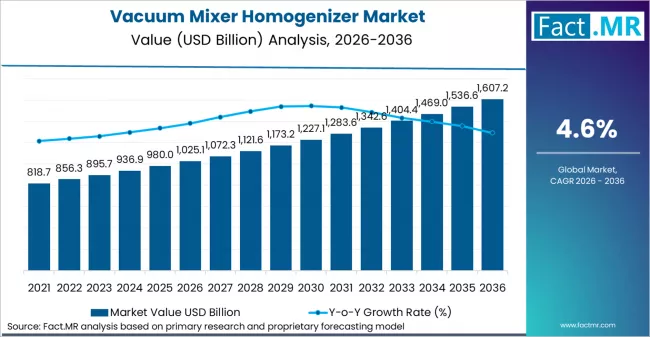
    Vacuum Mixer Homogenizer Market Market Value Analysis

    Market growth is supported by increasing demand for high-shear, contamination-free, and precision mixing solutions across cosmetics, personal care, pharmaceuticals, food processing, and specialty chemical manufacturing. Rising adoption of automated and closed-system processing technologies is further strengthening market momentum.

    Vacuum mixer homogenizers enable uniform dispersion, deaeration, and emulsification of complex formulations while preventing oxidation and microbial contamination. These capabilities are essential for producing high-viscosity creams, ointments, gels, suspensions, and emulsions with consistent texture and stability. Integration of mixing, homogenization, and vacuum functions in a single system improves production efficiency, reduces batch variability, and ensures compliance with strict hygiene and quality standards.

    By industry, cosmetics and personal care applications dominate in 2026, driven by strong demand for premium, high-performance formulations requiring precise rheological control and repeatable product quality.

    Vacuum Mixer Homogenizer Market

    Metric Value
    Estimated Value in (2026E) USD 1.02 billion
    Forecast Value in (2036F) USD 1.61 billion
    Forecast CAGR 2026 to 2036 4.6%

    Category 

    Category Segments
    By Capacity ≤100 L, 101-500 L, 501-1,000 L, >1,000 L
    By Industry Cosmetics & Personal Care, Pharma/Nutraceutical, Food & Dairy, Chemicals & Others
    By Configuration Top-Entry Homogenizer, Bottom-Entry, Inline Recirculation, Dual-Stage/High-Shear
    By Automation Semi-Automatic (HMI), Fully Automatic (PLC/SCADA), Manual/Basic.
    Region North America; Europe; Asia Pacific; Latin America; Middle East & Africa

    Segmental Analysis

    By Capacity, Which Segment Holds the Dominant Share in the Vacuum Mixer Homogenizer Market?
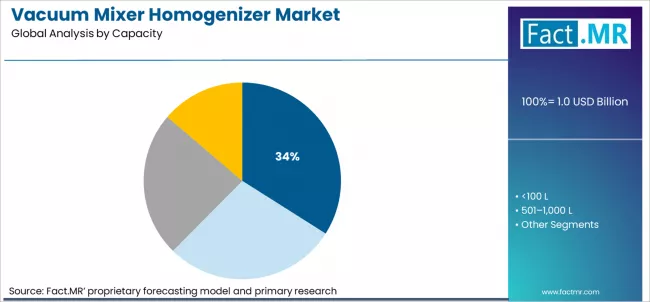
    Vacuum Mixer Homogenizer Market Analysis By Capacity

    In terms of capacity, the 101-500 L segment leads the vacuum mixer homogenizer market, accounting for approximately 34% share in 2026. This segment is widely adopted across cosmetics, pharmaceutical, and food processing industries due to its ability to support both pilot-scale development and medium-volume commercial production. Manufacturers favor this capacity range for its operational flexibility, efficient batch control, and compatibility with modular production setups.

    • Ongoing investments in scalable equipment platforms and flexible batch processing continue to strengthen adoption of mid-capacity vacuum mixer homogenizers.
    • As manufacturers prioritize versatility and consistent quality across multiple product lines, the 101-500 L segment remains the most influential capacity category.

    By Industry, Which Segment Registers the Highest Share in the Vacuum Mixer Homogenizer Market?
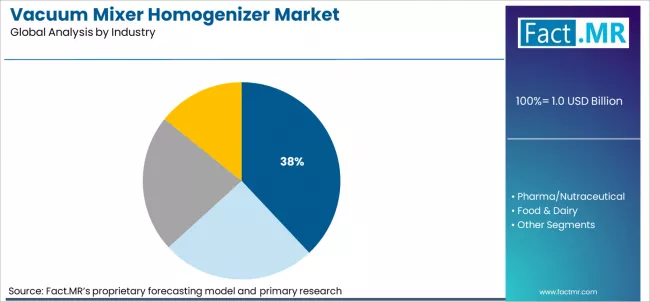
    Vacuum Mixer Homogenizer Market Analysis By Industry

    By industry, cosmetics and personal care applications dominate the vacuum mixer homogenizer market, capturing nearly 38% of total demand in 2026. Cosmetic manufacturers rely on vacuum mixer homogenizers to achieve stable emulsions, uniform dispersion, and superior texture control required for premium skincare, haircare, and dermocosmetic products.

    • Production facilities are increasingly optimizing formulation processes to meet growing consumer expectations for product performance and sensory quality.
    • With continued innovation in personal care formulations and rising demand for premium products, this segment is expected to remain the leading end-use category.

    What are the Drivers, Restraints, and Key Trends of the Vacuum Mixer Homogenizer Market?

    • Drivers: Rising demand for high-quality, contamination-free, and uniform formulations across cosmetics, pharmaceuticals, food, and specialty chemicals is driving the widespread adoption of vacuum mixer homogenizers. Manufacturers increasingly require precise control over mixing, emulsification, and deaeration processes to meet stringent quality, hygiene, and regulatory standards, making vacuum-based homogenization systems essential across modern production facilities.
    • Restraint: High initial capital investment and integration complexity associated with advanced vacuum mixer homogenizer systems can limit adoption, particularly among small- and mid-sized manufacturers. Equipment customization requirements, installation costs, and operator training further contribute to longer return-on-investment timelines.
    • Trend 1: Growing adoption of fully automated and digitally controlled vacuum mixer homogenizers equipped with PLC/SCADA systems to enhance process repeatability, batch traceability, and operational efficiency.
    • Trend 2: Increasing development of modular, scalable vacuum mixing platforms that support multiple product viscosities, batch sizes, and formulation types, enabling flexible production across diverse application requirements.

    Analysis of the Vacuum Mixer Homogenizer Market by Key Country 

    Country CAGR 2026 to 2036
    China 5.8%
    Brazil 5.4%
    U.S 4.3%
    UK 4.3%
    Germany 4.2 %
    South Korea 3.8%
    Japan 3.1%

    How Is Rapid Manufacturing Expansion Influencing Vacuum Mixer Homogenizer Demand in China?

    Vacuum mixer homogenizer demand in China is projected to grow at a CAGR of 5.8% between 2026 and 2036. Growth is driven by large-scale expansion of cosmetics, pharmaceutical, and specialty chemical manufacturing, along with rising investment in automated and hygienic processing equipment. Industrial manufacturing studies highlight increasing adoption of vacuum homogenization to support high-volume production, formulation consistency, and export-quality compliance. Strong domestic equipment manufacturing capabilities and rapid facility upgrades continue to support sustained demand growth.

    What Is Driving Adoption of Vacuum Mixer Homogenizers in Brazil?

    The Brazilian vacuum mixer homogenizer market is expected to expand at a CAGR of 5.4% over the forecast period. Growth is supported by increasing investment in cosmetics, personal care, and food processing industries, alongside gradual modernization of manufacturing infrastructure. Industry reports indicate rising preference for versatile and cost-efficient mixing systems capable of handling diverse formulations. Expansion of local production facilities and import substitution initiatives further contribute to steady adoption of vacuum homogenizer technologies.

    Why Is the United States Seeing Stable Growth in Vacuum Mixer Homogenizer Demand?

    Vacuum mixer homogenizer demand in the United States is forecast to grow at a CAGR of 4.3% through 2036. Growth is anchored in advanced cosmetics, pharmaceutical, and specialty chemical manufacturing clusters that prioritize formulation precision and regulatory compliance. Process engineering studies highlight strong demand for fully automated, PLC-controlled vacuum systems to improve batch repeatability and traceability. Replacement of legacy equipment and ongoing investments in automation sustain stable, technology-driven growth.

    What Factors Support Continued Demand for Vacuum Mixer Homogenizers in the U.K.?

    The U.K. vacuum mixer homogenizer market is projected to grow at a CAGR of 4.3% during the forecast period. Demand is supported by pharmaceutical manufacturing, premium personal care production, and contract manufacturing organizations requiring high hygiene and precision standards. Manufacturing research emphasizes growing adoption of compact, flexible vacuum homogenization systems suited for small-to-medium batch production. Regulatory compliance and formulation innovation continue to underpin market stability.

    How Is Precision Manufacturing Sustaining the Vacuum Mixer Homogenizer Market in Germany?

    Vacuum mixer homogenizer demand in Germany is expected to expand at a CAGR of 4.2%. Growth is supported by the country’s strong engineering base, pharmaceutical manufacturing excellence, and emphasis on process accuracy. Industrial automation studies highlight high adoption of digitally integrated and energy-efficient homogenization systems. German manufacturers prioritize equipment reliability, process documentation, and quality consistency, sustaining demand despite the maturity of the market.

    What Is Supporting Vacuum Mixer Homogenizer Adoption in South Korea?

    The South Korean vacuum mixer homogenizer market is forecast to grow at a CAGR of 3.8% through 2036. Growth is driven by advanced cosmetics and personal care manufacturing, particularly in export-oriented beauty and skincare production. Industry analysts note increasing use of vacuum homogenizers to achieve fine emulsions and consistent textures required for premium formulations. Strong automation capabilities and technology-focused manufacturing culture support steady market expansion.

    Why Is Japan Experiencing Moderate Growth in the Vacuum Mixer Homogenizer Market?

    Vacuum mixer homogenizer demand in Japan is expected to grow at a CAGR of 3.1%, reflecting a mature but stable manufacturing environment. Growth is supported by pharmaceutical, cosmetics, and specialty chemical producers that emphasize precision, reliability, and long equipment life cycles. Manufacturing studies highlight continued demand for high-quality, low-maintenance vacuum systems, though expansion remains measured due to market saturation and long replacement cycles.

    Competitive Landscape of the Vacuum Mixer Homogenizer Market
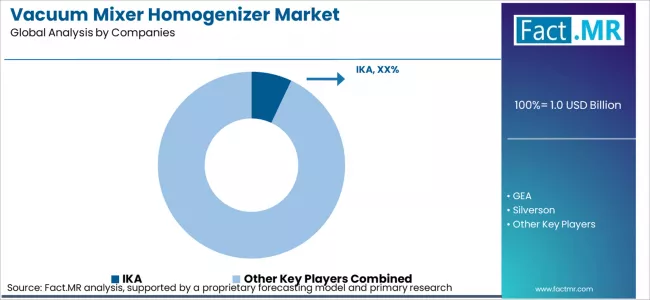
    Vacuum Mixer Homogenizer Market Analysis By Company

    The vacuum mixer homogenizer market is characterized by competition among established process equipment manufacturers, precision engineering specialists, and integrated mixing technology providers serving cosmetics, pharmaceutical, food, and specialty chemical industries. Competition is driven by technological performance rather than scale alone, with emphasis on mixing efficiency, vacuum integrity, hygienic design, and process repeatability. Manufacturers focus on delivering systems capable of producing uniform emulsions, minimizing air entrapment, and ensuring compliance with stringent regulatory and quality standards.

    Key participants include global equipment suppliers and niche engineering firms with strong expertise in high-shear mixing and vacuum processing. These players differentiate through proprietary homogenization technologies, modular system design, and advanced automation capabilities.

    Investments in PLC/SCADA integration, hygienic construction, and customizable configurations support adoption across diverse formulation requirements. Rather than competing solely on price, market positioning is built around application know-how, long-term service support, and close collaboration with end users during system design and validation.

    Key Players in Vacuum Mixer Homogenizer Market

    • IKA-Werke GmbH & Co. KG
    • GEA Group Aktiengesellschaft
    • Silverson Machines Ltd.
    • L.B. Bohle Maschinen + Verfahren GmbH
    • NETZSCH Vakumix GmbH
    • Diosna Dierks & Söhne GmbH
    • FrymaKoruma AG
    • IKA-YTRON GmbH
    • Charles Ross & Son Company
    • AMIXON GmbH

    Bibliography

    • International Organization for Standardization. (2023). Process equipment and machinery for hygienic applications: Performance evaluation, vacuum mixing efficiency, and quality management of industrial homogenizer systems (ISO Technical Report). ISO.
    • European Committee for Standardization. (2022). Food, pharmaceutical, and chemical processing equipment: Evaluation of vacuum mixing, homogenization accuracy, and hygienic design compliance (EN Technical Report). CEN.
    • Society of Manufacturing Engineers. (2024). Vacuum mixing and homogenization technologies for cosmetics, pharmaceutical, and food manufacturing. SME Technical Publications.
    • Journal of Manufacturing Processes Editorial Board. (2023). Process optimization, automation integration, and quality control in vacuum mixer homogenizer systems. Journal of Manufacturing Processes, 94(3), 287-305.
    • International Federation of Robotics, Process Automation Committee. (2023). Automation-ready vacuum mixing and homogenization systems in advanced manufacturing environments. IFR.

    Scope of Report

    Items Values
    Quantitative Units (2026) USD 1.02 Billion
    By Capacity ≤100 L, 101-500 L, 501-1,000 L, >1,000 L
    By Industry Cosmetics & Personal Care, Pharma/Nutraceutical, Food & Dairy, Chemicals & Others
    By Configuration Top-Entry Homogenizer, Bottom-Entry, Inline Recirculation, Dual-Stage/High-Shear
    By Automation Semi-Automatic (HMI), Fully Automatic (PLC/SCADA), Manual/Basic.
    Regions Covered North America, Europe, Asia Pacific, Latin America, Middle East & Africa
    Countries Covered U.S., Canada, Germany, Italy, UK, France, Japan, Australia, and other countries
    Key Companies Profiled IKA-Werke GmbH & Co. KG; GEA Group Aktiengesellschaft; Silverson Machines Ltd.; L.B. Bohle Maschinen + Verfahren GmbH; NETZSCH Vakumix GmbH; Diosna Dierks & Söhne GmbH; FrymaKoruma AG; IKA-YTRON GmbH; Charles Ross & Son Company; AMIXON GmbH
    Additional Attributes Dollar revenue by capacity, configuration, automation level, end-use industry, and region; regional demand trends driven by cosmetics, pharmaceutical, and food manufacturing expansion; competitive landscape shaped by global process equipment suppliers and specialized mixing technology providers; technological advancements in vacuum homogenization, high-shear mixing efficiency, hygienic design, and automation-enabled process optimization.

    Vacuum Mixer Homogenizer Market by Segments 

    • By Capacity :

      • ≤100 L
      • 101-500 L
      • 501-1,000 L
      • >1,000 L
    • By Industry :

      • Cosmetics & Personal Care
      • Pharma/Nutraceutical
      • Food & Dairy
      • Chemicals & Others
    • By Configuration :

      • Top-Entry Homogenizer
      • Bottom-Entry
      • Inline Recirculation
      • Dual-Stage/High-Shear
    • By Automation :

      • Semi‑Automatic (HMI)
      • Fully Automatic (PLC/SCADA)
      • Manual/Basic
    • Region :

      • Asia Pacific
        • Japan
        • South Korea
        • China
        • Australia
        • New Zealand
        • Rest of Asia Pacific
      • North America
        • United States
        • Canada
        • Mexico
      • Europe
        • France
        • Italy
        • Spain
        • Norway
        • UK
        • Rest of Europe
      • Latin America
        • Chile
        • Peru
        • Argentina
        • Rest of Latin America

    Table of Content

    1. Executive Summary
      • Global Market Outlook
      • Demand to side Trends
      • Supply to side Trends
      • Technology Roadmap Analysis
      • Analysis and Recommendations
    2. Market Overview
      • Market Coverage / Taxonomy
      • Market Definition / Scope / Limitations
    3. Research Methodology
      • Chapter Orientation
      • Analytical Lens and Working Hypotheses
        • Market Structure, Signals, and Trend Drivers
        • Benchmarking and Cross-market Comparability
        • Market Sizing, Forecasting, and Opportunity Mapping
      • Research Design and Evidence Framework
        • Desk Research Programme (Secondary Evidence)
          • Company Annual and Sustainability Reports
          • Peer-reviewed Journals and Academic Literature
          • Corporate Websites, Product Literature, and Technical Notes
          • Earnings Decks and Investor Briefings
          • Statutory Filings and Regulatory Disclosures
          • Technical White Papers and Standards Notes
          • Trade Journals, Industry Magazines, and Analyst Briefs
          • Conference Proceedings, Webinars, and Seminar Materials
          • Government Statistics Portals and Public Data Releases
          • Press Releases and Reputable Media Coverage
          • Specialist Newsletters and Curated Briefings
          • Sector Databases and Reference Repositories
          • FMR Internal Proprietary Databases and Historical Market Datasets
          • Subscription Datasets and Paid Sources
          • Social Channels, Communities, and Digital Listening Inputs
          • Additional Desk Sources
        • Expert Input and Fieldwork (Primary Evidence)
          • Primary Modes
            • Qualitative Interviews and Expert Elicitation
            • Quantitative Surveys and Structured Data Capture
            • Blended Approach
          • Why Primary Evidence is Used
          • Field Techniques
            • Interviews
            • Surveys
            • Focus Groups
            • Observational and In-context Research
            • Social and Community Interactions
          • Stakeholder Universe Engaged
            • C-suite Leaders
            • Board Members
            • Presidents and Vice Presidents
            • R&D and Innovation Heads
            • Technical Specialists
            • Domain Subject-matter Experts
            • Scientists
            • Physicians and Other Healthcare Professionals
          • Governance, Ethics, and Data Stewardship
            • Research Ethics
            • Data Integrity and Handling
        • Tooling, Models, and Reference Databases
      • Data Engineering and Model Build
        • Data Acquisition and Ingestion
        • Cleaning, Normalisation, and Verification
        • Synthesis, Triangulation, and Analysis
      • Quality Assurance and Audit Trail
    4. Market Background
      • Market Dynamics
        • Drivers
        • Restraints
        • Opportunity
        • Trends
      • Scenario Forecast
        • Demand in Optimistic Scenario
        • Demand in Likely Scenario
        • Demand in Conservative Scenario
      • Opportunity Map Analysis
      • Product Life Cycle Analysis
      • Supply Chain Analysis
      • Investment Feasibility Matrix
      • Value Chain Analysis
      • PESTLE and Porter’s Analysis
      • Regulatory Landscape
      • Regional Parent Market Outlook
      • Production and Consumption Statistics
      • Import and Export Statistics
    5. Global Market Analysis 2021 to 2025 and Forecast, 2026 to 2036
      • Historical Market Size Value (USD Million) Analysis, 2021 to 2025
      • Current and Future Market Size Value (USD Million) Projections, 2026 to 2036
        • Y to o to Y Growth Trend Analysis
        • Absolute $ Opportunity Analysis
    6. Global Market Pricing Analysis 2021 to 2025 and Forecast 2026 to 2036
    7. Global Market Analysis 2021 to 2025 and Forecast 2026 to 2036, By Capacity
      • Introduction / Key Findings
      • Historical Market Size Value (USD Million) Analysis By Capacity, 2021 to 2025
      • Current and Future Market Size Value (USD Million) Analysis and Forecast By Capacity, 2026 to 2036
        • 101-500 L
        • <100 L
        • 501-1,000 L
        • >1,000 L
      • Y to o to Y Growth Trend Analysis By Capacity, 2021 to 2025
      • Absolute $ Opportunity Analysis By Capacity, 2026 to 2036
    8. Global Market Analysis 2021 to 2025 and Forecast 2026 to 2036, By Industry
      • Introduction / Key Findings
      • Historical Market Size Value (USD Million) Analysis By Industry, 2021 to 2025
      • Current and Future Market Size Value (USD Million) Analysis and Forecast By Industry, 2026 to 2036
        • Cosmetics & Personal Care
        • Pharma/Nutraceutical
        • Food & Dairy
        • Chemicals & Others
      • Y to o to Y Growth Trend Analysis By Industry, 2021 to 2025
      • Absolute $ Opportunity Analysis By Industry, 2026 to 2036
    9. Global Market Analysis 2021 to 2025 and Forecast 2026 to 2036, By Configuration
      • Introduction / Key Findings
      • Historical Market Size Value (USD Million) Analysis By Configuration, 2021 to 2025
      • Current and Future Market Size Value (USD Million) Analysis and Forecast By Configuration, 2026 to 2036
        • Top-Entry Homogenizer
        • Bottom-Entry
        • Inline Recirculation
        • Dual-Stage/High-Shear
      • Y to o to Y Growth Trend Analysis By Configuration, 2021 to 2025
      • Absolute $ Opportunity Analysis By Configuration, 2026 to 2036
    10. Global Market Analysis 2021 to 2025 and Forecast 2026 to 2036, By Automation
      • Introduction / Key Findings
      • Historical Market Size Value (USD Million) Analysis By Automation, 2021 to 2025
      • Current and Future Market Size Value (USD Million) Analysis and Forecast By Automation, 2026 to 2036
        • Semi-Automatic (HMI)
        • Fully Automatic (PLC/SCADA)
        • Manual/Basic
      • Y to o to Y Growth Trend Analysis By Automation, 2021 to 2025
      • Absolute $ Opportunity Analysis By Automation, 2026 to 2036
    11. Global Market Analysis 2021 to 2025 and Forecast 2026 to 2036, By Region
      • Introduction
      • Historical Market Size Value (USD Million) Analysis By Region, 2021 to 2025
      • Current Market Size Value (USD Million) Analysis and Forecast By Region, 2026 to 2036
        • North America
        • Latin America
        • Western Europe
        • Eastern Europe
        • East Asia
        • South Asia and Pacific
        • Middle East & Africa
      • Market Attractiveness Analysis By Region
    12. North America Market Analysis 2021 to 2025 and Forecast 2026 to 2036, By Country
      • Historical Market Size Value (USD Million) Trend Analysis By Market Taxonomy, 2021 to 2025
      • Market Size Value (USD Million) Forecast By Market Taxonomy, 2026 to 2036
        • By Country
          • USA
          • Canada
          • Mexico
        • By Capacity
        • By Industry
        • By Configuration
        • By Automation
      • Market Attractiveness Analysis
        • By Country
        • By Capacity
        • By Industry
        • By Configuration
        • By Automation
      • Key Takeaways
    13. Latin America Market Analysis 2021 to 2025 and Forecast 2026 to 2036, By Country
      • Historical Market Size Value (USD Million) Trend Analysis By Market Taxonomy, 2021 to 2025
      • Market Size Value (USD Million) Forecast By Market Taxonomy, 2026 to 2036
        • By Country
          • Brazil
          • Chile
          • Rest of Latin America
        • By Capacity
        • By Industry
        • By Configuration
        • By Automation
      • Market Attractiveness Analysis
        • By Country
        • By Capacity
        • By Industry
        • By Configuration
        • By Automation
      • Key Takeaways
    14. Western Europe Market Analysis 2021 to 2025 and Forecast 2026 to 2036, By Country
      • Historical Market Size Value (USD Million) Trend Analysis By Market Taxonomy, 2021 to 2025
      • Market Size Value (USD Million) Forecast By Market Taxonomy, 2026 to 2036
        • By Country
          • Germany
          • UK
          • Italy
          • Spain
          • France
          • Nordic
          • BENELUX
          • Rest of Western Europe
        • By Capacity
        • By Industry
        • By Configuration
        • By Automation
      • Market Attractiveness Analysis
        • By Country
        • By Capacity
        • By Industry
        • By Configuration
        • By Automation
      • Key Takeaways
    15. Eastern Europe Market Analysis 2021 to 2025 and Forecast 2026 to 2036, By Country
      • Historical Market Size Value (USD Million) Trend Analysis By Market Taxonomy, 2021 to 2025
      • Market Size Value (USD Million) Forecast By Market Taxonomy, 2026 to 2036
        • By Country
          • Russia
          • Poland
          • Hungary
          • Balkan & Baltic
          • Rest of Eastern Europe
        • By Capacity
        • By Industry
        • By Configuration
        • By Automation
      • Market Attractiveness Analysis
        • By Country
        • By Capacity
        • By Industry
        • By Configuration
        • By Automation
      • Key Takeaways
    16. East Asia Market Analysis 2021 to 2025 and Forecast 2026 to 2036, By Country
      • Historical Market Size Value (USD Million) Trend Analysis By Market Taxonomy, 2021 to 2025
      • Market Size Value (USD Million) Forecast By Market Taxonomy, 2026 to 2036
        • By Country
          • China
          • Japan
          • South Korea
        • By Capacity
        • By Industry
        • By Configuration
        • By Automation
      • Market Attractiveness Analysis
        • By Country
        • By Capacity
        • By Industry
        • By Configuration
        • By Automation
      • Key Takeaways
    17. South Asia and Pacific Market Analysis 2021 to 2025 and Forecast 2026 to 2036, By Country
      • Historical Market Size Value (USD Million) Trend Analysis By Market Taxonomy, 2021 to 2025
      • Market Size Value (USD Million) Forecast By Market Taxonomy, 2026 to 2036
        • By Country
          • India
          • ASEAN
          • Australia & New Zealand
          • Rest of South Asia and Pacific
        • By Capacity
        • By Industry
        • By Configuration
        • By Automation
      • Market Attractiveness Analysis
        • By Country
        • By Capacity
        • By Industry
        • By Configuration
        • By Automation
      • Key Takeaways
    18. Middle East & Africa Market Analysis 2021 to 2025 and Forecast 2026 to 2036, By Country
      • Historical Market Size Value (USD Million) Trend Analysis By Market Taxonomy, 2021 to 2025
      • Market Size Value (USD Million) Forecast By Market Taxonomy, 2026 to 2036
        • By Country
          • Kingdom of Saudi Arabia
          • Other GCC Countries
          • Turkiye
          • South Africa
          • Other African Union
          • Rest of Middle East & Africa
        • By Capacity
        • By Industry
        • By Configuration
        • By Automation
      • Market Attractiveness Analysis
        • By Country
        • By Capacity
        • By Industry
        • By Configuration
        • By Automation
      • Key Takeaways
    19. Key Countries Market Analysis
      • USA
        • Pricing Analysis
        • Market Share Analysis, 2025
          • By Capacity
          • By Industry
          • By Configuration
          • By Automation
      • Canada
        • Pricing Analysis
        • Market Share Analysis, 2025
          • By Capacity
          • By Industry
          • By Configuration
          • By Automation
      • Mexico
        • Pricing Analysis
        • Market Share Analysis, 2025
          • By Capacity
          • By Industry
          • By Configuration
          • By Automation
      • Brazil
        • Pricing Analysis
        • Market Share Analysis, 2025
          • By Capacity
          • By Industry
          • By Configuration
          • By Automation
      • Chile
        • Pricing Analysis
        • Market Share Analysis, 2025
          • By Capacity
          • By Industry
          • By Configuration
          • By Automation
      • Germany
        • Pricing Analysis
        • Market Share Analysis, 2025
          • By Capacity
          • By Industry
          • By Configuration
          • By Automation
      • UK
        • Pricing Analysis
        • Market Share Analysis, 2025
          • By Capacity
          • By Industry
          • By Configuration
          • By Automation
      • Italy
        • Pricing Analysis
        • Market Share Analysis, 2025
          • By Capacity
          • By Industry
          • By Configuration
          • By Automation
      • Spain
        • Pricing Analysis
        • Market Share Analysis, 2025
          • By Capacity
          • By Industry
          • By Configuration
          • By Automation
      • France
        • Pricing Analysis
        • Market Share Analysis, 2025
          • By Capacity
          • By Industry
          • By Configuration
          • By Automation
      • India
        • Pricing Analysis
        • Market Share Analysis, 2025
          • By Capacity
          • By Industry
          • By Configuration
          • By Automation
      • ASEAN
        • Pricing Analysis
        • Market Share Analysis, 2025
          • By Capacity
          • By Industry
          • By Configuration
          • By Automation
      • Australia & New Zealand
        • Pricing Analysis
        • Market Share Analysis, 2025
          • By Capacity
          • By Industry
          • By Configuration
          • By Automation
      • China
        • Pricing Analysis
        • Market Share Analysis, 2025
          • By Capacity
          • By Industry
          • By Configuration
          • By Automation
      • Japan
        • Pricing Analysis
        • Market Share Analysis, 2025
          • By Capacity
          • By Industry
          • By Configuration
          • By Automation
      • South Korea
        • Pricing Analysis
        • Market Share Analysis, 2025
          • By Capacity
          • By Industry
          • By Configuration
          • By Automation
      • Russia
        • Pricing Analysis
        • Market Share Analysis, 2025
          • By Capacity
          • By Industry
          • By Configuration
          • By Automation
      • Poland
        • Pricing Analysis
        • Market Share Analysis, 2025
          • By Capacity
          • By Industry
          • By Configuration
          • By Automation
      • Hungary
        • Pricing Analysis
        • Market Share Analysis, 2025
          • By Capacity
          • By Industry
          • By Configuration
          • By Automation
      • Kingdom of Saudi Arabia
        • Pricing Analysis
        • Market Share Analysis, 2025
          • By Capacity
          • By Industry
          • By Configuration
          • By Automation
      • Turkiye
        • Pricing Analysis
        • Market Share Analysis, 2025
          • By Capacity
          • By Industry
          • By Configuration
          • By Automation
      • South Africa
        • Pricing Analysis
        • Market Share Analysis, 2025
          • By Capacity
          • By Industry
          • By Configuration
          • By Automation
    20. Market Structure Analysis
      • Competition Dashboard
      • Competition Benchmarking
      • Market Share Analysis of Top Players
        • By Regional
        • By Capacity
        • By Industry
        • By Configuration
        • By Automation
    21. Competition Analysis
      • Competition Deep Dive
        • IKA
          • Overview
          • Product Portfolio
          • Profitability by Market Segments (Product/Age /Sales Channel/Region)
          • Sales Footprint
          • Strategy Overview
            • Marketing Strategy
            • Product Strategy
            • Channel Strategy
        • GEA
        • Silverson
        • Bohle (L.B. Bohle)
        • NETZSCH
        • Diosna
        • FrymaKoruma
        • IKA-Ytron
        • Ross Mixers
        • Amixon
        • Companies
    22. Assumptions & Acronyms Used

    List Of Table

    • Table 1: Global Market Value (USD Million) Forecast by Region, 2021 to 2036
    • Table 2: Global Market Value (USD Million) Forecast by Capacity, 2021 to 2036
    • Table 3: Global Market Value (USD Million) Forecast by Industry, 2021 to 2036
    • Table 4: Global Market Value (USD Million) Forecast by Configuration, 2021 to 2036
    • Table 5: Global Market Value (USD Million) Forecast by Automation, 2021 to 2036
    • Table 6: North America Market Value (USD Million) Forecast by Country, 2021 to 2036
    • Table 7: North America Market Value (USD Million) Forecast by Capacity, 2021 to 2036
    • Table 8: North America Market Value (USD Million) Forecast by Industry, 2021 to 2036
    • Table 9: North America Market Value (USD Million) Forecast by Configuration, 2021 to 2036
    • Table 10: North America Market Value (USD Million) Forecast by Automation, 2021 to 2036
    • Table 11: Latin America Market Value (USD Million) Forecast by Country, 2021 to 2036
    • Table 12: Latin America Market Value (USD Million) Forecast by Capacity, 2021 to 2036
    • Table 13: Latin America Market Value (USD Million) Forecast by Industry, 2021 to 2036
    • Table 14: Latin America Market Value (USD Million) Forecast by Configuration, 2021 to 2036
    • Table 15: Latin America Market Value (USD Million) Forecast by Automation, 2021 to 2036
    • Table 16: Western Europe Market Value (USD Million) Forecast by Country, 2021 to 2036
    • Table 17: Western Europe Market Value (USD Million) Forecast by Capacity, 2021 to 2036
    • Table 18: Western Europe Market Value (USD Million) Forecast by Industry, 2021 to 2036
    • Table 19: Western Europe Market Value (USD Million) Forecast by Configuration, 2021 to 2036
    • Table 20: Western Europe Market Value (USD Million) Forecast by Automation, 2021 to 2036
    • Table 21: Eastern Europe Market Value (USD Million) Forecast by Country, 2021 to 2036
    • Table 22: Eastern Europe Market Value (USD Million) Forecast by Capacity, 2021 to 2036
    • Table 23: Eastern Europe Market Value (USD Million) Forecast by Industry, 2021 to 2036
    • Table 24: Eastern Europe Market Value (USD Million) Forecast by Configuration, 2021 to 2036
    • Table 25: Eastern Europe Market Value (USD Million) Forecast by Automation, 2021 to 2036
    • Table 26: East Asia Market Value (USD Million) Forecast by Country, 2021 to 2036
    • Table 27: East Asia Market Value (USD Million) Forecast by Capacity, 2021 to 2036
    • Table 28: East Asia Market Value (USD Million) Forecast by Industry, 2021 to 2036
    • Table 29: East Asia Market Value (USD Million) Forecast by Configuration, 2021 to 2036
    • Table 30: East Asia Market Value (USD Million) Forecast by Automation, 2021 to 2036
    • Table 31: South Asia and Pacific Market Value (USD Million) Forecast by Country, 2021 to 2036
    • Table 32: South Asia and Pacific Market Value (USD Million) Forecast by Capacity, 2021 to 2036
    • Table 33: South Asia and Pacific Market Value (USD Million) Forecast by Industry, 2021 to 2036
    • Table 34: South Asia and Pacific Market Value (USD Million) Forecast by Configuration, 2021 to 2036
    • Table 35: South Asia and Pacific Market Value (USD Million) Forecast by Automation, 2021 to 2036
    • Table 36: Middle East & Africa Market Value (USD Million) Forecast by Country, 2021 to 2036
    • Table 37: Middle East & Africa Market Value (USD Million) Forecast by Capacity, 2021 to 2036
    • Table 38: Middle East & Africa Market Value (USD Million) Forecast by Industry, 2021 to 2036
    • Table 39: Middle East & Africa Market Value (USD Million) Forecast by Configuration, 2021 to 2036
    • Table 40: Middle East & Africa Market Value (USD Million) Forecast by Automation, 2021 to 2036

    List Of Figures

    • Figure 1: Global Market Pricing Analysis
    • Figure 2: Global Market Value (USD Million) Forecast 2021 to 2036
    • Figure 3: Global Market Value Share and BPS Analysis by Capacity, 2026 and 2036
    • Figure 4: Global Market Y to o to Y Growth Comparison by Capacity, 2026 to 2036
    • Figure 5: Global Market Attractiveness Analysis by Capacity
    • Figure 6: Global Market Value Share and BPS Analysis by Industry, 2026 and 2036
    • Figure 7: Global Market Y to o to Y Growth Comparison by Industry, 2026 to 2036
    • Figure 8: Global Market Attractiveness Analysis by Industry
    • Figure 9: Global Market Value Share and BPS Analysis by Configuration, 2026 and 2036
    • Figure 10: Global Market Y to o to Y Growth Comparison by Configuration, 2026 to 2036
    • Figure 11: Global Market Attractiveness Analysis by Configuration
    • Figure 12: Global Market Value Share and BPS Analysis by Automation, 2026 and 2036
    • Figure 13: Global Market Y to o to Y Growth Comparison by Automation, 2026 to 2036
    • Figure 14: Global Market Attractiveness Analysis by Automation
    • Figure 15: Global Market Value (USD Million) Share and BPS Analysis by Region, 2026 and 2036
    • Figure 16: Global Market Y to o to Y Growth Comparison by Region, 2026 to 2036
    • Figure 17: Global Market Attractiveness Analysis by Region
    • Figure 18: North America Market Incremental Dollar Opportunity, 2026 to 2036
    • Figure 19: Latin America Market Incremental Dollar Opportunity, 2026 to 2036
    • Figure 20: Western Europe Market Incremental Dollar Opportunity, 2026 to 2036
    • Figure 21: Eastern Europe Market Incremental Dollar Opportunity, 2026 to 2036
    • Figure 22: East Asia Market Incremental Dollar Opportunity, 2026 to 2036
    • Figure 23: South Asia and Pacific Market Incremental Dollar Opportunity, 2026 to 2036
    • Figure 24: Middle East & Africa Market Incremental Dollar Opportunity, 2026 to 2036
    • Figure 25: North America Market Value Share and BPS Analysis by Country, 2026 and 2036
    • Figure 26: North America Market Value Share and BPS Analysis by Capacity, 2026 and 2036
    • Figure 27: North America Market Y to o to Y Growth Comparison by Capacity, 2026 to 2036
    • Figure 28: North America Market Attractiveness Analysis by Capacity
    • Figure 29: North America Market Value Share and BPS Analysis by Industry, 2026 and 2036
    • Figure 30: North America Market Y to o to Y Growth Comparison by Industry, 2026 to 2036
    • Figure 31: North America Market Attractiveness Analysis by Industry
    • Figure 32: North America Market Value Share and BPS Analysis by Configuration, 2026 and 2036
    • Figure 33: North America Market Y to o to Y Growth Comparison by Configuration, 2026 to 2036
    • Figure 34: North America Market Attractiveness Analysis by Configuration
    • Figure 35: North America Market Value Share and BPS Analysis by Automation, 2026 and 2036
    • Figure 36: North America Market Y to o to Y Growth Comparison by Automation, 2026 to 2036
    • Figure 37: North America Market Attractiveness Analysis by Automation
    • Figure 38: Latin America Market Value Share and BPS Analysis by Country, 2026 and 2036
    • Figure 39: Latin America Market Value Share and BPS Analysis by Capacity, 2026 and 2036
    • Figure 40: Latin America Market Y to o to Y Growth Comparison by Capacity, 2026 to 2036
    • Figure 41: Latin America Market Attractiveness Analysis by Capacity
    • Figure 42: Latin America Market Value Share and BPS Analysis by Industry, 2026 and 2036
    • Figure 43: Latin America Market Y to o to Y Growth Comparison by Industry, 2026 to 2036
    • Figure 44: Latin America Market Attractiveness Analysis by Industry
    • Figure 45: Latin America Market Value Share and BPS Analysis by Configuration, 2026 and 2036
    • Figure 46: Latin America Market Y to o to Y Growth Comparison by Configuration, 2026 to 2036
    • Figure 47: Latin America Market Attractiveness Analysis by Configuration
    • Figure 48: Latin America Market Value Share and BPS Analysis by Automation, 2026 and 2036
    • Figure 49: Latin America Market Y to o to Y Growth Comparison by Automation, 2026 to 2036
    • Figure 50: Latin America Market Attractiveness Analysis by Automation
    • Figure 51: Western Europe Market Value Share and BPS Analysis by Country, 2026 and 2036
    • Figure 52: Western Europe Market Value Share and BPS Analysis by Capacity, 2026 and 2036
    • Figure 53: Western Europe Market Y to o to Y Growth Comparison by Capacity, 2026 to 2036
    • Figure 54: Western Europe Market Attractiveness Analysis by Capacity
    • Figure 55: Western Europe Market Value Share and BPS Analysis by Industry, 2026 and 2036
    • Figure 56: Western Europe Market Y to o to Y Growth Comparison by Industry, 2026 to 2036
    • Figure 57: Western Europe Market Attractiveness Analysis by Industry
    • Figure 58: Western Europe Market Value Share and BPS Analysis by Configuration, 2026 and 2036
    • Figure 59: Western Europe Market Y to o to Y Growth Comparison by Configuration, 2026 to 2036
    • Figure 60: Western Europe Market Attractiveness Analysis by Configuration
    • Figure 61: Western Europe Market Value Share and BPS Analysis by Automation, 2026 and 2036
    • Figure 62: Western Europe Market Y to o to Y Growth Comparison by Automation, 2026 to 2036
    • Figure 63: Western Europe Market Attractiveness Analysis by Automation
    • Figure 64: Eastern Europe Market Value Share and BPS Analysis by Country, 2026 and 2036
    • Figure 65: Eastern Europe Market Value Share and BPS Analysis by Capacity, 2026 and 2036
    • Figure 66: Eastern Europe Market Y to o to Y Growth Comparison by Capacity, 2026 to 2036
    • Figure 67: Eastern Europe Market Attractiveness Analysis by Capacity
    • Figure 68: Eastern Europe Market Value Share and BPS Analysis by Industry, 2026 and 2036
    • Figure 69: Eastern Europe Market Y to o to Y Growth Comparison by Industry, 2026 to 2036
    • Figure 70: Eastern Europe Market Attractiveness Analysis by Industry
    • Figure 71: Eastern Europe Market Value Share and BPS Analysis by Configuration, 2026 and 2036
    • Figure 72: Eastern Europe Market Y to o to Y Growth Comparison by Configuration, 2026 to 2036
    • Figure 73: Eastern Europe Market Attractiveness Analysis by Configuration
    • Figure 74: Eastern Europe Market Value Share and BPS Analysis by Automation, 2026 and 2036
    • Figure 75: Eastern Europe Market Y to o to Y Growth Comparison by Automation, 2026 to 2036
    • Figure 76: Eastern Europe Market Attractiveness Analysis by Automation
    • Figure 77: East Asia Market Value Share and BPS Analysis by Country, 2026 and 2036
    • Figure 78: East Asia Market Value Share and BPS Analysis by Capacity, 2026 and 2036
    • Figure 79: East Asia Market Y to o to Y Growth Comparison by Capacity, 2026 to 2036
    • Figure 80: East Asia Market Attractiveness Analysis by Capacity
    • Figure 81: East Asia Market Value Share and BPS Analysis by Industry, 2026 and 2036
    • Figure 82: East Asia Market Y to o to Y Growth Comparison by Industry, 2026 to 2036
    • Figure 83: East Asia Market Attractiveness Analysis by Industry
    • Figure 84: East Asia Market Value Share and BPS Analysis by Configuration, 2026 and 2036
    • Figure 85: East Asia Market Y to o to Y Growth Comparison by Configuration, 2026 to 2036
    • Figure 86: East Asia Market Attractiveness Analysis by Configuration
    • Figure 87: East Asia Market Value Share and BPS Analysis by Automation, 2026 and 2036
    • Figure 88: East Asia Market Y to o to Y Growth Comparison by Automation, 2026 to 2036
    • Figure 89: East Asia Market Attractiveness Analysis by Automation
    • Figure 90: South Asia and Pacific Market Value Share and BPS Analysis by Country, 2026 and 2036
    • Figure 91: South Asia and Pacific Market Value Share and BPS Analysis by Capacity, 2026 and 2036
    • Figure 92: South Asia and Pacific Market Y to o to Y Growth Comparison by Capacity, 2026 to 2036
    • Figure 93: South Asia and Pacific Market Attractiveness Analysis by Capacity
    • Figure 94: South Asia and Pacific Market Value Share and BPS Analysis by Industry, 2026 and 2036
    • Figure 95: South Asia and Pacific Market Y to o to Y Growth Comparison by Industry, 2026 to 2036
    • Figure 96: South Asia and Pacific Market Attractiveness Analysis by Industry
    • Figure 97: South Asia and Pacific Market Value Share and BPS Analysis by Configuration, 2026 and 2036
    • Figure 98: South Asia and Pacific Market Y to o to Y Growth Comparison by Configuration, 2026 to 2036
    • Figure 99: South Asia and Pacific Market Attractiveness Analysis by Configuration
    • Figure 100: South Asia and Pacific Market Value Share and BPS Analysis by Automation, 2026 and 2036
    • Figure 101: South Asia and Pacific Market Y to o to Y Growth Comparison by Automation, 2026 to 2036
    • Figure 102: South Asia and Pacific Market Attractiveness Analysis by Automation
    • Figure 103: Middle East & Africa Market Value Share and BPS Analysis by Country, 2026 and 2036
    • Figure 104: Middle East & Africa Market Value Share and BPS Analysis by Capacity, 2026 and 2036
    • Figure 105: Middle East & Africa Market Y to o to Y Growth Comparison by Capacity, 2026 to 2036
    • Figure 106: Middle East & Africa Market Attractiveness Analysis by Capacity
    • Figure 107: Middle East & Africa Market Value Share and BPS Analysis by Industry, 2026 and 2036
    • Figure 108: Middle East & Africa Market Y to o to Y Growth Comparison by Industry, 2026 to 2036
    • Figure 109: Middle East & Africa Market Attractiveness Analysis by Industry
    • Figure 110: Middle East & Africa Market Value Share and BPS Analysis by Configuration, 2026 and 2036
    • Figure 111: Middle East & Africa Market Y to o to Y Growth Comparison by Configuration, 2026 to 2036
    • Figure 112: Middle East & Africa Market Attractiveness Analysis by Configuration
    • Figure 113: Middle East & Africa Market Value Share and BPS Analysis by Automation, 2026 and 2036
    • Figure 114: Middle East & Africa Market Y to o to Y Growth Comparison by Automation, 2026 to 2036
    • Figure 115: Middle East & Africa Market Attractiveness Analysis by Automation
    • Figure 116: Global Market - Tier Structure Analysis
    • Figure 117: Global Market - Company Share Analysis

    - Frequently Asked Questions -

    How big is the vacuum mixer homogenizer market in 2026?

    The global vacuum mixer homogenizer market is estimated to be valued at USD 1.0 billion in 2026.

    What will be the size of vacuum mixer homogenizer market in 2036?

    The market size for the vacuum mixer homogenizer market is projected to reach USD 1.6 billion by 2036.

    How much will be the vacuum mixer homogenizer market growth between 2026 and 2036?

    The vacuum mixer homogenizer market is expected to grow at a 4.6% CAGR between 2026 and 2036.

    What are the key product types in the vacuum mixer homogenizer market?

    The key product types in vacuum mixer homogenizer market are 101–500 l, <100 l, 501–1,000 l and >1,000 l.

    Which industry segment to contribute significant share in the vacuum mixer homogenizer market in 2026?

    In terms of industry, cosmetics & personal care segment to command 38.0% share in the vacuum mixer homogenizer market in 2026.

    Vacuum Mixer Homogenizer Market