- Estimated Value(2026): 1.1 Bn
- Forecast Value (2036): 1.9 Bn
- CAGR (2026 - 2036): 6.0%
Vacuum Leak Detectors Market Forecast and Outlook 2026 to 2036
In 2025, the vacuum leak detectors market surpassed a valuation of USD 1.0 billion. Based on Fact.MR analysis, demand for vacuum leak detectors is estimated to grow to USD 1.1 billion in 2026 and USD 1.9 billion by 2036. Fact.MR projects a CAGR of 6.0% during the forecast period.
Between 2026 and 2036, the vacuum leak detectors market is projected to generate an absolute dollar opportunity of USD 0.8 billion, reflecting steady and structurally well-supported expansion rather than disruptive volume acceleration. Growth is moderated by the elevated cost of helium tracer gas, which creates operating cost sensitivity for high-volume automotive and packaging testing operations, and by the increasing market penetration of multi-gas platforms from INFICON and Pfeiffer Vacuum that can substitute forming gas (5% hydrogen/95% nitrogen) for helium in accumulation testing applications, reducing per-test gas cost but compressing premium helium-only system revenue.
Oliver Wyrsch, CEO of INFICON Holding AG said, "We are seeing record sales in the Semiconductor and Vacuum Coating markets. Our focus remains on profitable growth in a demanding environment by investing in latest-generation production capacities, particularly to meet the global demand for memory and microchips."
China leads at 8.8% CAGR, driven by aggressive semiconductor fab expansion and large-scale EV battery production requiring continuous vacuum leak testing. India follows at 7.9% CAGR, supported by semiconductor incentive investments and new fabrication capacity. Germany posts 7.1% CAGR, anchored by semiconductor and automotive manufacturing depth. Brazil records 6.8% CAGR from petrochemical and piping growth. The United States grows at 5.9% CAGR, the United Kingdom at 5.3%, and Japan at 4.8%, reflecting mature industrial demand.
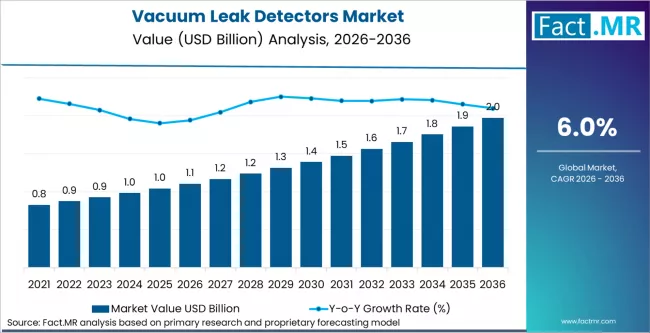
Vacuum Leak Detectors Market Market Value Analysis | Source: Fact.MR
| Metric | Value |
|---|---|
| Estimated Value in 2026 | USD 1.1 billion |
| Forecast Value in 2036 | USD 1.9 billion |
| Forecast CAGR (2026 to 2036) | 6.0% |
Source: Fact.MR analysis. Updated Mar 2, 2026
Market Definition
Covers instruments that detect gas leaks in vacuum or pressurised components. Includes portable sniffers and automated helium spray systems. Scope is limited to the detector instrument.
Market Inclusions
Provides global and regional forecasts from 2026 to 2036. Covers helium and hydrogen detectors across portable and stationary formats. Includes key industries and major countries, along with pricing and competition analysis.
Market Exclusions
Excludes standalone tracer gases. Excludes vacuum pumps and chambers unless integrated. Excludes non-vacuum acoustic tools and general gas analyzers.
Research Methodology
- Primary Research: Interviews were conducted with manufacturers, distributors, semiconductor procurement managers, automotive quality engineers, HVAC testing labs, aerospace MRO specialists, and piping inspection contractors across Asia Pacific, Europe, and North America.
- Desk Research: Sources included manufacturer portfolios, investor reports, semiconductor association data, IEC and ISO standards, national semiconductor programme documents, automotive supplier quality requirements, and verified press releases.
- Market Sizing and Forecasting: A hybrid top down and bottom up model was used. Top down inputs included semiconductor equipment spending, automotive output, and aerospace MRO benchmarks. Bottom up inputs included average unit prices, replacement cycles, new facility installations, and detector attach rates per line.
- Data Validation and Update Cycle: Findings were validated against manufacturer revenue disclosures, SEMI semiconductor data, OICA automotive output, and aerospace procurement announcements. Forecasts are reviewed annually to reflect fab investment schedules, EV battery expansion, tracer gas costs, and technology shifts.
Summary
- Market Definition
- Vacuum leak detectors are precision instruments that measure gas leakage through components under vacuum or pressure using helium, hydrogen, or acoustic methods across portable and automated systems serving semiconductor, automotive, aerospace, piping, and packaging industries globally.
- Demand Drivers
- Semiconductor fab expansion including major investments in the United States, Germany, and India is generating sustained demand for helium leak detection across process tools and vacuum systems.
- Rapid EV battery cell manufacturing growth is increasing demand for hydrogen sniffer and helium accumulation systems for battery housing integrity testing at very low leak rates.
- New product launches from leading manufacturers targeting battery and semiconductor applications are expanding the addressable market and supporting premium pricing.
- Key Segments Analyzed
- By Test Type: Helium Spray Probe Vacuum Leak Detectors hold about 38.0 percent share in 2026 due to high sensitivity and precise leak location capability.
- By Modularity: Portable Vacuum Leak Detectors account for about 47.0 percent share in 2026, driven by field service and multi station inspection needs.
- By Industry: Automobile Manufacturing represents about 27.0 percent share in 2026 due to high volume automated leak testing across components and EV battery systems.
- Analyst Opinion at FACT.MR
- Shambhu Nath Jha, Principal Consultant at FACT.MR, states that future value growth through 2036 will concentrate in semiconductor servicing, EV battery housing testing, and aerospace MRO, favoring manufacturers investing in automation, connectivity, and multi gas capability.
- Strategic Implications
- Manufacturers should prioritise automated helium and hydrogen systems for EV battery gigafactories in China, Germany, Hungary, and the United States.
- Distributors in India should establish certified calibration and repair facilities to support new semiconductor assembly operations.
- Industrial gas suppliers should partner with detector manufacturers to offer bundled tracer gas programmes that reduce operating costs.
- Methodology
- Market sizing used semiconductor spending from SEMI, automotive production from OICA, aerospace MRO benchmarks, and validated detector attach rates and pricing.
- Segment shares were validated through manufacturer disclosures and industry quality standards referencing helium leak testing.
- Country forecasts were developed using semiconductor programme budgets, automotive output trends, EV battery expansion plans, and aerospace expenditure data.
Segmental Analysis
Vacuum Leak Detectors Market Analysis by Test Type
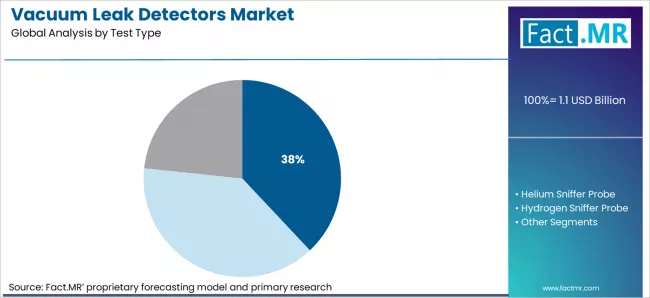
Vacuum Leak Detectors Market Analysis By Test Type | Source: Fact.MR
Helium spray probe detectors are estimated to hold about 38.0% share in 2026 due to ultra high sensitivity below 10⁻¹² mbar·l/s and precise leak localisation required in semiconductor and automotive applications.
- INFICON 42 Technology SMART Spray Handheld Microdispenser Launch December 2024 In December 2024, 42 Technology and INFICON launched SMART Spray, a handheld helium microdispenser compatible with UL series detectors. It reduces helium waste, improves sensitivity, and supports faster testing. [1]
- INFICON UL3000 Fab Semiconductor Leak Detector Launch June 2024 INFICON introduced UL3000 Fab in June 2024 for semiconductor cleanrooms with enhanced signal processing for ultra low leak detection in new fab projects. [2]
- Automotive EV Component Testing Driving Helium Spray Probe Integration EV platforms add battery housings and power electronics requiring leak testing. INFICON’s LDS3000 and UL1000 systems support rising EV related test points. [3]
Vacuum Leak Detectors Market Analysis by Modularity
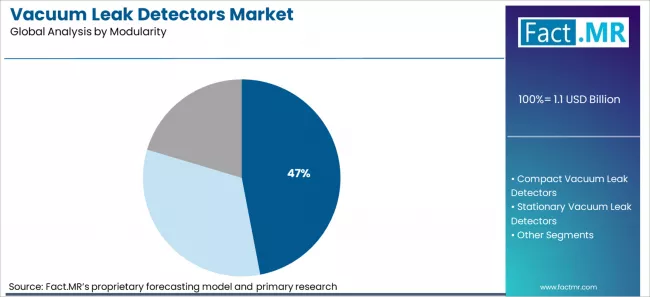
Vacuum Leak Detectors Market Analysis By Modularity | Source: Fact.MR
Portable detectors are estimated to hold about 47.0% share in 2026 as most semiconductor, aerospace, HVAC, and piping tests require moving the instrument to installed equipment.
- Pfeiffer Vacuum ASM 340 Portable Detector at Battery Show Europe 2025 In June 2025, Pfeiffer Vacuum showcased ASM 340 for EV battery testing, supporting both helium spray and hydrogen sniffing in one portable platform. [4]
- Busch Group AVT GmbH Acquisition Expanding Industrial Vacuum Service Footprint Busch Group acquired AVT GmbH in 2024 to strengthen vacuum service capability and integrated maintenance solutions supporting portable leak detection demand. [5]
- Pfeiffer Vacuum Portable Detector Deployment at SEMICON Korea 2025 At SEMICON Korea 2025, Busch Group presented portable leak detectors for semiconductor fabs serving major Korean chip manufacturers. [8]
Drivers, Restraints, and Opportunities
FACT.MR analysts note that the vacuum leak detectors market has historically tracked industrial output, automotive production, and semiconductor equipment cycles. Long replacement cycles and OEM qualification standards favour incumbent suppliers. Simultaneous semiconductor fab, EV gigafactory, and aerospace investment cycles are lifting growth.
The market is splitting between mature automotive and industrial uses growing at moderate rates and high growth semiconductor, EV battery, and aerospace applications demanding higher specification systems. Automotive spray systems face pricing pressure. Semiconductor UHV requirements below 10⁻¹² mbar·l/s support premium pricing for qualified suppliers.
- Semiconductor Fab Buildout Driving Helium Leak Detector Adoption: The US CHIPS Act and major fab projects from TSMC, Samsung, and Micron require extensive helium leak detection across process tools and vacuum systems. INFICON launched the UL3000 Fab in June 2024 targeting cleanroom qualification demand created by new fab construction.
- EV Battery Manufacturing Creating Hydrogen and Helium Accumulation Demand: Rapid global battery gigafactory expansion from CATL, BYD, Panasonic, LG Energy Solution, and Samsung SDI requires mandatory leak testing of every battery cell housing. Pfeiffer Vacuum introduced ASI 35 and HiScroll 46 systems in June 2025 for high throughput battery leak testing.
- Infineon Dresden Expansion and European Industrial Demand: Infineon’s EUR 5 billion Dresden expansion and new TSMC and STMicroelectronics investments are creating semiconductor grade detector demand in Europe. Germany’s automotive base sustains steady production line helium system demand from major OEMs. [6][7]
Regional Analysis
The vacuum leak detectors market is analysed across Asia Pacific, Europe, North America, Latin America, and Middle East and Africa, spanning over 40+ countries with distinct demand profiles shaped by semiconductor manufacturing investment scale, automotive production intensity, aerospace MRO activity, and industrial safety regulatory regimes. The full report offers market attractiveness analysis by region based on application mix, technology upgrade cycle timing, and regulatory compliance investment requirements.
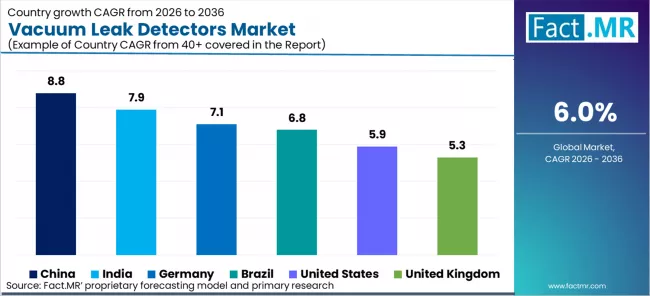
Vacuum Leak Detectors Market Cagr Analysis By Country | Source: Fact.MR
| Country | CAGR (2026-2036) |
|---|---|
| China | 8.8% |
| India | 7.9% |
| Germany | 7.1% |
| Brazil | 6.8% |
| United States | 5.9% |
| United Kingdom | 5.3% |
Source: Fact.MR analysis. Updated Mar 2, 2026
Source: Fact.MR (FACT.MR) analysis, based on proprietary forecasting model and primary research
Asia Pacific Vacuum Leak Detectors Market Analysis
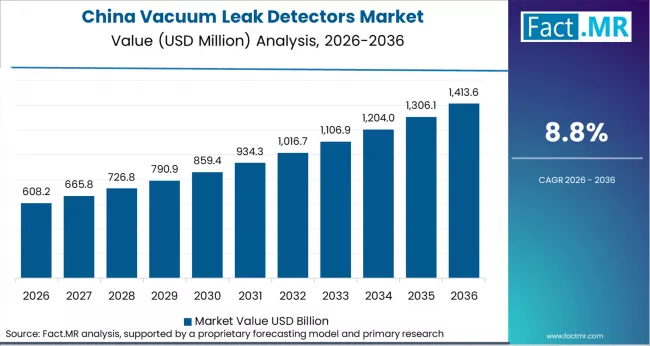
Vacuum Leak Detectors Market Country Value Analysis | Source: Fact.MR
Asia Pacific is the largest demand center, driven by semiconductor expansion, EV battery gigafactories, and rising industrial output. Global leaders serve premium semiconductor and automotive segments, while Chinese suppliers compete in standard industrial applications.
- China: Demand is projected to grow at 8.8% CAGR through 2036. Semiconductor expansion led by SMIC, CXMT, and Hua Hong under the Big Fund supports sustained leak detection demand across new fabs. Large scale EV battery production by CATL and BYD requires mandatory helium and hydrogen testing at each cell stage. Industrial energy and emissions regulations reinforce adoption of calibrated systems.
- India: Demand is projected to grow at 7.9% CAGR through 2036. India Semiconductor Mission incentives have attracted Tata Electronics, CG Power, and Micron assembly investments requiring vacuum based leak testing. Automotive production of 5.85 million vehicles annually sustains HVAC and EV battery inspection demand. AIS 040 HVAC standards mandate refrigerant leak validation.
FACT.MR covers China, Japan, South Korea, India, ASEAN, Australia and New Zealand, and Rest of Asia Pacific, including fab timelines, battery procurement, and competitive positioning.
Europe Vacuum Leak Detectors Market Analysis
Europe is a technology hub and home to leading manufacturers. Germany is the most strategic market due to automotive scale and new semiconductor investments.
- Germany: Demand is projected to grow at 7.1% CAGR through 2036. Infineon’s EUR 5 billion Dresden fab and TSMC’s EUR 10 billion project require semiconductor grade leak detection at installation and maintenance. Automotive Tier 1 suppliers sustain high volume helium spray system use. Battery testing platforms introduced in 2025 target EV demand.
- United Kingdom: Demand is projected to grow at 5.3% CAGR through 2036. Aerospace and defence manufacturing led by Rolls Royce, BAE Systems, and GKN Aerospace drives AS9100 compliant leak testing demand. Edwards Vacuum supports local aerospace and semiconductor users. ATI funding supports inspection technology upgrades.
FACT.MR covers Germany, France, the United Kingdom, Norway, Spain, the Netherlands, Nordics, and Rest of Europe including fab procurement, automotive upgrades, and aerospace compliance trends.
Latin America Vacuum Leak Detectors Market Analysis
Latin America is an emerging market led by Brazil’s automotive and petrochemical base. Regional distributors serve industrial and infrastructure demand.
- Brazil: Demand is projected to grow at 6.8% CAGR through 2036. Automotive output of 2.7 million vehicles annually sustains engine and HVAC leak testing. ANP pipeline regulations require periodic leak inspection in gas networks. BYD’s Camaçari battery plant adds future battery housing testing demand. INMETRO calibration updates reinforce traceable instrument use.
FACT.MR covers Brazil, Chile, Ecuador, and Rest of Latin America including automotive adoption and oil and gas regulatory frameworks.
North America Vacuum Leak Detectors Market Analysis
North America is a mature, high specification market driven by semiconductor fab construction, aerospace MRO, and automotive Tier 1 production.
- United States: Demand is projected to grow at 5.9% CAGR through 2036. CHIPS Act projects from TSMC, Micron, Samsung, and Intel are generating large scale helium leak detection installations. Defence manufacturing sustains aerospace grade portable and stationary detector demand. ASNT certification requirements support compliance driven equipment procurement.
FACT.MR covers the United States, Canada, and Mexico including fab timelines, aerospace MRO compliance, EV testing investment, and distribution networks.
Competitive Aligners for Market Players
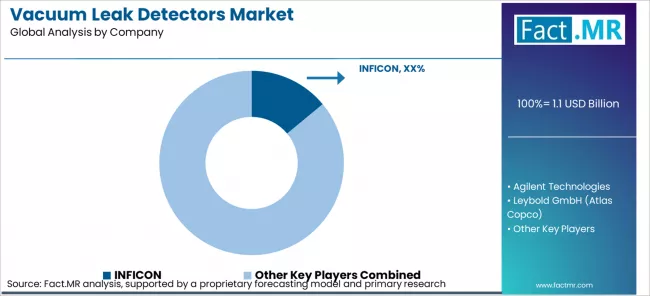
Vacuum Leak Detectors Market Analysis By Company | Source: Fact.MR
The global vacuum leak detectors market is concentrated in premium semiconductor and aerospace applications and fragmented in standard industrial and automotive segments. INFICON leads high sensitivity helium detection, especially in semiconductor and HVAC markets, supported by proprietary counterflow design, I CAL and HYDRO S algorithms, and SMART Spray integration. Pfeiffer Vacuum, under the Busch Group, holds a strong position with ASM 340 portable, ASI 35 accumulation, and HiScroll 46 integrated systems. Leybold and Edwards under Atlas Copco maintain European and North American presence. Agilent serves laboratory and semiconductor niches. Cincinnati Test Systems and ATEQ focus on turnkey production line systems.
Competitive advantage depends on sensor technology, signal processing software, and semiconductor qualification. INFICON’s I BOOST software improves detection speed and reduces cycle times, strengthening customer retention. Busch Group leverages pump and service integration, supported by AVT acquisition, to expand industrial reach.
Semiconductor and aerospace buyers follow strict qualification protocols, creating high switching costs. Once approved, detector replacement requires full requalification. Automotive Tier 1 suppliers typically standardize on one primary supplier per plant, reinforcing incumbent renewal advantages.
Recent Development
- In June 2025, Pfeiffer Vacuum's Busch Group presented the modular ASI 35 tracer gas leak detector and the HiScroll 46 integrated pump-detector system at Battery Show Europe in Stuttgart, specifically designed for EV battery cell housing leak testing in high-volume gigafactory production environments.
- In June 2024, INFICON introduced the UL3000 Fab next-generation helium leak detector optimised for semiconductor cleanroom environments with advanced signal processing and noise suppression, targeting the US CHIPS Act and European semiconductor fab construction pipeline requiring new vacuum leak detection infrastructure.
Key Players
- INFICON
- Agilent Technologies
- Leybold GmbH (Atlas Copco)
- Edwards Vacuum (Atlas Copco)
- Pfeiffer Vacuum (Busch Group)
- YAMAHA Corporation
- Cincinnati Test Systems
- ATEQ Corporation
Bibliography
- [1] 42 Technology / INFICON. (December 2024). 42T Helps INFICON Develop World's First Handheld Smart Helium Microdispenser: SMART-Spray Commercial Launch.
- [2] Fact.MR. (2024, June). INFICON Introduces UL3000 Fab Next-Generation Helium Leak Detector for Semiconductor Cleanroom Applications.
- [3] INFICON. (2024-2025). INFICON Automotive Leak Detection Portfolio: LDS3000 Automated Production-Line System and UL1000 Series Portable Helium Leak Detectors.
- [4] Pfeiffer Vacuum / Busch Group. (June 2025). Busch Group Presents Innovative Vacuum Solutions at Battery Show Europe 2025 in Stuttgart: ASI 35 Tracer Gas Leak Detector and HiScroll 46 Integrated Pump-Detector System for Battery Cell Housing Leak Testing.
- [5] Busch Group. (March 2024). New Busch Group Strengthens Portfolio with Pfeiffer Vacuum: Strategic Cooperation Bringing Together Busch Vacuum Solutions, Pfeiffer Vacuum, and centrotherm clean solutions.
- [6] Infineon Technologies. (2023-2025). Smart Power Fab Dresden EUR 5 Billion Investment: Construction Progress and 2026 Production Target for Automotive Power Semiconductors.
- [7] TSMC / Bosch / Infineon / NXP. (August 2024). TSMC Dresden EUR 10 Billion European Semiconductor Manufacturing Facility Announcement. Joint Press Release.
- [8] Pfeiffer Vacuum / Busch Group. (2025). Busch Group Presents Vacuum Solutions for Semiconductor Fabs at SEMICON Korea 2025. Pfeiffer Vacuum News and Media.
This Report Addresses
- Strategic intelligence on semiconductor fab procurement, EV battery leak testing demand, automotive helium spray upgrade cycles, aerospace MRO compliance, and positioning of INFICON, Pfeiffer Vacuum, Leybold, and Edwards Vacuum.
- Market size and forecast from USD 1.1 billion in 2026 to USD 1.9 billion by 2036 at 6.0% CAGR, segmented by test type, modularity, industry, and region.
- Growth mapping across US CHIPS Act fabs, Germany’s Dresden projects, India Semiconductor Mission facilities, China battery gigafactories, and UK and North America aerospace MRO upgrades.
- Country CAGR analysis for China 8.8%, India 7.9%, Germany 7.1%, Brazil 6.8%, United States 5.9%, United Kingdom 5.3%, and Japan 4.8%, with segment splits by region.
- Competitive assessment of INFICON, Pfeiffer Vacuum, Leybold, Edwards Vacuum, Agilent, Cincinnati Test Systems, and ATEQ across product depth, software capability, service reach, and OEM qualification.
- Technology tracking including SMART Spray December 2024, UL3000 Fab June 2024, ASI 35 and HiScroll 46 June 2025, I BOOST upgrades, and multi gas accumulation testing.
- Regulatory review covering CHIPS Act, EU policy, India Semiconductor Mission, ANSI AVS, AS9100, Nadcap, ISO 20485, and Brazil ANP standards.
- Delivery in PDF, Excel, PowerPoint, and interactive dashboard formats supported by verified industry and regulatory sources.
Segmentation
Scope of Report
| Items | Values |
|---|---|
| Quantitative Units | USD 1.1 billion (2026) to USD 1.9 billion (2036), at a CAGR of 6.0% |
| Market Definition | Vacuum leak detectors are precision instruments that measure gas leakage under vacuum or pressure using helium, hydrogen, or ultrasonic methods. They are deployed in portable and stationary formats across semiconductor, automotive, aerospace MRO, HVAC, packaging, piping, shipbuilding, and aircraft manufacturing applications. |
| Test Type Segmentation | Helium Spray Probe Vacuum Leak Detectors (38.0%), Helium Sniffer Probe Vacuum Leak Detectors, Hydrogen Sniffer Probe Vacuum Leak Detectors, Ultrasonic Vacuum Leak Detectors |
| Modularity Segmentation | Portable Vacuum Leak Detectors (47.0%), Compact Vacuum Leak Detectors, Stationary Vacuum Leak Detectors |
| Industry Segmentation | Vacuum Leak Detectors for Automobile Manufacturing (27.0%), Vessel Manufacturing, Radiator Manufacturing, Mechanical Industries, Packaging Industries, Piping Industries, Ship Manufacturing, Aircraft Manufacturing |
| Application Coverage | Semiconductor chamber qualification and maintenance, EV battery housing production testing, automotive HVAC and engine 100% inspection, aerospace fuel and hydraulic MRO testing, industrial piping and vessel verification, packaging seal checks, ship hull and HVAC inspection, and aircraft fuel and hydraulic system qualification. |
| Regions Covered | Asia Pacific, Europe, North America, Latin America, Middle East and Africa |
| Countries Covered | China, Japan, South Korea, India, Australia and New Zealand, ASEAN, Rest of Asia Pacific, Germany, United Kingdom, France, Norway, Spain, Netherlands, Nordics, Rest of Europe, United States, Canada, Mexico, Brazil, Chile, Ecuador, Rest of Latin America, Kingdom of Saudi Arabia, United Arab Emirates, South Africa, Turkey, Rest of Middle East and Africa |
| Key Companies Profiled | INFICON, Agilent Technologies, Leybold GmbH (Atlas Copco), Edwards Vacuum (Atlas Copco), Pfeiffer Vacuum (Busch Group), YAMAHA Corporation, Cincinnati Test Systems, ATEQ Corporation |
| Forecast Period | 2026 to 2036 |
| Approach | A hybrid top down and bottom up model was used. Top down inputs included semiconductor equipment spending from SEMI, automotive output from OICA, and aerospace MRO benchmarks. Bottom up inputs covered average unit prices by type, replacement cycles, detector attach rates per line, and demand from new semiconductor fabs and EV battery plants validated through primary interviews. |
Source: Fact.MR analysis. Updated Mar 2, 2026
Vacuum Leak Detectors Market by Segment
-
By Test Type :
- Helium Spray Probe Vacuum Leak Detectors
- Helium Sniffer Probe Vacuum Leak Detectors
- Hydrogen Sniffer Probe Vacuum Leak Detectors
- Ultrasonic Vacuum Leak Detectors
-
By Modularity :
- Portable Vacuum Leak Detectors
- Compact Vacuum Leak Detectors
- Stationary Vacuum Leak Detectors
-
By Industry :
- Vacuum Leak Detectors for Automobile Manufacturing
- Vacuum Leak Detectors for Vessel Manufacturing
- Vacuum Leak Detectors for Radiator Manufacturing
- Vacuum Leak Detectors for Mechanical Industries
- Vacuum Leak Detectors for Packaging Industries
- Vacuum Leak Detectors for Piping Industries
- Vacuum Leak Detectors for Ship Manufacturing
- Vacuum Leak Detectors for Aircraft Manufacturing
-
By Region :
- North America
- United States
- Canada
- Mexico
- Europe
- Germany
- United Kingdom
- France
- Norway
- Spain
- Netherlands
- Nordics
- Rest of Europe
- Asia Pacific
- China
- Japan
- South Korea
- India
- Australia and New Zealand
- ASEAN
- Rest of Asia Pacific
- Latin America
- Brazil
- Chile
- Ecuador
- Rest of Latin America
- Middle East and Africa
- Kingdom of Saudi Arabia
- United Arab Emirates
- South Africa
- Turkey
- Rest of Middle East and Africa
- North America
Who worked on this report


Preview the report firsthand - request a free sample
Free SampleGet the brochure for pricing and purchase details
Download PDF