- Base Value(2026): 0.6 Bn
- Estimated Value(2026): 0.6 Bn
- Forecast Value (2036): 1.2 Bn
- CAGR (2026 - 2036): 7.6%
Ventilated Balance Enclosure Market Forecast and Outlook 2026 to 2036
The global ventilated balance enclosure market is projected to total USD 0.59 billion in 2026, advancing to USD 1.23 billion by 2036, achieving a compound annual growth rate of 7.6%. Growth is sustained by stringent regulatory requirements for laboratory safety and the critical need to protect both sensitive weighing operations and personnel from hazardous particulates and powders.
Key Takeaways from the Ventilated Balance Enclosure Market
- Market Value for 2026: USD 0.59 Billion
- Market Value for 2036: USD 1.23 Billion
- Forecast CAGR 2026 to 2036: 7.6%
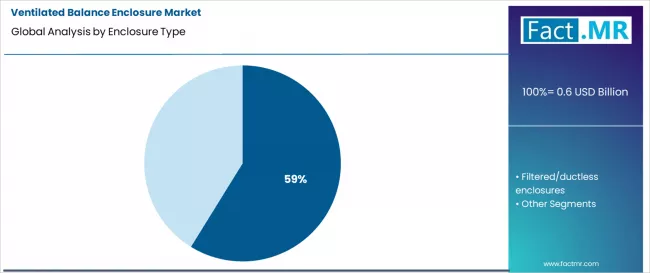
- Leading Enclosure Type Segment (2026): Ducted Balance Enclosures (58.8%)
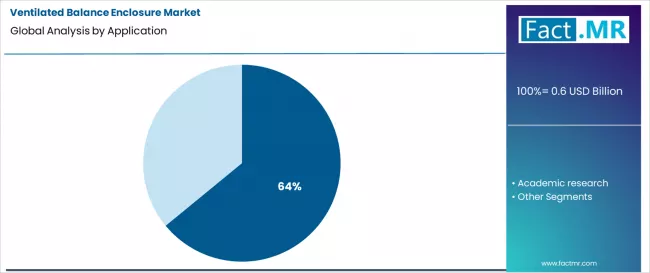
- Leading Application Segment (2026): Pharma & Biotech Labs (64.1%)
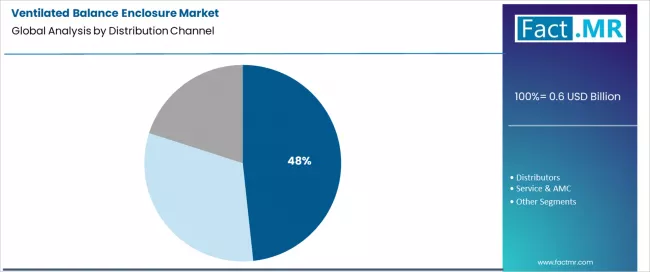
- Leading Distribution Channel Segment (2026): Direct Sales (48.3%)
- Key Growth Countries: India (11.2% CAGR), China (11.0% CAGR), Brazil (10.5% CAGR), USA (10.0% CAGR), UK (8.3% CAGR)
- Key Players in the Market: Labconco, Thermo Fisher Scientific, Erlab, Esco, Air Science, Others
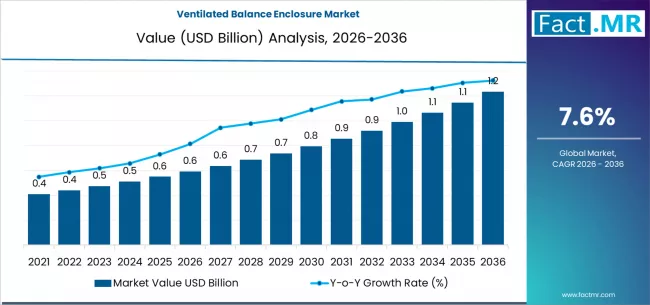
Ventilated Balance Enclosure Market Market Value Analysis | Source: Fact.MR
The market is defined by the dominance of ducted balance enclosures, which hold a 58.8% share due to their high containment efficiency, primarily serving the demanding needs of pharmaceutical and biotechnology laboratories that account for 64.1% of application demand. Nearly half of all products are sold through direct sales channels, representing 48.3% of distribution, highlighting the preference for manufacturer-led specification and installation support.
Geographically, India and China show the highest growth momentum with CAGRs of 11.2% and 11.0% respectively, driven by rapid expansion in their domestic life sciences sectors. Brazil follows at 10.5%, with the USA at 10.0%, while the UK grows at 8.3%. Demand is fundamentally linked to the global increase in pharmaceutical R&D expenditure, the proliferation of high-potency active pharmaceutical ingredient handling, and the modernization of academic and industrial research infrastructure seeking to enhance operational safety and data integrity.
Metric
| Metric | Value |
|---|---|
| Market Value (2026) | USD 0.59 Billion |
| Market Forecast Value (2036) | USD 1.23 Billion |
| Forecast CAGR 2026 to 2036 | 7.6% |
Source: Fact.MR analysis. Updated Jan 9, 2026
Category
| Category | Segments |
|---|---|
| Enclosure Type | Ducted Balance Enclosures, Filtered/Ductless Enclosures |
| Application | Pharma & Biotech Labs, Academic Research |
| Distribution Channel | Direct Sales, Distributors, Service & AMC |
| Region | North America, Latin America, Western Europe, Eastern Europe, East Asia, South Asia & Pacific, MEA |
Source: Fact.MR analysis. Updated Jan 9, 2026
Segmental Analysis
By Enclosure Type, Which System is Preferred for High-Hazard Containment?
Ventilated Balance Enclosure Market Analysis By Enclosure Type | Source: Fact.MR
Ducted balance enclosures command a dominant 58.8% share. This preference is rooted in their superior ability to provide maximum containment for highly toxic or potent compounds by directly exhausting contaminated air outside the laboratory.
Ducted enclosures are the gold standard in pharmaceutical manufacturing and advanced research settings. These enclosures are beneficial in safeguarding operator health and preventing cross-contamination are non-negotiable, despite requiring more complex building infrastructure for installation.
By Application, Which Sector Drives Stringent Performance Specifications?
Ventilated Balance Enclosure Market Analysis By Application | Source: Fact.MR
The pharmaceutical and biotechnology laboratory segment is the leading application with a 64.1% share. This sector operates under the strictest good manufacturing practice and occupational safety regulations, mandating the use of engineered controls like ventilated enclosures for weighing active ingredients. The high value of materials and the critical nature of dose accuracy in this field create a mandatory, compliance-driven demand for high-performance enclosure systems.
By Distribution Channel, Which Route Supports Complex Integration?
Ventilated Balance Enclosure Market Analysis By Distribution Channel | Source: Fact.MR
Direct sales from manufacturers constitute the primary channel, holding a 48.3% share. Given the technical complexity of integrating enclosures with laboratory HVAC systems and the need for precise airflow validation, end-users in regulated industries rely on direct engagement with OEMs. This ensures correct specification, proper installation, and direct accountability for performance, which is crucial for passing facility audits and safety certifications.
What are the Principal Drivers, Constraints, and Evolving Dynamics of this Market?
| Attribute | Analysis |
|---|---|
| Global Enforcement of Stringent Lab Safety Regulations | Encourages compliance-mandated demand across pharmaceutical and chemical research, as regulatory bodies worldwide enforce stricter exposure limits for hazardous powders, necessitating engineered containment solutions. |
| High Installation Cost and Infrastructure Dependency | Ducted systems require expensive building modifications, posing a significant barrier for smaller labs, academic facilities, and retrofit projects with budget or spatial constraints. |
| Rise of Flexible and Modular Lab Designs | Demand is rising for ductless filtered enclosures offering easier reconfiguration and portability. These cater to the growing trend of open-plan, adaptable research spaces in both industry and academia. |
| Integration with Smart Lab and IoT Monitoring | Embedding sensors for real-time airflow monitoring, filter life indication, and usage logging transform enclosures into connected devices supporting data integrity and predictive maintenance. |
Source: Fact.MR analysis. Updated Jan 9, 2026
Analysis of the Ventilated Balance Enclosure Market by Key Countries
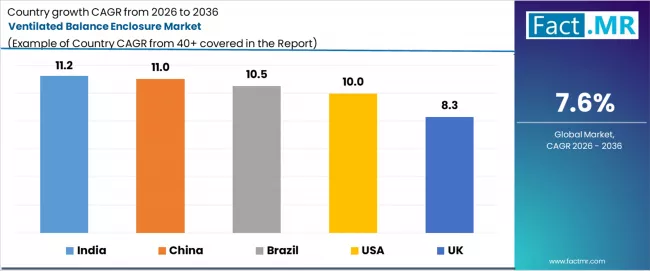
Ventilated Balance Enclosure Market Cagr Analysis By Country | Source: Fact.MR
| Country | CAGR 2026 to 2036 |
|---|---|
| India | 11.2% |
| China | 11.0% |
| Brazil | 10.5% |
| USA | 10.0% |
Source: Fact.MR analysis. Updated Jan 9, 2026
How is India's Growth in Generic Pharma and CROs Influencing Demand?
India's leading CAGR of 11.2% is propelled by its position as a global hub for generic pharmaceutical manufacturing and a rapidly expanding contract research organization sector. Growth is driven by the need for these facilities to upgrade their laboratories to comply with international regulatory standards from the US FDA and European EMA to secure export approvals.
This has triggered significant investment in modern lab infrastructure, where ventilated enclosures are a critical component for worker safety and product quality assurance, creating sustained demand from both new facilities and retrofits.
What Strategic Developments Underpin China's Domestic Market Expansion?
China's 11.0% CAGR is driven by a strategic shift towards innovative drug discovery and biopharmaceuticals, moving beyond its traditional manufacturing base. This transition is accompanied by massive state and private investment in new research parks and bio-clusters.
The growth in demand for ventilated enclosures is closely tied to this qualitative upgrade in research capabilities, where cutting-edge labs require high-containment equipment. Furthermore, increasing environmental and workplace safety regulations within China are enforcing higher standards in domestic chemical and pharmaceutical operations.
Why does Brazil's Evolving Regulatory and Research Landscape Drive Growth?
Brazil's 10.5% CAGR is linked to the strengthening of its national health surveillance agency, ANVISA, and its alignment with international laboratory practice guidelines. This regulatory tightening compels domestic pharma companies and public research institutes to invest in proper containment equipment.
Growth in agricultural biotechnology and cosmetic chemistry sectors, which also handle fine particulates, contributes to a broader-based demand for ventilated enclosures beyond traditional pharma, supporting market diversification.
How does the USA's Mature but Innovating Bio-Pharma Sector Sustain Demand?
The USA's strong 10.0% CAGR is sustained by its mature yet dynamic life sciences sector. While replacement and upgrade cycles in existing pharmaceutical plants provide a steady baseline, the primary growth driver is the prolific biotechnology and cell therapy startup ecosystem.
These companies, often working with novel and potent compounds, build new facilities from the ground up with the latest safety standards, incorporating advanced ventilated enclosures as a default specification. Furthermore, updated OSHA and NIOSH guidelines continue to push for higher levels of engineering controls in laboratories.
What characterizes the UK's Focus on Laboratory Quality and Renovation?
The UK's growth at 8.3% is characterized by a strong focus on research quality and the renovation of existing university and life sciences infrastructure. Demand is driven less by new greenfield construction and more by the retrofit of older academic and pharmaceutical research labs to meet modern COSHH regulations and enhance safety.
The market is also influenced by the presence of many specialized CROs and biotech firms that require high-quality, compact containment solutions for their often space-constrained facilities, favoring technically advanced, ductless options.
Competitive Landscape of the Ventilated Balance Enclosure Market
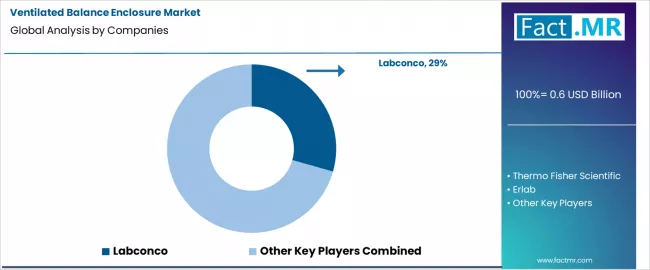
Ventilated Balance Enclosure Market Analysis By Company | Source: Fact.MR
The competitive landscape includes established specialists in laboratory containment and large diversified laboratory equipment suppliers. Competition centers on technical expertise in airflow design, material compatibility, and the ability to provide validated performance documentation for regulated customers. Success increasingly depends on offering a full spectrum of services from design consultation to certification.
| Strategic Imperative | Rationale & Action |
|---|---|
| Develop Hybrid and Flexible Containment Solutions | Innovate in enclosures that can switch between ducted and ductless modes or easily integrate with modular lab furniture to serve the growing demand for adaptable, future-proof laboratory spaces. |
| Expand and Digitize Service and Validation Offerings | Build a strong service arm offering installation qualification, operational qualification, and annual performance re-certification. Integrate these services with digital platforms for remote monitoring and compliance reporting. |
| Target Growth in Biologics and Advanced Therapy Sectors | Develop specialized enclosure solutions tailored for the unique needs of cell and gene therapy labs, such as aseptic weighing applications or containment for viral vectors, which represent a high-value niche. |
| Strengthen Partnerships with Lab Design and Build Firms | Form strategic alliances with architectural and engineering firms that design research facilities. Becoming a specified partner at the design phase can secure large-scale projects in both emerging and mature markets. |
Source: Fact.MR analysis. Updated Jan 9, 2026
Key Players in the Ventilated Balance Enclosure Market
- Labconco
- Thermo Fisher Scientific
- Erlab
- Esco
- Air Science
- Others
Bibliography
- American Conference of Governmental Industrial Hygienists. (2025).Threshold Limit Values and Biological Exposure Indices. ACGIH.
- International Society for Pharmaceutical Engineering. (2024).ISPE Baseline Guide: Sterile Product Manufacturing Facilities. ISPE.
- Occupational Safety and Health Administration. (2025).Laboratory Safety Guidance. OSHA.
- Scientific Equipment and Furniture Association. (2024).Recommended Practices for Laboratory Ventilated Enclosures. SEFA.
- World Health Organization. (2025).Laboratory Biosafety Manual, Fourth Edition. WHO.
Segmentation
Scope of Report
| Items | Values |
|---|---|
| Quantitative Units | USD Billion |
| Enclosure Type | Ducted Balance Enclosures, Filtered/Ductless Enclosures |
| Application | Pharma & Biotech Labs, Academic Research |
| Distribution Channel | Direct Sales, Distributors, Service & AMC |
| Key Countries | India, China, Brazil, USA, UK |
| Key Companies | Labconco, Thermo Fisher Scientific, Erlab, Esco, Air Science, Others |
| Additional Analysis | Comparative analysis of containment performance and energy consumption; study of total cost of ownership for ducted vs. ductless systems; impact of international standards on product design and testing; risk assessment for handling novel compounds like nanomaterials; analysis of filter technology advancements for hazardous particulates. |
Source: Fact.MR analysis. Updated Jan 9, 2026
Market by Segments
-
Enclosure Type :
- Ducted Balance Enclosures
- Filtered/Ductless Enclosures
-
Application :
- Pharma & Biotech Labs
- Academic Research
-
Distribution Channel :
- Direct Sales
- Distributors
- Service & AMC
-
Region :
-
North America
- USA
- Canada
-
Latin America
- Brazil
- Mexico
- Argentina
- Rest of Latin America
-
Western Europe
- Germany
- France
- Italy
- Spain
- UK
- BENELUX
- Rest of Western Europe
-
Eastern Europe
- Russia
- Poland
- Czech Republic
- Rest of Eastern Europe
-
East Asia
- China
- Japan
- South Korea
- Rest of East Asia
-
South Asia & Pacific
- India
- ASEAN
- Australia
- Rest of South Asia & Pacific
-
MEA
- GCC Countries
- South Africa
- Turkiye
- Rest of MEA
-
Frequently Asked Questions
How big is the ventilated balance enclosure market in 2026?
What will be the size of ventilated balance enclosure market in 2036?
How much will be the ventilated balance enclosure market growth between 2026 and 2036?
What are the key product types in the ventilated balance enclosure market?
Which application segment to contribute significant share in the ventilated balance enclosure market in 2026?
Who worked on this report


Preview the report firsthand - request a free sample
Free SampleGet the brochure for pricing and purchase details
Download PDF