- Market Value (2025): USD 339.2 Mn
- Estimated Value (2026): USD 363.4 Mn
- Forecast Value (2036): USD 725.0 Mn
- CAGR (2026-2036): 7.2%
What is the Volute Sludge Dewatering Machine Market forecast to be worth by 2036?
USD 363.4 million in 2026 to USD 725.0 million by 2036 at a 7.2% CAGR.
- Volute sludge dewatering machine revenue totalled USD 339.2 million in 2025, with municipal plants placing most of the orders.
- Market value will grow from USD 363.4 million in 2026 to USD 725.0 million by 2036 as utilities replace older belt presses and add capacity at expanded plants.
- A 7.2% CAGR for 2026 to 2036 reflects steady public funding for sewage treatment and a wider industrial user base.
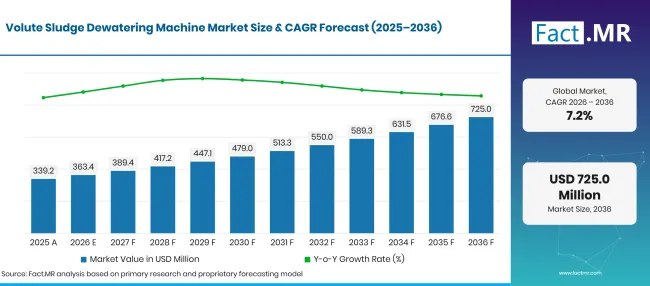
Volute Sludge Dewatering Machine Market Forecast Global | Source: Fact.MR
| Year | Basis | Market Value (USD million) |
|---|---|---|
| 2025 | Actual | 339.2 |
| 2026 | Estimate | 363.4 |
| 2036 | Forecast | 725.0 |
| CAGR 2026 to 2036 | Forecast period | 7.2% |
Source: Fact.MR analysis. Updated Nov 2, 2026
What are the defining numbers behind Volute Sludge Dewatering Machine Market growth?
Between 2026 and 2036, the market gains USD 361.6 million in new value, led by municipal plant upgrades and industrial sludge reduction.
- Demand Drivers in the Market
- New sewage capacity creates new sludge to treat. India completed 11 projects in 2025 that created or rehabilitated 359 MLD of sewage treatment capacity under the National Mission for Clean Ganga [1]. Each plant of this kind needs a dewatering step before sludge leaves the site.
- Stricter rules in Europe lift the bar for treatment plants. The revised EU Urban Wastewater Treatment Directive entered into force on 1 January 2025 and includes the recovery of valuable resources from wastewater among its aims [2]. Drier sludge cake makes reuse, drying and incineration cheaper.
- Wastewater now leads environmental spending in the EU. Eurostat reports that wastewater accounted for 37.7% of total EU environmental protection investment in 2025, while corporations spent EUR 49.6 billion on environmental protection that year [3]. Part of that spend goes to on-site sludge handling at factories.
- Large loans now fund sludge treatment directly. The European Investment Bank signed EUR 265 million in July 2025 for a Flanders wastewater programme that includes two sludge dryers working on residual heat [4]. Dryers of this type run best when the incoming cake has already been mechanically dewatered.
- Key Segments Analyzed
- By Product Type: Fully Automatic will hold 61.4% share in 2026, since plants want feed, polymer dosing and cake discharge controlled without an operator on the floor.
- By Application: Municipal will account for 53.8% of 2026 value because public sewage works produce sludge every day of the year.
- By End-User: Wastewater Treatment Plants will capture 48.6% of 2026 revenue, as dedicated treatment sites run the longest dewatering hours.
- By Distribution Channel: Direct Sales will command 56.4% of 2026 sales, given that each order needs sludge testing and site engineering by the maker.
- Analyst Opinion at Fact.MR
- Shambhu Nath Jha, Principal Consultant at Fact.MR, states, “Operators no longer judge a volute press by its nameplate flow; they ask how dry the cake will be on their own sludge and how much polymer it takes to get there. Suppliers that prove those two numbers on site trials will win the municipal replacement cycle in Europe and North America. Containerised and skid-mounted units will also open small towns and food plants that never had room for a dewatering building.”
- Strategic Implications
- Manufacturers should report dry solids throughput and cake dryness from trials on the buyer’s own sludge, since hydraulic capacity alone no longer wins tenders.
- Distributors should stock wear rings, screws and polymer units, because uptime decides repeat orders in regions far from the factory.
- Utilities should compare polymer use and power draw over the full service life when they replace belt presses.
- Investors should track packaged and mobile units, which let plants add dewatering without new civil works.
Germany leads the five countries at 8.4%, with almost all sewage sludge now heading to thermal treatment and a growing need for dry cake. Brazil follows at 7.7%, where new sewage works funded by federal sanitation programmes start from a low base of mechanical dewatering. The United States, at 6.9%, grows through replacement at existing plants funded by state revolving loans. A fixed 2025 to 2030 investment cycle in England keeps the United Kingdom at 6.2%. Japan closes the group at 5.5%, since its plants already dewater and reuse most sludge and buy mainly for replacement.
How does the Volute Sludge Dewatering Machine Market break down by segment?
Fully Automatic will lead Product Type at 61.4%; Municipal will head Application at 53.8%; Wastewater Treatment Plants will hold End-User at 48.6%; Direct Sales will lead Distribution Channel at 56.4% in 2026.
Which Product Type leads?
Fully Automatic machines take 61.4% of 2026 sales.
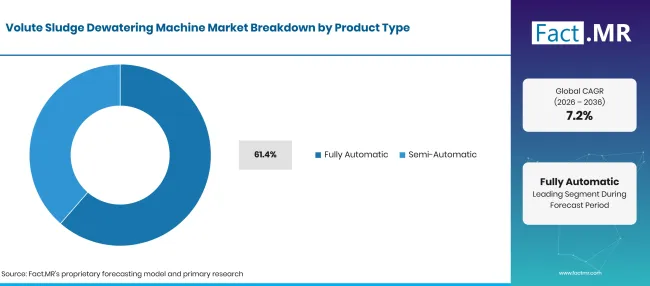
Volute Sludge Dewatering Machine Market Breakdown Product Type | Source: Fact.MR
| Product Type | Share (2026) |
|---|---|
| Fully Automatic (Leading segment) | 61.4% |
| Other segments combined | 38.6%* |
| Total | 100.0% |
Source: Fact.MR analysis. Updated Nov 2, 2026
Plants that run around the clock cannot keep an operator next to the press. Automatic units read the incoming sludge concentration, adjust the screw speed and polymer dose, and restart after an alarm without help. Many buyers pair them with a sludge dewatering equipment review to replace older belt presses that need constant washing and tension checks. Semi-automatic models remain a fit for small sites with short daily runs and a staff member on hand. They cost less to buy and are simpler to repair, which suits rural utilities and small factories. The choice comes down to running hours, staffing and how much the sludge varies from day to day.
What supports Municipal within Application?
Municipal use accounts for 53.8% of 2026 revenue.
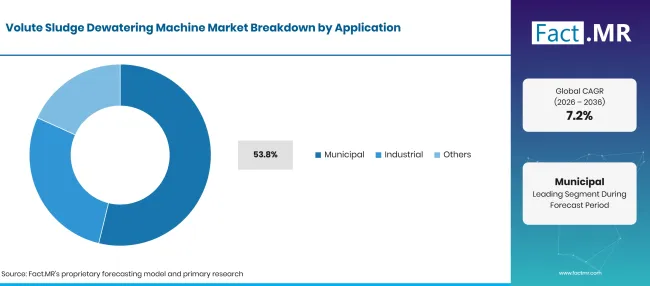
Volute Sludge Dewatering Machine Market Breakdown Application | Source: Fact.MR
| Application | Share (2026) |
|---|---|
| Municipal (Leading segment) | 53.8% |
| Other segments combined | 46.2%* |
| Total | 100.0% |
Source: Fact.MR analysis. Updated Nov 2, 2026
Sewage works receive wastewater every day, so their sludge flow never stops and dewatering is a fixed part of plant work. Major plant projects keep this demand fresh. In March 2026, the European Investment Bank agreed a SEK 5 billion loan, about EUR 470 million, to expand and modernise Stockholm’s Henriksdal treatment plant [5]. Upgrades of this kind often reset the dewatering and sludge treatment chemicals plan at the same time. Industrial use is smaller and more varied. Fatty dairy sludge, oily food residues and chemical precipitates each need a different ring gap and polymer. Others include landfill leachate, livestock and mining sites that buy fewer units.
How does End-User shape demand?
Wastewater Treatment Plants represent 48.6% of 2026 value.
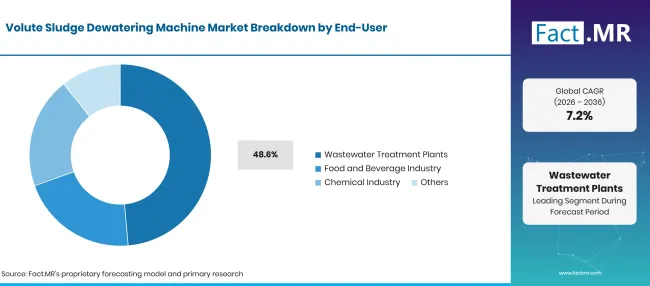
Volute Sludge Dewatering Machine Market Breakdown End User | Source: Fact.MR
| End-User | Share (2026) |
|---|---|
| Wastewater Treatment Plants (Leading segment) | 48.6% |
| Other segments combined | 51.4%* |
| Total | 100.0% |
Source: Fact.MR analysis. Updated Nov 2, 2026
Treatment plants run dewatering for the longest hours of any user group, so they replace and add machines most often. Utilities compare volute presses with decanter centrifuges on power use, noise and the skill needed to run them. Volute units tend to win at small and mid-sized plants where staff numbers are low. Food and beverage plants handle biological sludge with fats and oils, while chemical plants handle precipitation residues. These profiles change the machine size and polymer type, and many sites order a trial unit before they commit.
How does Distribution Channel shape demand?
Direct Sales generate 56.4% of 2026 revenue.
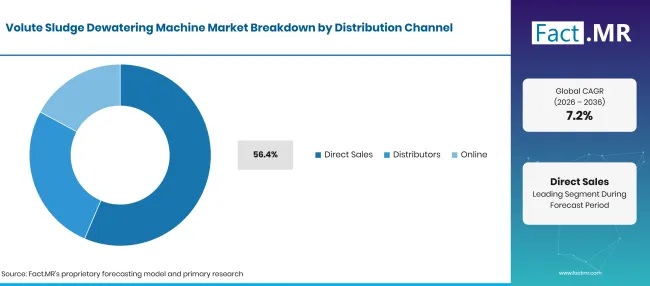
Volute Sludge Dewatering Machine Market Breakdown Distribution Channel | Source: Fact.MR
| Distribution Channel | Share (2026) |
|---|---|
| Direct Sales (Leading segment) | 56.4% |
| Other segments combined | 43.6%* |
| Total | 100.0% |
Source: Fact.MR analysis. Updated Nov 2, 2026
Every installation starts with sludge tests, a site survey and a plan for pumps, polymer make-up and cake handling. Manufacturers prefer to run these steps themselves, and public tenders usually ask for the maker’s own guarantee on cake dryness. Many projects also bring a screw conveyor into the same order to move cake to a skip or dryer. Distributors give regional access to spare parts and service, mainly where the maker has no local office. Online channels help buyers compare models and send enquiries, but complete units still close through direct technical talks.
What is accelerating Volute Sludge Dewatering Machine Market adoption, and what is holding it back?
Added sewage capacity, stricter rules on sludge in Europe and the wish to run plants with fewer staff all favour compact automatic presses. High upfront cost for a complete package, sludge that changes from season to season and polymer bills hold some buyers back. Centrifuges and belt presses also keep their place at very large plants.
Drivers Impact Analysis
| DRIVER | (~) % IMPACT ON CAGR | GEOGRAPHIC RELEVANCE | IMPACT TIMELINE |
|---|---|---|---|
| Upgrades of municipal treatment plants and replacement of older dewatering equipment | +2.1% | Global | Medium term (2-4 years) |
| Growing sludge loads at food, beverage and chemical plants | +1.4% | Global | Medium term (2-4 years) |
| Preference for automatic equipment that needs little operator time | +1.0% | Global | Short term (<=2 years) |
| New sewage collection and treatment capacity in developing economies | +0.8% | Latin America, South Asia & Pacific | Long term (>=4 years) |
Source: Fact.MR analysis. Updated Nov 2, 2026
Opportunity Impact Analysis
| OPPORTUNITY | (~) % IMPACT ON CAGR | GEOGRAPHIC RELEVANCE | IMPACT TIMELINE |
|---|---|---|---|
| Compact units for municipal plants with little installation space | +0.7% | Western Europe, East Asia | Medium term (2-4 years) |
| Integrated polymer dosing and sludge conditioning packages | +0.6% | Global | Medium term (2-4 years) |
| Food processing and chemical sludge applications | +0.5% | North America, Western Europe, East Asia | Short term (<=2 years) |
| Decentralised treatment and small municipal sites | +0.3% | Latin America, South Asia & Pacific | Long term (>=4 years) |
Source: Fact.MR analysis. Updated Nov 2, 2026
Restraints Impact Analysis
| RESTRAINT | (~) % IMPACT ON CAGR | GEOGRAPHIC RELEVANCE | IMPACT TIMELINE |
|---|---|---|---|
| High upfront cost of complete dewatering packages | -0.5% | Global | Short term (<=2 years) |
| Changing sludge properties that need site-specific conditioning | -0.3% | Global | Medium term (2-4 years) |
| Competition from centrifuges and belt presses at large plants | -0.2% | North America, Western Europe, East Asia | Long term (>=4 years) |
| Recurring polymer and maintenance costs | -0.2% | Global | Short term (<=2 years) |
Source: Fact.MR analysis. Updated Nov 2, 2026
Which countries are scaling the Volute Sludge Dewatering Machine Market through 2036?
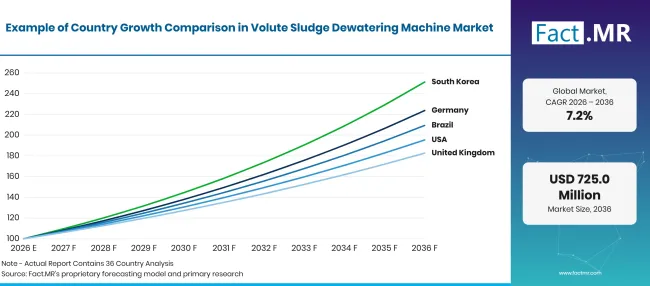
Volute Sludge Dewatering Machine Market Growth Index | Source: Fact.MR
| Country | CAGR (2026 to 2036) |
|---|---|
| Germany | 8.4% |
| Brazil | 7.7% |
| United States | 6.9% |
| United Kingdom | 6.2% |
| Japan | 5.5% |
Source: Fact.MR analysis. Updated Nov 2, 2026
What supports Germany’s adoption?
8.4% CAGR, driven by thermal sludge disposal that rewards drier cake.
Public treatment plants in Germany disposed of about 1.67 million tonnes of sewage sludge in 2024, and the share sent to thermal treatment rose to 82% that year, according to Destatis [6]. Every point of extra dryness cuts the fuel and haulage cost of that route. Mid-sized plants that once spread sludge on fields now need dewatering that can feed an incinerator or mono-combustion plant.
How is Brazil developing demand?
7.7% CAGR, backed by federal sanitation funding for new sewage works.
Brazil’s Novo PAC directed BRL 22.1 billion to sanitation in 2025, and 255 projects worth BRL 8.1 billion were contracted during the year [7]. New sewage works in mid-sized cities often run with small staff teams. Compact automatic presses suit these sites, and many will buy their first mechanical dewatering unit during the forecast period.
What is supporting United States adoption?
6.9% CAGR, helped by state revolving loans for plant renewal.
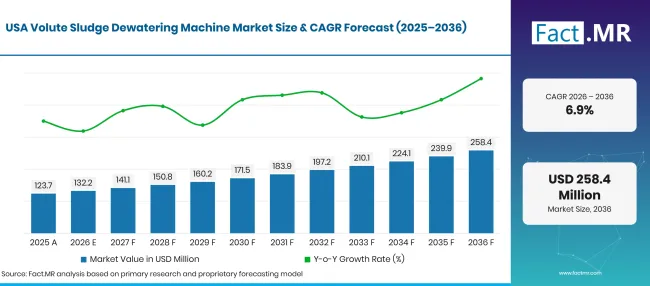
Volute Sludge Dewatering Machine Market Forecast Usa | Source: Fact.MR
EPA allotment tables for fiscal year 2026 put the Clean Water State Revolving Fund at USD 3.57 billion, combining base funding with Infrastructure Investment and Jobs Act money [8]. Small and rural utilities draw on these loans to replace worn belt presses and drying beds. Low-speed volute units appeal to them because they run with little noise and little wash water.
How is the United Kingdom developing demand?
6.2% CAGR, as England’s water companies spend a fixed five-year wastewater budget.
Water and sewerage companies in England have GBP 50.45 billion to spend on wastewater between 2025 and 2030, and they dispatched 873,522 tonnes of sewage sludge on a dry-solids basis in 2025, the Environment Agency reports [9]. Cake quality and odour control shape equipment choice at these sites. Satellite works that send liquid sludge by tanker are a clear target for small presses.
What supports Japan’s adoption?
5.5% CAGR, reflecting a mature network that buys mainly for replacement.
Japan generated about 76.82 million tonnes of sewage sludge in FY2024 on a concentrated-sludge basis, and 76% was put to effective use on a dry-weight basis, according to the Ministry of the Environment [10]. With most sludge already dewatered and reused, new orders come from renewing older machines at small plants and from food factories.
Who leads the Volute Sludge Dewatering Machine Market?
The field splits into two tiers that compete on different ground. Ring-type screw press specialists, AMCON, PWTech, Esmil and Benenv, sell the volute or multi-disc design as their core product and compete on low power use, self-cleaning rings and quick installation. Larger separation groups, HUBER SE and ANDRITZ, offer screw presses alongside centrifuges and belt presses, so they win where a utility wants one supplier for a whole sludge line.
HUBER ran a webinar on its Q-PRESS screw press for biosolids managers in May 2025, comparing it with other dewatering methods [11]. Benenv took an integrated skid-mounted sludge dewatering system to IFAT in Munich in May 2026 [12]. AMCON set out a plug-and-play containerised VOLUTE unit in July 2026, built for plants with no room for a new building [13]. The next round of competition will turn on proven cake dryness, polymer savings and how fast a press can start work on site.
Which companies are the key providers?
Key companies in the Volute Sludge Dewatering Machine Market include AMCON, PWTech, HUBER SE, Esmil, Benenv and ANDRITZ.
- AMCON
- PWTech
- HUBER SE
- Esmil
- Benenv
- ANDRITZ
How is the market segmented?
-
By Product Type
- Fully Automatic
- Semi-Automatic
-
By Application
- Municipal
- Industrial
- Others
-
By End-User
- Wastewater Treatment Plants
- Food and Beverage Industry
- Chemical Industry
- Others
-
By Distribution Channel
- Direct Sales
- Distributors
- Online
-
By Region
- North America
- Latin America
- Western Europe
- Eastern Europe
- East Asia
- South Asia & Pacific
- Middle East & Africa
Bibliography
- [1] Press Information Bureau. (2025, December 30). Achievements of the DoWR, RD & GR for the year 2025.
- [2] European Commission. (2026). Urban wastewater.
- [3] Eurostat. (2026, June 24). Wastewater drives investments in environmental protection.
- [4] European Investment Bank. (2025, July 31). Flanders smart wastewater & sludge management.
- [5] European Investment Bank. (2026, March 26). Sweden: EIB loan to help Stockholm cut wastewater pollution and protect the Baltic Sea.
- [6] Statistisches Bundesamt. (2025, December 12). Einsatz von Klärschlamm als Dünger in der Landwirtschaft im Jahr 2024 erneut gesunken.
- [7] Agência Gov. (2026, January 14). Novo PAC direcionou R$ 22,1 bilhões ao saneamento em 2025.
- [8] U.S. Environmental Protection Agency. (2026). FY 2026 allotment tables: Distribution of Clean Water SRF Appropriation.
- [9] Environment Agency. (2026, October 29). Water and sewerage companies in England: environmental performance report for 2025.
- [10] Ministry of the Environment, Japan. (2026).
- [11] HUBER SE. (2025, May 22). Dewatering Done Right: Unlocking the Benefits of the HUBER Q-Press.
- [12] Benenv. (2026, May 7).
- [13] AMCON Europe. (2026, July 21). No Building, No Permits, No Design Work: The Rise of Containerised Sludge Dewatering.
This Report Answers
- How much volute press revenue will each product type, application, end-user and channel generate through 2036?
- Why do automatic machines outsell semi-automatic ones at public sewage works?
- Which national funding programmes and sludge rules separate growth in Germany, Brazil, the United States, the United Kingdom and Japan?
- Where do volute presses beat centrifuges and belt presses, and where do they lose?
- How do ring-type specialists and broad separation groups compete for the same tenders?
- What role will containerised and skid-mounted units play at small sites?
What does the Volute Sludge Dewatering Machine Market cover?
A volute press moves sludge along a slow screw inside a cylinder of fixed and moving rings. Water drains through the gaps between the rings, the moving rings keep those gaps clear, and pressure builds toward the outlet where the cake leaves the machine.
Revenue counts new fully automatic and semi-automatic machines sold to municipal and industrial buyers, through direct contracts, distributors and online channels. Values are given at the price of the equipment sold.
What is included in the scope?
New volute and multi-disc screw press machines, with their main mechanical assemblies, at municipal sewage works and industrial sites.
Complete packages in which the volute press is the main dewatering unit, including the flocculation tank, polymer dosing, control panel and cake discharge when sold with the machine. Containerised and skid-mounted units built around a volute press. Replacement machines and capacity additions that involve new volute units.
What is excluded from the scope?
Centrifuges, belt presses, chamber filter presses and other machines that do not use the ring-type screw press design, including the vibrating units covered in dewatering screen studies.
Standalone polymer units, sludge pumps, conveyors and treatment chemicals sold on their own. Inlet works equipment such as wastewater screening equipment, sewer networks and sludge haulage services. Sludge dryers, incinerators, used machines and spare parts sold separately from a new machine.
How Was the Analysis Built?
The analysis draws on 120+ sources, 35+ company portfolios, 25+ countries, and more than 20 industry interviews.
- Primary Research: Primary research includes discussions with manufacturers, service providers, technology developers, distributors, end users, and subject-matter experts. These conversations examine purchasing priorities, product adoption, operational challenges, approval requirements, competitive positioning, and the factors that influence wider market acceptance.
- Desk Research: Desk research covers government statistics, regulatory publications, company filings, trade data, technical studies, industry associations, standards, public policy, and other authoritative sources. Every source used in the analysis is documented in the bibliography.
- Market Sizing and Forecasting: Market estimates combine historical performance, demand indicators, pricing and volume trends, segment shares, company participation, country-level growth, adoption patterns, investment activity, and barriers to market expansion.
- Data Validation and Update Cycle: Findings are validated by comparing primary interviews with public data, company activity, regulatory changes, trade patterns, and industry developments. Regular updates review new product launches, capacity changes, partnerships, approvals, and shifts in commercial adoption.
Segmentation
What is the report’s scope and coverage?
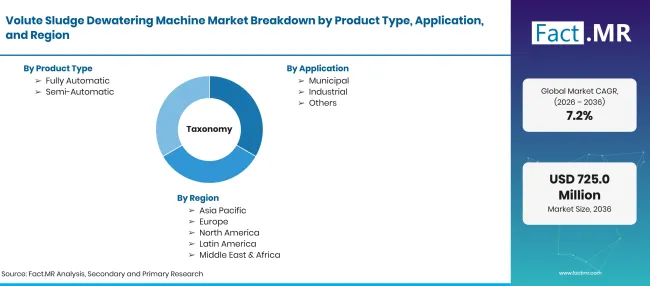
Volute Sludge Dewatering Machine Market Taxonomy | Source: Fact.MR
| Attribute | Details |
|---|---|
| Quantitative Units | USD million |
| Market Definition | Sludge dewatering machines that use a rotating screw inside a cylinder of alternating fixed and moving rings to separate water from sludge and discharge a dewatered cake. |
| Product Type | Fully Automatic; Semi-Automatic |
| Application | Municipal; Industrial; Others |
| End-User | Wastewater Treatment Plants; Food and Beverage Industry; Chemical Industry; Others |
| Distribution Channel | Direct Sales; Distributors; Online |
| Regions Covered | North America; Latin America; Western Europe; Eastern Europe; East Asia; South Asia & Pacific; Middle East & Africa |
| Countries Covered | Germany; Brazil; United States; United Kingdom; Japan |
| Companies Profiled | AMCON; PWTech; HUBER SE; Esmil; Benenv; ANDRITZ |
| Forecast Period | 2026 to 2036 |
| Approach | Installed dewatering capacity, sludge generation and treatment budgets by country, cross-checked against manufacturer product lines and order patterns. |
Source: Fact.MR analysis. Updated Nov 2, 2026
Frequently Asked Questions
How large is the volute sludge dewatering machine market in 2026?
What growth rate will the volute sludge dewatering machine market record?
Which product type leads?
Which application leads?
Which end-user leads?
Which distribution channel leads?
Which country will grow quickest?
Who are the main companies?
What holds the market back?
Who worked on this report


Preview the report firsthand - request a free sample
Free SampleGet the brochure for pricing and purchase details
Download PDF