Residue-Sensitive Baby Leaf Salad Nutrient Program Market

Residue-Sensitive Baby Leaf Salad Nutrient Program Market Size and Share Forecast Outlook 2026 to 2036

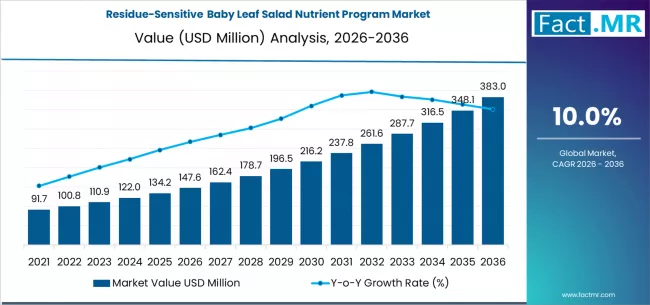
Residue-sensitive baby leaf salad nutrient program market is projected to grow from USD 147.6 million in 2026 to USD 383.0 million by 2036, at a CAGR of 10.0%. Cereals will dominate with a 45.5% market share, while granular will lead the form segment with a 37.1% share.

Residue-Sensitive Baby Leaf Salad Nutrient Program Market Forecast and Outlook 2026 to 2036

The global market for residue-sensitive baby leaf salad nutrient programs is projected to grow from USD 147.65 million in 2026 to USD 382.96 million by 2036, advancing at a CAGR of 10.0%. This market serves the precise nutritional management needs of the high-value, fast-growing baby leaf salad sector, including spinach, arugula, kale, and lettuce mixes, with an uncompromising focus on minimizing detectable chemical residues in the harvested product.

These programs are engineered to deliver optimal crop nutrition while ensuring that fertilizer components, particularly nitrates and heavy metals, remain well below the stringent thresholds set by retailers and food safety authorities for ready-to-eat salads.

Key Takeaways from the Residue-Sensitive Baby Leaf Salad Nutrient Program Market

  • Market Value for 2026: USD 147.65 Million
  • Market Value for 2036: USD 382.96 Million
  • Forecast CAGR (2026-2036): 10.0%
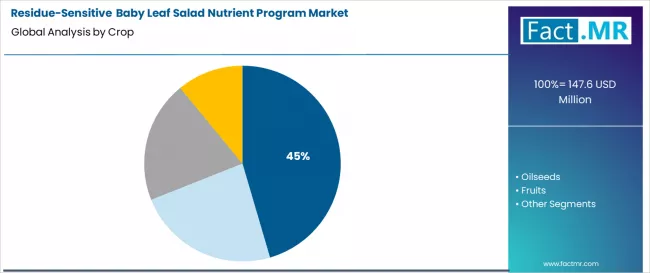
  • Leading Crop Type Segment (2026): Cereals (45%)
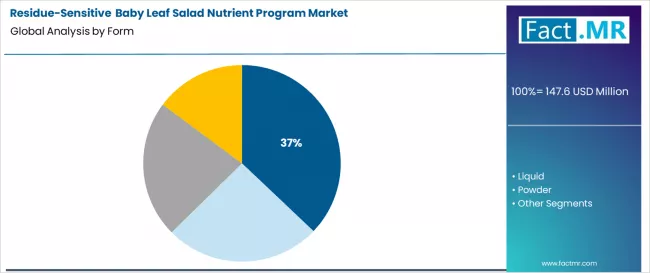
  • Leading Form Segment (2026): Granular (37%)
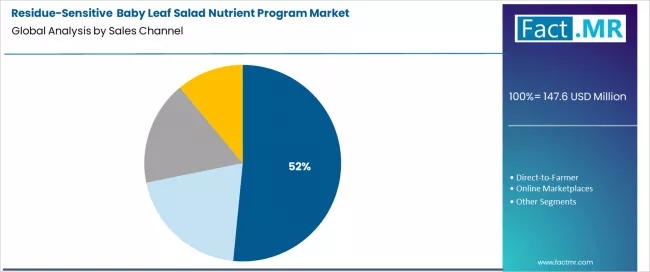
  • Leading Sales Channel Segment (2026): Ag-Retailers (52%)
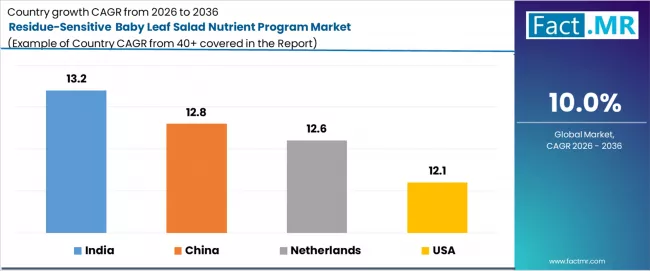
  • Key Growth Countries: India (13.2% CAGR), Netherlands (12.6% CAGR), China (12.8% CAGR), USA (12.1% CAGR)
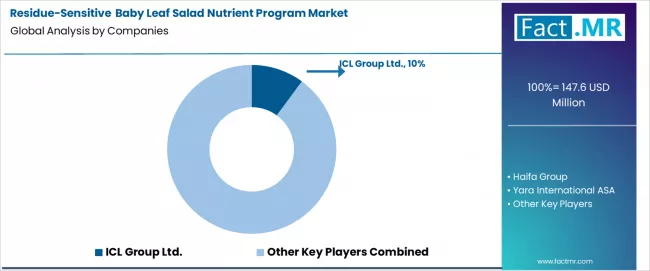
  • Key Players in the Market: ICL Group Ltd., Haifa Group, Yara International ASA, Nutrien, BASF SE, UPL Limited

Residue Sensitive Baby Leaf Salad Nutrient Program Market Market Value Analysis

Growth is propelled by relentless consumer demand for convenient, healthy, and safe fresh produce, coupled with the zero-tolerance policies of major supermarkets for residues that compromise shelf-life or perceived safety. Baby leaf salads are consumed raw, often with minimal washing, placing extraordinary importance on the purity of inputs. These nutrient programs integrate carefully selected fertilizer forms, precise application timings, and complementary biostimulants to maximize growth and quality without pushing nitrate accumulation or leaving undesirable elemental residues in the delicate leaf tissue.

The market’s expansion is a direct response to the strict protocols of modern fresh produce supply chains. Success hinges on the ability to provide growers with science-backed, holistic programs that guarantee both vigorous crop performance and compliance with the most rigorous residue standards, thereby protecting brand reputation and ensuring uninterrupted market access for these perishable, high-turnover products.

Metric

Metric Value
Market Value (2026) USD 147.65 Million
Market Forecast Value (2036) USD 382.96 Million
Forecast CAGR (2026-2036) 10.0%

Category

Category Segments
Crop Type Cereals, Oilseeds, Fruits, Vegetables
Form Granular, Liquid, Powder, Suspension
Sales Channel Ag-Retailers, Direct-to-Farmer, Online Marketplaces, Cooperatives
Region North America, Latin America, Western Europe, Eastern Europe, East Asia, South Asia & Pacific, MEA

Segmental Analysis

By Crop Type, Which Systems are Under the Greatest Scrutiny?

Residue Sensitive Baby Leaf Salad Nutrient Program Market Analysis By Crop

While the Cereals segment shows a 45% share in the broader categorization, the Vegetables segment-specifically baby leaf salads-is the unequivocal focus of these residue-sensitive programs. These crops are harvested at an immature stage, leaving a short window for plant metabolism to process applied nutrients. The risk of nitrate accumulation is high, and even minor traces of certain metals can trigger buyer rejection. Programs are meticulously designed for these greens, prioritizing nutrient sources and schedules that ensure rapid uptake and conversion, leaving minimal residual footprint in the harvested leaf.

By Form, Which Supports Clean and Precise Delivery?

Residue Sensitive Baby Leaf Salad Nutrient Program Market Analysis By Form

Granular form, particularly coated or slow-release varieties, leads with a 37% share for open-field production. For baby leaf salads, granular fertilizers can be pre-plant incorporated, providing a steady nutrient supply that aligns with crop demand and reduces the need for later top-dressing, which can risk foliar residue. This method supports a "fertigate once" approach in some systems, minimizing direct contact with the edible portion and simplifying compliance with residue monitoring protocols.

By Sales Channel, Where is Technical Guidance Most Critical?

Residue Sensitive Baby Leaf Salad Nutrient Program Market Analysis By Sales Channel

Ag-Retailers specializing in horticulture are the primary channel, holding a 52% share. Implementing a residue-sensitive program requires expert knowledge of local water quality, soil conditions, and the specific compliance requirements of different supermarket buyers. Retailer agronomists provide indispensable guidance on product selection, application timing to avoid pre-harvest intervals, and interpretation of soil test results to preemptively manage potential residue issues.

What are the Drivers, Restraints, and Key Trends of the Residue-Sensitive Baby Leaf Salad Nutrient Program Market?

The dominant driver is the enforcement of private food safety standards by global retailers (e.g., GlobalG.A.P., SQF) that include strict limits for nitrates and heavy metals in leafy greens. Product recalls and reputational damage from failed tests create a powerful incentive for growers to adopt preventative nutritional strategies.

A significant restraint is the narrow agronomic window for managing crop nutrition without impacting yield, quality, or harvest schedule. Overly conservative fertility can lead to poor color, slow growth, and reduced shelf-life. The higher cost of premium, low-residue fertilizer inputs and the required technical monitoring can also pressure profit margins in a competitive market. Demonstrating a clear return on investment through reduced testing failures and secure buyer contracts is essential for grower adoption.

Key trends include the increased use of organic nitrogen sources and nitrification inhibitors to provide steady nitrogen while minimizing nitrate accumulation. Integration of rapid nitrate testing in the field or packhouse allows for real-time crop management decisions. There is also a strong trend toward whole-system nutrient management that includes water source testing and soil amendment strategies to address background levels of elements like boron or molybdenum that can contribute to residue loads.

Analysis of the Residue-Sensitive Baby Leaf Salad Nutrient Program Market by Key Countries

Residue Sensitive Baby Leaf Salad Nutrient Program Market Cagr Analysis By Country

Country CAGR (2026-2036)
India 13.2%
China 12.8%
Netherlands 12.6%
USA 12.1%

How is India's Expanding Organized Retail and Export Focus Driving Growth?

India’s leading CAGR of 13.2% is fueled by the rapid growth of modern retail chains and increasing exports of fresh produce. Domestic supermarkets and export buyers are imposing strict residue standards. Large-scale commercial farms producing baby greens for these markets are transitioning from traditional practices to adopt structured nutrient programs designed to meet international compliance, creating a fast-growing market for specialized inputs and agronomic services.

What is the Impact of China's Food Safety Modernization and Urban Demand?

China’s 12.8% growth is driven by stringent federal food safety laws and the booming demand for premium, safe salad mixes in urban centers. Large-scale greenhouse and hydroponic operations producing baby leaves are at the forefront of implementing controlled nutrition strategies. The government’s push for traceability and green agriculture supports the adoption of input programs that can demonstrably reduce chemical residues in the food supply.

Why are the Netherlands a European Hub for High-Technology Salad Production?

The Netherlands' 12.6% growth is built on its leadership in high-tech greenhouse salad production and its role as a European distribution hub. Dutch growers supply major retailers across the continent and have pioneered integrated cultivation systems. Residue-sensitive nutrition is a standard component of these systems, with a strong focus on precision fertigation and substrate cultivation to exert absolute control over nutrient delivery and avoid soil-borne contamination.

How is the USA's Robust Food Safety Regulatory Framework and Retail Power Influencing the Market?

Residue Sensitive Baby Leaf Salad Nutrient Program Market Country Value Analysis

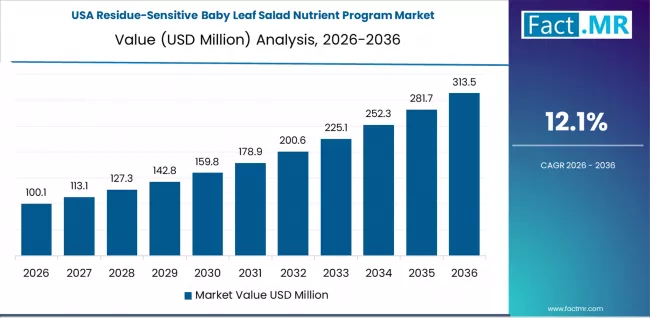
The USA’s 12.1% growth is shaped by the Food Safety Modernization Act (FSMA) and the powerful buying specifications of national grocery chains. The leafy greens industry, particularly in states like California and Arizona, has developed commodity-specific food safety practices. Compliance with these mandatory and voluntary standards makes the use of verified, residue-conscious fertility programs a standard operating procedure for commercial salad growers, ensuring year-round market access.

Competitive Landscape of the Residue-Sensitive Baby Leaf Salad Nutrient Program Market

Residue Sensitive Baby Leaf Salad Nutrient Program Market Analysis By Company

The competitive landscape features specialized horticultural nutrition companies and global agriscience firms with strong biostimulant and micronutrient portfolios. Competition centers on developing formulations with low salt indexes and optimized nitrogen forms, providing robust scientific data on residue profiles, and offering integrated digital tools for nutrient and compliance tracking. Success requires deep partnerships with large salad producers and packers, and a proven ability to help growers pass rigorous third-party audits through reliable program performance.

Key Players in the Residue-Sensitive Baby Leaf Salad Nutrient Program Market

  • ICL Group Ltd.
  • Haifa Group
  • Yara International ASA
  • Nutrien
  • BASF SE
  • UPL Limited

Scope of Report

Items Values
Quantitative Units USD Million
Crop Type Cereals, Oilseeds, Fruits, Vegetables
Form Granular, Liquid, Powder, Suspension
Sales Channel Ag-Retailers, Direct-to-Farmer, Online Marketplaces, Cooperatives
Key Countries Netherlands, USA, India, China
Key Companies ICL Group Ltd., Haifa Group, Yara International ASA, Nutrien, BASF SE, UPL Limited
Additional Analysis Analysis of nitrate accumulation pathways in leafy greens under different nitrogen forms; correlation between fertilizer application timing and residue levels at harvest; review of maximum residue levels (MRLs) for fertilizers in key markets; economic impact of crop rejection due to residue violations; efficacy of biostimulants in enhancing nutrient use efficiency and reducing residue risk.

Market by Segments

  • Crop Type :

    • Cereals
    • Oilseeds
    • Fruits
    • Vegetables
  • Form :

    • Granular
    • Liquid
    • Powder
    • Suspension
  • Sales Channel :

    • Ag-Retailers
    • Direct-to-Farmer
    • Online Marketplaces
    • Cooperatives
  • Region :

    • North America
      • USA
      • Canada
      • Rest of North America
    • Latin America
      • Brazil
      • Mexico
      • Argentina
      • Rest of Latin America
    • Western Europe
      • Germany
      • UK
      • France
      • Spain
      • Italy
      • BENELUX
      • Rest of Western Europe
    • Eastern Europe
      • Russia
      • Poland
      • Czech Republic
      • Rest of Eastern Europe
    • East Asia
      • China
      • Japan
      • South Korea
      • Rest of East Asia
    • South Asia & Pacific
      • India
      • ASEAN
      • Australia
      • Rest of South Asia & Pacific
    • MEA
      • Saudi Arabia
      • UAE
      • Turkiye
      • Rest of MEA

Table of Content

  1. Executive Summary
    • Global Market Outlook
    • Demand to side Trends
    • Supply to side Trends
    • Technology Roadmap Analysis
    • Analysis and Recommendations
  2. Market Overview
    • Market Coverage / Taxonomy
    • Market Definition / Scope / Limitations
  3. Market Background
    • Market Dynamics
      • Drivers
      • Restraints
      • Opportunity
      • Trends
    • Scenario Forecast
      • Demand in Optimistic Scenario
      • Demand in Likely Scenario
      • Demand in Conservative Scenario
    • Opportunity Map Analysis
    • Product Life Cycle Analysis
    • Supply Chain Analysis
    • Investment Feasibility Matrix
    • Value Chain Analysis
    • PESTLE and Porter’s Analysis
    • Regulatory Landscape
    • Regional Parent Market Outlook
    • Production and Consumption Statistics
    • Import and Export Statistics
  4. Global Market Analysis 2021 to 2025 and Forecast, 2026 to 2036
    • Historical Market Size Value (USD Million) Analysis, 2021 to 2025
    • Current and Future Market Size Value (USD Million) Projections, 2026 to 2036
      • Y to o to Y Growth Trend Analysis
      • Absolute $ Opportunity Analysis
  5. Global Market Pricing Analysis 2021 to 2025 and Forecast 2026 to 2036
  6. Global Market Analysis 2021 to 2025 and Forecast 2026 to 2036, By Crop
    • Introduction / Key Findings
    • Historical Market Size Value (USD Million) Analysis By Crop, 2021 to 2025
    • Current and Future Market Size Value (USD Million) Analysis and Forecast By Crop, 2026 to 2036
      • Cereals
      • Oilseeds
      • Fruits
      • Vegetables
    • Y to o to Y Growth Trend Analysis By Crop, 2021 to 2025
    • Absolute $ Opportunity Analysis By Crop, 2026 to 2036
  7. Global Market Analysis 2021 to 2025 and Forecast 2026 to 2036, By Form
    • Introduction / Key Findings
    • Historical Market Size Value (USD Million) Analysis By Form, 2021 to 2025
    • Current and Future Market Size Value (USD Million) Analysis and Forecast By Form, 2026 to 2036
      • Granular
      • Liquid
      • Powder
      • Suspension
    • Y to o to Y Growth Trend Analysis By Form, 2021 to 2025
    • Absolute $ Opportunity Analysis By Form, 2026 to 2036
  8. Global Market Analysis 2021 to 2025 and Forecast 2026 to 2036, By Sales Channel
    • Introduction / Key Findings
    • Historical Market Size Value (USD Million) Analysis By Sales Channel, 2021 to 2025
    • Current and Future Market Size Value (USD Million) Analysis and Forecast By Sales Channel, 2026 to 2036
      • Ag-Retailers
      • Direct-to-Farmer
      • Online Marketplaces
      • Cooperatives
    • Y to o to Y Growth Trend Analysis By Sales Channel, 2021 to 2025
    • Absolute $ Opportunity Analysis By Sales Channel, 2026 to 2036
  9. Global Market Analysis 2021 to 2025 and Forecast 2026 to 2036, By Region
    • Introduction
    • Historical Market Size Value (USD Million) Analysis By Region, 2021 to 2025
    • Current Market Size Value (USD Million) Analysis and Forecast By Region, 2026 to 2036
      • North America
      • Latin America
      • Western Europe
      • Eastern Europe
      • East Asia
      • South Asia and Pacific
      • Middle East & Africa
    • Market Attractiveness Analysis By Region
  10. North America Market Analysis 2021 to 2025 and Forecast 2026 to 2036, By Country
    • Historical Market Size Value (USD Million) Trend Analysis By Market Taxonomy, 2021 to 2025
    • Market Size Value (USD Million) Forecast By Market Taxonomy, 2026 to 2036
      • By Country
        • USA
        • Canada
        • Mexico
      • By Crop
      • By Form
      • By Sales Channel
    • Market Attractiveness Analysis
      • By Country
      • By Crop
      • By Form
      • By Sales Channel
    • Key Takeaways
  11. Latin America Market Analysis 2021 to 2025 and Forecast 2026 to 2036, By Country
    • Historical Market Size Value (USD Million) Trend Analysis By Market Taxonomy, 2021 to 2025
    • Market Size Value (USD Million) Forecast By Market Taxonomy, 2026 to 2036
      • By Country
        • Brazil
        • Chile
        • Rest of Latin America
      • By Crop
      • By Form
      • By Sales Channel
    • Market Attractiveness Analysis
      • By Country
      • By Crop
      • By Form
      • By Sales Channel
    • Key Takeaways
  12. Western Europe Market Analysis 2021 to 2025 and Forecast 2026 to 2036, By Country
    • Historical Market Size Value (USD Million) Trend Analysis By Market Taxonomy, 2021 to 2025
    • Market Size Value (USD Million) Forecast By Market Taxonomy, 2026 to 2036
      • By Country
        • Germany
        • UK
        • Italy
        • Spain
        • France
        • Nordic
        • BENELUX
        • Rest of Western Europe
      • By Crop
      • By Form
      • By Sales Channel
    • Market Attractiveness Analysis
      • By Country
      • By Crop
      • By Form
      • By Sales Channel
    • Key Takeaways
  13. Eastern Europe Market Analysis 2021 to 2025 and Forecast 2026 to 2036, By Country
    • Historical Market Size Value (USD Million) Trend Analysis By Market Taxonomy, 2021 to 2025
    • Market Size Value (USD Million) Forecast By Market Taxonomy, 2026 to 2036
      • By Country
        • Russia
        • Poland
        • Hungary
        • Balkan & Baltic
        • Rest of Eastern Europe
      • By Crop
      • By Form
      • By Sales Channel
    • Market Attractiveness Analysis
      • By Country
      • By Crop
      • By Form
      • By Sales Channel
    • Key Takeaways
  14. East Asia Market Analysis 2021 to 2025 and Forecast 2026 to 2036, By Country
    • Historical Market Size Value (USD Million) Trend Analysis By Market Taxonomy, 2021 to 2025
    • Market Size Value (USD Million) Forecast By Market Taxonomy, 2026 to 2036
      • By Country
        • China
        • Japan
        • South Korea
      • By Crop
      • By Form
      • By Sales Channel
    • Market Attractiveness Analysis
      • By Country
      • By Crop
      • By Form
      • By Sales Channel
    • Key Takeaways
  15. South Asia and Pacific Market Analysis 2021 to 2025 and Forecast 2026 to 2036, By Country
    • Historical Market Size Value (USD Million) Trend Analysis By Market Taxonomy, 2021 to 2025
    • Market Size Value (USD Million) Forecast By Market Taxonomy, 2026 to 2036
      • By Country
        • India
        • ASEAN
        • Australia & New Zealand
        • Rest of South Asia and Pacific
      • By Crop
      • By Form
      • By Sales Channel
    • Market Attractiveness Analysis
      • By Country
      • By Crop
      • By Form
      • By Sales Channel
    • Key Takeaways
  16. Middle East & Africa Market Analysis 2021 to 2025 and Forecast 2026 to 2036, By Country
    • Historical Market Size Value (USD Million) Trend Analysis By Market Taxonomy, 2021 to 2025
    • Market Size Value (USD Million) Forecast By Market Taxonomy, 2026 to 2036
      • By Country
        • Kingdom of Saudi Arabia
        • Other GCC Countries
        • Turkiye
        • South Africa
        • Other African Union
        • Rest of Middle East & Africa
      • By Crop
      • By Form
      • By Sales Channel
    • Market Attractiveness Analysis
      • By Country
      • By Crop
      • By Form
      • By Sales Channel
    • Key Takeaways
  17. Key Countries Market Analysis
    • USA
      • Pricing Analysis
      • Market Share Analysis, 2025
        • By Crop
        • By Form
        • By Sales Channel
    • Canada
      • Pricing Analysis
      • Market Share Analysis, 2025
        • By Crop
        • By Form
        • By Sales Channel
    • Mexico
      • Pricing Analysis
      • Market Share Analysis, 2025
        • By Crop
        • By Form
        • By Sales Channel
    • Brazil
      • Pricing Analysis
      • Market Share Analysis, 2025
        • By Crop
        • By Form
        • By Sales Channel
    • Chile
      • Pricing Analysis
      • Market Share Analysis, 2025
        • By Crop
        • By Form
        • By Sales Channel
    • Germany
      • Pricing Analysis
      • Market Share Analysis, 2025
        • By Crop
        • By Form
        • By Sales Channel
    • UK
      • Pricing Analysis
      • Market Share Analysis, 2025
        • By Crop
        • By Form
        • By Sales Channel
    • Italy
      • Pricing Analysis
      • Market Share Analysis, 2025
        • By Crop
        • By Form
        • By Sales Channel
    • Spain
      • Pricing Analysis
      • Market Share Analysis, 2025
        • By Crop
        • By Form
        • By Sales Channel
    • France
      • Pricing Analysis
      • Market Share Analysis, 2025
        • By Crop
        • By Form
        • By Sales Channel
    • India
      • Pricing Analysis
      • Market Share Analysis, 2025
        • By Crop
        • By Form
        • By Sales Channel
    • ASEAN
      • Pricing Analysis
      • Market Share Analysis, 2025
        • By Crop
        • By Form
        • By Sales Channel
    • Australia & New Zealand
      • Pricing Analysis
      • Market Share Analysis, 2025
        • By Crop
        • By Form
        • By Sales Channel
    • China
      • Pricing Analysis
      • Market Share Analysis, 2025
        • By Crop
        • By Form
        • By Sales Channel
    • Japan
      • Pricing Analysis
      • Market Share Analysis, 2025
        • By Crop
        • By Form
        • By Sales Channel
    • South Korea
      • Pricing Analysis
      • Market Share Analysis, 2025
        • By Crop
        • By Form
        • By Sales Channel
    • Russia
      • Pricing Analysis
      • Market Share Analysis, 2025
        • By Crop
        • By Form
        • By Sales Channel
    • Poland
      • Pricing Analysis
      • Market Share Analysis, 2025
        • By Crop
        • By Form
        • By Sales Channel
    • Hungary
      • Pricing Analysis
      • Market Share Analysis, 2025
        • By Crop
        • By Form
        • By Sales Channel
    • Kingdom of Saudi Arabia
      • Pricing Analysis
      • Market Share Analysis, 2025
        • By Crop
        • By Form
        • By Sales Channel
    • Turkiye
      • Pricing Analysis
      • Market Share Analysis, 2025
        • By Crop
        • By Form
        • By Sales Channel
    • South Africa
      • Pricing Analysis
      • Market Share Analysis, 2025
        • By Crop
        • By Form
        • By Sales Channel
  18. Market Structure Analysis
    • Competition Dashboard
    • Competition Benchmarking
    • Market Share Analysis of Top Players
      • By Regional
      • By Crop
      • By Form
      • By Sales Channel
  19. Competition Analysis
    • Competition Deep Dive
      • ICL Group Ltd.
        • Overview
        • Product Portfolio
        • Profitability by Market Segments (Product/Age /Sales Channel/Region)
        • Sales Footprint
        • Strategy Overview
          • Marketing Strategy
          • Product Strategy
          • Channel Strategy
      • Haifa Group
      • Yara International ASA
      • Nutrien
      • BASF SE
      • UPL Limited
  20. Assumptions & Acronyms Used
  21. Research Methodology

List Of Table

  • Table 1: Global Market Value (USD Million) Forecast by Region, 2021 to 2036
  • Table 2: Global Market Value (USD Million) Forecast by Crop, 2021 to 2036
  • Table 3: Global Market Value (USD Million) Forecast by Form, 2021 to 2036
  • Table 4: Global Market Value (USD Million) Forecast by Sales Channel, 2021 to 2036
  • Table 5: North America Market Value (USD Million) Forecast by Country, 2021 to 2036
  • Table 6: North America Market Value (USD Million) Forecast by Crop, 2021 to 2036
  • Table 7: North America Market Value (USD Million) Forecast by Form, 2021 to 2036
  • Table 8: North America Market Value (USD Million) Forecast by Sales Channel, 2021 to 2036
  • Table 9: Latin America Market Value (USD Million) Forecast by Country, 2021 to 2036
  • Table 10: Latin America Market Value (USD Million) Forecast by Crop, 2021 to 2036
  • Table 11: Latin America Market Value (USD Million) Forecast by Form, 2021 to 2036
  • Table 12: Latin America Market Value (USD Million) Forecast by Sales Channel, 2021 to 2036
  • Table 13: Western Europe Market Value (USD Million) Forecast by Country, 2021 to 2036
  • Table 14: Western Europe Market Value (USD Million) Forecast by Crop, 2021 to 2036
  • Table 15: Western Europe Market Value (USD Million) Forecast by Form, 2021 to 2036
  • Table 16: Western Europe Market Value (USD Million) Forecast by Sales Channel, 2021 to 2036
  • Table 17: Eastern Europe Market Value (USD Million) Forecast by Country, 2021 to 2036
  • Table 18: Eastern Europe Market Value (USD Million) Forecast by Crop, 2021 to 2036
  • Table 19: Eastern Europe Market Value (USD Million) Forecast by Form, 2021 to 2036
  • Table 20: Eastern Europe Market Value (USD Million) Forecast by Sales Channel, 2021 to 2036
  • Table 21: East Asia Market Value (USD Million) Forecast by Country, 2021 to 2036
  • Table 22: East Asia Market Value (USD Million) Forecast by Crop, 2021 to 2036
  • Table 23: East Asia Market Value (USD Million) Forecast by Form, 2021 to 2036
  • Table 24: East Asia Market Value (USD Million) Forecast by Sales Channel, 2021 to 2036
  • Table 25: South Asia and Pacific Market Value (USD Million) Forecast by Country, 2021 to 2036
  • Table 26: South Asia and Pacific Market Value (USD Million) Forecast by Crop, 2021 to 2036
  • Table 27: South Asia and Pacific Market Value (USD Million) Forecast by Form, 2021 to 2036
  • Table 28: South Asia and Pacific Market Value (USD Million) Forecast by Sales Channel, 2021 to 2036
  • Table 29: Middle East & Africa Market Value (USD Million) Forecast by Country, 2021 to 2036
  • Table 30: Middle East & Africa Market Value (USD Million) Forecast by Crop, 2021 to 2036
  • Table 31: Middle East & Africa Market Value (USD Million) Forecast by Form, 2021 to 2036
  • Table 32: Middle East & Africa Market Value (USD Million) Forecast by Sales Channel, 2021 to 2036

List Of Figures

  • Figure 1: Global Market Pricing Analysis
  • Figure 2: Global Market Value (USD Million) Forecast 2021 to 2036
  • Figure 3: Global Market Value Share and BPS Analysis by Crop, 2026 and 2036
  • Figure 4: Global Market Y to o to Y Growth Comparison by Crop, 2026 to 2036
  • Figure 5: Global Market Attractiveness Analysis by Crop
  • Figure 6: Global Market Value Share and BPS Analysis by Form, 2026 and 2036
  • Figure 7: Global Market Y to o to Y Growth Comparison by Form, 2026 to 2036
  • Figure 8: Global Market Attractiveness Analysis by Form
  • Figure 9: Global Market Value Share and BPS Analysis by Sales Channel, 2026 and 2036
  • Figure 10: Global Market Y to o to Y Growth Comparison by Sales Channel, 2026 to 2036
  • Figure 11: Global Market Attractiveness Analysis by Sales Channel
  • Figure 12: Global Market Value (USD Million) Share and BPS Analysis by Region, 2026 and 2036
  • Figure 13: Global Market Y to o to Y Growth Comparison by Region, 2026 to 2036
  • Figure 14: Global Market Attractiveness Analysis by Region
  • Figure 15: North America Market Incremental Dollar Opportunity, 2026 to 2036
  • Figure 16: Latin America Market Incremental Dollar Opportunity, 2026 to 2036
  • Figure 17: Western Europe Market Incremental Dollar Opportunity, 2026 to 2036
  • Figure 18: Eastern Europe Market Incremental Dollar Opportunity, 2026 to 2036
  • Figure 19: East Asia Market Incremental Dollar Opportunity, 2026 to 2036
  • Figure 20: South Asia and Pacific Market Incremental Dollar Opportunity, 2026 to 2036
  • Figure 21: Middle East & Africa Market Incremental Dollar Opportunity, 2026 to 2036
  • Figure 22: North America Market Value Share and BPS Analysis by Country, 2026 and 2036
  • Figure 23: North America Market Value Share and BPS Analysis by Crop, 2026 and 2036
  • Figure 24: North America Market Y to o to Y Growth Comparison by Crop, 2026 to 2036
  • Figure 25: North America Market Attractiveness Analysis by Crop
  • Figure 26: North America Market Value Share and BPS Analysis by Form, 2026 and 2036
  • Figure 27: North America Market Y to o to Y Growth Comparison by Form, 2026 to 2036
  • Figure 28: North America Market Attractiveness Analysis by Form
  • Figure 29: North America Market Value Share and BPS Analysis by Sales Channel, 2026 and 2036
  • Figure 30: North America Market Y to o to Y Growth Comparison by Sales Channel, 2026 to 2036
  • Figure 31: North America Market Attractiveness Analysis by Sales Channel
  • Figure 32: Latin America Market Value Share and BPS Analysis by Country, 2026 and 2036
  • Figure 33: Latin America Market Value Share and BPS Analysis by Crop, 2026 and 2036
  • Figure 34: Latin America Market Y to o to Y Growth Comparison by Crop, 2026 to 2036
  • Figure 35: Latin America Market Attractiveness Analysis by Crop
  • Figure 36: Latin America Market Value Share and BPS Analysis by Form, 2026 and 2036
  • Figure 37: Latin America Market Y to o to Y Growth Comparison by Form, 2026 to 2036
  • Figure 38: Latin America Market Attractiveness Analysis by Form
  • Figure 39: Latin America Market Value Share and BPS Analysis by Sales Channel, 2026 and 2036
  • Figure 40: Latin America Market Y to o to Y Growth Comparison by Sales Channel, 2026 to 2036
  • Figure 41: Latin America Market Attractiveness Analysis by Sales Channel
  • Figure 42: Western Europe Market Value Share and BPS Analysis by Country, 2026 and 2036
  • Figure 43: Western Europe Market Value Share and BPS Analysis by Crop, 2026 and 2036
  • Figure 44: Western Europe Market Y to o to Y Growth Comparison by Crop, 2026 to 2036
  • Figure 45: Western Europe Market Attractiveness Analysis by Crop
  • Figure 46: Western Europe Market Value Share and BPS Analysis by Form, 2026 and 2036
  • Figure 47: Western Europe Market Y to o to Y Growth Comparison by Form, 2026 to 2036
  • Figure 48: Western Europe Market Attractiveness Analysis by Form
  • Figure 49: Western Europe Market Value Share and BPS Analysis by Sales Channel, 2026 and 2036
  • Figure 50: Western Europe Market Y to o to Y Growth Comparison by Sales Channel, 2026 to 2036
  • Figure 51: Western Europe Market Attractiveness Analysis by Sales Channel
  • Figure 52: Eastern Europe Market Value Share and BPS Analysis by Country, 2026 and 2036
  • Figure 53: Eastern Europe Market Value Share and BPS Analysis by Crop, 2026 and 2036
  • Figure 54: Eastern Europe Market Y to o to Y Growth Comparison by Crop, 2026 to 2036
  • Figure 55: Eastern Europe Market Attractiveness Analysis by Crop
  • Figure 56: Eastern Europe Market Value Share and BPS Analysis by Form, 2026 and 2036
  • Figure 57: Eastern Europe Market Y to o to Y Growth Comparison by Form, 2026 to 2036
  • Figure 58: Eastern Europe Market Attractiveness Analysis by Form
  • Figure 59: Eastern Europe Market Value Share and BPS Analysis by Sales Channel, 2026 and 2036
  • Figure 60: Eastern Europe Market Y to o to Y Growth Comparison by Sales Channel, 2026 to 2036
  • Figure 61: Eastern Europe Market Attractiveness Analysis by Sales Channel
  • Figure 62: East Asia Market Value Share and BPS Analysis by Country, 2026 and 2036
  • Figure 63: East Asia Market Value Share and BPS Analysis by Crop, 2026 and 2036
  • Figure 64: East Asia Market Y to o to Y Growth Comparison by Crop, 2026 to 2036
  • Figure 65: East Asia Market Attractiveness Analysis by Crop
  • Figure 66: East Asia Market Value Share and BPS Analysis by Form, 2026 and 2036
  • Figure 67: East Asia Market Y to o to Y Growth Comparison by Form, 2026 to 2036
  • Figure 68: East Asia Market Attractiveness Analysis by Form
  • Figure 69: East Asia Market Value Share and BPS Analysis by Sales Channel, 2026 and 2036
  • Figure 70: East Asia Market Y to o to Y Growth Comparison by Sales Channel, 2026 to 2036
  • Figure 71: East Asia Market Attractiveness Analysis by Sales Channel
  • Figure 72: South Asia and Pacific Market Value Share and BPS Analysis by Country, 2026 and 2036
  • Figure 73: South Asia and Pacific Market Value Share and BPS Analysis by Crop, 2026 and 2036
  • Figure 74: South Asia and Pacific Market Y to o to Y Growth Comparison by Crop, 2026 to 2036
  • Figure 75: South Asia and Pacific Market Attractiveness Analysis by Crop
  • Figure 76: South Asia and Pacific Market Value Share and BPS Analysis by Form, 2026 and 2036
  • Figure 77: South Asia and Pacific Market Y to o to Y Growth Comparison by Form, 2026 to 2036
  • Figure 78: South Asia and Pacific Market Attractiveness Analysis by Form
  • Figure 79: South Asia and Pacific Market Value Share and BPS Analysis by Sales Channel, 2026 and 2036
  • Figure 80: South Asia and Pacific Market Y to o to Y Growth Comparison by Sales Channel, 2026 to 2036
  • Figure 81: South Asia and Pacific Market Attractiveness Analysis by Sales Channel
  • Figure 82: Middle East & Africa Market Value Share and BPS Analysis by Country, 2026 and 2036
  • Figure 83: Middle East & Africa Market Value Share and BPS Analysis by Crop, 2026 and 2036
  • Figure 84: Middle East & Africa Market Y to o to Y Growth Comparison by Crop, 2026 to 2036
  • Figure 85: Middle East & Africa Market Attractiveness Analysis by Crop
  • Figure 86: Middle East & Africa Market Value Share and BPS Analysis by Form, 2026 and 2036
  • Figure 87: Middle East & Africa Market Y to o to Y Growth Comparison by Form, 2026 to 2036
  • Figure 88: Middle East & Africa Market Attractiveness Analysis by Form
  • Figure 89: Middle East & Africa Market Value Share and BPS Analysis by Sales Channel, 2026 and 2036
  • Figure 90: Middle East & Africa Market Y to o to Y Growth Comparison by Sales Channel, 2026 to 2036
  • Figure 91: Middle East & Africa Market Attractiveness Analysis by Sales Channel
  • Figure 92: Global Market - Tier Structure Analysis
  • Figure 93: Global Market - Company Share Analysis

- FAQs -

How big is the residue-sensitive baby leaf salad nutrient program market in 2026?

The global residue-sensitive baby leaf salad nutrient program market is estimated to be valued at USD 147.6 million in 2026.

What will be the size of residue-sensitive baby leaf salad nutrient program market in 2036?

The market size for the residue-sensitive baby leaf salad nutrient program market is projected to reach USD 383.0 million by 2036.

How much will be the residue-sensitive baby leaf salad nutrient program market growth between 2026 and 2036?

The residue-sensitive baby leaf salad nutrient program market is expected to grow at a 10.0% CAGR between 2026 and 2036.

What are the key product types in the residue-sensitive baby leaf salad nutrient program market?

The key product types in residue-sensitive baby leaf salad nutrient program market are cereals, oilseeds, fruits and vegetables.

Which form segment to contribute significant share in the residue-sensitive baby leaf salad nutrient program market in 2026?

In terms of form, granular segment to command 37.1% share in the residue-sensitive baby leaf salad nutrient program market in 2026.
Residue-Sensitive Baby Leaf Salad Nutrient Program Market