- Market Value (2025): USD 3.5 Bn
- Estimated Value (2026): USD 3.8 Bn
- Forecast Value (2036): USD 7.0 Bn
- CAGR (2026-2036): 6.4%
What is the Waterless Industrial Cleaning Towels Market forecast to be worth by 2036?
USD 3.8 Billion in 2026 to USD 7.0 Billion by 2036 at a 6.4% CAGR.
- The Waterless Industrial Cleaning Towels Market reached USD 3.5 Billion in 2025.
- Demand is projected to increase from USD 3.8 Billion in 2026 to USD 7.0 Billion by 2036.
- The market is forecast to record a 6.4% CAGR from 2026 to 2036, supported by workstation cleaning and controlled dispensing.
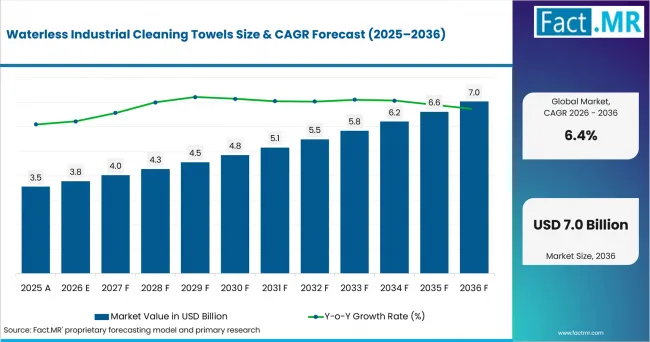
Waterless Industrial Cleaning Towels Value Analysis | Source: Fact.MR
What are the defining numbers behind Waterless Industrial Cleaning Towels Market growth?
USD 3.2 Billion absolute opportunity by 2036, led by spunlace, solvent-free surfactant and industrial hands.
- Demand Drivers in the Market
- Plant operators need ready-to-use hand and surface cleaning at the workstation. U.S. Census Bureau reported seasonally adjusted all-manufacturing shipments of USD 612.879 billion in January 2026.
- Maintenance supervisors need towels that work dry or with cleaners, supported by repeated wipe-downs around tools and machinery between shifts.
- Facility managers need canisters and dispensers near work cells. EPA reported 1,656 Safer Choice-certified products in FY2025, providing businesses and purchasers with a broad pool of products that meet the program’s safer-ingredient and performance requirements.
- Safety teams need towel systems that limit splashes from open cleaning liquids. BLS reported a total recordable nonfatal injury and illness incidence rate of 1.9 cases per 100 full-time workers in U.S. soap, cleaning compound and toilet preparation manufacturing in 2024.
- Key Segments Analyzed
- By Substrate: Spunlace is expected to hold 33.0% share in 2026, supported by wet strength and cloth-like handling during grease removal.
- By Cleaning Chemistry: Solvent-free surfactant is projected to account for 34.0% share in 2026, owing to lower odor and easier worker handling.
- By Application: Industrial hands are anticipated to capture 37.0% share in 2026, driven by repeat cleaning during repair and maintenance tasks.
- By Format: Canister is estimated to represent 29.0% share in 2026, reflecting the need for closed packs near fixed cleaning points.
- Analyst Opinion at Fact.MR
- Shambhu Nath Jha, Principal Consultant at Fact.MR, states, "Industrial towel selection is becoming a control problem as much as a cleaning problem. The market is expected to reward suppliers that combine durable substrates with safer chemistry and packs that fit workstations. Buyers want proof that towels remove grease without forcing a change in daily maintenance routines."
- Strategic Implications
- Converters should match substrate strength to oil and abrasive-surface tasks. Essity states that Tork Industrial Cleaning Cloth Grey W4 handles oil, grease and water spills.
- Brand owners should document chemical compatibility for common degreasers and sanitizers. Kimberly-Clark Professional states that WypAll WetTask buckets help reduce exposure to vapors and splashes.
- Facility teams should separate hand-cleaning towels from tool-cleaning towels so stock placement matches worker use and hygiene expectations.
China is projected to record 7.2% CAGR through 2036, supported by factory output and machinery production. France is anticipated to post 7.1%, reflecting transport-equipment and manufacturing activity. The USA is forecast to reach 6.7% due to industrial maintenance demand. Germany is expected to record 6.5% through order recovery in manufacturing. Japan is estimated to reach 5.6%, linked to machinery maintenance and controlled workplace cleaning.
How does the Waterless Industrial Cleaning Towels Market break down by segment?
Spunlace leads Substrate at 33.0%; Industrial hands leads Application at 37.0%.
Which Substrate dominates?
Spunlace is expected to hold 33.0% share in 2026.
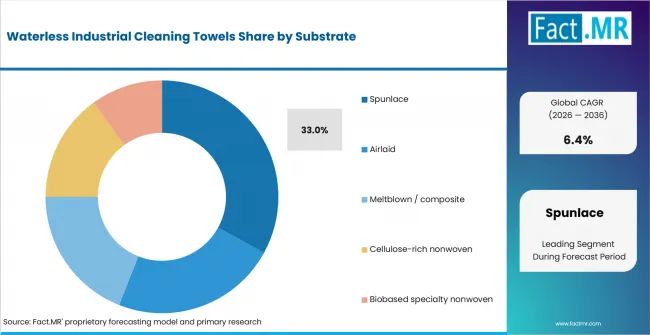
Waterless Industrial Cleaning Towels Analysis By Substrate | Source: Fact.MR
Spunlace leads because it combines softness with wet strength. Plant operators can use it for hands and equipment without the tearing risk linked to weaker paper towels. The substrate also supports pre-moistened formats and dry-roll products.
Essity lists Tork Industrial Cleaning Cloth Grey W4 for professional industrial cleaning tasks. The product page states that the cloth handles oil, grease and water spills. That fit supports the use of stronger substrates in maintenance locations where workers need one towel for several wiping steps.
What leads the Cleaning Chemistry segment?
Solvent-free surfactant is projected to account for 34.0% share in 2026.
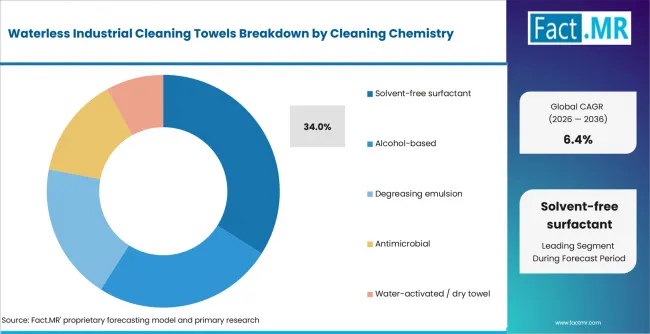
Waterless Industrial Cleaning Towels Analysis By Cleaning Chemistry | Source: Fact.MR
Solvent-free surfactant chemistry fits sites that want lower odor and less open handling of aggressive liquids. EPA updated its Safer Choice performance measures in January 2026 and added 26 chemicals to the Safer Chemical Ingredients List in FY 2025. That reference point supports selection of safer cleaning formulations, which is also visible in adjacent low-VOC cleaning chemicals.
Alcohol-based and antimicrobial towels remain relevant where fast drying and surface hygiene guide selection. The same buyer expectation appears in surface disinfectant wipes when wipe formats are used for controlled surface treatment.
How does Application shape demand?
Industrial hands are anticipated to capture 37.0% share in 2026.
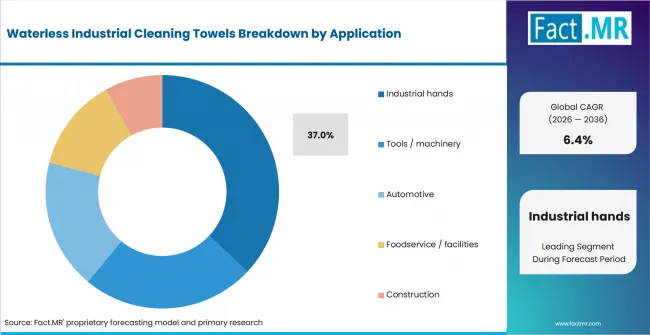
Waterless Industrial Cleaning Towels Analysis By Application | Source: Fact.MR
Industrial hand cleaning leads because maintenance work creates repeated contact with grease and soils. Towels placed near machines shorten the cleaning step and reduce movement to wash stations.
BLS reported 2,000 nonfatal injury and illness cases in U.S. soap, cleaning compound and toilet preparation manufacturing in 2024. Worker-contact data keeps attention on chemistry handling and wipe use. Industrial hand formats therefore gain value when they reduce open-liquid handling at the task area.
What supports demand for canisters within Format?
Canister is estimated to represent 29.0% share in 2026.
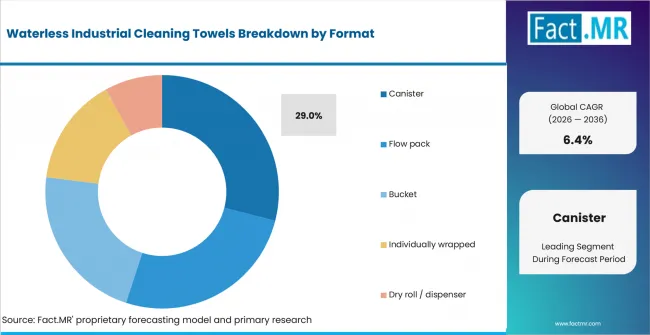
Waterless Industrial Cleaning Towels Analysis By Format | Source: Fact.MR
Canisters lead where plants need fast access and stable moisture retention. The format suits vehicles, repair benches and back-of-house locations where workers need a closed pack. Nearby ready-to-use disinfectant wipes show how pre-dosed formats shape professional cleaning behavior.
Kimberly-Clark Professional lists WypAll products across multi-surface wiping, heavy-duty cleaning, foodservice cloths and closed bucket systems. This range ties packaging format to task control. It also shows why industrial towel purchasing is often tied to the place where the cleaning step happens.
What is accelerating Waterless Industrial Cleaning Towels Market adoption, and what is holding it back?
Demand is expected to rise through workstation cleaning and controlled dispensing. Adoption is constrained by chemistry validation and disposal rules.
Drivers Impact Analysis
| Driver | (~) % Impact on CAGR | Geographic Relevance | Impact Timeline |
|---|---|---|---|
| Workstation hand and tool cleaning | +1.4% | Global | Short term (<= 2 years) |
| Substitution of rags in maintenance work | +1.1% | North America, Europe | Medium term (2-4 years) |
| Controlled canister and bucket dispensing | +0.8% | Global | Medium term (2-4 years) |
| Safer formulation screening | +0.6% | USA, Europe | Long term (>= 4 years) |
Opportunity Impact Analysis
| Opportunity | (~) % Impact on CAGR | Geographic Relevance | Impact Timeline |
|---|---|---|---|
| Biobased specialty nonwovens | +0.7% | Europe, Japan | Long term (>= 4 years) |
| Water-activated dry towel systems | +0.6% | Global | Medium term (2-4 years) |
| Foodservice and facility placement | +0.5% | USA, France | Short term (<= 2 years) |
Restraints Impact Analysis
| Restraint | (~) % Impact on CAGR | Geographic Relevance | Impact Timeline |
|---|---|---|---|
| Chemical compatibility limits | -0.5% | Global | Short term (<= 2 years) |
| Waste and disposal scrutiny | -0.4% | Europe, USA | Medium term (2-4 years) |
| Price comparison with rags | -0.3% | Global | Long term (>= 4 years) |
Which countries are scaling the Waterless Industrial Cleaning Towels Market through 2036?
- The country comparison spans 1.6 percentage points and forms two practical growth bands across the forecast period.
- China remains 0.1 percentage point above France through factory output and machinery production.
- France remains 0.4 percentage point above the USA as transport-equipment output supports facility cleaning demand.
- The USA remains 0.2 percentage point above Germany through broad manufacturing shipments and maintenance activity.
- Germany remains 0.9 percentage point above Japan through order recovery and machinery-led cleaning routines.
- Japan closes the displayed range through maintenance discipline in machinery and manufacturing work sites.
Comparable CAGRs can create different entry conditions due to substrate preferences, workplace chemical rules, distributor reach and format habits. Full report coverage includes North America, Latin America, Western Europe, Eastern Europe, East Asia, South Asia & Pacific, Middle East & Africa.
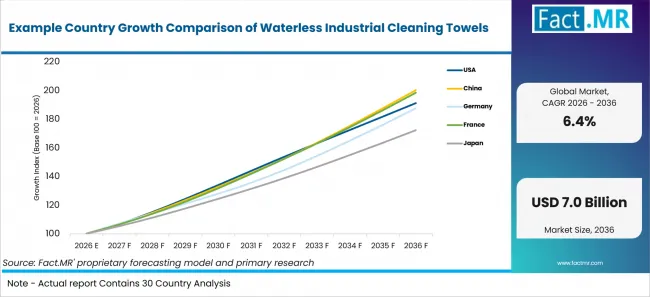
Example Country Growth Comparison Of Waterless Industrial Cleaning Towels | Source: Fact.MR
| Country | CAGR (2026-2036) |
|---|---|
| China | 7.2% |
| France | 7.1% |
| USA | 6.7% |
| Germany | 6.5% |
| Japan | 5.6% |
How is China scaling demand?
7.2% CAGR, supported by factory output and machinery maintenance.
China benefits from the scale of its production base. National Bureau of Statistics of China reported in February 2026 that the value added of manufacturing among industrial enterprises above designated size increased 6.4% in 2025. That output base creates frequent cleaning around machinery, assembly lines and tools. Canisters and dry rolls are expected to gain attention where plants need fast grease removal near workstations.
What supports France adoption?
7.1% CAGR, backed by transport-equipment output and manufacturing value.
France gains from manufacturing depth and transport-equipment activity. INSEE reported in July 2026 that manufacturing production in value reached EUR 981 billion in France in 2025, based on provisional data. Separately, INSEE reported that transport-equipment output increased 12.4% year on year in the fourth quarter of 2025. These conditions support towels used around parts, tools and facility surfaces.
What supports USA growth?
6.7% CAGR, supported by manufacturing shipments and workplace cleaning routines.
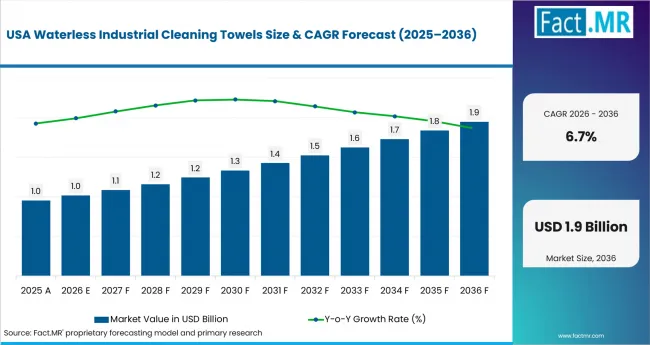
Waterless Industrial Cleaning Towels Country Value Analysis | Source: Fact.MR
The USA has a broad industrial base for task-based wiping. U.S. Census Bureau reported in March 2026 that seasonally adjusted mining, oil field and gas field machinery shipments were revised to USD 1.440 billion in December 2025. That scale supports towel use in maintenance bays, tool rooms and mobile repair units. Canisters remain useful where workers need closed packs near repeated cleaning points.
What is supporting Germany adoption?
6.5% CAGR, shaped by order recovery and controlled industrial cleaning.
Germany’s manufacturing sector showed stronger order activity at the end of 2025. Destatis reported in February 2026 that real new orders in manufacturing rose 7.8% month on month in December 2025, after seasonal and calendar adjustment. That recovery gives towel suppliers a route through factories where oil removal, tool preparation and equipment wipe-downs are routine tasks.
How does Japan perform?
5.6% CAGR, led by machinery maintenance and careful product validation.
Japan shows steadier demand tied to disciplined maintenance routines. METI reported in December 2025 that the Survey of Production Forecast in Manufacturing expected production to increase by 8.0% in January 2026. Towel formats are expected to gain use where compact work areas require clean storage, controlled access and predictable residue removal.
Who leads the Waterless Industrial Cleaning Towels Market?
Essity participates through Tork industrial cleaning cloths, biobased heavy-duty cleaning cloths and professional dispensing systems.
Kimberly-Clark Professional participates through WypAll wiping products, including foodservice cloths, waterless cleaning wipes and WetTask wipes and bucket systems. These portfolios address professional wiping, workstation cleaning, grease and dirt removal, and facility-maintenance applications.
Which companies are the key providers?
Essity; Kimberly-Clark Professional; ITW Pro Brands – SCRUBS; Zep; CRC Industries; and Tub O’ Towels.
- Essity
- Kimberly-Clark Professional
- ITW Pro Brands – SCRUBS
- Zep
- CRC Industries
- Tub O’ Towels
Bibliography
- Amcor. (2025, April 30). Amcor completes combination with Berry Global; positioned to significantly enhance value for customers and shareholders.
- Cabinet Office, Government of Japan. (2026, January). Monthly economic report executive summary (Jan 2026).
- Federal Reserve Board. (2026, August 18). Industrial production and capacity utilization - G.17.
- Federal Statistical Office (Destatis). (2026, February 5). New orders in manufacturing in December 2025: +7.8% on the previous month.
- Institut national de la statistique et des études économiques. (2026, February 5). In December 2025, manufacturing output fell back sharply (-0.8%): Industrial production index - December 2025 (Informations rapides No. 33).
- Institut national de la statistique et des études économiques. (2026, July 21). Indicateurs macroéconomiques de l’industrie manufacturière : Données annuelles de 2010 à 2025.
- Kimberly-Clark Professional. (2026, September 15). Kimberly-Clark Professional expands Thrive™ program to divert more waste from landfills.
- Ministry of Economy, Trade and Industry. (2026, January 30). Indices of industrial production: Preliminary report for December 2025.
- National Bureau of Statistics of China. (2026, February 28). Statistical communiqué of the People’s Republic of China on the 2025 national economic and social development.
- Nice-Pak Products, Inc. (2025, June 16). Nice-Pak revitalizes Wet-Nap® wipes.
- Therapeutic Goods Administration. (2025, August 27). GAMA Healthcare Australia Pty Ltd - Medical device cleaning/disinfecting wipe (510510) [Australian Register of Therapeutic Goods record].
- U.S. Bureau of Labor Statistics. (2026, January 22). Table 1. Incidence rates of nonfatal occupational injuries and illnesses by industry and case types, 2024.
- U.S. Bureau of Labor Statistics. (2026, January 22). Table 2. Numbers of nonfatal occupational injuries and illnesses by industry and case types, 2024.
- U.S. Census Bureau. (2026, February 23). Monthly full report on manufacturers’ shipments, inventories and orders: December 2025 (Release No. CB 26-24 M3-2 (25)-12).
- U.S. Census Bureau. (2026, March 18). Monthly full report on manufacturers’ shipments, inventories and orders: January 2026 (Release No. CB 26-38 M3-2 (26)-01).
- U.S. Environmental Protection Agency. (2026, January). Safer Choice performance measures.
This Report Answers
- The report explains where waterless industrial cleaning towels are used across substrate, chemistry, application and format. It also connects the category with industrial and institutional cleaning chemicals where workplace cleaning chemistry shapes buyer expectations.
- Segment analysis identifies the leading subsegments and the operational reasons facility teams prioritize them. It compares wipe formats with nearby surface cleaning products used in professional settings.
- Country analysis examines the listed markets and the manufacturing or workplace mechanisms supporting towel use.
- Competitive analysis reviews current providers across industrial cloths, professional wipes, nonwoven substrates and hygiene systems.
- Application analysis assesses how hand cleaning, tool cleaning, machinery wipe-down and facility cleaning shape purchasing. It also reviews adjacent green cleaning chemicals and water-saving cleaning chemicals where lower-rinse use affects cleaning routines.
What does the Waterless Industrial Cleaning Towels Market cover?
The Waterless Industrial Cleaning Towels Market covers dry and pre-moistened towel systems used to clean hands, tools, equipment and facility surfaces without a fixed water source. It includes engineered nonwoven substrates, task-specific wiping formats and chemistry options. The scope is adjacent to eco-label certified cleaning chemicals where safer workplace formulations guide cleaning choices.
The assessment covers spunlace, airlaid, meltblown or composite and cellulose-rich towels. It also covers canisters, flow packs, buckets, individually wrapped formats and dry roll dispensers used across industrial, automotive, foodservice and construction settings.
What is included in the scope?
The scope includes disposable and reusable engineered towels sold for professional wiping tasks. It includes towels used dry, towels activated with water, and pre-moistened towels that carry surfactant, alcohol, degreasing or antimicrobial chemistry.
It includes industrial hand-cleaning towels, tool and machinery wipes, automotive cleaning towels, foodservice or facility towels and construction-site cleaning towels.
What is excluded from the scope?
The scope excludes household wet wipes, baby wipes, cosmetic wipes and general paper towels sold without industrial positioning.
The scope excludes laundering services, loose reclaimed textile rags, mop systems and cleaning equipment sold without towel consumables. Medical disinfectant wipes are referenced only for professional wipe capability and surface-decontamination adjacency.
How Was the Analysis Built?
The analysis draws on 120+ sources, 35+ company portfolios, 25+ countries, and more than 20 industry interviews.
- Primary Research: Primary research includes discussions with manufacturers, service providers, technology developers, distributors, end users, and subject-matter experts. These conversations examine purchasing priorities, product adoption, operational challenges, approval requirements, competitive positioning, and the factors that influence wider market acceptance.
- Desk Research: Desk research covers government statistics, regulatory publications, company filings, trade data, technical studies, industry associations, standards, public policy, and other authoritative sources. Every source used in the analysis is documented in the bibliography.
- Market Sizing and Forecasting: Market estimates combine historical performance, demand indicators, pricing and volume trends, segment shares, company participation, country-level growth, adoption patterns, investment activity, and barriers to market expansion.
- Data Validation and Update Cycle: Findings are validated by comparing primary interviews with public data, company activity, regulatory changes, trade patterns, and industry developments. Regular updates review new product launches, capacity changes, partnerships, approvals, and shifts in commercial adoption.
What is the report’s scope and coverage?
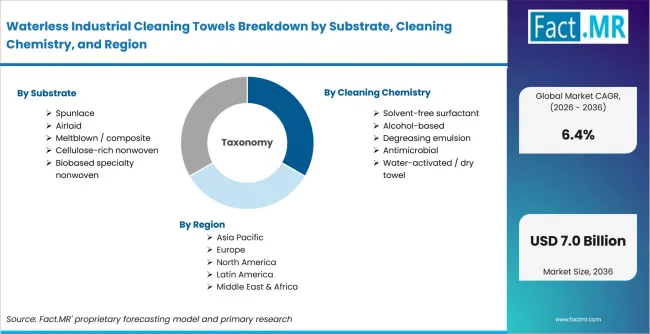
Waterless Industrial Cleaning Towels Breakdown By Substrate, Cleaning Chemistry, And Region | Source: Fact.MR
| Attribute | Details |
|---|---|
| Quantitative Units | USD Billion |
| Market Definition | Waterless towels and cloth systems used for industrial hand cleaning, tool cleaning, machinery wipe-down, automotive cleaning, foodservice facilities and construction cleaning without requiring a fixed wash station. |
| Substrate | Spunlace; Airlaid; Meltblown/composite; Cellulose-rich nonwoven; Biobased specialty nonwoven |
| Cleaning Chemistry | Solvent-free surfactant; Alcohol-based; Degreasing emulsion; Antimicrobial; Water-activated/dry towel |
| Application | Industrial hands; Tools/machinery; Automotive; Foodservice/facilities; Construction |
| Format | Canister; Flow pack; Bucket; Individually wrapped; Dry roll/dispenser |
| Regions Covered | North America; Latin America; Western Europe; Eastern Europe; East Asia; South Asia & Pacific; Middle East & Africa |
| Countries Covered | USA; China; Germany; France; Japan |
| Companies Profiled | Essity; Kimberly-Clark Professional; ITW Pro Brands – SCRUBS; Zep; CRC Industries; Tub O’ Towels |
| Forecast Period | 2026 to 2036 |
| Approach | Hybrid top-down and bottom-up approach using industrial cleaning occasions, substrate mix, chemistry use, format demand, application intensity, country manufacturing indicators and provider portfolio review. |
How is the market segmented?
-
By Substrate
- Spunlace
- Airlaid
- Meltblown/composite
- Cellulose-rich nonwoven
- Biobased specialty nonwoven
-
By Cleaning Chemistry
- Solvent-free surfactant
- Alcohol-based
- Degreasing emulsion
- Antimicrobial
- Water-activated/dry towel
-
By Application
- Industrial hands
- Tools/machinery
- Automotive
- Foodservice/facilities
- Construction
-
By Format
- Canister
- Flow pack
- Bucket
- Individually wrapped
- Dry roll/dispenser
-
By Region
- North America
- Latin America
- Western Europe
- Eastern Europe
- East Asia
- South Asia & Pacific
- Middle East & Africa