Low-VOC Cleaning Chemicals Market (2026 - 2036)
Low-VOC Cleaning Chemicals Market Size and Share Forecast Outlook 2026 to 2036
Core Findings
Low-VOC Cleaning Chemicals Market Forecast and Outlook 2026 to 2036
The global low-VOC cleaning chemicals market is likely to be valued at USD 4.4 billion in 2026 and is forecasted to reach USD 7.5 billion by 2036, expanding at a 5.5% CAGR.
Low-VOC Cleaning Chemicals Market Key Takeaways
- Low-VOC Cleaning Chemicals Market Value (2026): USD 4.4 billion
- Low-VOC Cleaning Chemicals Market Forecast Value (2036): USD 7.5 billion
- Low-VOC Cleaning Chemicals Market Forecast CAGR (2026-2036): 5.5%
- Leading Product Type by Demand Share: Specialty Cleaners (Low-VOC) (33.0%)
- Key Growth Region: Asia Pacific
- Key Industry Participants: Ecolab, Diversey, SC Johnson Professional, 3M, Reckitt
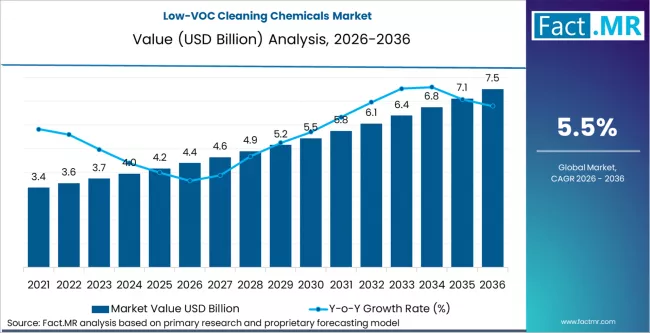
This growth reflects a structural reset in how cleaning efficacy is engineered, priced, and regulated across industrial and institutional applications. Between 2024 and 2026, leading manufacturers repositioned away from solvent-heavy, volume-driven portfolios toward bio-based, concentrated, and data-validated formulations.
Reckitt’s divestment of its Essential Home business in 2025 signals an exit from low-margin commodity cleaning, freeing capital for regulated health and hygiene categories that demand advanced low-VOC chemistry. Ecolab accelerated this shift through concentrated dosing platforms such as ReadyDose™, reducing chemical transport volumes and total VOC exposure per use. In its 2025 Growth & Impact Report, Ecolab states that customers increasingly link low-emission chemistry with operational risk reduction and regulatory readiness.
Clorox and Henkel reinforced the same trajectory by redesigning fragrance and surfactant systems to meet indoor air quality standards without compromising performance, supporting margin expansion despite tighter regulations. The enforcement of EU CSRD reporting and rising healthcare procurement standards in North America further anchor demand in verified low-VOC solutions. As regulation, transparency, and performance converge, low-VOC chemistry has moved from sustainability signalling to a core commercial requirement.
Low-VOC Cleaning Chemicals Market
| Metric | Value |
|---|---|
| Estimated Value in (2026E) | USD 4.4 billion |
| Forecast Value in (2036F) | USD 7.5 billion |
| Forecast CAGR 2026 to 2036 | 5.5% |
Category
| Category | Segments |
|---|---|
| Product Type | Specialty Cleaners (Low-VOC); General-Purpose Cleaners (Low-VOC); Degreasers & Heavy-Duty Cleaners (Low-VOC); Glass & Surface Cleaners (Low-VOC) |
| Form | Liquid Concentrates; Ready-to-Use Liquids; Powders / Granules; Wipes & Other Formats |
| End-Use Sector | Commercial Facilities; Industrial & Manufacturing; Healthcare & Institutions; Residential |
| Compliance Positioning | Eco-Label / Certified Low-Emission; Standard Low-VOC Reformulations; Low-Odor / IAQ-Focused |
| Region | North America; Europe; Asia Pacific; Latin America; Middle East & Africa |
Segmental Analysis
What Is the Impact of Product Type on the Low-VOC Cleaning Chemicals Market?
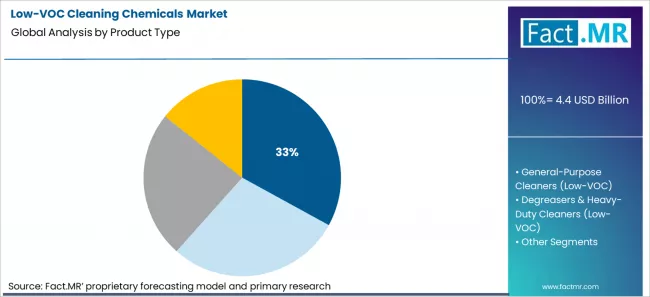
In the low-VOC cleaning chemicals market, product type strongly determines adoption due to regulatory exposure, performance expectations, and compliance requirements in controlled environments. Specialty low-VOC cleaners hold a 33.0% share because they are formulated for specific contaminants while meeting indoor air quality and occupational exposure limits. These products are widely used in healthcare facilities, cleanrooms, electronics manufacturing, and commercial buildings where conventional solvents are restricted. Buyers prioritize specialty formulations that replace high-VOC chemistries without compromising cleaning efficacy, particularly for sensitive surfaces, equipment maintenance, and regulated workplaces.
How Does Product Form Influence Demand in the Low-VOC Cleaning Chemicals Market?
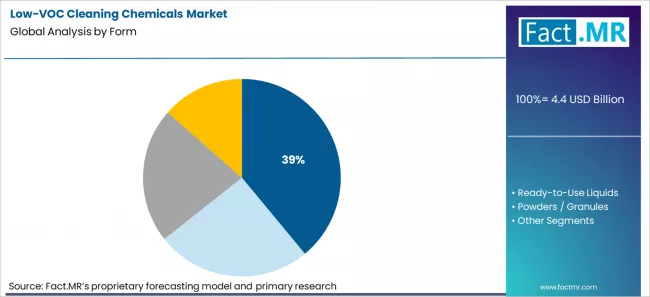
Product form directly affects handling efficiency, dilution control, and logistics across professional cleaning operations. Liquid concentrates account for a 39.0% share, driven by their suitability for centralized dilution systems and large-scale facility usage. Concentrates reduce packaging waste, lower transport volumes, and allow precise dosing aligned with compliance protocols. Adoption is strongest among industrial, institutional, and contract cleaning operators managing cost control alongside sustainability targets. The ability to customize dilution ratios while maintaining low-VOC thresholds reinforces the preference for concentrated liquid formats.
What are the Drivers, Restraints, and Key Trends in the Low-VOC Cleaning Chemicals Market?
- Drivers: Demand in the low-VOC cleaning chemicals market is shaped by stringent air quality regulations and corporate sustainability goals that require reduced volatile organic compound emissions in cleaning operations. In North America, California Air Resources Board (CARB) formulations and South Coast Air Quality Management District VOC limits drive specification of low-VOC degreasers, surface cleaners, and floor care solutions. In the European Union, product labelling under the Detergents Regulation and indoor air quality standards in commercial buildings push facility managers toward low-VOC chemistries that support employee health and LEED or BREEAM certification targets. Industrial end users in healthcare, food processing and aerospace seek products that maintain cleaning efficacy while minimizing odour and respiratory irritation risks for workers.
- Restraints: Adoption is constrained where low-VOC formulations do not meet specific soil load removal expectations in heavy industrial settings, prompting users to retain small volumes of high-VOC solvents for critical degreasing tasks. Cost pressures also influence procurement, as advanced low-VOC chemistries, such as those based on engineered surfactants or solvent replacements, can carry a price premium relative to conventional solvent blends. In markets with limited regulatory enforcement capacity, such as parts of Southeast Asia and Latin America, end users defer switching until compliance incentives or cost savings from regulatory alignment justify the transition. Supply chain variability in bio-based feedstocks used to craft low-VOC ingredients can introduce formulation inconsistency and affect performance across batches.
- Trend 1: Expansion of bio-based, low-VOC cleaning formulations that incorporate plant-derived solvents and surfactants with lower odour and toxicity profiles, enabling brands to claim renewable content percentages while meeting performance benchmarks in institutional and industrial applications.
- Trend 2: Growth in concentrated low-VOC chemical systems designed for dilution at point of use, which reduce transport and packaging weight, support closed-loop dilution control in facilities, and lower end-user cost per use while maintaining compliance with site-specific VOC emission limits.
Analysis of the Low-VOC Cleaning Chemicals Market by Key Country
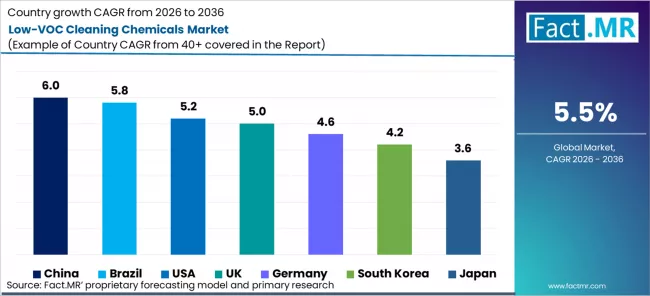
| Country | CAGR (%) |
|---|---|
| China | 6.0% |
| Brazil | 5.8% |
| USA | 5.2% |
| UK | 5.0% |
| Germany | 4.6% |
| South Korea | 4.2% |
| Japan | 3.6% |
The report covers an in-depth analysis of 40+ countries; top-performing countries are highlighted below.
What Drives Growth in China for Low-VOC Cleaning Chemicals?
China’s market is projected to grow at 6.0% CAGR, driven by tightening environmental and occupational safety standards that increasingly restrict high-VOC chemicals. The Ministry of Ecology and Environment (MEE) and other regulatory bodies have strengthened policies aimed at reducing urban air pollution and improving workplace safety, which has accelerated adoption of low-VOC cleaning products in manufacturing and commercial facilities. Expansion of large commercial and industrial complexes across major cities increases demand for surface and equipment cleaners with lower emissions profiles.
“New environmental regulations and a more informed customer base are making low-VOC formulations standard in manufacturing and commercial cleaning,” notes Li Jian, Product Manager at a major Chinese specialty chemicals company.
Rapid industrialization combined with heightened consumer awareness about indoor air quality drives steady growth in this category.
What Fuels the Rapid Rise in Brazil?
Brazil’s market is expected to grow at 5.8% CAGR, buoyed by accelerating demand from the industrial cleaning and facilities services sectors. With growing large commercial infrastructure and expanding service industries, companies are shifting toward low-VOC alternatives that cater to enhanced workplace safety and environmental commitments. Brazil’s regulatory environment, though less restrictive than North America or Europe, is increasingly aligning with global best practices regarding air quality and emissions.
“Clients are demanding products that deliver performance without compromising air quality or worker safety,” says Marcos Silva, Director of Product Development at a Brazilian specialty chemicals supplier.
How Is the USA Market Evolving in the Low-VOC Cleaning Chemicals Sector?
The USA market is forecast to grow at 5.2%, reflecting a regulatory and commercial environment where occupational health, indoor air quality, and sustainability priorities intersect. Growth is being propelled by increased adoption of low-VOC formulations across industrial, institutional, and consumer cleaning applications, driven by stringent standards such as those under the U.S. Environmental Protection Agency’s Safer Choice program, which guides procurement toward products with reduced volatile organic compounds. According to the American Cleaning Institute, demand for low-VOC industrial and institutional cleaners is rising as corporations aim to improve worker safety and meet ESG (environmental, social, governance) benchmarks.
“Reducing VOC levels in products used in enclosed environments is no longer optional - facilities managers are specifying low-VOC solutions to ensure compliance, improve air quality, and support sustainability goals,” says Jennifer Simpson, Director of Sustainability at a U.S. facilities services firm.
Despite steady adoption, price sensitivity remains a challenge for broader penetration, particularly in budget-constrained segments. Nevertheless, demand continues to grow as regulatory compliance and corporate health policies reinforce product selection decisions.
Why Is the UK Market Critical for Low-VOC Cleaning Chemicals?
The UK market is expanding at 5.0%, supported by strong regulatory frameworks such as REACH (Registration, Evaluation, Authorization and Restriction of Chemicals) and targeted initiatives to improve indoor air quality in workplaces and public spaces. Adoption of low-VOC cleaning solutions in healthcare, education, and commercial buildings is pronounced as facilities align with carbon reduction and health-centric standards. A study from the UK Health and Safety Executive highlights a shift in public sector procurement toward products with lower emissions and improved occupational safety profiles.
“Low-VOC products are increasingly included in company sustainability plans because they help improve indoor environments where people spend most of their day,” explains Sophie Turner, Head of Procurement at a major UK facilities management firm.
This alignment between regulatory compliance and corporate ESG goals makes the UK a bellwether for broader European adoption.
What Is Driving Expansion in Germany?
Germany is projected to grow at 4.6% CAGR, anchored by strong industrial and public sector adoption of low-VOC cleaning chemicals within manufacturing facilities, healthcare, and educational institutions. As Europe’s largest economy, Germany enforces environmental and occupational safety standards that favor reduced VOC emissions. The Federal Environment Agency (Umweltbundesamt) has encouraged uptake of environmentally friendly chemical products through certification programs such as Blue Angel, which includes criteria for low VOC content.
“The combination of environmental certification and corporate sustainability targets has accelerated demand for low-VOC cleaning solutions in industrial sectors,” says Dr. Petra Müller, Environmental Compliance Lead at a German industrial chemical group.
Germany’s precision manufacturing and research sectors further emphasize cleaning standards that balance performance with safety and emissions reduction.
How Is South Korea Shaping Demand for Low-VOC Cleaning Chemicals?
South Korea’s market is growing at 4.2% CAGR, supported by an increasingly health-conscious corporate environment and regulatory emphasis on reducing air pollutants. Standards set by the Ministry of Environment and policies aimed at improving indoor air quality are driving adoption in commercial, institutional, and industrial cleaning applications. South Korean firms, particularly in electronics and automotive manufacturing, specify low-VOC cleaning products to meet stringent internal specifications and export market expectations.
“In precision manufacturing, controlling VOC emissions matters not only for compliance but also for product quality and worker health,” notes Hyun-woo Kim, Senior Technical Director at a Korean specialty chemicals firm.
Export-oriented production and strong quality assurance frameworks support steady market expansion.
What Fuels the Gradual Rise in Japan?
Japan’s low-VOC cleaning chemicals market is forecast to grow at 3.6% CAGR, reflecting a cautious but steady shift toward safer formulations. Japan’s industrial sectors emphasize precision and quality, and while traditional chemical formulations have dominated, there is a growing preference for low-VOC alternatives to support improved occupational health and environmental targets. Regulations from the Ministry of the Environment, coupled with corporate sustainability initiatives, encourage progressive procurement of low-VOC solutions.
“In sectors where cleanliness and reliability are critical, the adoption of low-VOC products supports both worker safety and compliance with evolving environmental policies,” explains Masato Tanaka, Director of Product Strategy at a Japanese industrial chemicals company.
Although growth is measured, ongoing efforts to reduce emissions and improve indoor environments sustain category demand.
What Strategic Moves Are Defining Competitive Landscape?
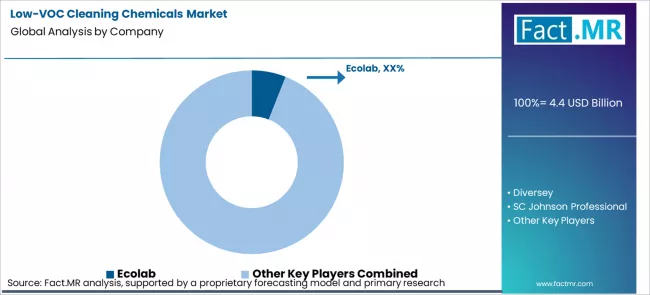
The competitive landscape is defined by the race to dominate the high-performance bio-based segment while defending legacy heavy-duty chemical franchises. Market analysis indicates that strategic investment is intensifying as global firms seek to acquire specialized green chemistries to complement their traditional cleaning portfolios. The focus is not just on removing surface contaminants but on the preservation of indoor air quality and the measurable reduction of carbon footprints which represents the next frontier of asset value creation. Christophe Beck, Chairman and CEO of Ecolab, highlights how technological integration is becoming a primary catalyst for this industrial shift.
'The AI boom is helping to shape this future and unleashing the potential for new business growth and transformative innovation.' - Christophe Beck, CEO of Ecolab
Companies like Ecolab and Diversey are leveraging their early lead in water-saving technologies and automated dosing systems to set the standard for institutional hygiene. Meanwhile, competitors like Clorox and SC Johnson Professional are looking at probiotic formulations and ultra-concentrated plastic-free formats to capture the growing demand for sustainable facility management. This strategic pivot ensures they remain relevant in a market that is rapidly moving away from purely reactive janitorial services toward a proactive and resource-efficient ecosystem.
Key Players in the Low-VOC Cleaning Chemicals Market
- Ecolab
- Diversey
- SC Johnson Professional
- 3M
- Reckitt
- Procter & Gamble
- Unilever
- Clorox
- Zep
- Betco
Scope of the Report
| Items | Values |
|---|---|
| Quantitative Units | USD billion |
| Product Type | Specialty Cleaners (Low-VOC); General-Purpose Cleaners (Low-VOC); Degreasers & Heavy-Duty Cleaners (Low-VOC); Glass & Surface Cleaners (Low-VOC) |
| Form | Liquid Concentrates; Ready-to-Use Liquids; Powders / Granules; Wipes & Other Formats |
| End-Use Sector | Commercial Facilities; Industrial & Manufacturing; Healthcare & Institutions; Residential |
| Compliance Positioning | Eco-Label / Certified Low-Emission; Standard Low-VOC Reformulations; Low-Odor / IAQ-Focused |
| Regions Covered | Asia Pacific, Europe, North America, Latin America, Middle East & Africa |
| Countries Covered | China, Brazil, USA, UK, Germany, South Korea, Japan, and 40+ countries |
| Key Companies Profiled | Ecolab; Diversey; SC Johnson Professional; 3M; Reckitt; Procter & Gamble; Unilever; Clorox; Zep; Betco |
| Additional Attributes | Dollar sales by product type, form, and end-use sector; regulatory pressure from indoor air quality (IAQ) standards and green building certifications influencing formulation shifts; procurement preference for eco-labelled and low-odor cleaning chemicals across commercial and healthcare facilities; reformulation capex linked to VOC thresholds under regional environmental regulations; growing adoption of low-VOC concentrates to reduce transport emissions and packaging waste. |
Low-VOC Cleaning Chemicals Market Key Segment
-
Product Type :
- Specialty Cleaners (Low-VOC)
- General-Purpose Cleaners (Low-VOC)
- Degreasers & Heavy-Duty Cleaners (Low-VOC)
- Glass & Surface Cleaners (Low-VOC)
-
Form :
- Liquid Concentrates
- Ready-to-Use Liquids
- Powders / Granules
- Wipes & Other Formats
-
End-Use Sector :
- Commercial Facilities
- Industrial & Manufacturing
- Healthcare & Institutions
- Residential
-
Compliance Positioning :
- Eco-Label / Certified Low-Emission
- Standard Low-VOC Reformulations
- Low-Odor / IAQ-Focused
-
Region :
- North America
- USA
- Canada
- Mexico
- Europe
- Germany
- UK
- France
- Italy
- Spain
- Nordic Countries
- BENELUX
- Rest of Europe
- Asia Pacific
- China
- Japan
- South Korea
- India
- Australia
- Rest of Asia Pacific
- Latin America
- Brazil
- Argentina
- Rest of Latin America
- Middle East and Africa
- Kingdom of Saudi Arabia
- United Arab Emirates
- South Africa
- Rest of Middle East and Africa
- Other Regions
- Oceania
- Central Asia
- Other Markets
- North America
Bibliographies
- U.S. Environmental Protection Agency. (2024). Safer Choice standard: Criteria for low-VOC and low-emission cleaning products. EPA.
- European Commission. (2023). Detergents Regulation (EC) No 648/2004: Environmental performance and labelling requirements. European Union.
- European Chemicals Agency. (2024). REACH guidance on substances contributing to indoor air emissions. ECHA.
- Japan Ministry of the Environment. (2024). Volatile organic compound management in consumer and industrial products. MOE Japan.
- Korea Ministry of Environment. (2023). Indoor air quality management standards and low-emission products. MOE Korea.
- International Organization for Standardization. (2023). ISO 16000 series: Indoor air-Determination of emissions from building products. ISO.
Table of Content
- Executive Summary
- Global Market Outlook
- Demand to side Trends
- Supply to side Trends
- Technology Roadmap Analysis
- Analysis and Recommendations
- Market Overview
- Market Coverage / Taxonomy
- Market Definition / Scope / Limitations
- Research Methodology
- Chapter Orientation
- Analytical Lens and Working Hypotheses
- Market Structure, Signals, and Trend Drivers
- Benchmarking and Cross-market Comparability
- Market Sizing, Forecasting, and Opportunity Mapping
- Research Design and Evidence Framework
- Desk Research Programme (Secondary Evidence)
- Company Annual and Sustainability Reports
- Peer-reviewed Journals and Academic Literature
- Corporate Websites, Product Literature, and Technical Notes
- Earnings Decks and Investor Briefings
- Statutory Filings and Regulatory Disclosures
- Technical White Papers and Standards Notes
- Trade Journals, Industry Magazines, and Analyst Briefs
- Conference Proceedings, Webinars, and Seminar Materials
- Government Statistics Portals and Public Data Releases
- Press Releases and Reputable Media Coverage
- Specialist Newsletters and Curated Briefings
- Sector Databases and Reference Repositories
- FMR Internal Proprietary Databases and Historical Market Datasets
- Subscription Datasets and Paid Sources
- Social Channels, Communities, and Digital Listening Inputs
- Additional Desk Sources
- Expert Input and Fieldwork (Primary Evidence)
- Primary Modes
- Qualitative Interviews and Expert Elicitation
- Quantitative Surveys and Structured Data Capture
- Blended Approach
- Why Primary Evidence is Used
- Field Techniques
- Interviews
- Surveys
- Focus Groups
- Observational and In-context Research
- Social and Community Interactions
- Stakeholder Universe Engaged
- C-suite Leaders
- Board Members
- Presidents and Vice Presidents
- R&D and Innovation Heads
- Technical Specialists
- Domain Subject-matter Experts
- Scientists
- Physicians and Other Healthcare Professionals
- Governance, Ethics, and Data Stewardship
- Research Ethics
- Data Integrity and Handling
- Primary Modes
- Tooling, Models, and Reference Databases
- Desk Research Programme (Secondary Evidence)
- Data Engineering and Model Build
- Data Acquisition and Ingestion
- Cleaning, Normalisation, and Verification
- Synthesis, Triangulation, and Analysis
- Quality Assurance and Audit Trail
- Market Background
- Market Dynamics
- Drivers
- Restraints
- Opportunity
- Trends
- Scenario Forecast
- Demand in Optimistic Scenario
- Demand in Likely Scenario
- Demand in Conservative Scenario
- Opportunity Map Analysis
- Product Life Cycle Analysis
- Supply Chain Analysis
- Investment Feasibility Matrix
- Value Chain Analysis
- PESTLE and Porter’s Analysis
- Regulatory Landscape
- Regional Parent Market Outlook
- Production and Consumption Statistics
- Import and Export Statistics
- Market Dynamics
- Global Market Analysis 2021 to 2025 and Forecast, 2026 to 2036
- Historical Market Size Value (USD Million) Analysis, 2021 to 2025
- Current and Future Market Size Value (USD Million) Projections, 2026 to 2036
- Y to o to Y Growth Trend Analysis
- Absolute $ Opportunity Analysis
- Global Market Pricing Analysis 2021 to 2025 and Forecast 2026 to 2036
- Global Market Analysis 2021 to 2025 and Forecast 2026 to 2036, By Product Type
- Introduction / Key Findings
- Historical Market Size Value (USD Million) Analysis By Product Type, 2021 to 2025
- Current and Future Market Size Value (USD Million) Analysis and Forecast By Product Type, 2026 to 2036
- Specialty Cleaners (Low-VOC)
- General-Purpose Cleaners (Low-VOC)
- Degreasers & Heavy-Duty Cleaners (Low-VOC)
- Glass & Surface Cleaners (Low-VOC)
- Specialty Cleaners (Low-VOC)
- Y to o to Y Growth Trend Analysis By Product Type, 2021 to 2025
- Absolute $ Opportunity Analysis By Product Type, 2026 to 2036
- Global Market Analysis 2021 to 2025 and Forecast 2026 to 2036, By Form
- Introduction / Key Findings
- Historical Market Size Value (USD Million) Analysis By Form, 2021 to 2025
- Current and Future Market Size Value (USD Million) Analysis and Forecast By Form, 2026 to 2036
- Liquid Concentrates
- Ready-to-Use Liquids
- Powders / Granules
- Wipes & Other Formats
- Liquid Concentrates
- Y to o to Y Growth Trend Analysis By Form, 2021 to 2025
- Absolute $ Opportunity Analysis By Form, 2026 to 2036
- Global Market Analysis 2021 to 2025 and Forecast 2026 to 2036, By End-Use Sector
- Introduction / Key Findings
- Historical Market Size Value (USD Million) Analysis By End-Use Sector, 2021 to 2025
- Current and Future Market Size Value (USD Million) Analysis and Forecast By End-Use Sector, 2026 to 2036
- Commercial Facilities
- Industrial & Manufacturing
- Healthcare & Institutions
- Residential
- Commercial Facilities
- Y to o to Y Growth Trend Analysis By End-Use Sector, 2021 to 2025
- Absolute $ Opportunity Analysis By End-Use Sector, 2026 to 2036
- Global Market Analysis 2021 to 2025 and Forecast 2026 to 2036, By Compliance Positioning
- Introduction / Key Findings
- Historical Market Size Value (USD Million) Analysis By Compliance Positioning, 2021 to 2025
- Current and Future Market Size Value (USD Million) Analysis and Forecast By Compliance Positioning, 2026 to 2036
- Eco-Label / Certified Low-Emission
- Standard Low-VOC Reformulations
- Low-Odor / IAQ-Focused
- Eco-Label / Certified Low-Emission
- Y to o to Y Growth Trend Analysis By Compliance Positioning, 2021 to 2025
- Absolute $ Opportunity Analysis By Compliance Positioning, 2026 to 2036
- Global Market Analysis 2021 to 2025 and Forecast 2026 to 2036, By Region
- Introduction
- Historical Market Size Value (USD Million) Analysis By Region, 2021 to 2025
- Current Market Size Value (USD Million) Analysis and Forecast By Region, 2026 to 2036
- North America
- Latin America
- Western Europe
- Eastern Europe
- East Asia
- South Asia and Pacific
- Middle East & Africa
- Market Attractiveness Analysis By Region
- North America Market Analysis 2021 to 2025 and Forecast 2026 to 2036, By Country
- Historical Market Size Value (USD Million) Trend Analysis By Market Taxonomy, 2021 to 2025
- Market Size Value (USD Million) Forecast By Market Taxonomy, 2026 to 2036
- By Country
- USA
- Canada
- Mexico
- By Product Type
- By Form
- By End-Use Sector
- By Compliance Positioning
- By Country
- Market Attractiveness Analysis
- By Country
- By Product Type
- By Form
- By End-Use Sector
- By Compliance Positioning
- Key Takeaways
- Latin America Market Analysis 2021 to 2025 and Forecast 2026 to 2036, By Country
- Historical Market Size Value (USD Million) Trend Analysis By Market Taxonomy, 2021 to 2025
- Market Size Value (USD Million) Forecast By Market Taxonomy, 2026 to 2036
- By Country
- Brazil
- Chile
- Rest of Latin America
- By Product Type
- By Form
- By End-Use Sector
- By Compliance Positioning
- By Country
- Market Attractiveness Analysis
- By Country
- By Product Type
- By Form
- By End-Use Sector
- By Compliance Positioning
- Key Takeaways
- Western Europe Market Analysis 2021 to 2025 and Forecast 2026 to 2036, By Country
- Historical Market Size Value (USD Million) Trend Analysis By Market Taxonomy, 2021 to 2025
- Market Size Value (USD Million) Forecast By Market Taxonomy, 2026 to 2036
- By Country
- Germany
- UK
- Italy
- Spain
- France
- Nordic
- BENELUX
- Rest of Western Europe
- By Product Type
- By Form
- By End-Use Sector
- By Compliance Positioning
- By Country
- Market Attractiveness Analysis
- By Country
- By Product Type
- By Form
- By End-Use Sector
- By Compliance Positioning
- Key Takeaways
- Eastern Europe Market Analysis 2021 to 2025 and Forecast 2026 to 2036, By Country
- Historical Market Size Value (USD Million) Trend Analysis By Market Taxonomy, 2021 to 2025
- Market Size Value (USD Million) Forecast By Market Taxonomy, 2026 to 2036
- By Country
- Russia
- Poland
- Hungary
- Balkan & Baltic
- Rest of Eastern Europe
- By Product Type
- By Form
- By End-Use Sector
- By Compliance Positioning
- By Country
- Market Attractiveness Analysis
- By Country
- By Product Type
- By Form
- By End-Use Sector
- By Compliance Positioning
- Key Takeaways
- East Asia Market Analysis 2021 to 2025 and Forecast 2026 to 2036, By Country
- Historical Market Size Value (USD Million) Trend Analysis By Market Taxonomy, 2021 to 2025
- Market Size Value (USD Million) Forecast By Market Taxonomy, 2026 to 2036
- By Country
- China
- Japan
- South Korea
- By Product Type
- By Form
- By End-Use Sector
- By Compliance Positioning
- By Country
- Market Attractiveness Analysis
- By Country
- By Product Type
- By Form
- By End-Use Sector
- By Compliance Positioning
- Key Takeaways
- South Asia and Pacific Market Analysis 2021 to 2025 and Forecast 2026 to 2036, By Country
- Historical Market Size Value (USD Million) Trend Analysis By Market Taxonomy, 2021 to 2025
- Market Size Value (USD Million) Forecast By Market Taxonomy, 2026 to 2036
- By Country
- India
- ASEAN
- Australia & New Zealand
- Rest of South Asia and Pacific
- By Product Type
- By Form
- By End-Use Sector
- By Compliance Positioning
- By Country
- Market Attractiveness Analysis
- By Country
- By Product Type
- By Form
- By End-Use Sector
- By Compliance Positioning
- Key Takeaways
- Middle East & Africa Market Analysis 2021 to 2025 and Forecast 2026 to 2036, By Country
- Historical Market Size Value (USD Million) Trend Analysis By Market Taxonomy, 2021 to 2025
- Market Size Value (USD Million) Forecast By Market Taxonomy, 2026 to 2036
- By Country
- Kingdom of Saudi Arabia
- Other GCC Countries
- Turkiye
- South Africa
- Other African Union
- Rest of Middle East & Africa
- By Product Type
- By Form
- By End-Use Sector
- By Compliance Positioning
- By Country
- Market Attractiveness Analysis
- By Country
- By Product Type
- By Form
- By End-Use Sector
- By Compliance Positioning
- Key Takeaways
- Key Countries Market Analysis
- USA
- Pricing Analysis
- Market Share Analysis, 2025
- By Product Type
- By Form
- By End-Use Sector
- By Compliance Positioning
- Canada
- Pricing Analysis
- Market Share Analysis, 2025
- By Product Type
- By Form
- By End-Use Sector
- By Compliance Positioning
- Mexico
- Pricing Analysis
- Market Share Analysis, 2025
- By Product Type
- By Form
- By End-Use Sector
- By Compliance Positioning
- Brazil
- Pricing Analysis
- Market Share Analysis, 2025
- By Product Type
- By Form
- By End-Use Sector
- By Compliance Positioning
- Chile
- Pricing Analysis
- Market Share Analysis, 2025
- By Product Type
- By Form
- By End-Use Sector
- By Compliance Positioning
- Germany
- Pricing Analysis
- Market Share Analysis, 2025
- By Product Type
- By Form
- By End-Use Sector
- By Compliance Positioning
- UK
- Pricing Analysis
- Market Share Analysis, 2025
- By Product Type
- By Form
- By End-Use Sector
- By Compliance Positioning
- Italy
- Pricing Analysis
- Market Share Analysis, 2025
- By Product Type
- By Form
- By End-Use Sector
- By Compliance Positioning
- Spain
- Pricing Analysis
- Market Share Analysis, 2025
- By Product Type
- By Form
- By End-Use Sector
- By Compliance Positioning
- France
- Pricing Analysis
- Market Share Analysis, 2025
- By Product Type
- By Form
- By End-Use Sector
- By Compliance Positioning
- India
- Pricing Analysis
- Market Share Analysis, 2025
- By Product Type
- By Form
- By End-Use Sector
- By Compliance Positioning
- ASEAN
- Pricing Analysis
- Market Share Analysis, 2025
- By Product Type
- By Form
- By End-Use Sector
- By Compliance Positioning
- Australia & New Zealand
- Pricing Analysis
- Market Share Analysis, 2025
- By Product Type
- By Form
- By End-Use Sector
- By Compliance Positioning
- China
- Pricing Analysis
- Market Share Analysis, 2025
- By Product Type
- By Form
- By End-Use Sector
- By Compliance Positioning
- Japan
- Pricing Analysis
- Market Share Analysis, 2025
- By Product Type
- By Form
- By End-Use Sector
- By Compliance Positioning
- South Korea
- Pricing Analysis
- Market Share Analysis, 2025
- By Product Type
- By Form
- By End-Use Sector
- By Compliance Positioning
- Russia
- Pricing Analysis
- Market Share Analysis, 2025
- By Product Type
- By Form
- By End-Use Sector
- By Compliance Positioning
- Poland
- Pricing Analysis
- Market Share Analysis, 2025
- By Product Type
- By Form
- By End-Use Sector
- By Compliance Positioning
- Hungary
- Pricing Analysis
- Market Share Analysis, 2025
- By Product Type
- By Form
- By End-Use Sector
- By Compliance Positioning
- Kingdom of Saudi Arabia
- Pricing Analysis
- Market Share Analysis, 2025
- By Product Type
- By Form
- By End-Use Sector
- By Compliance Positioning
- Turkiye
- Pricing Analysis
- Market Share Analysis, 2025
- By Product Type
- By Form
- By End-Use Sector
- By Compliance Positioning
- South Africa
- Pricing Analysis
- Market Share Analysis, 2025
- By Product Type
- By Form
- By End-Use Sector
- By Compliance Positioning
- USA
- Market Structure Analysis
- Competition Dashboard
- Competition Benchmarking
- Market Share Analysis of Top Players
- By Regional
- By Product Type
- By Form
- By End-Use Sector
- By Compliance Positioning
- Competition Analysis
- Competition Deep Dive
- Ecolab
- Overview
- Product Portfolio
- Profitability by Market Segments (Product/Age /Sales Channel/Region)
- Sales Footprint
- Strategy Overview
- Marketing Strategy
- Product Strategy
- Channel Strategy
- Diversey
- SC Johnson Professional
- 3M
- Reckitt
- Procter & Gamble
- Unilever
- Clorox
- Zep
- Betco
- Ecolab
- Competition Deep Dive
- Assumptions & Acronyms Used
List Of Table
- Table 1: Global Market Value (USD Million) Forecast by Region, 2021 to 2036
- Table 2: Global Market Value (USD Million) Forecast by Product Type, 2021 to 2036
- Table 3: Global Market Value (USD Million) Forecast by Form, 2021 to 2036
- Table 4: Global Market Value (USD Million) Forecast by End-Use Sector, 2021 to 2036
- Table 5: Global Market Value (USD Million) Forecast by Compliance Positioning, 2021 to 2036
- Table 6: North America Market Value (USD Million) Forecast by Country, 2021 to 2036
- Table 7: North America Market Value (USD Million) Forecast by Product Type, 2021 to 2036
- Table 8: North America Market Value (USD Million) Forecast by Form, 2021 to 2036
- Table 9: North America Market Value (USD Million) Forecast by End-Use Sector, 2021 to 2036
- Table 10: North America Market Value (USD Million) Forecast by Compliance Positioning, 2021 to 2036
- Table 11: Latin America Market Value (USD Million) Forecast by Country, 2021 to 2036
- Table 12: Latin America Market Value (USD Million) Forecast by Product Type, 2021 to 2036
- Table 13: Latin America Market Value (USD Million) Forecast by Form, 2021 to 2036
- Table 14: Latin America Market Value (USD Million) Forecast by End-Use Sector, 2021 to 2036
- Table 15: Latin America Market Value (USD Million) Forecast by Compliance Positioning, 2021 to 2036
- Table 16: Western Europe Market Value (USD Million) Forecast by Country, 2021 to 2036
- Table 17: Western Europe Market Value (USD Million) Forecast by Product Type, 2021 to 2036
- Table 18: Western Europe Market Value (USD Million) Forecast by Form, 2021 to 2036
- Table 19: Western Europe Market Value (USD Million) Forecast by End-Use Sector, 2021 to 2036
- Table 20: Western Europe Market Value (USD Million) Forecast by Compliance Positioning, 2021 to 2036
- Table 21: Eastern Europe Market Value (USD Million) Forecast by Country, 2021 to 2036
- Table 22: Eastern Europe Market Value (USD Million) Forecast by Product Type, 2021 to 2036
- Table 23: Eastern Europe Market Value (USD Million) Forecast by Form, 2021 to 2036
- Table 24: Eastern Europe Market Value (USD Million) Forecast by End-Use Sector, 2021 to 2036
- Table 25: Eastern Europe Market Value (USD Million) Forecast by Compliance Positioning, 2021 to 2036
- Table 26: East Asia Market Value (USD Million) Forecast by Country, 2021 to 2036
- Table 27: East Asia Market Value (USD Million) Forecast by Product Type, 2021 to 2036
- Table 28: East Asia Market Value (USD Million) Forecast by Form, 2021 to 2036
- Table 29: East Asia Market Value (USD Million) Forecast by End-Use Sector, 2021 to 2036
- Table 30: East Asia Market Value (USD Million) Forecast by Compliance Positioning, 2021 to 2036
- Table 31: South Asia and Pacific Market Value (USD Million) Forecast by Country, 2021 to 2036
- Table 32: South Asia and Pacific Market Value (USD Million) Forecast by Product Type, 2021 to 2036
- Table 33: South Asia and Pacific Market Value (USD Million) Forecast by Form, 2021 to 2036
- Table 34: South Asia and Pacific Market Value (USD Million) Forecast by End-Use Sector, 2021 to 2036
- Table 35: South Asia and Pacific Market Value (USD Million) Forecast by Compliance Positioning, 2021 to 2036
- Table 36: Middle East & Africa Market Value (USD Million) Forecast by Country, 2021 to 2036
- Table 37: Middle East & Africa Market Value (USD Million) Forecast by Product Type, 2021 to 2036
- Table 38: Middle East & Africa Market Value (USD Million) Forecast by Form, 2021 to 2036
- Table 39: Middle East & Africa Market Value (USD Million) Forecast by End-Use Sector, 2021 to 2036
- Table 40: Middle East & Africa Market Value (USD Million) Forecast by Compliance Positioning, 2021 to 2036
List Of Figures
- Figure 1: Global Market Pricing Analysis
- Figure 2: Global Market Value (USD Million) Forecast 2021 to 2036
- Figure 3: Global Market Value Share and BPS Analysis by Product Type, 2026 and 2036
- Figure 4: Global Market Y to o to Y Growth Comparison by Product Type, 2026 to 2036
- Figure 5: Global Market Attractiveness Analysis by Product Type
- Figure 6: Global Market Value Share and BPS Analysis by Form, 2026 and 2036
- Figure 7: Global Market Y to o to Y Growth Comparison by Form, 2026 to 2036
- Figure 8: Global Market Attractiveness Analysis by Form
- Figure 9: Global Market Value Share and BPS Analysis by End-Use Sector, 2026 and 2036
- Figure 10: Global Market Y to o to Y Growth Comparison by End-Use Sector, 2026 to 2036
- Figure 11: Global Market Attractiveness Analysis by End-Use Sector
- Figure 12: Global Market Value Share and BPS Analysis by Compliance Positioning, 2026 and 2036
- Figure 13: Global Market Y to o to Y Growth Comparison by Compliance Positioning, 2026 to 2036
- Figure 14: Global Market Attractiveness Analysis by Compliance Positioning
- Figure 15: Global Market Value (USD Million) Share and BPS Analysis by Region, 2026 and 2036
- Figure 16: Global Market Y to o to Y Growth Comparison by Region, 2026 to 2036
- Figure 17: Global Market Attractiveness Analysis by Region
- Figure 18: North America Market Incremental Dollar Opportunity, 2026 to 2036
- Figure 19: Latin America Market Incremental Dollar Opportunity, 2026 to 2036
- Figure 20: Western Europe Market Incremental Dollar Opportunity, 2026 to 2036
- Figure 21: Eastern Europe Market Incremental Dollar Opportunity, 2026 to 2036
- Figure 22: East Asia Market Incremental Dollar Opportunity, 2026 to 2036
- Figure 23: South Asia and Pacific Market Incremental Dollar Opportunity, 2026 to 2036
- Figure 24: Middle East & Africa Market Incremental Dollar Opportunity, 2026 to 2036
- Figure 25: North America Market Value Share and BPS Analysis by Country, 2026 and 2036
- Figure 26: North America Market Value Share and BPS Analysis by Product Type, 2026 and 2036
- Figure 27: North America Market Y to o to Y Growth Comparison by Product Type, 2026 to 2036
- Figure 28: North America Market Attractiveness Analysis by Product Type
- Figure 29: North America Market Value Share and BPS Analysis by Form, 2026 and 2036
- Figure 30: North America Market Y to o to Y Growth Comparison by Form, 2026 to 2036
- Figure 31: North America Market Attractiveness Analysis by Form
- Figure 32: North America Market Value Share and BPS Analysis by End-Use Sector, 2026 and 2036
- Figure 33: North America Market Y to o to Y Growth Comparison by End-Use Sector, 2026 to 2036
- Figure 34: North America Market Attractiveness Analysis by End-Use Sector
- Figure 35: North America Market Value Share and BPS Analysis by Compliance Positioning, 2026 and 2036
- Figure 36: North America Market Y to o to Y Growth Comparison by Compliance Positioning, 2026 to 2036
- Figure 37: North America Market Attractiveness Analysis by Compliance Positioning
- Figure 38: Latin America Market Value Share and BPS Analysis by Country, 2026 and 2036
- Figure 39: Latin America Market Value Share and BPS Analysis by Product Type, 2026 and 2036
- Figure 40: Latin America Market Y to o to Y Growth Comparison by Product Type, 2026 to 2036
- Figure 41: Latin America Market Attractiveness Analysis by Product Type
- Figure 42: Latin America Market Value Share and BPS Analysis by Form, 2026 and 2036
- Figure 43: Latin America Market Y to o to Y Growth Comparison by Form, 2026 to 2036
- Figure 44: Latin America Market Attractiveness Analysis by Form
- Figure 45: Latin America Market Value Share and BPS Analysis by End-Use Sector, 2026 and 2036
- Figure 46: Latin America Market Y to o to Y Growth Comparison by End-Use Sector, 2026 to 2036
- Figure 47: Latin America Market Attractiveness Analysis by End-Use Sector
- Figure 48: Latin America Market Value Share and BPS Analysis by Compliance Positioning, 2026 and 2036
- Figure 49: Latin America Market Y to o to Y Growth Comparison by Compliance Positioning, 2026 to 2036
- Figure 50: Latin America Market Attractiveness Analysis by Compliance Positioning
- Figure 51: Western Europe Market Value Share and BPS Analysis by Country, 2026 and 2036
- Figure 52: Western Europe Market Value Share and BPS Analysis by Product Type, 2026 and 2036
- Figure 53: Western Europe Market Y to o to Y Growth Comparison by Product Type, 2026 to 2036
- Figure 54: Western Europe Market Attractiveness Analysis by Product Type
- Figure 55: Western Europe Market Value Share and BPS Analysis by Form, 2026 and 2036
- Figure 56: Western Europe Market Y to o to Y Growth Comparison by Form, 2026 to 2036
- Figure 57: Western Europe Market Attractiveness Analysis by Form
- Figure 58: Western Europe Market Value Share and BPS Analysis by End-Use Sector, 2026 and 2036
- Figure 59: Western Europe Market Y to o to Y Growth Comparison by End-Use Sector, 2026 to 2036
- Figure 60: Western Europe Market Attractiveness Analysis by End-Use Sector
- Figure 61: Western Europe Market Value Share and BPS Analysis by Compliance Positioning, 2026 and 2036
- Figure 62: Western Europe Market Y to o to Y Growth Comparison by Compliance Positioning, 2026 to 2036
- Figure 63: Western Europe Market Attractiveness Analysis by Compliance Positioning
- Figure 64: Eastern Europe Market Value Share and BPS Analysis by Country, 2026 and 2036
- Figure 65: Eastern Europe Market Value Share and BPS Analysis by Product Type, 2026 and 2036
- Figure 66: Eastern Europe Market Y to o to Y Growth Comparison by Product Type, 2026 to 2036
- Figure 67: Eastern Europe Market Attractiveness Analysis by Product Type
- Figure 68: Eastern Europe Market Value Share and BPS Analysis by Form, 2026 and 2036
- Figure 69: Eastern Europe Market Y to o to Y Growth Comparison by Form, 2026 to 2036
- Figure 70: Eastern Europe Market Attractiveness Analysis by Form
- Figure 71: Eastern Europe Market Value Share and BPS Analysis by End-Use Sector, 2026 and 2036
- Figure 72: Eastern Europe Market Y to o to Y Growth Comparison by End-Use Sector, 2026 to 2036
- Figure 73: Eastern Europe Market Attractiveness Analysis by End-Use Sector
- Figure 74: Eastern Europe Market Value Share and BPS Analysis by Compliance Positioning, 2026 and 2036
- Figure 75: Eastern Europe Market Y to o to Y Growth Comparison by Compliance Positioning, 2026 to 2036
- Figure 76: Eastern Europe Market Attractiveness Analysis by Compliance Positioning
- Figure 77: East Asia Market Value Share and BPS Analysis by Country, 2026 and 2036
- Figure 78: East Asia Market Value Share and BPS Analysis by Product Type, 2026 and 2036
- Figure 79: East Asia Market Y to o to Y Growth Comparison by Product Type, 2026 to 2036
- Figure 80: East Asia Market Attractiveness Analysis by Product Type
- Figure 81: East Asia Market Value Share and BPS Analysis by Form, 2026 and 2036
- Figure 82: East Asia Market Y to o to Y Growth Comparison by Form, 2026 to 2036
- Figure 83: East Asia Market Attractiveness Analysis by Form
- Figure 84: East Asia Market Value Share and BPS Analysis by End-Use Sector, 2026 and 2036
- Figure 85: East Asia Market Y to o to Y Growth Comparison by End-Use Sector, 2026 to 2036
- Figure 86: East Asia Market Attractiveness Analysis by End-Use Sector
- Figure 87: East Asia Market Value Share and BPS Analysis by Compliance Positioning, 2026 and 2036
- Figure 88: East Asia Market Y to o to Y Growth Comparison by Compliance Positioning, 2026 to 2036
- Figure 89: East Asia Market Attractiveness Analysis by Compliance Positioning
- Figure 90: South Asia and Pacific Market Value Share and BPS Analysis by Country, 2026 and 2036
- Figure 91: South Asia and Pacific Market Value Share and BPS Analysis by Product Type, 2026 and 2036
- Figure 92: South Asia and Pacific Market Y to o to Y Growth Comparison by Product Type, 2026 to 2036
- Figure 93: South Asia and Pacific Market Attractiveness Analysis by Product Type
- Figure 94: South Asia and Pacific Market Value Share and BPS Analysis by Form, 2026 and 2036
- Figure 95: South Asia and Pacific Market Y to o to Y Growth Comparison by Form, 2026 to 2036
- Figure 96: South Asia and Pacific Market Attractiveness Analysis by Form
- Figure 97: South Asia and Pacific Market Value Share and BPS Analysis by End-Use Sector, 2026 and 2036
- Figure 98: South Asia and Pacific Market Y to o to Y Growth Comparison by End-Use Sector, 2026 to 2036
- Figure 99: South Asia and Pacific Market Attractiveness Analysis by End-Use Sector
- Figure 100: South Asia and Pacific Market Value Share and BPS Analysis by Compliance Positioning, 2026 and 2036
- Figure 101: South Asia and Pacific Market Y to o to Y Growth Comparison by Compliance Positioning, 2026 to 2036
- Figure 102: South Asia and Pacific Market Attractiveness Analysis by Compliance Positioning
- Figure 103: Middle East & Africa Market Value Share and BPS Analysis by Country, 2026 and 2036
- Figure 104: Middle East & Africa Market Value Share and BPS Analysis by Product Type, 2026 and 2036
- Figure 105: Middle East & Africa Market Y to o to Y Growth Comparison by Product Type, 2026 to 2036
- Figure 106: Middle East & Africa Market Attractiveness Analysis by Product Type
- Figure 107: Middle East & Africa Market Value Share and BPS Analysis by Form, 2026 and 2036
- Figure 108: Middle East & Africa Market Y to o to Y Growth Comparison by Form, 2026 to 2036
- Figure 109: Middle East & Africa Market Attractiveness Analysis by Form
- Figure 110: Middle East & Africa Market Value Share and BPS Analysis by End-Use Sector, 2026 and 2036
- Figure 111: Middle East & Africa Market Y to o to Y Growth Comparison by End-Use Sector, 2026 to 2036
- Figure 112: Middle East & Africa Market Attractiveness Analysis by End-Use Sector
- Figure 113: Middle East & Africa Market Value Share and BPS Analysis by Compliance Positioning, 2026 and 2036
- Figure 114: Middle East & Africa Market Y to o to Y Growth Comparison by Compliance Positioning, 2026 to 2036
- Figure 115: Middle East & Africa Market Attractiveness Analysis by Compliance Positioning
- Figure 116: Global Market - Tier Structure Analysis
- Figure 117: Global Market - Company Share Analysis
- FAQs -
How big is the low-voc cleaning chemicals market in 2026?
The global low-voc cleaning chemicals market is estimated to be valued at USD 4.4 billion in 2026.
What will be the size of low-voc cleaning chemicals market in 2036?
The market size for the low-voc cleaning chemicals market is projected to reach USD 7.5 billion by 2036.
How much will be the low-voc cleaning chemicals market growth between 2026 and 2036?
The low-voc cleaning chemicals market is expected to grow at a 5.5% CAGR between 2026 and 2036.
What are the key product types in the low-voc cleaning chemicals market?
The key product types in low-voc cleaning chemicals market are specialty cleaners (low-voc), general-purpose cleaners (low-voc), degreasers & heavy-duty cleaners (low-voc) and glass & surface cleaners (low-voc).
Which form segment to contribute significant share in the low-voc cleaning chemicals market in 2026?
In terms of form, liquid concentrates segment to command 39.0% share in the low-voc cleaning chemicals market in 2026.