- Base Value(2025): 23.2 Bn
- Estimated Value(2026): 25.7 Bn
- Forecast Value (2036): 71.7 Bn
- CAGR (2026 - 2036): 10.8%
Web Conferencing Market Forecast and Outlook By Fact.MR
In 2025, the web conferencing market was valued at USD 23.2 billion. Based on FACT.MR Insights’ analysis, demand for web conferencing solutions is estimated to grow to USD 25.7 billion in 2026 and USD 71.7 billion by 2036. FACT.MR projects a CAGR of 10.8% during the forecast period.
FACT.MR analysis indicates that the web conferencing market is expected to generate an absolute dollar opportunity of USD 46.0 billion between 2026 and 2036. This substantial expansion reflects permanent structural embedding of remote and hybrid work collaboration tools across enterprise, education, and healthcare sectors globally. Growth is moderated by market saturation in large enterprise accounts in North America and Western Europe, platform consolidation compressing standalone web conferencing vendor revenue, and data residency regulation compliance costs in the European Union and Asia Pacific adding implementation friction to cloud-based deployment.
Zoom and Microsoft reported that enterprise customers now prioritise AI-powered collaboration features over basic video conferencing. Zoom’s AI Companion reached over 1 million monthly users, while Microsoft Teams Premium surpassed 10 million licensed seats, showing AI capabilities are becoming the key factor in enterprise web conferencing platform selection.
Country growth reflects hybrid work adoption, AI collaboration demand, and government digital programmes. China leads at 9.0% CAGR through enterprise digital transformation and domestic platform adoption. The United States follows at 8.8% with AI collaboration upgrades and cloud-first policies. The United Kingdom grows at 8.1% via NHS virtual consultations. South Korea records 7.8% from virtual classroom expansion. France grows at 7.6% through digital services investment. Germany posts 7.4%, while Japan records 7.0% growth.
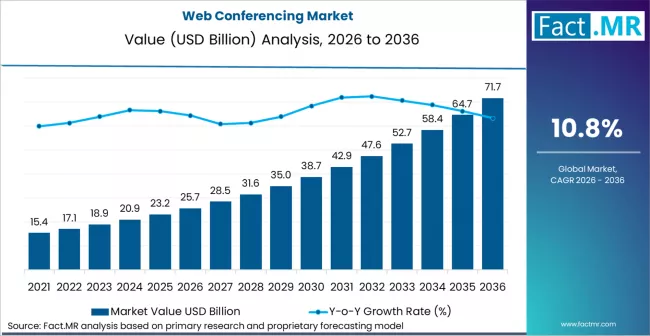
Web Conferencing Market Market Value Analysis | Source: Fact.MR
| Metric | Value |
|---|---|
| Estimated Value in 2026 | USD 25.7 billion |
| Forecast Value in 2036 | USD 71.7 billion |
| Forecast CAGR (2026 to 2036) | 10.8% |
Source: Fact.MR analysis. Updated Mar 12, 2026
Market Definition
The web conferencing market includes software and cloud platforms that enable real-time video, audio, screen sharing, and online collaboration. These platforms support remote meetings, virtual classrooms, telehealth consultations, and hybrid workplace communication.
Market Inclusions
Includes global forecasts from 2026 to 2036 by component, deployment model, and end user. Covers hosted, SaaS, on-premises, and managed conferencing across enterprise, education, government, healthcare, and other industries.
Market Exclusions
Excludes standalone chat apps without video capability, hardware-only conference systems, broadcast-only webinar tools, and telephony services without video collaboration features.
Research Methodology
- Primary Research: Interviews with enterprise IT managers, CIOs, education technology leaders, government digital teams, and conferencing platform product managers.
- Desk Research: Sources include vendor earnings reports, SEC filings, government digital transformation programmes, GDPR compliance records, education ministry statistics, and telehealth programme reports.
- Market Sizing and Forecasting: Hybrid model using SaaS subscription counts, contract values by deployment type, customer acquisition rates, and AI feature upsell revenue data.
- Data Validation and Update Cycle: Data validated using vendor revenues, IT spending surveys, government procurement databases, education deployment data, and telehealth adoption statistics.
Summary
- Market Definition
- Web conferencing platforms provide cloud or on-premises video, audio, and collaboration tools for enterprises, education institutions, government agencies, and healthcare organisations.
- Demand Drivers
- Hybrid work policies are sustaining enterprise SaaS conferencing subscriptions and increasing AI feature adoption.
- Government digital service programmes are expanding demand for secure web conferencing platforms.
- Telehealth consultations and remote clinical collaboration are increasing healthcare platform adoption.
- Key Segments Analyzed
- By Component: Solutions hold about 70% share in 2026 due to strong SaaS platform subscription revenue.
- By Deployment: SaaS leads with about 38% share in 2026 due to scalable cloud delivery.
- By Geography: China records the fastest growth while North America generates the highest revenue.
- Analyst Opinion at FACT.MR
- Shambhu Nath Jha, Principal Consultant at Fact.MR, opines that CXOs will find this report helpful for understanding how AI-enabled meeting intelligence, enterprise hybrid work platform adoption, telehealth consultation expansion, and government digital service programmes are shaping long-term growth and competitive positioning in the web conferencing market through 2036.
- Strategic Implications
- Vendors should develop AI features such as transcription, translation, and meeting summaries.
- Companies should offer GDPR-compliant private cloud and on-premises deployment options.
- Vendors should build industry-specific modules for healthcare, finance, and education.
- Methodology
- Market sizing used SaaS licence counts and contract values validated with vendor revenue disclosures.
- Government digital programmes, GDPR records, and telehealth policy updates supported demand analysis.
- Forecasts used AI upsell benchmarks, enterprise migration timelines, and interviews with IT procurement teams.
Segmental Analysis
Web Conferencing Market Analysis by Component
Web Conferencing Market Analysis By Component | Source: Fact.MR
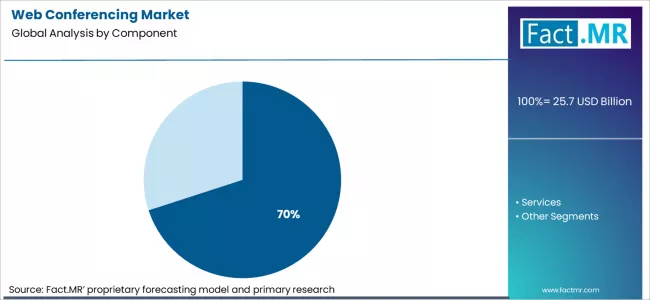
Based on FACT.MR’s web conferencing market report, solutions are expected to hold around 70% share in 2026. Software platform subscriptions generate the majority of recurring revenue across enterprise, education, and government users.
- Zoom AI Companion Investment: Zoom launched AI Companion 2.0 in 2024 with meeting summaries, action extraction, and workflow automation. Active monthly users exceeded 1 million by Q3 FY2025. [5]
- Cisco Webex AI Technology Development: Cisco introduced Webex AI Agent and AI Assistant features with multilingual transcription and automated meeting summaries. AI tools were used in more than 1.5 billion meeting minutes monthly in 2024. [6]
- SaaS Platform Adoption Trend: Gartner reported that SaaS conferencing solutions represented 78% of new enterprise contracts in 2024 as companies migrated from on-premises systems to cloud platforms. [7]
Web Conferencing Market Analysis by Deployment
Web Conferencing Market Analysis By Deployment | Source: Fact.MR
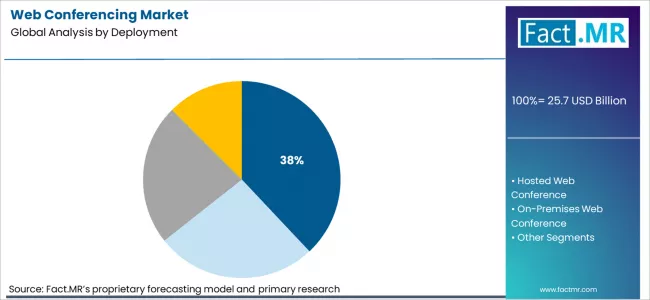
Based on FACT.MR’s web conferencing market report, software-as-a-service deployment is projected to hold about 38% share in 2026. SaaS delivery enables rapid scaling, automatic updates, and immediate AI feature availability.
- Microsoft Teams SaaS Investment: Microsoft disclosed that Teams Premium exceeded 10 million licensed seats by January 2025, while total Teams users surpassed 320 million daily active users. [8]
- GoTo SaaS Consolidation Development: GoTo merged GoToMeeting, GoToWebinar, and GoToConnect into a unified SaaS collaboration platform to improve integration and increase average contract value. [9]
- On-Premises Persistence Trend: KLAS Research reported that 34% of hospital web conferencing deployments remained on-premises or private cloud in 2024 due to HIPAA compliance and patient data security requirements. [10]
Drivers, Restraints, and Opportunities
FACT.MR analysts observe that the web conferencing market is increasingly integrated into enterprise workflows and public sector digital services. Hybrid work models, AI collaboration features, and secure cloud infrastructure are now key platform selection factors rather than basic video meeting capability.
The market shows a split between AI-enabled premium collaboration suites and basic conferencing tools with limited pricing power. Platforms including Zoom, Microsoft Teams, and Cisco Webex are expanding AI meeting intelligence and workflow automation features to sustain revenue growth even as enterprise seat expansion slows.
- U.S. Federal Cloud Modernization Policy: The U.S. Office of Management and Budget’s Federal Zero Trust Strategy requires agencies to adopt FedRAMP High-authorised collaboration platforms. This policy supports procurement of Zoom for Government, Microsoft Teams GCC High, and Cisco Webex Government for federal communications. [2]
- China Data Localization Requirements: China’s Personal Information Protection Law and Data Security Law require domestic data hosting for enterprise communication platforms. This supports adoption of Tencent Meeting, DingTalk, and WeChat Work while raising compliance costs for international providers. [3]
- NHS Telehealth Virtual Consultation Expansion: NHS England expanded virtual consultation targets with video appointments expected to reach 30% of outpatient services by 2026. Attend Anywhere processed more than 8 million NHS video consultations in 2024. [4]
Regional Analysis
The web conferencing market is analysed across Asia Pacific, Europe, North America, Latin America, and Middle East and Africa, covering 40+ countries with demand profiles shaped by hybrid work policy institutionalisation, government digital transformation investment. The full report offers market attractiveness analysis based on regulatory compliance requirements, SaaS penetration rates, and public sector procurement timelines.
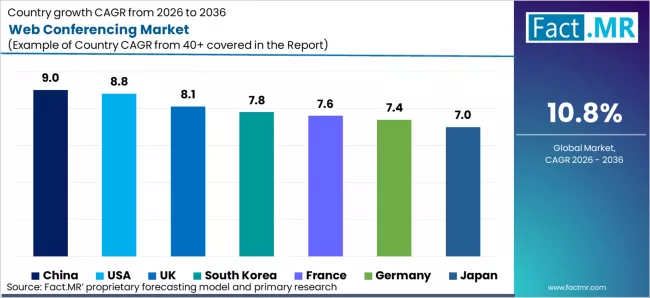
Web Conferencing Market Cagr Analysis By Country | Source: Fact.MR
| Country | CAGR (2026-2036) |
|---|---|
| China | 9.0% |
| United States | 8.8% |
| South Korea | 7.8% |
| United Kingdom | 8.1% |
| France | 7.6% |
| Germany | 7.4% |
| Japan | 7.0% |
Source: Fact.MR analysis. Updated Mar 12, 2026
Source: Fact.MR (FACT.MR) analysis, based on proprietary forecasting model and primary research
Asia Pacific Web Conferencing Market Analysis
Asia Pacific is experiencing rapid growth in web conferencing adoption due to enterprise digitalization, education technology expansion, and government digital infrastructure programmes. Domestic and global platforms compete as regulatory requirements influence platform selection across the region.
- China: Strong enterprise digital transformation is driving web conferencing demand in China, which is projected to grow at 9.0% CAGR through 2036. Data localization laws favour domestic platforms. Tencent Meeting reported 300 million registered users in 2025. The Smart Education of China programme expanded virtual classrooms across 350,000 schools, strengthening platform adoption.
- South Korea: Education sector digitalization and financial compliance requirements are accelerating web conferencing adoption in South Korea, expected to grow at 7.8% CAGR through 2036. Government EduTech programmes expanded virtual classroom platforms across thousands of schools. Financial regulators also require recorded conferencing tools for advisory meetings.
- Japan: Corporate digital transformation initiatives are encouraging enterprise video collaboration adoption in Japan, where demand is projected to grow at 7.0% CAGR through 2036. Government DX policies highlight video collaboration as a productivity benchmark. NTT Communications expanded managed Microsoft Teams and Cisco Webex services with domestic hosting and ISMAP security compliance.
FACT.MR’s Asia Pacific analysis of the web conferencing market covers China, Japan, South Korea, India, Australia and New Zealand, ASEAN, and Rest of South Asia and Pacific. Readers can find country growth forecasts, regulatory impact, education programme deployment, and platform competition insights.
Europe Web Conferencing Market Analysis
Europe’s web conferencing demand is strongly influenced by regulatory compliance, data protection laws, and government digital service initiatives. Enterprises prioritise secure collaboration platforms meeting GDPR and sector-specific communication requirements.
- United Kingdom: Healthcare digitalisation and hybrid workplace adoption are supporting web conferencing growth in the United Kingdom, forecast to expand at 8.1% CAGR through 2036. NHS virtual consultation programmes continue expanding video appointments. Attend Anywhere processed over 8 million sessions in 2024 while government IT policies encourage cloud collaboration adoption.
- France: Public sector digital services expansion is strengthening demand for web conferencing platforms in France, projected to grow at 7.6% CAGR through 2036. Plan France 2030 supports online citizen service delivery. The Pix education programme expanded virtual classroom collaboration for millions of students nationwide.
- Germany: Strong cybersecurity and data protection compliance requirements are shaping the web conferencing market in Germany, expected to grow at 7.4% CAGR through 2036. BSI security guidelines require encrypted and GDPR-compliant conferencing platforms. Deutsche Telekom expanded its managed web conferencing services for enterprise and government clients.
FACT.MR’s European analysis of the web conferencing market covers Germany, France, the United Kingdom, Italy, Spain, Nordic countries, BENELUX, and Rest of Western Europe. Readers can find GDPR compliance trends, regulatory communication requirements, and country-level forecasts.
North America Web Conferencing Market Analysis
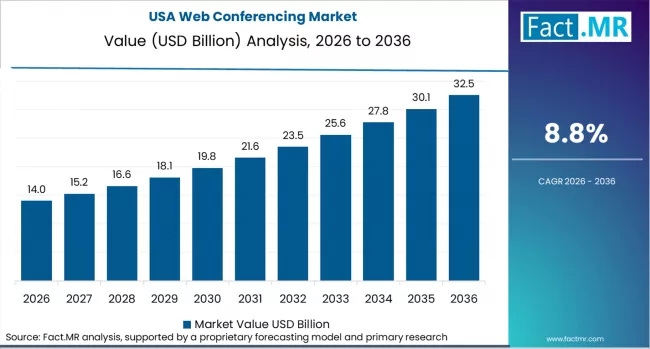
Web Conferencing Market Country Value Analysis | Source: Fact.MR
North America remains the largest revenue-generating region for web conferencing solutions due to enterprise collaboration platforms, AI meeting tools, and government digital modernisation programmes.
- United States: Federal cloud modernisation programmes and enterprise AI collaboration adoption are driving demand for web conferencing solutions in the United States, projected to grow at 8.8% CAGR through 2036. Zero Trust policies require FedRAMP-authorised platforms such as Zoom for Government, Microsoft Teams GCC High, and Cisco Webex Government. Zoom AI Companion surpassed 1 million active users in FY2025.
FACT.MR’s North American analysis of the web conferencing market covers the United States, Canada, and Mexico. Readers can find federal procurement trends, AI collaboration adoption, and market forecasts by component and deployment.
Competitive Aligners for Market Players
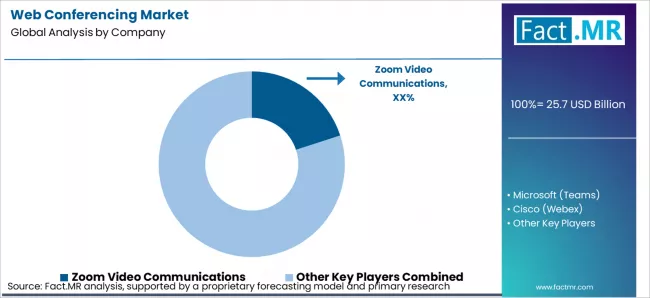
Web Conferencing Market Analysis By Company | Source: Fact.MR
The global web conferencing market is moderately concentrated, led by Microsoft Teams, Zoom Video Communications, and Cisco Webex. These platforms dominate enterprise usage due to strong ecosystem integration, brand reliability, and enterprise-grade security capabilities. Microsoft Teams benefits greatly from its integration with Microsoft 365, which is widely used by large corporations. This allows enterprises to adopt Teams without separate procurement processes.
Zoom continues to compete through its strong reputation for video quality, extensive AI Companion features, and a broad developer ecosystem. Cisco Webex focuses on highly regulated enterprise and government sectors by offering advanced security certifications such as FedRAMP and ISO 27001. Meanwhile, Google Meet, RingCentral, and GoTo mainly compete in the mid-market and small business segments by offering simpler features and competitive pricing.
Competitive strength in this market largely depends on ecosystem integration and compliance capabilities. Microsoft Teams creates strong switching barriers through deep integration with Outlook, SharePoint, Azure Active Directory, and Copilot AI tools. Cisco benefits from its Webex hardware ecosystem installed in corporate meeting rooms, which encourages long-term software renewals. Zoom’s open developer platform, with thousands of third-party integrations, supports enterprise workflow automation and strengthens its competitive positioning across diverse enterprise collaboration environments.
Key Players
- Zoom Video Communications
- Microsoft (Teams)
- Cisco (Webex)
- Google (Meet)
- GoTo (LogMeIn)
- BlueJeans by Verizon
- RingCentral Video
- Adobe Connect
- Zoho Meeting
- BigBlueButton
Bibliography
- [1] Zoom Video Communications Inc. and Microsoft Corporation. (2025). Fiscal Q3 2025 Earnings and Investor Commentary: AI Companion Monthly Active Users, Teams Premium Licensed Seat Count, and AI Feature Adoption Data. January 2025. ir.zoom.us and microsoft.com/investor
- [2] Office of Management and Budget, Executive Office of the President. (2025). Federal Zero Trust Strategy Implementation Update: FedRAMP High Authorisation Requirements for Cloud Collaboration Tools at Federal Agencies. January 2025. whitehouse.gov/omb
- [3] Cyberspace Administration of China. (2024). Personal Information Protection Law and Data Security Law Enforcement Update: Enterprise Data Residency Compliance Requirements for Cloud Collaboration Platforms. October 2024. cac.gov.cn
- [4] NHS England. (2024). Digital Health Futures Programme Investment Update: Virtual Consultation Service Targets, Attend Anywhere Contract Performance, and Video Consultation Volume Statistics 2024. December 2024. england.nhs.uk
- [5] Zoom Video Communications Inc. (2024). Product Launch: Zoom AI Companion 2.0-Expanded AI Meeting Intelligence, Cross-Product Workflow Integration, and Real-Time Coaching Features for Paid Plan Subscribers. October 2024. zoom.com/en/newsroom
- [6] Cisco Systems Inc. (2024). Product Update: Webex AI Agent and AI Assistant with 30-Language Real-Time Transcription, Meeting Summary Generation, and Salesforce and ServiceNow Workflow Integration. Q4 2024 Disclosure. newsroom.cisco.com
- [7] Gartner Inc. (2024). Market Guide for Meeting Solutions: Cloud SaaS Conferencing Contract Value Share, On-Premises Decline, and Enterprise Platform Consolidation Trends. December 2024. gartner.com
- [8] Microsoft Corporation. (2025). Q2 FY2025 Earnings Disclosure: Microsoft Teams Daily Active Users, Teams Premium Licensed Seat Milestone, and Copilot AI Integration Update. January 2025. microsoft.com/investor
- [9] GoTo (formerly LogMeIn). (2024). Product Consolidation Announcement: GoTo Connect Unified SaaS Collaboration Platform Launch Combining GoToMeeting, GoToWebinar, and GoToConnect for SMB Market. September 2024. goto.com/newsroom
- [10] KLAS Research. (2024). Collaboration Tools in Healthcare 2024: On-Premises and Private Cloud Deployment Persistence in Hospital Web Conferencing and HIPAA Compliance Preference Data. November 2024. klasresearch.com
This Report Addresses
- Strategic insights on U.S. FedRAMP Zero Trust policy, China PIPL data localisation, EU GDPR compliance, NHS telehealth expansion, and AI meeting feature adoption shaping the web conferencing market.
- Market forecast from USD 25.7 billion in 2026 to USD 71.7 billion by 2036 at a CAGR of 10.8%, segmented by component, deployment model, end use, and region.
- Growth opportunities across China Smart Education programmes, South Korea financial compliance platforms, France e-governance services, Germany cloud security mandates, and U.S. federal collaboration platform procurement.
- Country CAGR outlook: China 9.0%, United States 8.8%, United Kingdom 8.1%, South Korea 7.8%, France 7.6%, Germany 7.4%, and Japan 7.0%.
- Competitive analysis of Zoom, Microsoft Teams, Cisco Webex, Google Meet, and RingCentral focusing on AI features, security certifications, enterprise integration, and pricing models.
- Technology coverage including AI meeting transcription, translation, automated summaries, compliance-ready cloud platforms, open-source conferencing tools, and generative AI workflow automation.
- Regulatory analysis covering U.S. FedRAMP and Zero Trust policies, EU GDPR data compliance, MiFID II communication recording rules, BSI cloud standards, China PIPL, and Korea FSC guidelines.
- Report available in PDF, Excel datasets, PowerPoint summary, and dashboard formats supported by vendor earnings data, procurement databases, IT spending surveys, and primary interviews.
Segmentation
Scope of Report
| Quantitative Units | USD 25.7 billion (2026) to USD 71.7 billion (2036), at a CAGR of 10.8% |
|---|---|
| Market Definition | Software platforms and services enabling multi-participant internet-based audio, video, and content-sharing meetings for enterprise, education, government, and healthcare users. |
| Component Segmentation | Solutions, Services |
| Deployment Segmentation | Software-as-a-Service, Hosted, On-Premises, Managed Web Conferencing |
| End Use Segmentation | Banking and Financial Services, Education, Pharmaceutical/Healthcare, Manufacturing, Media and Entertainment, IT and Telecommunications, Government, Others |
| Application Coverage | Remote team meetings, virtual classrooms, telehealth consultations, government e-governance sessions, financial client advisory, and industrial workforce training. |
| Regions Covered | Asia Pacific, Europe, North America, Latin America, Middle East and Africa |
| Countries Covered | China, Japan, South Korea, India, Australia and New Zealand, ASEAN, Rest of South Asia and Pacific, Germany, UK, France, Italy, Spain, Nordic, BENELUX, Rest of Western Europe, Russia, Poland, Hungary, Balkan and Baltic, USA, Canada, Mexico, Brazil, Chile, Ecuador, Rest of Latin America, Saudi Arabia, GCC, Turkey, South Africa, Rest of MEA |
| Key Companies Profiled | Zoom Video Communications, Microsoft Teams, Cisco Webex, Google Meet, GoTo, BlueJeans by Verizon, RingCentral Video, Adobe Connect, Zoho Meeting, BigBlueButton |
| Forecast Period | 2026 to 2036 |
| Approach | Hybrid top-down and bottom-up model using enterprise SaaS subscription counts, average contract values by deployment, end-user adoption rates, and primary interviews with IT procurement managers. |
Source: Fact.MR analysis. Updated Mar 12, 2026
Web Conferencing Market by Segments
-
By Component:
- Solutions
- Services
-
By Deployment:
- Hosted Web Conference
- Software-as-a-Service
- On-Premises Web Conference
- Managed Web Conferencing
-
By End Use:
- Banking and Financial Services
- Education
- Pharmaceutical/Healthcare
- Manufacturing
- Media and Entertainment
- IT and Telecommunications
- Government
- Others
-
By Region:
- North America
- United States
- Canada
- Mexico
- Latin America
- Brazil
- Chile
- Ecuador
- Rest of Latin America
- Western Europe
- Germany
- United Kingdom
- France
- Italy
- Spain
- Nordic
- BENELUX
- Rest of Western Europe
- Eastern Europe
- Russia
- Poland
- Hungary
- Balkan and Baltic
- Rest of Eastern Europe
- East Asia
- China
- Japan
- South Korea
- South Asia and Pacific
- India
- ASEAN
- Australia and New Zealand
- Rest of South Asia and Pacific
- Middle East and Africa
- Kingdom of Saudi Arabia
- Other GCC Countries
- Turkey
- South Africa
- Other African Union
- Rest of Middle East and Africa
- North America
Frequently Asked Questions
How large is the web conferencing market in 2025?
What will the market size be in 2026?
What is the projected market size by 2036?
What is the expected CAGR?
Which component segment leads the market?
Which deployment model dominates?
Which country shows the fastest growth?
Which country is expected to grow fastest in the web conferencing market?
What is the expected growth rate of the web conferencing market in South Korea?
How fast is the web conferencing market growing in the United Kingdom?
What is the projected growth rate of the web conferencing market in France?
How is Germany’s web conferencing market expected to grow?
Who worked on this report


Preview the report firsthand - request a free sample
Free SampleGet the brochure for pricing and purchase details
Download PDF