- Base Value(2026): 2.2 Bn
- Estimated Value(2026): 2.2 Bn
- Forecast Value (2036): 6.5 Bn
- CAGR (2026 - 2036): 11.4%
White Goods Plastic Recovery and PCR Market Forecast Outlook 2026 to 2036
The white goods plastic recovery and PCR market is projected to reach USD 2.2 billion in 2026 and grow to USD 6.5 billion by 2036, reflecting a CAGR of 11.4%.
Key Takeaways from White Goods Plastic Recovery and PCR Market
- White Goods Plastic Recovery and PCR Market Value (2026): USD 2.2 billion
- White Goods Plastic Recovery and PCR Market Forecast Value (2036): USD 6.5 billion
- White Goods Plastic Recovery and PCR Market Forecast CAGR 2026 to 2036: 11.4%
- Leading Segment in White Goods Plastic Recovery and PCR Market: Dismantling + density separation (52%)
- Key Growth Region in White Goods Plastic Recovery and PCR Market: Asia Pacific
- Key Players in White Goods Plastic Recovery and PCR Market: BSH Recycling, MBA Polymers, WM Plastics Recovery, Eastman, GEM Co. (Global Eco Manufacturing Co.), TCL Circular, Panasonic Eco Technology, DOWA
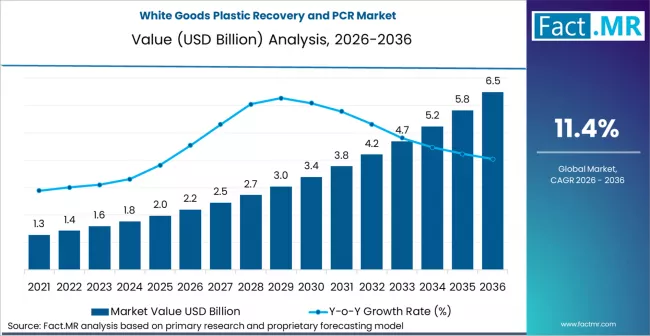
White Goods Plastic Recovery And Pcr Market Market Value Analysis | Source: Fact.MR
Commercial performance in this market will be heavily influenced by pricing discipline, as producers face upward pressure on material costs and the need for sustainable production practices. Buyer leverage will continue to increase, with larger companies able to negotiate more favorable terms due to their scale and volume.
Smaller players will find it challenging to maintain competitive pricing without compromising margins. Volume predictability remains uncertain, as demand fluctuates based on regulatory changes and shifts in consumer preferences. While the market is poised for growth, businesses must navigate these complexities to ensure profitability. Operational efficiency, cost management, and strategic supplier relationships will be essential for success, particularly as pressure mounts to meet sustainability targets while maintaining financial stability.
White Goods Plastic Recovery and PCR Market
| Metric | Value |
|---|---|
| Estimated Value in (2026E) | USD 2.2 billion |
| Forecast Value in (2036F) | USD 6.5 billion |
| Forecast CAGR (2026 to 2036) | 11.4% |
Source: Fact.MR analysis. Updated Jan 22, 2026
Category
| Category | Segments |
|---|---|
| End-use | Large home appliances; Appliance remanufacturing; End-of-life appliances; Precision appliance recycling; Emerging EPR systems |
| Appliance Segment | Refrigerators and washing machines; Mixed white goods plastics; TV and appliance housings; High-purity plastics; Others |
| Polymer | PCR-ABS or PCR-PP; PCR engineering plastics; PCR-ABS; PCR-PC or PCR-ABS; Others |
| Recovery or Processing Technology | Dismantling + density separation; Automated sorting & compounding; High-volume dismantling lines; Controlled recovery systems; Others |
| Region | North America; Europe; Asia Pacific; Latin America; Middle East & Africa |
Source: Fact.MR analysis. Updated Jan 22, 2026
Segmental Analysis
What Is the Impact of Polymer on the White Goods Plastic Recovery and PCR Market?
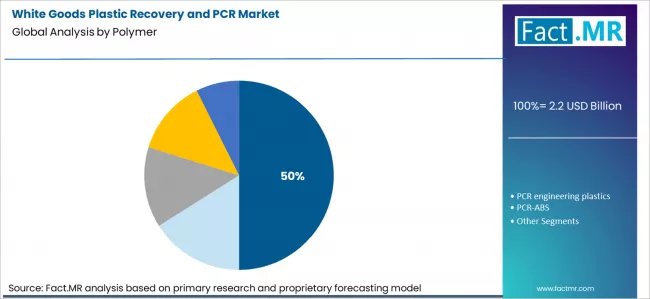
White Goods Plastic Recovery And Pcr Market Analysis By Polymer | Source: Fact.MR
In the white goods plastic recovery and PCR market, polymer type plays a significant role in determining the recovery and processing techniques used. PCR-ABS or PCR-PP leads the market with a 50% share due to their widespread use in white goods and their relative ease of recovery and processing. These polymers are commonly found in household appliances, such as refrigerators, washing machines, and dishwashers, making their recovery crucial for the recycling and reuse of plastic materials. As the demand for sustainable and circular economies grows, the recovery of PCR-ABS and PCR-PP will continue to be a major focus in the white goods plastic recovery sector.
How Does Recovery or Processing Technology Influence the White Goods Plastic Recovery and PCR Market?
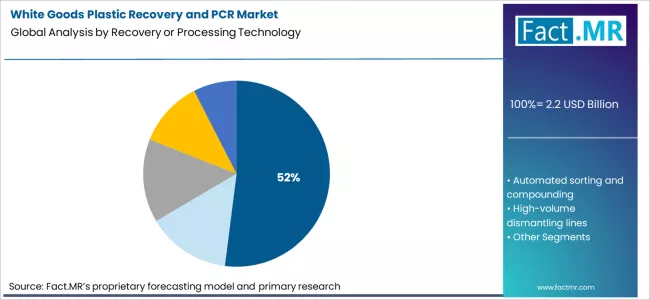
White Goods Plastic Recovery And Pcr Market Analysis By Recovery Or Processing Technology | Source: Fact.MR
Recovery or processing technology is key to ensuring efficient recycling and high-quality output in the market, with dismantling and density separation leading the segment at 52%. This method is particularly effective in separating different types of plastics and materials found in white goods, enabling the recovery of valuable polymer materials like PCR-ABS and PCR-PP. Dismantling and density separation also ensure that non-recyclable materials are efficiently removed, improving the purity of the recovered plastic. As the focus on recycling and sustainability in manufacturing intensifies, technologies like dismantling and density separation will continue to drive the market for white goods plastic recovery and PCR.
What are the Drivers, Restraints, and Key Trends in the White Goods Plastic Recovery and PCR Market?
- Drivers: Growth in white goods plastic recovery and post consumer recycled (PCR) resin use is influenced by extended producer responsibility policies and regulatory mandates for recycled content in appliances. Manufacturers of refrigerators, washers, and dishwashers specify PCR resins to meet compliance goals and internal material use targets. Procurement teams evaluate recovered plastics that can satisfy mechanical performance needs for housings, trims, and internal components while supporting documentation for sustainability reporting.
- Restraints: Variability in recovered plastic quality affects processability and end use performance, requiring additional sorting, cleaning, and characterization before PCR resins can be reintegrated. Some converters face increased processing costs when adapting molding parameters to accommodate mixed feedstock streams. Limited availability of high quality, consistent recovered plastic volumes constrains broad adoption at scale.
- Trend 1: Development of advanced sorting and separation technologies that improve purity and recovery rates for rigid polymers from end of life appliances.
- Trend 2: Expansion of partnerships between appliance manufacturers, recyclers, and resin compounders to establish closed loop supply arrangements and enhance PCR material validation for appliance applications.
Analysis of the White Goods Plastic Recovery and PCR Market by Key Country
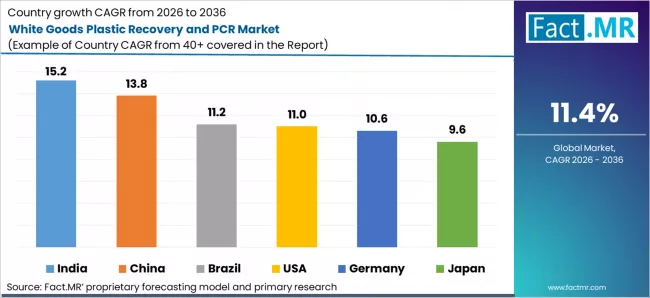
White Goods Plastic Recovery And Pcr Market Cagr Analysis By Country | Source: Fact.MR
| Country | CAGR (2026–2036) |
|---|---|
| Germany | 10.6% |
| USA | 11% |
| China | 13.8% |
| Japan | 9.6% |
| India | 15.2% |
| Brazil | 11.2% |
Source: Fact.MR analysis. Updated Jan 22, 2026
The report covers an in-depth analysis of 40+ countries; top-performing countries are highlighted below.
What is the Outlook on the White Goods Plastic Recovery and PCR Market in Germany?
Germany market in white goods plastic recovery and PCR is projected to grow at a CAGR of 10.6% from 2026 to 2036. Demand for plastic recovery in the white goods sector is increasing as Germany’s manufacturing industry focuses on sustainability, waste reduction, and resource optimization. Plastic recovery and the use of post-consumer recycled (PCR) materials in white goods are essential for meeting regulatory requirements and environmental targets. With Germany’s strong commitment to circular economy practices and environmental responsibility, the market for plastic recovery in white goods is expected to continue growing steadily.
What is the Demand for White Goods Plastic Recovery and PCR in the USA?
USA sales of white goods plastic recovery and PCR are expected to grow at a CAGR of 11% from 2026 to 2036. As the USA continues to invest in sustainability and recycling initiatives, the demand for plastic recovery in the white goods industry is on the rise. Companies are increasingly focusing on incorporating PCR materials into product designs to meet consumer and regulatory demands for sustainable products. With rising awareness about the environmental impact of plastic waste and increasing consumer preference for eco-friendly products, the market for white goods plastic recovery and PCR in the USA is expected to expand steadily.
What is the Sales Outlook on White Goods Plastic Recovery and PCR in China?
China demand for white goods plastic recovery and PCR is projected to grow at a CAGR of 13.8% from 2026 to 2036. China’s rapidly growing manufacturing industry, particularly in electronics and white goods, is driving the need for efficient plastic recovery systems and the use of PCR materials. With the country’s increasing commitment to sustainability and waste reduction, recycling plastic from white goods is becoming more important. The Chinese government’s support for circular economy practices and sustainable manufacturing will continue to support the growth of this market, positioning China as a major player in the white goods plastic recovery and PCR sector.
What is the Demand for White Goods Plastic Recovery and PCR in Japan?
Japan market in white goods plastic recovery and PCR is forecast to grow at a CAGR of 9.6% from 2026 to 2036. Japan’s focus on environmental sustainability and waste reduction is driving demand for plastic recovery systems in the white goods sector. The country’s robust recycling infrastructure and commitment to eco-friendly product design are leading to increased use of PCR materials in white goods manufacturing. As Japan continues to innovate in the areas of recycling and sustainable design, the market for white goods plastic recovery and PCR is expected to experience steady growth, supported by both consumer demand and regulatory requirements.
What is the Sales Outlook on White Goods Plastic Recovery and PCR in India?
India sales of white goods plastic recovery and PCR are projected to grow at a CAGR of 15.2% from 2026 to 2036. As India’s manufacturing sector continues to expand, particularly in the production of white goods, the demand for plastic recovery and the use of PCR materials is increasing. These practices are critical for addressing the country’s growing waste management challenges and supporting sustainability efforts. With India’s increasing regulatory pressure for sustainable manufacturing and rising consumer awareness of environmental issues, the market for white goods plastic recovery and PCR in India is expected to grow significantly.
What is the Market Expansion Outlook for White Goods Plastic Recovery and PCR in Brazil?
Brazil market in white goods plastic recovery and PCR is set to grow at a CAGR of 11.2% from 2026 to 2036. Brazil’s growing focus on recycling and sustainability is driving the demand for plastic recovery in the white goods sector. As industries shift towards more sustainable practices, the need for efficient systems to recover plastic from old white goods and incorporate PCR materials into new products is increasing. With Brazil’s regulatory push toward reducing plastic waste and improving recycling practices, the market for white goods plastic recovery and PCR is expected to expand steadily.
How is Competition Structured in the White Goods Plastic Recovery and PCR Market?
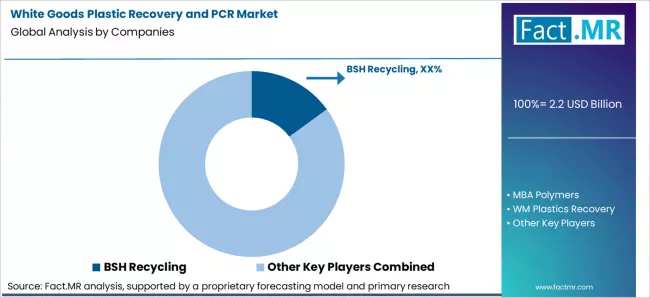
White Goods Plastic Recovery And Pcr Market Analysis By Company | Source: Fact.MR
Competition in the white goods plastic recovery and PCR market is shaped by the ability to efficiently reclaim, sort, and process plastics from end of life appliances into high quality post consumer recycled (PCR) resins. BSH Recycling and MBA Polymers lead with established take back programs and material recovery facilities that feed consistent streams of appliance plastics into recycling systems. WM Plastics Recovery positions offerings with regional recovery infrastructure that aligns with municipal and industrial waste streams.
Eastman and DOWA compete on advanced recycling technologies and PCR resin production that meet stringent performance criteria for reuse in new white goods components. GEM Co. (Global Eco Manufacturing Co.) and TCL Circular emphasize integrated approaches that link material recovery with downstream circular manufacturing. Panasonic Eco Technology focuses on upstream design for disassembly and recycling integration to improve material yield. Competitive differentiation arises from sorting precision, contamination control, and ability to deliver PCR resins with documented performance properties. Buyers evaluate suppliers based on feedstock security, processing efficiency, and alignment with regulatory and brand sustainability commitments for closed loop appliance manufacturing.
Key Players of the
- BSH Recycling
- MBA Polymers
- WM Plastics Recovery
- Eastman
- GEM Co. (Global Eco Manufacturing Co.)
- TCL Circular
- Panasonic Eco Technology
- DOWA
Bibliographies
- European Commission. (2023). Waste electrical and electronic equipment (WEEE) Directive evaluation and plastics recovery outcomes.
- European Commission, Joint Research Centre. (2023). Plastics recycling from WEEE and large household appliances. JRC.
- Organisation for Economic Co-operation and Development. (2023). Improving plastics recycling in electrical and electronic equipment value chains. OECD.
- U.S. Environmental Protection Agency. (2023). Electronics waste management and plastics recovery in major appliances. EPA.
- United Nations Environment Programme. (2024). Plastics in electrical and electronic equipment: Circularity challenges and solutions. UNEP.
Segmentation
Scope of the Report
| Items | Values |
|---|---|
| Quantitative Units (2026) | USD Billion |
| End-use | Large home appliances, Appliance remanufacturing, End-of-life appliances, Precision appliance recycling, Emerging EPR systems |
| Appliance Segment | Refrigerators and washing machines, Mixed white goods plastics, TV and appliance housings, High-purity plastics, Others |
| Polymer | PCR-ABS or PCR-PP, PCR engineering plastics, PCR-ABS, PCR-PC or PCR-ABS, Others |
| Recovery or Processing Technology | Dismantling + density separation, Automated sorting & compounding, High-volume dismantling lines, Controlled recovery systems, Others |
| Regions Covered | North America, Europe, Asia Pacific, Latin America, Middle East & Africa |
| Countries Covered | United States, Canada, Mexico, Brazil, Germany, United Kingdom, France, Italy, Spain, China, Japan, South Korea, India, Australia & New Zealand |
| Key Companies Profiled | BSH Recycling, MBA Polymers, WM Plastics Recovery, Eastman, GEM Co. (Global Eco Manufacturing Co.), TCL Circular, Panasonic Eco Technology, DOWA |
| Additional Attributes | Dollar revenue by end-use, appliance segment, polymer, and recovery or processing technology; regional demand trends, competitive landscape, technological advancements in white goods plastic recovery, and innovations in appliance recycling and processing systems |
Source: Fact.MR analysis. Updated Jan 22, 2026
White Goods Plastic Recovery and PCR Market Key Segments
-
End-use :
- Large home appliances
- Appliance remanufacturing
- End-of-life appliances
- Precision appliance recycling
- Emerging EPR systems
- Regional white goods
-
Appliance Segment :
- Refrigerators and washing machines
- Mixed white goods plastics
- TV and appliance housings
- High-purity plastics
- Others
-
Polymer :
- PCR-ABS or PCR-PP
- PCR engineering plastics
- PCR-ABS
- PCR-PC or PCR-ABS
- Others
-
Recovery or Processing Technology :
- Dismantling + density separation
- Automated sorting & compounding
- High-volume dismantling lines
- Controlled recovery systems
- Others
-
Region :
- North America
- U.S.
- Canada
- Mexico
- Europe
- Germany
- UK
- France
- Italy
- Spain
- Nordic Countries
- BENELUX
- Rest of Europe
- Asia Pacific
- China
- Japan
- South Korea
- India
- Australia
- Rest of Asia Pacific
- Latin America
- Brazil
- Argentina
- Rest of Latin America
- Middle East and Africa
- Kingdom of Saudi Arabia
- United Arab Emirates
- South Africa
- Rest of Middle East and Africa
- Other Regions
- Oceania
- Central Asia
- Other Markets
- North America
Frequently Asked Questions
How big is the white goods plastic recovery and pcr market in 2026?
What will be the size of white goods plastic recovery and pcr market in 2036?
How much will be the white goods plastic recovery and pcr market growth between 2026 and 2036?
What are the key product types in the white goods plastic recovery and pcr market?
Which appliance segment segment to contribute significant share in the white goods plastic recovery and pcr market in 2026?
Who worked on this report


Preview the report firsthand - request a free sample
Free SampleGet the brochure for pricing and purchase details
Download PDF