- Base Value(2026): 535.5 Mn
- Estimated Value(2026): 535.5 Mn
- Forecast Value (2036): 932.2 Mn
- CAGR (2026 - 2036): 5.7%
White-Label Computer Peripheral Packaging Market Forecast and Outlook 2026 to 2036
The global white-label computer peripheral packaging market is projected to grow from USD 535.5 million in 2026 to USD 932.2 million by 2036, reflecting a compound annual growth rate of 5.7%.
Key Takeaways from White-Label Computer Peripheral Packaging Market
- White-Label Computer Peripheral Packaging Market Value 2026: USD 535.5 million
- White-Label Computer Peripheral Packaging Market Forecast Value 2036: USD 932.2 million
- White-Label Computer Peripheral Packaging Market Forecast CAGR: 5.7%
- Leading Packaging Type in White-Label Computer Peripheral Packaging Market: Folding cartons 48.3%
- Leading Brand or Customer Type in White-Label Computer Peripheral Packaging Market: OEM private label 44.1%
- Key Growth Regions in White-Label Computer Peripheral Packaging Market: India, Vietnam, Indonesia, China, Mexico, U.S., Germany, Japan
- Key Players in White-Label Computer Peripheral Packaging Market: Mondi, Berry Global, Avery Dennison, Ranpak, NEFAB, Smurfit Kappa, WestRock, International Paper, Amcor, Sealed Air
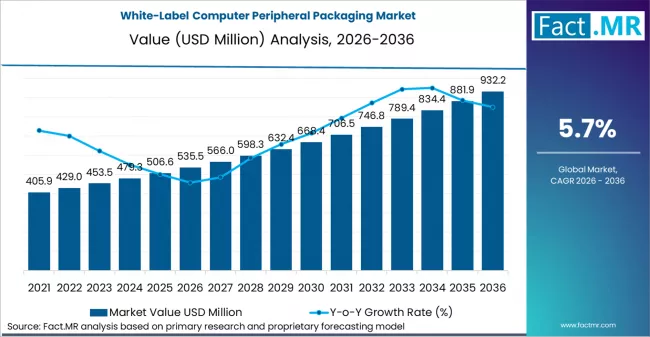
White Label Computer Peripheral Packaging Market Market Value Analysis | Source: Fact.MR
Growth is driven by the increasing demand for private-label packaging solutions by OEMs, retailers, and third-party fulfillment providers. Folding cartons dominate the segment due to their cost-effectiveness, print quality, and ease of handling, while mailers, bags, blister packs, clamshells, and rigid boxes support diverse packaging needs for various peripheral products.
OEM private label brands account for the largest share, reflecting the rising trend of customized packaging for white-label peripherals, followed by retailer private label and 3PL fulfillment brands. Paperboard is the leading material due to strength, printability, and recyclability, while plastics, recycled plastics, and hybrid structures are used for specialized applications. Asia-Pacific, particularly India, Vietnam, and Indonesia, shows the fastest growth driven by production and consumption of private-label peripherals, while North America and Europe maintain steady adoption. Suppliers focus on providing protective, customizable, and operationally efficient packaging solutions to meet both client and consumer expectations.
White-Label Computer Peripheral Packaging Market
| Metric | Value |
|---|---|
| Estimated Value in (2026E) | USD 535.5 million |
| Forecast Value in (2036F) | USD 932.2 million |
| Forecast CAGR (2026 to 2036) | 5.7% |
Source: Fact.MR analysis. Updated Jan 27, 2026
Category
| Category | Segments |
|---|---|
| Packaging Type | Folding Cartons; Mailers and Bags; Blister or Clamshell; Rigid Boxes; Other |
| Brand or Customer Type | OEM Private Label; Retailer Private Label; 3PL Fulfillment Brands; Other |
| Material | Paperboard; Plastics; Recycled Plastics; Hybrid Structures; Other |
| Sales Channel | E-commerce; Retail Chains; B2B Distribution; Private Label Contracts; Other |
| Region | North America; Europe; Asia Pacific; Latin America; Middle East & Africa |
Source: Fact.MR analysis. Updated Jan 27, 2026
Segmental Analysis
By Packaging Type, Which Segment Holds the Dominant Share in the White-Label Computer Peripheral Packaging Market?
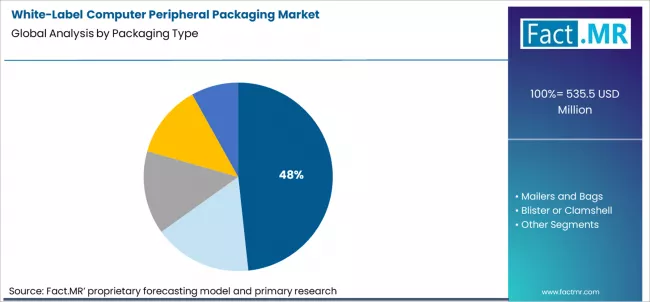
White Label Computer Peripheral Packaging Market Analysis By Packaging Type | Source: Fact.MR
In terms of packaging type, folding cartons lead the White-Label Computer Peripheral Packaging Market with a 48.3% share. White-label peripheral programs rely on folding cartons to support fast brand switching, private labeling, and neutral visual presentation across multiple customers. This format allows distributors and retailers to standardize pack sizes for keyboards, mice, webcams, and accessories while keeping printing and tooling changes minimal.
- Packaging layouts are optimized for rapid artwork changeovers without altering structural design.
- High-volume private label programs continue to favor cartons that balance cost control and shelf readiness.
By Brand or Customer Type, Which Segment Registers the Highest Share in the White-Label Computer Peripheral Packaging Market?
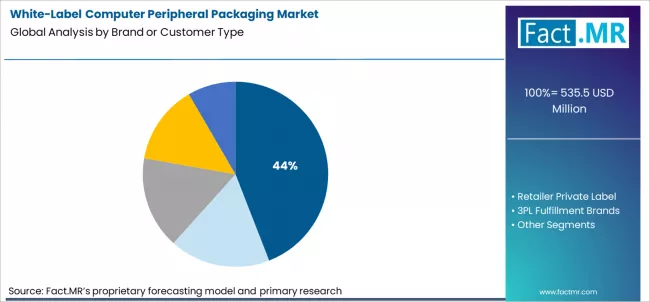
White Label Computer Peripheral Packaging Market Analysis By Brand Or Customer Type | Source: Fact.MR
By brand or customer type, OEM private label accounts for a 44.1% share. OEM private label packaging supports contract manufacturing models where peripherals are sold under retailer or distributor branding. Packaging in this segment emphasizes consistency, regulatory labeling accuracy, and compatibility with multiple sales channels.
- OEM-driven programs prioritize packaging that scales across regions with limited customization.
- Repeat production cycles sustain steady demand for standardized white-label packaging formats.
By Material, Which Segment Holds the Dominant Share in the White-Label Computer Peripheral Packaging Market?
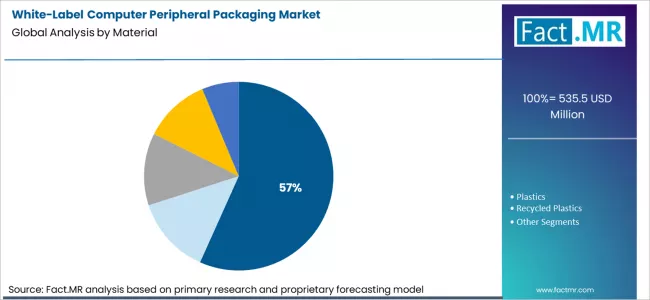
White Label Computer Peripheral Packaging Market Analysis By Material | Source: Fact.MR
By material, paperboard dominates with a 56.7% share. Paperboard is widely used in white-label packaging due to its print adaptability, structural rigidity, and suitability for neutral branding. The material supports clean presentation while accommodating inserts for cables, manuals, and accessories.
- Material choice supports efficient die cutting and folding across large production runs.
- Preference remains strong where cost efficiency and visual uniformity are required.
What are the Drivers, Restraints, and Key Trends of the White-Label Computer Peripheral Packaging Market?
- Drivers: Rapid expansion of private label peripherals by OEMs, retailers, and online marketplaces is driving demand for neutral, cost efficient packaging that supports fast brand onboarding, high volume launches, and consistent presentation across cables, chargers, adapters, and entry level peripherals.
- Restraint: White label packaging places strong pressure on cost control and speed, often limiting design complexity and material choices while still needing to meet protection, compliance, and retailer specific packaging requirements.
- Trend 1: Folding cartons made from paperboard are increasingly preferred for white label programs as they offer flexibility for quick artwork changes, scalable production, and compatibility with both retail and e commerce distribution models.
- Trend 2: Packaging suppliers are focusing on standardized structures with customizable print zones, enabling retailers and OEM private label brands to refresh branding quickly without redesigning the full packaging format.
Analysis of the White-Label Computer Peripheral Packaging Market by Key Country
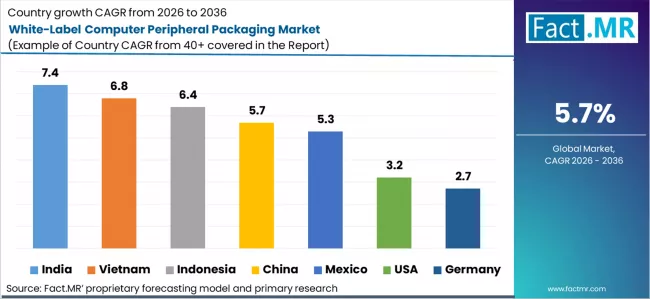
White Label Computer Peripheral Packaging Market Cagr Analysis By Country | Source: Fact.MR
| Country | CAGR |
|---|---|
| India | 7.4% |
| Vietnam | 6.8% |
| Indonesia | 6.4% |
| China | 5.7% |
| Mexico | 5.3% |
| U.S. | 3.2% |
| Germany | 2.7% |
| Japan | 2.2% |
Source: Fact.MR analysis. Updated Jan 27, 2026
The report covers an in depth analysis of 8 countries; higher growth markets are highlighted below.
What Is Driving Growth of White-Label Computer Peripheral Packaging in India?
India leads growth at 7.4%, supported by rapid expansion of private label peripherals sold through online marketplaces and organized retail. Packaging prioritizes neutral branding, scalability, and cost efficiency for cables, chargers, and accessories. Folding cartons dominate due to print flexibility and ease of customization across multiple customer brands.
- Growth of private label electronics supports steady packaging demand.
- Preference for standardized cartons enables volume scalability.
How Is Vietnam Emerging as a Key Market for White-Label Packaging?
Vietnam is projected to grow at 6.8%, driven by OEM focused manufacturing serving global private label brands. Packaging solutions emphasize generic design and compatibility across multiple customer specifications. Paperboard folding cartons are widely used to support export shipments and retailer rebranding requirements.
- OEM private label production sustains packaging demand.
- Export focused manufacturing favors flexible carton formats.
What Factors Are Supporting Market Expansion in Indonesia?
Indonesia is expected to expand at 6.4%, supported by growth of retailer owned peripheral brands and regional distribution. Mailers and bags are commonly used for small accessories shipped through retail and online channels. Packaging selection focuses on cost control and fulfillment efficiency.
- Retailer private label growth supports packaging volumes.
- Lightweight mailer formats improve fulfillment efficiency.
How Is China Influencing Demand for White-Label Peripheral Packaging?
China is forecast to grow at 5.7%, reflecting large scale production for third party and fulfillment driven brands. Blister and clamshell formats are used for visibility and theft deterrence in retail settings. Packaging demand aligns with contract manufacturing volumes and distributor requirements.
- Contract manufacturing sustains consistent packaging demand.
- Retail focused formats support standardized presentation.
What Role Does Mexico Play in This Market?
Mexico is projected to grow at 5.3%, supported by regional assembly and private label distribution for North American markets. Rigid boxes are used selectively for higher value peripherals. Packaging demand follows distributor led branding and cross border logistics patterns.
- Regional private label distribution supports packaging demand.
- Cross border logistics favor durable box formats.
What Defines Market Conditions in the U.S.?
The U.S. market is expected to expand at 3.2%, shaped by mature private label accessory sales and established fulfillment systems. White label packaging emphasizes simplicity, compliance, and rapid customization. Growth remains moderate due to stable replacement driven demand.
- Established private label programs sustain baseline demand.
- Mature sales channels limit faster expansion.
How Is the Market Positioned in Germany?
Germany is forecast to grow at 2.7%, influenced by cautious private label expansion and preference for standardized packaging. White label formats focus on material efficiency and clean presentation. Demand growth remains limited due to stable peripheral consumption.
- Standardized packaging supports consistent demand.
- Conservative private label adoption moderates growth.
What Factors Shape Market Development in Japan?
Japan is expected to register a CAGR of 2.2%, reflecting selective use of white label peripherals and high quality expectations. Packaging designs prioritize compactness and precision. Adoption remains limited due to strong brand preference and mature retail markets.
- Focus on presentation quality supports selective adoption.
- Mature retail conditions constrain market growth.
Competitive Landscape of the White-Label Computer Peripheral Packaging Market
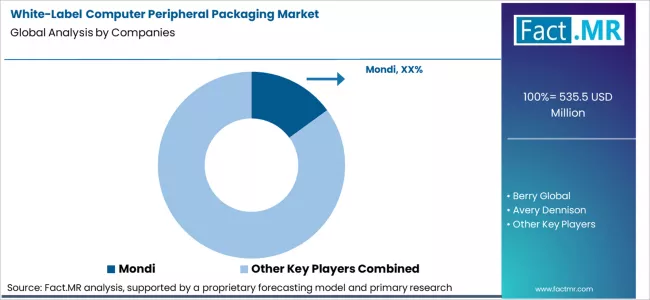
White Label Computer Peripheral Packaging Market Analysis By Company | Source: Fact.MR
The white-label computer peripheral packaging market is shaped by brands and distributors that prioritize speed, flexibility, and cost control over heavy branding. Packaging in this segment is designed to support OEM private labels, retailer-owned brands, and third-party fulfillment programs where neutral appearance, consistent quality, and scalable supply matter more than visual differentiation. Products commonly packaged include cables, chargers, adapters, mice, keyboards, and bundled accessories distributed through both online and offline channels.
Competition centers on standardization, material availability, and turnaround time. Folding cartons dominate due to their adaptability across multiple product SKUs and ease of customization through simple print or labeling. Mailers, bags, and blister formats are widely used in e-commerce and private-label retail programs where packaging must integrate smoothly with automated fulfillment systems. Paperboard leads material preference for its balance of cost, protection, and broad acceptance across regions, while recycled plastics and hybrid structures remain relevant for durability-driven use cases.
Market players include Mondi, Berry Global, Avery Dennison, Ranpak, NEFAB, Smurfit Kappa, WestRock, International Paper, Amcor, and Sealed Air, supporting high-volume white-label programs through standardized packaging platforms and global sourcing networks.
Key Players in the White-Label Computer Peripheral Packaging Market
- Mondi
- Berry Global
- Avery Dennison
- Ranpak
- NEFAB
- Smurfit Kappa
- WestRock
- International Paper
- Amcor
- Sealed Air
Bibliography
- Organisation for Economic Co-operation and Development. (2023). Private-label manufacturing, packaging standardization, and cost efficiency in global consumer electronics supply chains. OECD Publishing.
- United Nations Conference on Trade and Development. (2024). Private brands, contract manufacturing, and packaging requirements in cross-border e-commerce and electronics trade. UNCTAD.
- U.S. Environmental Protection Agency. (2024). Paperboard and hybrid packaging materials for private-label and unbranded consumer electronics applications. U.S. Environmental Protection Agency.
- World Packaging Organisation. (2023). Standardized and white-label packaging systems for consumer electronics and peripheral products. World Packaging Organisation.
- International Organization for Standardization. (2023). Packaging requirements for unbranded, private-label, and multi-customer retail products. ISO.
Segmentation
Scope of the Report
| Items | Values |
|---|---|
| Quantitative Units 2026 | USD 535.5 Million |
| Packaging Type | Folding cartons, Mailers and bags, Blister or clamshell packs, Rigid boxes |
| Brand or Customer Type | OEM private label programs, Retailer private label brands, Third-party fulfillment brands |
| Material | Paperboard, Plastics, Recycled plastics, Hybrid material structures |
| Regions Covered | North America, Europe, Asia Pacific, Latin America, Middle East & Africa |
| Countries Covered | India, Vietnam, Indonesia, China, Mexico, U.S., Germany, Japan |
| Key Companies Profiled | Mondi, Berry Global, Avery Dennison, Ranpak, NEFAB, Smurfit Kappa, WestRock, International Paper, Amcor, Sealed Air |
| Additional Attributes | Dollar revenue by white-label packaging type, brand or customer type, material, and region; regional demand trends; private-label branding and customization requirements; cost optimization priorities for unbranded peripherals; compatibility with e-commerce and retail distribution; transition toward standardized and recyclable packaging formats |
Source: Fact.MR analysis. Updated Jan 27, 2026
White-Label Computer Peripheral Packaging Market Segments
-
Packaging Type :
- Folding Cartons
- Mailers and Bags
- Blister or Clamshell
- Rigid Boxes
- Other
-
Brand or Customer Type :
- OEM Private Label
- Retailer Private Label
- 3PL Fulfillment Brands
- Other
-
Material :
- Paperboard
- Plastics
- Recycled Plastics
- Hybrid Structures
- Other
-
Region :
- North America
- U.S.
- Canada
- Mexico
- Europe
- Germany
- Italy
- UK
- France
- Spain
- Netherlands
- Switzerland
- Rest of Europe
- Asia Pacific
- Japan
- Australia
- South Korea
- China
- India
- Rest of Asia Pacific
- Latin America
- Brazil
- Argentina
- Rest of Latin America
- Middle East and Africa
- United Arab Emirates
- South Africa
- Rest of Middle East and Africa
- North America
Frequently Asked Questions
How big is the white-label computer peripheral packaging market in 2026?
What will be the size of white-label computer peripheral packaging market in 2036?
How much will be the white-label computer peripheral packaging market growth between 2026 and 2036?
What are the key product types in the white-label computer peripheral packaging market?
Which brand or customer type segment to contribute significant share in the white-label computer peripheral packaging market in 2026?
Who worked on this report


Preview the report firsthand - request a free sample
Free SampleGet the brochure for pricing and purchase details
Download PDF