- Base Value(2026): 620.0 Mn
- Estimated Value(2026): 620.0 Mn
- Forecast Value (2036): 2238.7 Mn
- CAGR (2026 - 2036): 13.7%
Cable Retention Packaging Market Forecast and Outlook 2026 to 2036
Starting from USD 620.0 million in 2026, the cable retention packaging market progresses toward USD 2,239.0 million by 2036, which reflects a 13.70% CAGR over the period.
Cable Retention Packaging Market Key Takeaways
- Cable Retention Packaging Market Value (2026): USD 620 million
- Cable Retention Packaging Market Forecast Value (2036): USD 2,239 million
- Cable Retention Packaging Market Forecast CAGR 2026 to 2036: 13.7%
- Leading Cable Type in Cable Retention Packaging Market: Consumer electronics cables
- Key Growth Regions in Cable Retention Packaging Market: Asia Pacific, North America, Europe, Latin America, Middle East & Africa
- Top Players in Cable Retention Packaging Market: Nefab Group, Mondi Group, Amcor plc, Sealed Air Corporation
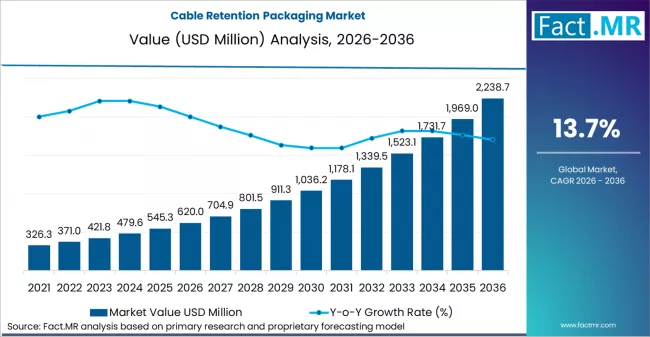
Cable Retention Packaging Market Market Value Analysis | Source: Fact.MR
This segment supports products such as chargers, data cables, and bundled accessories where order, protection, and presentation must be managed together. Packaging needs to hold cables in a fixed shape, prevent tangling, and protect connectors during transport and display.
Brand owners prefer retention formats that can be used across many models, since any change affects packing speed, insert tooling, and shelf layout. Once a format is approved, it usually remains in place to avoid disruption across kitting lines. Buyers focus on ease of assembly, consistency of fit, and clean appearance rather than decorative features. Volume growth follows higher shipments of electronic accessories and wider retail and e-commerce coverage rather than frequent redesign of core packaging structures.
Cable Retention Packaging Market
| Metric | Value |
|---|---|
| Market Value (2026) | USD 620 million |
| Forecast Value (2036) | USD 2,239 million |
| Forecast CAGR 2026 to 2036 | 13.7% |
Source: Fact.MR analysis. Updated Jan 24, 2026
Category
| Category | Segments |
|---|---|
| Cable Type | Consumer electronics cables; Industrial cables; OEM export cables; Precision wiring |
| Retention Mechanism | Clip and tie mounts; Strap systems; Carded retention packs; Custom holders |
| Material | PET; PP; Paperboard; ABS |
| Region | North America; Europe; Asia Pacific; Latin America; Middle East & Africa |
Source: Fact.MR analysis. Updated Jan 24, 2026
Segmental Analysis
Why Do Consumer Electronics Cables Dominate Volume In Cable Retention Packaging Programs?
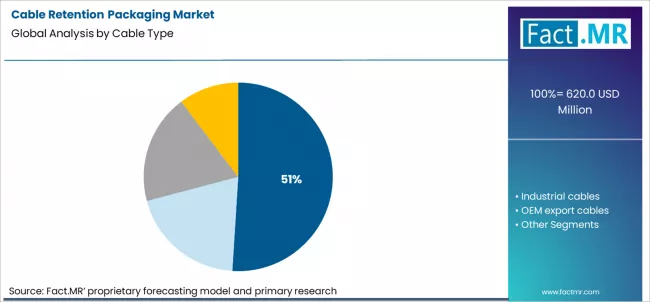
Cable Retention Packaging Market Analysis By Cable Type | Source: Fact.MR
Consumer electronics cables represent 51% of cable type usage in the cable retention packaging market. This category moves in high unit volumes across phones, laptops, audio devices, and accessories that ship through retail and e-commerce channels. Packaging teams manage frequent model changes and short product cycles, which increases turnover of retention components. Assembly lines also rely on fast, repeatable bundling steps to keep packing speed aligned with device output. Return handling and repacking operations add further throughput to this segment. Industrial, OEM export, and precision wiring applications run in lower unit counts and longer project cycles. The continuous flow of small consumer devices keeps this cable class as the main source of daily packaging demand.
What Retention Mechanism Is Used Most Widely Across High-Volume Cable Packing Lines?
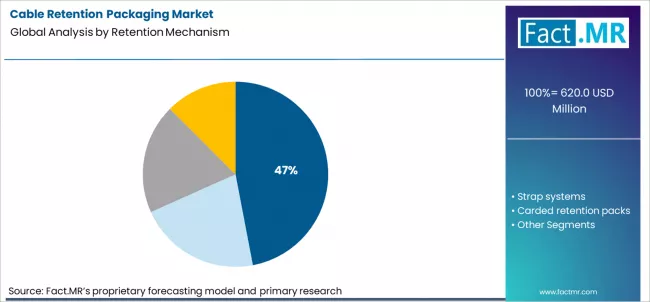
Cable Retention Packaging Market Analysis By Retention Mechanism | Source: Fact.MR
Clip and tie mounts account for 47% of retention mechanism usage in this market. This approach suits high speed packing lines where operators or machines must secure cables in a single motion. The mechanism holds coils in place without adding bulk or requiring complex alignment steps. Storage bins and feeders for clips and ties fit easily into existing workstations. Visual inspection also remains simple, since the cable shape stays clearly defined after fixing. Strap systems, carded packs, and custom holders serve more specific presentation or protection needs. Most mass production environments still default to clip and tie systems for their speed, simplicity, and consistent results.
What are the Drivers, Restraints, and Key Trends of the Cable Retention Packaging Market?
- Drivers: Requirements for secure organization and protection of cables during storage, transport, and retail display are shaping the specification of retention packaging solutions that prevent tangling, damage, and loss across consumer electronics, industrial, and automotive segments.
- Restraint: Competition from generic packaging alternatives and cost sensitivity among distributors and OEMs restrict uptake of specialized retention solutions in price-driven channels.
- Trend 1: Expansion of reusable and adjustable retention systems that accommodate diverse cable diameters and lengths without single-use waste.
- Trend 2: Broader use of identification features such as color coding and labeling integrated into packaging to support faster inventory handling and end-user selection.
Analysis of the Cable Retention Packaging Market by Key Country
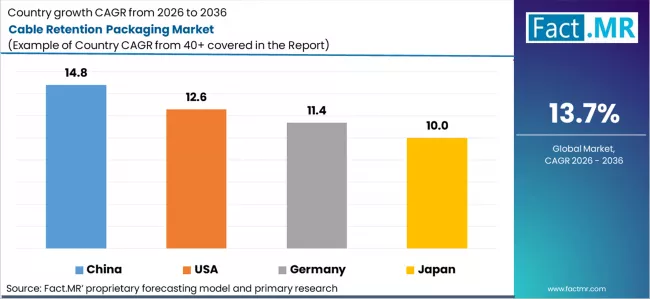
Cable Retention Packaging Market Cagr Analysis By Country | Source: Fact.MR
| Country | CAGR 2026 to 2036 |
|---|---|
| USA | 12.6% |
| Germany | 11.4% |
| China | 14.8% |
| Japan | 10.0% |
Source: Fact.MR analysis. Updated Jan 24, 2026
The report covers an in-depth analysis of 40+ countries; top-performing countries are highlighted below.
How Are Electronics Assembly and Distribution Practices in USA Shaping Cable Retention Packaging?
Growth in USA runs at about 12.6% per year through 2036. Demand is shaped by rising volumes of consumer electronics, peripherals, and bundled accessory kits. Brand owners focus on preventing cable movement, avoiding connector damage, and keeping packs compact. Packaging formats favor clips, trays, and paper based restraints integrated into cartons. Purchasing decisions balance material cost, packing speed, and line compatibility. Conversions usually occur during product refresh cycles. Distribution relies on contract packers and electronics packaging suppliers. Volume growth tracks device shipment expansion and growth of direct to consumer channels rather than changes in retail display rules.
Why Do Quality and Logistics Standards in Germany Influence Cable Retention Packaging?
Growth in Germany runs at about 11.4% per year through 2036. Demand follows steady production of electronics, appliances, and industrial devices. Buyers emphasize transport security, repeatable pack quality, and compliance with recycling rules. Packaging designs prioritize robustness and precise fit. Purchasing decisions remain specification driven and conservative. Conversions proceed cautiously because damage rates and return handling costs receive close attention. Distribution stays concentrated among established packaging and automation suppliers. Volume growth tracks gradual increases in device shipments and export activity rather than rapid shifts in product mix or aggressive packaging redesign programs.
What Is Driving Faster Adoption of Cable Retention Packaging in China?
Growth in China runs at about 14.8% per year through 2036. Demand rises from large scale electronics manufacturing, contract assembly, and export packaging. Operators prioritize speed of packing, consistency, and compatibility with automated lines. Product formats favor molded inserts, clips, and paper fiber fixtures. Purchasing aligns with factory efficiency targets and throughput expansion plans. Local production capacity influences supplier choice. Volume increases follow commissioning of new production lines and expansion of export programs. Market development remains tied to electronics manufacturing scale and automation investment rather than retail presentation or branding driven packaging changes.
How Are Compact Design and Presentation Norms in Japan Shaping Cable Retention Packaging?
Growth in Japan runs at about 10.0% per year through 2036. Demand follows strong focus on neat presentation, space efficiency, and protection of small accessories. Buyers prioritize precise fit, clean layout, and consistent assembly quality. Packaging decisions emphasize reliability and minimal material use. Conversions happen through scheduled product updates rather than frequent experimentation. Distribution remains concentrated among approved packaging partners. Volume growth tracks steady output of consumer electronics and accessories. Market development stays tied to disciplined product planning and manufacturing efficiency rather than rapid shifts in device form factors or short term promotional campaigns.
How Do Assembly Line Constraints and Transit Protection Rules Shape Competition in the Cable Retention Packaging Market?
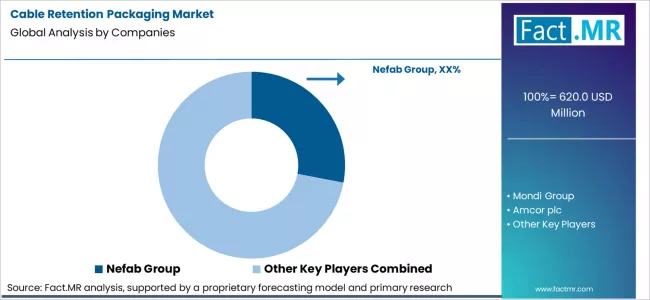
Cable Retention Packaging Market Analysis By Company | Source: Fact.MR
Packaging decisions for cables are usually fixed during harness design and kitting trials rather than during sourcing rounds. Engineering teams first define bend radius limits, coil memory control, and bundle stability under vibration. Nefab, Mondi, Amcor, and Sealed Air compete by aligning retention structures to automated winding, bagging, and boxing lines used across electronics and industrial programs.
Operations groups evaluate options using pack speed, snag risk, abrasion protection, and consistency across batch runs. Logistics teams also review cube efficiency and recovery behavior after long distance transport. Once a retention format is approved for a product family, it is reused across SKUs and contract cycles. Volume growth follows production ramps and customer onboarding. Supplier changes usually occur after line retooling or changes in cable specification.
Key Players in Cable Retention Packaging Market
- Nefab Group
- Mondi Group
- Amcor plc
- Sealed Air Corporation
References
- European Commission. (2024). Proposal for a regulation of the European Parliament and of the Council on packaging and packaging waste and repealing Directive 94/62/EC. European Commission.
- European Commission, Joint Research Centre. (2023). The future of packaging in a circular economy: Material use, reuse systems and waste prevention. Publications Office of the European Union.
- International Organization for Standardization. (2023). ISO 2248: Packaging - Complete, filled transport packages - Vertical impact test by dropping. ISO.
- International Organization for Standardization. (2023). ISO 12048: Packaging - Complete, filled transport packages - Compression and stacking tests. ISO.
- International Organization for Standardization. (2023). ISO 4180: Packaging - Complete, filled transport packages - General rules for the compilation of performance test schedules. ISO.
Segmentation
Scope of the Report
| Items | Values |
|---|---|
| Quantitative Units (2026) | USD million |
| Cable Type | Consumer electronics cables, industrial cables, OEM export cables, precision wiring |
| Retention Mechanism | Clip and tie mounts, strap systems, carded retention packs, custom holders |
| Material | PET, PP, paperboard, ABS |
| Regions Covered | Asia Pacific, Europe, North America, Latin America, Middle East & Africa |
| Countries Covered | United States, Canada, Mexico, Germany, United Kingdom, France, Italy, Spain, Nordics, BENELUX, China, Japan, South Korea, India, Australia & New Zealand, ASEAN, Brazil, Chile, Saudi Arabia, Turkey, South Africa, and other regional markets |
| Key Companies Profiled | Nefab Group, Mondi Group, Amcor plc, Sealed Air Corporation |
| Additional Attributes | Dollar sales by cable type, retention mechanism, and material; performance focus on anti-tangle control, connector protection, and assembly speed; demand driven by electronics shipments, kitting operations, and retail and e-commerce distribution |
Source: Fact.MR analysis. Updated Jan 24, 2026
Cable Retention Packaging Market Segmentation
-
Cable Type :
- Consumer electronics cables
- Industrial cables
- OEM export cables
- Precision wiring
-
Retention Mechanism :
- Clip & tie mounts
- Strap systems
- Carded retention packs
- Custom holders
-
Material :
- PET
- PP
- Paperboard
- ABS
-
Region :
- Asia Pacific
- China
- Japan
- South Korea
- India
- Australia & New Zealand
- ASEAN
- Rest of Asia Pacific
- Europe
- Germany
- United Kingdom
- France
- Italy
- Spain
- Nordic
- BENELUX
- Rest of Europe
- North America
- United States
- Canada
- Mexico
- Latin America
- Brazil
- Chile
- Rest of Latin America
- Middle East & Africa
- Kingdom of Saudi Arabia
- Other GCC Countries
- Turkey
- South Africa
- Other African Union
- Rest of Middle East & Africa
- Asia Pacific
Frequently Asked Questions
How big is the cable retention packaging market in 2026?
What will be the size of cable retention packaging market in 2036?
How much will be the cable retention packaging market growth between 2026 and 2036?
What are the key product types in the cable retention packaging market?
Which retention mechanism segment to contribute significant share in the cable retention packaging market in 2026?
Who worked on this report


Preview the report firsthand - request a free sample
Free SampleGet the brochure for pricing and purchase details
Download PDF