Wind Blade Inspection Equipment Market (2026 - 2036)
Wind Blade Inspection Equipment Market Size and Share Forecast Outlook 2026 to 2036
Core Findings
Wind Blade Inspection Equipment Market Forecast and Outlook 2026 to 2036
The wind blade inspection market is expected to grow from USD 1,168.4 million in 2026 to USD 2,092.4 million by 2036, with a CAGR of 6.0%.
Wind Blade Inspection Equipment Market Key Takeaways
- Wind Blade Inspection Equipment Market Value (2026): USD 1,168.4 million
- Wind Blade Inspection Equipment Market Forecast Value (2036): USD 2,092.4 million
- Wind Blade Inspection Equipment Market Forecast CAGR (2026-2036): 6.0%
- Leading Platform in Wind Blade Inspection Equipment Market: Drones - Multirotor (50.0%)
- Key Growth Region in Wind Blade Inspection Equipment Market: Asia Pacific
- Key Players in Wind Blade Inspection Equipment Market: DJI Enterprise, Skydio, Parrot, Autel Robotics, Flyability, Evident (Olympus)
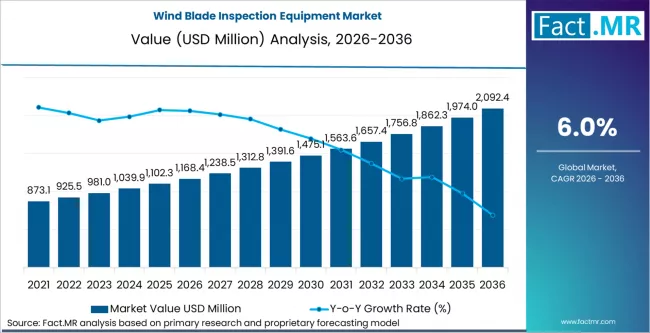
As per Fact.MR analysis, the wind blade inspection market is undergoing a significant transformation, driven by advancements in autonomous inspection technologies and a shift toward predictive maintenance. As of 2026, the focus has moved from manual and reactive inspection processes to integrated, AI-powered, and robotic solutions. Industry leaders are increasingly prioritizing field service and lifecycle management, with TPI Composites reporting a 38.4% YoY increase in inspection services in 2025, demonstrating the growing importance of "service as a revenue driver." This shift highlights the broader industry trend towards the servitization of wind turbine assets.
The deployment of autonomous NDT platforms, like Sulzer Schmid’s 3DX™ system and Siemens Gamesa’s FOD4Wind drones, is revolutionizing how wind blades are inspected, making traditional manual methods obsolete. These innovations not only cut inspection costs but also enhance operational efficiency by reducing downtime. "Predictive maintenance will emerge as the next frontier," states Dr. Morten Vestergaard, Head of Innovations at Vestas, reflecting the industry's growing belief in data-driven strategies for long-term asset management.
Wind Blade Inspection Equipment Market
| Metric | Value |
|---|---|
| Estimated Value in (2026E) | USD 1,168.4 million |
| Forecast Value in (2036F) | USD 2,092.4 million |
| Forecast CAGR 2026 to 2036 | 6.0% |
Category
| Category | Segments |
|---|---|
| Platform | Drones - Multirotor; Drones - VTOL / Fixed-Wing; Rope-Access Kits; Ground-Based Optics |
| Sensor Payload | RGB; Thermal IR; LiDAR; UT / Phased Array; Shearography |
| Use Case | Onshore; Offshore |
| Offering | Hardware + Software; Hardware Only; SaaS Analytics; Full Service Kits |
| Region | North America; Europe; Asia Pacific; Latin America; Middle East & Africa |
Segmental Analysis
What Is the Impact of Platform on the Wind Blade Inspection Equipment Market?
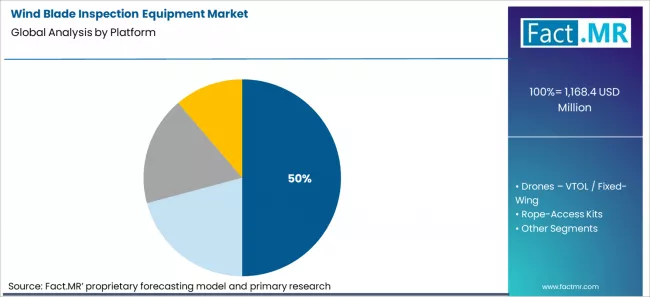
In the wind blade inspection equipment market, platform selection plays a critical role in determining operational efficiency, inspection accuracy, and cost-effectiveness. Drones - multirotor platforms lead with a 50.0% market share due to their versatility, ease of maneuverability, and ability to hover in place for detailed inspections. Multirotor drones are particularly well-suited for wind blade inspections, where precision is crucial in assessing surface damage, cracks, and structural integrity.
Their ability to fly at low altitudes, hover, and conduct inspections in hard-to-reach areas without the need for scaffolding or cranes makes them the preferred choice for operators. The rising demand for autonomous, efficient, and cost-effective solutions in wind turbine maintenance drives the dominance of multirotor drones, which enable faster turnaround times and reduced operational costs, contributing to their leading market position.
How Does Sensor Payload Influence the Wind Blade Inspection Equipment Market?
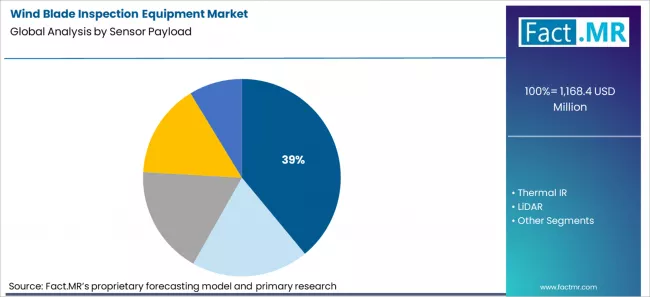
Sensor payload is a key factor influencing the effectiveness of wind blade inspection systems, as it determines the type and accuracy of data collected during inspections. RGB sensors lead the sensor payload segment with a 39.0% share, driven by their cost-effectiveness, high-resolution imaging, and broad application in visual assessments of blade surfaces. RGB sensors are ideal for identifying surface defects such as cracks, chips, and wear, which are common issues in wind blade maintenance.
The popularity of RGB sensors stems from their ability to deliver high-quality images in real-time, enabling inspectors to quickly assess the condition of the blades. The compatibility of RGB sensors with drones and their ability to work alongside other payloads, such as thermal or LiDAR sensors, further enhances their utility in comprehensive wind blade inspection operations, thus reinforcing their leading position in the market.
What are the Drivers, Restraints, and Key Trends in the Wind Blade Inspection Equipment Market?
Drivers: Demand for wind blade inspection equipment is directly tied to the rapid increase in global wind fleet capacity, which exceeded 900 GW by early 2024 and continues to expand at 8-10% annually, especially in China, Europe, and the United States. Significant installed base growth in offshore wind (exceeding 70 GW globally) creates acute need for non-destructive evaluation solutions because manual visual checks are costly and pose safety risks at heights above 80 meters. Owners of utility-scale wind farms mandate periodic inspection cycles every 12-24 months to maintain availability targets above 95%, which drives procurement of sensor-based inspection systems, including phased array ultrasonic (PAUT), blade tip and root strain monitoring, and bolted joint torque inspection. Wind asset operators regularly benchmark equipment that reduces unplanned maintenance costs, which on average account for 20-30% of lifetime operations and maintenance (O&M) spend.
Restraints: Capital intensity and total cost of ownership limit adoption, especially for independent power producers with smaller fleets (<100 MW). High-resolution phased array ultrasonic testing (PAUT) systems can cost 30-50% more than legacy pulsed eddy current tools, and blade access platforms or rope access add further O&M cost. Field validation of new technologies such as guided wave ultrasonic remains limited in cold climates and offshore splash zones, where salt deposition and condensation impact signal quality. Regulatory frameworks in some Asian and African markets lack inspection frequency mandates, reducing urgency compared to markets like Germany and the UK where safety compliance and insurer requirements enforce stricter inspection cadences.
Trend 1: Accelerated adoption of multi-sensor unmanned aerial inspection systems tailored to wind blades with integrated high-definition optical cameras, infrared thermography, and laser profilometry. Leading wind service providers report that hybrid sensor drones reduce inspection cycle time by 40-60% compared to ground-based rope access, and enable quantitative measurement of erosion, leading edge cracking, and adhesive delamination.
Trend 2: Deployment of AI-enabled analytics platforms that standardize defect categorization and severity scoring across OEM blade models. Early adopters in Europe and North America integrate time-series inspection data into digital twin dashboards that flag fatigue progression and enable condition-based maintenance planning, reducing unscheduled downtime by an estimated 15-25% over annualized maintenance runs.
Analysis of the Wind Blade Inspection Equipment Market by Key Country
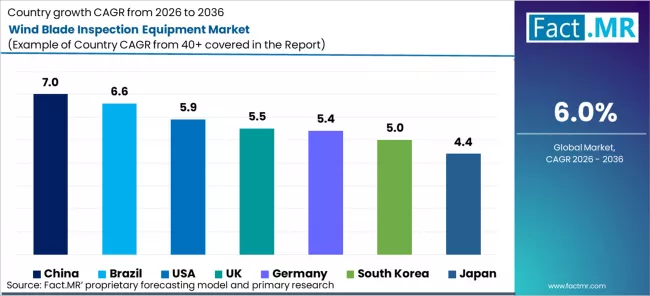
| Country | CAGR (%) |
|---|---|
| China | 7.0% |
| Brazil | 6.6% |
| USA | 5.9% |
| UK | 5.5% |
| Germany | 5.4% |
| South Korea | 5.0% |
| Japan | 4.4% |
The report covers an in-depth analysis of 40+ countries; top-performing countries are highlighted below.
What is driving growth of wind blade inspection equipment demand in China?
Demand for wind blade inspection equipment in China is expanding as the world’s largest installed wind capacity enters mid-life operational phases. Growth at 7.0% CAGR reflects rising inspection cycles across onshore wind farms exceeding 300 GW capacity. State-owned utilities deploy drone-based visual inspection systems to reduce downtime and labor risk. Adoption of ultrasonic testing and thermography supports early crack and delamination detection. Large-scale repowering programs increase need for baseline blade health assessments. Demand concentrates within northern and western wind corridors with high turbine density.
- Aging onshore wind fleet inspections
- Large-scale drone inspection deployment
- Repowering-driven blade assessments
- High turbine density regions
Why is Brazil seeing expansion in wind blade inspection equipment adoption?
Wind blade inspection equipment demand in Brazil is rising as installed wind capacity in northeastern states matures operationally. Growth at 6.6% CAGR reflects increasing inspection needs across utility-scale onshore projects exceeding 25 GW. High wind speeds accelerate leading-edge erosion, increasing reliance on high-resolution visual and thermal inspection tools. Remote site locations favor drone-based inspection over rope access. Independent power producers prioritize defect mapping to extend blade service life. Demand remains concentrated in Bahia, Rio Grande do Norte, and Ceará.
- High erosion rates from strong wind profiles
- Expansion of utility-scale onshore wind
- Preference for drone-based inspections
- Focus on blade life extension
What factors are shaping wind blade inspection equipment sales in the USA?
Sales of wind blade inspection equipment in the USA are increasing as operators adopt condition-based maintenance strategies. Growth at 5.9% CAGR representing demand from wind fleets installed and entering heavy maintenance cycles. Adoption of LiDAR-assisted drones and AI defect analytics supports standardized inspection reporting. Insurance and warranty compliance require documented blade condition assessments. Offshore wind project development along the East Coast drives demand for remote inspection platforms. Demand centers on Midwest and coastal wind clusters.
- Aging wind fleet maintenance cycles
- AI-enabled defect classification adoption
- Insurance-driven inspection documentation
- Offshore wind inspection requirements
How is the UK supporting growth of wind blade inspection equipment demand?
Wind blade inspection equipment demand in the UK is advancing as offshore wind dominates capacity additions. Growth at 5.5% CAGR reflects high reliance on drone and robotic inspection tools suited for offshore environments. Operators deploy thermographic and ultrasonic sensors to detect subsurface defects without turbine shutdown. Asset owners prioritize inspection systems compatible with digital twin platforms. Stringent health and safety standards accelerate replacement of rope-access inspections. Demand concentrates within North Sea offshore wind farms.
- Offshore wind inspection intensity
- Reduction of rope-access inspections
- Integration with digital twin systems
- Use of advanced NDT sensors
What is driving expansion of wind blade inspection equipment demand in Germany?
Demand for wind blade inspection equipment in Germany is rising as repowering and life-extension programs expand. Growth at 5.4% CAGR reflects inspection needs for turbines operating beyond original design lifetimes. Operators deploy shearography and ultrasonic tools to assess internal structural integrity. Grid stability requirements increase emphasis on minimizing turbine downtime. Inspection demand remains strongest within onshore wind parks undergoing capacity upgrades.
- Repowering and life-extension inspections
- Use of shearography and ultrasonic testing
- Downtime minimization priorities
- Onshore wind park modernization
How is South Korea shaping demand for wind blade inspection equipment?
Wind blade inspection equipment demand in South Korea is growing as offshore wind projects advance under national energy transition plans. Growth at 5.0% CAGR reflects adoption of drone and robotic inspection platforms suited for harsh marine conditions. Local operators emphasize corrosion and leading-edge damage detection. Integration with centralized asset management systems supports predictive maintenance. Demand remains concentrated within coastal offshore wind developments.
- Offshore wind project expansion
- Focus on marine damage detection
- Use of robotic inspection platforms
- Centralized asset monitoring adoption
What factors are influencing wind blade inspection equipment demand in Japan?
Demand for wind blade inspection equipment in Japan is expanding steadily as operators manage complex terrain and typhoon exposure. Growth at 4.4% CAGR reflects need for frequent inspections addressing fatigue cracks and lightning damage. Drone inspections reduce access challenges in mountainous regions. Earthquake and extreme weather risk management increases inspection frequency. Demand centers on onshore wind assets requiring high-resolution defect detection.
- High weather-induced blade stress
- Frequent inspection cycles
- Drone use in complex terrain
- Focus on structural integrity monitoring
How is Competition Structured in the Wind Blade Inspection Equipment Market?
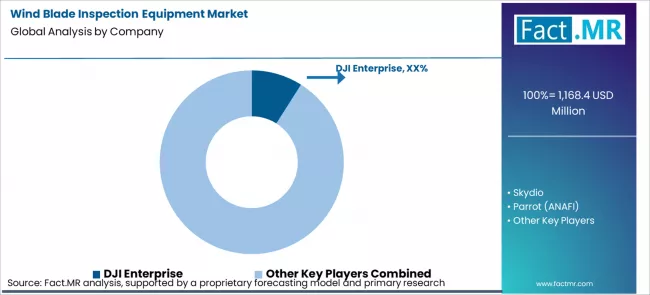
Wind blade inspection equipment has transitioned from a basic tool for safety compliance into a sophisticated driver of asset profitability. Between 2020 and 2024, the primary objective for operators was the replacement of manual rope-access techniques with standardized aerial data collection from providers like DJI, Skydio, and Parrot. This phase succeeded in removing human risk and digitizing the record-keeping process. This early adoption primarily generated vast quantities of raw visual data that often remained underutilized due to the sheer volume of imagery and the absence of automated analysis.
Moving into 2026 and beyond, the focus is evolving toward a model of autonomous lifecycle orchestration. Industry leaders such as Hexagon, Evident, and Teledyne FLIR are now integrating surface-level visual data with subsurface NDT technologies to create comprehensive digital twins. This shift moves the industry away from reactive repairs toward a zero-downtime objective. For those managing large-scale portfolios, the value has moved beyond the drone itself and now resides in the ability to predict the remaining useful life of an asset. Success in this new era depends on transforming raw sensor data into actionable health indices that directly drive long-term ROI and fleet resilience.
Key Players in the Wind Blade Inspection Equipment Market
- DJI Enterprise
- Skydio
- Parrot (ANAFI)
- Autel Robotics
- Flyability
- Evident (Olympus)
- Teledyne FLIR
- Hexagon / Leica
- Eddyfi Technologies
- Phase One Industrial
Scope of the Report
| Items | Values |
|---|---|
| Quantitative Units | USD million |
| Platform | Drones - Multirotor; Drones - VTOL / Fixed-Wing; Rope-Access Kits; Ground-Based Optics |
| Sensor Payload | RGB; Thermal IR; LiDAR; UT / Phased Array; Shearography |
| Use Case | Onshore; Offshore |
| Offering | Hardware + Software; Hardware Only; SaaS Analytics; Full Service Kits |
| Regions Covered | Asia Pacific, Europe, North America, Latin America, Middle East & Africa |
| Countries Covered | China, Brazil, USA, UK, Germany, South Korea, Japan, and 40+ countries |
| Key Companies Profiled | DJI Enterprise; Skydio; Parrot (ANAFI); Autel Robotics; Flyability; Evident (Olympus); Teledyne FLIR; Hexagon / Leica; Eddyfi Technologies; Phase One Industrial |
| Additional Attributes | Dollar sales by platform, sensor payload, use case, and offering; adoption of drones for offshore wind blade inspections; increasing demand for thermal and LiDAR sensors in remote blade inspections; growth in SaaS-based analytics for real-time wind blade condition monitoring; advancements in multirotor and VTOL drone technologies for large-scale, high-efficiency inspections; growing focus on safety and reducing downtime for wind turbine maintenance. |
Wind Blade Inspection Equipment Market Key Segment
-
Platform:
- Drones - Multirotor
- Drones - VTOL / Fixed-Wing
- Rope-Access Kits
- Ground-Based Optics
-
Sensor Payload:
- RGB
- Thermal IR
- LiDAR
- UT / Phased Array
- Shearography
-
Use Case:
- Onshore
- Offshore
-
Offering:
- Hardware + Software
- Hardware Only
- SaaS Analytics
- Full Service Kits
-
Region:
- North America
- USA
- Canada
- Mexico
- Europe
- Germany
- UK
- France
- Italy
- Spain
- Nordic Countries
- BENELUX
- Rest of Europe
- Asia Pacific
- China
- Japan
- South Korea
- India
- Australia
- Rest of Asia Pacific
- Latin America
- Brazil
- Argentina
- Rest of Latin America
- Middle East and Africa
- Kingdom of Saudi Arabia
- United Arab Emirates
- South Africa
- Rest of Middle East and Africa
- Other Regions
- Oceania
- Central Asia
- Other Markets
- North America
Bibliographies
- International Electrotechnical Commission. (2023). Wind energy generation systems-Design requirements for wind turbine blades (IEC 61400-5). IEC.
- DNV. (2023). Recommended practice DNV-RP-0573: Condition monitoring and inspection of wind turbine blades. DNV.
- International Renewable Energy Agency. (2024). Wind power technology trends: Digitalisation, inspection, and asset management. IRENA.
- National Renewable Energy Laboratory. (2023). Advanced inspection methods for wind turbine blades: UAVs, robotics, and nondestructive evaluation. USA Department of Energy.
- European Wind Energy Association. (2024). Operations and maintenance strategies for onshore and offshore wind assets. WindEurope.
- International Organization for Standardization. (2023). ISO 9712: Non-destructive testing-Qualification and certification of NDT personnel. ISO.
- Siemens Gamesa Renewable Energy. (2024). Digital inspection and predictive maintenance approaches for wind turbine blades. Technical White Paper.
- American Society for Nondestructive Testing. (2023). Handbook on ultrasonic, thermographic, and visual inspection for composite structures. ASNT.
Table of Content
- Executive Summary
- Global Market Outlook
- Demand to side Trends
- Supply to side Trends
- Technology Roadmap Analysis
- Analysis and Recommendations
- Market Overview
- Market Coverage / Taxonomy
- Market Definition / Scope / Limitations
- Research Methodology
- Chapter Orientation
- Analytical Lens and Working Hypotheses
- Market Structure, Signals, and Trend Drivers
- Benchmarking and Cross-market Comparability
- Market Sizing, Forecasting, and Opportunity Mapping
- Research Design and Evidence Framework
- Desk Research Programme (Secondary Evidence)
- Company Annual and Sustainability Reports
- Peer-reviewed Journals and Academic Literature
- Corporate Websites, Product Literature, and Technical Notes
- Earnings Decks and Investor Briefings
- Statutory Filings and Regulatory Disclosures
- Technical White Papers and Standards Notes
- Trade Journals, Industry Magazines, and Analyst Briefs
- Conference Proceedings, Webinars, and Seminar Materials
- Government Statistics Portals and Public Data Releases
- Press Releases and Reputable Media Coverage
- Specialist Newsletters and Curated Briefings
- Sector Databases and Reference Repositories
- FMR Internal Proprietary Databases and Historical Market Datasets
- Subscription Datasets and Paid Sources
- Social Channels, Communities, and Digital Listening Inputs
- Additional Desk Sources
- Expert Input and Fieldwork (Primary Evidence)
- Primary Modes
- Qualitative Interviews and Expert Elicitation
- Quantitative Surveys and Structured Data Capture
- Why Primary Evidence is Used
- Field Techniques
- Interviews
- Surveys
- Focus Groups
- Observational and In-context Research
- Social and Community Interactions
- Stakeholder Universe Engaged
- C-suite Leaders
- Board Members
- Presidents and Vice Presidents
- R&D and Innovation Heads
- Technical Specialists
- Domain Subject-matter Experts
- Scientists
- Physicians and Other Healthcare Professionals
- Governance, Ethics, and Data Stewardship
- Research Ethics
- Data Integrity and Handling
- Primary Modes
- Tooling, Models, and Reference Databases
- Desk Research Programme (Secondary Evidence)
- Data Engineering and Model Build
- Data Acquisition and Ingestion
- Cleaning, Normalisation, and Verification
- Synthesis, Triangulation, and Analysis
- Quality Assurance and Audit Trail
- Market Background
- Market Dynamics
- Drivers
- Restraints
- Opportunity
- Trends
- Scenario Forecast
- Demand in Optimistic Scenario
- Demand in Likely Scenario
- Demand in Conservative Scenario
- Opportunity Map Analysis
- Product Life Cycle Analysis
- Supply Chain Analysis
- Investment Feasibility Matrix
- Value Chain Analysis
- PESTLE and Porter’s Analysis
- Regulatory Landscape
- Regional Parent Market Outlook
- Production and Consumption Statistics
- Import and Export Statistics
- Market Dynamics
- Global Market Analysis 2021 to 2025 and Forecast, 2026 to 2036
- Historical Market Size Value (USD Million) Analysis, 2021 to 2025
- Current and Future Market Size Value (USD Million) Projections, 2026 to 2036
- Y to o to Y Growth Trend Analysis
- Absolute $ Opportunity Analysis
- Global Market Pricing Analysis 2021 to 2025 and Forecast 2026 to 2036
- Global Market Analysis 2021 to 2025 and Forecast 2026 to 2036, By Platform
- Introduction / Key Findings
- Historical Market Size Value (USD Million) Analysis By Platform, 2021 to 2025
- Current and Future Market Size Value (USD Million) Analysis and Forecast By Platform, 2026 to 2036
- Drones - Multirotor
- Drones - VTOL / Fixed-Wing
- Rope-Access Kits
- Ground-Based Optics
- Drones - Multirotor
- Y to o to Y Growth Trend Analysis By Platform, 2021 to 2025
- Absolute $ Opportunity Analysis By Platform, 2026 to 2036
- Global Market Analysis 2021 to 2025 and Forecast 2026 to 2036, By Sensor Payload
- Introduction / Key Findings
- Historical Market Size Value (USD Million) Analysis By Sensor Payload, 2021 to 2025
- Current and Future Market Size Value (USD Million) Analysis and Forecast By Sensor Payload, 2026 to 2036
- RGB
- Thermal IR
- LiDAR
- UT / Phased Array
- Shearography
- RGB
- Y to o to Y Growth Trend Analysis By Sensor Payload, 2021 to 2025
- Absolute $ Opportunity Analysis By Sensor Payload, 2026 to 2036
- Global Market Analysis 2021 to 2025 and Forecast 2026 to 2036, By Use Case
- Introduction / Key Findings
- Historical Market Size Value (USD Million) Analysis By Use Case, 2021 to 2025
- Current and Future Market Size Value (USD Million) Analysis and Forecast By Use Case, 2026 to 2036
- Onshore
- Offshore
- Onshore
- Y to o to Y Growth Trend Analysis By Use Case, 2021 to 2025
- Absolute $ Opportunity Analysis By Use Case, 2026 to 2036
- Global Market Analysis 2021 to 2025 and Forecast 2026 to 2036, By Offering
- Introduction / Key Findings
- Historical Market Size Value (USD Million) Analysis By Offering, 2021 to 2025
- Current and Future Market Size Value (USD Million) Analysis and Forecast By Offering, 2026 to 2036
- Hardware + Software
- Hardware Only
- SaaS Analytics
- Full Service Kits
- Hardware + Software
- Y to o to Y Growth Trend Analysis By Offering, 2021 to 2025
- Absolute $ Opportunity Analysis By Offering, 2026 to 2036
- Global Market Analysis 2021 to 2025 and Forecast 2026 to 2036, By Region
- Introduction
- Historical Market Size Value (USD Million) Analysis By Region, 2021 to 2025
- Current Market Size Value (USD Million) Analysis and Forecast By Region, 2026 to 2036
- North America
- Latin America
- Western Europe
- Eastern Europe
- East Asia
- South Asia and Pacific
- Middle East & Africa
- Market Attractiveness Analysis By Region
- North America Market Analysis 2021 to 2025 and Forecast 2026 to 2036, By Country
- Historical Market Size Value (USD Million) Trend Analysis By Market Taxonomy, 2021 to 2025
- Market Size Value (USD Million) Forecast By Market Taxonomy, 2026 to 2036
- By Country
- USA
- Canada
- Mexico
- By Platform
- By Sensor Payload
- By Use Case
- By Offering
- By Country
- Market Attractiveness Analysis
- By Country
- By Platform
- By Sensor Payload
- By Use Case
- By Offering
- Key Takeaways
- Latin America Market Analysis 2021 to 2025 and Forecast 2026 to 2036, By Country
- Historical Market Size Value (USD Million) Trend Analysis By Market Taxonomy, 2021 to 2025
- Market Size Value (USD Million) Forecast By Market Taxonomy, 2026 to 2036
- By Country
- Brazil
- Chile
- Rest of Latin America
- By Platform
- By Sensor Payload
- By Use Case
- By Offering
- By Country
- Market Attractiveness Analysis
- By Country
- By Platform
- By Sensor Payload
- By Use Case
- By Offering
- Key Takeaways
- Western Europe Market Analysis 2021 to 2025 and Forecast 2026 to 2036, By Country
- Historical Market Size Value (USD Million) Trend Analysis By Market Taxonomy, 2021 to 2025
- Market Size Value (USD Million) Forecast By Market Taxonomy, 2026 to 2036
- By Country
- Germany
- UK
- Italy
- Spain
- France
- Nordic
- BENELUX
- Rest of Western Europe
- By Platform
- By Sensor Payload
- By Use Case
- By Offering
- By Country
- Market Attractiveness Analysis
- By Country
- By Platform
- By Sensor Payload
- By Use Case
- By Offering
- Key Takeaways
- Eastern Europe Market Analysis 2021 to 2025 and Forecast 2026 to 2036, By Country
- Historical Market Size Value (USD Million) Trend Analysis By Market Taxonomy, 2021 to 2025
- Market Size Value (USD Million) Forecast By Market Taxonomy, 2026 to 2036
- By Country
- Russia
- Poland
- Hungary
- Balkan & Baltic
- Rest of Eastern Europe
- By Platform
- By Sensor Payload
- By Use Case
- By Offering
- By Country
- Market Attractiveness Analysis
- By Country
- By Platform
- By Sensor Payload
- By Use Case
- By Offering
- Key Takeaways
- East Asia Market Analysis 2021 to 2025 and Forecast 2026 to 2036, By Country
- Historical Market Size Value (USD Million) Trend Analysis By Market Taxonomy, 2021 to 2025
- Market Size Value (USD Million) Forecast By Market Taxonomy, 2026 to 2036
- By Country
- China
- Japan
- South Korea
- By Platform
- By Sensor Payload
- By Use Case
- By Offering
- By Country
- Market Attractiveness Analysis
- By Country
- By Platform
- By Sensor Payload
- By Use Case
- By Offering
- Key Takeaways
- South Asia and Pacific Market Analysis 2021 to 2025 and Forecast 2026 to 2036, By Country
- Historical Market Size Value (USD Million) Trend Analysis By Market Taxonomy, 2021 to 2025
- Market Size Value (USD Million) Forecast By Market Taxonomy, 2026 to 2036
- By Country
- India
- ASEAN
- Australia & New Zealand
- Rest of South Asia and Pacific
- By Platform
- By Sensor Payload
- By Use Case
- By Offering
- By Country
- Market Attractiveness Analysis
- By Country
- By Platform
- By Sensor Payload
- By Use Case
- By Offering
- Key Takeaways
- Middle East & Africa Market Analysis 2021 to 2025 and Forecast 2026 to 2036, By Country
- Historical Market Size Value (USD Million) Trend Analysis By Market Taxonomy, 2021 to 2025
- Market Size Value (USD Million) Forecast By Market Taxonomy, 2026 to 2036
- By Country
- Kingdom of Saudi Arabia
- Other GCC Countries
- Turkiye
- South Africa
- Other African Union
- Rest of Middle East & Africa
- By Platform
- By Sensor Payload
- By Use Case
- By Offering
- By Country
- Market Attractiveness Analysis
- By Country
- By Platform
- By Sensor Payload
- By Use Case
- By Offering
- Key Takeaways
- Key Countries Market Analysis
- USA
- Pricing Analysis
- Market Share Analysis, 2025
- By Platform
- By Sensor Payload
- By Use Case
- By Offering
- Canada
- Pricing Analysis
- Market Share Analysis, 2025
- By Platform
- By Sensor Payload
- By Use Case
- By Offering
- Mexico
- Pricing Analysis
- Market Share Analysis, 2025
- By Platform
- By Sensor Payload
- By Use Case
- By Offering
- Brazil
- Pricing Analysis
- Market Share Analysis, 2025
- By Platform
- By Sensor Payload
- By Use Case
- By Offering
- Chile
- Pricing Analysis
- Market Share Analysis, 2025
- By Platform
- By Sensor Payload
- By Use Case
- By Offering
- Germany
- Pricing Analysis
- Market Share Analysis, 2025
- By Platform
- By Sensor Payload
- By Use Case
- By Offering
- UK
- Pricing Analysis
- Market Share Analysis, 2025
- By Platform
- By Sensor Payload
- By Use Case
- By Offering
- Italy
- Pricing Analysis
- Market Share Analysis, 2025
- By Platform
- By Sensor Payload
- By Use Case
- By Offering
- Spain
- Pricing Analysis
- Market Share Analysis, 2025
- By Platform
- By Sensor Payload
- By Use Case
- By Offering
- France
- Pricing Analysis
- Market Share Analysis, 2025
- By Platform
- By Sensor Payload
- By Use Case
- By Offering
- India
- Pricing Analysis
- Market Share Analysis, 2025
- By Platform
- By Sensor Payload
- By Use Case
- By Offering
- ASEAN
- Pricing Analysis
- Market Share Analysis, 2025
- By Platform
- By Sensor Payload
- By Use Case
- By Offering
- Australia & New Zealand
- Pricing Analysis
- Market Share Analysis, 2025
- By Platform
- By Sensor Payload
- By Use Case
- By Offering
- China
- Pricing Analysis
- Market Share Analysis, 2025
- By Platform
- By Sensor Payload
- By Use Case
- By Offering
- Japan
- Pricing Analysis
- Market Share Analysis, 2025
- By Platform
- By Sensor Payload
- By Use Case
- By Offering
- South Korea
- Pricing Analysis
- Market Share Analysis, 2025
- By Platform
- By Sensor Payload
- By Use Case
- By Offering
- Russia
- Pricing Analysis
- Market Share Analysis, 2025
- By Platform
- By Sensor Payload
- By Use Case
- By Offering
- Poland
- Pricing Analysis
- Market Share Analysis, 2025
- By Platform
- By Sensor Payload
- By Use Case
- By Offering
- Hungary
- Pricing Analysis
- Market Share Analysis, 2025
- By Platform
- By Sensor Payload
- By Use Case
- By Offering
- Kingdom of Saudi Arabia
- Pricing Analysis
- Market Share Analysis, 2025
- By Platform
- By Sensor Payload
- By Use Case
- By Offering
- Turkiye
- Pricing Analysis
- Market Share Analysis, 2025
- By Platform
- By Sensor Payload
- By Use Case
- By Offering
- South Africa
- Pricing Analysis
- Market Share Analysis, 2025
- By Platform
- By Sensor Payload
- By Use Case
- By Offering
- USA
- Market Structure Analysis
- Competition Dashboard
- Competition Benchmarking
- Market Share Analysis of Top Players
- By Regional
- By Platform
- By Sensor Payload
- By Use Case
- By Offering
- Competition Analysis
- Competition Deep Dive
- DJI Enterprise
- Overview
- Product Portfolio
- Profitability by Market Segments (Product/Age /Sales Channel/Region)
- Sales Footprint
- Strategy Overview
- Marketing Strategy
- Product Strategy
- Channel Strategy
- Skydio
- Parrot (ANAFI)
- Autel Robotics
- Flyability
- Evident (Olympus)
- Teledyne FLIR
- Hexagon / Leica
- Eddyfi Technologies
- Phase One Industrial
- DJI Enterprise
- Competition Deep Dive
- Assumptions & Acronyms Used
List Of Table
- Table 1: Global Market Value (USD Million) Forecast by Region, 2021 to 2036
- Table 2: Global Market Value (USD Million) Forecast by Platform, 2021 to 2036
- Table 3: Global Market Value (USD Million) Forecast by Sensor Payload, 2021 to 2036
- Table 4: Global Market Value (USD Million) Forecast by Use Case, 2021 to 2036
- Table 5: Global Market Value (USD Million) Forecast by Offering, 2021 to 2036
- Table 6: North America Market Value (USD Million) Forecast by Country, 2021 to 2036
- Table 7: North America Market Value (USD Million) Forecast by Platform, 2021 to 2036
- Table 8: North America Market Value (USD Million) Forecast by Sensor Payload, 2021 to 2036
- Table 9: North America Market Value (USD Million) Forecast by Use Case, 2021 to 2036
- Table 10: North America Market Value (USD Million) Forecast by Offering, 2021 to 2036
- Table 11: Latin America Market Value (USD Million) Forecast by Country, 2021 to 2036
- Table 12: Latin America Market Value (USD Million) Forecast by Platform, 2021 to 2036
- Table 13: Latin America Market Value (USD Million) Forecast by Sensor Payload, 2021 to 2036
- Table 14: Latin America Market Value (USD Million) Forecast by Use Case, 2021 to 2036
- Table 15: Latin America Market Value (USD Million) Forecast by Offering, 2021 to 2036
- Table 16: Western Europe Market Value (USD Million) Forecast by Country, 2021 to 2036
- Table 17: Western Europe Market Value (USD Million) Forecast by Platform, 2021 to 2036
- Table 18: Western Europe Market Value (USD Million) Forecast by Sensor Payload, 2021 to 2036
- Table 19: Western Europe Market Value (USD Million) Forecast by Use Case, 2021 to 2036
- Table 20: Western Europe Market Value (USD Million) Forecast by Offering, 2021 to 2036
- Table 21: Eastern Europe Market Value (USD Million) Forecast by Country, 2021 to 2036
- Table 22: Eastern Europe Market Value (USD Million) Forecast by Platform, 2021 to 2036
- Table 23: Eastern Europe Market Value (USD Million) Forecast by Sensor Payload, 2021 to 2036
- Table 24: Eastern Europe Market Value (USD Million) Forecast by Use Case, 2021 to 2036
- Table 25: Eastern Europe Market Value (USD Million) Forecast by Offering, 2021 to 2036
- Table 26: East Asia Market Value (USD Million) Forecast by Country, 2021 to 2036
- Table 27: East Asia Market Value (USD Million) Forecast by Platform, 2021 to 2036
- Table 28: East Asia Market Value (USD Million) Forecast by Sensor Payload, 2021 to 2036
- Table 29: East Asia Market Value (USD Million) Forecast by Use Case, 2021 to 2036
- Table 30: East Asia Market Value (USD Million) Forecast by Offering, 2021 to 2036
- Table 31: South Asia and Pacific Market Value (USD Million) Forecast by Country, 2021 to 2036
- Table 32: South Asia and Pacific Market Value (USD Million) Forecast by Platform, 2021 to 2036
- Table 33: South Asia and Pacific Market Value (USD Million) Forecast by Sensor Payload, 2021 to 2036
- Table 34: South Asia and Pacific Market Value (USD Million) Forecast by Use Case, 2021 to 2036
- Table 35: South Asia and Pacific Market Value (USD Million) Forecast by Offering, 2021 to 2036
- Table 36: Middle East & Africa Market Value (USD Million) Forecast by Country, 2021 to 2036
- Table 37: Middle East & Africa Market Value (USD Million) Forecast by Platform, 2021 to 2036
- Table 38: Middle East & Africa Market Value (USD Million) Forecast by Sensor Payload, 2021 to 2036
- Table 39: Middle East & Africa Market Value (USD Million) Forecast by Use Case, 2021 to 2036
- Table 40: Middle East & Africa Market Value (USD Million) Forecast by Offering, 2021 to 2036
List Of Figures
- Figure 1: Global Market Pricing Analysis
- Figure 2: Global Market Value (USD Million) Forecast 2021 to 2036
- Figure 3: Global Market Value Share and BPS Analysis by Platform, 2026 and 2036
- Figure 4: Global Market Y to o to Y Growth Comparison by Platform, 2026 to 2036
- Figure 5: Global Market Attractiveness Analysis by Platform
- Figure 6: Global Market Value Share and BPS Analysis by Sensor Payload, 2026 and 2036
- Figure 7: Global Market Y to o to Y Growth Comparison by Sensor Payload, 2026 to 2036
- Figure 8: Global Market Attractiveness Analysis by Sensor Payload
- Figure 9: Global Market Value Share and BPS Analysis by Use Case, 2026 and 2036
- Figure 10: Global Market Y to o to Y Growth Comparison by Use Case, 2026 to 2036
- Figure 11: Global Market Attractiveness Analysis by Use Case
- Figure 12: Global Market Value Share and BPS Analysis by Offering, 2026 and 2036
- Figure 13: Global Market Y to o to Y Growth Comparison by Offering, 2026 to 2036
- Figure 14: Global Market Attractiveness Analysis by Offering
- Figure 15: Global Market Value (USD Million) Share and BPS Analysis by Region, 2026 and 2036
- Figure 16: Global Market Y to o to Y Growth Comparison by Region, 2026 to 2036
- Figure 17: Global Market Attractiveness Analysis by Region
- Figure 18: North America Market Incremental Dollar Opportunity, 2026 to 2036
- Figure 19: Latin America Market Incremental Dollar Opportunity, 2026 to 2036
- Figure 20: Western Europe Market Incremental Dollar Opportunity, 2026 to 2036
- Figure 21: Eastern Europe Market Incremental Dollar Opportunity, 2026 to 2036
- Figure 22: East Asia Market Incremental Dollar Opportunity, 2026 to 2036
- Figure 23: South Asia and Pacific Market Incremental Dollar Opportunity, 2026 to 2036
- Figure 24: Middle East & Africa Market Incremental Dollar Opportunity, 2026 to 2036
- Figure 25: North America Market Value Share and BPS Analysis by Country, 2026 and 2036
- Figure 26: North America Market Value Share and BPS Analysis by Platform, 2026 and 2036
- Figure 27: North America Market Y to o to Y Growth Comparison by Platform, 2026 to 2036
- Figure 28: North America Market Attractiveness Analysis by Platform
- Figure 29: North America Market Value Share and BPS Analysis by Sensor Payload, 2026 and 2036
- Figure 30: North America Market Y to o to Y Growth Comparison by Sensor Payload, 2026 to 2036
- Figure 31: North America Market Attractiveness Analysis by Sensor Payload
- Figure 32: North America Market Value Share and BPS Analysis by Use Case, 2026 and 2036
- Figure 33: North America Market Y to o to Y Growth Comparison by Use Case, 2026 to 2036
- Figure 34: North America Market Attractiveness Analysis by Use Case
- Figure 35: North America Market Value Share and BPS Analysis by Offering, 2026 and 2036
- Figure 36: North America Market Y to o to Y Growth Comparison by Offering, 2026 to 2036
- Figure 37: North America Market Attractiveness Analysis by Offering
- Figure 38: Latin America Market Value Share and BPS Analysis by Country, 2026 and 2036
- Figure 39: Latin America Market Value Share and BPS Analysis by Platform, 2026 and 2036
- Figure 40: Latin America Market Y to o to Y Growth Comparison by Platform, 2026 to 2036
- Figure 41: Latin America Market Attractiveness Analysis by Platform
- Figure 42: Latin America Market Value Share and BPS Analysis by Sensor Payload, 2026 and 2036
- Figure 43: Latin America Market Y to o to Y Growth Comparison by Sensor Payload, 2026 to 2036
- Figure 44: Latin America Market Attractiveness Analysis by Sensor Payload
- Figure 45: Latin America Market Value Share and BPS Analysis by Use Case, 2026 and 2036
- Figure 46: Latin America Market Y to o to Y Growth Comparison by Use Case, 2026 to 2036
- Figure 47: Latin America Market Attractiveness Analysis by Use Case
- Figure 48: Latin America Market Value Share and BPS Analysis by Offering, 2026 and 2036
- Figure 49: Latin America Market Y to o to Y Growth Comparison by Offering, 2026 to 2036
- Figure 50: Latin America Market Attractiveness Analysis by Offering
- Figure 51: Western Europe Market Value Share and BPS Analysis by Country, 2026 and 2036
- Figure 52: Western Europe Market Value Share and BPS Analysis by Platform, 2026 and 2036
- Figure 53: Western Europe Market Y to o to Y Growth Comparison by Platform, 2026 to 2036
- Figure 54: Western Europe Market Attractiveness Analysis by Platform
- Figure 55: Western Europe Market Value Share and BPS Analysis by Sensor Payload, 2026 and 2036
- Figure 56: Western Europe Market Y to o to Y Growth Comparison by Sensor Payload, 2026 to 2036
- Figure 57: Western Europe Market Attractiveness Analysis by Sensor Payload
- Figure 58: Western Europe Market Value Share and BPS Analysis by Use Case, 2026 and 2036
- Figure 59: Western Europe Market Y to o to Y Growth Comparison by Use Case, 2026 to 2036
- Figure 60: Western Europe Market Attractiveness Analysis by Use Case
- Figure 61: Western Europe Market Value Share and BPS Analysis by Offering, 2026 and 2036
- Figure 62: Western Europe Market Y to o to Y Growth Comparison by Offering, 2026 to 2036
- Figure 63: Western Europe Market Attractiveness Analysis by Offering
- Figure 64: Eastern Europe Market Value Share and BPS Analysis by Country, 2026 and 2036
- Figure 65: Eastern Europe Market Value Share and BPS Analysis by Platform, 2026 and 2036
- Figure 66: Eastern Europe Market Y to o to Y Growth Comparison by Platform, 2026 to 2036
- Figure 67: Eastern Europe Market Attractiveness Analysis by Platform
- Figure 68: Eastern Europe Market Value Share and BPS Analysis by Sensor Payload, 2026 and 2036
- Figure 69: Eastern Europe Market Y to o to Y Growth Comparison by Sensor Payload, 2026 to 2036
- Figure 70: Eastern Europe Market Attractiveness Analysis by Sensor Payload
- Figure 71: Eastern Europe Market Value Share and BPS Analysis by Use Case, 2026 and 2036
- Figure 72: Eastern Europe Market Y to o to Y Growth Comparison by Use Case, 2026 to 2036
- Figure 73: Eastern Europe Market Attractiveness Analysis by Use Case
- Figure 74: Eastern Europe Market Value Share and BPS Analysis by Offering, 2026 and 2036
- Figure 75: Eastern Europe Market Y to o to Y Growth Comparison by Offering, 2026 to 2036
- Figure 76: Eastern Europe Market Attractiveness Analysis by Offering
- Figure 77: East Asia Market Value Share and BPS Analysis by Country, 2026 and 2036
- Figure 78: East Asia Market Value Share and BPS Analysis by Platform, 2026 and 2036
- Figure 79: East Asia Market Y to o to Y Growth Comparison by Platform, 2026 to 2036
- Figure 80: East Asia Market Attractiveness Analysis by Platform
- Figure 81: East Asia Market Value Share and BPS Analysis by Sensor Payload, 2026 and 2036
- Figure 82: East Asia Market Y to o to Y Growth Comparison by Sensor Payload, 2026 to 2036
- Figure 83: East Asia Market Attractiveness Analysis by Sensor Payload
- Figure 84: East Asia Market Value Share and BPS Analysis by Use Case, 2026 and 2036
- Figure 85: East Asia Market Y to o to Y Growth Comparison by Use Case, 2026 to 2036
- Figure 86: East Asia Market Attractiveness Analysis by Use Case
- Figure 87: East Asia Market Value Share and BPS Analysis by Offering, 2026 and 2036
- Figure 88: East Asia Market Y to o to Y Growth Comparison by Offering, 2026 to 2036
- Figure 89: East Asia Market Attractiveness Analysis by Offering
- Figure 90: South Asia and Pacific Market Value Share and BPS Analysis by Country, 2026 and 2036
- Figure 91: South Asia and Pacific Market Value Share and BPS Analysis by Platform, 2026 and 2036
- Figure 92: South Asia and Pacific Market Y to o to Y Growth Comparison by Platform, 2026 to 2036
- Figure 93: South Asia and Pacific Market Attractiveness Analysis by Platform
- Figure 94: South Asia and Pacific Market Value Share and BPS Analysis by Sensor Payload, 2026 and 2036
- Figure 95: South Asia and Pacific Market Y to o to Y Growth Comparison by Sensor Payload, 2026 to 2036
- Figure 96: South Asia and Pacific Market Attractiveness Analysis by Sensor Payload
- Figure 97: South Asia and Pacific Market Value Share and BPS Analysis by Use Case, 2026 and 2036
- Figure 98: South Asia and Pacific Market Y to o to Y Growth Comparison by Use Case, 2026 to 2036
- Figure 99: South Asia and Pacific Market Attractiveness Analysis by Use Case
- Figure 100: South Asia and Pacific Market Value Share and BPS Analysis by Offering, 2026 and 2036
- Figure 101: South Asia and Pacific Market Y to o to Y Growth Comparison by Offering, 2026 to 2036
- Figure 102: South Asia and Pacific Market Attractiveness Analysis by Offering
- Figure 103: Middle East & Africa Market Value Share and BPS Analysis by Country, 2026 and 2036
- Figure 104: Middle East & Africa Market Value Share and BPS Analysis by Platform, 2026 and 2036
- Figure 105: Middle East & Africa Market Y to o to Y Growth Comparison by Platform, 2026 to 2036
- Figure 106: Middle East & Africa Market Attractiveness Analysis by Platform
- Figure 107: Middle East & Africa Market Value Share and BPS Analysis by Sensor Payload, 2026 and 2036
- Figure 108: Middle East & Africa Market Y to o to Y Growth Comparison by Sensor Payload, 2026 to 2036
- Figure 109: Middle East & Africa Market Attractiveness Analysis by Sensor Payload
- Figure 110: Middle East & Africa Market Value Share and BPS Analysis by Use Case, 2026 and 2036
- Figure 111: Middle East & Africa Market Y to o to Y Growth Comparison by Use Case, 2026 to 2036
- Figure 112: Middle East & Africa Market Attractiveness Analysis by Use Case
- Figure 113: Middle East & Africa Market Value Share and BPS Analysis by Offering, 2026 and 2036
- Figure 114: Middle East & Africa Market Y to o to Y Growth Comparison by Offering, 2026 to 2036
- Figure 115: Middle East & Africa Market Attractiveness Analysis by Offering
- Figure 116: Global Market - Tier Structure Analysis
- Figure 117: Global Market - Company Share Analysis
- FAQs -
How big is the wind blade inspection equipment market in 2026?
The global wind blade inspection equipment market is estimated to be valued at USD 1,168.4 million in 2026.
What will be the size of wind blade inspection equipment market in 2036?
The market size for the wind blade inspection equipment market is projected to reach USD 2,092.4 million by 2036.
How much will be the wind blade inspection equipment market growth between 2026 and 2036?
The wind blade inspection equipment market is expected to grow at a 6.0% CAGR between 2026 and 2036.
What are the key product types in the wind blade inspection equipment market?
The key product types in wind blade inspection equipment market are drones - multirotor, drones - vtol / fixed-wing, rope-access kits and ground-based optics.
Which sensor payload segment to contribute significant share in the wind blade inspection equipment market in 2026?
In terms of sensor payload, rgb segment to command 39.0% share in the wind blade inspection equipment market in 2026.