- Market Value (2025): USD 15.4 Bn
- Estimated Value (2026): USD 16.8 Bn
- Forecast Value (2036): USD 39.8 Bn
- CAGR (2026-2036): 9.0%
What is the Wind Energy Foundation Market forecast to be worth by 2036?
USD 16.8 billion in 2026 to USD 39.8 billion by 2036, at 9.0% CAGR.
- The market reached USD 15.4 billion in 2025 across offshore and onshore foundation projects.
- Demand is projected to increase from USD 16.8 billion in 2026 to USD 39.8 billion by 2036.
- The market is forecast to record a 9.0% CAGR as developers reserve certified designs and heavy-fabrication capacity earlier.
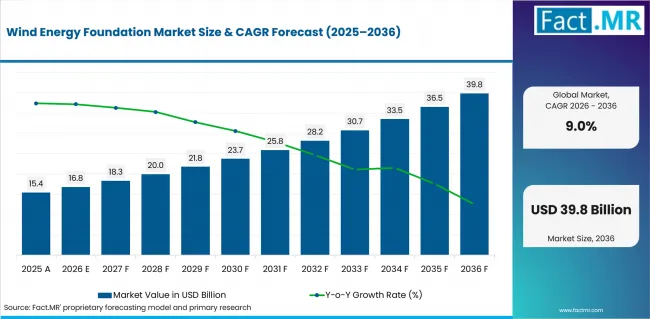
Wind Energy Foundation Market Value Analysis | Source: Fact.MR
What are the defining numbers behind Wind Energy Foundation Market growth?
USD 23.0 billion absolute opportunity by 2036, led by monopile foundations and offshore wind farms.
- Demand Drivers in the Market
- Offshore developers require certifiable load paths because turbine ratings and seabed conditions alter steel thickness and installation methods.
- Utility engineering teams need delivery certainty since final investment timing controls long-lead foundation orders and reserved yard capacity.
- EPC contractors prefer clear interface control so turbine loads and geotechnical updates reach fabricators before plate cutting begins.
- Key Segments Analyzed
- Foundation type is expected to be led by monopile foundations at 48.0% share in 2026, supported by repeatable fixed-bottom engineering.
- Application demand is projected to place offshore wind farms at 58.0% share in 2026, driven by marine installation requirements.
- End-user demand is anticipated to place utility companies at 46.0% share in 2026, owing to bankability and offtake control.
- Distribution channel is estimated to place direct project contracts at 54.0% share in 2026, attributable to delivery accountability.
- Material demand is forecast to place steel at 56.0% share in 2026, reinforced by established heavy-fabrication practices.
- Analyst Opinion at Fact.MR
- Senior Analyst Shambhu Nath Jha at Fact.MR states, “Foundation revenue depends on certified designs and reserved yard slots. Demand is expected to favor firms combining geotechnical control with traceable materials and installation-ready planning.”
- Strategic Implications
- Developers should lock turbine loads and seabed data before reserving capacity with qualified foundation manufacturers.
- Utility engineering teams need to compare design margins and delivery windows during capital allocation across competing foundation concepts.
- Fabricators should align plate supply and welding schedules with certification milestones before production drawings are released.
- Port operators must confirm quay strength and loadout access before serial foundation marshalling begins.
Large fixed-bottom projects require dedicated serial capacity to protect schedules. In July 2025, SeAH Wind began Hornsea 3 production at Teesside. The facility supports foundations exceeding 100 metres and 2,000 tonnes through a dedicated route.
The United States is expected at 10.3% CAGR, supported by approved projects and offshore support vessel services. Germany is projected at 10.0% CAGR, driven by North Sea auctions. The United Kingdom is anticipated at 9.7% CAGR, owing to awarded projects. Japan is estimated at 9.4% CAGR, shaped by seismic constraints. South Korea is forecast at 9.1% CAGR, reinforced by planned zones.
How does the Wind Energy Foundation Market break down by segment?
Monopile foundations are projected to account for 48.0% share; offshore wind farms are estimated to garner 58.0% share.
Which foundation type dominates?
Monopile foundations are projected to account for 48.0% share in 2026
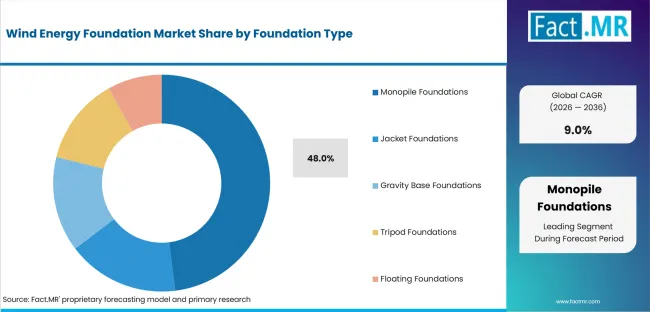
Wind Energy Foundation Market Analysis By Foundation Type | Source: Fact.MR
By foundation type, monopile foundations are estimated to hold 48.0% share in 2026 owing to repeatable engineering. Jackets and floating structures serve deeper sites while steel structures require reserved plate capacity.
Why do offshore wind farms lead the application category?
Offshore wind farms are anticipated to capture 58.0% share in 2026, driven by marine installation requirements.
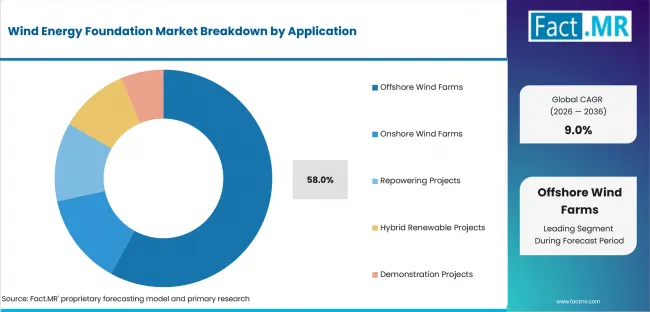
Wind Energy Foundation Market Analysis By Application | Source: Fact.MR
In 2026, offshore wind farms are expected to lead application demand with 58.0% share because marine projects require dedicated installation packages. Onshore wind energy uses repeatable civil works while offshore repowering upgrades require revised load checks.
How do utility companies shape end-user demand?
Utility companies are expected to represent 46.0% share in 2026
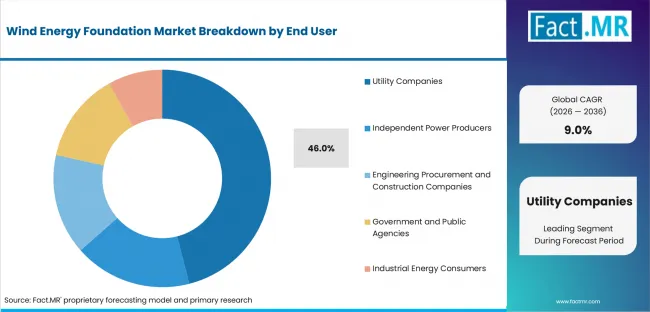
Wind Energy Foundation Market Analysis By End User | Source: Fact.MR
Based on end user, utility companies are projected to account for 46.0% share in 2026 due to credit and offtake control. Independent developers and EPC companies carry awards into construction once finance and permits remain intact. Utility approvals align foundation commitments with wind turbine generators schedules.
What supports direct project contracts within distribution channel?
Direct project contracts are estimated to hold 54.0% share in 2026
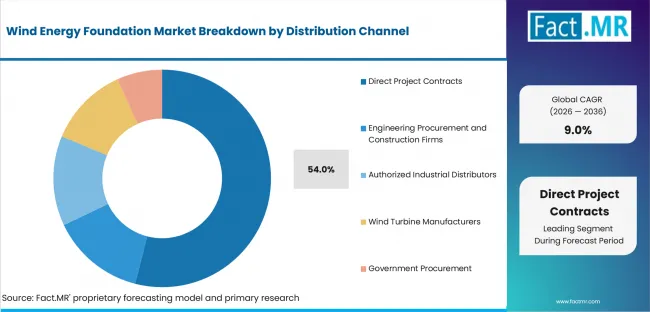
Wind Energy Foundation Market Analysis By Distribution Channel | Source: Fact.MR
The distribution channel is forecast to be led by direct project contracts at 54.0% share in 2026 due to project accountability. EPC and OEM routes remain relevant for integrated delivery. Direct contracts connect certified drawings with wind turbine automation interfaces before fabrication begins.
What drives steel leadership in the material category?
Steel is forecast to account for 56.0% share in 2026
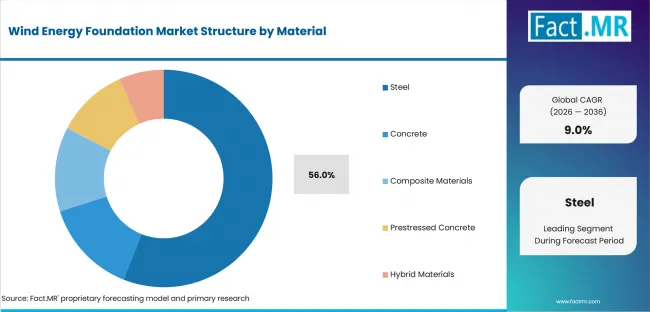
Wind Energy Foundation Market Analysis By Material | Source: Fact.MR
Steel is projected to hold 56.0% share in 2026 owing to proven weldability across monopile and jacket production. Concrete and hybrid materials serve selected gravity-base or floating concepts. Established plate routes support traceable wind turbine materials production at serial scale.
What is accelerating Wind Energy Foundation Market adoption, and what is holding it back?
Project conversion and larger turbine loads drive demand; bankability delays and site uncertainty restrain commitments.
Drivers Impact Analysis
| DRIVER | (~) % IMPACT ON CAGR | GEOGRAPHIC RELEVANCE | IMPACT TIMELINE |
|---|---|---|---|
| Auction and lease conversion | +1.0% | Europe, Asia Pacific, North America | Medium term |
| Larger turbine loads | +0.8% | Global offshore projects | Medium term |
| Repowering programmes | +0.6% | Europe and North America | Long term |
| Deep-water projects | +0.5% | USA, Japan, South Korea | Long term |
| Local fabrication requirements | +0.4% | Europe and East Asia | Short term |
Source: Fact.MR analysis. Updated Jul 31, 2026
- Project conversion: Consented capacity creates revenue after developers secure finance and schedules; GWEC identified about 25 GW awaiting final investment decisions in June 2026.
- Rising turbine loads: Larger turbine ratings require wider diameters and thicker plate, increasing the value of rolling accuracy and weld productivity.
- Repowering demand: Revised turbine loads can exceed original fatigue margins and require replacement foundations or reinforced load-transfer structures.
Opportunity Impact Analysis
| OPPORTUNITY | (~) % IMPACT ON CAGR | GEOGRAPHIC RELEVANCE | IMPACT TIMELINE |
|---|---|---|---|
| Floating deep-water foundations | +0.7% | USA and Asia Pacific | Long term |
| Serial monopile lines | +0.5% | Europe and East Asia | Medium term |
| Offshore construction growth | +0.4% | Global offshore projects | Medium term |
| Hybrid modular designs | +0.3% | Europe, Japan, South Korea | Long term |
Source: Fact.MR analysis. Updated Jul 31, 2026
- Floating foundations: Deep-water resources create demand beyond fixed-bottom limits and support serial port assembly across repeatable substructure designs.
- Serial monopile production: Dedicated lines improve throughput across repeated diameters and coordinated plate schedules for multi-unit orders.
- Expanding installations: Contracted construction creates demand when yard output aligns with port capacity and available installation vessels.
Restraints Impact Analysis
| RESTRAINT | (~) % IMPACT ON CAGR | GEOGRAPHIC RELEVANCE | IMPACT TIMELINE |
|---|---|---|---|
| Delayed investment decisions | -0.8% | Global offshore projects | Short term |
| Permitting and seabed uncertainty | -0.6% | USA, Europe, East Asia | Medium term |
| Factory and port bottlenecks | -0.5% | Europe and North America | Medium term |
| Corrosion and inspection exposure | -0.3% | Global offshore projects | Long term |
Source: Fact.MR analysis. Updated Jul 31, 2026
- Project bankability: Commitments slow when developers reprice offtake or postpone investment decisions across awarded projects.
- Permitting and seabed uncertainty: Designs remain provisional until surveys and approvals resolve site constraints and release certified drawings.
- Factory and port bottlenecks: XXL foundations require heavy fabrication beside suitable quays that support serial loadout windows.
Which countries are scaling Wind Energy Foundation Market fastest?
USA 10.3%; Germany 10.0%; UK 9.7%; Japan 9.4%; and South Korea 9.1%.
Regional analysis covers North America, Latin America, Europe, East Asia, South Asia and Pacific, and Middle East and Africa.
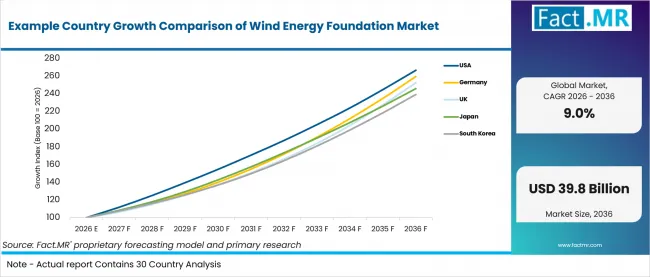
Example Country Growth Comparison Of Wind Energy Foundation Market | Source: Fact.MR
| COUNTRY | CAGR |
|---|---|
| USA | 10.3% |
| Germany | 10.0% |
| UK | 9.7% |
| Japan | 9.4% |
| South Korea | 9.1% |
Source: Fact.MR analysis. Updated Jul 31, 2026
What is driving United States growth through 2036?
10.3% CAGR, supported by approved offshore projects and domestic foundation capacity.
United States developers rely on approved projects while new federal leasing remains paused. Demand is expected to record a 10.3% CAGR over the forecast period as permitted projects require domestic foundations. BOEM approved SouthCoast Wind in January 2025 for 141 turbine positions, although later lease changes reduced future order visibility.
How is Germany scaling foundation demand?
10.0% CAGR, driven by North Sea projects and established fabrication routes.
German developers use established North Sea fabrication and loadout routes. RWE reported in March 2025 that the first Nordseecluster foundations reached Eemshaven. Demand is projected to expand at 10.0% CAGR by 2036, however, competing yard commitments remain a material friction.
What supports the United Kingdom outlook?
9.7% CAGR, owing to awarded offshore projects and mature port infrastructure.
UK developers use awarded projects and established North Sea construction routes. RWE reported in July 2025 that Sofia completed 100 monopile foundations through the Port of Tyne. Demand is anticipated to post a 9.7% CAGR, although port competition affects reservations.
How is Japan developing foundation demand?
9.4% CAGR, shaped by seismic engineering and constrained base-port capacity.
Japanese projects require foundations adapted to typhoons and earthquakes across constrained ports. The market in Japan is estimated to register a 9.4% CAGR by 2036 owing to base-port investment which supports projects.
What underpins South Korea growth?
9.1% CAGR, reinforced by planned-zone development and domestic fabrication.
South Korean projects use planned zones that coordinate seabed suitability and industrial participation. Demand is forecast to advance at a 9.1% CAGR owing to foundational support from domestic yards.
Who leads the Wind Energy Foundation Market?
Some of the key players include Ramboll, EEW SPC and Sif Holding anchor monopile manufacturing coverage.
Competition is concentrated by function because certified design and XXL fabrication require different specialist assets. Developers pair engineering advisers with yards that match each diameter and loadout plan. Entry requires heavy-plate access and qualified welding systems alongside deep-water quays. Protective coatings add another qualification layer across weld inspection and marine service schedules.
Which companies are the key providers?
Ramboll Group A/S and EEW Special Pipe Constructions GmbH are profiled with Sif Holding N.V. and CS WIND Offshore A/S. Smulders Group NV, SeAH Wind Ltd., and Steelwind Nordenham GmbH complete the provider set.
- Ramboll Group A/S
- EEW Special Pipe Constructions GmbH
- Sif Holding N.V.
- CS WIND Offshore A/S
- Smulders Group NV
- SeAH Wind Ltd.
- Steelwind Nordenham GmbH
Bibliography
- Bureau of Ocean Energy Management. (2025, January 17). BOEM Approves Construction and Operations Plan for SouthCoast Wind Project. Bureau of Ocean Energy Management.
- Bureau of Ocean Energy Management. (2025, July 30). Lease and Grant Information. Bureau of Ocean Energy Management.
- RWE Offshore Wind GmbH. (2025, March 14). Nordseecluster: First foundations for German offshore wind project offloaded in Eemshaven. RWE.
- EEW Group. (2025, January 31). Vattenfall awards monopile contract to EEW SPC. EEW Group.
- Iberdrola. (2025, April 25). Record-breaking monopile installation sets a solid foundation for ScottishPower’s biggest-ever offshore windfarm. Iberdrola.
- Global Wind Energy Council. (2026, June 9). GWEC Report: Fast-Track Offshore Wind To Help Prevent Future Energy Crises. Global Wind Energy Council.
- Ministry of Economy, Trade and Industry. (2025, March 7).
- Ministry of Economy, Trade and Industry.
- Ministry of Government Legislation. (2026, March 24).
- Government of the Republic of Korea.
This Report Addresses
- The report examines foundation choices that shape project bankability and fabrication planning.
- Segment analysis covers monopile foundations and offshore wind farms across distinct purchasing mechanisms.
- Regional analysis compares the United States, Germany, United Kingdom, Japan, and South Korea.
- Competitive analysis profiles Ramboll and six manufacturers across design authority and serial production.
- Foundation assessment covers fixed-bottom and floating structures across different seabed conditions.
- Application assessment covers offshore, onshore, repowering, and demonstration projects across contracting routes.
What does the Wind Energy Foundation Market cover?
Fixed-bottom and floating foundations used to transfer wind-turbine loads into seabed or onshore support systems.
The market covers engineered substructures for offshore and onshore turbines. Monopiles and jackets serve fixed-bottom sites while floating structures serve deeper water.
Standalone towers remain outside the boundary because foundation value comes from load transfer and seabed interfaces. Vessels and turbine equipment are excluded unless packaged with foundations.
What is included in the scope?
Foundation engineering and fabrication packages used across utility-scale wind projects and documented repowering programmes.
The scope includes steel and concrete structures sold through direct contracts or EPC packages. Fixed-bottom and floating concepts cover utilities, developers, agencies, and industrial operators.
What is excluded from the scope?
Turbines and standalone towers are excluded unless their value is contracted within the foundation supply package.
Standalone blades and nacelles remain outside the scope alongside separate grid equipment. General civil works are excluded unless they form the certified load-transfer structure.
How was the analysis built?
The analysis draws on 120+ sources, 35+ company portfolios, 25+ countries, and more than 20 industry interviews.
- Primary Research: Primary research includes discussions with manufacturers, service providers, technology developers, distributors, end users, procurement teams, and subject-matter experts. These conversations examine purchasing priorities, product adoption, operational challenges, approval requirements, competitive positioning, and the factors that influence wider market acceptance.
- Desk Research: Desk research covers government statistics, regulatory publications, company filings, trade data, technical studies, industry associations, standards, public policy, and other authoritative sources. Every source used in the analysis is documented in the bibliography.
- Market Sizing and Forecasting: Market estimates combine historical performance, demand indicators, pricing and volume trends, segment shares, company participation, country-level growth, adoption patterns, investment activity, and barriers to market expansion.
- Data Validation and Update Cycle: Findings are validated by comparing primary interviews with public data, company activity, regulatory changes, trade patterns, and industry developments. Regular updates review new product launches, capacity changes, partnerships, approvals, procurement trends, and shifts in commercial adoption.
Segmentation
What is the report’s scope and coverage?
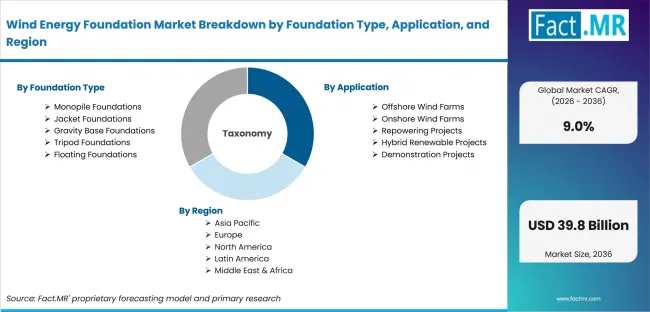
Wind Energy Foundation Market Breakdown By Foundation Type, Application, And Region | Source: Fact.MR
| Coverage field | Report scope |
|---|---|
| Quantitative Units | USD Billion |
| Market Definition | Engineered fixed-bottom and floating structures that transfer wind-turbine loads into seabed or onshore civil systems |
| Foundation Type | Monopile Foundations, Jacket Foundations, Gravity Base Foundations, Tripod Foundations, Floating Foundations |
| Application | Offshore Wind Farms, Onshore Wind Farms, Repowering Projects, Hybrid Renewable Projects, Demonstration Projects |
| End User | Utility Companies, Independent Power Producers, EPC Companies, Public Agencies, Industrial Consumers |
| Distribution Channel | Direct Project Contracts, EPC Contracts, OEM Supply Agreements, Industrial Distributors, Government Procurement |
| Material | Steel, Concrete, Composite Materials, Prestressed Concrete, Hybrid Materials |
| Regions Covered | North America, Latin America, Western Europe, Eastern Europe, East Asia, South Asia and Pacific, Middle East and Africa |
| Countries Covered | United States, Canada, Brazil, Mexico, Argentina, Chile, Germany, France, United Kingdom, Italy, Spain, China, Japan, South Korea, India, Australia, South Africa, Türkiye |
| Key Companies Profiled | Ramboll Group A/S, EEW Special Pipe Constructions GmbH, Sif Holding N.V., CS WIND Offshore A/S, Smulders Group NV, SeAH Wind Ltd., Steelwind Nordenham GmbH |
| Forecast Period | 2026 to 2036 |
| Approach | Hybrid top-down and bottom-up assessment using project pipelines, foundation values, material intensity, fabrication capacity, and conversion timing |
Source: Fact.MR analysis. Updated Jul 31, 2026
How is the market segmented?
-
By Foundation Type
- Monopile Foundations
- Jacket Foundations
- Gravity Base Foundations
- Tripod Foundations
- Floating Foundations
-
By Application
- Offshore Wind Farms
- Onshore Wind Farms
- Repowering Projects
- Hybrid Renewable Projects
- Demonstration Projects
-
By End User
- Utility Companies
- Independent Power Producers
- EPC Companies
- Public Agencies
- Industrial Consumers
-
By Distribution Channel
- Direct Project Contracts
- EPC Contracts
- OEM Supply Agreements
- Industrial Distributors
- Government Procurement
-
By Material
- Steel
- Concrete
- Composite Materials
- Prestressed Concrete
- Hybrid Materials
-
By Region
- North America
- United States
- Canada
- Latin America
- Brazil
- Mexico
- Argentina
- Chile
- Western Europe
- Germany
- France
- United Kingdom
- Italy
- Spain
- Benelux
- Nordics
- Eastern Europe
- Poland
- Czech Republic
- Romania
- Hungary
- East Asia
- China
- Japan
- South Korea
- South Asia and Pacific
- India
- ASEAN
- Australia and New Zealand
- Middle East and Africa
- GCC Countries
- South Africa
- Türkiye
- Israel
- North America
Frequently Asked Questions
Which foundation type is projected to capture the primary share?
How are offshore wind farms positioned within application demand?
What supports utility companies within end-user demand?
Which distribution route carries the main 2026 share?
How much material share is steel forecast to represent?
What pace is expected for the United States?
Which mechanism drives foundation revenue most directly?
What restraint delays foundation commitments most materially?
Who worked on this report


Preview the report firsthand - request a free sample
Free SampleGet the brochure for pricing and purchase details
Download PDF