- Base Value(2025): 4.2 Bn
- Estimated Value(2026): 4.5 Bn
- Forecast Value (2036): 7.8 Bn
- CAGR (2026 - 2036): 5.6%
Wire Protection and Routing Component Systems Market Forecast and Outlook by Fact.MR
- The wire protection and routing component systems market was valued at USD 4.2 billion in 2025.
- According to Fact.MR, demand is projected to reach USD 4.5 billion in 2026 and expand to USD 7.8 billion by 2036, reflecting a CAGR of 5.6% during the forecast period.
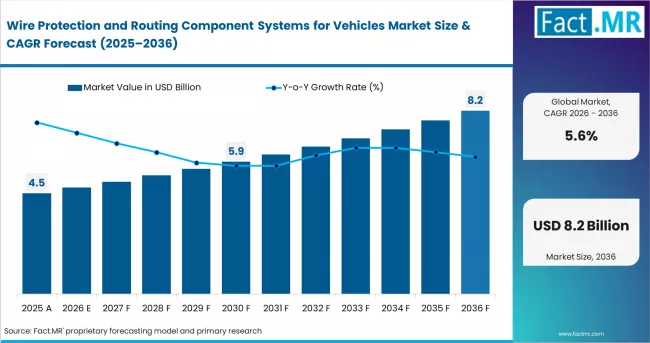
Wire Protection And Routing Component Systems For Vehicles Market Value Analysis | Source: Fact.MR
| Metric | Value |
|---|---|
| Estimated Value in 2026 | USD 4.5 billion |
| Forecast Value in 2036 | USD 7.8 billion |
| Forecast CAGR (2026 to 2036) | 5.6% |
Source: Fact.MR analysis. Updated May 12, 2026
Summary of the Wire Protection and Routing Component Systems for Vehicles Market
- Market Definition
- The wire protection and routing component systems market includes the protective and fixing hardware that helps vehicle wires survive abrasion, heat, vibration, contaminants, and poor routing conditions.
- Demand Drivers
- Vehicle wiring is being pushed through tighter packaging zones that need more robust mechanical protection and path control.
- OEMs are adding higher-value routing aids and protection layers as EV and electronics content increase.
- Harness producers need components that support automated assembly while still protecting wires in harsh operating zones.
- Key Segments Analyzed
- By Component Type, Corrugated Conduits and Tubes are expected to account for 32.0% share in 2026, supported by their broad use as the main protective routing layer.
- By Application, Underhood Wiring is projected to hold 30.0% share in 2026 because it combines heat, contamination, and vibration exposure.
- By Vehicle Type, Passenger Cars are expected to capture 60.0% share in 2026 due to larger production volume and rising electrical-content density.
- By Geography, China leads growth with a 6.4% CAGR through 2036, supported by scale and harness-manufacturing depth.
- Analyst Opinion at Fact.MR
- Shambhu Nath Jha, Senior Analyst at Fact.MR, notes, strongest shift in this market is that wire protection is no longer treated as a low-attention add-on after the harness is designed. It is becoming part of the packaging strategy itself. Once more power and data lines must run through tighter, hotter, and more exposed zones, routing aids and protection components begin to influence both reliability and manufacturability.”
- Strategic Implications
- Suppliers that combine protection, routing stability, and assembly efficiency will be better placed in next-generation harness programs.
- OEMs need routing-component vendors that solve abrasion and packaging problems early rather than as late engineering fixes.
- Aftermarket participants gain more from fitment reliability and durability than from low-cost generic substitutes.
- Methodology
- Market sizing used vehicle production, harness complexity, and protection-content intensity as baseline anchors.
- Analysis incorporated supplier positioning around conduits, tapes, clips, and grommets.
- Forecasts were checked against environmental test frameworks and the growing spread of higher-density vehicle wiring.
The market is expected to create an absolute opportunity of USD 3.3 billion between 2026 and 2036, supported by rising electrical complexity across automotive and industrial platforms. Growth remains steady because wiring protection is no longer judged only by whether a conduit covers a cable. Buyers increasingly evaluate how effectively systems prevent abrasion, preserve bend behavior, support automated assembly, and maintain stable harness routing through vibration and long service life. HellermannTyton describes protection solutions including plastic and metal conduits, corrugated tubing, spiral wraps, protective sleeves, and wiring ducts designed to guard against mechanical damage, moisture, chemicals, and heat. Coroplast also emphasizes abrasion resistance, temperature tolerance, and noise-damping in automotive wire-harness tapes, reflecting growing demand for durable routing solutions. [1]
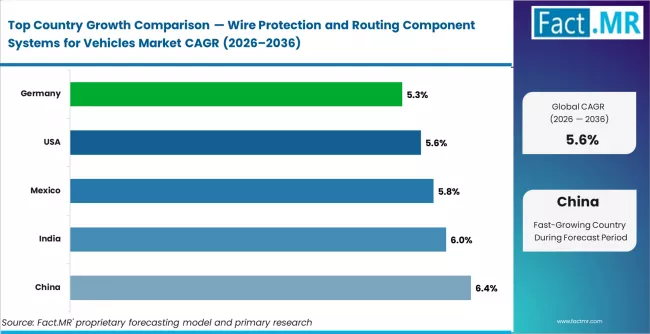
China is projected to remain the fastest-growing country, with a CAGR of 6.4% from 2026 to 2036, followed by India at 6.0% and Mexico at 5.8%. The United States is expected to expand at 5.6%, Germany at 5.3%. Fact.MR views this spread as a reflection of differences in vehicle output, EV penetration, harness-manufacturing depth, and adoption of higher-value routing and protection content across mainstream platforms. The broader supplier environment described by Aptiv, HellermannTyton, and Coroplast supports a market where routing hardware and cable protection move upward with vehicle electrical complexity. [2]
Segmental Analysis
Wire Protection and Routing Component Systems Market Analysis by Component Type
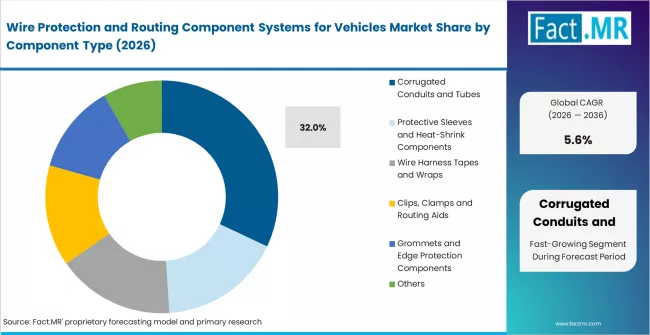
Wire Protection And Routing Component Systems For Vehicles Market Analysis By Component Type | Source: Fact.MR
Corrugated conduits and tubes continue to lead demand within wire protection and routing component systems because they remain one of the most practical first layers of mechanical protection and harness organization. These components help secure wiring paths while shielding cables from abrasion, compression, and environmental exposure across automotive and industrial applications. Corrugated conduits and tubes are expected to hold 32.0% share in 2026. Their dual role in protection and routing supports widespread use across complex harness layouts. HellermannTyton includes plastic and metal conduits, corrugated tubing, spiral wraps, and protective sleeves within its cable protection portfolio, designed to guard wiring against damage, moisture, chemicals, and heat. This positioning reflects the practical value of conduit-based systems in demanding operating environments.
- Mechanical shielding: Corrugated tubing provides a robust barrier against rubbing, impact, and edge contact.
- Routing stability: It helps keep wire bundles organized through long, exposed runs.
- Application breadth: The format works across a wide range of vehicle zones and harness sizes.
Wire Protection and Routing Component Systems Market Analysis by Application
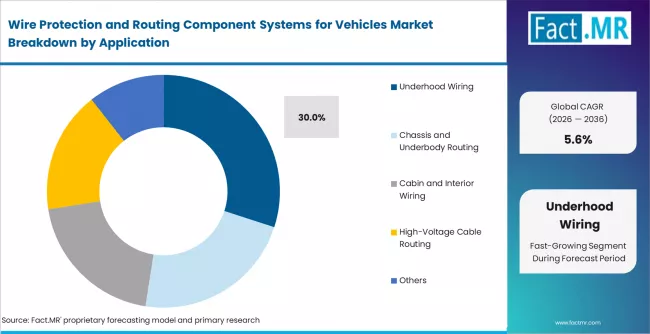
Wire Protection And Routing Component Systems For Vehicles Market Analysis By Application | Source: Fact.MR
Underhood wiring is projected to account for 30.0% share in 2026. This lead is rooted in the concentration of heat, vibration, splash exposure, and contamination under the hood. Coroplast explicitly states that its automotive harness tapes are used from the engine compartment to the rear of the vehicle, while HellermannTyton describes cable protection systems as safeguards against heat, chemicals, and mechanical damage. That combination makes underhood wiring the clearest commercial center for protective routing hardware. [5]
- Thermal exposure: Underhood harnesses face higher sustained temperatures and greater cycling stress.
- Contaminant risk: Fluids, splash, and debris increase the need for robust protective layers.
- Reliability pressure: Routing failures in this zone can disrupt more critical functions than many interior-harness issues.
Wire Protection and Routing Component Systems Market Analysis by Vehicle Type
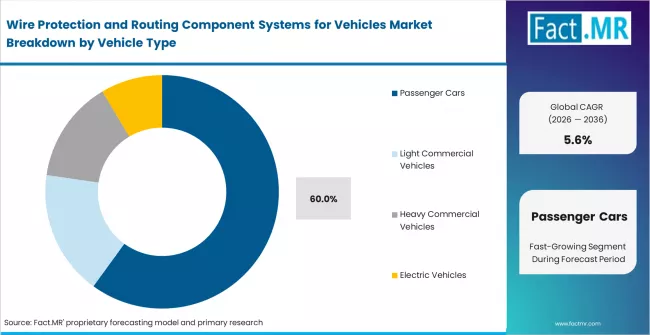
Wire Protection And Routing Component Systems For Vehicles Market Analysis By Vehicle Type | Source: Fact.MR
Passenger cars are projected to hold 60.0% share in 2026. The lead comes from production scale and the spread of electronics, EV content, and feature density into high-volume vehicle lines. HellermannTyton positions itself as an automotive partner for cable management and routing, while Aptiv says its engineered components business develops connection and protection solutions for demanding environments. That supports the view that mainstream passenger platforms are absorbing more routing and protection content as electrical complexity rises.
- Volume leverage: Passenger vehicles spread routing and protection content across the largest production base.
- Feature migration: More electronics and electrification increase harness-management needs in mainstream platforms.
- Packaging pressure: Dense passenger-car layouts make routing hardware more important than before.
Wire Protection and Routing Component Systems Market Drivers, Restraints, and Opportunities
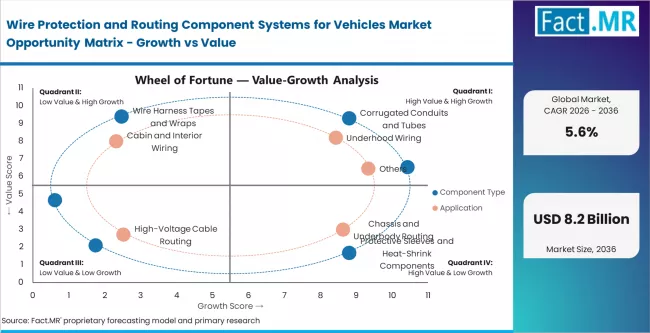
Wire Protection And Routing Component Systems For Vehicles Market Opportunity Matrix Growth Vs Value | Source: Fact.MR
The strongest market driver is the need to keep larger and more complex harnesses safe in exposed, crowded, and hotter vehicle zones. HellermannTyton’s protection portfolio directly frames conduits, sleeves, and related systems as safeguards against mechanical damage, moisture, chemicals, and heat, while Coroplast emphasizes abrasion resistance, flexibility, and temperature performance in wire-harness tape. Those supplier positions align with a market where protection and routing hardware becomes more important as harness density rises.
The main restraint is the tradeoff between stronger protection and tighter packaging or lower mass. More conduit, wrap, and clip content can improve durability, but it can also add bulk, assembly steps, and material cost. Coroplast itself notes that harness tape can offer advantages over corrugated tubes in some automotive applications, which underscores that OEMs constantly balance protection depth against weight, flexibility, and packaging efficiency.
Opportunities in the Wire Protection and Routing Component Systems Market
- Compact routing hardware: Tighter vehicle packaging creates room for smaller clips, edge-fixation systems, and shaped protection parts that secure wires without excessive bulk. HellermannTyton’s cable clips and edge clips support this opportunity.
- High-voltage cable protection: Electrified vehicles need more robust protection and identification around higher-value cable runs. Coroplast’s materials explicitly mention protection of high-voltage cables.
- Tape-versus-tube optimization: OEMs can tune cost, noise behavior, and flexibility by choosing where harness tape outperforms corrugated conduit and where conduit remains necessary. Coroplast directly positions its tapes against or alongside tubes in automotive use.
Regional Analysis
Based on the regional analysis, the Wire Protection and Routing Component Systems Market is segmented into East Asia, South Asia and Pacific, North America, Europe, Latin America, and Middle East and Africa across 40 plus countries.
.webp "Top Country Growth Comparison Wire Protection And Routing Component Systems For Vehicles Market Cagr (2026 2036)")
Top Country Growth Comparison Wire Protection And Routing Component Systems For Vehicles Market Cagr (2026 2036) | Source: Fact.MR
| Country | CAGR (2026 to 2036) |
|---|---|
| China | 6.4% |
| India | 6.0% |
| Mexico | 5.8% |
| United States | 5.6% |
| Germany | 5.3% |
Source: Fact.MR analysis. Updated May 12, 2026
Source: Fact.MR analysis, based on proprietary forecasting model and primary research
Wire Protection And Routing Component Systems For Vehicles Market Cagr Analysis By Country | Source: Fact.MR
East Asia Wire Protection and Routing Component Systems Market Analysis
East Asia remains the strongest production and supply base for this market. The region combines high vehicle output with deep harness, plastics, and component-manufacturing capability. That matters because routing and protection systems are most competitive when suppliers can scale conduits, tapes, clips, and molded aids close to harness production. Aptiv’s engineered-components positioning and HellermannTyton’s automotive cable-management presence both support the importance of supplier depth in this regional ecosystem.
- China: China continues to lead due to strong vehicle output, rising EV content, and broad harness-manufacturing depth. Demand for wire protection and routing component systems is projected to grow at a 6.4% CAGR through 2036. Growth is supported by the combination of production scale and increasing wiring complexity across passenger vehicles, commercial platforms, and EV architectures.
Fact.MR’s report also covers ASEAN, Australia and New Zealand, and other South Asia and Pacific countries. These markets matter where vehicle assembly and harness production continue to spread across regional manufacturing networks.
South Asia & Pacific Wire Protection and Routing Component Systems Market Analysis
South Asia & Pacific is emerging as a meaningful growth region as vehicle assembly and harness production continue to spread across regional manufacturing networks. Rising electronics penetration and localization of wiring systems are creating stronger demand for durable protection components.
- India: India is expected to expand at a 6.0% CAGR from 2026 to 2036, supported by increasing passenger vehicle production, rising utility vehicle demand, and growing EV assembly activity. As wiring architectures become more complex, automakers are placing greater emphasis on harness durability, thermal resistance, and efficient routing solutions. Demand is especially relevant in compact cars, SUVs, two-wheeler EV platforms, and commercial vehicles.
Fact.MR’s report also includes ASEAN, Australia, and New Zealand, where expanding assembly footprints and increasing electronics content continue to support gradual growth.
North America Wire Protection and Routing Component Systems Market Analysis
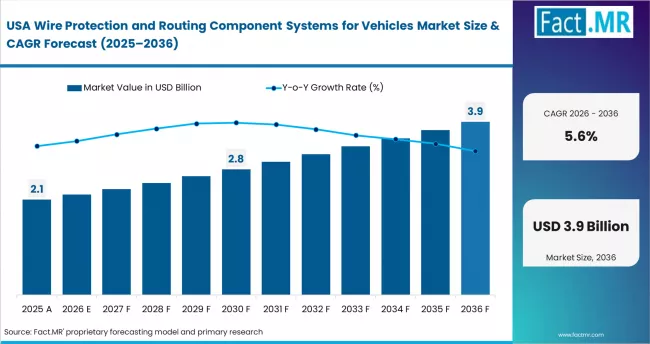
Wire Protection And Routing Component Systems For Vehicles Market Country Value Analysis | Source: Fact.MR
North America is shaped by strong demand from larger vehicles, commercial applications, and a sizable installed base that values serviceable protection hardware. Routing and protection components matter here because exposed wiring runs in pickups, SUVs, vans, and work vehicles face higher abrasion and contamination risk. HellermannTyton’s automotive cable-management positioning and Aptiv’s commercial-vehicle connector materials both support the importance of durable routing logic in this regional mix.
- United States: Wire protection and routing component systems demand in the United States is projected to rise at a CAGR of 5.6% through 2036. The market is supported by larger vehicle formats, growing EV content, and continued need for robust protection in exposed harness zones.
- Mexico: Mexico is expected to record a CAGR of 5.8% by 2036. Its faster growth comes from its role in automotive harness and component manufacturing for North American OEM programs.
Fact.MR’s report also includes Canada and the broader North American supply ecosystem. Additional value comes from service-heavy fleets and strong demand for durable routing aids that preserve harness life under real operating stress.
Europe Wire Protection and Routing Component Systems Market Analysis
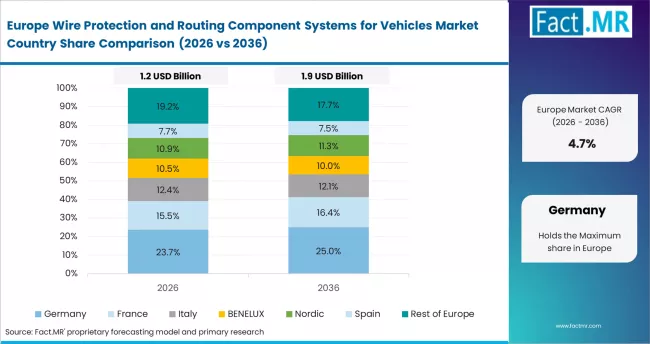
Wire Protection And Routing Component Systems For Vehicles Market Europe Country Market Share Analysis, 2026 & 2036 | Source: Fact.MR
Europe remains a high-discipline market rather than the fastest-growing one. Vehicle makers in the region put strong weight on packaging efficiency, environmental resistance, and validated behavior under real mounting conditions. ISO states that the ISO 16750 series describes environmental conditions and tests for vehicle electrical and electronic systems or components, which reinforces the commercial importance of protection hardware that survives those operating stresses even if harnesses themselves require additional applicable standards.
- Germany: Germany is projected to expand at a CAGR of 5.3% over the study period. Its importance comes from engineering intensity, premium vehicle content, and strong emphasis on durable cable-management solutions that support both compact packaging and long service life.
Fact.MR’s report also covers France, Italy, the United Kingdom, Spain, and the rest of Europe. These markets add commercial depth through mature vehicle production and ongoing demand for wiring durability under challenging environmental conditions.
Competitive Aligners for Market Players
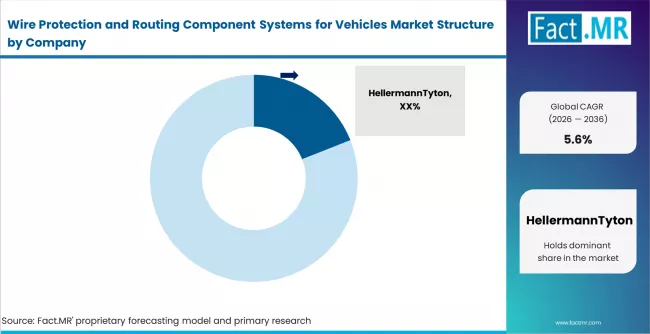
Wire Protection And Routing Component Systems For Vehicles Market Analysis By Company | Source: Fact.MR
The wire protection and routing component systems market remains moderately consolidated, with buyers evaluating suppliers on more than conduit diameter or clip count. Purchasing decisions are shaped by abrasion control, routing stability, installation ease, packaging efficiency, and material durability under heat, moisture, and vibration. Companies such as HellermannTyton, Coroplast, and Aptiv remain relevant because they operate where wiring protection meets manufacturability and long service life.
Established suppliers retain an advantage because routing and protection performance is difficult to separate from the complete harness layout. A new entrant may offer a conduit, sleeve, or clip, but matching OEM confidence is more challenging when the component must align with routing geometry, bend radii, mounting points, and vehicle-level durability targets. These requirements make system integration and application engineering important competitive factors.
Buyer power still matters, though it is limited by application specificity and durability validation cost. OEMs want lower weight and lower cost, but they also want low risk in components that protect wires from abrasion, heat, and misrouting. Through 2036, Fact.MR expects competition to remain rational, with stronger selectivity in compact routing aids, high-voltage cable protection, and integrated clip-and-conduit solutions.
Key Players in Wire Protection and Routing Component Systems Market
- HellermannTyton
- Coroplast Group
- Aptiv PLC
- TE Connectivity
- LEONI AG
- Yazaki Corporation
- Sumitomo Wiring Systems, Ltd.
- Lear Corporation
- Molex
- Furukawa Electric Co., Ltd.
- Fränkische Industrial Pipes
- Avery Dennison
Bibliography
- [1] HellermannTyton. Cable Protection Systems and Automotive Cable Management product materials.
- [2] Aptiv. Engineered Components and related connection-system materials.
- [3] ISO. ISO 16750 scope and applicability materials.
- [4] HellermannTyton. Grommets, Clips, Clamps and Plugs, and Edge Clips materials.
- [5] Coroplast. Automotive Wire Harness Tape and Wire Harness Tape product materials.
This Report Addresses
- Strategic demand outlook for wire protection and routing component systems across modern vehicle harness architectures.
- Market forecast from USD 4.5 billion in 2026 to USD 7.8 billion by 2036.
- The growing role of conduits, tapes, clips, grommets, and sleeves in wiring durability and packaging stability.
- The effect of EVs and higher electrical-content density on cable-protection needs.
- OEM versus aftermarket demand patterns in a packaging- and durability-sensitive harness category.
- Regional differences in vehicle production, harness manufacturing depth, and protection-content adoption.
- Competitive positioning of suppliers active in cable protection, routing hardware, and harness-management components.
- Segment analysis by component type, application, vehicle type, sales channel, and geography.
Wire Protection and Routing Component Systems for Vehicles Market Definition
The market covers the component systems used to protect, secure, separate, and route vehicle wiring across exposed and space-constrained environments. This includes conduits, corrugated tubing, protective sleeves, wraps, tapes, routing clips, clamps, grommets, and edge-protection parts that reduce the risk of abrasion, heat damage, impact, vibration wear, or routing failure.
Wire Protection and Routing Component Systems for Vehicles Market Inclusions
The market includes corrugated conduits, slit tubes, spiral wraps, braided or woven sleeves, heat-shrink protection elements, wire-harness tapes, connector clips, edge clips, clamps, fixing elements, grommets, and comparable routing aids used in passenger, commercial, and electrified vehicle wiring systems.
Wire Protection and Routing Component Systems for Vehicles Market Exclusions
The market excludes complete wire harnesses where routing and protection value cannot be isolated, standalone electrical connectors and terminals, ECU enclosure shielding, and non-vehicle industrial cable-protection systems. It also excludes vehicle electrical equipment itself. ISO states that the ISO 16750 series applies to electric and electronic systems or components directly mounted in or on the vehicle and is not sufficient as a complete standard for wiring harnesses, cables, and connectors, which reinforces the need to treat harness-protection hardware as a specific component layer rather than a catch-all electrical category. [3]
Wire Protection and Routing Component Systems for Vehicles Market Research Methodology
- Primary Research
- Interviews with harness-routing engineers, vehicle packaging teams, cable-protection material specialists, commercial vehicle electrical architects, and aftermarket service distributors.
- Desk Research
- Review of supplier product materials covering cable protection systems, automotive cable management, wire-harness tapes, clips, clamps, grommets, and vehicle environmental test frameworks from HellermannTyton, Coroplast, Aptiv, and ISO.
- Market-Sizing and Forecasting
- Fact.MR used a blended model based on vehicle production, harness complexity, exposed routing length, electrified-vehicle cable-management intensity, and replacement demand in the installed vehicle base.
- Data Validation and Update Cycle
- Forecasts were cross-checked through supplier positioning around conduits, tapes, clips, and routing accessories, together with ISO 16750 references for the environmental conditions and tests applied to vehicle electrical and electronic equipment. [4]
Segmentation
Scope of the Report
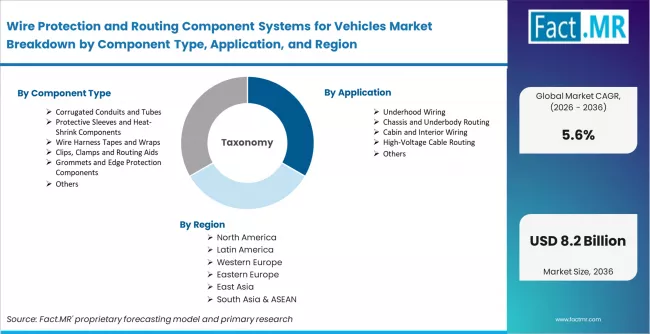
Wire Protection And Routing Component Systems For Vehicles Market Breakdown By Component Type, Application, And Region | Source: Fact.MR
| Attribute | Details |
|---|---|
| Quantitative Units | USD 4.5 billion in 2026 to USD 7.8 billion in 2036, at a CAGR of 5.6% |
| Market Definition | Vehicle wire protection and routing component systems that protect, secure, separate, and guide wiring through harsh and space-constrained automotive environments. |
| Component Type Segmentation | Corrugated Conduits and Tubes, Protective Sleeves and Heat-Shrink Components, Wire Harness Tapes and Wraps, Clips, Clamps and Routing Aids, Grommets and Edge Protection Components, Others |
| Application Segmentation | Underhood Wiring, Chassis and Underbody Routing, Cabin and Interior Wiring, High-Voltage Cable Routing, Others |
| Vehicle Type Segmentation | Passenger Cars, Light Commercial Vehicles, Heavy Commercial Vehicles, Electric Vehicles |
| Regions Covered | East Asia, South Asia and Pacific, North America, Europe, Latin America, Middle East and Africa |
| Countries Covered | China, India, Mexico, United States, Germany, Japan, South Korea, and 40+ countries |
| Key Companies Profiled | HellermannTyton, Coroplast Group, Aptiv, TE Connectivity, LEONI, Yazaki, Sumitomo Wiring Systems, Lear, Molex, Furukawa Electric, Fränkische, Avery Dennison |
| Forecast Period | 2026 to 2036 |
| Approach | Fact.MR combined primary interviews with harness and packaging stakeholders, desk research across official supplier product materials, and a forecast model anchored in vehicle production, wiring complexity, and protection-content growth. |
Source: Fact.MR analysis. Updated May 12, 2026
Wire Protection and Routing Component Systems Market by Segments
-
By Component Type:
- Corrugated Conduits and Tubes
- Protective Sleeves and Heat-Shrink Components
- Wire Harness Tapes and Wraps
- Clips, Clamps and Routing Aids
- Grommets and Edge Protection Components
- Others
-
By Application:
- Underhood Wiring
- Chassis and Underbody Routing
- Cabin and Interior Wiring
- High-Voltage Cable Routing
- Others
-
By Vehicle Type:
- Passenger Cars
- Light Commercial Vehicles
- Heavy Commercial Vehicles
- Electric Vehicles
-
By Region:
- North America
- United States
- Canada
- Mexico
- Latin America
- Brazil
- Argentina
- Rest of Latin America
- Europe
- Germany
- France
- United Kingdom
- Italy
- Spain
- Rest of Europe
- East Asia
- China
- Japan
- South Korea
- South Asia and Pacific
- India
- ASEAN
- Australia and New Zealand
- Rest of South Asia and Pacific
- Middle East and Africa
- GCC Countries
- South Africa
- Turkey
- Rest of Middle East and Africa
- North America
Frequently Asked Questions
What is the estimated size of the wire protection and routing component systems market in 2026?
How large is the market expected to become by 2036?
What is the forecast CAGR for 2026 to 2036?
Which component type leads the market?
Which application dominates demand?
Why does the OEM channel dominate?
Why are wire protection and routing components important here?
What is the strongest demand driver?
What is the key restraint?
Which country is growing fastest?
Why is China ahead?
How does India compare?
Why does Mexico rank strongly?
Why does Germany remain important?
How do EVs affect this market?
Is this a fragmented supplier market?
What do OEM buyers prioritize?
Why do clips and edge-fixation parts matter in this segment?
Is the aftermarket attractive?
Which companies are most visible in this market?
What is the broader outlook through 2036?
Who worked on this report


Preview the report firsthand - request a free sample
Free SampleGet the brochure for pricing and purchase details
Download PDF