- Base Value(2025): 4.9 Bn
- Estimated Value(2026): 5.2 Bn
- Forecast Value (2036): 9.8 Bn
- CAGR (2026 - 2036): 6.4%
Steer-by-Wire Road Wheel Actuator Modules Market Forecast and Outlook by Fact.MR
- In 2025, the steer-by-wire road wheel actuator modules market was valued at USD 4.9 billion.
- Based on Fact.MR analysis, demand for steer-by-wire road wheel actuator modules is estimated to grow to USD 5.2 billion in 2026 and USD 9.8 billion by 2036.
- Fact.MR projects a CAGR of 6.4% during the forecast period.
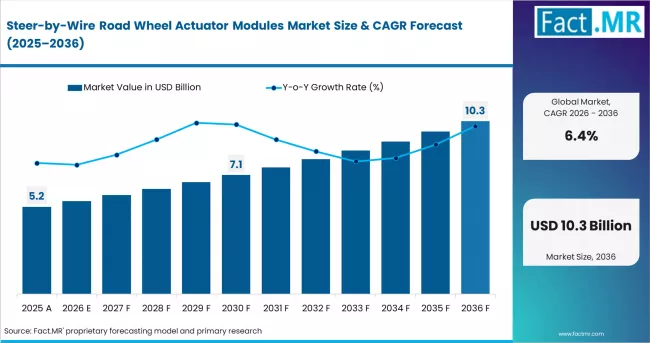
Steer By Wire Road Wheel Actuator Modules Market Value Analysis | Source: Fact.MR
| Metric | Value |
|---|---|
| Estimated Value in 2026 | USD 5.2 billion |
| Forecast Value in 2036 | USD 9.8 billion |
| Forecast CAGR (2026 to 2036) | 6.4% |
Source: Fact.MR analysis. Updated May 14, 2026
Summary of the Steer-by-Wire Road Wheel Actuator Modules Market
- Market Definition
- The steer-by-wire road wheel actuator modules market includes the mechatronic steering execution units that translate electronic steering commands into physical wheel-angle movement.
- Demand Drivers
- Vehicle platforms need steering systems that support new packaging, variable steering behavior, and software-defined control.
- OEMs are moving toward redundant steering execution layers that can support higher safety availability.
- EV and premium platforms are increasing the addressable base for steer-by-wire road wheel actuation.
- Key Segments Analyzed
- By Module Type: Rack Actuator Modules are expected to account for 39.0% share in 2026, supported by their role as the main physical steering execution point in current production-ready steer-by-wire systems.
- By Vehicle Type: Passenger Cars are projected to hold 67.0% share in 2026 because steer-by-wire commercialization is currently centered on advanced passenger-vehicle platforms.
- By Steering Architecture: Central Rack-Actuated Steer-by-Wire is expected to capture 35.0% share in 2026 as current supplier offerings remain concentrated around rack or front-axle modules rather than widespread wheel-individual deployment.
- By Geography: China leads growth with a 7.2% CAGR through 2036, supported by EV scale and earlier steer-by-wire series deployment.
- Analyst Opinion at Fact.MR
- Shambhu Nath Jha, Senior Analyst at Fact.MR, opines that the strongest change in this market is that the road-wheel actuator module is becoming the true center of steer-by-wire value. Once the steering shaft disappears, the actuator module at the wheels is no longer a hidden execution device. It becomes the component that determines steering precision, availability, packaging freedom, and readiness for future automation.”
- Strategic Implications
- Suppliers that combine redundancy, compact packaging, and software-ready steering execution will be better placed in next-generation vehicle programs.
- OEMs need road-wheel actuator vendors that support full system safety and tuning rather than isolated hardware delivery.
- Aftermarket participants gain more from exact replacement compatibility and validated service procedures than from low-cost generic substitution.
- Methodology
- Market sizing used passenger-vehicle production, EV mix, and steer-by-wire penetration as baseline anchors.
- Analysis incorporated supplier positioning around steering rack actuators, front axle actuators, and redundant wheel-side steering execution.
- Forecasts were checked against current production and commercialization signals from steer-by-wire suppliers.
The market is projected to create an absolute opportunity of USD 4.5 billion between 2026 and 2036. Growth remains firm because the road wheel actuator module is no longer treated as a steering subassembly alone. It is increasingly treated as the core execution layer of steer-by-wire, where steering angle, redundancy, safety availability, and automated-driving readiness all converge. Bosch says its steering rack actuator is based on a redundant steering system and enables maximum safety and availability for automated driving, while ZF describes the road-wheel-side system as a mechatronic actuator positioned between the wheels. [1]
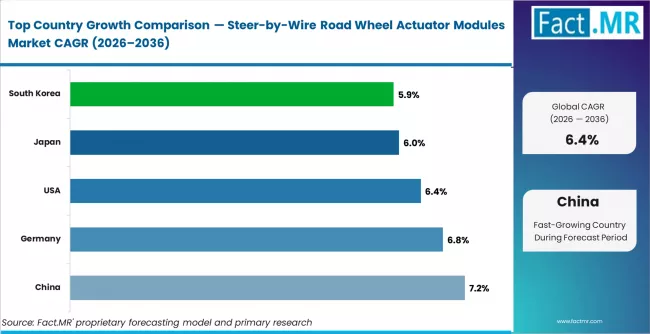
China is projected to remain the fastest-growing country, with a CAGR of 7.2% through 2036, followed by Germany at 6.8% and the United States at 6.4%. Japan is expected to expand at 6.0%, South Korea at 5.9%. Fact.MR views this spread as a reflection of differences in EV platform rollout, premium vehicle content, and the speed at which OEMs adopt steer-by-wire-ready chassis architectures. Recent production and technology positioning from ZF, Bosch, Nexteer, and JTEKT support that direction. [2]
Segmental Analysis
Steer-by-Wire Road Wheel Actuator Modules Market Analysis by Module Type
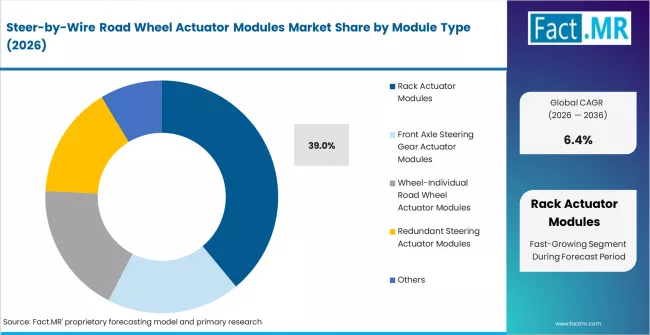
Steer By Wire Road Wheel Actuator Modules Market Analysis By Module Type | Source: Fact.MR
Rack actuator modules are expected to hold 39.0% share in 2026. Their lead comes from the fact that the steering rack remains the most practical and commercially mature point for by-wire wheel-angle execution in current passenger-vehicle architectures. Bosch explicitly identifies the steering rack actuator as the unit that steers the wheels based on driving speed and conditions, while ZF describes the front axle actuator as the road-wheel-side execution element in its steer-by-wire system. This makes the rack or front-axle module the dominant format because it preserves familiar wheel-side geometry while shifting control authority into mechatronic actuation.
The segment stays ahead because OEMs prefer migration paths that preserve front axle packaging discipline and chassis familiarity even as the mechanical steering shaft disappears. Wheel-individual modules remain strategically important, though they are still more developmental in broad passenger-car commercialization than centralized rack execution. JTEKT’s engineering materials describe steer-by-wire possibilities with one actuator per steered wheel, showing the longer-term direction even if current market pull is stronger for rack-centered solutions. [4]
- Execution maturity: Rack modules fit more naturally into current front-axle layouts than fully wheel-individual concepts.
- Migration logic: OEMs can move toward by-wire steering without redesigning the entire wheel-side steering topology at once.
- Validation advantage: Centralized rack actuation gives suppliers a more controlled path to redundancy and safety validation.
Steer-by-Wire Road Wheel Actuator Modules Market Analysis by Vehicle Type
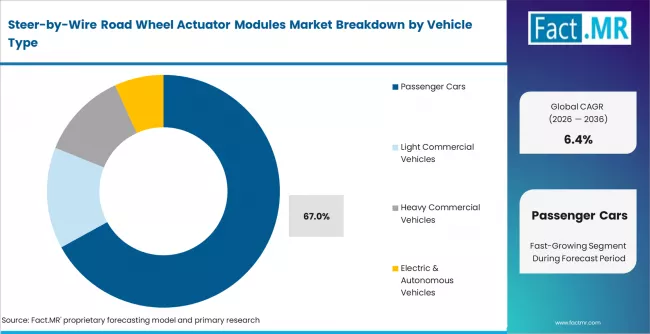
Steer By Wire Road Wheel Actuator Modules Market Analysis By Vehicle Type | Source: Fact.MR
Passenger cars are projected to hold 67.0% share in 2026, as steer-by-wire commercialization is currently driven by premium and advanced passenger-vehicle programs rather than broad heavy-vehicle deployment. ZF’s series-production announcement for NIO’s ET9, Bosch’s steer-by-wire positioning for modern passenger vehicles, and Nexteer’s steering roadmap all reinforce that passenger platforms are the first major commercial base for road wheel actuation modules. Passenger cars remain ahead because they combine high production potential with stronger demand for packaging freedom, new cockpit concepts, and software-led steering features. Commercial and autonomous shuttle use cases are strategically relevant, and Nexteer’s automated steering actuator points to that future direction, but the current addressable scale is still centered on passenger-car platforms. [5]
- Commercial readiness: Passenger cars are where steer-by-wire has already moved into visible production programs.
- Feature pull: Premium cabin design, variable steering feel, and software-defined driving dynamics matter more in passenger vehicles.
- Volume potential: Once validated, passenger platforms offer the largest pathway for steer-by-wire module scale-up.
Steer-by-Wire Road Wheel Actuator Modules Market Analysis by Steering Architecture
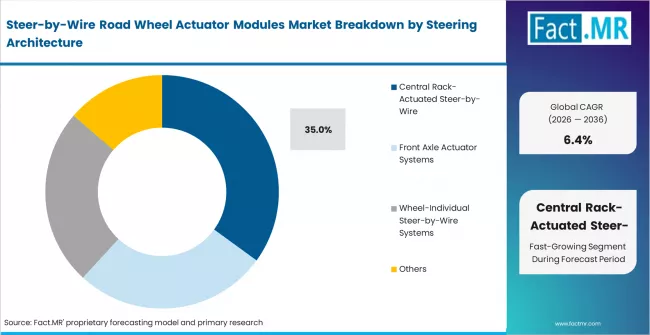
Steer By Wire Road Wheel Actuator Modules Market Analysis By Steering Architecture | Source: Fact.MR
Central rack-actuated steer-by-wire systems are expected to capture 35.0% share in 2026. Their rise comes from the fact that current supplier architectures are still primarily described around a steering rack actuator or front axle actuator rather than widespread independent wheel-level actuation. Bosch’s system centers on a steering rack actuator, and ZF’s product page uses the language of a front axle actuator paired with a handwheel actuator. That commercial positioning supports a market where central road-wheel actuation remains the clearest near-term architecture.
- Packaging discipline: Centralized actuation fits more easily within current front-axle and suspension layouts.
- Commercial clarity: Supplier roadmaps are more explicit today around rack and front axle modules than full wheel-individual steering.
- Transition readiness: Central architectures reduce the jump from EPS evolution to by-wire deployment.
Steer-by-Wire Road Wheel Actuator Modules Market Drivers, Restraints, and Opportunities
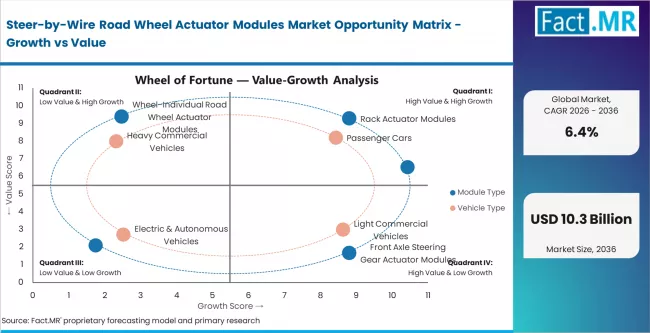
Steer By Wire Road Wheel Actuator Modules Market Opportunity Matrix Growth Vs Value | Source: Fact.MR
The strongest market driver is the need to decouple steering execution from the mechanical shaft so OEMs can gain packaging freedom, flexible steering characteristics, and better integration with advanced control software. Bosch says act-by-wire enables new interior concepts by replacing the mechanical connection with electrical signal lines, while ZF frames by-wire as a route to easier integration and higher automation potential. Nexteer also ties steer-by-wire directly to light-weighting, packaging flexibility, and advanced safety functionality.
The main restraint is validation burden. Road wheel actuator modules sit at the most safety-critical end of steer-by-wire, and suppliers must prove redundancy, response precision, and high availability. Bosch’s emphasis on maximum safety and availability and ZF’s repeated reference to front axle actuation and safety-rich steering execution show why adoption grows steadily rather than instantly.
Opportunities in the Steer-by-Wire Road Wheel Actuator Modules Market
- Passenger-EV platform rollout: Advanced EV platforms create room for larger-scale steer-by-wire road wheel actuator demand. ZF’s ET9 production start is the clearest current proof point.
- Automation-ready steering: Suppliers that offer high-availability and redundant actuator modules gain from vehicles targeting higher assisted and automated driving capability. Bosch and ZF both position steer-by-wire around that direction.
- Wheel-individual steering development: Longer term, one-actuator-per-wheel concepts create room for more maneuverability-oriented modules in specialized or future vehicle designs. JTEKT’s engineering materials support this pathway.
Regional Analysis
Based on the regional analysis, the Steer-by-Wire Road Wheel Actuator Modules Market is segmented into East Asia, Europe, North America, South Asia and Pacific, Latin America, and Middle East and Africa across 40 plus countries.
.webp "Top Country Growth Comparison Steer By Wire Road Wheel Actuator Modules Market Cagr (2026 2036)")
Top Country Growth Comparison Steer By Wire Road Wheel Actuator Modules Market Cagr (2026 2036) | Source: Fact.MR
| Country | CAGR (2026 to 2036) |
|---|---|
| China | 7.2% |
| Germany | 6.8% |
| United States | 6.4% |
| Japan | 6.0% |
| South Korea | 5.9% |
Source: Fact.MR analysis. Updated May 14, 2026
Source: Fact.MR analysis, based on proprietary forecasting model and primary research
Steer By Wire Road Wheel Actuator Modules Market Cagr Analysis By Country | Source: Fact.MR
East Asia Steer-by-Wire Road Wheel Actuator Modules Market Analysis
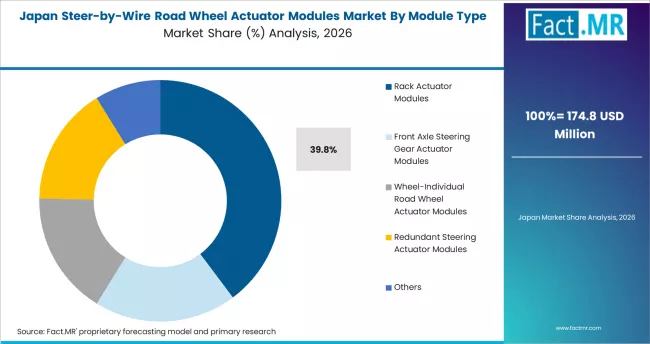
Steer By Wire Road Wheel Actuator Modules Market Japan Market Share Analysis By Module Type | Source: Fact.MR
East Asia remains the strongest production and early-adoption base for this market. The region combines large EV output with faster deployment of advanced steering architectures and a greater willingness to commercialize electronic chassis technologies in new flagship platforms. ZF’s start of series production for NIO’s ET9 is the most direct current example of passenger-vehicle steer-by-wire road wheel actuation reaching production scale in the region. Bosch also notes customer demand from Asian automakers for its by-wire technologies, while JTEKT and other regional suppliers maintain active steer-by-wire development visibility.
- China: Strong EV output and earlier series deployment of steer-by-wire architectures support China’s lead. Steer-by-wire road wheel actuator modules demand in China is projected to grow at a CAGR of 7.2% by 2036. The country benefits from premium EV rollout and a stronger commercial case for architecture-intensive chassis innovation.
- Japan: Japanese demand is projected to expand at a CAGR of 6.0% through 2036. Growth is steadier because the market is more controlled and places stronger emphasis on steering precision, reliability, and phased deployment. JTEKT’s steer-by-wire materials reinforce the region’s continued engineering relevance.
- South Korea: South Korea is expected to grow at a CAGR of 5.9% over the study period. Its role is tied to electronics-rich vehicle platforms and faster integration of software-defined vehicle functions that increase the appeal of by-wire steering architectures.
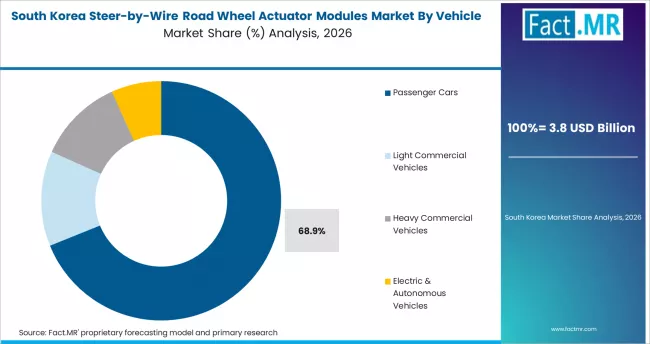
Steer By Wire Road Wheel Actuator Modules Market South Korea Market Share Analysis By Vehicle Type | Source: Fact.MR
Fact.MR’s report also covers ASEAN, Australia and New Zealand, and other South Asia and Pacific markets. These countries matter where EV adoption broadens and where imported or localized by-wire steering platforms begin to scale beyond initial premium launches.
North America Steer-by-Wire Road Wheel Actuator Modules Market Analysis
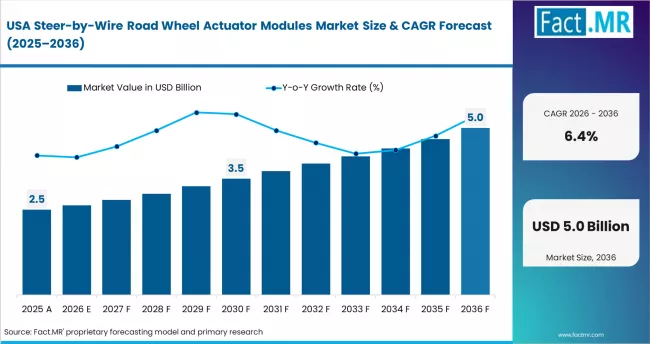
Steer By Wire Road Wheel Actuator Modules Market Country Value Analysis | Source: Fact.MR
North America is shaped by software-defined vehicle interest, EV platform activity, and growing demand for packaging flexibility in premium and advanced passenger vehicles. Road wheel actuator modules matter in this region because OEMs increasingly view steer-by-wire as part of the broader transition toward digital chassis control. Nexteer’s positioning around safety, performance, and packaging flexibility, combined with Bosch and ZF’s by-wire roadmaps, fits this regional shift closely.
- United States: Steer-by-wire road wheel actuator modules demand in the United States is projected to rise at a CAGR of 6.4% through 2036. The market is supported by EV program activity, premium-vehicle software content, and stronger interest in new steering architectures that remove the intermediate steering shaft.
Fact.MR’s report also includes Canada and the broader North American passenger-vehicle supply ecosystem. Additional value comes from premium vehicle content, EV growth, and the spread of more advanced steering architectures across software-led platforms.
Europe Steer-by-Wire Road Wheel Actuator Modules Market Analysis
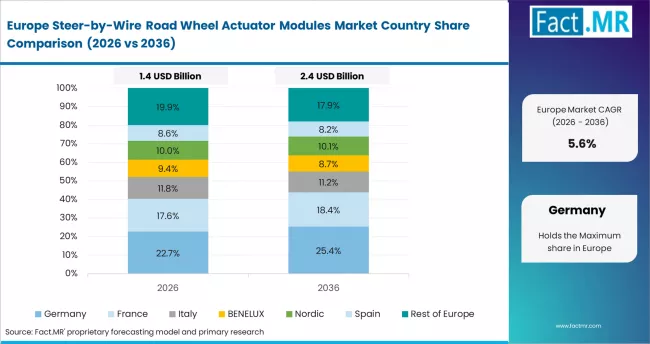
Steer By Wire Road Wheel Actuator Modules Market Europe Country Market Share Analysis, 2026 & 2036 | Source: Fact.MR
Europe remains a high-discipline market rather than the biggest volume center. Vehicle makers in the region put strong weight on steering feel, safety availability, and chassis integration quality. Bosch and ZF are both central European suppliers in current by-wire steering commercialization, and their official materials consistently tie steer-by-wire to higher automation potential, easier integration, and advanced driving dynamics. That keeps Europe strategically important as an engineering and premium vehicle deployment center for road wheel actuator modules.
- Germany: Germany is projected to expand at a CAGR of 6.8% over the assessment period. Its importance comes from premium passenger-vehicle engineering, supplier depth, and strong investment in redundant front-axle actuation for steer-by-wire architectures.
Fact.MR’s report also covers France, Italy, the United Kingdom, Spain, and the rest of Europe. These markets add commercial depth through premium vehicle production, EV adoption, and continued development of software-intensive chassis technologies.
Competitive Aligners for Market Players
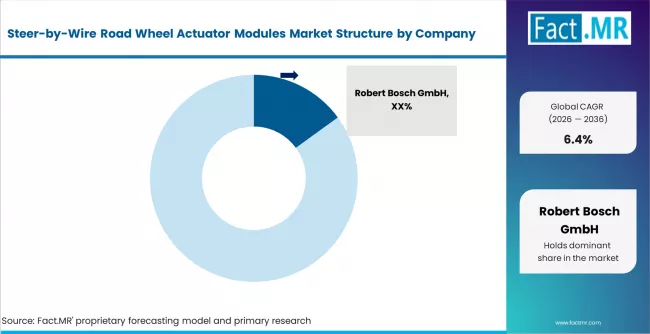
Steer By Wire Road Wheel Actuator Modules Market Analysis By Company | Source: Fact.MR
The steer-by-wire road wheel actuator modules market is moderately consolidated. Buyers do not choose suppliers only on motor output or steering ratio capability. They choose on redundancy, response precision, software compatibility, packaging efficiency, and availability under safety-critical conditions. Bosch, ZF, Nexteer, and JTEKT remain highly visible because they operate at the point where steering execution hardware meets advanced control logic.
Incumbents hold an advantage because road wheel actuation is difficult to separate from the full steer-by-wire system. A challenger may offer a capable module, but replicating OEM confidence is harder when steering precision, feel, redundancy, and automation readiness all depend on integrated system behavior. Bosch’s and ZF’s materials both make clear that the road-wheel-side actuator must work as part of a complete by-wire chain rather than as an isolated component. Buyer power still matters, though it is limited by safety validation cost and architecture dependence. OEMs want packaging and feature gains, but they also want low risk in one of the vehicle’s most safety-critical motion systems. Through 2036, Fact.MR expects competition to remain rational, with stronger selectivity in redundant rack actuator modules, front axle execution systems, and automation-ready steer-by-wire platforms.
Key Players in Steer-by-Wire Road Wheel Actuator Modules Market
- Robert Bosch GmbH
- ZF Friedrichshafen AG
- Nexteer Automotive
- JTEKT Corporation
- NSK Ltd.
- Schaeffler AG
- thyssenkrupp Steering
- Mando Corporation
- Hyundai Mobis
- Hitachi Astemo, Ltd.
- Marelli
- Nidec Corporation
Bibliography
- [1] Bosch Mobility. Steer-by-wire. Official product page describing elimination of the mechanical connection and the steering rack actuator.
- [2] ZF. Steer-by-Wire Systems. Official product page describing the hand wheel actuator and front axle actuator.
- [3] ZF Press. Start of series production for steer-by-wire steering at NIO ET9 (February 17, 2025). Official production announcement.
- [4] JTEKT. Electric Power Steering Systems catalog. Official material describing merits of steer-by-wire and ability to control tire angle.
- [5] Nexteer. Steer-by-Wire. Official product page describing replacement of the mechanical connection with algorithms, electronics, and actuators.
This Report Addresses
- Strategic demand outlook for steer-by-wire road wheel actuator modules across advanced steering architectures.
- Market forecast from USD 5.2 billion in 2026 to USD 9.8 billion by 2036.
- The growing role of rack and front axle actuation in steering systems without a mechanical steering shaft.
- The effect of EVs, premium vehicle content, and software-defined chassis control on road-wheel actuation demand.
- OEM versus aftermarket demand patterns in a validation-sensitive steering safety category.
- Regional differences in EV adoption, premium steering content, and steer-by-wire commercialization.
- Competitive positioning of suppliers active in steer-by-wire wheel-side actuation and redundant steering execution.
- Segment analysis by module type, vehicle type, steering architecture, sales channel, and geography.
Steer-by-Wire Road Wheel Actuator Modules Market Definition
The market covers the mechatronic actuator modules located at the steering rack, front axle, or wheel-side steering execution point in steer-by-wire vehicle systems. These modules receive steering commands electronically and generate the physical wheel-angle response without a permanent mechanical steering shaft connection.
Steer-by-Wire Road Wheel Actuator Modules Market Inclusions
The market includes steering rack actuators, redundant steering gear actuators, front axle actuator modules, wheel-individual steer-by-wire actuation units, and associated mechatronic steering execution hardware used in passenger and advanced vehicle steering systems.
Steer-by-Wire Road Wheel Actuator Modules Market Exclusions
The market excludes steering wheel actuators, conventional column EPS units without by-wire wheel-side actuation, passive steering racks, and full autonomous driving stacks where road-wheel actuator value cannot be isolated. It also excludes brake-by-wire and unrelated chassis actuators.
Steer-by-Wire Road Wheel Actuator Modules Market Research Methodology
- Primary Research
- Interviews with steering system engineers, chassis control architects, front axle integration teams, passenger-vehicle platform engineers, and steer-by-wire validation specialists.
- Desk Research
- Review of official steer-by-wire product pages, production-launch announcements, steering technology articles, and engineering materials from Bosch, ZF, Nexteer, and JTEKT.
- Market-Sizing and Forecasting
- Fact.MR used a blended model based on passenger-vehicle production, EV and premium-vehicle mix, steer-by-wire penetration, redundancy requirements, and autonomous-ready steering-content intensity.
- Data Validation and Update Cycle
- Forecasts were cross-checked through supplier commercialization signals, official production announcements, and current technology positioning around redundant wheel-angle actuation and front axle execution systems. [3]
Segmentation
Scope of the Report
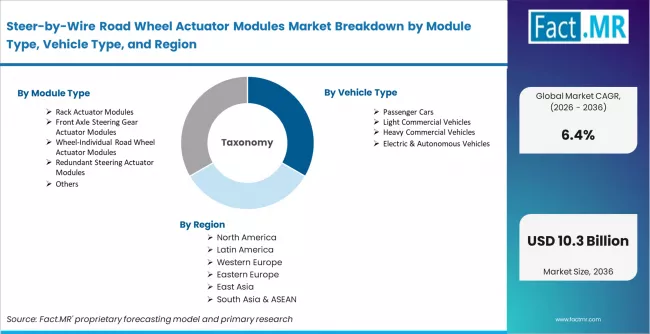
Steer By Wire Road Wheel Actuator Modules Market Breakdown By Module Type, Vehicle Type, And Region | Source: Fact.MR
| Attribute | Details |
|---|---|
| Quantitative Units | USD 5.2 billion in 2026 to USD 9.8 billion in 2036, at a CAGR of 6.4% |
| Market Definition | Steer-by-wire road wheel actuator modules that convert electronic steering commands into physical wheel-angle actuation in passenger and advanced vehicle steering systems. |
| Module Type Segmentation | Rack Actuator Modules, Front Axle Steering Gear Actuator Modules, Wheel-Individual Road Wheel Actuator Modules, Redundant Steering Actuator Modules, Others |
| Vehicle Type Segmentation | Passenger Cars, Light Commercial Vehicles, Heavy Commercial Vehicles, Electric & Autonomous Vehicles |
| Steering Architecture Segmentation | Central Rack-Actuated Steer-by-Wire, Front Axle Actuator Systems, Wheel-Individual Steer-by-Wire Systems, Others |
| Regions Covered | East Asia, Europe, North America, South Asia and Pacific, Latin America, Middle East and Africa |
| Countries Covered | China, Germany, United States, Japan, South Korea, India, Mexico, and 40+ countries |
| Key Companies Profiled | Bosch, ZF, Nexteer, JTEKT, NSK, Schaeffler, thyssenkrupp Steering, Mando, Hyundai Mobis, Hitachi Astemo, Marelli, Nidec |
| Forecast Period | 2026 to 2036 |
| Approach | Fact.MR combined primary interviews with steering and chassis stakeholders, desk research across official steer-by-wire materials, and a forecast model anchored in passenger-vehicle production, EV mix, and by-wire steering penetration. |
Source: Fact.MR analysis. Updated May 14, 2026
Steer-by-Wire Road Wheel Actuator Modules Market by Segments
-
By Module Type:
- Rack Actuator Modules
- Front Axle Steering Gear Actuator Modules
- Wheel-Individual Road Wheel Actuator Modules
- Redundant Steering Actuator Modules
- Others
-
By Vehicle Type:
- Passenger Cars
- Light Commercial Vehicles
- Heavy Commercial Vehicles
- Electric & Autonomous Vehicles
-
By Steering Architecture:
- Central Rack-Actuated Steer-by-Wire
- Front Axle Actuator Systems
- Wheel-Individual Steer-by-Wire Systems
- Others
-
By Region:
- North America
- United States
- Canada
- Mexico
- Latin America
- Brazil
- Argentina
- Rest of Latin America
- Europe
- Germany
- France
- United Kingdom
- Italy
- Spain
- Rest of Europe
- East Asia
- China
- Japan
- South Korea
- South Asia and Pacific
- India
- ASEAN
- Australia and New Zealand
- Rest of South Asia and Pacific
- Middle East and Africa
- GCC Countries
- South Africa
- Turkey
- Rest of Middle East and Africa
- North America
Frequently Asked Questions
What is the estimated size of the steer-by-wire road wheel actuator modules market in 2026?
How large is the market expected to become by 2036?
What is the forecast CAGR for 2026 to 2036?
Which module type leads the market?
Which vehicle type dominates demand?
Why does the OEM channel dominate?
Why are road wheel actuator modules important here?
What is the strongest demand driver?
What is the key restraint?
Which country is growing fastest?
Why is China ahead?
How does Germany compare?
How do EVs affect this market?
Is this a fragmented supplier market?
What do OEM buyers prioritize?
Why do wheel-individual steering concepts matter in this segment?
Is the aftermarket attractive?
Which companies are most visible in this market?
What is the broader outlook through 2036?
Who worked on this report


Preview the report firsthand - request a free sample
Free SampleGet the brochure for pricing and purchase details
Download PDF