- Base Value(2025): 2.6 Bn
- Estimated Value(2026): 2.9 Bn
- Forecast Value (2036): 8.1 Bn
- CAGR (2026 - 2036): 10.8%
Steer-By-Wire and Brake-By-Wire HMI Controller Systems Market Forecast and Outlook By Fact.MR
- In 2025, the steer-by-wire and brake-by-wire HMI controller systems market was valued at USD 2.6 billion.
- Based on Fact.MR analysis, demand for steer-by-wire and brake-by-wire HMI controller systems is estimated to grow to USD 2.9 billion in 2026 and USD 8.1 billion by 2036.
- FACT.MR projects a CAGR of 10.8% during the forecast period.
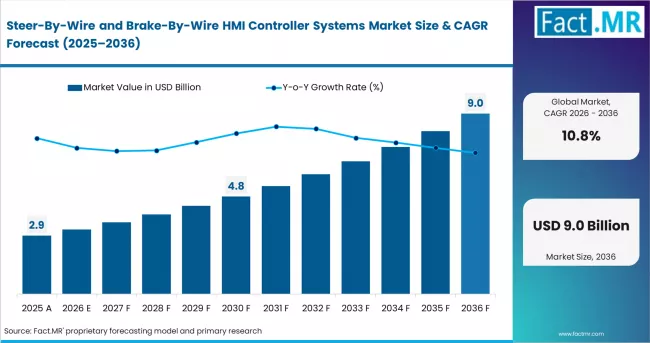
Steer By Wire And Brake By Wire Hmi Controller Systems Market Market Value Analysis | Source: Fact.MR
| Metric | Value |
|---|---|
| Estimated Value in 2026 | USD 2.9 billion |
| Forecast Value in 2036 | USD 8.1 billion |
| Forecast CAGR (2026 to 2036) | 10.8% |
Source: Fact.MR analysis. Updated May 14, 2026
Summary of Steer-By-Wire and Brake-By-Wire HMI Controller Systems Market
- Market Definition
- Covers steer-by-wire and brake-by-wire HMI controller systems in ECU, sensor, actuator interface, and software configurations for fully electronic and hybrid electro-mechanical architectures across passenger and commercial vehicle platforms globally.
- Demand Drivers
- Global EV platform programmes are replacing mechanical linkages with fully electronic by-wire architectures, creating mandatory ECU and HMI controller procurement across OEM vehicle lines.
- UNECE WP.29 automated driving regulations and ISO 26262 functional safety mandates are accelerating steer-by-wire and brake-by-wire system certification investment across tier-1 suppliers.
- Software-defined vehicle programmes at GM, BMW, Toyota, and Hyundai are requiring integrated HMI controller systems capable of over-the-air update compatibility and latency-controlled actuator feedback.
- Key Segments Analyzed
- By Component: Electronic Control Units (HMI Controllers) lead with 45% share in 2026. Dominant due to drive-by-wire architecture centralisation across EV and SDV platforms.
- By Technology: Fully Electronic By-Wire HMI Systems lead with 70% share in 2026. Driven by OEM transition away from hybrid electro-mechanical fallback configurations.
- By System Type: Steer-By-Wire HMI Controllers lead with 55% share in 2026. Higher ECU complexity and premium OEM adoption differentiate steering from braking sub-systems.
- Analyst Opinion at FACT.MR
- Shambhu Nath Jha, Principal Consultant at Fact.MR, opines, ‘CXOs will find that ECU-centric steer-by-wire and brake-by-wire HMI systems are steadily replacing conventional electro-mechanical solutions, especially in premium and EV programmes. Platforms that meet ISO 26262 ASIL-D certification requirements and support OTA software updates are becoming the preferred choice in OEM procurement cycles.’
- Strategic Implications
- Invest in ISO 26262 ASIL-D certified ECU development and OTA software update capability to capture premium OEM and SDV platform HMI controller supply contracts across Europe and North America.
- Expand manufacturing and application engineering capacity in South Korea and China to serve Hyundai, BYD, and SAIC EV platform by-wire procurement volumes in high-growth markets.
- Develop brake-by-wire HMI controller systems optimised for regenerative braking integration to align with EV and hybrid platform technical specifications across Asia Pacific OEMs.
- Methodology
- Market sizing is based on tier-1 ECU supplier revenues and by-wire system shipment volumes. Validated using 2024-2025 company data and automotive platform programme benchmarks.
- Demand and country analysis use UNECE WP.29 regulation records, ISO 26262 certification data, and OEM EV programme investment disclosures from 2024 to 2025.
- Forecasts incorporate automotive platform replacement cycles, ECU cost trajectories, and SDV adoption rates. Supported by expert interviews with automotive electronics procurement teams.
Between 2026 and 2036, the market is expected to create USD 5.2 billion in new opportunity. Growth is transformational and architecture-driven. Demand is expanding through accelerated electric vehicle platform adoption, software-defined vehicle programmes, and ADAS integration mandates across premium and mass-market automotive segments. Growth is moderated by functional safety certification complexity and high ECU development costs.
South Korea leads country-level growth at 11.8% CAGR through 2036, driven by deep electronics integration across Hyundai and Kia EV platform architectures. China follows at 12.5%, anchored by national EV policy and autonomous vehicle scaling at SAIC, BYD, and Nio. The United States records 11.2%, driven by ADAS adoption and SDV platform investment across GM, Ford, and Stellantis. Germany records 11.0%, led by premium OEM by-wire innovation at BMW, Mercedes-Benz, and ZF. Japan records 10.8%, supported by Toyota and Denso advanced control system deployment across next-generation vehicle platforms. Mature European markets face constraints from high ECU certification costs and established electro-mechanical supply chain inertia among mid-tier component producers.
Segmental Analysis
Steer-By-Wire and Brake-By-Wire HMI Controller Systems Market Analysis by Component
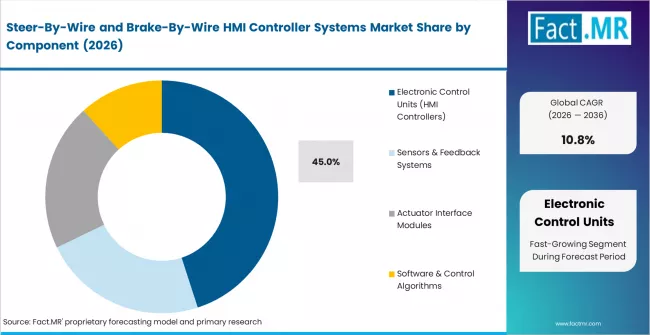
Steer By Wire And Brake By Wire Hmi Controller Systems Market Analysis By Component | Source: Fact.MR
Based on FACT.MR's steer-by-wire and brake-by-wire HMI controller systems market report, Electronic Control Units (HMI Controllers) hold 45% share in 2026. This segment leads due to centralised drive-by-wire architecture design across EV and SDV platforms. ECUs consolidate steering and braking control loops, reducing latency and enabling ISO 26262 compliant fault management at the system level.
- Bosch Investment: Robert Bosch GmbH expanded its steer-by-wire ECU production facility in Abstatt, Germany in Q2 2024, targeting premium OEM supply for EV and autonomous vehicle programmes. The investment supports ISO 26262 ASIL-D certified ECU output. [1]
- Continental Development: Continental AG launched its ADAS-integrated brake-by-wire HMI controller module for passenger EVs in early 2025, combining actuator feedback and driver-intent signal processing in a single ECU architecture. The system targets mass-market OEM platform integration. [2]
- ECU Integration Trend: ZF Friedrichshafen reported growing OEM demand for centralised by-wire HMI ECU platforms in 2024, reflecting a structural shift from distributed control architectures to domain-centralised ECU designs across German and South Korean EV programmes. [3]
Steer-By-Wire and Brake-By-Wire HMI Controller Systems Market Analysis by Technology
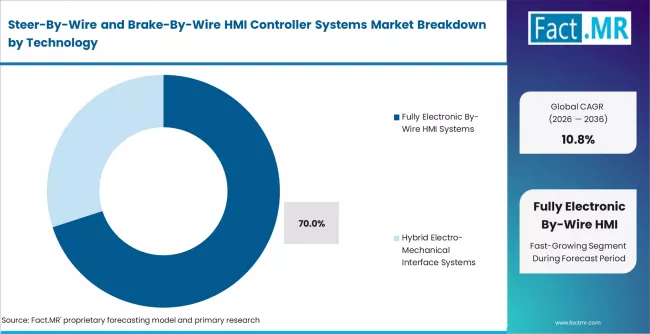
Steer By Wire And Brake By Wire Hmi Controller Systems Market Analysis By Technology | Source: Fact.MR
Based on FACT.MR's steer-by-wire and brake-by-wire HMI controller systems market report, fully electronic by-wire HMI systems hold 70% share in 2026. This segment leads due to OEM platform decisions to eliminate mechanical fallback systems in next-generation EV and autonomous vehicle designs, driven by functional safety certification advances and sensor redundancy improvements.
- Nexteer Investment: Nexteer Automotive disclosed a USD 200 million R&D investment in fully electronic steer-by-wire system development in 2024, targeting North American and Chinese OEM programmes. The investment includes software-defined HMI architecture and OTA update capability development. [4]
- Valeo Development: Valeo SA launched its fully electronic brake-by-wire HMI system for European EV platforms in mid-2024, integrating regenerative braking signal processing with conventional friction brake actuation control. The system supports UNECE WP.29 regulation compliance. [5]
- Hybrid System Transition: JTEKT Corporation reported accelerated OEM adoption of fully electronic steer-by-wire in Japan in 2025, with hybrid electro-mechanical systems declining in new platform specifications as Toyota and Honda advanced their SDV architecture roadmaps. [6]
Drivers, Restraints, and Opportunities
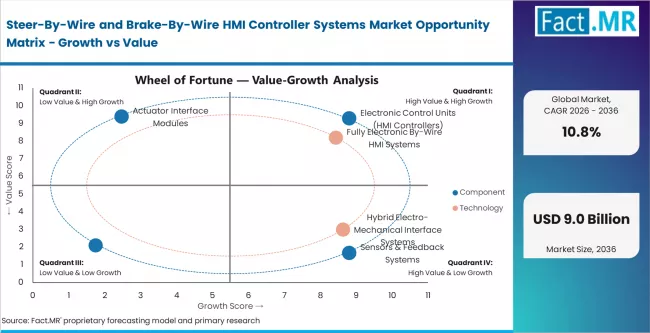
Steer By Wire And Brake By Wire Hmi Controller Systems Market Opportunity Matrix Growth Vs Value | Source: Fact.MR
Fact.MR analysis notes that growth is structurally linked to global EV and autonomous vehicle platform development cycles. Steer-by-wire and brake-by-wire HMI systems are moving from premium-vehicle exclusive to mainstream OEM specification as ECU costs decline and ISO 26262 certification processes mature across tier-1 supplier portfolios.
Conventional electro-mechanical steering and braking systems are losing platform specification in EV architecture design. Fully electronic by-wire HMI systems command a 30-50% price premium over hybrid alternatives. ECU-centric architectures are gaining dominance as OEM software-defined vehicle programmes consolidate control functions into domain-level platforms.
- ISO 26262 Functional Safety Mandate: ISO 26262 ASIL-D requirements for automotive electronic systems compel all steer-by-wire and brake-by-wire HMI controllers to meet rigorous fault tolerance and diagnostic coverage standards. Bosch and Continental disclosed expanded ISO 26262 certified ECU product lines in 2024 to meet OEM qualification timelines for EV platforms.
- China EV Policy Scaling: China's NEV mandate under the New Energy Vehicle Industry Development Plan requires OEMs to accelerate full electronic architecture adoption. SAIC and BYD disclosed by-wire system integration commitments in 2024, driving tier-1 ECU supplier order pipelines for steer-by-wire and brake-by-wire HMI systems.
- UNECE WP.29 Automated Driving Regulation: UNECE Regulation No. 157 on automated lane-keeping systems, effective in EU markets since 2022 and enforced with expanded scope from 2024, mandates by-wire steering control architecture for Level 2+ ADAS systems, creating structural pull for certified steer-by-wire HMI controller procurement.
Regional Analysis
The steer-by-wire and brake-by-wire HMI controller systems market is assessed across Asia Pacific, Europe, North America, Latin America, and Middle East and Africa, covering 40+ countries with demand profiles shaped by EV platform adoption, ADAS regulatory requirements, OEM investment cycles, and functional safety certification infrastructure. The full report offers market attractiveness analysis by region and country.
.webp "Top Country Growth Comparison Steer By Wire And Brake By Wire Hmi Controller Systems Market Cagr (2026 2036)")
Top Country Growth Comparison Steer By Wire And Brake By Wire Hmi Controller Systems Market Cagr (2026 2036) | Source: Fact.MR
| Country | CAGR (2026 to 2036) |
|---|---|
| China | 12.5% |
| South Korea | 11.8% |
| United States | 11.2% |
| Germany | 11.0% |
| Japan | 10.8% |
Source: Fact.MR analysis. Updated May 14, 2026
Source: Fact.MR (FACT.MR) analysis, based on proprietary forecasting model and primary research
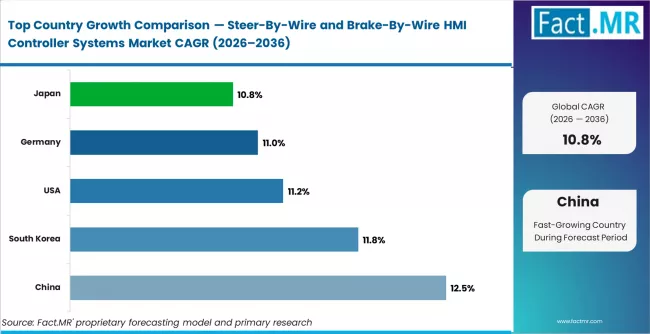
Steer By Wire And Brake By Wire Hmi Controller Systems Market Cagr Analysis By Country | Source: Fact.MR
Asia Pacific Steer-By-Wire and Brake-By-Wire HMI Controller Systems Market Analysis
Asia Pacific is the fastest-growing region, defined by national EV mandates and deep electronics manufacturing integration. China and South Korea anchor regional demand. China is policy-driven and volume-led, while South Korea is electronics-integration-led and export-platform-oriented. Bosch, Continental, Denso, and Hyundai Mobis are the dominant regional suppliers by platform coverage.
- China: National EV policy is the primary demand engine for by-wire HMI controller systems. Growth is projected at 12.5% CAGR through 2036. China's NEV mandate requires OEMs to achieve full electronic architecture integration across EV platforms. BYD disclosed steer-by-wire integration plans in its Ocean series platform roadmap in mid-2024. SAIC confirmed brake-by-wire HMI ECU procurement for its new electric platform in Q3 2024. Continental expanded its Shanghai ECU manufacturing line in 2024 to serve rising domestic OEM demand.
- South Korea: Electronics integration depth is the defining regional advantage. Growth is projected at 11.8% CAGR through 2036. Hyundai Mobis disclosed a steer-by-wire system supply agreement for Hyundai's next-generation IONIQ platform in Q1 2025, covering ECU hardware and software algorithm supply. Kia confirmed by-wire HMI integration for its EV9 successor platform in 2024, requiring ISO 26262 certified ECU architecture.
- Japan: Advanced control system engineering culture defines the domestic by-wire HMI market. Growth is projected at 10.8% CAGR through 2036. Toyota disclosed a fully electronic steer-by-wire system deployment for its next-generation SDV platform in early 2025, developed in partnership with JTEKT Corporation. Denso confirmed an expanded brake-by-wire ECU component supply agreement with Honda for its 2026 model year EV platform in Q2 2024.
Fact.MR's analysis of Asia Pacific covers China, Japan, South Korea, India, ASEAN, and Australia and New Zealand. Includes EV platform programme data, OEM procurement timelines, and regional ECU certification trends.
North America Steer-By-Wire and Brake-By-Wire HMI Controller Systems Market Analysis
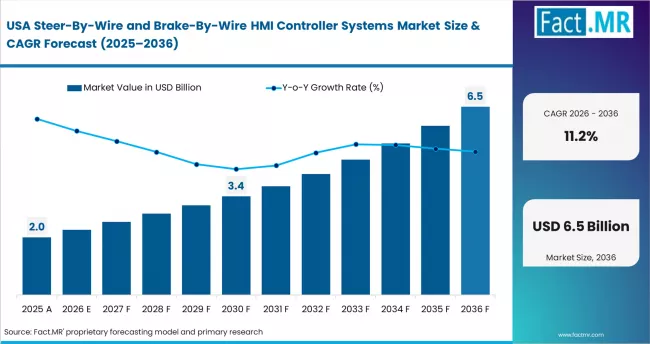
Steer By Wire And Brake By Wire Hmi Controller Systems Market Country Value Analysis | Source: Fact.MR
North America is a mature, ADAS- and SDV-investment-driven market. Demand is shaped by major OEM software-defined vehicle programmes and federal NHTSA automated driving standards. GM, Ford, and Stellantis are the primary procurement anchors. Bosch, ZF, and Nexteer Automotive lead supply through long-term OEM platform agreements.
- United States: SDV investment and ADAS regulatory development are reshaping HMI controller procurement. Growth is projected at 11.2% CAGR through 2036. GM disclosed full steer-by-wire integration for its Ultium-based autonomous vehicle programme in 2024, requiring ASIL-D certified ECU supply. Ford confirmed brake-by-wire HMI controller procurement for its next-generation electric truck platform in Q2 2024.
Fact.MR covers the United States, Canada, and Mexico. Includes NHTSA regulation impact, SDV investment timelines, and OEM by-wire platform adoption data.
Europe Steer-By-Wire and Brake-By-Wire HMI Controller Systems Market Analysis
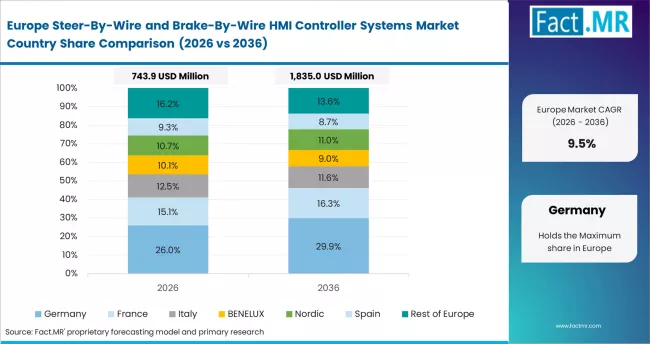
Steer By Wire And Brake By Wire Hmi Controller Systems Market Europe Country Market Share Analysis, 2026 & 2036 | Source: Fact.MR
Europe remains the most regulation- and premium-OEM-driven region for by-wire HMI systems. UNECE WP.29 regulations and EU automated driving standards define procurement specifications. BMW, Mercedes-Benz, and Volkswagen Group lead platform adoption. ZF, Continental, and Bosch dominate regional supply with ISO 26262 certified product portfolios.
- Germany: Premium OEM innovation drives the highest by-wire system specification density in Europe. Growth is projected at 11.0% CAGR through 2036. BMW disclosed steer-by-wire ECU integration for the Neue Klasse EV platform in Q3 2024, selecting ZF as the primary ECU supplier. Mercedes-Benz confirmed brake-by-wire HMI controller deployment for its EQS successor platform in 2024. Bosch expanded its Reutlingen ECU facility output in Q1 2025 to support German OEM delivery timelines.
Fact.MR covers Germany, France, the UK, Italy, Spain, Nordic Countries, BENELUX, and Rest of Europe. Includes UNECE regulation impact, premium OEM platform timelines, and ECU certification procurement trends.
Competitive Aligners for Market Players
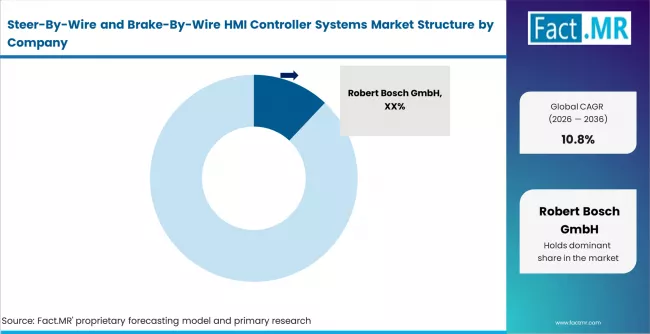
Steer By Wire And Brake By Wire Hmi Controller Systems Market Analysis By Company | Source: Fact.MR
The steer-by-wire and brake-by-wire HMI controller systems market is characterised by moderate concentration among global tier-1 automotive suppliers. The top five players, Bosch, Continental, ZF Friedrichshafen, Denso, and Nexteer Automotive, collectively account for an estimated 55-60% of ECU and system-level supply. Competition is centred on ISO 26262 certification depth, software-defined ECU architecture capability, and OEM platform co-development relationships rather than price alone.
Structural advantages accrue to suppliers with integrated ECU development and functional safety validation infrastructure. ZF and Continental benefit from vertical integration across hardware design, software stack development, and ASIL-D certification services. Bosch leverages captive semiconductor supply relationships and established OEM co-development agreements spanning steering, braking, and ADAS domain integration. These advantages support long-term platform supply agreements and insulate top-tier suppliers from mid-cycle substitution.
OEM procurement teams operate with structured dual-sourcing strategies for ECU and sensor components, reflecting functional safety redundancy requirements. Qualification processes for steer-by-wire and brake-by-wire HMI systems require 18-36 month OEM validation timelines, creating high switching costs. Large customers such as BMW, Toyota, and Hyundai use co-development contracts to manage supplier dependency while retaining software architecture IP, limiting the pricing power of pure-hardware ECU suppliers.
Key Players
- Robert Bosch GmbH
- Continental AG
- ZF Friedrichshafen AG
- Denso Corporation
- Valeo SA
- Nexteer Automotive
- JTEKT Corporation
- Hyundai Mobis
- Brembo S.p.A.
Bibliography
- [1] Robert Bosch GmbH. (Q2 2024). Manufacturing Expansion: Steer-By-Wire ECU Production Programme Expansion at Abstatt Facility for ISO 26262 Certified Supply to Premium European and North American OEM EV Platform Programmes. Q2 2024. bosch.com/investor-relations
- [2] Continental AG. (Early 2025). Product Launch: Integrated Brake-By-Wire HMI Controller System for Passenger EV Platforms Combining Regenerative Braking Signal Processing and Friction Brake ECU Control in Single Domain Architecture. Early 2025. continental.com/investor-relations
- [3] ZF Friedrichshafen AG. (2024). Market Development Report: Centralised By-Wire HMI ECU Platform Demand Growth from German and South Korean OEM EV Programme Procurement Reflecting Shift from Distributed to Domain-Centralised ECU Architecture. 2024. zf.com/investor-relations
- [4] Nexteer Automotive. (2024). R&D Investment Disclosure: USD 200 Million Steer-By-Wire Fully Electronic HMI System Development Programme for North American and Chinese OEM Platform Supply Including OTA Software Update Architecture. 2024. nexteer.com/investor-relations
- [5] Valeo SA. (Mid-2024). Product Launch: Fully Electronic Brake-By-Wire HMI System for European EV Platforms Integrating Regenerative Braking Signal Processing with Conventional Friction Brake Actuation Control Under UNECE WP.29 Compliance. Mid-2024. valeo.com/investor-relations
- [6] JTEKT Corporation. (2025). Market Update: Accelerated OEM Adoption of Fully Electronic Steer-By-Wire Systems in Japan Reflecting Decline of Hybrid Electro-Mechanical Configurations in Toyota and Honda SDV Architecture Platform Specifications. Early 2025. jtekt.co.jp/investor-relations
This Report Addresses
- Strategic intelligence on steer-by-wire and brake-by-wire HMI controller system demand across EV platform, ADAS, and SDV procurement programmes globally.
- Market forecast from USD 2.9 billion in 2026 to USD 8.1 billion by 2036 at a CAGR of 10.8%.
- Growth opportunity mapping across China NEV mandate EV platform scaling, South Korea electronics integration, U.S. SDV investment, Germany premium OEM by-wire innovation, and Japan advanced control system deployment.
- Segment analysis by component (ECU, sensors, actuator interface, software), technology (fully electronic, hybrid electro-mechanical), and system type (steer-by-wire, brake-by-wire).
- Regional outlook covering Asia Pacific EV-led demand, North America SDV investment-driven procurement, and Europe UNECE regulation-led architecture adoption.
- Competitive analysis of Bosch, Continental, ZF, Denso, Valeo, Nexteer, JTEKT, Hyundai Mobis, and Brembo. Focus on ISO 26262 certification, software-defined ECU capability, and OEM co-development positioning.
- Regulatory impact analysis covering ISO 26262 functional safety standards, UNECE WP.29 Regulation No. 157, China NEV mandate provisions, NHTSA automated driving safety standards, and Japan JASIC functional safety updates.
- Report delivered in PDF, Excel datasets, and presentation formats. Supported by primary interviews, tier-1 supplier revenue data, OEM platform programme benchmarks, and regulatory filing documentation.
Steer-By-Wire and Brake-By-Wire HMI Controller Systems Market Definition
The market covers HMI controller systems integrated into steer-by-wire and brake-by-wire architectures for automotive platforms. Electronic control units manage steering torque, braking force, and driver-intent signal translation without mechanical linkage.
Steer-By-Wire and Brake-By-Wire HMI Controller Systems Market Inclusions
Includes global and regional forecasts from 2026 to 2036 by component, technology, and system type. Covers ECU controllers, sensor and feedback systems, actuator interface modules, and software algorithms across fully electronic and hybrid electro-mechanical HMI configurations for passenger vehicle and commercial vehicle applications.
Steer-By-Wire and Brake-By-Wire HMI Controller Systems Market Exclusions
Excludes conventional hydraulic and electro-hydraulic steering and braking systems without wire-based HMI integration. Omits standalone ADAS sensors, vehicle body control modules, and powertrain ECUs not directly integrated into steer-by-wire or brake-by-wire HMI control loops. Focus is on HMI controller hardware, software, and interface modules only.
Steer-By-Wire and Brake-By-Wire HMI Controller Systems Market Research Methodology
- Primary Research:Interviews with automotive OEM platform engineers, tier-1 ECU suppliers, steer-by-wire and brake-by-wire system integrators, and functional safety certification specialists across key automotive markets.
- Desk Research:Analysis of Bosch, Continental, ZF Friedrichshafen, Denso, Nexteer Automotive, and Hyundai Mobis company reports, UNECE WP.29 automated driving regulation records, ISO 26262 functional safety standards, and automotive supplier ECU trade data from 2024 to 2025.
- Market-Sizing and Forecasting:Hybrid model integrating top-down estimates from tier-1 ECU supplier revenues with bottom-up system-level volume forecasts by component type, technology configuration, and vehicle platform segment.
- Data Validation and Update Cycle:Validated through OEM platform programme data, tier-1 supplier revenues, ISO 26262 certification pipeline cross-checks, and expert interviews with automotive electronics procurement and systems engineering teams.
Segmentation
Scope of Report
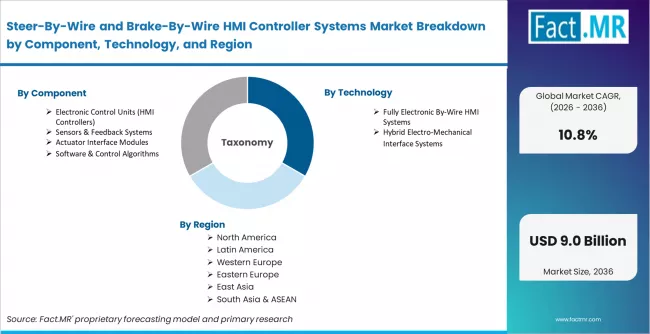
Steer By Wire And Brake By Wire Hmi Controller Systems Market Breakdown By Component, Technology, And Region | Source: Fact.MR
| Attribute | Details |
|---|---|
| Quantitative Units | USD 2.9 billion (2026) to USD 8.1 billion (2036), at a CAGR of 10.8% |
| Market Definition | Steer-by-wire and brake-by-wire HMI controller systems in ECU, sensor, actuator interface, and software configurations for fully electronic and hybrid electro-mechanical architectures across passenger and commercial vehicle platforms globally. |
| Component Segmentation | Electronic Control Units (HMI Controllers), Sensors & Feedback Systems, Actuator Interface Modules, Software & Control Algorithms |
| Technology Segmentation | Fully Electronic By-Wire HMI Systems, Hybrid Electro-Mechanical Interface Systems |
| System Type Segmentation | Steer-By-Wire HMI Controllers, Brake-By-Wire HMI Controllers |
| Application Coverage | Passenger EV platform ECU supply, commercial vehicle by-wire integration, ADAS-linked steering and braking control, SDV software-defined HMI controller procurement, and OTA-compatible ECU system deployment. |
| Regions Covered | North America, Europe, Asia Pacific, Latin America, Middle East and Africa |
| Countries Covered | USA, Canada, Mexico, Germany, UK, France, Italy, Spain, Nordic, BENELUX, China, Japan, South Korea, India, ASEAN, Australia and New Zealand, Brazil, Argentina, Saudi Arabia, GCC, South Africa, Rest of MEA |
| Key Companies Profiled | Robert Bosch GmbH, Continental AG, ZF Friedrichshafen AG, Denso Corporation, Valeo SA, Nexteer Automotive, JTEKT Corporation, Hyundai Mobis, Brembo S.p.A. |
| Forecast Period | 2026 to 2036 |
| Approach | Hybrid top-down and bottom-up model using tier-1 ECU supplier revenues, steer-by-wire and brake-by-wire system volume by component and technology type, OEM platform programme data, average selling prices by ECU grade, and primary interviews with automotive electronics procurement and systems engineering specialists. |
Source: Fact.MR analysis. Updated May 14, 2026
Steer-By-Wire and Brake-By-Wire HMI Controller Systems Market by Segments
-
By Component:
- Electronic Control Units (HMI Controllers)
- Sensors & Feedback Systems
- Actuator Interface Modules
- Software & Control Algorithms
-
By Technology:
- Fully Electronic By-Wire HMI Systems
- Hybrid Electro-Mechanical Interface Systems
-
By System Type:
- Steer-By-Wire HMI Controllers
- Brake-By-Wire HMI Controllers
-
By Region:
- North America
- United States
- Canada
- Mexico
- Latin America
- Brazil
- Argentina
- Chile
- Rest of Latin America
- Western Europe
- Germany
- United Kingdom
- France
- Italy
- Spain
- Nordic Countries
- BENELUX
- Rest of Western Europe
- Eastern Europe
- Russia
- Poland
- Hungary
- Balkan and Baltic
- Rest of Eastern Europe
- East Asia
- China
- Japan
- South Korea
- South Asia and Pacific
- India
- ASEAN
- Australia and New Zealand
- Rest of South Asia and Pacific
- Middle East and Africa
- Kingdom of Saudi Arabia
- Other GCC Countries
- Turkey
- South Africa
- Rest of Middle East and Africa
- North America
Frequently Asked Questions
How large is the steer-by-wire and brake-by-wire HMI controller systems market in 2025?
What will the market size be by 2036?
What is the expected CAGR for the market from 2026 to 2036?
Which component segment is poised to lead the market?
Which technology is expected to dominate?
Which country shows the fastest growth?
What is driving demand for steer-by-wire and brake-by-wire HMI controller systems?
What are the major restraints?
Which system type leads the market?
What is the main challenge in this market?
Who worked on this report


Preview the report firsthand - request a free sample
Free SampleGet the brochure for pricing and purchase details
Download PDF