- Forecast Value (2035): 1334 Mn
- CAGR (2035): 15.4%
Wireless Neural Interfaces Market Outlook 2025 to 2035
The global wireless neural interfaces market is expected to reach USD 1,334 Million by 2035, up from estimated value of USD 324.0 Million in 2025. During the forecast period 2025 to 2035, the industry is projected to expand at a CAGR of 15.2%.
The market endured by the wireless neural interfaces is largely motivated by the escalating occurrence of neurological disorders, the growing need for minimally invasive and non-invasive neuro-computer interface technologies, developments in AI-based neural decoding, and the growing use of wearable and wireless technology in clinical, research, and consumer settings. All these aspects have a positive effect on patient care, monitoring, and cognitive performance.
Quick Stats for Wireless Neural Interfaces Market
- Industry Value (2025): USD 324.0 Million
- Projected Value (2035): USD 1,334 Million
- Forecast CAGR (2025 to 2035): 15.2%
- Leading Segment (2025): Non-Invasive (40% Market Share)
- Fastest Growing Country (2025-2035): China (15.5% CAGR)
- Top Key Players: are Neuralink, Synchron, Kernel, Emotiv, NeuroSky, Paradromics Inc., Blackrock Neurotech, and NeuroPace Inc.
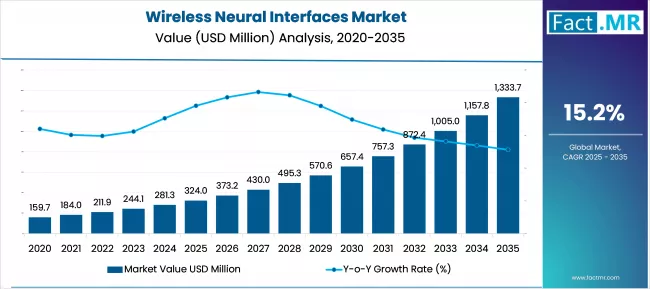
Wireless Neural Interfaces Market Market Value Analysis | Source: Fact.MR
What are the key factors driving growth in the Wireless Neural Interfaces Market?
The growth of the prevalence of neurological disorders, and the requirement of a minimum of invasive neurotechnologies, and real-time brain monitoring are major driving forces. Patients become more comfortable and able to move freely with wireless systems which allow continuous collection of data. The increasing investments in neurotechnology startups, progress in AI-powered neural decoding, and its integration with rehabilitation and cognitive training apps only contribute to its uptake. Market growth also advances with the growth of research programs and the growing awareness of the uses of brain-computer interface in the fields of healthcare, defense, and consumer markets.
What are the key trends driving growth in the Wireless Neural Interfaces market?
Among the major trends are the miniaturization of implants, neural signal processing powered by AI, combination with wearable devices, and cloud computing. Non-invasive EEG and hybrid neuroimaging systems are becoming increasingly popular with research and consumer uses. Remote tele-neurotherapy and remote monitoring are made possible by IoT-enabled and wireless telemetry systems.
The research on user-centric design, battery-less and energy-harvesting devices, and software analytics of predictive neural insights are becoming a priority of companies, which opens the prospects of scalable and personalized neural interface solutions in industries.
What factors hinder the growth of the Wireless Neural Interfaces market?
The cost of development and manufacturing is high; the regulatory requirements are strict and technical difficulties of wireless signal fidelity make it challenging to adopt in the market. Surgical risks and specialized clinical knowledge are associated with invasive devices. There are further obstacles to data privacy and cybersecurity and interoperability.
Commercialization is slowed by limited reimbursement structures and presentation of large clinical validation requirements. In addition, absence of standard operating procedures and community education about wireless neural systems inhibit wider application in both clinical and consumer uses especially in the new markets.
What are the key regional trends driving the Wireless Neural Interfaces Market growth?
North America
North America controls the market as it has powerful R&D infrastructure, healthcare facilities, and other major neurotechnology companies. Wireless BCIs have been widely adopted in hospitals, research institutes, and consumer applications, with positive regulations, clinical trials, and heavy investments in AI-based neural interface advancements.
East Asia
The rapid development of East Asia is also supported by the government and the emerging research in neuroscience, as well as the growing popularity of wearable and non-invasive wireless neural devices. China, Japan, South Korea are among the countries that are concentrating on AI adoption, digital health solutions, and consumer neurotech generating a robust growth trend in clinical, research, and wellness solutions.
Western Europe
The market growth in Western Europe is upheld by developed health care systems, accuracy in engineering and adherence to regulations. Neurorehabilitation, cognitive research and clinical therapy are some application areas in hospitals and research centers using wireless neural interfaces. University-business-government efforts are the key to innovation and the quicker uptake of safe, reliable and clinically proven solutions.
Country-wise Outlook
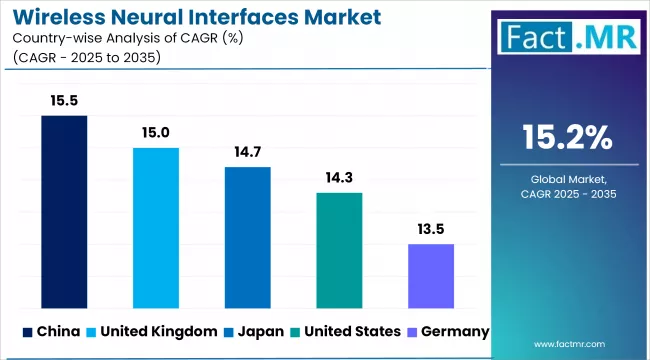
Wireless Neural Interfaces Market Cagr Analysis By Country | Source: Fact.MR
Innovation and Neurotechnology Leadership Drive the United States’ Wireless Neural Interfaces Market
The US is the leader in the global market of wireless neural interfaces with the highly developed R and D ecosystems, regulatory systems and academic industrial partnerships. Multiple companies such as Neuralink, Synchron, and Blackrock Neurotech are already developing invasive and non-invasive, whereas wearable EEG headsets have become popular among consumers in the wellness and healthcare sector.
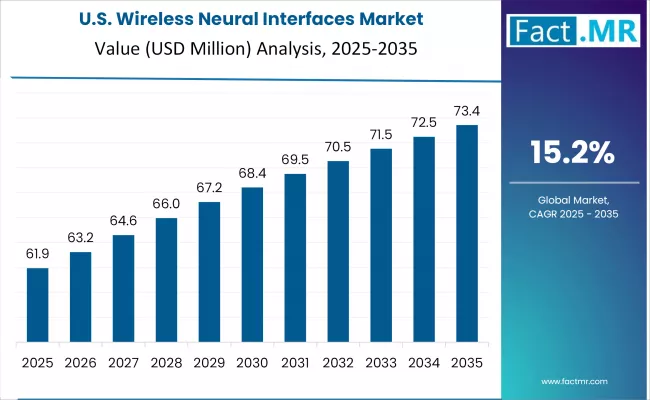
Wireless Neural Interfaces Market Country Value Analysis | Source: Fact.MR
Wireless systems are being incorporated in hospitals and research centers in neuromodulation, brain-computer interfaces and rehabilitation. Venture capital, clinical trial infrastructure, and cross-sector partnerships are favorable to the U.S. market in terms of commercializing next-generation neurotechnologies.
Engineering Excellence and Regulatory Compliance Propel Germany’s Wireless Neural Interfaces Market
The market of the wireless neural interfaces of Germany is flourishing on the culture of precision engineering, strong compliance with regulations, and clinical acceptance. Wireless EEG and hybrid BCI systems are becoming more popular in German hospitals and neurorehabilitation facilities as another way to improve patient outcomes. Local companies focus on biocompatibility, the reliability of the devices, and an unfictitious character of integration into hospital practices. Collaborations between academic institutions and technology medtechs facilitate neural signal acquisition technology development. Germany is now becoming a European center of safe, effective, and clinically validated wireless neural interface solutions.
Technological Expansion and Digital Healthcare Priorities Fuel China’s Wireless Neural Interfaces Market
The market base of wireless neural interfaces in China is being rapidly growing because the country invests in the field of neuroscience, AI, and digital health programs. Invasive and non-invasive brain-computer interface technologies are being developed by local companies and research institutions. Wearable EEG devices are being marketed as a mental health, education and consumer product, but clinical studies focus on neurorehabilitation and cognitive therapy. The support of the government, effective investments, and the development of the start-up community make China a developing international player in wireless neural technologies oriented towards massive applications.
Category-Wise Market Outlook
Non-Invasive Interfaces Lead Invasiveness Growth
The least invasive sub-sub-category is non-invasive wireless neural interfaces which are rapidly growing. The implementation of these solutions is quite rapid as they eliminate the risks of surgery, which are cheaper and may be implemented on several uses during healthcare and consumer practice. They cause the popularity of wearable EEG headsets, mental wellness tools and neurofeedback devices. Other enhancements to the usability include building wireless connections, AI-powered interpretation of brain waves and integration of mobile medical systems. They are the most available due to their non-invasive nature and have been extended to hospital, research laboratories, rehabilitation centers and in consumer wellness markets.
Wearables & Headsets Drive Form Factor Expansion
The rapidly expanding sub-category in the form factor is wearables and headsets. They can also be made very scalable due to the fact that they can be carried around, be easily operated on and allow for continuous observation of the brain without surgery. They are devices that are emerging as features of practices like cognitive training, stress management, neurorehabilitation and games. Their use is augmented by compact size sensors, improved wireless technologies and ergonomics. The best market to grow in wireless neural interfaces market is wearables because it can serve both clinical and consumer markets.
Scalp EEG Systems Dominate Technology Growth
The swiftly growing subcategory in technology business is scalp EEG systems. Their use is attributed to their safety, non-invasiveness and to the real-time neural activities that they can measure. EEG wireless is widely used when diagnosing epilepsy, sleep, rehabilitation and in mental health assessment. Beyond medical applications, EEG headsets are finding applications in the gaming, human-computer interaction, and wellness tracking. They can be used more effectively as they are connected to cloud-based analytics and AI-based insights. Scalp EEG has been a fast-growing technology due to its ease of access, flexibility and established reliability.
Competitive Analysis
Competitive Outlook: Wireless Neural Interfaces Market
The Market of the Wireless Neural Interfaces is very competitive with both novel neurotechnology developers and old medtech giants. Some of these companies include Neuralink, Synchron, Paradromics, Blackrock Neurotech, and Precision Neuroscience, which are introducing implantable and minimally invasive brain-computer interface systems, with high-fidelity neural recording, wireless telemetry, and scalability to clinical applications. Meanwhile, Kernel, Emotiv, NeuroSky, MindMaze, Bitbrain Technologies, and OpenBCI are pioneering the new non-invasive and wearable wireless neural devices to wellness, research, and cognitive enhancement into bigger markets.
The major world healthcare companies such as Medtronic, Boston Scientific, Abbott Laboratories, and NeuroPace Inc are using their regulatory experience, research and production skills, and robust distribution systems to enhance their dominance in neuromodulation and wireless neural monitoring. The competitive platforms of these players revolve around miniaturization, neural decoding with AI, cloud integration of data, and user-centric designs. Together, these strategies make companies competitive in clinical therapy, rehabilitation, research, consumer wellness and defense applications globally.
Key players in the Wireless Neural Interfaces market are Neuralink, Synchron, Kernel, Emotiv, NeuroSky, Paradromics Inc., Blackrock Neurotech, NeuroPace Inc., Medtronic plc, Boston Scientific Corporation, Abbott Laboratories, MindMaze SA, Bitbrain Technologies, OpenBCI, Precision Neuroscience.
Recent Development
- In September 2025, researchers at DGIST developed a wireless neural interface with an integrated peristaltic micropump for deep-brain drug delivery, using soft materials and wireless control for precise dosage, without needing external pumps or tubes.
- In March 2025, Synchron introduced a version of its BCI integrated with Nvidia AI and Apple Vision Pro, enabling a participant with ALS to control home devices using thought commands, reflecting strides in combining less-invasive implants with advanced AI-powered decoding.
Fact.MR has provided detailed information about the price points of key manufacturers of Wireless Neural Interfaces market positioned across regions, sales growth, production capacity, and speculative technological expansion, in the recently published report.
Methodology and Industry Tracking Approach
Survey Fact.MR 2025 Survey on the Wireless Neural Interfaces Market participated in the survey over 10,000 people, and at least 250 representatives of each of 30 countries responded. End-users (two-thirds of the participants) included hospitals, medical schools, rehabilitation centers, and research institutes, the remaining third of the participants were industry experts, including device designers, regulatory experts, technical consultants, and healthcare technology advisors. The survey will take place during the period between September 2024 and August 2025 and will address the areas of adoption, wireless and AI-enabled technologies integration, regulatory environments, and innovations that will define advanced and sustainable neural interface solutions.
In order to complement the survey, more than 250 secondary sources such as patents, products introductions, policy guidelines, and sustainability reports were reviewed with the help of high-end modeling and predictive analytics. Since 2018, Fact.MR has been tracking the market of Wireless Neural Interfaces and observing the maturity of technologies, regulatory achievements, and the pattern of their adoption. The 2025 report provides actionable, strategic recommendations and long term guidance to the stakeholders to survive in this highly dynamic and rapidly developing market.
Segmentation
Segmentation of Wireless Neural Interfaces Market Research
-
By Type / Invasiveness :
- Invasive
- Partially Invasive
- Non-Invasive
-
By Product / Form Factor :
- Fully Implantable Systems
- Wearables & Headsets
- Hybrid Systems
-
By Technology / Signal Acquisition :
- Intracortical Microelectrodes
- Electrocorticography (ECoG)
- Scalp EEG Systems
- Optical / Emerging Modalities
-
By Connectivity / Telemetry :
- RF-based
- Inductive / Near-field
- Ultrasonic Telemetry
- Proprietary Low-power Links
-
By Power Source :
- Battery-powered
- Batteryless / Energy-harvesting
-
By Application :
- Clinical & Therapeutics
- Rehabilitation & Assistive Communication
- Cognitive & Behavioral Research
- Consumer Applications (gaming, wellness, neurofeedback)
- Defense & Aerospace Performance Monitoring
-
By End User :
- Hospitals & Clinics
- Academic & Research Institutes
- Medical Device Manufacturers / OEMs
- Contract Research Organizations (CROs)
- Individual Consumers
-
By Region :
- North America
- Latin America
- Western Europe
- Eastern Europe
- East Asia
- South Asia & Pacific
- Middle East & Africa
Frequently Asked Questions
What was the Global Wireless Neural Interfaces Market Size Reported by Fact.MR for 2025?
Who are the Major Players Operating in the Wireless Neural Interfaces Market?
What is the Estimated Valuation of the Wireless Neural Interfaces Market in 2035?
What Value CAGR did the Wireless Neural Interfaces Market Exhibit Over the Last Five Years?
Who worked on this report


Preview the report firsthand - request a free sample
Free SampleGet the brochure for pricing and purchase details
Download PDF