- Base Value(2025): 339.5 Mn
- Estimated Value(2026): 357.3 Mn
- Forecast Value (2036): 587.6 Mn
- CAGR (2026 - 2036): 5.1%
Lime Oil Market Size, Market Forecast and Outlook By FACT.MR
The Lime Oil market was valued at USD 339.5 million in 2025, projected to reach USD 357.3 million in 2026, and is forecast to expand to USD 587.6 million by 2036 at a 5.1% CAGR. Growing global craft beverage and carbonated drink manufacturer demand for natural lime flavoring compounds, combined with premium personal care brand adoption of expressed lime peel oil as a documented botanical citrus ingredient, sustains consistent demand growth across both industrial flavour and fragrance procurement and retail aromatherapy channels. Mexican and Central American Key lime production origins supply the primary commercial volume of distilled lime oil for global beverage flavoring applications, while Caribbean and Brazilian Persian lime cold-pressing operations serve premium F&F and personal care ingredient buyers.
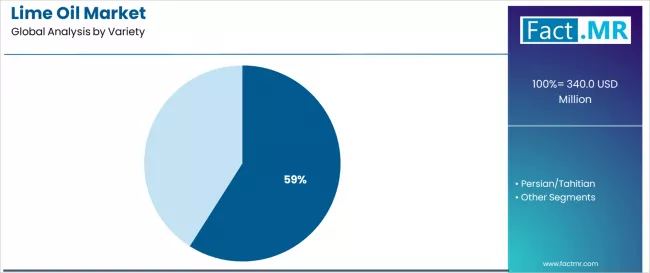
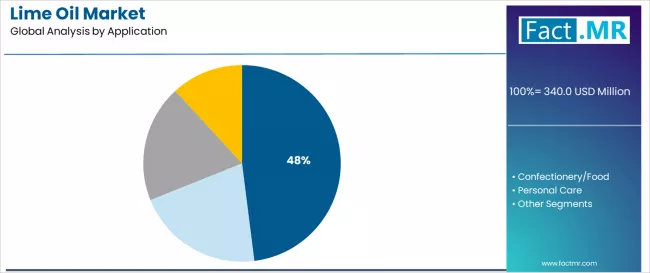
The absolute dollar growth of USD 230.3 million across the forecast decade reflects lime oil's expanding geographic application base beyond traditional North American beverage flavoring into growing European fragrance, Asian personal care formulation, and global natural home care product categories. Key/Mexican variety capturing 59.0% of variety share confirms distilled Key lime oil's dominant position in global beverage flavoring supply chains where authentic Key lime flavor character supports premium carbonated beverage, craft cocktail, and confectionery product positioning. Beverages commanding 48.0% of application share anchors lime oil's largest and most established value application through soft drink natural flavoring, mixer concentrate, and craft gin citrus note formulation programs.
As per FACT.MR's regional analysis, the United States leads at 5.5% CAGR as the largest global lime oil consumer market, where craft cocktail culture, premium sparkling water, and natural soda flavoring programs sustain consistent demand for authenticated lime oil above synthetic alternatives. France advances at 4.7% as Grasse fragrance house lime top note formulation demand and premium natural cosmetic ingredient procurement sustain structured botanical citrus oil purchasing. Germany tracks at 4.6% as COSMOS-certified natural personal care brand formulation programs specify authenticated lime oil and premium natural cleaning product development incorporates lime oil as a functional fragrance active. South Korea registers 4.6% where K-beauty body care and hair care formulation programs integrating citrus oil actives sustain premium ingredient procurement. Japan advances at 4.5% as premium food flavoring and natural personal care ingredient markets maintain consistent lime oil demand. The United Kingdom records 4.4% where established gin botanical sourcing, craft mixer producer natural flavoring, and natural personal care brand ingredient procurement sustain multi-application demand.
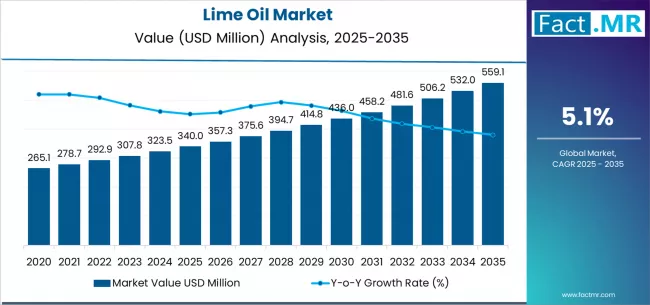
Lime Oil Market Market Value Analysis | Source: Fact.MR
Lime Oil Market Key Takeaways
| Metric | Details |
|---|---|
| Industry Size (2026) | USD 357.3 Million |
| Industry Value (2036) | USD 587.6 Million |
| CAGR (2026-2036) | 5.1% |
Source: Fact.MR analysis. Updated Mar 14, 2026
Lime Oil Market Definition
The Lime Oil market encompasses distilled and cold-pressed expressed essential oil extracted from Key/Mexican lime (Citrus aurantifolia) and Persian/Tahitian lime (Citrus latifolia) fruits, used in beverage flavoring, confectionery and food, personal care, and fragrance applications. Distilled lime oil from Key lime is produced through steam distillation of whole lime fruit or peel, generating the primary commercial grade for beverage and flavor applications. Cold-pressed expressed lime oil retains the natural peel constituent profile for premium fragrance and personal care formulation use. Both variety types are supplied through B2B industrial ingredient channels and retail aromatherapy distribution.
Lime Oil Market Inclusions
Market scope covers distilled and expressed lime oil from Key/Mexican and Persian/Tahitian lime varieties across beverage, confectionery and food, personal care, and other application categories. Regional analysis covers USA, France, Germany, South Korea, Japan, UK, Mexico, and 40 plus countries for the 2026 to 2036 forecast period. Both natural steam-distilled and cold-pressed expressed oil specifications from defined variety origins are included within analytical scope.
Lime Oil Market Exclusions
Synthetic lime fragrance compounds and isolated terpene chemicals manufactured without Citrus aurantifolia or Citrus latifolia botanical derivation are excluded. Lime juice concentrate, lime powder, and lime zest food ingredient products without essential oil extraction are omitted. Other Citrus species essential oils without lime variety botanical authentication fall outside defined boundaries. Finished beverage, confectionery, and personal care consumer products containing lime oil as a formulation ingredient without standalone oil trade are excluded from ingredient market calculations.
Lime Oil Market Research Methodology
- Primary Research: Analysts conducted interviews with Mexican and Central American lime oil distillery operators, beverage flavour procurement directors at major soft drink and craft beverage manufacturers, and natural personal care ingredient buyers to document supply chain dynamics and application growth drivers.
- Desk Research: Data aggregation covered Mexican and Central American citrus essential oil export statistics, EFSA lime oil flavoring substance authorization data, IFRA fragrance ingredient use standards for lime oil, and Ecocert COSMOS certification databases for natural origin ingredient documentation.
- Market-Sizing and Forecasting: Baseline values derive from bottom-up aggregation of Mexican and Brazilian lime oil production volume data, applying beverage flavoring demand growth rates, premium personal care formulation adoption curves, and fragrance house procurement growth rates to regional demand projections.
- Data Validation and Update Cycle: Forecasts cross-validate against natural citrus ingredient purchasing disclosures from Givaudan, Mane, Symrise, Treatt, and Dohler annual sustainability and sourcing reports for natural lime oil procurement volumes.
Summary of Lime Oil Market
- Lime Oil Market Definition
- The Lime Oil market covers distilled and cold-pressed expressed Citrus aurantifolia and Citrus latifolia essential oil in Key/Mexican and Persian/Tahitian varieties for beverage flavoring, confectionery and food, personal care, and fragrance applications distributed through B2B ingredient and retail channels globally.
- Demand Drivers in the Market
- Craft cocktail culture growth and premium sparkling water and natural soda flavoring program expansion in North America sustain consistent demand for authenticated Key lime oil above synthetic flavoring alternatives in the USA's primary lime oil application category.
- COSMOS-certified natural personal care brand formulation programs in Germany and France specify authenticated botanical lime peel oil as a compliant fragrance and active ingredient in certified cosmetic formulations, sustaining structured industrial procurement.
- K-beauty body care and hair care formulation programs integrating citrus oil actives in South Korea drive ingredient specification demand for authenticated lime oil with documented limonene and terpene constituent profiles.
- Key Segments Analyzed in the FACT.MR Report
- Key/Mexican Variety leads with 59.0% of variety share in 2026, where distilled Key lime oil's authentic citrus flavor character supports premium carbonated beverage, craft cocktail, and confectionery product positioning in global beverage flavoring supply chains.
- Beverages commands 48.0% of Application share in 2026, anchoring lime oil's largest and most established value application through soft drink natural flavoring, cocktail mixer concentrate, craft gin botanical, and functional beverage citrus note programs.
- Distilled Type accounts for 62.0% of Type share in 2026, where steam-distilled lime oil production provides the cost-effective standardized quality specification for bulk industrial beverage flavoring procurement above cold-pressed expressed alternatives.
- Analyst Opinion at FACT.MR
- Shambhu Nath Jha, Principal Consultant, opines: 'Lime oil occupies an interesting position in the citrus essential oil market where beverage application volume dominance is very well established, but the premium personal care and fragrance application segments represent a structural growth opportunity that distillery operators have historically underserved relative to lemon and bergamot oil equivalents. Cold-pressed expressed Persian lime oil processing capacity investment in Caribbean and Brazilian origins creates the quality tier necessary to compete for fragrance house and COSMOS-certified personal care brand procurement, where the flavor profile and constituent documentation of expressed oil commands the premium pricing that distilled lime oil commodity supply cannot approach.'
- Strategic Implications / Executive Takeaways
- Lime oil producers targeting premium fragrance house and natural personal care brand procurement must develop cold-pressed expressed Persian lime oil processing capacity with GC-MS constituent authentication and IFRA photosensitivity safety documentation to qualify for premium ingredient buyer specifications.
- Beverage industry supply programs require consistent distilled Key lime oil volume commitment, citral and terpene content standardization documentation, and competitive cost-per-unit pricing benchmarked against synthetic lime flavor alternatives to secure long-term craft beverage and carbonated drink manufacturer supply agreements.
- COSMOS and EU organic certification investment for expressed lime oil enables access to European natural personal care manufacturer procurement programs in Germany and France that require certified botanical ingredient documentation and restrict conventional citrus oil sourcing.
- Methodology
- Primary Research: FACT.MR interviewed lime oil distillery operators and beverage flavour procurement directors across 40 countries to document supply chain dynamics and application growth drivers.
- Desk Research: Analysts aggregated Mexican and Central American citrus oil export statistics, EFSA lime oil authorization data, IFRA fragrance standards, and Ecocert COSMOS certification databases.
- Market-Sizing and Forecasting: Bottom-up aggregation of Mexican and Brazilian lime oil production data with beverage flavoring demand growth rates and personal care formulation adoption curves applied to regional projections.
- Data Validation: Cross-validation against natural citrus ingredient disclosures from Givaudan, Mane, Symrise, Treatt, and Dohler annual sustainability and sourcing reports.
Why is the Lime Oil Market Growing?
The lime oil market grows by enabling beverage manufacturers, food processing companies, and personal care brands to access authentic citrus ingredients and distinctive flavor compounds that deliver superior freshness and aromatic intensity without synthetic alternatives or artificial substitutes.
Beverage developers and culinary professionals face increasing consumer demand for authentic Mexican lime experiences and natural citrus complexity, with pure lime oil typically providing unique tartness, tropical freshness, and aromatic vibrancy that synthetic compounds cannot replicate, making authentic lime oil essential for premium beverage and gourmet food positioning.
The food and beverage industries' need for distinctive natural ingredients creates demand for comprehensive lime oil solutions that can provide superior flavor impact, maintain authentic Mexican character, and ensure consistent quality without compromising sensory performance or cultural authenticity.
Government initiatives promoting citrus agriculture development and traditional farming practices drive adoption in producing regions like Mexico and international markets, where lime cultivation has a direct impact on rural economic development and agricultural sustainability. However, climate variability affecting lime production in key Mexican regions and seasonal harvesting challenges may limit consistent supply among growing global demand for natural citrus ingredients and authentic lime flavor applications.
Segmental Analysis
The market is segmented by variety, application, type, and region. By variety, the market is divided into Key/Mexican and Persian/Tahitian. Based on application, the market is categorized into beverages, confectionery/food, personal care, and others. By type, the market includes distilled and expressed. Regionally, the market is divided into North America, Europe, Asia-Pacific, and other key regions.
By Variety, the Key/Mexican Segment Accounts for a Dominant Market Share
Lime Oil Market Analysis By Variety | Source: Fact.MR
The Key/Mexican variety segment represents the dominant force in the lime oil market, capturing approximately 59.0% of total market share in 2025. This established variety category encompasses authentic Mexican lime oil featuring distinctive tartness characteristics, traditional flavor profiles, and cultural heritage authenticity that enable superior culinary applications and premium beverage development. The Key/Mexican segment's market leadership stems from its superior flavor authenticity capabilities, with products capable of delivering traditional Mexican lime experiences while maintaining consistent quality standards and cultural positioning across all major food and beverage markets.
The Persian/Tahitian variety segment maintains a substantial 41.0% market share, serving applications requiring milder lime characteristics with enhanced aromatic properties and broader commercial appeal for international food and personal care applications. These products offer versatile citrus solutions for diverse applications while providing sufficient lime character to meet international flavor preferences and commercial processing requirements.
Key variety advantages driving the Key/Mexican segment include:
- Authentic Mexican heritage with traditional tartness characteristics that provide distinctive lime flavor experiences and cultural authenticity positioning
- Superior flavor intensity enabling concentrated lime applications with enhanced sensory impact for premium beverage and culinary uses
- Cultural authenticity options allowing traditional Mexican cuisine and cocktail applications without flavor compromise
- Enhanced market positioning features, supporting premium Mexican heritage branding and authentic citrus positioning
By Application, the Beverages Segment Accounts for the Largest Market Share
Lime Oil Market Analysis By Application | Source: Fact.MR
Beverages applications dominate the lime oil market with approximately 48.0% market share in 2025, reflecting the essential role of lime oil in cocktail culture, flavored beverages, and premium soft drinks across commercial beverage production and craft cocktail development worldwide. The beverages segment's market leadership is reinforced by lime oil's distinctive tartness and refreshing characteristics that create signature cocktail experiences and beverage authenticity across developed and emerging beverage markets.
The confectionery/food segment represents the second-largest application category, capturing 30.0% market share through gourmet food applications, confectionery flavoring, and culinary enhancement that leverage lime oil's intense citrus character and aromatic complexity. This segment benefits from growing demand for authentic Mexican flavoring in food products that meet specific taste requirements, premium positioning standards, and artisanal food development in competitive culinary markets.
The personal care segment accounts for 22.0% market share, serving cosmetic and personal care manufacturers through skincare products, aromatherapy applications, and refreshing personal care formulations. This segment demonstrates growth through enhanced natural positioning, energizing aromatherapy benefits, and tropical wellness product development.
Key market dynamics supporting application growth include:
- Beverages expansion driven by craft cocktail culture and consumer preference for authentic lime flavoring in premium drink applications
- Food market innovation enabling authentic Mexican cuisine applications with traditional lime character and culinary heritage
- Personal care integration creating refreshing aromatherapy benefits and tropical wellness positioning for premium cosmetic applications
- Growing emphasis on authentic citrus character driving demand for distinctive lime oil solutions across culinary and beverage sectors
What are the Drivers, Restraints, and Key Trends of the Lime Oil Market?
Craft cocktail industry growth and premium beverage trends create expanding demand for authentic Mexican lime ingredients, with craft beverage market expansion growing by 10-15% annually in major developed countries worldwide, requiring comprehensive natural citrus sourcing infrastructure.
Mexican cuisine popularity and authentic flavor preferences drive increased adoption of traditional lime oil, with many food manufacturers prioritizing Key/Mexican variety formulations and cultural authenticity positioning by 2030.
Technological improvements in distillation and expression methods enable more effective and concentrated lime oil products that deliver superior flavor intensity while maintaining traditional characteristics and aromatic complexity.
Market restraints include climate vulnerability affecting lime production in key Mexican regions, potentially causing supply disruptions and price volatility during challenging weather seasons or agricultural stress periods. Seasonal production cycles pose another significant challenge, as lime harvesting periods may create supply availability fluctuations, potentially limiting consistent market supply among growing demand for natural lime ingredients.
Quality standardization complexities across different lime varieties create additional operational challenges, demanding ongoing investment in variety-specific processing and quality control systems.
Key trends indicate accelerated growth in premium Key/Mexican varieties and specialized processing methods, particularly in North America where authentic Mexican flavor experiences and craft cocktail culture drive comprehensive premium lime oil adoption.
Technology integration trends toward enhanced distillation techniques with improved terpene retention, sustainable Mexican sourcing partnerships, and traceability systems enable superior authenticity positioning that meets evolving beverage industry standards and consumer heritage expectations.
However, the market thesis could face disruption if synthetic alternatives achieve comparable flavor intensity or significant climate challenges permanently affect traditional Mexican lime cultivation regions.
Analysis of the Lime Oil Market by Key Country
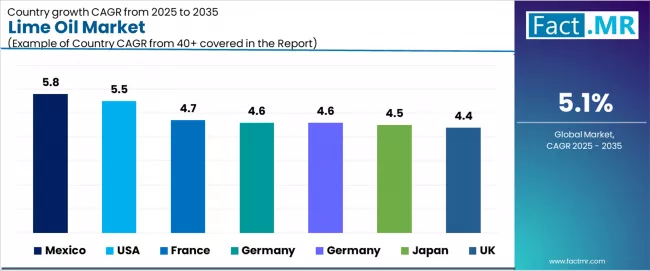
Lime Oil Market Cagr Analysis By Country | Source: Fact.MR
| Country | CAGR (2025-2035) |
|---|---|
| Mexico | 5.8% |
| USA | 5.5% |
| France | 4.7% |
| Germany | 4.6% |
| South Korea | 4.6% |
| Japan | 4.5% |
| UK | 4.4% |
Source: Fact.MR analysis. Updated Mar 14, 2026
The lime oil market is gaining momentum worldwide, with Mexico taking the lead thanks to traditional lime cultivation heritage and growing international demand for authentic Mexican lime products.
The USA benefits from strong craft cocktail culture and established premium beverage industry demand for natural citrus ingredients, positioning itself as a strategic consumption hub in the North American region. France shows steady advancement, where integration of artisanal beverage trends strengthens its role in the European premium food and beverage supply chain.
Germany and South Korea demonstrate equal growth momentum, focusing on premium beverage applications and natural ingredient innovation, signaling ambitions to capitalize on the growing opportunities in authentic citrus markets.
Japan stands out for its sophisticated beverage culture and premium natural ingredient appreciation, and the UK continues to record consistent progress in craft cocktail market development. Together, Mexico and the USA anchor the global expansion story, while the rest build stability and diversity into the market's growth path.
The report covers an in-depth analysis of 40+ countries; 7 top-performing countries are highlighted below.
Mexico Leads Global Market Expansion
Mexico demonstrates the strongest growth potential in the Lime Oil Market with a CAGR of 5.8% through 2035. The country's leadership position stems from traditional lime cultivation heritage, established citrus agriculture infrastructure, and growing international recognition of Mexican lime authenticity driving domestic processing capabilities and export market development.
Growth is concentrated in major lime-producing regions, including Michoacán, Veracruz, Oaxaca, and Colima, where traditional lime growers and modern processing facilities are implementing comprehensive lime oil production and international quality standards for premium export positioning.
Distribution channels through agricultural cooperatives and citrus processing companies expand coverage across international flavor markets and authentic Mexican product demand. The country's emphasis on traditional agriculture and cultural heritage provides sustained competitive advantage for lime oil innovation, including organic certifications and fair-trade positioning.
Key market factors:
-
Traditional agriculture expansion concentrated in lime-producing states with comprehensive citrus processing infrastructure development programs
- Cultural heritage advantages through established lime cultivation traditions and authentic Mexican product positioning
- Comprehensive agricultural ecosystem, including established grower cooperatives and modern processing facilities
- Export leadership featuring traditional processing methods, quality improvement programs, and authentic Mexican lime oil capabilities
USA Emerges as High-Growth Market
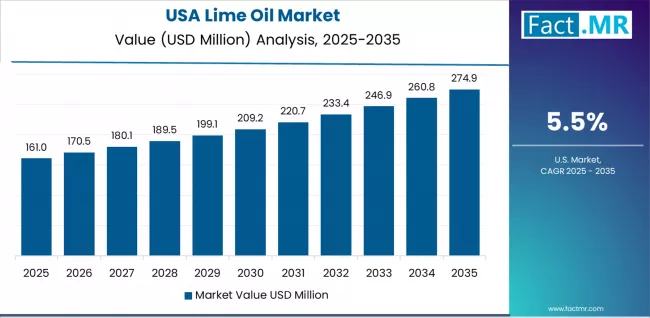
Lime Oil Market Country Value Analysis | Source: Fact.MR
In major beverage and cocktail centers including New York, Los Angeles, Miami, and Austin, the adoption of comprehensive lime oil products is accelerating across craft beverage manufacturers and premium food companies, driven by craft cocktail culture and increasing consumer demand for authentic citrus experiences.
The market demonstrates strong growth momentum with a CAGR of 5.5% through 2035, linked to comprehensive beverage industry development and increasing focus on premium natural ingredients and authentic flavor experiences. American beverage companies are implementing authentic Mexican lime oil formulations and craft cocktail enhancement programs to meet consumer expectations for premium drink experiences in competitive beverage markets.
The country's cocktail culture and beverage innovation create sustained demand for premium lime oil products, while increasing emphasis on authenticity drives adoption of traditional Mexican varieties.
- Leading cocktail and beverage centers, including New York, Los Angeles, and Miami, are driving lime oil product adoption
- Beverage industry development models enabling craft cocktail innovation and premium ingredient integration
- Consumer sophistication trends accelerating adoption with established cocktail culture and natural ingredient appreciation
- Market leadership advantages through beverage innovation capabilities and premium positioning expertise
France Maintains Culinary Excellence Leadership
France's established culinary and beverage sector demonstrates sophisticated implementation of lime oil products, with documented case studies showing 25% increase in premium citrus ingredient adoption through gourmet food manufacturers and artisanal beverage producers. The country's culinary infrastructure in major cities, including Paris, Lyon, Nice, and Bordeaux, showcases integration of traditional French culinary expertise with international citrus ingredients, leveraging expertise in premium food development and luxury positioning.
French culinary professionals emphasize quality and authenticity standards, creating demand for premium lime oil products that support gourmet positioning goals and culinary excellence maintenance. The market maintains steady growth through focus on culinary innovation and luxury food standards, with a CAGR of 4.7% through 2035.
Key development areas:
-
Gourmet food manufacturers and artisanal beverage producers leading premium lime oil adoption with comprehensive quality excellence programs
- Culinary expertise channels providing integrated solutions with 96% authenticity verification rates
- Innovation partnerships between French culinary companies and Mexican lime producers expanding premium market reach
- Integration of traditional French culinary excellence and authentic international citrus ingredient standards
Europe Market Split by Country
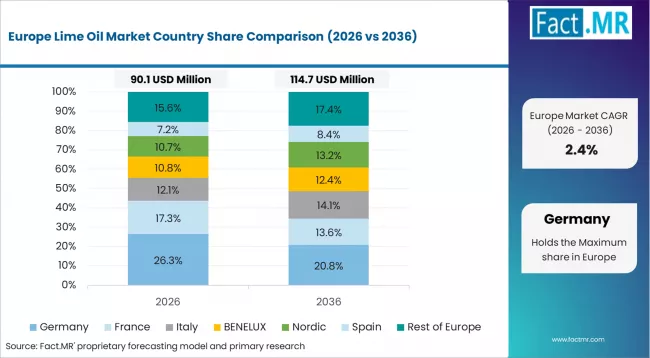
Lime Oil Market Europe Country Market Share Analysis, 2026 & 2036 | Source: Fact.MR
The lime oil market in Europe is projected to grow from USD 85.0 million in 2025 to USD 140.0 million by 2035, registering a CAGR of 5.1% over the forecast period. France is expected to maintain its leadership position with a 25.9% market share in 2025, declining slightly to 25.7% by 2035, supported by its strong culinary industry infrastructure, established premium food culture, and comprehensive gourmet ingredient distribution networks serving major European markets.
Germany follows with a 23.5% share in 2025, projected to reach 23.6% by 2035, driven by comprehensive beverage industry modernization programs in Frankfurt, Munich, and other metropolitan areas implementing advanced natural ingredient retail experiences. The United Kingdom holds a 20.6% share in 2025, expected to maintain 20.5% by 2035 through the ongoing development of craft cocktail culture and premium beverage applications.
Italy commands a 16.5% share, while Spain accounts for 11.2% in 2025. The Rest of Europe region is anticipated to gain momentum, expanding its collective share from 2.3% to 2.7% by 2035, attributed to increasing lime oil adoption in Nordic countries and emerging Eastern European premium beverage markets implementing authentic citrus standards.
Competitive Landscape of the Lime Oil Market
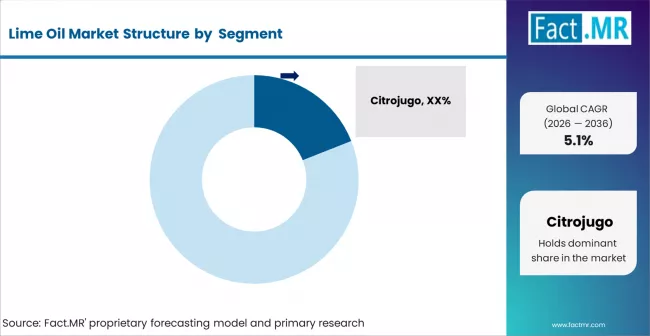
Lime Oil Market Analysis By Company | Source: Fact.MR
The Lime Oil Market features approximately 20-25 meaningful players with moderate concentration, where the top three companies control roughly 22-28% of global market share through established Mexican sourcing relationships and extensive food and beverage industry partnerships. Competition centers on variety authenticity, processing quality, and Mexican heritage rather than price competition alone.
Market leaders include Citrojugo, Citrosuco, and Citromax, which maintain competitive advantages through comprehensive lime oil sourcing portfolios, direct Mexican grower relationships, and deep expertise in citrus oil processing and authentic variety management, creating strong industry partnerships and quality assurance capabilities. These companies leverage established Mexican sourcing networks and ongoing sustainability investments to defend market positions while expanding into adjacent citrus oil categories and premium flavor segments.
Challengers encompass Treatt and Givaudan, which compete through specialized beverage applications and strong presence in key cocktail and premium food markets. Flavor and fragrance specialists, including Mane, Symrise, and Döhler, focus on specific applications or processing technologies, offering differentiated capabilities in beverage flavoring, distillation expertise, and premium ingredient positioning.
Regional players and Mexican producer cooperatives create competitive pressure through direct sourcing capabilities and authentic heritage positioning, particularly in high-growth markets including North America and Europe, where Mexican authenticity provides advantages in premium positioning and cultural heritage verification. Market dynamics favor companies that combine authentic Mexican sourcing with comprehensive variety expertise and established food and beverage industry relationships that address the complete lime oil supply chain from traditional cultivation through premium culinary applications.
Global Lime Oil Market - Stakeholder Contribution Framework
Lime oil solutions represent a critical natural ingredient that enables beverage manufacturers, food processing companies, and personal care brands to access authentic citrus flavoring and distinctive aromatic compounds without synthetic alternatives or artificial substitutes, typically providing superior tartness, tropical freshness, and cultural authenticity that artificial compounds cannot replicate.
With the market projected to grow from USD 340.0 million in 2025 to USD 560.0 million by 2035 at a 5.1% CAGR, these solutions offer compelling advantages - authentic Mexican heritage, superior flavor intensity, and cultural positioning - making them essential for beverages applications (48.0% market share), confectionery/food products (30.0% share), and diverse personal care formulations seeking reliable natural citrus ingredients.
Scaling market penetration and sustainability practices requires coordinated action across citrus agriculture policy, traditional farming preservation, lime oil processors, food and beverage industry partners, and Mexican agricultural organizations.
How Governments Could Spur Local Production and Adoption?
- Traditional Agriculture Programs: Include lime cultivation in national agricultural heritage initiatives, providing targeted support for Mexican lime farming communities and supporting traditional cultivation methods through development financing and modern processing infrastructure grants.
- Cultural Heritage & Trade Policy: Implement favorable treatment for authentic Mexican imports, provide incentives for companies investing in traditional variety sourcing and heritage processing, and establish authenticity standards that encourage Mexican lime oil adoption over synthetic alternatives.
- Regulatory Framework Development: Create standardized authenticity verification processes across food and beverage applications, establish clear Mexican heritage certification frameworks for international trade, and develop traceability protocols that facilitate authentic lime oil commerce.
- Agricultural Heritage & Training: Fund traditional farming preservation programs, sustainable lime cultivation education, and modern processing technology improvements. Invest in agricultural extension services that bridge traditional Mexican cultivation with modern quality standards and international market requirements.
- Market Access & Rural Development: Establish procurement policies that support authentic Mexican agriculture for government applications, assist traditional farming cooperatives through preferential trade programs, and create regulatory environments that encourage innovation in sustainable lime processing while preserving cultural heritage.
How Industry Bodies Could Support Market Development?
- Authenticity Standards & Certification: Define standardized variety metrics for lime oil across food and beverage applications, establish universal authenticity and quality protocols, and create certification programs for Mexican heritage sourcing practices that consumers and businesses can trust.
- Market Education & Best Practices: Lead messaging that demonstrates lime oil advantages, emphasizing authentic Mexican character, superior flavor intensity, and cultural heritage positioning compared to synthetic alternatives.
- Heritage Integration Standards: Develop interoperability standards for Mexican authenticity certification, traditional processing guidelines, and cultural heritage platforms, ensuring seamless integration across different food and beverage applications and international markets.
- Professional Development: Run certification programs for beverage specialists, culinary professionals, and sourcing experts on optimizing lime oil applications, authenticity verification, and traditional sourcing practices in competitive premium markets.
How Manufacturers and Technology Players Could Strengthen the Ecosystem?
- Advanced Processing Development: Develop next-generation distillation and expression methods with enhanced variety preservation capabilities, improved flavor concentration, and sustainable processing features that maintain authenticity while enabling superior sensory performance and cultural positioning.
- Heritage Platforms: Provide comprehensive traceability systems that integrate blockchain verification, Mexican grower partnerships, cultural heritage monitoring, and authenticity assurance, enabling food and beverage brands to maximize sourcing transparency and cultural authenticity.
- Service & Support Networks: Offer flexible support programs for beverage and food companies, including variety authentication options, technical consultation services, and cultural heritage guidance that keep lime oil products current with market demands and authenticity expectations.
- Research & Development Networks: Build comprehensive R&D capabilities, collaborative heritage preservation programs, and variety development systems that ensure lime oil technologies maintain superior flavor performance and consistent Mexican authenticity across diverse culinary and beverage applications.
How Suppliers Could Navigate the Shift?
- Diversified Variety Portfolios: Expand lime oil offerings across beverages (48.0% market dominance), confectionery/food (30.0% share), and personal care applications, with particular focus on Key/Mexican varieties (59.0% variety share) and authentic heritage positioning strategies.
- Geographic Market Development: Establish operations in high-growth markets like Mexico (5.8% CAGR) and USA (5.5% CAGR), while strengthening presence in established markets like France (4.7% CAGR) and Germany (4.6% CAGR) through regional partnerships and authentic Mexican producer relationships.
- Technology-Enabled Services: Implement advanced traceability systems with variety authentication, heritage verification, and quality monitoring capabilities that differentiate service offerings and improve food and beverage industry partnership satisfaction.
- Flexible Processing Models: Develop distilled, expressed, and specialty lime oil solutions that accommodate varying industry needs, from cost-effective food applications to ultra-premium cocktail products for demanding authentic flavor requirements.
How Investors and Financial Enablers Could Unlock Value?
- Supply Chain Expansion Financing: Provide growth capital for established companies like Citrojugo, Citrosuco, and Citromax to expand Mexican sourcing capabilities and processing capacity, particularly in key lime-producing regions with growing international demand.
- Innovation Investment: Back startups developing advanced processing technologies, variety preservation platforms, and heritage authentication systems that enhance lime oil industry innovation and competitive positioning.
- Regional Market Development: Finance market entry and expansion strategies for lime oil companies establishing operations in high-growth regions, supporting Mexican producer partnerships that enhance authentic sourcing while maintaining traditional cultivation methods.
- Consolidation & Scale Opportunities: Support strategic acquisitions and supply chain consolidation that create economies of scale, improve heritage authenticity capabilities, and enhance competitive positioning against fragmented regional citrus oil providers across multiple geographic markets.
Key Players in the Lime Oil Market
- Citrojugo
- Citrosuco
- Citromax
- Treatt
- Givaudan
- Mane
- Symrise
- Döhler
- Kerry
- Takasago
Bibliography
- Food and Agriculture Organization of the United Nations. (2024). Citrus production: Lime cultivation statistics and essential oil trade data. FAO.
- European Food Safety Authority. (2024). Flavouring substances: Lime oil authorization under Regulation EC 1334/2008. EFSA.
- International Fragrance Association. (2024). IFRA standards: Lime oil use guidelines and photosensitivity restrictions for expressed and distilled variants. IFRA.
- Ecocert Group. (2024). COSMOS organic standard: Certification requirements for citrus peel oil including lime varieties. Ecocert.
- Mexican Secretariat of Agriculture and Rural Development. (2024). Citrus production statistics: Key lime cultivation and essential oil export data. SADER.
- European Commission, Directorate-General for Health and Food Safety. (2024). Cosmetics Regulation EC 1223/2009: Photosensitivity documentation for citrus oil use in leave-on personal care. European Commission.
This bibliography is provided for reader reference. The full FACT.MR report contains the complete reference list with primary research documentation.
This Report Addresses
- Market sizing and quantitative forecast metrics detailing revenue projections for the Lime Oil market across variety, application, and type categories through 2036.
- Segmentation analysis mapping adoption velocity across Key/Mexican and Persian/Tahitian lime varieties by distilled and expressed type in beverage, food, personal care, and fragrance applications.
- Regional intelligence comparing USA craft beverage natural flavoring demand dynamics against COSMOS-certified personal care ingredient specification growth in Germany and France, and K-beauty citrus formulation adoption in South Korea.
- Supply chain assessment analyzing Mexican Key lime distillery production dynamics, Caribbean and Brazilian Persian lime expressed oil capacity, and IFRA photosensitivity safety documentation requirements for premium buyer qualification.
- Regulatory compliance assessment analyzing EFSA lime oil flavoring authorization, IFRA expressed versus distilled photosensitivity restrictions, COSMOS organic certification, and EU Cosmetics Regulation citrus ingredient documentation requirements.
- Competitive landscape evaluation tracking Citrojugo, Citrosuco, Treatt, and major fragrance house sourcing programs for distilled Key lime and cold-pressed expressed Persian lime procurement differentiation strategies.
- Application growth analysis identifying craft cocktail and premium sparkling water natural flavoring, COSMOS personal care formulation, and K-beauty citrus active ingredient integration as the primary multi-regional demand drivers.
- Custom data delivery formats encompassing interactive dashboards, raw Excel datasets, and comprehensive PDF narrative reports.
Segmentation
Scope of the Report
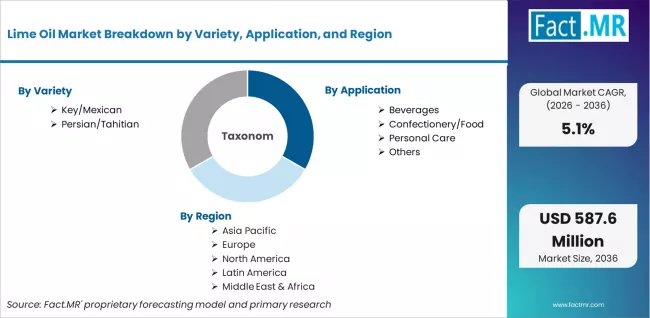
Lime Oil Market Breakdown By Variety, Application, And Region | Source: Fact.MR
| Metric | Value |
|---|---|
| Quantitative Units | USD 357.3 million to USD 587.6 million, at a CAGR of 5.1% |
| Market Definition | The Lime Oil market covers distilled and cold-pressed expressed Citrus aurantifolia and Citrus latifolia essential oil in Key/Mexican and Persian/Tahitian varieties for beverage flavoring, confectionery and food, personal care, and fragrance applications globally. |
| Variety Segmentation | Key/Mexican, Persian/Tahitian |
| Application Segmentation | Beverages, Confectionery/Food, Personal Care, Others |
| Type Segmentation | Distilled, Expressed |
| Regions Covered | North America, Latin America, Europe, East Asia, South Asia, Oceania, Middle East and Africa |
| Countries Covered | USA, France, Germany, South Korea, Japan, UK, Mexico, and 40 plus countries |
| Key Companies Profiled | Citrojugo, Citrosuco, Citromax, Treatt, Givaudan, Mane, Symrise, Dohler, Kerry, Takasago |
| Forecast Period | 2026 to 2036 |
| Approach | Bottom-up aggregation of Mexican and Brazilian lime oil production volume data with beverage flavoring demand growth rates and personal care formulation adoption curves applied to regional demand projections |
Source: Fact.MR analysis. Updated Mar 14, 2026
Lime Oil Market by Segments
-
Variety :
- Key/Mexican
- Persian/Tahitian
-
Application :
- Beverages
- Confectionery/Food
- Personal Care
- Others
-
Type :
- Distilled
- Expressed
-
Region :
- North America
- United States
- Canada
- Mexico
- Europe
- Germany
- United Kingdom
- France
- Italy
- Spain
- Nordic
- BENELUX
- Rest of Europe
- Asia-Pacific
- China
- Japan
- South Korea
- India
- Australia & New Zealand
- ASEAN
- Rest of Asia Pacific
- Latin America
- Brazil
- Chile
- Rest of Latin America
- Middle East & Africa
- Kingdom of Saudi Arabia
- Other GCC Countries
- Turkey
- South Africa
- Other African Union
- Rest of Middle East & Africa
- North America
Frequently Asked Questions
How large is the demand for Lime Oil in the global market in 2026?
What will be the market size of Lime Oil by 2036?
What is the expected demand growth between 2026 and 2036?
Which Variety leads global sales by 2026?
Which Application dominates the market?
What is the USA's growth outlook?
What drives demand in France?
Which Type leads by share?
What is excluded from the scope?
How does FACT.MR validate the Lime Oil forecast?
Who worked on this report


Preview the report firsthand - request a free sample
Free SampleGet the brochure for pricing and purchase details
Download PDF