- Base Value(2025): 4.8 Bn
- Estimated Value(2026): 4.9 Bn
- Forecast Value (2036): 7.0 Bn
- CAGR (2026 - 2036): 3.7%
Mineral Feed Market Forecast and Outlook By Fact.MR
In 2025, the mineral feed market was valued at USD 4.8 billion. Based on Fact.MR analysis, demand for mineral feed is estimated to grow to USD 4.9 billion in 2026 and USD 7.0 billion by 2036. FACT.MR projects a CAGR of 3.7% during the forecast period.
FACT.MR analysis indicates the mineral feed market is expected to generate an absolute dollar opportunity of USD 2.1 billion between 2026 and 2036. Growth is supported by rising livestock populations in Asia Pacific. Poultry and dairy production are expanding in India and Brazil. Feed formulations are also shifting from inorganic minerals to chelated and organic forms. However, growth faces some constraints. Phosphate and zinc raw material prices remain volatile. Antibiotic restrictions have increased feed formulation complexity. Environmental regulations on phosphorus excretion also add compliance costs in the EU and North America.
Country growth reflects livestock production intensity, protein consumption growth, and chelated mineral adoption rates. India leads at 6.5% CAGR driven by expanding dairy herd intensification and government-backed livestock productivity programmes. Brazil follows at 5.0% supported by growing poultry and swine export production and expanding mineral supplementation adoption across feedlot operations. Japan posts 5.5% through premium aquaculture and high-bioavailability mineral adoption in intensified livestock operations. China records 4.9% driven by swine herd rebuilding after ASF recovery and growing poultry layer production. The USA at 3.7% represents a mature market generating reformulation-driven demand, with structural constraints from low birth rate herd growth and high existing mineral supplementation saturation.
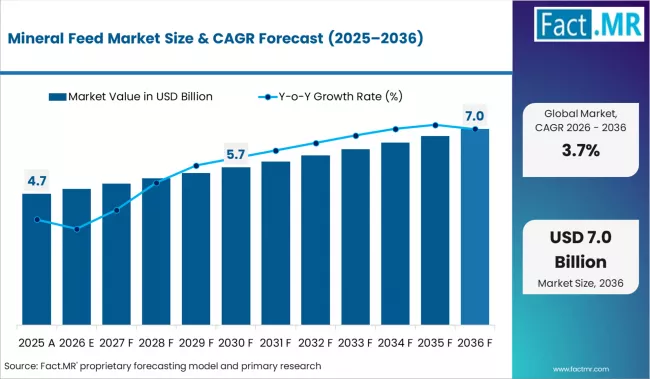
Mineral Feed Market Market Value Analysis | Source: Fact.MR
| Metric | Value |
|---|---|
| Estimated Value in 2026 | USD 4.9 billion |
| Forecast Value in 2036 | USD 7.0 billion |
| Forecast CAGR (2026 to 2036) | 3.7% |
Source: Fact.MR analysis. Updated Mar 23, 2026
Mineral Feed Market Definition
The mineral feed market includes inorganic, organic, and chelated mineral supplements used in livestock nutrition. These minerals are added to compound feed, premixes, and mineral licks for livestock, poultry, aquaculture, and equine production.
Mineral Feed Market Inclusions
Includes global and regional revenue forecasts from 2026 to 2036 by mineral type and end-use application. The scope covers inorganic mineral salts, chelated trace minerals, mineral premixes, and mineral lick blocks used across dairy, poultry, swine, equine, and aquaculture sectors.
Mineral Feed Market Exclusions
Excludes vitamin and amino acid premixes not classified as mineral feeds. Finished compound feed with low mineral inclusion levels is also excluded. Pet food mineral additives, crop fertiliser minerals, and veterinary mineral injections are outside the market scope.
Mineral Feed market Research Methodology
- Primary Research:
- Interviews were conducted with livestock nutritionists and dairy farm procurement managers. Feed mill formulators, poultry integrator procurement heads, and mineral ingredient distributors were also interviewed. Respondents were located across North America, Europe, Asia Pacific, and Latin America.
- Desk Research:
- Key sources included FAO livestock production statistics and USDA feed ingredient reports. The Alltech Agri-Food Outlook 2025 and the EU Feed Additives Register were also used.
- Additional sources included India’s Department of Animal Husbandry data, Brazil MAPA feed standards, and company annual reports from 2024–2025.
- Market Sizing and Forecasting:
- Market estimates combine top-down and bottom-up approaches. The model uses livestock population data by species and country.
- Mineral inclusion rates by application and ingredient prices by mineral type were also analysed. Feed mill production data by region supported demand estimates.
- Data Validation and Update Cycle:
- Forecasts were validated using annual revenue disclosures from Cargill, Nutreco, Kemin Industries, and Novus International. FAO livestock census data supported additional verification.
- Primary interviews with feed formulation specialists were also used to confirm market estimates.
Summary Of Mineral Feed Market
- Market Definition
- The mineral feed market includes inorganic salts, chelated minerals, and organic mineral premixes used as livestock nutritional supplements.
- These products support animal health, productivity, and regulatory feed standards across dairy, poultry, swine, aquaculture, and equine sectors.
- Demand Drivers
- India’s National Livestock Mission and Rashtriya Gokul Mission are improving dairy herd nutrition standards. These programmes are increasing mineral supplement adoption among dairy farmers.
- Brazil’s poultry and swine export industry requires mineral feed formulations that meet EU and U.S. import standards. Feed mills are therefore increasing use of higher-quality mineral additives.
- EU antibiotic restrictions are encouraging the use of organic trace minerals that support immune health and growth performance in poultry and swine operations.
- Key Segments Analyzed
- By Mineral Type: Phosphorus holds around 30% share in 2026. It is essential for bone formation and energy metabolism in livestock diets.
- By End-Use Application: Poultry accounts for about 36% share in 2026. Strong broiler production and egg quality requirements drive mineral supplementation demand.
- By Geography: India records the highest growth with around 6.5% CAGR through 2036. North America and Western Europe show slower growth due to mature livestock production systems.
- Analyst Opinion at FACT.MR
- Shambhu Nath Jha, Principal Consultant at Fact.MR, states that organic and chelated minerals are creating premium opportunities for feed producers. Environmental phosphorus regulations and antibiotic restrictions are also influencing feed formulation strategies in major livestock markets.
- Strategic Implications
- Mineral feed producers should expand production of chelated zinc, copper, and manganese. Demand is increasing from poultry and swine producers shifting away from inorganic mineral forms.
- Companies should develop low-phosphorus mineral formulations to meet environmental compliance standards in intensive livestock regions.
- Manufacturers should strengthen distribution partnerships with feed mills in India and Brazil. These markets offer strong growth opportunities as livestock production expands.
- Methodology
- Market sizing uses livestock population data by species and country. Mineral inclusion rates and ingredient pricing data were also analysed.
- FAO livestock statistics, USDA feed ingredient reports, Alltech Agri-Food Outlook 2025, and EU Feed Additives Register supported supply-side analysis.
- Forecasts incorporate livestock population growth, adoption of chelated minerals, antibiotic policy changes, and interviews with feed formulation specialists.
Segmental Analysis
Mineral Feed Market Analysis by Mineral Type
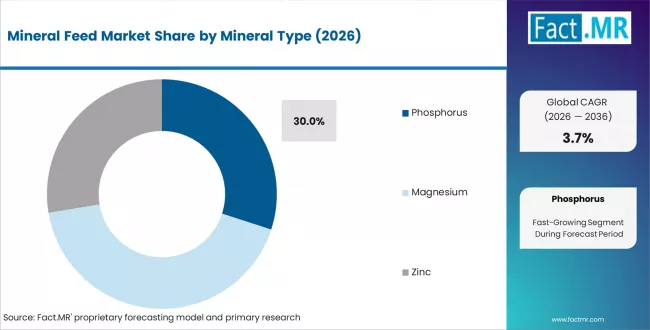
Mineral Feed Market Analysis By Mineral Type | Source: Fact.MR
FACT.MR estimates phosphorus will hold around 30% share of market value in 2026. Phosphorus plays a key role in skeletal development and energy metabolism. Dicalcium phosphate and monocalcium phosphate remain the most widely used mineral feed ingredients.
- Cargill Micronutrition Expansion: In 2025, Cargill expanded production capacity within its Micronutrition and Health Solutions division. The platform integrates Diamond V, Delacon, and Provimi nutrition capabilities. Growth in chelated minerals and phytase enzymes supported strong demand from poultry and swine producers. [5]
- Novus International Biotech Partnership: In September 2024, Novus International partnered with a biotechnology company to develop new organic trace mineral products. The collaboration focuses on zinc and copper chelation technologies designed to improve bioavailability and reduce environmental mineral excretion. [6]
- Alltech Global Feed Production Data: Alltech’s 2025 Agri-Food Outlook analysed feed production from over 28,000 feed mills worldwide. Global feed production reached approximately 1.26 billion tonnes in 2024. The recovery in compound feed volumes supported mineral premix demand across livestock sectors. [1]
Mineral Feed Market Analysis by End-Use Application
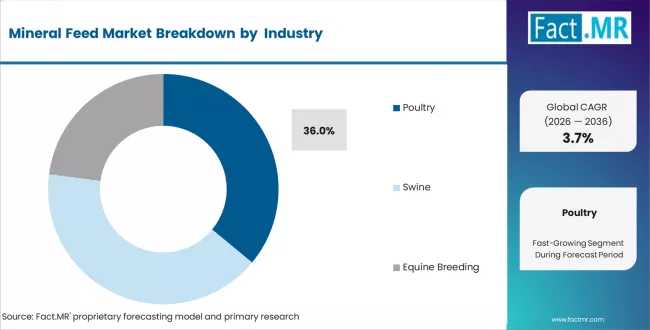
Mineral Feed Market Analysis By End Use Application | Source: Fact.MR
FACT.MR estimates poultry will account for around 36% of mineral feed demand in 2026. Broiler and layer production systems require precise mineral nutrition. Minerals support bone development, feed efficiency, and eggshell quality in high-density poultry operations.
- Trouw Nutrition Southeast Asia: Nutreco’s Trouw Nutrition division expanded online distribution of mineral supplements across Southeast Asia in 2024. Digital agriculture platforms recorded strong growth in livestock nutrition product sales in Indonesia, Vietnam, and Thailand. [7]
- dsm-firmenich Egypt Premix Plant: In 2024, dsm-firmenich opened a premix and additives plant in Egypt. The facility supplies vitamin and mineral premixes to poultry and dairy producers across North Africa and the Middle East. The plant also reduces regional dependence on imported feed additives. [8]
- Aquaculture Mineral Demand Growth: Japan’s aquaculture sector requires specialised mineral nutrition for marine species. Updated aquafeed nutrient guidelines introduced in 2024 require improved documentation of trace minerals in fish feed. This change is increasing demand for bioavailable mineral supplements from suppliers such as Kemin Industries Japan. [9]
Drivers, Restraints, and Opportunities
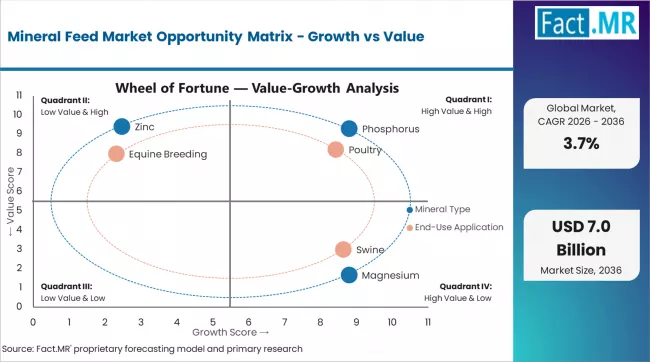
Mineral Feed Market Opportunity Matrix Growth Vs Value | Source: Fact.MR
FACT.MR analysts note that the mineral feed market is a core segment of the animal nutrition industry. Mineral supplementation is necessary to maintain livestock growth, immunity, and reproductive performance. Most livestock diets based on grass, silage, and grain lack sufficient minerals. This makes mineral supplementation a routine requirement for commercial livestock production. The market is gradually shifting toward chelated and organic trace minerals. These formulations offer better bioavailability and lower environmental excretion.
- EU Antibiotics and Trace Mineral Regulation: EU Regulation (EU) 2019/6 restricts prophylactic antimicrobial use in livestock production from January 2022. Feed producers are increasing use of chelated zinc, copper, and selenium to support animal immunity. EU Implementing Regulation 2016/1095 also limits zinc inclusion levels in feed, encouraging the use of more bioavailable mineral forms. [2]
- Brazil Poultry Mineral Standards: Brazil updated Normative Instruction No. 65 in November 2024. The regulation requires clearer mineral content declarations in compound feed. Poultry integrators such as BRF and JBS operate large feed mills that follow export market mineral standards. Cargill also expanded feed production capacity in North America in 2025, strengthening its mineral supplement distribution network. [3]
- India Livestock Productivity Programme: India’s Rashtriya Gokul Mission includes funding for mineral supplementation programmes. Veterinary centres and dairy cooperatives distribute mineral mixtures to improve livestock productivity. The Department of Animal Husbandry also expanded dairy development programmes in 2024. Companies including Kemin Industries and Novus International expanded their sales networks in India to serve the growing feed sector. [4]
Regional Analysis
The mineral feed market is analysed across North America, Europe, Asia Pacific, Latin America, and Middle East and Africa, covering country-level demand profiles shaped by livestock population size, protein consumption growth trajectories, mineral supplementation regulatory frameworks, and feed mill infrastructure maturity. The full report offers market attractiveness analysis based on livestock herd growth, feed production volumes, and chelated mineral adoption rates.
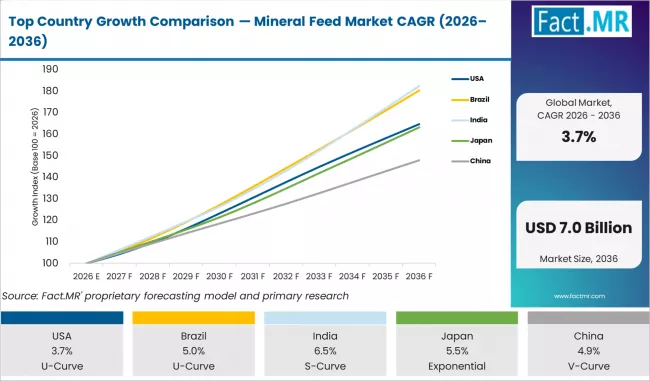
Top Country Growth Comparison Mineral Feed Market Cagr 2026 To 2036 | Source: Fact.MR
| Country | CAGR (2026 to 2036) |
|---|---|
| USA | 3.7% |
| Brazil | 5.0% |
| India | 6.5% |
| Japan | 5.5% |
| China | 4.9% |
Source: Fact.MR analysis. Updated Mar 23, 2026
Source: Fact.MR (FACT.MR) analysis, based on proprietary forecasting model and primary research
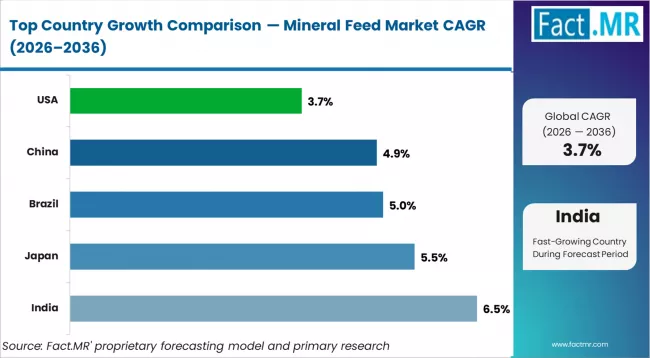
Mineral Feed Market Cagr Analysis By Country | Source: Fact.MR
Asia Pacific Mineral Feed Market Analysis
Asia Pacific is the largest and fastest-growing mineral feed market. Growth comes from expanding dairy production in India and recovery of the swine sector in China. Global suppliers such as Cargill, Nutreco’s Trouw Nutrition, Kemin Industries, and dsm-firmenich compete with regional producers including Ajinomoto Animal Nutrition and local premix manufacturers.
- India: Across India, mineral feed demand is expected to grow at 6.5% CAGR through 2036. The country has more than 300 million cattle and buffalo. Mineral deficiency in smallholder dairy herds supports steady demand for calcium, phosphorus, and trace mineral supplements. The Rashtriya Gokul Mission includes funding for mineral mixture distribution through dairy cooperatives and veterinary networks. Government dairy development programmes launched in 2024 also include mineral supplementation targets. Companies such as Kemin Industries and Novus International expanded feed mill distribution networks in tier-2 cities.
- China: Within China, mineral feed demand is projected to grow at 4.9% CAGR through 2036. The national swine herd recovered to about 440 million head after African Swine Fever losses. This recovery increased demand for phosphorus, calcium, and zinc in swine feed. China updated GB 13078 feed hygiene standards in 2024, tightening heavy metal limits in mineral ingredients. These changes increased demand for certified clean-source minerals. Companies such as dsm-firmenich and Trouw Nutrition maintain strong premix manufacturing presence in the country.
FACT.MR’s Asia Pacific analysis covers India, China, Japan, South Korea, ASEAN, Australia and New Zealand, and the Rest of South Asia and Pacific. The report includes livestock population benchmarks, mineral adoption trends, and government livestock programme investments by country.
Latin America Mineral Feed Market Analysis
Latin America represents a high-growth mineral feed region. Brazil’s poultry and beef export industry supports large compound feed production volumes. Mineral premix formulations increasingly follow EU and U.S. market requirements for export compliance. Cargill and Nutreco operate large premix production facilities in the region, while regional suppliers serve domestic livestock sectors.
- Brazil: In Brazil, mineral feed demand is forecast to grow at 5.0% CAGR through 2036. The country is the world’s largest exporter of beef and chicken. Poultry processors such as BRF and JBS operate large integrated production systems that require mineral-specified feed. Brazil updated Normative Instruction No. 65 in November 2024, requiring clearer mineral declarations on feed labels. The regulation is encouraging feed mills to improve mineral formulation accuracy. Cargill expanded its feed production infrastructure through acquisitions and new facility investments across the Americas.
FACT.MR’s Latin America analysis covers Brazil, Mexico, Argentina, Chile, and the Rest of Latin America. The report includes regulatory benchmarks, export compliance requirements, and country-level mineral feed demand forecasts.
North America Mineral Feed Market Analysis
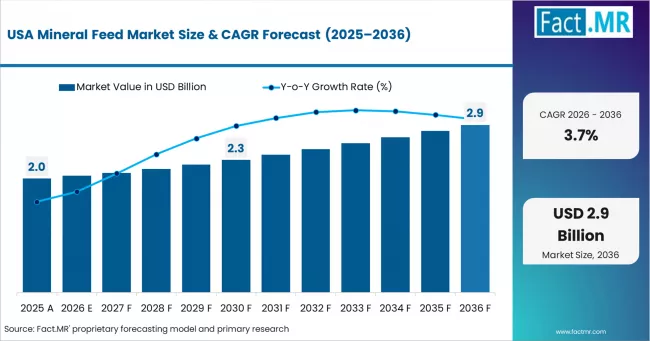
Mineral Feed Market Country Value Analysis | Source: Fact.MR
North America is a mature mineral feed market. Growth mainly comes from reformulation toward chelated and organic trace minerals rather than expansion in livestock numbers. Major suppliers include Cargill, Kemin Industries, and Purina Animal Nutrition, competing through precision nutrition solutions and feed mill partnerships.
- USA: For the United States, mineral feed demand is expected to grow at 3.7% CAGR through 2036. Poultry, swine, and dairy sectors already maintain advanced feed formulation practices. Updated FDA guidance on selenium inclusion levels in 2024 is driving reformulation of mineral premixes. Cargill expanded its feed mill network through acquisitions in Denver and Kansas City in 2024. The company also increased micronutrition production capacity through its Diamond V, Delacon, and Provimi businesses. Kemin Industries expanded subscription-based mineral supply programmes for dairy and poultry farms, reflecting demand for stable supply logistics.
FACT.MR’s North America analysis covers the United States, Canada, and Mexico. The report includes regulatory guidance data, chelated mineral adoption benchmarks, and country-level demand forecasts by mineral type and application.
Competitive Aligners for Market Players
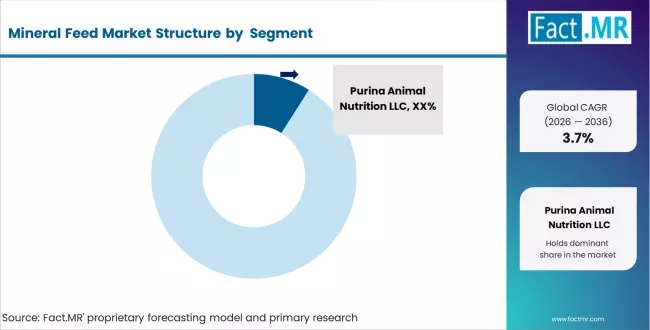
Mineral Feed Market Analysis By Company | Source: Fact.MR
The global mineral feed market shows moderate concentration at the ingredient and premix level, while remaining fragmented at the regional production level. Leading companies such as Cargill, Nutreco (Trouw Nutrition), dsm-firmenich, Kemin Industries, and Novus International together account for roughly 25–35% of global mineral feed ingredient and premix revenue. The rest of the market is served by regional premix manufacturers, mineral salt suppliers, and feed mills linked to cooperatives across Asia Pacific and Latin America. Competition in this market is shaped by formulation expertise, product bioavailability, and regulatory compliance rather than price alone.
Cargill benefits from its vertically integrated supply chain and strong access to key raw materials such as phosphorus and calcium. Its micronutrition platforms, including Diamond V, Delacon, and Provimi, support the development of higher-value mineral nutrition solutions. Nutreco’s Trouw Nutrition focuses on precision livestock nutrition and has strong market presence in the EU poultry and swine sectors. Kemin Industries is recognised for its expertise in organic trace mineral chelation technologies and strong regulatory relationships.
Large poultry integrators and dairy cooperatives typically purchase mineral feed through competitive tenders. However, specialised chelated mineral technologies can create switching barriers in premium nutrition segments.
Key Players
- Purina Animal Nutrition LLC
- Nutreco N.V.
- VH Group
- Kemin Industries, Inc.
- Novus International, Inc.
- Cargill Inc.
- Kent Feeds
- Avitech Nutrition Pvt. Ltd.
- Royal DSM (dsm-firmenich)
- Kalmbach Feeds, Inc.
- Ranch-Way Feeds
- Mercer Milling Company
Bibliography
- [1] Alltech Inc. (2025). 2025 Alltech Agri-Food Outlook: 14th Annual Global Feed Production Survey Data from 28,235 Feed Mills in 142 Countries Reporting 1.2% Rebound in Global Feed Production for 2024. April 2025. alltech.com/agri-food-outlook
- [2] European Commission. (2022). Commission Implementing Regulation (EU) 2022/1643 Amending Implementing Regulation 2016/1095 on Maximum Zinc Content in Complete Feed for All Animal Species Including Livestock. October 2022. eur-lex.europa.eu
- [3] Cargill Inc. (2024). Press Release: Cargill Acquires Two Feed Mills from Compana Pet Brands in Denver Colorado and Kansas City Kansas to Expand Animal Nutrition and Health Business Production and Distribution in US Western and Central Regions. September 2024. cargill.com/news
- [4] Department of Animal Husbandry and Dairying, Government of India. (2024). National Programme for Dairy Development Implementation Update: Mineral Supplementation Distribution Targets for Organised Dairy Cluster Development and Rashtriya Gokul Mission Phase III Funding Allocation. October 2024. dahd.gov.in
- [5] Cargill Inc. (2025). Press Release: Cargill Animal Nutrition and Health Increases Micronutrition Production Capacity to Meet Growing Customer Demand for Chelated Mineral and Precision Nutrition Solutions Across Poultry Swine and Dairy Species. 2025. cargill.com/news
- [6] Novus International Inc. (2024). Press Release: Novus International Strategic Partnership with Biotechnology Company to Develop Next-Generation Organic Trace Mineral Formulations for Livestock Immunity and Gut Health Performance. September 2024. novusint.com/news
- [7] Nutreco N.V. / Trouw Nutrition. (2024). Trouw Nutrition Southeast Asia E-Commerce Distribution Expansion: Cattle and Poultry Mineral Supplement Ranges Listed on Digital Agri-Platforms in Indonesia Vietnam and Thailand Responding to 18% Growth in Online Animal Nutrition Sales. 2024. trouwnutrition.com
- [8] dsm-firmenich. (2024). Press Release: dsm-firmenich Opens Premix and Additives Manufacturing Plant in Egypt to Supply Vitamin and Mineral Premixes for Poultry and Dairy Operations in North Africa and the Middle East. 2024. dsm-firmenich.com/news
- [9] Ministry of Agriculture Forestry and Fisheries, Japan. (2024). Aquafeed Mineral Nutrient Guideline Update: Bioavailable Zinc and Iodine Level Documentation Requirements for Commercial Aquaculture Feed Products. 2024. maff.go.jp
This Report Addresses
- Insights on key regulations affecting mineral feed demand, including EU zinc and copper limits, India’s Rashtriya Gokul Mission programmes, Brazil MAPA feed labelling rules, and FDA selenium guidance.
- Market forecast from USD 4.9 billion in 2026 to USD 7.0 billion by 2036, growing at 3.7% CAGR across mineral type, application, and region.
- Growth opportunities across India dairy mineral supplementation, Brazil poultry export compliance, Japan aquaculture nutrition, China swine herd recovery, and EU chelated mineral adoption.
- Country CAGR outlook including India (6.5%), Japan (5.5%), Brazil (5.0%), China (4.9%), and USA (3.7%), supported by livestock population and feed production data.
- Competitive analysis of major companies including Cargill, Nutreco (Trouw Nutrition), dsm-firmenich, Kemin Industries, Novus International, Purina Animal Nutrition, and Avitech Nutrition.
- Technology tracking covering chelated zinc and copper minerals, low-excretion phosphorus solutions, phytase–mineral optimisation, precision livestock nutrition platforms, and e-commerce mineral supplement distribution.
- Regulatory review of EU feed additive rules, India BIS feed standards, Brazil MAPA regulations, China GB 13078 standards, and FDA selenium limits.
- Report delivery includes PDF report, Excel datasets, PowerPoint summary, and dashboard tools supported by FAO statistics, Alltech data, company reports, and industry interviews.
Segmentation
Scope of Report
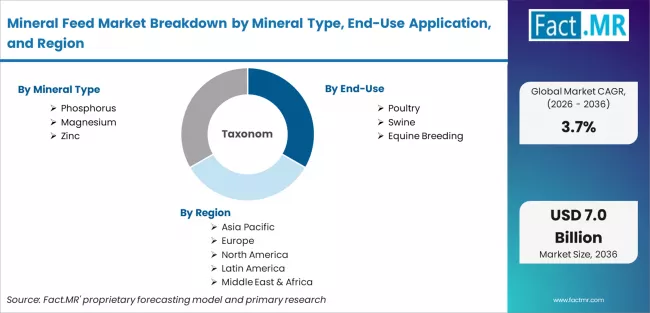
Mineral Feed Market Breakdown By Mineral Type End Use Application And Region | Source: Fact.MR
| Attribute | Details |
|---|---|
| Quantitative Units | USD 4.9 billion (2026) to USD 7.0 billion (2036), at a CAGR of 3.7% |
| Market Definition | Inorganic, chelated, and organic mineral supplement ingredients supplied to livestock, poultry, aquaculture, and equine producers for incorporation into compound feed, premixes, and mineral licks globally. |
| Mineral Type Segmentation | Phosphorus, Calcium, Zinc, Magnesium, Iron, Others |
| End-Use Application Segmentation | Poultry, Dairy, Swine, Aquaculture, Equine Breeding, Others |
| Application Coverage | Broiler and layer feed mineral premixes, dairy cattle mineral licks, swine trace mineral programmes, aquafeed mineral enrichment, equine mineral supplements, and ruminant mineral boluses. |
| Regions Covered | North America, Europe, Asia Pacific, Latin America, Middle East and Africa |
| Countries Covered | USA, Canada, Mexico, Brazil, Argentina, Chile, Rest of Latin America, Germany, UK, France, Netherlands, Spain, Denmark, Poland, Rest of Western Europe, Eastern Europe, China, Japan, South Korea, India, ASEAN, Australia and New Zealand, GCC, South Africa, Rest of MEA |
| Key Companies Profiled | Purina Animal Nutrition, Nutreco, VH Group, Kemin Industries, Novus International, Cargill, Kent Feeds, Avitech Nutrition, dsm-firmenich, Kalmbach Feeds, Ranch-Way Feeds, Mercer Milling Company |
| Forecast Period | 2026 to 2036 |
| Approach | Hybrid top-down and bottom-up model using livestock population by species, average mineral inclusion rates, ingredient pricing by type and form, and primary interviews with feed formulation specialists. |
Source: Fact.MR analysis. Updated Mar 23, 2026
Mineral Feed Market by Segments
-
By Mineral Type:
- Magnesium
- Calcium
- Phosphorus
- Iron
- Zinc
- Others
-
By End-Use Application:
- Dairy (Goat, Buffalo, Cow, etc.)
- Poultry
- Swine
- Equine Breeding
- Aquaculture
- Others
-
By Region:
- North America
- United States
- Canada
- Mexico
- Latin America
- Brazil
- Argentina
- Chile
- Rest of Latin America
- Western Europe
- Germany
- United Kingdom
- France
- Netherlands
- Spain
- Denmark
- Poland
- Rest of Western Europe
- Eastern Europe
- Russia
- Poland
- Hungary
- Balkan and Baltic
- Rest of Eastern Europe
- East Asia
- China
- Japan
- South Korea
- South Asia and Pacific
- India
- ASEAN
- Australia and New Zealand
- Rest of South Asia and Pacific
- Middle East and Africa
- Kingdom of Saudi Arabia
- Other GCC Countries
- Turkey
- South Africa
- Rest of Middle East and Africa
- North America
Frequently Asked Questions
How large is the mineral feed market in 2025?
What will the market size be in 2026?
What is the projected market size by 2036?
What is the expected CAGR for the forecast period 2026 to 2036?
Which mineral type holds the leading share?
Which end-use application commands the largest share?
Which country is projected to grow the fastest?
What is the primary restraint?
What is driving the 5.0% CAGR in Brazil?
Why does Japan record a 5.5% CAGR?
What is driving mineral feed demand globally?
Why are chelated minerals gaining popularity?
Which region dominates the mineral feed market?
What role do regulations play in the market?
Who worked on this report


Preview the report firsthand - request a free sample
Free SampleGet the brochure for pricing and purchase details
Download PDF