- Base Value(2025): 0.9 Bn
- Estimated Value(2026): 1.0 Bn
- Forecast Value (2036): 1.2 Bn
- CAGR (2026 - 2036): 3.0%
Feed Phytogenics Market Forecast and Outlook By Fact.MR
In 2025, the global feed phytogenics market was valued at USD 0.9 billion. Based on Fact.MR analysis, demand for feed phytogenics is estimated to grow to USD 1.0 billion in 2026 and USD 1.2 billion by 2036. Fact.MR projects a CAGR of 3.0% during the forecast period.
From 2026 to 2036, the market is expected to add about USD 0.2 billion in value. Growth remains steady but not transformative. Expansion is supported by antibiotic growth promoter bans in the EU, China, and Vietnam. Rising poultry and swine production in Asia Pacific also supports volume demand. Consumer preference for antibiotic-free meat is strengthening adoption. However, overall growth remains moderate. Feed manufacturers in developing markets remain highly price-sensitive. Inconsistent and hard-to-measure performance benefits continue to limit premium acceptance over conventional additives.
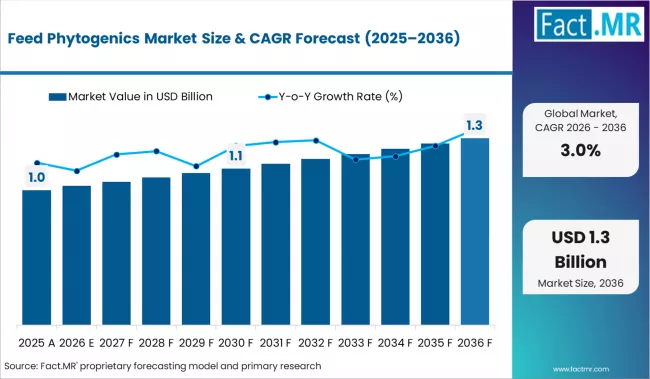
Feed Phytogenics Market Market Value Analysis | Source: Fact.MR
Summary of Feed Phytogenics Market
- Market Definition
- The market includes plant-based phytogenic feed additives such as essential oils, herbs, spices, and oleoresins. These are used to improve gut health, feed efficiency, and immunity in livestock as alternatives to antibiotic growth promoters.
- Demand Drivers
- China’s 2020 AGP ban is driving strong demand for essential oil and oleoresin phytogenic feed additives from both domestic and global suppliers.
- EU ECOANTIBIO 2 plans in France, Germany, and the Netherlands are pushing livestock producers to adopt phytogenic additives to meet antibiotic reduction targets.
- UK retailers like Tesco and Sainsbury’s are enforcing antibiotic-free poultry supply chains, driving demand for certified phytogenic gut health additives.
- Key Segments Analyzed
- By Product: Essential oils lead with 38% share in 2026 due to strong antimicrobial and digestive benefits.
- By Livestock: Poultry leads with 44% share, driven by high production volumes and pressure to eliminate antibiotics.
- By Geography: China leads growth at 4.5% CAGR through 2036, supported by AGP ban enforcement and large livestock sectors.
- Analyst Opinion at FACT.MR
- Shambhu Nath Jha, Principal Consultant at Fact.MR, opines, 'CXOs in the feed phytogenics space will find that efficacy documentation and regulatory alignment will be the primary commercial differentiators through 2036, as livestock integrators in China, India, and Europe consolidate supplier relationships around phytogenic products with verifiable trial data across specific livestock species and production systems.'
- Strategic Implications
- Phytogenic suppliers should invest in species-specific trials in poultry and swine, especially in China and India, to demonstrate gut health and feed efficiency benefits.
- Companies should develop EU-compliant essential oil and oleoresin products aligned with ECOANTIBIO plans, targeting ruminant and swine sectors.
- Manufacturers targeting the UK and US should align products with antibiotic-free certifications to meet retailer-driven poultry supply chain requirements.
- Methodology
- Market sizing is based on supplier revenues, feed production volumes, and additive pricing, validated with Delacon and DSM data (2024–2025).
- Demand analysis uses regulatory data from EU AGP bans, China enforcement, ECOANTIBIO targets, and UK retailer commitments.
- Forecasts include livestock production trends, policy timelines, market penetration rates, and expert insights from nutritionists and procurement managers.
| Metric | Value |
|---|---|
| Estimated Value in 2026 | USD 1.0 billion |
| Forecast Value in 2036 | USD 1.2 billion |
| Forecast CAGR (2026 to 2036) | 3.0% |
Source: Fact.MR analysis. Updated Mar 31, 2026
Country growth is shaped by antibiotic regulations, livestock scale, and market maturity. China leads at 4.5% CAGR with strict AGP bans and large production volumes. India follows at 4.0% with expanding poultry and rising antibiotic-free demand. Germany grows at 3.7% with strong EU compliance. France posts 3.4% supported by ECOANTIBIO 2. The UK records 3.0% with retailer-driven adoption. The USA sees 2.8% from voluntary programmes. Brazil grows slowest at 2.5% due to weak enforcement and price sensitivity.
Segmental Analysis
Feed Phytogenics Market Analysis by Product
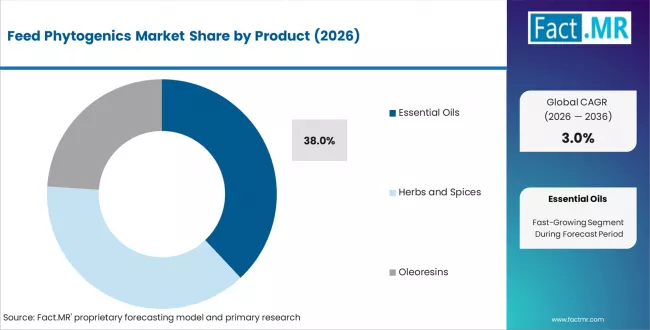
Feed Phytogenics Market Analysis By Product | Source: Fact.MR
Based on FACT.MR's report, essential oils are estimated to hold 38% share in 2026. This is due to strong antimicrobial, anti-inflammatory, and digestive benefits. They are widely used in poultry and swine systems. They are the most adopted phytogenic category in AGP replacement programmes globally.
- Delacon Essential Oil Trial Programme: In March 2024, Delacon published Activo trial results. The trials showed improved feed conversion ratio and gut morphology in broilers. This supports procurement decisions by poultry integrators in Europe and Asia. [1]
- DSM-Firmenich Phytogenic Blend Launch: In September 2024, DSM launched Digestarom DC Activate. The product combines essential oils with organic acids. It targets poultry gut health under antibiotic-free conditions. It is aligned with EU and US retailer supply chains. [2]
- Oleoresin Market Growth Trend: In 2024, the European Feed Manufacturers Federation reported 12% phytogenic adoption in EU poultry feed. Oleoresin products showed the fastest growth. This is due to stable and standardised active compound levels. [3]
Feed Phytogenics Market Analysis by Livestock
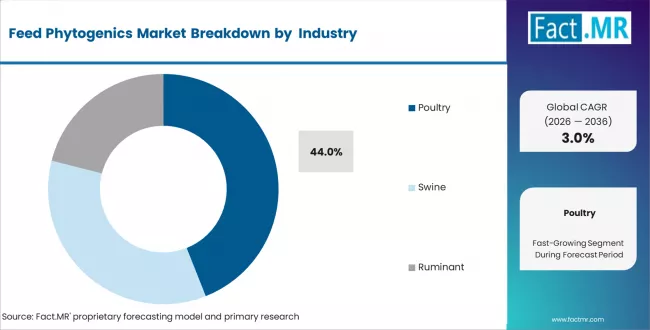
Feed Phytogenics Market Analysis By Livestock | Source: Fact.MR
Based on FACT.MR's report, poultry is estimated to hold 44% share in 2026. Poultry has the highest global production volume. It faces strong AGP replacement pressure. It is the most active market for phytogenic programmes in antibiotic-free production.
- Cargill Poultry Phytogenic Programme: In May 2024, Cargill expanded its antibiotic-free broiler programme. It included Delacon Activo and EW Nutrition Ventar D in feed formulations. This reflects integrated adoption in large poultry systems. [4]
- Phytobiotics Swine Product Development: In October 2024, Phytobiotics launched Xtract 6930. The product targets swine nursery feed. It supports gut health during post-weaning stages. This is critical under antibiotic reduction conditions. [5]
- Aquatic Phytogenic Adoption Trend: In 2024, FAO reported global aquaculture production at 94.4 million tonnes. Phytogenic use in shrimp and salmon feed is growing 8% annually. Adoption is driven by export certification requirements. [6]
Drivers, Restraints, and Opportunities
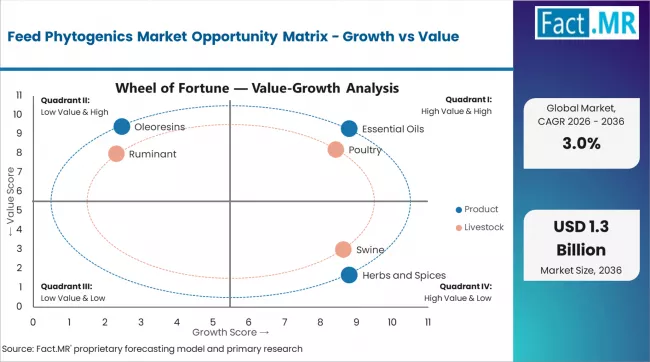
Feed Phytogenics Market Opportunity Matrix Growth Vs Value | Source: Fact.MR
FACT.MR identifies two regulatory environments. Regions with AGP bans (EU, China, Vietnam) show strong demand. Producers require non-antibiotic alternatives. Regions with weak enforcement (Brazil, Southeast Asia, parts of the US) show slower adoption due to price sensitivity.
Demand is shifting from trials to integrated feed programmes. Essential oils and oleoresins are becoming part of standard formulations. Prices are decreasing while volumes are increasing. Suppliers with strong clinical data gain premium positioning. Commodity suppliers face margin pressure.
- EU AGP Prohibition Enforcement: The EU has fully banned AGPs. Regulation 2019/6 restricts antibiotic use through 2025 reviews. This supports phytogenic demand across key countries. Enforcement is strict through national authorities.
- China AGP Market Conversion: China enforced a full AGP ban from July 2020. Inspections and penalties continue through 2025. This creates a large phytogenic market. Growth is estimated at 4.5% CAGR.
- India Organized Poultry Expansion: India’s AMR plan (2017) and 2024 updates are driving change. Organized poultry producers are adopting phytogenic solutions. This is linked to export certification requirements for global markets.
Regional Analysis
The global feed phytogenics market is analysed across Europe, Asia Pacific, North America, Latin America, and Middle East and Africa, covering 40+ key production countries shaped by AGP regulatory frameworks, organized livestock production scale, compound feed industry structure, and antibiotic stewardship programme adoption intensity. The full report offers market attractiveness analysis across regulatory compliance timelines, livestock production volumes, and phytogenic market penetration benchmarks.
.webp "Top Country Growth Comparison Feed Phytogenics Market Cagr (2026 2036)")
Top Country Growth Comparison Feed Phytogenics Market Cagr (2026 2036) | Source: Fact.MR
| Country | CAGR (2026 to 2036) |
|---|---|
| China | 4.5% |
| India | 4.0% |
| Germany | 3.7% |
| France | 3.4% |
| UK | 3.0% |
| USA | 2.8% |
| Brazil | 2.5% |
Source: Fact.MR analysis. Updated Mar 31, 2026
Source: Fact.MR (FACT.MR) analysis, based on proprietary forecasting model and primary research
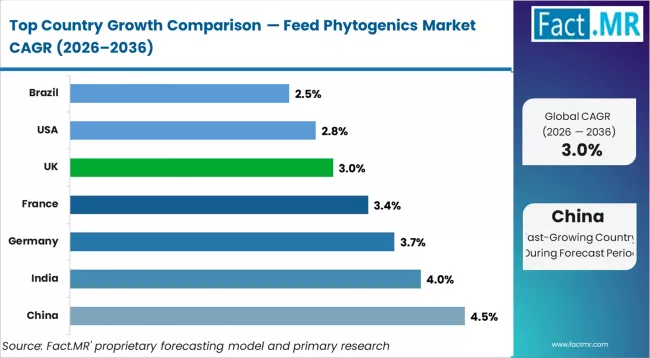
Feed Phytogenics Market Cagr Analysis By Country | Source: Fact.MR
Asia Pacific Feed Phytogenics Market
Asia Pacific is the fastest-growing region for feed phytogenics, driven by China's AGP ban conversion of the world's largest poultry and swine sector and India's expanding organized poultry production. Delacon, DSM, and EW Nutrition lead supply, while domestic Chinese and Indian phytogenic producers address price-sensitive mid-market feed manufacturers.
- China: Demand for feed phytogenics in China is projected to rise at 4.5% CAGR through 2036, the fastest among all covered countries, driven by AGP ban enforcement converting the world's largest poultry and swine production volumes to non-antibiotic feed additive programmes. The Ministry of Agriculture and Rural Affairs ban on all veterinary AGPs in feed, enforced from July 2020, has created a structurally converted demand environment where compound feed producers must source phytogenic alternatives at national scale
- India: India's feed phytogenics market is forecast to grow at 4.0% CAGR through 2036, driven by organized integrated poultry expansion in southern and western states and growing export certification requirements rather than domestic regulatory enforcement. India's Department of Animal Husbandry and Dairying 2024 antimicrobial resistance action plan update is guiding organized producers toward phytogenic gut health programmes aligned with NABL-certified antibiotic-free export certification for Gulf and European retail customers.
FACT.MR's analysis of the feed phytogenics market in Asia Pacific consists of country-wise assessment including China, India, Japan, ASEAN, and Australia and New Zealand. Readers can find AGP ban enforcement data, poultry and swine production benchmarks, phytogenic market penetration statistics, and regional supplier competitive positioning analysis.
Europe Feed Phytogenics Market
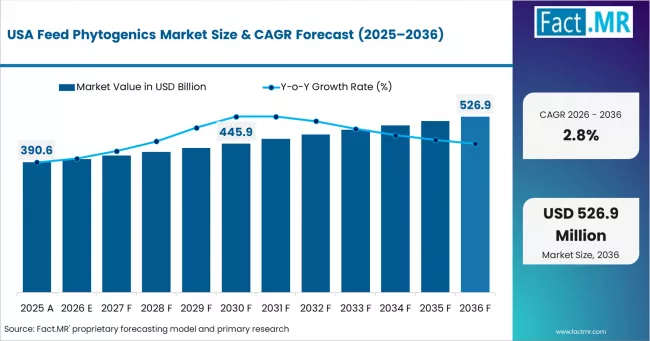
Feed Phytogenics Market Country Value Analysis | Source: Fact.MR
Europe is the most mature feed phytogenics region, shaped by the EU's complete AGP prohibition and national antibiotic reduction plans driving structured adoption across German, French, Dutch, and Danish livestock sectors. Delacon, Phytobiotics, and EW Nutrition lead European supply with established clinical documentation and long-term compound feed customer relationships.
- Germany: Germany's feed phytogenics market is projected to grow at 3.7% CAGR through 2036, sustained by its large concentrated swine and poultry sector operating under EU AGP prohibition and German national antibiotic monitoring system DIMDI AMR enforcement. In October 2024, Phytobiotics Futterzusatzstoffe GmbH launched its Xtract 6930 swine nursery blend in the German market, reflecting ongoing product development aligned with specific antibiotic reduction programme needs. Unlike France, where ruminant sector phytogenic demand is a significant proportion, Germany's procurement is concentrated in swine and poultry.
- France: France's feed phytogenics market is projected to grow at 3.4% CAGR through 2036, supported by the ECOANTIBIO 2 national action plan targeting a 50% reduction in antibiotic use in livestock by 2026 across bovine, swine, and poultry sectors. ECOANTIBIO 2, coordinated by the French Ministry of Agriculture and overseen by ANMV, requires documented antibiotic reduction trajectories from livestock producers, creating structured phytogenic demand across France's large ruminant sector that differentiates it from Germany's swine-focused procurement.
- UK: The UK feed phytogenics market is expected to grow at 3.0% CAGR through 2036, driven by major supermarket retailer antibiotic-free poultry supply chain commitments rather than the government mandate model operating in EU member states. UK retailers including Tesco, Sainsbury's, and M&S have embedded antibiotic-free poultry specifications into supplier codes of practice since 2024, compelling integrated poultry producers in the UK to specify phytogenic gut health programmes as part of retailer-approved antibiotic stewardship documentation.
FACT.MR's analysis of the feed phytogenics market in Europe consists of country-wise assessment including Germany, France, the United Kingdom, Netherlands, Spain, and Rest of Western Europe. Readers can find EU AGP ban compliance data, ECOANTIBIO plan progress benchmarks, retailer antibiotic-free supply chain commitment timelines, and regional supplier competitive positioning analysis.
North America Feed Phytogenics Market
North America is a voluntary adoption market shaped by antibiotic stewardship programmes and retailer-driven antibiotic-free commitments rather than mandatory AGP prohibition. Cargill, ADM, and DSM lead supply across integrated poultry and swine customer accounts with phytogenic programmes embedded in antibiotic-free production certification.
- USA: The feed phytogenics market in the United States is expected to grow at 2.8% CAGR through 2036, the second slowest among covered markets, reflecting the absence of a mandatory AGP ban and the voluntary nature of antibiotic stewardship adoption across US livestock production. The FDA's Veterinary Feed Directive, with guidance updates issued in 2024 restricting medically important antibiotic use in feed without veterinary authorisation, is progressively tightening AGP access without imposing a full prohibition, creating structured but gradual phytogenic adoption through market-led antibiotic reduction rather than regulatory mandate.
FACT.MR's analysis of the feed phytogenics market in North America consists of country-wise assessment including the United States, Canada, and Mexico. Readers can find FDA Veterinary Feed Directive update data, retailer antibiotic-free commitment supply chain benchmarks, voluntary antibiotic stewardship programme penetration data, and regional supplier adoption trend analysis.
Competitive Aligners for Market Players
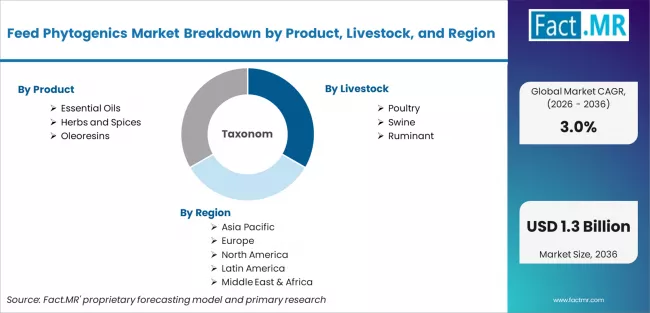
Feed Phytogenics Market Breakdown By Product, Livestock, And Region | Source: Fact.MR
The feed phytogenics market is fairly competitive, with no single player dominating globally. A handful of companies including Delacon Biotechnik, DSM-Firmenich, EW Nutrition, Cargill, and Phytobiotics together account for roughly 40 to 45% of total market revenue. What really differentiates these players is not scale alone, but how well they can prove product performance, meet regulatory expectations, and fit into evolving feed formulation strategies.
In this space, credibility matters. Companies like Delacon and Phytobiotics have built their reputation on strong scientific backing. Their investment in trials and documented results makes it easier for feed producers to transition away from antibiotics without risking animal performance. This becomes especially critical in regions with strict compliance frameworks, where buyers need more than just product claims.
DSM-Firmenich, on the other hand, stands out by taking a more integrated nutrition approach. Instead of offering phytogenics in isolation, it combines them with enzymes, vitamins, and other inputs to deliver broader gut health solutions. This not only improves performance outcomes but also strengthens long-term customer relationships.
From the buyer’s side, feed manufacturers are becoming more strategic. They rarely depend on a single supplier. High-performance solutions are sourced from established, research-driven companies, while more price-sensitive formulations often rely on regional suppliers, particularly in India and China. This dual sourcing approach keeps costs in check while still allowing access to premium, performance-backed products where needed.
Key Players of Feed Phytogenics Market
- Cargill
- Devenish Nutrition
- EW Nutrition GmbH
- Dodson and Horrell
- PMI Additives
- DSM
- ADM
- Vinayak Ingredients
- AVT Natural Products
- Delacon Biotechnik GmbH
- Phytobiotics Futterzusatzstoffe GmbH
- Natural Remedies Pvt. Ltd.
Bibliography
- [1] Delacon Biotechnik GmbH. (2024). Activo Multi-Species Phytogenic Feed Additive Efficacy Trial Results: Broiler Feed Conversion Ratio and Gut Morphology Improvement Data. March 2024. delacon.com
-
- [2] DSM-Firmenich. (2024). Digestarom DC Activate Phytogenic Feed Additive Launch: Essential Oil and Organic Acid Synergy Blend for Antibiotic-Free Poultry Production. September 2024. dsm-firmenich.com
- [3] European Feed Manufacturers Federation (FEFAC). (2024). EU Compound Feed Production Statistics 2024: Phytogenic Feed Additive Adoption Rates in Commercial Poultry Feed Formulations. fefac.eu
- [4] Cargill. (2024). Antibiotic-Free Broiler Production Programme Expansion: Phytogenic Feed Additive Integration in US and European Integrated Poultry Operations. May 2024. cargill.com
- [5] Phytobiotics Futterzusatzstoffe GmbH. (2024). Xtract 6930 Essential Oil-Herb Swine Nursery Feed Additive Launch for Post-Weaning Gut Health Management. October 2024. phytobiotics.com
- [6] Food and Agriculture Organization of the United Nations. (2024). The State of World Fisheries and Aquaculture 2024: Global Aquaculture Production Volume and Phytogenic Additive Adoption in Shrimp and Salmon Feed. fao.org
This Report Addresses
- Strategic intelligence on EU AGP prohibition enforcement, China MARA AGP ban conversion, France ECOANTIBIO 2 mandates, UK retailer antibiotic-free commitments, and FDA Veterinary Feed Directive updates shaping phytogenic demand through 2036.
- Market forecast from USD 1.0 billion in 2026 to USD 1.2 billion by 2036 at a CAGR of 3.0%.
- Growth opportunity mapping across essential oil AGP replacement programmes, oleoresin-based gut health platforms, swine nursery phytogenic applications, and aquatic antibiotic-free export certification markets.
- Segment-wise analysis by product (essential oils, herbs and spices, oleoresins, others) and livestock (poultry, swine, ruminant, aquatic, equine, others) across all major production regions.
- Regional outlook covering Asia Pacific AGP ban-driven conversion, European regulatory compliance adoption, North American voluntary stewardship, and Latin American export-driven phytogenic demand.
- Competitive landscape of leading players including Delacon Biotechnik, DSM-Firmenich, EW Nutrition, Phytobiotics, Cargill, Vinayak Ingredients, and Natural Remedies.
- Regulatory impact analysis covering EU Veterinary Medicines Regulation 2019/6, China MARA AGP ban, France ECOANTIBIO 2 targets, UK FSA antibiotic reduction guidelines, and India DADF AMR action plan updates.
Report delivery in PDF, Excel datasets, and presentation formats supported by primary interviews, livestock production statistics, regulatory authority databases, and phytogenic supplier clinical trial publications.
Feed Phytogenics Market Definition
The feed phytogenics market covers plant-derived feed additives including essential oils, herbs and spices, and oleoresins used to replace or reduce antibiotic growth promoters in livestock nutrition. These additives improve gut health, feed conversion, and animal immunity across poultry, swine, ruminant, aquatic, and equine production, serving as functional nutritional inputs supplied to compound feed manufacturers and integrators globally.
Feed Phytogenics Market Inclusions
Includes global and regional market sizes from 2026 to 2036 by product type and livestock category. Covers essential oil, herb and spice, and oleoresin-based phytogenic additives used in poultry, swine, ruminant, aquatic, and equine feed formulations across major production and consumption regions.
Feed Phytogenics Market Exclusions
Excludes synthetic feed additives, probiotic and prebiotic products, antibiotic growth promoters, and non-phytogenic botanical extracts used in veterinary medicine rather than feed formulation. Also excludes finished compound feed and premix blends. Focus is strictly on phytogenic active ingredient inputs supplied to feed manufacturers and premix producers.
Feed Phytogenics Market Research Methodology
-
Primary Research
- Interviews with compound feed manufacturers, livestock integrator procurement managers, phytogenic additive sales managers, and veterinary nutritionists across Europe, Asia Pacific, and North America.
-
Desk Research
-
Analysis of Delacon and Phytobiotics product development reports, EU AGP ban enforcement records, China AGP ban implementation data, and feed additive trade statistics from 2024 to 2025.
-
-
Market-Sizing and Forecasting
-
Hybrid model integrating top-down revenue estimates from phytogenic supplier disclosures with bottom-up livestock production-based demand forecasts by product and livestock category.
-
-
Data Validation and Update Cycle
-
Validated through supplier revenue data, compound feed production volumes, regulatory database updates, and expert interviews with livestock nutritionists and feed additive procurement specialists.
-
Segmentation
Scope of Report
Feed Phytogenics Market Breakdown By Product, Livestock, And Region | Source: Fact.MR
| Metric | Value |
|---|---|
| Quantitative Units | USD 1.0 billion (2026) to USD 1.2 billion (2036), at a CAGR of 3.0% |
| Market Definition | Plant-derived phytogenic feed additives including essential oils, herbs and spices, and oleoresins used to replace antibiotic growth promoters and support gut health, feed conversion, and immunity in poultry, swine, ruminant, aquatic, and equine livestock globally. |
| Product Segmentation | Essential Oils, Herbs and Spices, Oleoresins, Others |
| Livestock Segmentation | Poultry, Swine, Ruminant, Aquatic, Equine, Others |
| Application Coverage | Poultry broiler and layer AGP replacement, swine nursery gut health, ruminant ECOANTIBIO compliance, aquaculture antibiotic-free export certification, and equine digestive health supplementation. |
| Regions Covered | North America, Europe, Asia Pacific, Latin America, Middle East and Africa |
| Countries Covered | USA, Canada, Mexico, Germany, UK, France, Italy, Spain, Nordic, BENELUX, China, Japan, South Korea, India, ASEAN, Australia and New Zealand, Brazil, Argentina, Chile, Saudi Arabia, GCC, Turkey, South Africa, Rest of MEA |
| Key Companies Profiled | Cargill, Devenish Nutrition, EW Nutrition GmbH, Dodson and Horrell, PMI Additives, DSM, ADM, Vinayak Ingredients, AVT Natural Products, Delacon Biotechnik GmbH, Phytobiotics Futterzusatzstoffe GmbH, Natural Remedies Pvt. Ltd. |
| Forecast Period | 2026 to 2036 |
| Approach | Hybrid top-down and bottom-up model using phytogenic supplier revenues, compound feed production volumes, livestock production data by species, AGP ban compliance timelines, and primary interviews with veterinary nutritionists and feed additive procurement managers. |
Source: Fact.MR analysis. Updated Mar 31, 2026
Feed Phytogenics Market by Segments
-
By Product:
- Essential Oils
- Herbs and Spices
- Oleoresins
- Others
-
By Livestock:
- Poultry
- Swine
- Ruminant
- Aquatic
- Equine
- Others
-
By Region:
-
North America
- United States
- Canada
- Mexico
-
Latin America
- Brazil
- Mexico
- Argentina
- Chile
- Rest of Latin America
-
Western Europe
- Germany
- United Kingdom
- France
- Italy
- Spain
- Nordic Countries
- BENELUX
- Rest of Western Europe
-
Eastern Europe
- Russia
- Poland
- Hungary
- Balkan and Baltic
- Rest of Eastern Europe
-
East Asia
- China
- Japan
- South Korea
-
South Asia and Pacific
- India
- ASEAN
- Australia and New Zealand
- Rest of South Asia and Pacific
-
Middle East and Africa
- Kingdom of Saudi Arabia
- Other GCC Countries
- Turkey
- South Africa
- Rest of Middle East and Africa
-
Frequently Asked Questions
How large is the global feed phytogenics market in 2025?
What will the market size be in 2026?
What is the projected market size by 2036?
What is the expected CAGR from 2026 to 2036?
Which product segment is poised to lead the feed phytogenics market?
Which livestock segment holds the largest share?
Which country shows the fastest growth in the feed phytogenics market?
What is driving growth in the feed phytogenics market?
Why are essential oils dominant in this market?
Which livestock segment contributes the most demand?
Who are the key players in the feed phytogenics market?
How do regulations impact market adoption?
Who worked on this report


Preview the report firsthand - request a free sample
Free SampleGet the brochure for pricing and purchase details
Download PDF