Feed Mycotoxin Detoxifiers Market Size, Share, Growth and Forecast (2026 - 2036)

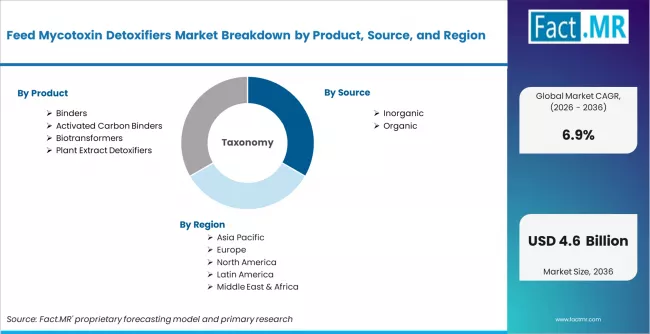
Feed Mycotoxin Detoxifiers Market is segmented by Product (Binders, Activated Carbon Binders, Biotransformers, Plant Extract Detoxifiers), Source (Inorganic, Organic), Form (Dry, Liquid), and Region, with forecasts covering the period from 2026 to 2036.

According to Fact.MR estimates, the global feed mycotoxin detoxifiers market market was valued at USD 2.2 billion in 2025. The market is projected to reach USD 2.3 billion in 2026 and is expected to grow to USD 4.6 billion by 2036, expanding at a CAGR of 6.9%. Binders is anticipated to account for 64.8% of the product segment in 2026, while Inorganic is expected to remain the leading application with around 55.0% share.

Feed Mycotoxin Detoxifiers Market Analysis and Forecast by Fact.MR

The feed mycotoxin detoxifiers market, valued at USD 2.19 billion in 2025, is projected to expand at a 6.9% CAGR to reach USD 4.562 billion by 2036. Feed mycotoxin detoxifiers are feed additives designed to adsorb, degrade, or neutralise mycotoxin contaminants in animal feed, protecting livestock from the immunosuppressive, hepatotoxic, and growth-impairing effects of aflatoxins, fumonisins, zearalenone, and other fungal metabolites. Growth reflects intensifying commercial livestock production, tightening regulatory limits on mycotoxin residues in animal products, and climate change-driven increases in grain contamination frequency across major cereal-producing regions.
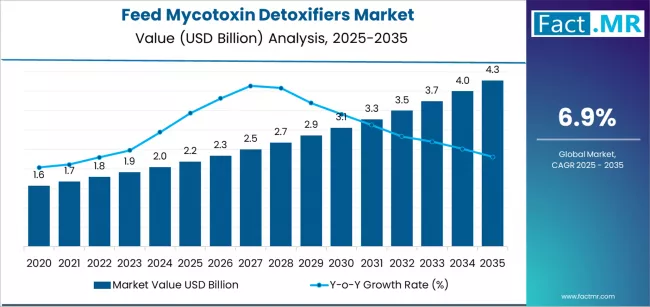
Feed Mycotoxin Detoxifiers Market Market Value Analysis

Summary of Feed Mycotoxin Detoxifiers Market

  • Market Snapshot
    • The market is valued at USD 2.19 billion in 2025.
    • Revenue is estimated to reach USD 2.341 billion in 2026 and USD 4.562 billion by 2036.
    • A CAGR of 6.9% is forecast for the 2026 to 2036 assessment period.
    • Incremental opportunity of USD 2.221 billion is projected between 2026 and 2036.
    • Binders hold a 64.8% share of the product segment.
    • India (8.4% CAGR) and China (8.1% CAGR) are the fastest-expanding country markets.
  • Demand and Growth Drivers
    • Commercial poultry and swine operations are scaling feed throughput volumes, with global compound feed production exceeding 1.2 billion tonnes annually per IFIF data, increasing the volume of feed requiring mycotoxin mitigation.
    • Climate change is elevating mycotoxin contamination risk in major cereal crops, with warmer, more humid growing seasons extending the geographic range of aflatoxin-producing Aspergillus species into previously unaffected temperate zones.
    • Regulatory tightening of maximum residue limits for mycotoxins in meat, milk, and eggs across the EU, USA, and China is compelling feed producers to adopt detoxifier inclusion as standard practice rather than optional supplementation.
    • Integration of rapid mycotoxin testing at feed mills is increasing contamination detection rates, driving corrective action through detoxifier supplementation in identified contaminated feed batches.
  • Product and Segment View
    • Binders command 64.8% of the product segment, reflecting the established efficacy and cost-effectiveness of clay-based and organic adsorbent products.
    • Inorganic sources account for 55.0% of source demand, driven by the widespread use of bentonite, montmorillonite, and other aluminosilicate mineral binders.
    • Poultry represents 67.9% of livestock end-use demand, reflecting the high susceptibility of broilers and layers to mycotoxin-induced performance losses.
    • Key segmentation includes:
      • Product: Binders, Activated Carbon Binders, Biotransformers, Plant Extract Detoxifiers
      • Source: Inorganic, Organic
      • Form: Dry, Liquid
      • Mycotoxin Target: Aflatoxins, Zearalenone, Fumonisins, Ochratoxins, T2 and HT2 Toxins
      • Livestock: Poultry, Swine, Ruminants, Aquaculture, Pets
  • Geography and Competitive Outlook
    • North America accounts for a significant regional share, with the USA generating USD 0.88 billion in 2025 revenue.
    • East Asia contributes growing demand, with Japan (USD 0.128 billion) and South Korea (USD 0.071 billion) in 2025.
    • Biomin Holding GmbH leads the competitive field with an estimated 16.0% revenue share.
    • Alltech Inc., Kemin Industries, and BASF SE are principal challengers across global markets.
  • Analyst Opinion
    • The feed mycotoxin detoxifiers market is transitioning from reactive contamination management toward proactive, data-driven supplementation strategies. Integrated feed producers are moving beyond single-mycotoxin binder products toward multi-component solutions that address complex contamination profiles typical of real-world feed ingredients. Climate volatility is structurally increasing the frequency and geographic spread of mycotoxin contamination events, making detoxifier inclusion a non-discretionary cost for commercial livestock operations. Companies offering validated efficacy data for multi-mycotoxin binding combined with diagnostic services will command premium positioning through 2036.

Key Growth Drivers, Constraints, and Opportunities
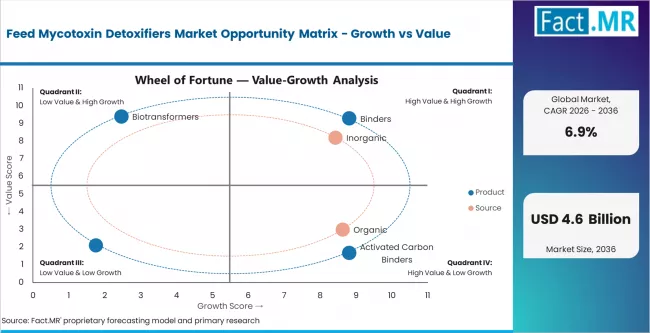
Feed Mycotoxin Detoxifiers Market Opportunity Matrix Growth Vs Value

Key Factors Driving Growth

  • Global poultry production, the largest end-use segment at 67.9% of detoxifier demand, is growing at 3 to 4% annually according to FAO data, with broiler operations in South and Southeast Asia scaling most rapidly. Each tonne of poultry feed produced creates a potential detoxifier application, directly linking feed volume growth to market expansion.
  • EU Commission Recommendation 2006/576/EC and subsequent updates set maximum mycotoxin levels in complete feedstuffs, with enforcement through feed business operator HACCP obligations. Non-compliance risks feed batch rejection and financial penalties, making detoxifier inclusion a regulatory compliance cost rather than a discretionary purchase.
  • Climate change projections from the European Food Safety Authority (EFSA) indicate that aflatoxin contamination risk in European maize crops will increase 10 to 100-fold by 2050 compared to current baselines, structurally expanding the geographic demand base for detoxifier products beyond traditional tropical and subtropical markets.

Key Market Constraints

  • Efficacy variability among commercial binder products, with in vitro binding capacity often not replicating under in vivo gastrointestinal conditions, creates buyer scepticism and makes product differentiation difficult for manufacturers without extensive animal trial data.
  • Limited binding specificity of clay-based products, which can simultaneously adsorb essential nutrients (vitamins, trace minerals) alongside mycotoxins, raises concerns about nutritional impact and requires careful dose optimisation to balance detoxification against nutrient availability.
  • Price sensitivity among smallholder and semi-commercial livestock producers in Africa and South Asia, who face the highest mycotoxin contamination risk but have the least capacity to absorb detoxifier costs, limits market penetration in regions where the product need is greatest.

Key Opportunity Areas

  • Biotransformer products using enzymatic degradation of mycotoxins (rather than adsorption) are gaining commercial traction as they do not bind essential nutrients and can degrade mycotoxins that resist adsorbent binding, including fumonisins and trichothecenes. Biomin's FUMzyme, a fumonisin esterase, is a commercial example of this approach.
  • Integration of mycotoxin risk prediction models using satellite crop data and weather forecasting is enabling proactive detoxifier dosing strategies that match inclusion rates to predicted contamination levels, reducing over-dosing costs and improving efficacy.
  • Aquaculture feed, the fastest-growing livestock segment globally at 5 to 7% annual volume growth per FAO data, presents an underpenetrated opportunity for detoxifier products, with shrimp and salmon operations in Asia Pacific increasingly recognising mycotoxin impact on growth performance and disease susceptibility.

Segment-wise Analysis of the Feed Mycotoxin Detoxifiers Market

  • Binders hold 64.8% of the product segment, reflecting the established cost-effectiveness of mineral-based adsorbent products.
  • Aflatoxins are the primary mycotoxin target at 58.3% of demand, driven by their high toxicity and regulatory priority.
  • Poultry represents 67.9% of livestock end-use demand, reflecting the species' high susceptibility to mycotoxin-induced performance losses.

Which product type dominates the Feed Mycotoxin Detoxifiers Market?
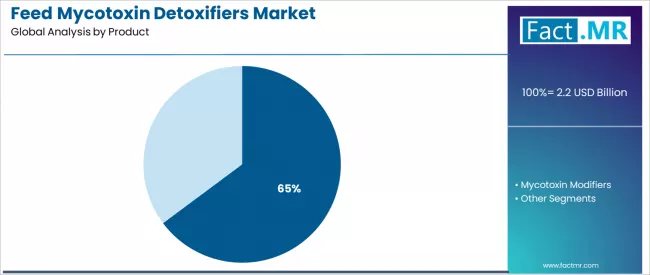
Feed Mycotoxin Detoxifiers Market Analysis By Product

Binders control 64.8% of the product segment. Clay-based binders, primarily bentonite and montmorillonite, are the workhorses of the market due to their high aflatoxin binding efficiency (typically exceeding 90% in vitro), low cost per tonne of feed treated (USD 1 to USD 3 per tonne), and ease of incorporation into dry feed formulations. Their dominance reflects a pragmatic market where cost-effectiveness and aflatoxin-centric contamination profiles drive purchasing decisions.

Biotransformers hold the second-largest position and are growing fastest, driven by their ability to enzymatically degrade mycotoxins (fumonisins, trichothecenes, zearalenone) that clay binders cannot effectively adsorb. Activated carbon binders serve premium applications requiring broad-spectrum binding.

Which mycotoxin target drives demand in the Feed Mycotoxin Detoxifiers Market?
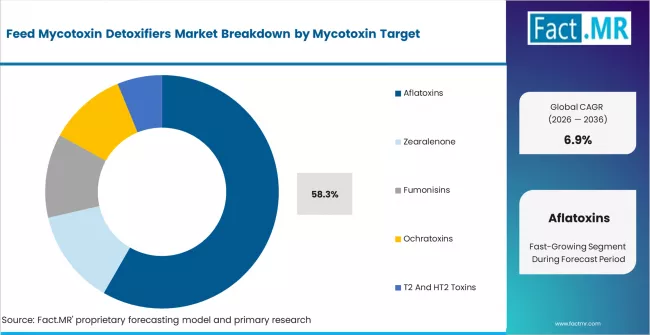
Feed Mycotoxin Detoxifiers Market Analysis By Mycotoxin Target

Aflatoxins account for 58.3% of mycotoxin target demand. Aflatoxin B1, produced by Aspergillus flavus and Aspergillus parasiticus, is the most regulated mycotoxin globally due to its carcinogenic classification (IARC Group 1) and its direct transfer to animal products (aflatoxin M1 in milk). EU maximum limits for aflatoxin B1 in complete feedstuffs (0.02 mg/kg for dairy and young animals) are among the strictest food safety standards applied to any feed contaminant.

Zearalenone, fumonisins, and ochratoxins collectively drive the balance of demand. Zearalenone is a particular concern in swine production due to its estrogenic effects on reproductive performance. Fumonisins primarily affect poultry, causing pulmonary oedema and liver damage in broilers. The multi-mycotoxin contamination reality of commercial feed ingredients is driving demand for multi-target detoxifier solutions.

Which livestock segment captures the largest share in the Feed Mycotoxin Detoxifiers Market?
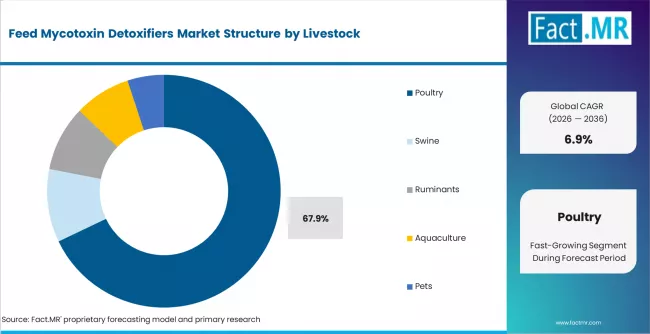
Feed Mycotoxin Detoxifiers Market Analysis By Livestock

Poultry accounts for 67.9% of livestock end-use demand. Broilers and layers are physiologically more susceptible to mycotoxin effects than ruminants (which benefit from ruminal microbial degradation), and the intensity of commercial poultry production, with rapid growth cycles and high feed conversion sensitivity, means that even subclinical mycotoxin exposure causes measurable economic losses through reduced weight gain, impaired feed conversion, and immunosuppression.

Swine hold the second-largest position, with zearalenone and deoxynivalenol (DON) being the primary mycotoxin concerns for reproductive and growth performance. Ruminants represent a smaller share due to the partial protective effect of ruminal microflora, though dairy operations require strict aflatoxin management to prevent M1 transfer to milk.

Which Product Trend is Shaping the Next Phase of Growth in the Feed Mycotoxin Detoxifiers Market?

The most commercially significant trend in the feed mycotoxin detoxifiers market is the shift from single-mechanism binder products toward multi-component detoxifier solutions that address the full spectrum of mycotoxin contamination found in real-world feed ingredients. Commercial grain batches rarely contain a single mycotoxin; contamination surveys conducted by Biomin (BIOMIN Mycotoxin Survey, published annually) consistently report co-contamination rates exceeding 75% across tested samples globally. This reality is driving feed producers away from simple clay binders that primarily address aflatoxins and toward formulated products combining mineral adsorbents, yeast cell wall fractions (for zearalenone and DON), enzymatic biotransformers (for fumonisins), and hepatoprotective plant extracts.

A parallel development is the integration of mycotoxin risk management into precision livestock farming platforms. Companies such as Biomin and Alltech are combining diagnostic testing services (rapid lateral flow assays, ELISA, and LC-MS/MS laboratory analysis) with proprietary risk assessment algorithms that translate contamination data into specific detoxifier dosing recommendations. This data-driven approach converts detoxifier purchasing from a standardised, fixed-inclusion-rate practice into a variable, risk-adjusted strategy that optimises cost-effectiveness. For integrated poultry and swine operators managing millions of tonnes of feed annually, even small improvements in dosing precision translate into substantial cost savings while maintaining animal performance protection.

Regional Outlook Across Key Markets

Top Country Growth Comparison Feed Mycotoxin Detoxifiers Market Cagr (2026 2036)

  • North America holds a significant regional share, anchored by the USD 0.88 billion USA market in 2025.
  • East Asia is a high-growth region, with Japan at USD 0.128 billion and South Korea at USD 0.071 billion in 2025.
  • South Asia and Pacific is the fastest-growing region, led by India's 8.4% CAGR.
  • Latin America is expanding rapidly, with Brazil recording a 7.6% CAGR driven by large-scale poultry and swine production.

CAGR Table

Country CAGR (%)
India 8.4%
China 8.1%
Brazil 7.6%
USA 7.3%
France 7.0%
Germany 6.9%
Japan 6.8%

Source: Fact.MR analysis, based on proprietary forecasting model and primary research.
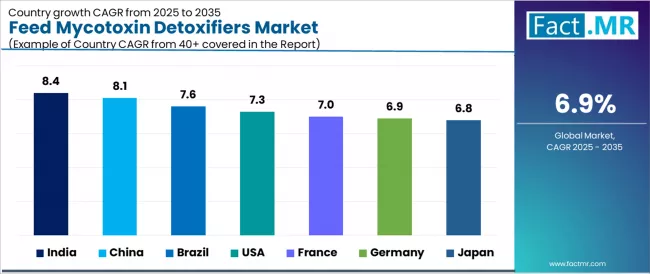
Feed Mycotoxin Detoxifiers Market Cagr Analysis By Country

India: rapid poultry sector expansion and tropical contamination pressure drive leadership

India leads global growth at an 8.4% CAGR, driven by the rapid scaling of commercial broiler and layer operations, particularly in southern states where tropical climate conditions create year-round mycotoxin pressure on feed ingredients. Indian compound feed production is growing at 8 to 10% annually, and increasing integration of poultry operations is shifting feed quality management toward systematic additive programmes that include mycotoxin detoxifiers.

  • India's compound feed production exceeded 45 million tonnes in 2024, with poultry feed accounting for over 55% of total output, per CLFMA of India data.

China: swine herd recovery and feed safety regulation enforcement accelerate adoption

China records an 8.1% CAGR, supported by the rebuilding of the national swine herd following African Swine Fever losses and the intensification of regulatory enforcement on feed safety. The Ministry of Agriculture and Rural Affairs has tightened mycotoxin maximum limits in compound feed, and large-scale integrators are mandating detoxifier inclusion in feed formulations as part of biosecurity protocols.

  • China's swine herd recovered to over 440 million head by end of 2024, per Ministry of Agriculture data, driving a corresponding increase in compound feed demand and detoxifier consumption.

Brazil: grain export quality requirements and intensive livestock production sustain demand

Brazil grows at 7.6% CAGR, reflecting the dual pressure of domestic livestock production intensity (the country is the world's largest poultry exporter) and export market quality requirements. Brazilian grain crops, particularly maize from the safrinha harvest, face elevated fumonisin and aflatoxin contamination risk. Detoxifier inclusion in poultry and swine feed is standard practice among major integrators.

  • Brazil produced over 95 million tonnes of compound feed in 2024, per Sindiraces (Brazilian Animal Feed Industry Association) data, with mycotoxin detoxifiers included in an estimated 60% of poultry feed formulations.

USA: corn belt contamination patterns and regulatory compliance drive adoption
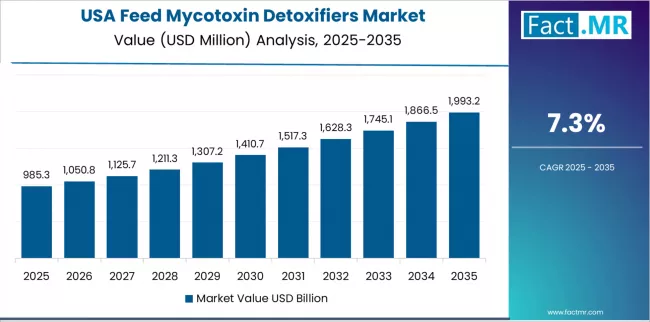
Feed Mycotoxin Detoxifiers Market Country Value Analysis

The USA generates USD 0.88 billion in 2025, growing at 7.3% CAGR. Mycotoxin risk is concentrated in the corn belt, where aflatoxin contamination events occur during drought stress years and DON/vomitoxin prevalence fluctuates with Fusarium infection pressure. FDA action levels for aflatoxin in animal feed and state-level enforcement create a compliance-driven demand floor for detoxifier products.

  • USDA Grain Inspection data reported aflatoxin detections above FDA action levels in 8% of corn samples from the 2024 harvest, concentrated in southern growing regions.

France: EU regulatory framework and precision livestock farming adoption support growth

France grows at 7.0% CAGR, supported by strict EU mycotoxin limits and the French livestock sector's advanced adoption of precision farming practices. French feed manufacturers are integrating mycotoxin testing and detoxifier dosing into automated feed production workflows. The country's large dairy sector creates particular demand for aflatoxin binders to prevent M1 transfer to milk.

  • France's compound feed production of approximately 22 million tonnes annually, per FeedSim Avenir programme data, positions it as the EU's second-largest feed market and a major detoxifier consumer.

Germany: feed safety standards and research-driven product adoption create steady demand

Germany grows at 6.9% CAGR, reflecting a feed industry that prioritises evidence-based additive selection. The German feed sector applies mycotoxin monitoring programmes that inform detoxifier purchasing decisions. German feed mills favour products with published in vivo efficacy data from accredited research institutions, creating a premium-oriented market.

  • Germany's Federal Institute for Risk Assessment (BfR) published updated mycotoxin risk guidance in 2024, reinforcing industry commitment to systematic detoxifier use in swine and poultry feed.

Japan: import-dependent feed chain and quality assurance focus sustain demand
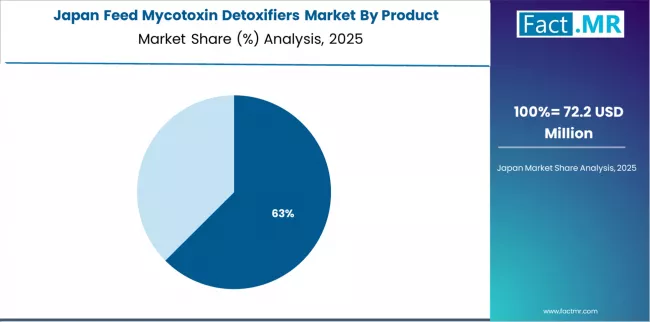
Feed Mycotoxin Detoxifiers Market Japan Market Share Analysis By Product

Japan contributes USD 0.128 billion in 2025, growing at 6.8% CAGR. As a major importer of feed grains from the USA, Brazil, and Argentina, Japan faces mycotoxin risk concentrated at the point of grain arrival and storage. Japanese feed manufacturers apply strict incoming grain testing protocols and routinely include detoxifier products in feed formulations as a quality assurance measure.

  • Japan imported over 15 million tonnes of feed-grade maize in 2024, per Japan Feed Trade Association data, with mycotoxin testing conducted on 100% of arriving cargoes.

Competitive Benchmarking and Company Positioning
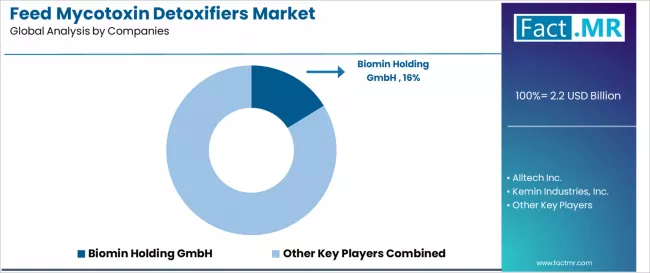
Feed Mycotoxin Detoxifiers Market Analysis By Company

Feed Mycotoxin Detoxifiers Market Analysis By Company

  • Biomin Holding GmbH holds approximately 16.0% of global revenue through its Mycofix product range, validated by the Biomin Mycotoxin Survey programme and proprietary biotransformer technology (FUMzyme).
  • Alltech Inc., Kemin Industries, and BASF SE collectively hold significant shares, competing on product range, technical service support, and global distribution networks.
  • Specialist players including Olmix Group, Impextraco, and Special Nutrients serve regional markets or specific product niches within the competitive field.

The competitive structure is moderately concentrated, with Biomin holding the largest single-company share at 16.0%. Biomin's strength is built on three pillars: the Mycofix multi-component product range (combining mineral binders, yeast cell wall fractions, and the FUMzyme fumonisin esterase), the Biomin Mycotoxin Survey (the largest annual global mycotoxin contamination database), and an integrated technical service model combining diagnostic testing with customised dosing recommendations.

Alltech competes through its Mycosorb product line and e-Max feed management platform, integrating mycotoxin risk assessment into broader feed efficiency optimisation. Kemin Industries differentiates with its TOXFIN product range and strong positioning in tropical Asian and Latin American markets. BASF SE brings chemical industry scale and distribution reach to its mycotoxin management portfolio.

ADM and Olmix Group occupy positions built on ingredient supply chain integration (ADM) and marine-derived algal extract technology (Olmix). The competitive dynamic is shifting toward companies offering integrated solutions combining testing, risk prediction, and multi-mycotoxin detoxification.

Key Companies in the Feed Mycotoxin Detoxifiers Market

The feed mycotoxin detoxifiers competitive field includes Biomin Holding GmbH, Alltech Inc., Kemin Industries Inc., BASF SE, ADM, Olmix Group, Impextraco N.V., Special Nutrients Inc., Amlan International, and Perstorp Holding AB.

Recent Industry Developments

  • Biomin: FUMzyme EU feed additive registration (2025)
    • Biomin secured EU Commission Implementing Regulation authorisation for FUMzyme as a feed additive for all avian species, making it the first and only purified fumonisin-degrading enzyme with full EU regulatory approval for commercial feed use.
  • Alltech Inc.: Mycosorb A+ reformulation launch (2025)
    • Alltech launched a reformulated Mycosorb A+ product with enhanced multi-mycotoxin binding capacity, incorporating an updated yeast cell wall fraction with improved adsorption characteristics for zearalenone and deoxynivalenol alongside standard aflatoxin binding.
  • Kemin Industries: TOXFIN digital dosing platform (2025)
    • Kemin Industries released a digital mycotoxin risk assessment platform linked to its TOXFIN detoxifier product range, enabling feed mill operators to input grain testing data and receive automated inclusion rate recommendations calibrated to contamination levels.
  • BASF SE: strategic partnership for mycotoxin diagnostics (2026)
    • BASF entered a strategic partnership with a rapid diagnostics company to integrate point-of-receipt mycotoxin testing with BASF's detoxifier product recommendations, creating an end-to-end contamination management solution for feed mills.

Leading Companies Shaping the Feed Mycotoxin Detoxifiers Market

  • Global Players

    • Biomin Holding GmbH
    • Alltech Inc.
    • Kemin Industries, Inc.
    • BASF SE
    • ADM
  • Regional Players

    • Olmix Group
    • Impextraco N.V.
    • Amlan International
    • Perstorp Holding AB
  • Emerging / Start-up Players

    • Special Nutrients, Inc.
    • Nutriad International NV
    • Unike Solutions

Sources and Research References

  • BIOMIN Mycotoxin Survey annual reports (global mycotoxin contamination data)
  • FAO compound feed production statistics and livestock population data
  • EU Commission Recommendations on mycotoxin maximum levels in animal feed (2006/576/EC and updates)
  • U.S. FDA Compliance Policy Guide for aflatoxin action levels in animal feed
  • CLFMA of India (Compound Livestock Feed Manufacturers Association) production data
  • Sindiraces (Brazilian Animal Feed Industry Association) feed production statistics
  • USDA Grain Inspection, Packers and Stockyards Administration mycotoxin monitoring data

All numerical data in this report is derived from Fact.MR proprietary forecasting models, validated through primary research interviews and cross-referenced with the public-domain sources listed above. No data from syndicated market research publishers has been used.

Key Questions This Report Addresses

  • What is the projected size of the feed mycotoxin detoxifiers market by 2036?
  • Which product type holds the largest share of the market?
  • What CAGR is forecast for the feed mycotoxin detoxifiers market between 2026 and 2036?
  • Which mycotoxin target drives the most demand?
  • Which country is expected to grow fastest in the market?
  • Who is the leading company in the global feed mycotoxin detoxifiers market?
  • What is the incremental opportunity between 2026 and 2036?
  • Which livestock segment consumes the most detoxifier products?
  • How is climate change affecting mycotoxin contamination risk?

Feed Mycotoxin Detoxifiers Market Definition

The feed mycotoxin detoxifiers market encompasses the manufacture, distribution, and application of feed additive products designed to reduce the bioavailability and toxic effects of mycotoxins in animal feed. Products in scope include mineral-based binders (bentonite, montmorillonite, zeolite), activated carbon adsorbents, biotransforming agents (enzymatic and microbial), and plant extract-based detoxifiers. The market covers products sold as standalone additives or premixed into compound feed for poultry, swine, ruminant, aquaculture, and pet feed applications.

Feed Mycotoxin Detoxifiers Market Inclusions

  • All commercially available mycotoxin binder, biotransformer, and plant extract detoxifier products sold as feed additives.
  • Revenue from dry and liquid formulations distributed through feed mills, distributors, and direct sales to livestock operations.
  • Products targeting aflatoxins, zearalenone, fumonisins, ochratoxins, and T2/HT2 toxins across all livestock species.
  • Both inorganic (mineral-based) and organic (yeast cell wall, enzymatic, plant extract) detoxifier categories.

Feed Mycotoxin Detoxifiers Market Exclusions

  • Pre-harvest crop management practices and fungicide treatments used to prevent mycotoxin formation in the field.
  • Mycotoxin testing and diagnostic equipment, rapid test kits, and laboratory analysis services sold independently.
  • Grain storage management technologies, aeration systems, and moisture control equipment used to prevent post-harvest mycotoxin development.
  • Pharmaceutical veterinary products used to treat clinical mycotoxicosis symptoms after animal exposure.

Feed Mycotoxin Detoxifiers Market Research Methodology

  • Primary research with feed mill managers, poultry integrators, swine production veterinarians, and animal nutrition consultants across 12 countries.
  • Revenue modelling based on feed additive inclusion rates, compound feed production volumes, and manufacturer-reported sales from annual filings.
  • Pricing analysis using distributor price lists, feed mill procurement records, and bulk purchasing contract data from major integrators.
  • Competitive share estimation through company annual reports, FEFANA membership data, and feed additive registration databases.
  • Demand validation through FAO compound feed production statistics, mycotoxin contamination survey data, and regulatory maximum residue limit compliance records.
  • Forecast calibration against climate modelling projections for mycotoxin risk, livestock production growth forecasts, and feed safety regulation timeline tracking.

Scope of Analysis

Feed Mycotoxin Detoxifiers Market Breakdown By Product, Source, And Region

Parameter Details
Report Coverage Global market analysis with country-level forecasts for 7 countries and 40+ additional markets
Base Year 2025
Forecast Period 2026 to 2036
Market Size (2025) USD 2.19 Billion
Units USD Billion
Segments Covered Product (Binders, Activated Carbon Binders, Biotransformers, Plant Extract Detoxifiers), Source (Inorganic, Organic), Form (Dry, Liquid), Mycotoxin Target (Aflatoxins, Zearalenone, Fumonisins, Ochratoxins, T2 and HT2 Toxins), Livestock (Poultry, Swine, Ruminants, Aquaculture, Pets)
Regions Covered North America, Latin America, Europe, East Asia, South Asia and Pacific, Middle East and Africa
Countries Profiled India, China, Brazil, USA, France, Germany, Japan
Companies Profiled Biomin, Alltech, Kemin Industries, BASF, ADM, Olmix Group, Impextraco, Special Nutrients, Amlan International, Perstorp Holding
Forecast Methodology Bottom-up revenue modelling validated through primary research, company filings, and FAO feed production data

Market Segmentation Analysis

  • Feed Mycotoxin Detoxifiers Market Market Segmented by Product:

    • Binders
      • Clay Based Binders
        • Bentonite
        • Montmorillonite
        • HSCAS
    • Activated Carbon Binders
      • Polymeric Binders
    • Biotransformers
      • Enzymes
        • Esterases
        • Epoxidases
      • Microbial Detoxifiers
        • Bacteria Based
        • Yeast Based
    • Plant Extract Detoxifiers
      • Herbal Extracts
      • Algae Based Extracts
  • Feed Mycotoxin Detoxifiers Market Market Segmented by Source:

    • Inorganic
      • Aluminosilicates
      • Clay Minerals
    • Organic
      • Enzymes
      • Microorganisms
      • Botanical Extracts
  • Feed Mycotoxin Detoxifiers Market Market Segmented by Form:

    • Dry
      • Powder
      • Granules
    • Liquid
      • Suspensions
      • Solutions
  • Feed Mycotoxin Detoxifiers Market Market Segmented by Mycotoxin Target:

    • Aflatoxins
      • Aflatoxin B1
      • Aflatoxin B2
    • Zearalenone
      • Deoxynivalenol
    • Fumonisins
      • Fumonisin B1
      • Fumonisin B2
    • Ochratoxins
      • Ochratoxin A
    • T2 And HT2 Toxins
      • Ergot Alkaloids
  • Feed Mycotoxin Detoxifiers Market Market Segmented by Livestock:

    • Poultry
      • Broilers
      • Layers
    • Swine
      • Piglets
      • Grower And Finisher Swine
    • Ruminants
      • Dairy Cattle
      • Beef Cattle
    • Aquaculture
      • Fish
      • Shrimp
    • Pets
      • Dogs
      • Cats
  • Feed Mycotoxin Detoxifiers Market Market by Region:

    • North America
      • USA
      • Canada
      • Mexico
    • Latin America
      • Brazil
      • Chile
      • Rest of Latin America
    • Western Europe
      • Germany
      • UK
      • Italy
      • Spain
      • France
      • Nordic
      • BENELUX
      • Rest of Western Europe
    • Eastern Europe
      • Russia
      • Poland
      • Hungary
      • Balkan & Baltic
      • Rest of Eastern Europe
    • East Asia
      • China
      • Japan
      • South Korea
    • South Asia and Pacific
      • India
      • ASEAN
      • Australia & New Zealand
      • Rest of South Asia and Pacific
    • Middle East & Africa
      • Kingdom of Saudi Arabia
      • Other GCC Countries
      • Turkiye
      • South Africa
      • Other African Union
      • Rest of Middle East & Africa

- Frequently Asked Questions -

What is the current size of the feed mycotoxin detoxifiers market?

The market is valued at USD 2.19 billion in 2025.

What CAGR is expected for the feed mycotoxin detoxifiers market?

The market is forecast to grow at a 6.9% CAGR from 2026 to 2036.

Which product type leads the market?

Binders hold a 64.8% share of the product segment.

Which livestock segment is largest?

Poultry accounts for 67.9% of total end-use demand.

Which country will grow fastest?

India is projected to grow at an 8.4% CAGR through 2036.

Who is the leading company?

Biomin Holding GmbH holds an estimated 16.0% global revenue share.

What is the forecast value by 2036?

The market is projected to reach USD 4.562 billion by 2036.

Table of Content

  1. Executive Summary
    • Global Market Outlook
    • Demand to side Trends
    • Supply to side Trends
    • Technology Roadmap Analysis
    • Analysis and Recommendations
  2. Market Overview
    • Market Coverage / Taxonomy
    • Market Definition / Scope / Limitations
  3. Research Methodology
    • Chapter Orientation
    • Analytical Lens and Working Hypotheses
      • Market Structure, Signals, and Trend Drivers
      • Benchmarking and Cross-market Comparability
      • Market Sizing, Forecasting, and Opportunity Mapping
    • Research Design and Evidence Framework
      • Desk Research Programme (Secondary Evidence)
        • Company Annual and Sustainability Reports
        • Peer-reviewed Journals and Academic Literature
        • Corporate Websites, Product Literature, and Technical Notes
        • Earnings Decks and Investor Briefings
        • Statutory Filings and Regulatory Disclosures
        • Technical White Papers and Standards Notes
        • Trade Journals, Industry Magazines, and Analyst Briefs
        • Conference Proceedings, Webinars, and Seminar Materials
        • Government Statistics Portals and Public Data Releases
        • Press Releases and Reputable Media Coverage
        • Specialist Newsletters and Curated Briefings
        • Sector Databases and Reference Repositories
        • Fact.MR Internal Proprietary Databases and Historical Market Datasets
        • Subscription Datasets and Paid Sources
        • Social Channels, Communities, and Digital Listening Inputs
        • Additional Desk Sources
      • Expert Input and Fieldwork (Primary Evidence)
        • Primary Modes
          • Qualitative Interviews and Expert Elicitation
          • Quantitative Surveys and Structured Data Capture
          • Blended Approach
        • Why Primary Evidence is Used
        • Field Techniques
          • Interviews
          • Surveys
          • Focus Groups
          • Observational and In-context Research
          • Social and Community Interactions
        • Stakeholder Universe Engaged
          • C-suite Leaders
          • Board Members
          • Presidents and Vice Presidents
          • R&D and Innovation Heads
          • Technical Specialists
          • Domain Subject-matter Experts
          • Scientists
          • Physicians and Other Healthcare Professionals
        • Governance, Ethics, and Data Stewardship
          • Research Ethics
          • Data Integrity and Handling
      • Tooling, Models, and Reference Databases
    • Data Engineering and Model Build
      • Data Acquisition and Ingestion
      • Cleaning, Normalisation, and Verification
      • Synthesis, Triangulation, and Analysis
    • Quality Assurance and Audit Trail
  4. Market Background
    • Market Dynamics
      • Drivers
      • Restraints
      • Opportunity
      • Trends
    • Scenario Forecast
      • Demand in Optimistic Scenario
      • Demand in Likely Scenario
      • Demand in Conservative Scenario
    • Opportunity Map Analysis
    • Product Life Cycle Analysis
    • Supply Chain Analysis
    • Investment Feasibility Matrix
    • Value Chain Analysis
    • PESTLE and Porter’s Analysis
    • Regulatory Landscape
    • Regional Parent Market Outlook
    • Production and Consumption Statistics
    • Import and Export Statistics
  5. Global Market Analysis 2021 to 2025 and Forecast, 2026 to 2036
    • Historical Market Size Value (USD Million) Analysis, 2021 to 2025
    • Current and Future Market Size Value (USD Million) Projections, 2026 to 2036
      • Y to o to Y Growth Trend Analysis
      • Absolute $ Opportunity Analysis
  6. Global Market Pricing Analysis 2021 to 2025 and Forecast 2026 to 2036
  7. Global Market Analysis 2021 to 2025 and Forecast 2026 to 2036, By Product
    • Introduction / Key Findings
    • Historical Market Size Value (USD Million) Analysis By Product , 2021 to 2025
    • Current and Future Market Size Value (USD Million) Analysis and Forecast By Product , 2026 to 2036
      • Binders
        • Clay Based Binders
        • _Bentonite
        • _Montmorillonite
        • _HSCAS
      • Activated Carbon Binders
        • Polymeric Binders
      • Biotransformers
        • Enzymes
        • _Esterases
        • _Epoxidases
        • Microbial Detoxifiers
        • _Bacteria Based
      • Plant Extract Detoxifiers
        • Herbal Extracts
        • Algae Based Extracts
    • Y to o to Y Growth Trend Analysis By Product , 2021 to 2025
    • Absolute $ Opportunity Analysis By Product , 2026 to 2036
  8. Global Market Analysis 2021 to 2025 and Forecast 2026 to 2036, By Source
    • Introduction / Key Findings
    • Historical Market Size Value (USD Million) Analysis By Source, 2021 to 2025
    • Current and Future Market Size Value (USD Million) Analysis and Forecast By Source, 2026 to 2036
      • Inorganic
        • Aluminosilicates
        • Clay Minerals
      • Organic
        • Enzymes
        • Microorganisms
        • Botanical Extracts
    • Y to o to Y Growth Trend Analysis By Source, 2021 to 2025
    • Absolute $ Opportunity Analysis By Source, 2026 to 2036
  9. Global Market Analysis 2021 to 2025 and Forecast 2026 to 2036, By Form
    • Introduction / Key Findings
    • Historical Market Size Value (USD Million) Analysis By Form, 2021 to 2025
    • Current and Future Market Size Value (USD Million) Analysis and Forecast By Form, 2026 to 2036
      • Dry
        • Powder
        • Granules
      • Liquid
        • Suspensions
        • Solutions
    • Y to o to Y Growth Trend Analysis By Form, 2021 to 2025
    • Absolute $ Opportunity Analysis By Form, 2026 to 2036
  10. Global Market Analysis 2021 to 2025 and Forecast 2026 to 2036, By Mycotoxin Target
    • Introduction / Key Findings
    • Historical Market Size Value (USD Million) Analysis By Mycotoxin Target, 2021 to 2025
    • Current and Future Market Size Value (USD Million) Analysis and Forecast By Mycotoxin Target, 2026 to 2036
      • Aflatoxins
        • Aflatoxin B1
        • Aflatoxin B2
      • Zearalenone
        • Deoxynivalenol
      • Fumonisins
        • Fumonisin B1
        • Fumonisin B2
      • Ochratoxins
        • Ochratoxin A
      • T2 And HT2 Toxins
        • Ergot Alkaloids
    • Y to o to Y Growth Trend Analysis By Mycotoxin Target, 2021 to 2025
    • Absolute $ Opportunity Analysis By Mycotoxin Target, 2026 to 2036
  11. Global Market Analysis 2021 to 2025 and Forecast 2026 to 2036, By Livestock
    • Introduction / Key Findings
    • Historical Market Size Value (USD Million) Analysis By Livestock, 2021 to 2025
    • Current and Future Market Size Value (USD Million) Analysis and Forecast By Livestock, 2026 to 2036
      • Poultry
        • Broilers
        • Layers
      • Swine
        • Piglets
        • Grower And Finisher Swine
      • Ruminants
        • Dairy Cattle
        • Beef Cattle
      • Aquaculture
        • Fish
        • Shrimp
      • Pets
        • Dogs
        • Cats
    • Y to o to Y Growth Trend Analysis By Livestock, 2021 to 2025
    • Absolute $ Opportunity Analysis By Livestock, 2026 to 2036
  12. Global Market Analysis 2021 to 2025 and Forecast 2026 to 2036, By Region
    • Introduction
    • Historical Market Size Value (USD Million) Analysis By Region, 2021 to 2025
    • Current Market Size Value (USD Million) Analysis and Forecast By Region, 2026 to 2036
      • North America
      • Latin America
      • Western Europe
      • Eastern Europe
      • East Asia
      • South Asia and Pacific
      • Middle East & Africa
    • Market Attractiveness Analysis By Region
  13. North America Market Analysis 2021 to 2025 and Forecast 2026 to 2036, By Country
    • Historical Market Size Value (USD Million) Trend Analysis By Market Taxonomy, 2021 to 2025
    • Market Size Value (USD Million) Forecast By Market Taxonomy, 2026 to 2036
      • By Country
        • USA
        • Canada
        • Mexico
      • By Product
      • By Source
      • By Form
      • By Mycotoxin Target
      • By Livestock
    • Market Attractiveness Analysis
      • By Country
      • By Product
      • By Source
      • By Form
      • By Mycotoxin Target
      • By Livestock
    • Key Takeaways
  14. Latin America Market Analysis 2021 to 2025 and Forecast 2026 to 2036, By Country
    • Historical Market Size Value (USD Million) Trend Analysis By Market Taxonomy, 2021 to 2025
    • Market Size Value (USD Million) Forecast By Market Taxonomy, 2026 to 2036
      • By Country
        • Brazil
        • Chile
        • Rest of Latin America
      • By Product
      • By Source
      • By Form
      • By Mycotoxin Target
      • By Livestock
    • Market Attractiveness Analysis
      • By Country
      • By Product
      • By Source
      • By Form
      • By Mycotoxin Target
      • By Livestock
    • Key Takeaways
  15. Western Europe Market Analysis 2021 to 2025 and Forecast 2026 to 2036, By Country
    • Historical Market Size Value (USD Million) Trend Analysis By Market Taxonomy, 2021 to 2025
    • Market Size Value (USD Million) Forecast By Market Taxonomy, 2026 to 2036
      • By Country
        • Germany
        • UK
        • Italy
        • Spain
        • France
        • Nordic
        • BENELUX
        • Rest of Western Europe
      • By Product
      • By Source
      • By Form
      • By Mycotoxin Target
      • By Livestock
    • Market Attractiveness Analysis
      • By Country
      • By Product
      • By Source
      • By Form
      • By Mycotoxin Target
      • By Livestock
    • Key Takeaways
  16. Eastern Europe Market Analysis 2021 to 2025 and Forecast 2026 to 2036, By Country
    • Historical Market Size Value (USD Million) Trend Analysis By Market Taxonomy, 2021 to 2025
    • Market Size Value (USD Million) Forecast By Market Taxonomy, 2026 to 2036
      • By Country
        • Russia
        • Poland
        • Hungary
        • Balkan & Baltic
        • Rest of Eastern Europe
      • By Product
      • By Source
      • By Form
      • By Mycotoxin Target
      • By Livestock
    • Market Attractiveness Analysis
      • By Country
      • By Product
      • By Source
      • By Form
      • By Mycotoxin Target
      • By Livestock
    • Key Takeaways
  17. East Asia Market Analysis 2021 to 2025 and Forecast 2026 to 2036, By Country
    • Historical Market Size Value (USD Million) Trend Analysis By Market Taxonomy, 2021 to 2025
    • Market Size Value (USD Million) Forecast By Market Taxonomy, 2026 to 2036
      • By Country
        • China
        • Japan
        • South Korea
      • By Product
      • By Source
      • By Form
      • By Mycotoxin Target
      • By Livestock
    • Market Attractiveness Analysis
      • By Country
      • By Product
      • By Source
      • By Form
      • By Mycotoxin Target
      • By Livestock
    • Key Takeaways
  18. South Asia and Pacific Market Analysis 2021 to 2025 and Forecast 2026 to 2036, By Country
    • Historical Market Size Value (USD Million) Trend Analysis By Market Taxonomy, 2021 to 2025
    • Market Size Value (USD Million) Forecast By Market Taxonomy, 2026 to 2036
      • By Country
        • India
        • ASEAN
        • Australia & New Zealand
        • Rest of South Asia and Pacific
      • By Product
      • By Source
      • By Form
      • By Mycotoxin Target
      • By Livestock
    • Market Attractiveness Analysis
      • By Country
      • By Product
      • By Source
      • By Form
      • By Mycotoxin Target
      • By Livestock
    • Key Takeaways
  19. Middle East & Africa Market Analysis 2021 to 2025 and Forecast 2026 to 2036, By Country
    • Historical Market Size Value (USD Million) Trend Analysis By Market Taxonomy, 2021 to 2025
    • Market Size Value (USD Million) Forecast By Market Taxonomy, 2026 to 2036
      • By Country
        • Kingdom of Saudi Arabia
        • Other GCC Countries
        • Turkiye
        • South Africa
        • Other African Union
        • Rest of Middle East & Africa
      • By Product
      • By Source
      • By Form
      • By Mycotoxin Target
      • By Livestock
    • Market Attractiveness Analysis
      • By Country
      • By Product
      • By Source
      • By Form
      • By Mycotoxin Target
      • By Livestock
    • Key Takeaways
  20. Key Countries Market Analysis
    • USA
      • Pricing Analysis
      • Market Share Analysis, 2025
        • By Product
        • By Source
        • By Form
        • By Mycotoxin Target
        • By Livestock
    • Canada
      • Pricing Analysis
      • Market Share Analysis, 2025
        • By Product
        • By Source
        • By Form
        • By Mycotoxin Target
        • By Livestock
    • Mexico
      • Pricing Analysis
      • Market Share Analysis, 2025
        • By Product
        • By Source
        • By Form
        • By Mycotoxin Target
        • By Livestock
    • Brazil
      • Pricing Analysis
      • Market Share Analysis, 2025
        • By Product
        • By Source
        • By Form
        • By Mycotoxin Target
        • By Livestock
    • Chile
      • Pricing Analysis
      • Market Share Analysis, 2025
        • By Product
        • By Source
        • By Form
        • By Mycotoxin Target
        • By Livestock
    • Germany
      • Pricing Analysis
      • Market Share Analysis, 2025
        • By Product
        • By Source
        • By Form
        • By Mycotoxin Target
        • By Livestock
    • UK
      • Pricing Analysis
      • Market Share Analysis, 2025
        • By Product
        • By Source
        • By Form
        • By Mycotoxin Target
        • By Livestock
    • Italy
      • Pricing Analysis
      • Market Share Analysis, 2025
        • By Product
        • By Source
        • By Form
        • By Mycotoxin Target
        • By Livestock
    • Spain
      • Pricing Analysis
      • Market Share Analysis, 2025
        • By Product
        • By Source
        • By Form
        • By Mycotoxin Target
        • By Livestock
    • France
      • Pricing Analysis
      • Market Share Analysis, 2025
        • By Product
        • By Source
        • By Form
        • By Mycotoxin Target
        • By Livestock
    • India
      • Pricing Analysis
      • Market Share Analysis, 2025
        • By Product
        • By Source
        • By Form
        • By Mycotoxin Target
        • By Livestock
    • ASEAN
      • Pricing Analysis
      • Market Share Analysis, 2025
        • By Product
        • By Source
        • By Form
        • By Mycotoxin Target
        • By Livestock
    • Australia & New Zealand
      • Pricing Analysis
      • Market Share Analysis, 2025
        • By Product
        • By Source
        • By Form
        • By Mycotoxin Target
        • By Livestock
    • China
      • Pricing Analysis
      • Market Share Analysis, 2025
        • By Product
        • By Source
        • By Form
        • By Mycotoxin Target
        • By Livestock
    • Japan
      • Pricing Analysis
      • Market Share Analysis, 2025
        • By Product
        • By Source
        • By Form
        • By Mycotoxin Target
        • By Livestock
    • South Korea
      • Pricing Analysis
      • Market Share Analysis, 2025
        • By Product
        • By Source
        • By Form
        • By Mycotoxin Target
        • By Livestock
    • Russia
      • Pricing Analysis
      • Market Share Analysis, 2025
        • By Product
        • By Source
        • By Form
        • By Mycotoxin Target
        • By Livestock
    • Poland
      • Pricing Analysis
      • Market Share Analysis, 2025
        • By Product
        • By Source
        • By Form
        • By Mycotoxin Target
        • By Livestock
    • Hungary
      • Pricing Analysis
      • Market Share Analysis, 2025
        • By Product
        • By Source
        • By Form
        • By Mycotoxin Target
        • By Livestock
    • Kingdom of Saudi Arabia
      • Pricing Analysis
      • Market Share Analysis, 2025
        • By Product
        • By Source
        • By Form
        • By Mycotoxin Target
        • By Livestock
    • Turkiye
      • Pricing Analysis
      • Market Share Analysis, 2025
        • By Product
        • By Source
        • By Form
        • By Mycotoxin Target
        • By Livestock
    • South Africa
      • Pricing Analysis
      • Market Share Analysis, 2025
        • By Product
        • By Source
        • By Form
        • By Mycotoxin Target
        • By Livestock
  21. Market Structure Analysis
    • Competition Dashboard
    • Competition Benchmarking
    • Market Share Analysis of Top Players
      • By Regional
      • By Product
      • By Source
      • By Form
      • By Mycotoxin Target
      • By Livestock
  22. Competition Analysis
    • Competition Deep Dive
      • Biomin Holding GmbH
        • Overview
        • Product Portfolio
        • Profitability by Market Segments (Product/Age /Sales Channel/Region)
        • Sales Footprint
        • Strategy Overview
          • Marketing Strategy
          • Product Strategy
          • Channel Strategy
      • Alltech Inc.
      • Kemin Industries, Inc.
      • BASF SE
      • ADM
      • Olmix Group
      • Impextraco N.V.
      • Special Nutrients, Inc.
      • Amlan International
      • Perstorp Holding AB
  23. Assumptions & Acronyms Used

List Of Table

  • Table 1: Global Market Value (USD Million) Forecast by Region, 2021 to 2036
  • Table 2: Global Market Value (USD Million) Forecast by Product , 2021 to 2036
  • Table 3: Global Market Value (USD Million) Forecast by Source, 2021 to 2036
  • Table 4: Global Market Value (USD Million) Forecast by Form, 2021 to 2036
  • Table 5: Global Market Value (USD Million) Forecast by Mycotoxin Target, 2021 to 2036
  • Table 6: Global Market Value (USD Million) Forecast by Livestock, 2021 to 2036
  • Table 7: North America Market Value (USD Million) Forecast by Country, 2021 to 2036
  • Table 8: North America Market Value (USD Million) Forecast by Product , 2021 to 2036
  • Table 9: North America Market Value (USD Million) Forecast by Source, 2021 to 2036
  • Table 10: North America Market Value (USD Million) Forecast by Form, 2021 to 2036
  • Table 11: North America Market Value (USD Million) Forecast by Mycotoxin Target, 2021 to 2036
  • Table 12: North America Market Value (USD Million) Forecast by Livestock, 2021 to 2036
  • Table 13: Latin America Market Value (USD Million) Forecast by Country, 2021 to 2036
  • Table 14: Latin America Market Value (USD Million) Forecast by Product , 2021 to 2036
  • Table 15: Latin America Market Value (USD Million) Forecast by Source, 2021 to 2036
  • Table 16: Latin America Market Value (USD Million) Forecast by Form, 2021 to 2036
  • Table 17: Latin America Market Value (USD Million) Forecast by Mycotoxin Target, 2021 to 2036
  • Table 18: Latin America Market Value (USD Million) Forecast by Livestock, 2021 to 2036
  • Table 19: Western Europe Market Value (USD Million) Forecast by Country, 2021 to 2036
  • Table 20: Western Europe Market Value (USD Million) Forecast by Product , 2021 to 2036
  • Table 21: Western Europe Market Value (USD Million) Forecast by Source, 2021 to 2036
  • Table 22: Western Europe Market Value (USD Million) Forecast by Form, 2021 to 2036
  • Table 23: Western Europe Market Value (USD Million) Forecast by Mycotoxin Target, 2021 to 2036
  • Table 24: Western Europe Market Value (USD Million) Forecast by Livestock, 2021 to 2036
  • Table 25: Eastern Europe Market Value (USD Million) Forecast by Country, 2021 to 2036
  • Table 26: Eastern Europe Market Value (USD Million) Forecast by Product , 2021 to 2036
  • Table 27: Eastern Europe Market Value (USD Million) Forecast by Source, 2021 to 2036
  • Table 28: Eastern Europe Market Value (USD Million) Forecast by Form, 2021 to 2036
  • Table 29: Eastern Europe Market Value (USD Million) Forecast by Mycotoxin Target, 2021 to 2036
  • Table 30: Eastern Europe Market Value (USD Million) Forecast by Livestock, 2021 to 2036
  • Table 31: East Asia Market Value (USD Million) Forecast by Country, 2021 to 2036
  • Table 32: East Asia Market Value (USD Million) Forecast by Product , 2021 to 2036
  • Table 33: East Asia Market Value (USD Million) Forecast by Source, 2021 to 2036
  • Table 34: East Asia Market Value (USD Million) Forecast by Form, 2021 to 2036
  • Table 35: East Asia Market Value (USD Million) Forecast by Mycotoxin Target, 2021 to 2036
  • Table 36: East Asia Market Value (USD Million) Forecast by Livestock, 2021 to 2036
  • Table 37: South Asia and Pacific Market Value (USD Million) Forecast by Country, 2021 to 2036
  • Table 38: South Asia and Pacific Market Value (USD Million) Forecast by Product , 2021 to 2036
  • Table 39: South Asia and Pacific Market Value (USD Million) Forecast by Source, 2021 to 2036
  • Table 40: South Asia and Pacific Market Value (USD Million) Forecast by Form, 2021 to 2036
  • Table 41: South Asia and Pacific Market Value (USD Million) Forecast by Mycotoxin Target, 2021 to 2036
  • Table 42: South Asia and Pacific Market Value (USD Million) Forecast by Livestock, 2021 to 2036
  • Table 43: Middle East & Africa Market Value (USD Million) Forecast by Country, 2021 to 2036
  • Table 44: Middle East & Africa Market Value (USD Million) Forecast by Product , 2021 to 2036
  • Table 45: Middle East & Africa Market Value (USD Million) Forecast by Source, 2021 to 2036
  • Table 46: Middle East & Africa Market Value (USD Million) Forecast by Form, 2021 to 2036
  • Table 47: Middle East & Africa Market Value (USD Million) Forecast by Mycotoxin Target, 2021 to 2036
  • Table 48: Middle East & Africa Market Value (USD Million) Forecast by Livestock, 2021 to 2036

List Of Figures

  • Figure 1: Global Market Pricing Analysis
  • Figure 2: Global Market Value (USD Million) Forecast 2021-2036
  • Figure 3: Global Market Value Share and BPS Analysis by Product, 2026 and 2036
  • Figure 4: Global Market Y-o-Y Growth Comparison by Product,2026 to 2036
  • Figure 5: Global Market Attractiveness Analysis by Product
  • Figure 6: Global Market Value Share and BPS Analysis by Source, 2026 and 2036
  • Figure 7: Global Market Y-o-Y Growth Comparison by Source,2026 to 2036
  • Figure 8: Global Market Attractiveness Analysis by Source
  • Figure 9: Global Market Value Share and BPS Analysis by Form, 2026 and 2036
  • Figure 10: Global Market Y-o-Y Growth Comparison by Form,2026 to 2036
  • Figure 11: Global Market Attractiveness Analysis by Form
  • Figure 12: Global Market Value Share and BPS Analysis by Mycotoxin Target, 2026 and 2036
  • Figure 13: Global Market Y-o-Y Growth Comparison by Mycotoxin Target,2026 to 2036
  • Figure 14: Global Market Attractiveness Analysis by Mycotoxin Target
  • Figure 15: Global Market Value Share and BPS Analysis by Livestock, 2026 and 2036
  • Figure 16: Global Market Y-o-Y Growth Comparison by Livestock,2026 to 2036
  • Figure 17: Global Market Attractiveness Analysis by Livestock
  • Figure 18: Global Market Value (USD Million) Share and BPS Analysis by Region, 2026 and 2036
  • Figure 19: Global Market Y-o-Y Growth Comparison by Region,2026 to 2036
  • Figure 20: Global Market Attractiveness Analysis by Region
  • Figure 21: North America Market Incremental Dollar Opportunity,2026 to 2036
  • Figure 22: Latin America Market Incremental Dollar Opportunity,2026 to 2036
  • Figure 23: Western Europe Market Incremental Dollar Opportunity,2026 to 2036
  • Figure 24: Eastern Europe Market Incremental Dollar Opportunity,2026 to 2036
  • Figure 25: East Asia Market Incremental Dollar Opportunity,2026 to 2036
  • Figure 26: South Asia and Pacific Market Incremental Dollar Opportunity,2026 to 2036
  • Figure 27: Middle East & Africa Market Incremental Dollar Opportunity,2026 to 2036
  • Figure 28: North America Market Value Share and BPS Analysis by Country, 2026 and 2036
  • Figure 29: North America Market Value Share and BPS Analysis by Product, 2026 and 2036
  • Figure 30: North America Market Y-o-Y Growth Comparison by Product,2026 to 2036
  • Figure 31: North America Market Attractiveness Analysis by Product
  • Figure 32: North America Market Value Share and BPS Analysis by Source, 2026 and 2036
  • Figure 33: North America Market Y-o-Y Growth Comparison by Source,2026 to 2036
  • Figure 34: North America Market Attractiveness Analysis by Source
  • Figure 35: North America Market Value Share and BPS Analysis by Form, 2026 and 2036
  • Figure 36: North America Market Y-o-Y Growth Comparison by Form,2026 to 2036
  • Figure 37: North America Market Attractiveness Analysis by Form
  • Figure 38: North America Market Value Share and BPS Analysis by Mycotoxin Target, 2026 and 2036
  • Figure 39: North America Market Y-o-Y Growth Comparison by Mycotoxin Target,2026 to 2036
  • Figure 40: North America Market Attractiveness Analysis by Mycotoxin Target
  • Figure 41: North America Market Value Share and BPS Analysis by Livestock, 2026 and 2036
  • Figure 42: North America Market Y-o-Y Growth Comparison by Livestock,2026 to 2036
  • Figure 43: North America Market Attractiveness Analysis by Livestock
  • Figure 44: Latin America Market Value Share and BPS Analysis by Country, 2026 and 2036
  • Figure 45: Latin America Market Value Share and BPS Analysis by Product, 2026 and 2036
  • Figure 46: Latin America Market Y-o-Y Growth Comparison by Product,2026 to 2036
  • Figure 47: Latin America Market Attractiveness Analysis by Product
  • Figure 48: Latin America Market Value Share and BPS Analysis by Source, 2026 and 2036
  • Figure 49: Latin America Market Y-o-Y Growth Comparison by Source,2026 to 2036
  • Figure 50: Latin America Market Attractiveness Analysis by Source
  • Figure 51: Latin America Market Value Share and BPS Analysis by Form, 2026 and 2036
  • Figure 52: Latin America Market Y-o-Y Growth Comparison by Form,2026 to 2036
  • Figure 53: Latin America Market Attractiveness Analysis by Form
  • Figure 54: Latin America Market Value Share and BPS Analysis by Mycotoxin Target, 2026 and 2036
  • Figure 55: Latin America Market Y-o-Y Growth Comparison by Mycotoxin Target,2026 to 2036
  • Figure 56: Latin America Market Attractiveness Analysis by Mycotoxin Target
  • Figure 57: Latin America Market Value Share and BPS Analysis by Livestock, 2026 and 2036
  • Figure 58: Latin America Market Y-o-Y Growth Comparison by Livestock,2026 to 2036
  • Figure 59: Latin America Market Attractiveness Analysis by Livestock
  • Figure 60: Western Europe Market Value Share and BPS Analysis by Country, 2026 and 2036
  • Figure 61: Western Europe Market Value Share and BPS Analysis by Product, 2026 and 2036
  • Figure 62: Western Europe Market Y-o-Y Growth Comparison by Product,2026 to 2036
  • Figure 63: Western Europe Market Attractiveness Analysis by Product
  • Figure 64: Western Europe Market Value Share and BPS Analysis by Source, 2026 and 2036
  • Figure 65: Western Europe Market Y-o-Y Growth Comparison by Source,2026 to 2036
  • Figure 66: Western Europe Market Attractiveness Analysis by Source
  • Figure 67: Western Europe Market Value Share and BPS Analysis by Form, 2026 and 2036
  • Figure 68: Western Europe Market Y-o-Y Growth Comparison by Form,2026 to 2036
  • Figure 69: Western Europe Market Attractiveness Analysis by Form
  • Figure 70: Western Europe Market Value Share and BPS Analysis by Mycotoxin Target, 2026 and 2036
  • Figure 71: Western Europe Market Y-o-Y Growth Comparison by Mycotoxin Target,2026 to 2036
  • Figure 72: Western Europe Market Attractiveness Analysis by Mycotoxin Target
  • Figure 73: Western Europe Market Value Share and BPS Analysis by Livestock, 2026 and 2036
  • Figure 74: Western Europe Market Y-o-Y Growth Comparison by Livestock,2026 to 2036
  • Figure 75: Western Europe Market Attractiveness Analysis by Livestock
  • Figure 76: Eastern Europe Market Value Share and BPS Analysis by Country, 2026 and 2036
  • Figure 77: Eastern Europe Market Value Share and BPS Analysis by Product, 2026 and 2036
  • Figure 78: Eastern Europe Market Y-o-Y Growth Comparison by Product,2026 to 2036
  • Figure 79: Eastern Europe Market Attractiveness Analysis by Product
  • Figure 80: Eastern Europe Market Value Share and BPS Analysis by Source, 2026 and 2036
  • Figure 81: Eastern Europe Market Y-o-Y Growth Comparison by Source,2026 to 2036
  • Figure 82: Eastern Europe Market Attractiveness Analysis by Source
  • Figure 83: Eastern Europe Market Value Share and BPS Analysis by Form, 2026 and 2036
  • Figure 84: Eastern Europe Market Y-o-Y Growth Comparison by Form,2026 to 2036
  • Figure 85: Eastern Europe Market Attractiveness Analysis by Form
  • Figure 86: Eastern Europe Market Value Share and BPS Analysis by Mycotoxin Target, 2026 and 2036
  • Figure 87: Eastern Europe Market Y-o-Y Growth Comparison by Mycotoxin Target,2026 to 2036
  • Figure 88: Eastern Europe Market Attractiveness Analysis by Mycotoxin Target
  • Figure 89: Eastern Europe Market Value Share and BPS Analysis by Livestock, 2026 and 2036
  • Figure 90: Eastern Europe Market Y-o-Y Growth Comparison by Livestock,2026 to 2036
  • Figure 91: Eastern Europe Market Attractiveness Analysis by Livestock
  • Figure 92: East Asia Market Value Share and BPS Analysis by Country, 2026 and 2036
  • Figure 93: East Asia Market Value Share and BPS Analysis by Product, 2026 and 2036
  • Figure 94: East Asia Market Y-o-Y Growth Comparison by Product,2026 to 2036
  • Figure 95: East Asia Market Attractiveness Analysis by Product
  • Figure 96: East Asia Market Value Share and BPS Analysis by Source, 2026 and 2036
  • Figure 97: East Asia Market Y-o-Y Growth Comparison by Source,2026 to 2036
  • Figure 98: East Asia Market Attractiveness Analysis by Source
  • Figure 99: East Asia Market Value Share and BPS Analysis by Form, 2026 and 2036
  • Figure 100: East Asia Market Y-o-Y Growth Comparison by Form,2026 to 2036
  • Figure 101: East Asia Market Attractiveness Analysis by Form
  • Figure 102: East Asia Market Value Share and BPS Analysis by Mycotoxin Target, 2026 and 2036
  • Figure 103: East Asia Market Y-o-Y Growth Comparison by Mycotoxin Target,2026 to 2036
  • Figure 104: East Asia Market Attractiveness Analysis by Mycotoxin Target
  • Figure 105: East Asia Market Value Share and BPS Analysis by Livestock, 2026 and 2036
  • Figure 106: East Asia Market Y-o-Y Growth Comparison by Livestock,2026 to 2036
  • Figure 107: East Asia Market Attractiveness Analysis by Livestock
  • Figure 108: South Asia and Pacific Market Value Share and BPS Analysis by Country, 2026 and 2036
  • Figure 109: South Asia and Pacific Market Value Share and BPS Analysis by Product, 2026 and 2036
  • Figure 110: South Asia and Pacific Market Y-o-Y Growth Comparison by Product,2026 to 2036
  • Figure 111: South Asia and Pacific Market Attractiveness Analysis by Product
  • Figure 112: South Asia and Pacific Market Value Share and BPS Analysis by Source, 2026 and 2036
  • Figure 113: South Asia and Pacific Market Y-o-Y Growth Comparison by Source,2026 to 2036
  • Figure 114: South Asia and Pacific Market Attractiveness Analysis by Source
  • Figure 115: South Asia and Pacific Market Value Share and BPS Analysis by Form, 2026 and 2036
  • Figure 116: South Asia and Pacific Market Y-o-Y Growth Comparison by Form,2026 to 2036
  • Figure 117: South Asia and Pacific Market Attractiveness Analysis by Form
  • Figure 118: South Asia and Pacific Market Value Share and BPS Analysis by Mycotoxin Target, 2026 and 2036
  • Figure 119: South Asia and Pacific Market Y-o-Y Growth Comparison by Mycotoxin Target,2026 to 2036
  • Figure 120: South Asia and Pacific Market Attractiveness Analysis by Mycotoxin Target
  • Figure 121: South Asia and Pacific Market Value Share and BPS Analysis by Livestock, 2026 and 2036
  • Figure 122: South Asia and Pacific Market Y-o-Y Growth Comparison by Livestock,2026 to 2036
  • Figure 123: South Asia and Pacific Market Attractiveness Analysis by Livestock
  • Figure 124: Middle East & Africa Market Value Share and BPS Analysis by Country, 2026 and 2036
  • Figure 125: Middle East & Africa Market Value Share and BPS Analysis by Product, 2026 and 2036
  • Figure 126: Middle East & Africa Market Y-o-Y Growth Comparison by Product,2026 to 2036
  • Figure 127: Middle East & Africa Market Attractiveness Analysis by Product
  • Figure 128: Middle East & Africa Market Value Share and BPS Analysis by Source, 2026 and 2036
  • Figure 129: Middle East & Africa Market Y-o-Y Growth Comparison by Source,2026 to 2036
  • Figure 130: Middle East & Africa Market Attractiveness Analysis by Source
  • Figure 131: Middle East & Africa Market Value Share and BPS Analysis by Form, 2026 and 2036
  • Figure 132: Middle East & Africa Market Y-o-Y Growth Comparison by Form,2026 to 2036
  • Figure 133: Middle East & Africa Market Attractiveness Analysis by Form
  • Figure 134: Middle East & Africa Market Value Share and BPS Analysis by Mycotoxin Target, 2026 and 2036
  • Figure 135: Middle East & Africa Market Y-o-Y Growth Comparison by Mycotoxin Target,2026 to 2036
  • Figure 136: Middle East & Africa Market Attractiveness Analysis by Mycotoxin Target
  • Figure 137: Middle East & Africa Market Value Share and BPS Analysis by Livestock, 2026 and 2036
  • Figure 138: Middle East & Africa Market Y-o-Y Growth Comparison by Livestock,2026 to 2036
  • Figure 139: Middle East & Africa Market Attractiveness Analysis by Livestock
  • Figure 140: Global Market - Tier Structure Analysis
  • Figure 141: Global Market - Company Share Analysis

Feed Mycotoxin Detoxifiers Market