- Base Value(2025): 1.1 Bn
- Estimated Value(2026): 1.2 Bn
- Forecast Value (2036): 2.6 Bn
- CAGR (2026 - 2036): 8.0%
Breathalyzer Market Analysis and Forecast by Fact.MR
The global market for breathalyzer is estimated to be around USD 1.2 billion in 2026 and has been forecast to expand at a CAGR of 8.0% to end up at USD 2.6 billion by 2036. The Breathalyzer segment is led by Portable Breathalyzers, which is anticipated to account for 61.0% of the product segment in 2026, while Alcohol Detection is expected to remain the leading application with around 54.0% share. The market was valued at USD 1.1 billion in 2025 and is poised for steady growth driven by evolving industry dynamics and regional demand patterns.
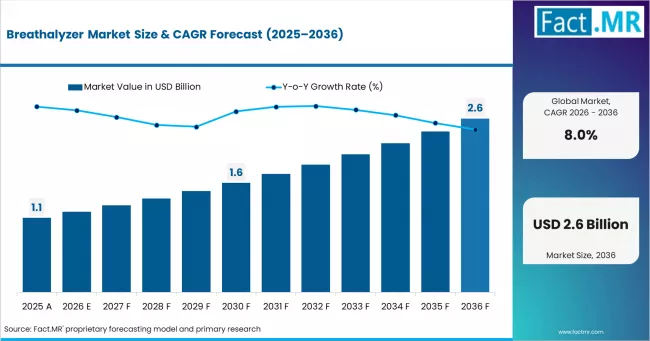
Breathalyzer Market Market Value Analysis | Source: Fact.MR
Summary of Breathalyzer Market
- Market Snapshot
- In 2025, the global Breathalyzer Market was valued at approximately USD 1.1 billion.
- The market is estimated to reach USD 1.2 billion in 2026 and is projected to attain USD 2.6 billion by 2036
- The breathalyzer market is likely to expand at a CAGR of 8.0% during the forecast period.
- The market is anticipated to create an absolute dollar opportunity of USD 1.4 billion between 2026 and 2036.
- Portable Breathalyzers account for 61.0% of market share in 2026.
- China (10.8%) and India (10.0%) are the key growth markets during the forecast period
- Demand and Growth Drivers
- Stricter drunk driving enforcement worldwide is increasing law enforcement procurement of fuel cell and semiconductor-based breath alcohol testing devices.
- Workplace safety regulations mandating pre-shift and random alcohol testing are expanding enterprise procurement of portable and desktop breathalyzer units.
- Growing personal use adoption, supported by smartphone-connected devices and consumer health awareness, is creating a retail demand channel independent of institutional procurement.
- Product and Segment View
- Portable breathalyzers account for 61% of the product segment in 2026, reflecting demand for field-deployable devices across law enforcement, workplace, and personal use applications.
- Alcohol detection applications represent 54% in 2026, with roadside and checkpoint testing driving the largest single-use case volume.
- Law enforcement agencies hold 47% of end-use demand in 2026, with police forces and traffic authorities as the primary institutional procurement channel.
- Geography and Competitive Outlook
- China leads at 10.8% CAGR, supported by expanding road safety enforcement and workplace testing regulations.
- Europe maintains significant demand anchored by strict DUI enforcement and mandatory interlock device programs.
- Dragerwerk holds 22% market share, with competition from BACtrack, Intoximeters, and regional device manufacturers.
- Analyst Opinion
- The breathalyzer market is expanding beyond its traditional law enforcement base into workplace safety and personal consumer segments. Fuel cell sensor technology is displacing semiconductor sensors in professional applications due to superior accuracy and specificity, creating a quality-driven upgrade cycle. The personal-use segment is the fastest-growing channel, driven by smartphone connectivity and consumer health monitoring trends. Interlock device mandates for DUI offenders represent a recurring revenue model gaining traction in North America and Europe. Companies that combine fuel cell accuracy with consumer-friendly design and digital connectivity are best positioned to capture growth across both institutional and retail channels.
Why is the Breathalyzer Market Growing?
- Stricter DUI enforcement legislation across Asia Pacific, Latin America, and the Middle East is expanding law enforcement device procurement beyond mature Western markets.
- Workplace alcohol testing mandates in transportation, mining, construction, and manufacturing are creating sustained enterprise procurement demand.
- Consumer breathalyzer adoption is accelerating, driven by smartphone-connected devices, health monitoring trends, and personal responsibility awareness.
The breathalyzer market is shaped by the convergence of regulatory enforcement, workplace safety requirements, and consumer health monitoring. Law enforcement remains the foundational demand channel, but growth is increasingly coming from workplace and personal use segments where testing frequency is higher than checkpoint-based enforcement.
Technology evolution is also shaping the market. Fuel cell sensors are becoming the standard for professional applications due to accuracy and alcohol-specific measurement capability. Semiconductor sensors continue to serve price-sensitive personal-use and screening applications where indicative rather than evidential accuracy is acceptable.
Segment-wise Analysis of the Breathalyzer Market
- Portable breathalyzers lead at 61% share in 2026, serving field-deployable testing across law enforcement, workplace, and personal use.
- Alcohol detection accounts for 54% of applications in 2026, with roadside and checkpoint testing the primary use case.
- Fuel cell technology holds 63% in 2026, reflecting professional demand for accurate, alcohol-specific measurement.
The market is segmented by product type (portable, desktop, fuel cell, semiconductor breathalyzers), application (alcohol detection, workplace safety, medical diagnostics, personal use), end use (law enforcement, enterprises, individuals, healthcare), technology (fuel cell, semiconductor sensor, infrared spectroscopy), and packaging (portable devices, device kits, desktop units).
Which Product Segment Leads?
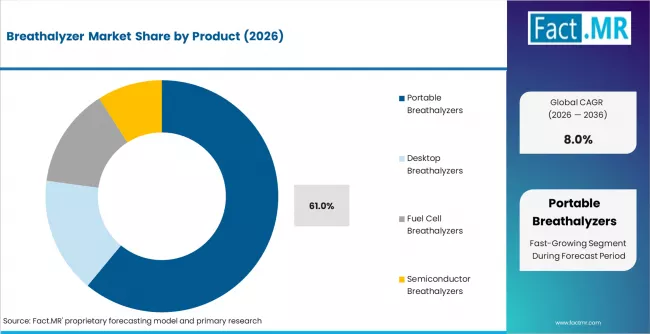
Breathalyzer Market Analysis By Product | Source: Fact.MR
Portable breathalyzers hold 61% of the product segment in 2026. Field portability is essential for law enforcement roadside testing, workplace screening, and personal monitoring. The segment benefits from advancing miniaturization, improved battery life, and smartphone connectivity that enhance usability across all end-use channels.
Which Application Drives Largest Demand?
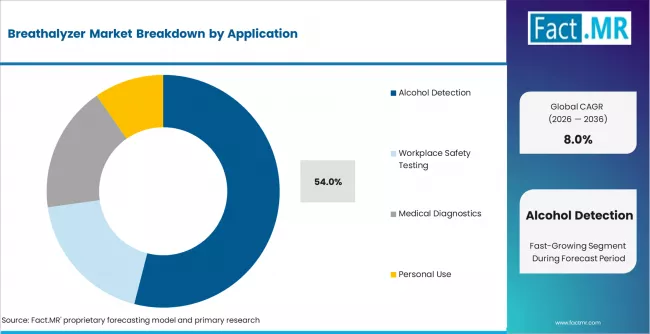
Breathalyzer Market Analysis By Application | Source: Fact.MR
Alcohol detection accounts for 54% of applications in 2026. Roadside DUI enforcement checkpoints and random testing programs drive the largest device utilization volumes. Workplace safety testing represents the second-largest application, with pre-shift screening and random testing protocols creating recurring device usage across regulated industries.
Key Growth Drivers, Constraints, and Market Scope
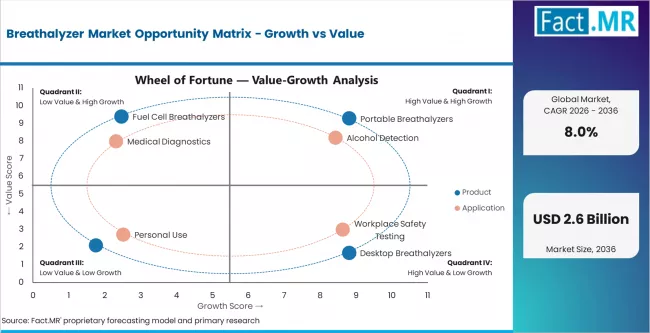
Breathalyzer Market Opportunity Matrix Growth Vs Value | Source: Fact.MR
- Expanding DUI enforcement legislation in emerging markets creates new institutional procurement channels.
- Workplace testing mandates across regulated industries generate recurring demand for device procurement and calibration.
- Calibration requirements and sensor replacement cycles create aftermarket revenue streams.
The breathalyzer market is shaped by road safety regulation, workplace compliance requirements, sensor technology development, and consumer adoption of personal health monitoring devices.
Growth Drivers
Demand is shaped by stricter DUI enforcement across emerging markets, workplace alcohol testing mandates expanding into new industries, and consumer device adoption driven by smartphone connectivity. Interlock device mandates for DUI offenders create recurring demand with legislative backing.
Constraints
Sensor degradation requiring regular calibration increases total cost of ownership. Price sensitivity in personal-use segments limits premium device adoption. Regulatory variation in evidential accuracy standards across jurisdictions complicates cross-border device certification.
Opportunities
Smartphone-connected personal breathalyzers represent the fastest-growing retail segment. Interlock device mandates for DUI offenders create a legislatively supported recurring demand channel. Medical diagnostics applications for breath-based disease screening could expand the addressable market beyond alcohol detection.
Regional Outlook Across Key Markets
.webp "Top Country Growth Comparison Breathalyzer Market Cagr (2026 2036)")
Top Country Growth Comparison Breathalyzer Market Cagr (2026 2036) | Source: Fact.MR
- China leads at 10.8% CAGR, driven by expanding road safety enforcement and workplace regulations.
- India follows at 10.0% CAGR, reflecting growing DUI enforcement and transportation safety mandates.
- Germany records 9.2% CAGR, supported by strict enforcement and interlock device programs.
- Brazil grows at 8.4% CAGR, driven by strengthening road safety legislation.
Country CAGR Table
| Country | CAGR (%) |
|---|---|
| China | 10.8% |
| India | 10.0% |
| Germany | 9.2% |
| Brazil | 8.4% |
| USA | 7.6% |
| UK | 6.8% |
| Japan | 6.0% |
Source: Fact.MR analysis. Updated Apr 27, 2026
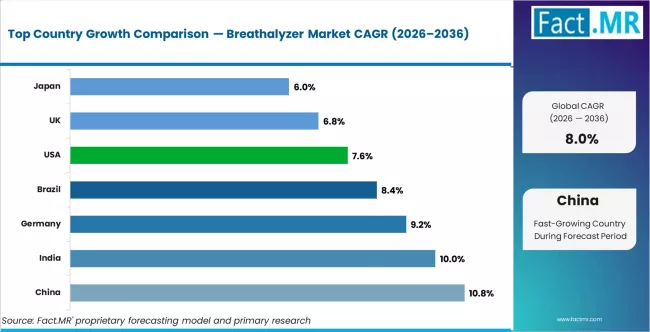
Breathalyzer Market Cagr Analysis By Country | Source: Fact.MR
Regional demand reflects road safety enforcement maturity, workplace testing regulation, consumer device adoption rates, and institutional procurement budgets.
Market Outlook in China
The China breathalyzer market is projected to grow at a CAGR of 10.8% through 2036. Growth is driven by expanding road safety enforcement programs, increasing workplace testing requirements, and growing consumer awareness of personal alcohol monitoring.
- Road safety enforcement expansion drives law enforcement procurement.
- Workplace testing regulations are broadening across industrial sectors.
- Consumer device adoption is growing through e-commerce channels.
Demand Trends in India
The India breathalyzer market is projected to grow at a CAGR of 10.0% through 2036. Demand reflects growing DUI enforcement, expanding transportation safety mandates, and increasing workplace testing adoption in industrial sectors.
- DUI enforcement strengthening drives law enforcement device procurement.
- Transportation sector safety mandates create institutional demand.
- Workplace testing adoption is expanding across manufacturing and construction.
Germany Market Growth
The Germany breathalyzer market is projected to grow at a CAGR of 9.2% through 2036. Demand is supported by strict DUI enforcement, interlock device programs, and workplace testing requirements in regulated industries.
- Strict enforcement maintains high device utilization rates.
- Interlock device mandates create recurring demand.
- Industrial workplace testing sustains enterprise procurement.
USA Market Outlook
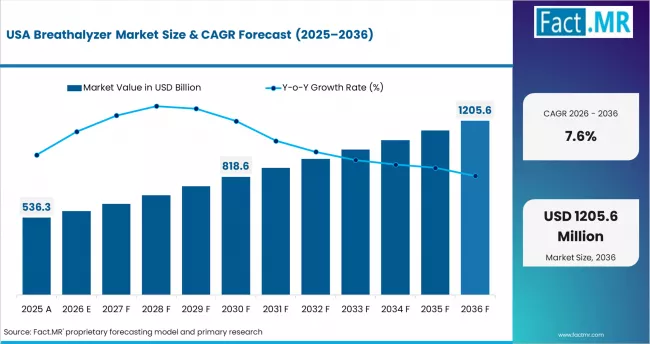
Breathalyzer Market Country Value Analysis | Source: Fact.MR
The USA breathalyzer market is projected to grow at a CAGR of 7.6% through 2036. Demand is shaped by state-level interlock device mandates, workplace testing in regulated industries, and growing personal-use device adoption.
- State-level interlock mandates expand legislatively backed demand.
- Workplace testing in DOT-regulated industries sustains institutional procurement.
- Personal device adoption grows through retail and e-commerce channels.
Competitive Benchmarking and Company Positioning
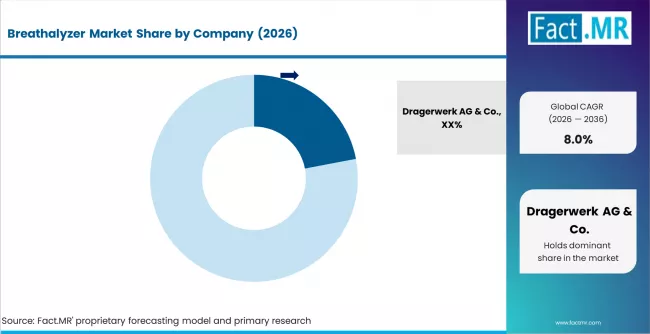
Breathalyzer Market Analysis By Company | Source: Fact.MR
- Dragerwerk holds 22% market share through its portfolio of professional-grade fuel cell breathalyzers for law enforcement and workplace applications.
- BACtrack and Intoximeters compete through consumer-accessible devices and established law enforcement relationships respectively.
- Competition is shaped by sensor technology, evidential certification, distribution channel coverage, and digital connectivity features.
The competitive landscape spans professional-grade manufacturers serving institutional procurement and consumer device brands targeting retail channels. Dragerwerk leads in professional applications through fuel cell sensor accuracy and evidential certification. BACtrack competes strongly in the consumer segment through smartphone connectivity and retail distribution.
Strategic priorities include advancing fuel cell sensor miniaturization, expanding smartphone connectivity, building interlock device portfolios, and developing medical-grade breath analysis capabilities.
Competitive Benchmarking
| Company | Sensor Technology | Market Focus | Distribution | Certification |
|---|---|---|---|---|
| Dragerwerk | Fuel cell | Professional | Global | Evidential |
| BACtrack | Fuel cell + semi | Consumer + pro | Americas/Europe | DOT approved |
| Intoximeters | Fuel cell | Law enforcement | Americas | Evidential |
| Lifeloc | Fuel cell | Professional | Americas | DOT approved |
| Alcolizer | Fuel cell | Professional | Asia Pacific | Regional certified |
Source: Fact.MR analysis. Updated Apr 27, 2026
Recent Industry Developments
- Dragerwerk launched a next-generation portable fuel cell breathalyzer in 2025, featuring improved sensor accuracy and Bluetooth connectivity for digital record management.
- BACtrack expanded its smartphone-connected breathalyzer range in early 2026, targeting the growing personal-use consumer segment through e-commerce distribution.
- Intoximeters announced an updated evidential breath testing platform in 2025, meeting new accuracy standards adopted by multiple US state enforcement agencies.
Leading Companies Shaping the Breathalyzer Market
-
Major Players
- Dragerwerk AG & Co. KGaA
- BACtrack
- Intoximeters Inc.
- Lifeloc Technologies
- Alcolizer Technology Pty Ltd
-
Emerging Players
- Andatech Pty Ltd
- AlcoPro
- Bedfont Scientific Ltd
- Abbott Laboratories
- Alcohol Countermeasure Systems
Sources and Research References
- World Health Organization (WHO). Road safety and alcohol policy data.
- National Highway Traffic Safety Administration (NHTSA). DUI enforcement and device standards.
- Dragerwerk AG. Annual reports and breath testing portfolio disclosures.
- International Council on Alcohol, Drugs and Traffic Safety (ICADTS). Enforcement best practices.
- Occupational Safety and Health Administration (OSHA). Workplace testing regulation.
- Primary interviews with device manufacturers, law enforcement agencies, and workplace safety managers.
This bibliography is provided for reader reference. The full report contains the complete reference list.
Key Questions This Report Addresses
- What is the current and projected size of the breathalyzer market?
- What CAGR is expected between 2026 and 2036?
- Which product type holds the largest share?
- Which application accounts for highest demand?
- What factors shape demand?
- Which countries show fastest growth?
- How is the competitive landscape structured?
- How does Fact.MR validate the forecast?
Breathalyzer Market Definition
The breathalyzer market covers devices that measure blood alcohol concentration through breath analysis, used in law enforcement, workplace safety, medical diagnostics, and personal monitoring. The market spans device manufacturing, calibration services, and distribution through institutional procurement and consumer retail channels.
Breathalyzer Market Inclusions
The scope covers global and regional market size and forecasts for 2026 to 2036 across product type, application, end use, technology, packaging, and region. It includes demand analysis based on DUI enforcement data, workplace testing regulations, and consumer device adoption trends.
Breathalyzer Market Exclusions
The scope excludes blood-based alcohol testing equipment, urine alcohol screening kits, continuous alcohol monitoring devices worn on the body, and laboratory-grade gas chromatography instruments not classified as portable or desktop breathalyzers.
Breathalyzer Market Research Methodology
- Primary research includes interviews with device manufacturers, law enforcement agencies, workplace safety managers, and retail distributors.
- Desk research draws on road safety enforcement data, workplace regulation databases, device certification records, and company financial disclosures.
- Market sizing uses a demand-side model validated through procurement data, device shipment statistics, and retail sales benchmarks.
- Data validation involves reconciliation with industry standards data and expert panel review.
Segmentation
Scope of Analysis
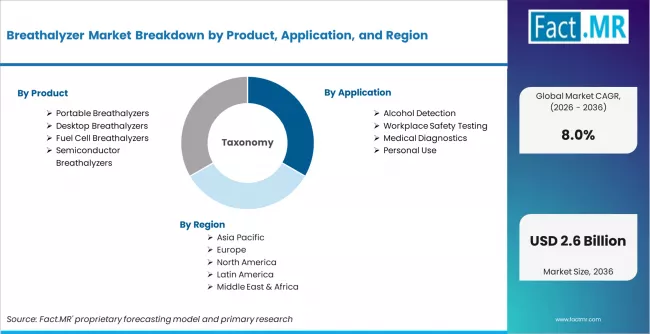
Breathalyzer Market Breakdown By Product, Application, And Region | Source: Fact.MR
| Parameter | Details |
|---|---|
| Quantitative Units | USD 1.2 billion to USD 2.6 billion, at a CAGR of 8.0% |
| Market Definition | Covers breath alcohol testing devices for law enforcement, workplace safety, medical diagnostics, and personal monitoring. |
| Regions Covered | North America, Latin America, Europe, East Asia, South Asia and Pacific, Middle East and Africa |
| Countries Covered | USA, China, India, Germany, Brazil, UK, Japan, and 30+ countries |
| Key Companies | Dragerwerk, BACtrack, Intoximeters, Lifeloc, Alcolizer, Andatech, AlcoPro, Bedfont, Abbott, Alcohol Countermeasure Systems |
| Forecast Period | 2026 to 2036 |
| Approach | Hybrid demand-side methodology built on enforcement data, workplace regulation analysis, device shipment statistics, and primary interviews across manufacturers and institutional buyers. |
Source: Fact.MR analysis. Updated Apr 27, 2026
Analysis by Product Type, Application, End Use, Technology, Source, Packaging, and Region
-
Breathalyzer Market Market Segmented by Product:
- Portable Breathalyzers
- Handheld Breathalyzers
- Smartphone Connected Devices
- Handheld Breathalyzers
- Desktop Breathalyzers
- Stationary Testing Units
- Law Enforcement Grade Systems
- Stationary Testing Units
- Fuel Cell Breathalyzers
- High Accuracy Alcohol Detectors
- Professional Testing Devices
- High Accuracy Alcohol Detectors
- Semiconductor Breathalyzers
- Low Cost Consumer Devices
- Personal Use Breathalyzers
- Low Cost Consumer Devices
- Portable Breathalyzers
-
Breathalyzer Market Market Segmented by Application:
- Alcohol Detection
- DUI Enforcement Testing
- Roadside Screening Programs
- DUI Enforcement Testing
- Workplace Safety Testing
- Corporate Alcohol Monitoring
- Industrial Safety Checks
- Corporate Alcohol Monitoring
- Medical Diagnostics
- Alcohol Monitoring Programs
- Rehabilitation Testing
- Alcohol Monitoring Programs
- Personal Use
- Self Monitoring Devices
- Consumer Health Devices
- Self Monitoring Devices
- Alcohol Detection
-
Breathalyzer Market Market Segmented by End Use:
- Law Enforcement Agencies
- Traffic Police Units
- Road Safety Departments
- Traffic Police Units
- Enterprises
- Workplace Safety Organizations
- Corporate Compliance Units
- Workplace Safety Organizations
- Individuals
- Personal Users
- Health Conscious Consumers
- Personal Users
- Healthcare Institutions
- Rehab & Treatment Centers
- Medical Monitoring Programs
- Rehab & Treatment Centers
- Law Enforcement Agencies
-
Breathalyzer Market Market Segmented by Technology:
- Fuel Cell Technology
- Electrochemical Sensors
- High Accuracy Detection Systems
- Electrochemical Sensors
- Semiconductor Sensors
- Oxide-Based Sensors
- Low Cost Detection Devices
- Oxide-Based Sensors
- Infrared Spectroscopy
- Advanced Analytical Systems
- Laboratory Grade Devices
- Advanced Analytical Systems
- Fuel Cell Technology
-
Breathalyzer Market Market Segmented by Source:
- Breath Analysis
- Alcohol in Exhaled Breath
- Ethanol Detection Systems
- Biochemical Breath Sampling
- Alcohol in Exhaled Breath
- Breath Analysis
-
Breathalyzer Market Market Segmented by Packaging:
- Portable Devices
- Handheld Units
- Pocket Breathalyzers
- Handheld Units
- Device Kits
- Testing Kit Packaging
- Calibration Accessories
- Testing Kit Packaging
- Desktop Units
- Fixed Installation Systems
- Professional Testing Stations
- Fixed Installation Systems
- Portable Devices
-
Breathalyzer Market Market by Region:
- North America
- USA
- Canada
- Mexico
- Latin America
- Brazil
- Chile
- Rest of Latin America
- Western Europe
- Germany
- UK
- Italy
- Spain
- France
- Nordic
- BENELUX
- Rest of Western Europe
- Eastern Europe
- Russia
- Poland
- Hungary
- Balkan & Baltic
- Rest of Eastern Europe
- East Asia
- China
- Japan
- South Korea
- South Asia and Pacific
- India
- ASEAN
- Australia & New Zealand
- Rest of South Asia and Pacific
- Middle East & Africa
- Kingdom of Saudi Arabia
- Other GCC Countries
- Turkiye
- South Africa
- Other African Union
- Rest of Middle East & Africa
- North America
Frequently Asked Questions
What is the market size in 2026?
What will be the market size in 2036?
What is the expected CAGR?
Which product type leads?
Which application accounts for highest demand?
Which country is fastest growing?
What does the market cover?
How does Fact.MR validate the forecast?
Who worked on this report


Preview the report firsthand - request a free sample
Free SampleGet the brochure for pricing and purchase details
Download PDF