- Market Value (2025): USD 813.6 Mn
- Estimated Value (2026): USD 860.0 Mn
- Forecast Value (2036): USD 1497.1 Mn
- CAGR (2026-2036): 5.7%
What is the Cryopreservation & Fertilization Media Market forecast to be worth by 2036?
USD 860.0 million in 2026 to USD 1497.1 million by 2036 at a 5.7% CAGR.
- The market reached USD 813.6 million in 2025.
- Demand is projected to increase from USD 860.0 million in 2026 to USD 1497.1 million by 2036.
- The market is forecast to expand at a 5.7% CAGR from 2026 to 2036 as fertility laboratories increase storage and transfer activity while research and animal-reproduction users require application-specific preservation formulations.
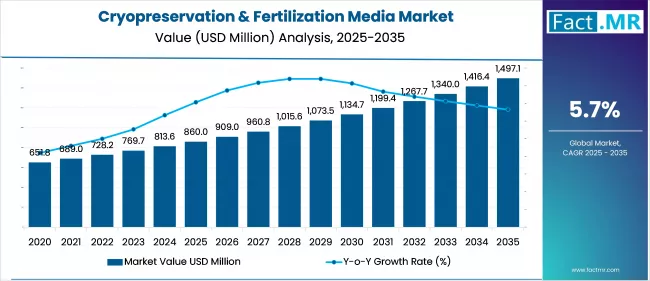
Cryopreservation & Fertilization Media Market Value Analysis | Source: Fact.MR
What are the defining numbers behind Cryopreservation & Fertilization Media Market growth?
An absolute opportunity of USD 637.1 million opens between 2026 and 2036.
- Demand Drivers in the Market
- Frozen embryo transfer expands demand for both preservation and warming solutions. HFEA data show that frozen transfers accounted for 45% of UK embryo transfers in 2023. A treatment pathway that stores additional embryos creates separate media requirements when those embryos return to the laboratory for transfer. The commercial effect is repeated consumption rather than a one-time equipment sale.
- Egg and embryo banking creates additional preparation and freezing activity. The CDC recorded 184,423 banking cycles among US assisted reproductive technology cycles in 2022. Each storage procedure requires an appropriate formulation and handling protocol, supporting regular procurement by fertility laboratories.
- As daily workloads increase, ready-to-use media can reduce preparation steps. Laboratories still need to control temperature, timing and handling, but a pre-formulated solution removes some local mixing requirements. This makes batch consistency and dependable availability commercially important in specialized cell culture media.
- Research repositories need to recover usable biological material after storage. Growth in biobanking can support preservation-media orders where programmes store viable cells or tissues. Purchases depend on sample type and intended recovery, so a repository's total sample count does not translate directly into media demand.
- Animal breeding programmes use preserved germ cells to separate collection from later reproductive use. For suppliers serving animal genetics, the opportunity lies in species-specific media and handling requirements across livestock, equine and aquaculture workflows. Human IVF formulations cannot automatically be substituted for those uses.
- Key Segments Analyzed
- Cryopreservation Media account for 41.9% of Product in 2026, supported by repeated freezing requirements for germ cells, embryos and other viable biological material.
- Liquid Media hold 53.7% of Form in 2026. Their practical value lies in dispensing and use within established laboratory protocols.
- Human Assisted Reproduction represents 38.6% of Application in 2026 as fertilization, storage and later transfer each generate distinct media requirements.
- IVF Centers capture 44.8% of End Use in 2026, reflecting the concentration of embryology procedures and recurring consumable purchasing within these facilities.
- At 47.5% of Technology in 2026, Vitrification Technology benefits from its use in oocyte and embryo preservation pathways with matched warming procedures.
- Analyst Opinion at Fact.MR
- Shambhu Nath Jha, Principal Consultant, Fact.MR
- Media suppliers earn a durable place in an IVF laboratory by protecting consistency at the moments when cells move between different conditions. Embryologists need formulations they can handle predictably, with enough shelf life to match their workload. Commercial advantage comes from combining reliable batches, practical pack sizes and responsive technical support across fertilization, vitrification and warming.
- Strategic Implications
- Media manufacturers should offer pack sizes that reflect actual daily caseloads, reducing avoidable wastage without encouraging storage beyond the labelled conditions.
- Fertility groups should evaluate supplier changes across the complete laboratory protocol, including freezing and warming, before standardizing purchasing across centres.
- Distribution partners need to monitor storage conditions and remaining shelf life because an available shipment is useful only if it can be used within the clinic's schedule.
- Suppliers expanding into animal reproduction or research preservation should qualify formulations for the target specimen and procedure instead of extending human-IVF claims to other applications.
How does the Cryopreservation & Fertilization Media Market break down by segment?
The market is segmented by Product, Form, Application, End Use and Technology.
Why do Cryopreservation Media lead Product?
Cryopreservation Media hold 41.9% of Product in 2026.
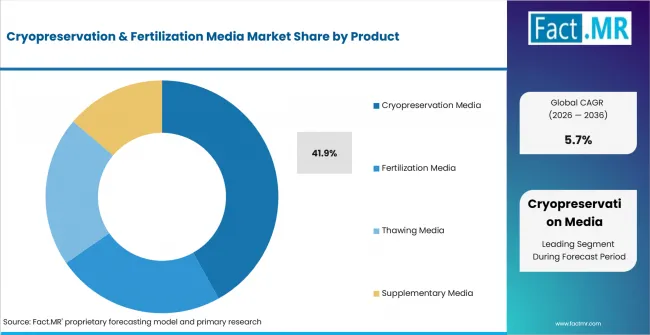
Cryopreservation & Fertilization Media Market Analysis By Product | Source: Fact.MR
Freezing requires the biological material to move from routine handling conditions into a preservation environment. The media therefore form part of the procedure itself, and each new storage event generates consumption even when the laboratory already owns the necessary equipment.
FertiPro's media portfolio includes embryo cryopreservation products, while Nidacon offers sperm cryopreservation and blastocyst vitrification solutions. These distinct formulations illustrate how the purchase requirement varies by specimen and process stage.
Storage capacity and formulation demand should be assessed separately. Biobanks may retain material for long periods, but media purchasing is associated mainly with processing new samples and preparing them for recovery.
Why do Liquid Media lead Form?
Liquid Media hold 53.7% of Form in 2026.
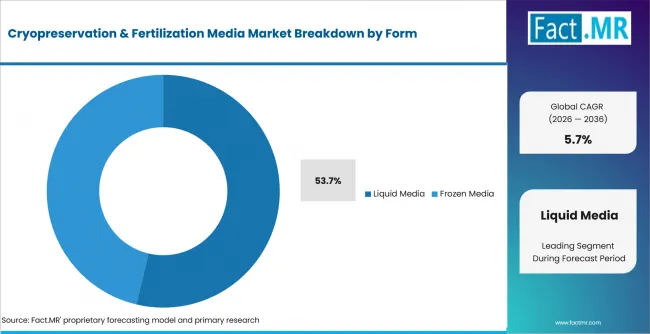
Cryopreservation & Fertilization Media Market Analysis By Form | Source: Fact.MR
A laboratory can dispense liquid solutions into a controlled workflow without first reconstituting a dry product. Ready-to-use formats help reduce preparation time, while concentrated formats require the appropriate preparation procedure and quality controls.
The purchasing decision remains sensitive to volume and shelf life. A pack that is economical for a high-throughput centre may create wastage in a smaller clinic. Nidacon's product instructions emphasize labelled storage and handling conditions, making inventory management part of the value delivered by the formulation.
Why does Human Assisted Reproduction lead Application?
Human Assisted Reproduction holds 38.6% of Application in 2026.
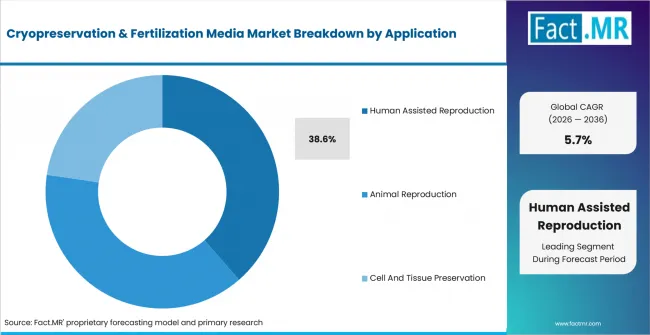
Cryopreservation & Fertilization Media Market Analysis By Application | Source: Fact.MR
Human reproduction links several laboratory events to the same treatment journey. Fertilization may be followed by embryo storage and a later warming cycle, creating demand for different solutions rather than a single universal medium.
The HFEA reports that UK egg-freezing cycles increased from 2,567 in 2019 to 6,932 in 2023; the 2023 treatment counts are preliminary. That shift supports additional preservation activity, but media demand must still be related to the number of procedures and protocols used rather than assumed from patient numbers alone.
Why do IVF Centers lead End Use?
IVF Centers hold 44.8% of End Use in 2026.
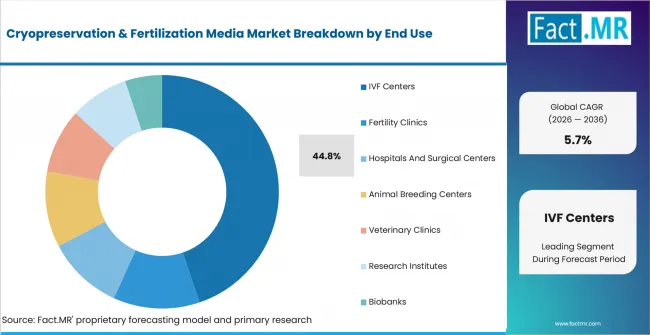
Cryopreservation & Fertilization Media Market Analysis By End Use | Source: Fact.MR
IVF centres bring fertilization and embryo-handling activity into a dedicated laboratory environment. This concentrates responsibility for inventory, lot acceptance, staff training and day-to-day use, making the centre a recurring buyer across several media categories.
Central purchasing does not remove clinical responsibility for a formulation change. Laboratory directors need compatibility with existing procedures and an orderly transition between batches or products. Suppliers that can support that process have a stronger chance of becoming part of routine procurement.
Why does Vitrification Technology lead Technology?
Vitrification Technology holds 47.5% of Technology in 2026.
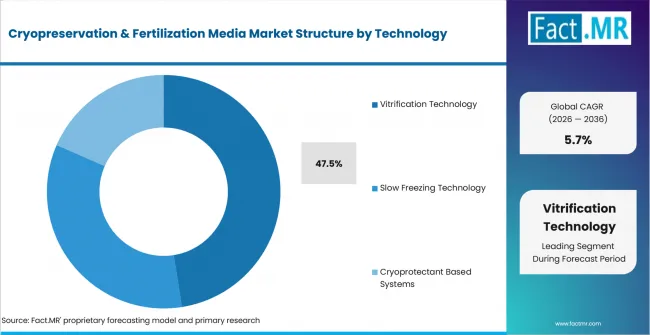
Cryopreservation & Fertilization Media Market Analysis By Technology | Source: Fact.MR
Vitrification connects the preservation solution with a specific cooling and warming sequence. Embryologists therefore assess the formulation, handling steps and recovery process together when choosing a system for oocytes and embryos.
Kitazato markets matched vitrification and thawing media for these applications. Vitrolife's warming products similarly show that recovery is a distinct commercial stage with its own formulation requirements. These portfolios support demand for coordinated protocols rather than interchangeable solutions.
Slow-freezing technology remains relevant to particular specimens and established procedures. Cryoprotectant-based systems describe another aspect of formulation choice and should be interpreted within the relevant application rather than as evidence that every technology category is interchangeable.
What is accelerating Cryopreservation & Fertilization Media Market adoption, and what is holding it back?
Media consumption rises with laboratory procedures, while supplier retention depends on consistency, availability and confidence in the complete protocol. The main friction occurs when a clinic changes products, receives short-dated inventory or cannot maintain required handling conditions. Strong procedure demand does not remove these constraints; it makes dependable replenishment more valuable.
Impact figures are approximate directional CAGR sensitivities to changes in procedure mix, availability and purchasing behaviour. They are scenario estimates, may overlap and do not form an additive forecast bridge.
Drivers Impact Analysis
| Factor | (~) % Impact on CAGR | Geographic Relevance | Impact Timeline |
|---|---|---|---|
| Additional embryo-freezing and warming activity | +0.6% | UK, USA and Japan | Short term (<= 2 years) |
| Egg and germ-cell banking procedures | +0.4% | All five countries | Medium term (2-4 years) |
| Routine adoption of ready-to-use laboratory solutions | +0.3% | Germany, USA and UK | Short term (<= 2 years) |
Source: Fact.MR analysis. Updated Sep 7, 2026
Demand is tied to completed laboratory steps. More freezing procedures generate preservation-media use, while later transfers create a separate requirement for warming solutions. Pack configuration determines how efficiently a clinic can translate those procedures into purchasing.
Opportunity Impact Analysis
| Factor | (~) % Impact on CAGR | Geographic Relevance | Impact Timeline |
|---|---|---|---|
| Matched vitrification and warming portfolios | +0.3% | Germany, USA | Medium term (2-4 years) |
| Media for viable-cell research repositories | +0.2% | Germany, USA and Japan | Medium term (2-4 years) |
| Species-specific animal-reproduction formulations | +0.2% | Brazil, Germany and USA | Short term (<= 2 years) |
Source: Fact.MR analysis. Updated Sep 7, 2026
A supplier can extend its commercial reach by serving more stages of the same workflow or by developing a formulation for a distinct specimen type. Applications associated with cell culture require particular attention to post-storage viability and the intended downstream use.
Restraints Impact Analysis
| Factor | (~) % Impact on CAGR | Geographic Relevance | Impact Timeline |
|---|---|---|---|
| Laboratory qualification of formulation changes | -0.4% | All profiled countries | Short term (<= 2 years) |
| Shelf-life losses and storage-condition failures | -0.3% | UK and USA | Short term (<= 2 years) |
| Patient funding constraints on treatment activity | -0.3% | Brazil, UK and USA | Medium term (2-4 years) |
Source: Fact.MR analysis. Updated Sep 7, 2026
Changing a medium can require a laboratory to review its working protocol, and short remaining shelf life can offset an attractive unit price. At the service level, treatment affordability constrains the number of cycles that reach the laboratory; this is separate from the clinical need for fertility care.
Which countries are scaling the Cryopreservation & Fertilization Media Market through 2036?
- Germany: Established IVF laboratories and registry-based observation of treatment practice support repeat purchasing around fertilization and cryotransfer workflows.
- Brazil: Assisted-reproduction services depend on reliable replenishment and traceable laboratory processes, creating demand for preservation and fertilization formulations suited to local clinic workloads.
- USA: Egg and embryo banking adds repeat preservation activity to an established assisted-reproduction service base.
- UK: Greater use of frozen embryo transfer extends media consumption beyond the initial fertilization cycle and increases the importance of matched warming products.
- Japan: Established frozen-thawed embryo-transfer practice sustains demand for vitrification and warming solutions within specialist reproductive laboratories.
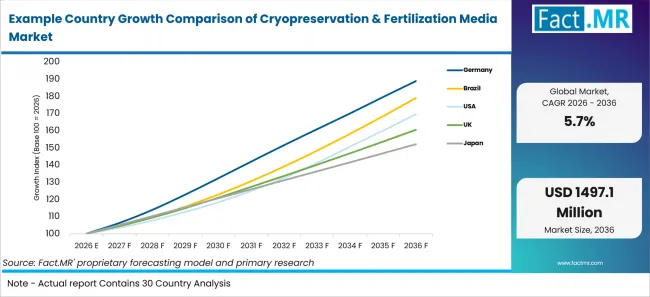
Example Country Growth Comparison Of Cryopreservation & Fertilization Media Market | Source: Fact.MR
Country CAGR (2026-2036)
| Country | CAGR, 2026-2036 |
|---|---|
| Germany | 6.6% |
| Brazil | 6.0% |
| USA | 5.4% |
| UK | 4.9% |
| Japan | 4.3% |
Source: Fact.MR analysis. Updated Sep 7, 2026
What is driving Germany's growth through 2036?
Germany is forecast to expand at a 6.6% CAGR from 2026 to 2036.
The German IVF Register's 2024 yearbook documents IVF, ICSI and cryotransfer treatment activity. Its discussion of single-embryo transfer highlights how clinical practice influences the sequence of fresh treatment, storage and subsequent transfer.
German laboratories need media portfolios that fit those sequences while preserving consistency between treatment cycles. Suppliers benefit from technical familiarity with embryology teams, but any product substitution must be assessed against the centre's existing protocol.
What is driving Brazil's growth through 2036?
Brazil is forecast to expand at a 6.0% CAGR from 2026 to 2036.
Anvisa's SisEmbrio system records information from assisted-reproduction centres and germ-cell and tissue banks. Its coverage of embryo production and related activity provides a framework for observing the procedures that consume media.
For Brazilian clinics, the commercial issue is the ability to obtain an appropriate formulation with usable shelf life and compliant storage throughout distribution. Suppliers need to match inventory and delivery schedules to actual laboratory demand rather than simply increase shipment volume.
What is driving USA's growth through 2036?
The USA is forecast to expand at a 5.4% CAGR from 2026 to 2036.
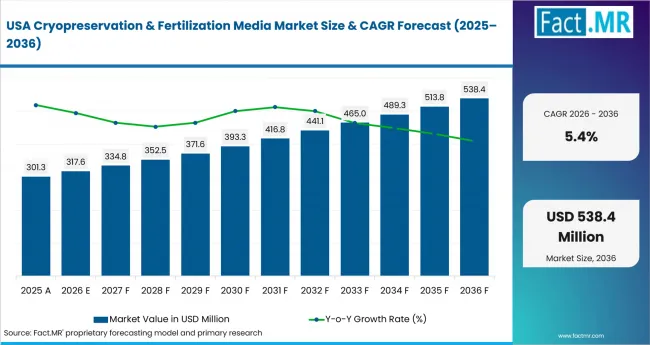
Cryopreservation & Fertilization Media Market Country Value Analysis | Source: Fact.MR
The CDC reported 435,426 ART cycles across 457 reporting US clinics in 2022. These historical surveillance figures show the scale and concentration of laboratory activity underlying media procurement, while the distinction between transfer and banking cycles helps explain the product mix.
Larger clinic groups can coordinate purchasing, but laboratory directors still need control over lot acceptance and protocol changes. Suppliers with responsive technical support and predictable replenishment can address both procurement efficiency and the operational needs of individual centres.
What is driving UK's growth through 2036?
The UK is forecast to expand at a 4.9% CAGR from 2026 to 2036.
HFEA's 2023 report connects the increased use of single-embryo transfer with subsequent frozen-transfer activity. The commercial effect is a treatment pathway spread across several laboratory events, each with its own solution requirements.
Clinic purchasing must also reflect caseload and expiry. Smaller packs may fit lower-volume services, while centres performing more cycles can use larger packs efficiently. Reliable supply is therefore measured by product usability within the laboratory schedule as well as by delivery speed.
What is driving Japan's growth through 2036?
Japan is forecast to expand at a 4.3% CAGR from 2026 to 2036.
The Japan Society of Obstetrics and Gynecology's national ART report for 2023 separately examines fresh treatment and frozen-thawed embryo-transfer cycles. This distinction supports an application-specific view of Japanese media demand rather than treating every cycle as the same consumable event.
A mature preservation workflow places emphasis on handling consistency and compatibility with established techniques. Product development can target simpler preparation or recovery steps, but a supplier must demonstrate that the revised process fits the clinic's technical requirements.
Who Leads the Cryopreservation & Fertilization Media Market?
Key players in the Cryopreservation & Fertilization Media Market include Cooper Surgical, Vitrolife AB, Kitazato Corporation, Genea Biomedx, FERTIPRO NV and Nidacon International AB.
Ownership consolidation changes how product portfolios should be viewed. Cook Medical's reproductive-health business, the ART and cytogenetics product lines formerly under FUJIFILM Irvine Scientific, and GYNEMED GmbH & Co. KG (A Hamilton Thorne Company) sit within the Nexpring Health platform. Nexpring announced completion of the Irvine acquisition in June 2025. These businesses should not be treated as unrelated corporate competitors simply because their established product names remain familiar to laboratories.
Genea Biomedx links media with laboratory equipment and workflow offerings, while specialists such as FERTIPRO NV and Nidacon International AB supply formulations for particular reproductive steps. This gives buyers a choice between broader laboratory portfolios and focused product expertise.
Microm Ltd. serves the fertility market as a supplier of diagnostic, consumable and media products. Its UK business was acquired by Calibre Scientific in 2024. Microm's distribution role is distinct from the manufacturing role of the media brands it supplies, which is important when examining supplier concentration and avoiding double counting along the sales chain.
Which companies are the key providers?
Key providers include Cooper Surgical, Vitrolife AB, Kitazato Corporation, Genea Biomedx, FERTIPRO NV and Nidacon International AB; the Cook Medical reproductive-health, former FUJIFILM Irvine Scientific ART and GYNEMED GmbH & Co. KG (A Hamilton Thorne Company) businesses operate within Nexpring Health, while Microm Ltd. participates through fertility-product supply.
- Cooper Surgical
- Vitrolife AB
- Kitazato Corporation
- Genea Biomedx
- FERTIPRO NV
- Nidacon International AB
- Cook Medical
- FUJIFILM Irvine Scientific
- GYNEMED GmbH & Co. KG
- Nexpring Health
- Microm Ltd.
Bibliography
- Human Fertilisation and Embryology Authority. (2025). Fertility Treatment 2023: Trends and Figures. HFEA.
- Centers for Disease Control and Prevention. (2024). ART Surveillance: National ART Surveillance System. U.S. Department of Health and Human Services.
- Deutsches IVF-Register. (2025). D.I.R Jahrbuch 2024. Deutsches IVF-Register.
- Agencia Nacional de Vigilancia Sanitaria. (2025). SisEmbrio: Sistema Nacional de Producao de Embrioes. Anvisa.
- Japan Society of Obstetrics and Gynecology. (2026). Assisted Reproductive Technology in Japan: A Summary Report for 2023 by the Committee on Professional Scientific Conduct and Clinical Ethics. Reproductive Medicine and Biology, 25, e70008.
- CooperSurgical. (n.d.). Fertility and Birth: Assisted Reproductive Technology and ART Media. CooperSurgical.
- Vitrolife. (n.d.). Ultra RapidWarm Blast. Vitrolife.
- Kitazato Corporation. (n.d.). Vitrification and Thawing Media. Kitazato.
- FertiPro. (n.d.). Media. FertiPro.
- Genea Biomedx. (n.d.). IVF Technology and Gems Media Suite. Genea Biomedx.
- Nidacon International AB. (n.d.). Products and Sperm CryoProtec Instructions for Use. Nidacon.
- Nexpring Health. (2025). Nexpring Health Completes Acquisition of Irvine Scientific's ART and Cytogenetics Product Lines. Nexpring Health.
- Gynemed. (n.d.). GM501 MediaLine and Nexpring Health Acquisition Announcement. Gynemed.
- Microm Limited. (n.d.). Products. Microm Limited.
- Calibre Scientific. (2024). Calibre Scientific Expands Assisted Reproductive Technologies Portfolio with Strategic Acquisitions of Scopescreen and Microm UK Limited. Calibre Scientific.
This Report Answers
- How does the shift toward frozen transfer change media consumption?
- Which formulations and technology pathways generate recurring purchases?
- Why do IVF centres concentrate procurement and qualification decisions?
- How do pack size, shelf life and laboratory workload affect supplier selection?
- What does ownership consolidation mean for fertility-media competition?
What does the Cryopreservation & Fertilization Media Market cover?
The market covers commercial media used for cryopreservation, fertilization, thawing and related transport or supplementary steps. Revenue relates to formulations purchased by reproductive laboratories, hospitals, animal-breeding facilities, research institutes and biobanks. The focus is the medium used in the procedure rather than the fee charged for clinical treatment or long-term sample storage.
What is included in the scope?
The scope includes cell, germ-cell and embryo freezing media; IVF and assisted-reproduction fertilization media; thawing media; and supplementary transport formulations. Liquid and frozen product forms are considered, including ready-to-use and concentrated solutions, media supplied in cryovials and lyophilized presentations. Applications span human assisted reproduction, animal reproduction and cell and tissue preservation. Vitrification, slow-freezing and cryoprotectant-based systems are examined within those uses.
What is excluded from the scope?
Empty cryovials, storage tanks, incubators and other standalone equipment are excluded from media revenue. Fertility drugs, diagnostic tests, genetic testing, clinical procedure fees and storage-service fees are also excluded. General research culture media fall outside the market when they do not serve the reproductive or preservation uses described here. A sale passing through a distributor is counted once, and businesses under common ownership are not treated as separate independent manufacturers.
How Was the Analysis Built?
- Primary Research: Relevant respondent groups include embryologists, IVF laboratory directors, reproductive-medicine procurement teams, veterinary reproduction specialists, biobank managers and media quality personnel. Their expertise addresses protocol compatibility, pack utilization, batch acceptance and replenishment.
- Desk Research: Fertility-regulator publications, national ART registries, technical instructions, manufacturer portfolios and corporate transaction announcements inform the interpretation of treatment activity, formulation use and supplier ownership.
- Market Sizing and Forecasting: The revenue framework relates media consumption to procedure type, sample preparation, freezing and warming events, product mix and expenditure per laboratory step. It distinguishes patient counts, treatment cycles and storage events because these measures generate different purchasing requirements.
- Data Validation and Update Cycle: Checks align product function with its reproductive or preservation use and distinguish manufacturing from distribution. Reviews track shifts in frozen-transfer practice, formulation availability, storage requirements, product introductions and ownership consolidation. Impact estimates describe directional purchasing sensitivities and are not additive.
Segmentation
What is the report's scope and coverage?
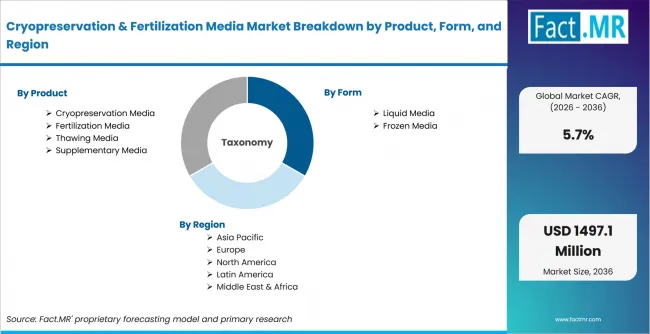
Cryopreservation & Fertilization Media Market Breakdown By Product, Form, And Region | Source: Fact.MR
| Attribute | Details |
|---|---|
| Quantitative Units | USD million |
| Market Definition | The market covers commercial media used for cryopreservation, fertilization, thawing and related transport or supplementary steps. |
| Segments Covered | Product; Form; Application; End Use; Technology |
| Countries Covered | Germany; Brazil; USA; UK; Japan |
| Key Companies Profiled | Cooper Surgical; Vitrolife AB; Cook Medical; FUJIFILM Irvine Scientific; Kitazato Corporation; Genea Biomedx; GYNEMED GmbH & Co. KG (A Hamilton Thorne Company); FERTIPRO NV; Nidacon International AB; Microm Ltd. |
| Historical Period | 2021 to 2025 |
| Forecast Period | 2026 to 2036 |
| Base Year | 2025 |
| Market Value, 2025 | USD 813.6 million |
| Market Value, 2026 | USD 860.0 million |
| Market Value, 2036 | USD 1,497.1 million |
| CAGR, 2026-2036 | 5.7% |
| Absolute Opportunity | USD 637.1 million |
| Approach | Procedure-led media revenue analysis using fertilization, freezing and warming activity, formulation mix, pack utilization and laboratory purchasing requirements. |
Source: Fact.MR analysis. Updated Sep 7, 2026
How is the market segmented?
-
By Product
- Cryopreservation Media
- Cell Freezing Media
- Germ Cell Freezing Media
- Embryo Freezing Media
- Fertilization Media
- IVF Fertilization Media
- Assisted Reproduction Media
- Thawing Media
- Supplementary Media
- Transport Media
- Cryopreservation Media
-
By Form
- Liquid Media
- Ready To Use Solutions
- Concentrated Solutions
- Frozen Media
- Cryovials
- Lyophilized Media
- Liquid Media
-
By Application
- Human Assisted Reproduction
- In Vitro Fertilization
- Intrauterine Procedures
- Animal Reproduction
- Livestock Breeding
- Equine Reproduction
- Aquaculture Breeding
- Cell And Tissue Preservation
- Biobanking
- Research Applications
- Human Assisted Reproduction
-
By End Use
- IVF Centers
- Fertility Clinics
- Hospitals And Surgical Centers
- Animal Breeding Centers
- Veterinary Clinics
- Research Institutes
- Biobanks
-
By Technology
- Vitrification Technology
- Slow Freezing Technology
- Cryoprotectant Based Systems
- Glycerol Based Media
- Ethylene Glycol Based Media
-
By Region
- North America
- Latin America
- Western Europe
- Eastern Europe
- East Asia
- South Asia and Pacific
- Middle East & Africa
Frequently Asked Questions
What is the Cryopreservation & Fertilization Media Market value in 2026?
At what CAGR is the market projected to grow?
What is the projected market value by 2036?
Which segment leads Product?
Which segment leads Form?
Which segment leads Application?
Which segment leads End Use?
Which segment leads Technology?
Which countries are analyzed?
Which companies provide products in this market?
Who worked on this report


Preview the report firsthand - request a free sample
Free SampleGet the brochure for pricing and purchase details
Download PDF